Exploring the Star Formation Histories of Galaxies in Different Environments from MaNGA Spectra
Maria Argudo-Fern\'andez, M\'ed\'eric Boquien, Shiyin Shen, Fangting, Yuan, Jun Yin, Ruixiang Chang, and Lei Hao

TL;DR
This paper develops new spectral energy distribution fitting techniques to precisely determine the star formation histories of nearby isolated galaxies using MaNGA IFU data, aiming to understand galaxy evolution in different environments.
Contribution
It introduces novel methods for constraining galaxy star formation histories from spectral data, focusing on isolated galaxies and environmental effects.
Findings
New techniques for high-precision SFH constraints from spectral data
Application of methods to MaNGA data of isolated galaxies
Insights into the role of environment in galaxy evolution
Abstract
The star formation history (SFH) of galaxies allow us to investigate when galaxies formed their stars and assembled their mass. We can constrain the SFH with high level of precision from galaxies with resolved stellar populations, since we are able to discriminate between stars of different ages from the spectrum they emit. However, the relative importance of secular evolution (nature) over nurture is not yet clear, and separating the effects of interaction-driven evolution in the observed galaxy properties is not trivial. The aim of this study is to use MaNGA (Mapping Nearby Galaxies at APO) Integral Field Unit (IFU) data, in combination with multi-wavelength data, to constrain the SFH of nearby isolated galaxies. We present here the new techniques we are developing to constrain the SFH with high level of precision from Spectral Energy Distribution (SED) fitting. This study is part of…
Click any figure to enlarge with its caption.
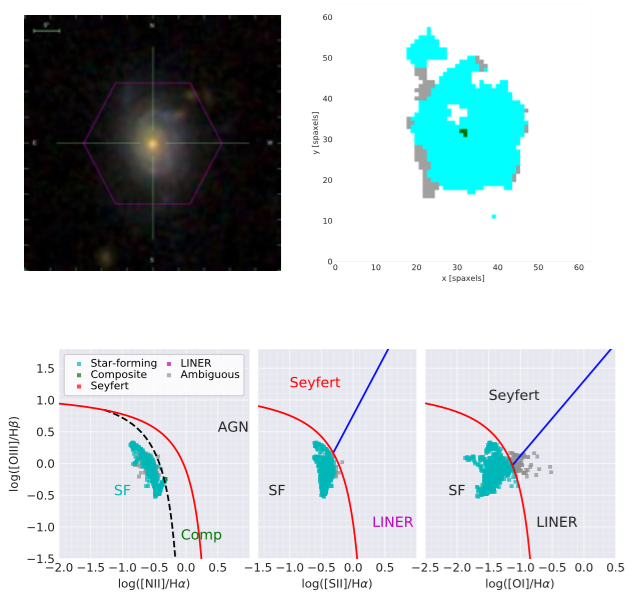 Figure 1
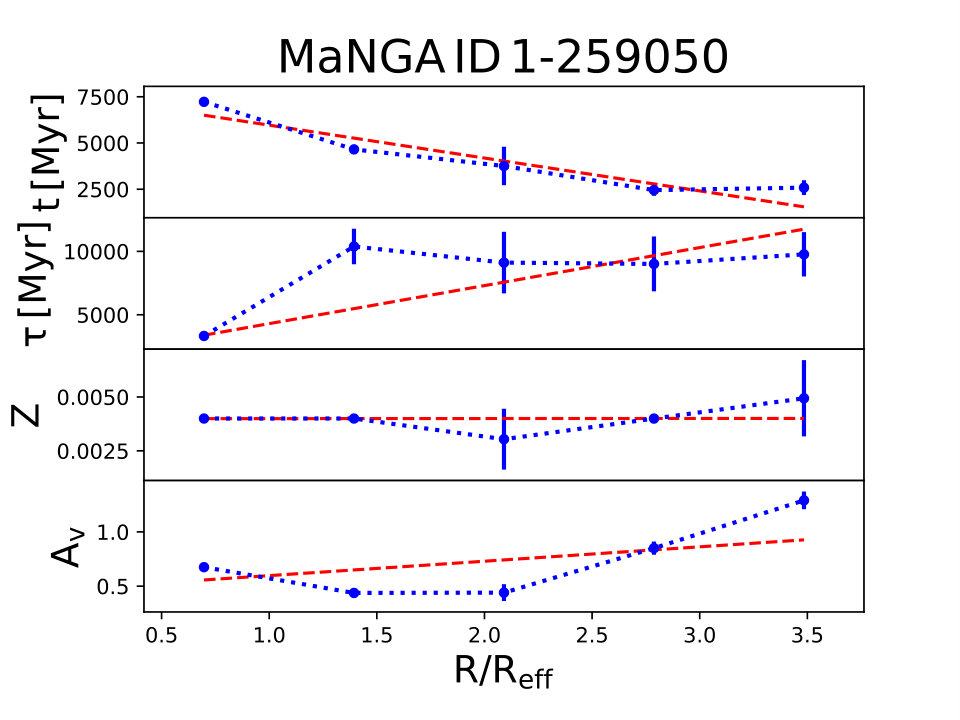 Figure 2
 Figure 3
Peer Reviews
No public reviews on file for this paper yet. If you reviewed it on a platform where reviews are public (OpenReview, ICLR, NeurIPS, ICML), you can paste yours below so the community can read it here.
Videos
No videos yet. Explain this paper in a talk, walkthrough, or lecture? Add one.
Exploring the Star Formation Histories of Galaxies in Different Environments from MaNGA Spectra
Maria Argudo-Fernández
1,2
Médéric Boquien
2
Shiyin Shen
3
Fangting Yuan
3
Jun Yin
3
Ruixiang Chang
3
Lei Hao3
1Centro de Astronomía (CITEVA), Universidad de Antofagasta, Avenida Angamos 601 Antofagasta, Chile
email: [email protected]
2Chinese Academy of Sciences South America Center for Astronomy, China-Chile Joint Center for Astronomy, Camino El Observatorio 1515, Las Condes, Santiago, Chile
3Shanghai Astronomical Observatory, Chinese Academy of Sciences, 80 Nandan Road, Shanghai 200030, China
(2018)
Abstract
The star formation history (SFH) of galaxies allow us to investigate when galaxies formed their stars and assembled their mass. We can constrain the SFH with high level of precision from galaxies with resolved stellar populations, since we are able to discriminate between stars of different ages from the spectrum they emit. However, the relative importance of secular evolution (nature) over nurture is not yet clear, and separating the effects of interaction-driven evolution in the observed galaxy properties is not trivial. The aim of this study is to use MaNGA (Mapping Nearby Galaxies at APO) Integral Field Unit (IFU) data, in combination with multi-wavelength data, to constrain the SFH of nearby isolated galaxies. We present here the new techniques we are developing to constrain the SFH with high level of precision from Spectral Energy Distribution (SED) fitting. This study is part of a China-Chile collaboration program where we are applying these new techniques to investigate how galaxies formed and evolve in different environments.
keywords:
galaxies: general, galaxies: formation, galaxies: evolution, galaxies: interactions, galaxies: spiral, techniques: miscellaneous.
††volume: 341††journal: PanModel2018 : Challenges in Panchromatic Galaxy Modelling with Next Generation Facilities††editors: M. Boquien, E. Lusso, C. Gruppioni, & P. Tissera, eds.
1 Introduction
The electromagnetic emission of galaxies is our main window into their formation and their evolution. Young stellar populations dominate the UV-optical energy budget of galaxies. As they evolve and die they produce dust and inject vast amounts of metals in the interstellar medium, which have a direct impact on the formation of new stars, shielding and cooling molecular clouds, but also reddening and dimming the UV-to-near-infrared spectrum. At the same time, galaxy can be red and dim simply because they are not forming stars anymore. In other words, the electromagnetic spectrum of galaxies encodes the past and current physical processes that have driven their evolution across cosmic times.
One of the major spectroscopic surveys in existence is the Sloan Digital Sky Survey (SDSS; [York et al.(2000), York et al. 2000], [Gunn et al.(2006), Gunn et al. 2006], [Aguado et al.(2019), Aguado et al. 2019]). It has provided us with spectra for a vast number of low redshift galaxies, yielding for each of them information about their star formation history, dust extinction, metallicity, stellar and ionized gas kinematics, etc. However, SDSS spectra are limited to a single spatial position at the center of galaxies ([Strauss et al.(2002), Strauss et al. 2002]). The advent of the MaNGA (Mapping Nearby Galaxies at APO, [Bundy et al.(2015), Bundy et al. 2015]) Integral Field Spectroscopy (IFS) survey is a giant leap forward. The survey is one of three core programs in the fourth-generation SDSS (SDSS-IV, [Blanton et al.(2017), Blanton et al. 2017]). It provides us with a 3-dimensional view of galaxies (one spectral, two spatial) that encodes the processes driving their evolution, allowing us to go far beyond either the broadly used approaches of spatially-resolved photometry and spatially-unresolved spectroscopy.
What we present here is part of a China-Chile collaboration research program. Our aim is to gain a unique insight into how nearby galaxies form and evolve by comparing their observed properties with results from state-of-the-art chemical evolution models. MaNGA 3-D maps allow us to measure their physical properties (SFH, mass, metallicity, ionized gas and stellar continuum extinctions, etc.) with unprecedented precision and accuracy combining with multi-wavelength spectral energy distribution (SED) modeling from the ultraviolet to the infrared. This will therefore provides us new constraints on the assembly of galaxies across cosmic times. Because processes governing the evolution of galaxies can be strongly intertwined, we collaborate to address these issues putting our own tools and expertise in common, from fundamental spectral modeling to the interpretation of the results of these models to understand the effect of the environment on the evolution of galaxies. In particular, we show here the developed techniques and first results on the study of the evolution of spiral isolated galaxies.
2 Modelling of MaNGA galaxies
2.1 Photometric and spectral modelling
Spectral and photometric models are outstanding tools for measuring the physical properties of galaxies. Yet, they both have their own strengths and weaknesses. Spectra allow us to detect the presence of an AGN and access to the physical conditions of the ionized gas and of the stellar populations through emission and absorption lines and spectral indices. This yields, for instance, estimates of the extinction of the ionized gas, of the metallicity (both of the ionized gas and the stars), and constraints on the star-formation rate (SFR) on very short (Halpha, 10 Myr) and very long (D4000, 1 Gyr) timescales. However spectra are limited to a relatively narrow range in wavelengths and thus are only sensitive to a fraction of the baryonic components of galaxies. Conversely, photometric observations from the UV to the far-IR allow us to also probe young stellar populations that dominate the UV and the dust that reprocesses short wavelength radiation into the IR. Combined together, such a broad wavelength coverage provides us with the leverage we need to constrain the attenuation curve of the stellar continuum, the UV-based and IR-based SFR, and the stellar mass of galaxies. In other words, spectral and photometric data provide us with complementary and synergistic constraints on the physical properties of galaxies.
2.2 CIGALE
To perform the SED modelling combining all these data we use the state-of-the-art Code Investigating GALaxy Emission (CIGALE111https://cigale.lam.fr, [Boquien et al.(2018), Boquien et al. 2018]). CIGALE is a self-consistent SED modelling code from the far-ultraviolet to the radio domain, including the contributions from stellar populations of all ages, thermal and non-thermal gas emission, dust (both in absorption and emission: the energy absorbed by the dust in the UV-to-near-IR domain is re-emitted self-consistently in the mid- and far-IR), and optionally an active nucleus. It allows us to estimate the physical properties of the modelled targets (most importantly SFR over different timescales, burst strength, metallicities, dust attenuation and stellar masses). It is based on a Bayesian-like analysis method. Therefore, used in combination with spatially resolved multi-wavelength data to complement MaNGA observations, this will allow us to obtain better estimates of the SFR, the SFH, and other physical properties of the galaxies in our sample. In this study we use CIGALE to create a set of modelled spectra and use the same Bayesian-like analysis method to fit the observed MaNGA spectra and to extract the physical parameters of the SFH of the stellar populations.
2.3 Application to a galaxy merger
The UV and IR data are usually used to constrain the star formation rate and dust attenuation for mergers, which are tracers of the evolutionary stage of the systems. However, spatially resolved studies of galaxy mergers are restricted to very close galaxies, especially due to the lack spatial resolution in IR data. In [Yuan et al.(2018)], we show how the use of UV-to-IR broadband SED, in combination with MaNGA IFS, provide unique opportunity to study the star formation histories and dust attenuation at the tail and core parts of the merging galaxy Mrk 848 (see Figures 2 and 3 in [Yuan et al.(2018), Yuan et al. 2018]). We find that dust derived from full spectra fitting is systematically lower than from UV to IR SED fitting (see Fig. 9 in [Yuan et al.(2018), Yuan et al. 2018]). Additionally, using both photometry and spectroscopy SED modelling, we find a starburst younger than 100 Myr in core region, consistent with the scenario where the interaction-induced gas in-flow enhances the star formation in the center of galaxies.
3 Evolution of spiral isolated galaxies
We are interested into explore how galaxies build their disk when they grow in isolation, unaffected by external influences. From models, it is predicted that disks grow from inner to outer parts of galaxies, the so-called inside-out model of galaxy formation. As a consequence, we expect to observe gradients in stellar age and metallicity as a function of galaxy radii. The sample of isolated galaxies used in this study is selected from the SDSS-based catalog of Isolated Galaxies (SIG; [Argudo-Fernández et al.(2015), Argudo-Fernández et al.2015]), composed of 3702 galaxies. Of the 200 SIG galaxies observed by MaNGA, we selected a sample of 18 almost face-on star-forming (SF) spiral galaxies. We focused on SF galaxies to assure that our results are not contaminating by quenching mechanisms (e.g., LINER or AGN emission). To identify the SF galaxies, we used Marvin ([Cherinka et al.(2018), Cherinka et al. 2018]) to create spatially-resolved BPT diagrams and selected the galaxies where more than the 90% of their spaxels are classified as star-forming (see the left panel of Fig. 1).
Considering that SIG galaxies in our sample are not subject to significant influence from close neighbours for significant time periods, we assume that their disk has homogeneously evolved form inside-out and we therefore divide each SIG galaxy in radial bins with separations of 3 arcsec (MaNGA spatial resolution is 2.5 arcsec). We finally use CIGALE, as explained in the previous section, to get the parameters of the SFH (see the right panel of Fig. 1). We find that, in general, the age and gradients of spiral SIG galaxies are in agreement in the inside-out disk growth. However, the stellar metallicity (Z) and dust attenuation (Av) gradients show more diverse results, which indicate that the evolution of the disk is more complex than expected (Argudo-Fernández et al. in prep.).
Acknowledgements.
MAF acknowledges IAU Travel Grant for S341 and CAS-CONICYT N° 17002 for funding support to assist this conference. Funding for the Sloan Digital Sky Survey IV has been provided by the Alfred P. Sloan Foundation, the U.S. Department of Energy Office of Science, and the Participating Institutions. SDSS-IV acknowledgessupport and resources from the Center for High-Performance Computing at the University of Utah. The SDSS web site is www.sdss.org.
The reference list from the paper itself. Each links out to its DOI / PubMed record.
- 1[Aguado et al.(2019)] Aguado, D. S., Ahumada, R., Almeida, A., Anderson, S. F., Andrews, B. H., Anguiano, B., Aquino Ortíz, E., Aragón-Salamanca, A., et al. 2019, Ap JS , 240, 23
- 2[Argudo-Fernández et al.(2015)] Argudo-Fernández, M., Verley, S., Bergond, G., Duarte Puertas, S., Ramos Carmona, E., Sabater, J., Fernández Lorenzo, M., Espada, D., et al. 2015, A&A , 578, A 110
- 3[Blanton et al.(2017)] Blanton, M. R., Bershady, M. A., Abolfathi, B., Albareti, F. D., Allende Prieto, C., Almeida, A., Alonso-García, J., Anders, F., et al. 2017, AJ , 154, 28
- 4[Boquien et al.(2018)] Boquien, M., Burgarella, D., Roehlly, Y., Buat, V., Ciesla, L., Corre, D., Inoue, A. K., and Salas, H., 2018, ar Xiv:1811.03094
- 5[Bundy et al.(2015)] Bundy, K., Bershady, M. A., Law, D. R., Yan, R., Drory, N., Mac Donald, N., Wake, D. A., Cherinka, B., et al. 2015, Ap J , 798, 7
- 6[Cherinka et al.(2018)] Cherinka, B., Andrews, B. H., Sánchez-Gallego, J., Brownstein, J., Argudo-Fernández, M., Blanton, M., Bundy, K., Jones, A., et al. 2018, ar Xiv:1812.03833
- 7[Gunn et al.(2006)] Gunn, J. E., Siegmund, W. A., Mannery, E. J., Owen, R. E., Hull, C. L., Leger, R. F., Carey, L. N., Knapp, G. R., et al. 2006, AJ , 131, 2332
- 8[Strauss et al.(2002)] Strauss, M. A., Weinberg, D. H., Lupton, R. H., Narayanan, V. K., Annis, J., Bernardi, M., Blanton, M., Burles, S., et al. 2002, AJ , 124, 1810