Graph-theoretic Simplification of Quantum Circuits with the ZX-calculus
Ross Duncan, Aleks Kissinger, Simon Perdrix, John van de, Wetering

TL;DR
This paper introduces a novel quantum circuit optimization method using ZX-calculus, simplifying diagrams through graph transformations and enabling efficient circuit extraction with improved size and depth bounds.
Contribution
The paper develops a new ZX-calculus-based approach for quantum circuit simplification, including a graph-theoretic extraction method and improved bounds for Clifford and Clifford+T circuits.
Findings
Simplifies quantum circuits via ZX-diagram transformations.
Provides a deterministic circuit extraction method from simplified ZX-diagrams.
Achieves smaller circuit size and depth bounds for Clifford and Clifford+T circuits.
Abstract
We present a completely new approach to quantum circuit optimisation, based on the ZX-calculus. We first interpret quantum circuits as ZX-diagrams, which provide a flexible, lower-level language for describing quantum computations graphically. Then, using the rules of the ZX-calculus, we give a simplification strategy for ZX-diagrams based on the two graph transformations of local complementation and pivoting and show that the resulting reduced diagram can be transformed back into a quantum circuit. While little is known about extracting circuits from arbitrary ZX-diagrams, we show that the underlying graph of our simplified ZX-diagram always has a graph-theoretic property called generalised flow, which in turn yields a deterministic circuit extraction procedure. For Clifford circuits, this extraction procedure yields a new normal form that is both asymptotically optimal in size and…
Click any figure to enlarge with its caption.
 Figure 1
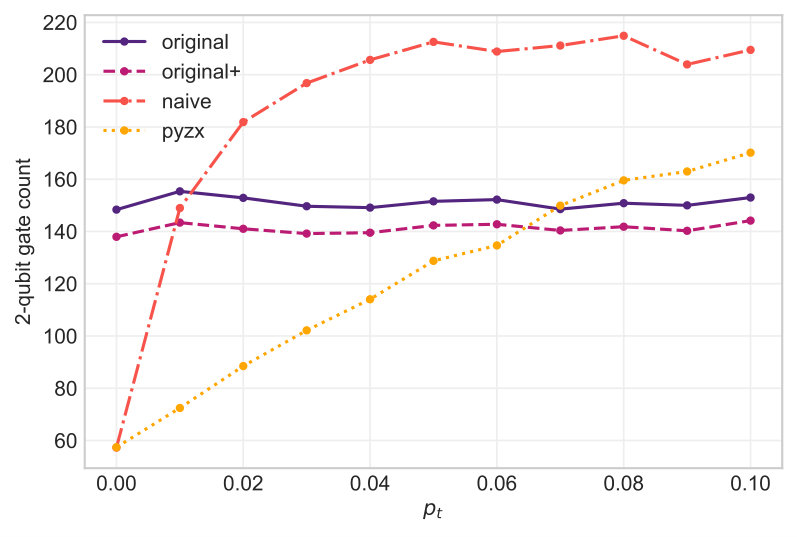 Figure 2
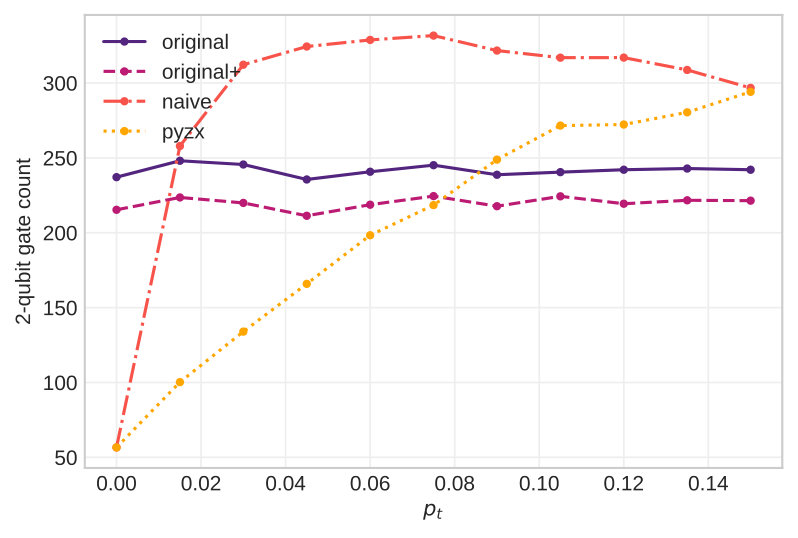 Figure 3
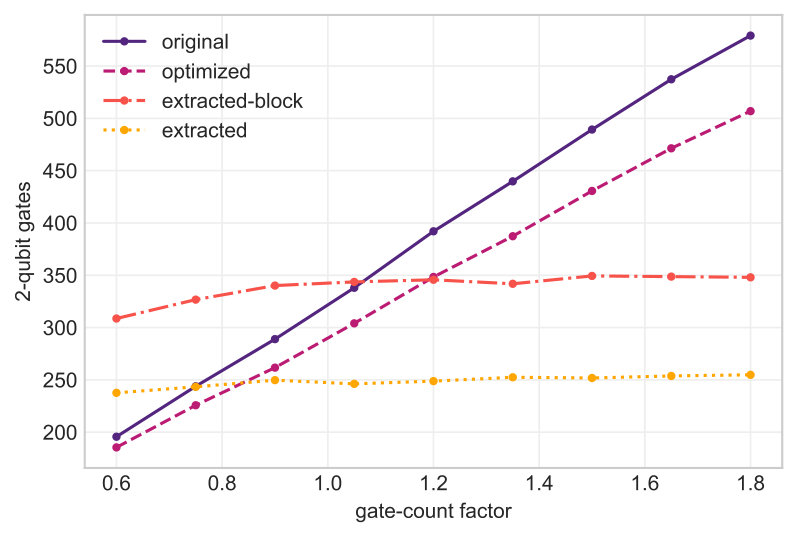 Figure 4
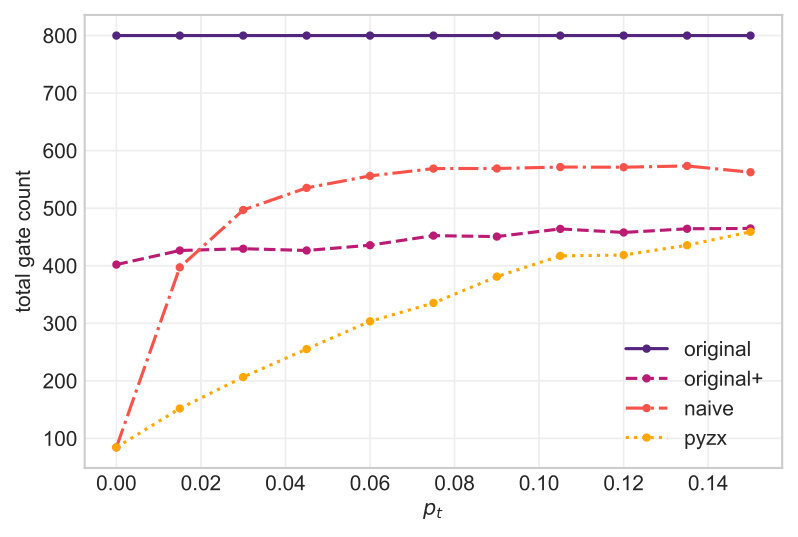 Figure 5
 Figure 6
Peer Reviews
No public reviews on file for this paper yet. If you reviewed it on a platform where reviews are public (OpenReview, ICLR, NeurIPS, ICML), you can paste yours below so the community can read it here.
Videos
No videos yet. Explain this paper in a talk, walkthrough, or lecture? Add one.