Modified spin-orbit couplings in uniaxially strained graphene
H. Rezaei, A. Phirouznia

TL;DR
This paper investigates how uniaxial strain affects spin-orbit couplings in graphene, proposing a generalized Hamiltonian and demonstrating strain-controlled tuning of spin-orbit interaction strengths and energy gaps.
Contribution
It introduces a strain-dependent effective Hamiltonian for graphene with spin-orbit couplings, incorporating ab initio data into a tight-binding framework.
Findings
Strain modifies Rashba and intrinsic spin-orbit coupling strengths.
Energy gap at Dirac points can be tuned by strain.
Strain slightly alters the low-energy dispersion topology.
Abstract
Intrinsic and Rashba spin-orbit interactions in strained graphene is studied within the tight-binding (TB) approach. Dependence of Slater-Koster (SK) parameters of graphene on strain are extracted by fitting the \emph{ab initio} band structure to the TB results. A generalized low-energy effective Hamiltonian in the presence of spin-orbit couplings is proposed for strained graphene subjected to an external perpendicular electric field. Dependence of the modified Rashba strength and other parameters of effective Hamiltonian on the strain and electric field are calculated. In order to analyze the influence of the applied strain on the electronic properties of the graphene, one must take into account the lattice deformation, modifications of the hopping amplitudes and shift of the Dirac points. We find that using the strain it is possible to control the strength of Rashba and intrinsic…
Click any figure to enlarge with its caption.
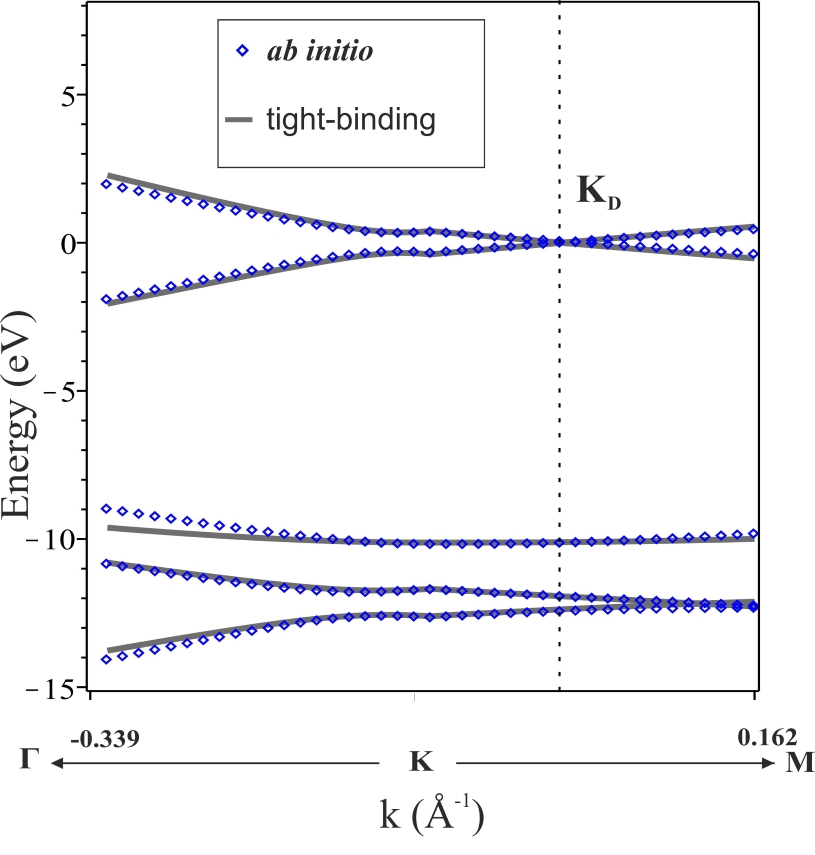 Figure 1
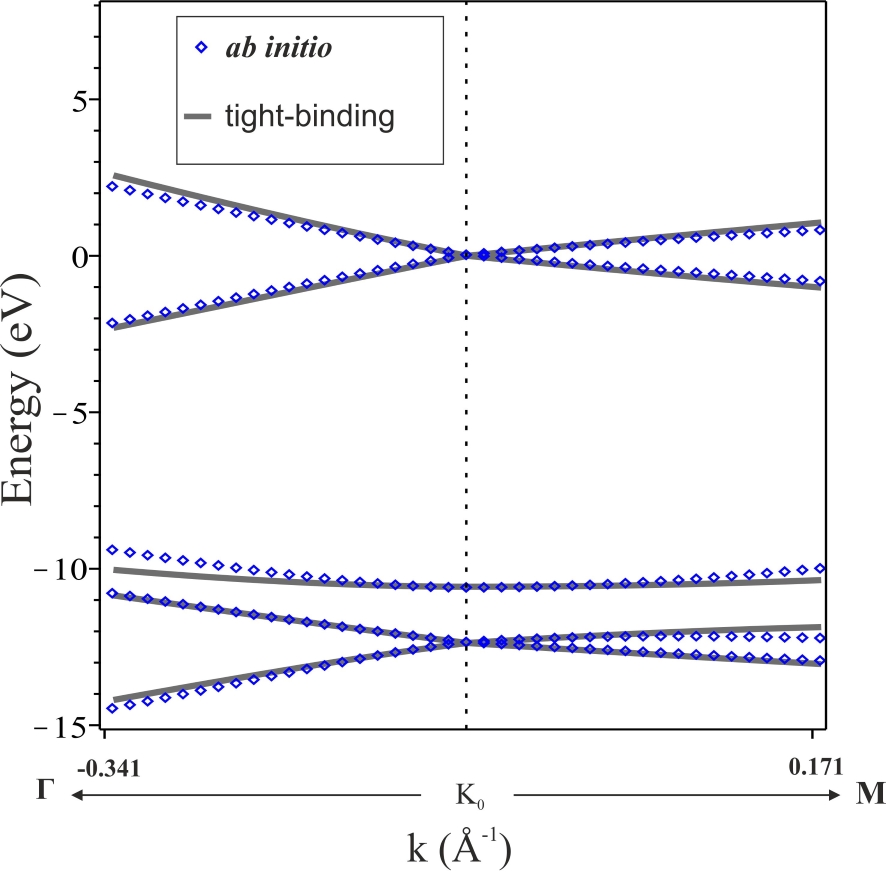 Figure 2
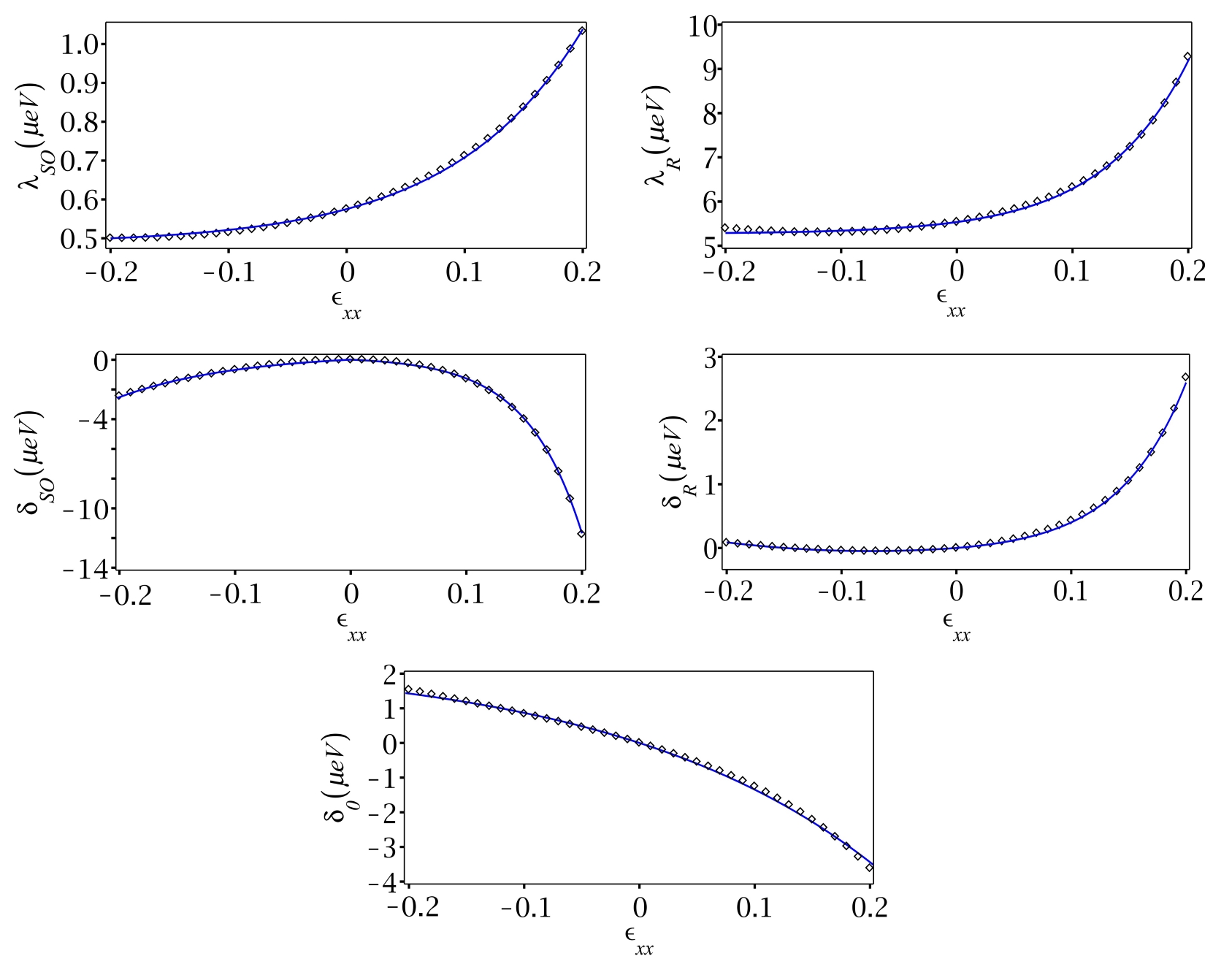 Figure 3
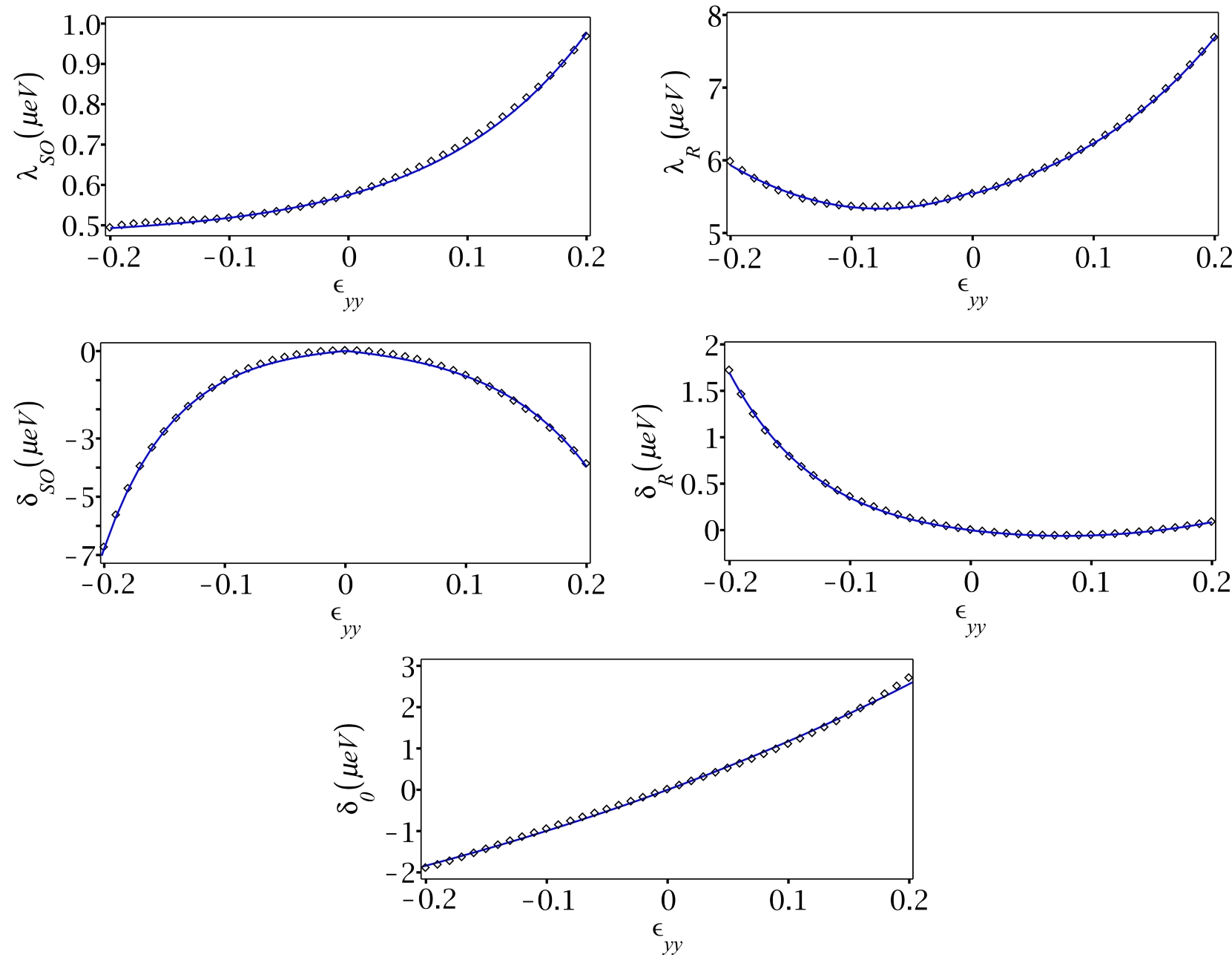 Figure 4
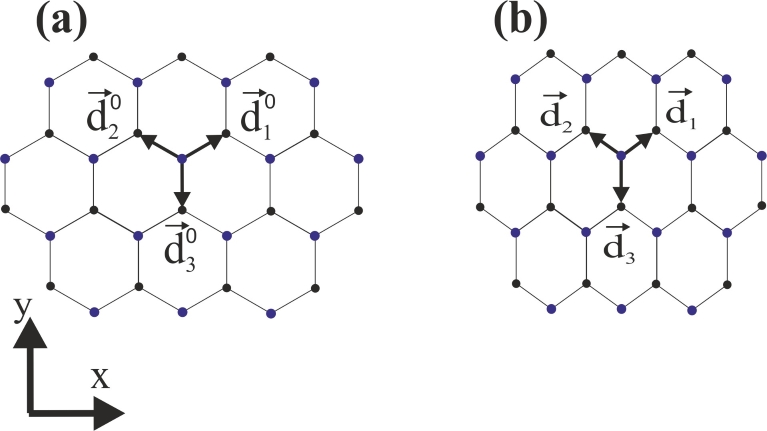 Figure 5
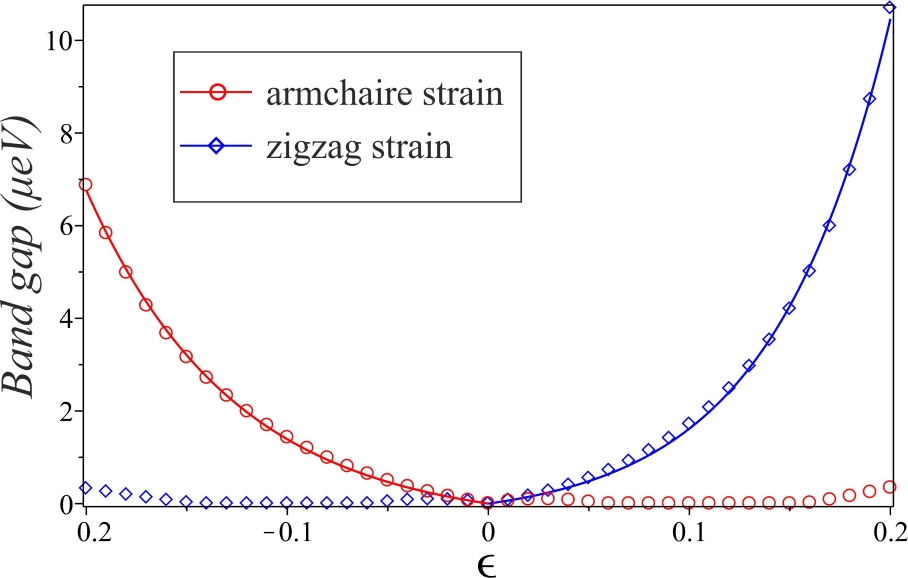 Figure 6
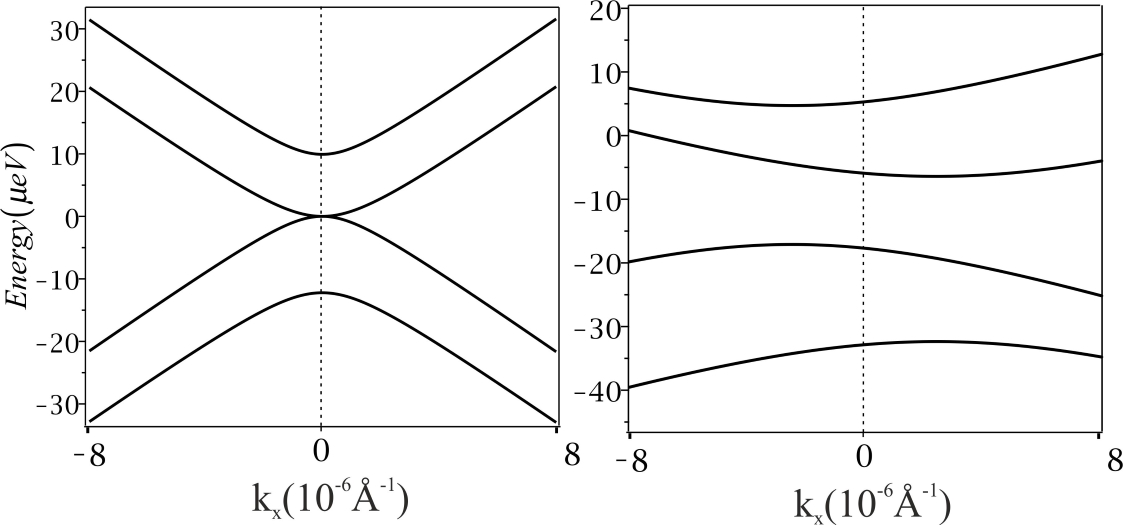 Figure 7
| Parameter | |||||
|---|---|---|---|---|---|
| -5.71 | 5.42 | 6.20 | -3.07 | -8.37 | |
| -5.729 | 5.618 | 6.05 | -3.07 | -8.37 | |
| -6.769 | 5.58 | 5.037 | -3.033 | -8.868 | |
| Parameter | |||||
| 0.10 | -0.170 | -0.140 | 0.07 | ||
| 0.102 | -0.171 | -0.377 | 0.07 | ||
| 0.212 | -0.102 | -0.146 | 0.129 |
| Parameter | ||||
|---|---|---|---|---|
| Value | 3.17 | 1.82 | 1.47 | 3.104 |
| Parameter | ||||
| Value | 2.72 | 1.28 | 0.77 | 2.11 |
| range of strain | ||
|---|---|---|
| range of strain | ||
| range of strain | ||
|---|---|---|
| range of strain | ||
Peer Reviews
No public reviews on file for this paper yet. If you reviewed it on a platform where reviews are public (OpenReview, ICLR, NeurIPS, ICML), you can paste yours below so the community can read it here.
Videos
No videos yet. Explain this paper in a talk, walkthrough, or lecture? Add one.
11institutetext: Department of Physics, Azarbaijan Shahid Madani University, 53714-161, Tabriz, Iran 22institutetext: Condensed Matter Computational Research Lab. Azarbaijan Shahid Madani University 53714-161, Tabriz, Iran 33institutetext: Computational Nanomaterials Research Group (CNRG) Azarbaijan Shahid Madani University 53714-161, Tabriz, Iran
Modified spin-orbit couplings in uniaxially strained graphene
H. Rezaei 1122
A. Phirouznia 112233
(Received: date / Revised version: date)
Abstract
Intrinsic and Rashba spin-orbit interactions in strained graphene is studied within the tight-binding (TB) approach. Dependence of Slater-Koster (SK) parameters of graphene on strain are extracted by fitting the ab initio band structure to the TB results. A generalized low-energy effective Hamiltonian in the presence of spin-orbit couplings is proposed for strained graphene subjected to an external perpendicular electric field. Dependence of the modified Rashba strength and other parameters of effective Hamiltonian on the strain and electric field are calculated. In order to analyze the influence of the applied strain on the electronic properties of the graphene, one must take into account the lattice deformation, modifications of the hopping amplitudes and shift of the Dirac points. We find that using the strain it is possible to control the strength of Rashba and intrinsic spin-orbit couplings as well as energy gap at the shifted Dirac points. Meanwhile, the strain slightly modifies the topology of low-energy dispersion around the Dirac points. We describe the SOCs induced energy splitting as a function of strain.
pacs:
73.22.-fElectronic structure of nanoscale materials and related systems and 71.70.EjSpin-orbit coupling, Zeeman and Stark splitting, Jahn-Teller effect 71.70.FkStrain-induced splitting
1 Introduction
Graphene has been the subject of intense investigations due to its outstanding electronic and mechanical properties Castro . The most notable electronic property of graphene is its linear gapless energy dispersion around the so called Dirac points ( and points) at low energy regime. However, it has been shown that spin-orbit couplings (SOCs) in graphene, slightly change the gapless linear band structure of graphene and can open up an energy gap at the Dirac points Macdonald . The magnitude of the intrinsic spin-orbit induced gap has been the subject of discussions by researchers of this filed Macdonald ; firstPrncpl9 ; firsPrncpl49 ; Fabian ; FabianTopolgy50 ; kane7 . Applying an external electric field perpendicular to the graphene sheet causes Rashba type SOC which can be regarded as external SOC. Although the spin-orbit interaction in the graphene is weak nanotube_10 , it plays an important role in the half integer quantum Hall effect, spintronics and spin dependent properties nature_spintronic_80 ; Macdonald ; kane7 ; Obtic_86 ; SOC_88 .
Another attracting field in the graphene research is the strain induced effects on the electronic properties. Electronic structure of strained graphene has been studied by several authors engineering_39 ; Strain_tensor_26 ; optical_31 ; guinea_strain_36 ; zhan2012engineering_69 . Strain modifies the electronic properties of graphene. For instance, strain changes the position of the Dirac points and hopping amplitude mexic . Investigating the SOCs in strained graphene is the subject of the present study.
Intrinsic spin-orbit coupling-induced band gap of the graphene under strain has been studied by B. Gong et al. using ab initio calculations and tight-binding (TB) method BAIHUA . They have used Harrison’s expression to formulate the dependence of the hopping parameters on strain, where they showed that the energy gap has a monotonic increasing dependence on the strain. Meanwhile, within the most of research in this field, the hopping amplitude is assumed to be modified as a result of the change in atomic distances and the lattice deformation which determines the neighboring orbitals orientation is not considered. However, in the case of uniaxial strains, orbitals reorientation must be taken into account. An effective Hamiltonian of intrinsic SOC for strained graphene has been extracted by employing the method of invariants and ab initio calculations in the vicinity of Dirac points at very small strains MoS_29 . In another work by G. S. Diniz et al. manipulation of the quantum anomalous Hall effect in graphene as a result of the applied strain has been studied engineering_39 .
In this article we have studied the intrinsic and Rashba spin-orbit interactions in the strained graphene using a TB model within the subspace of s and p orbitals at low-energy regimeMacdonald ; sp_82 ; low_11 ; nanotube_10 . It has been shown that the strain accountably changes the strength and functionality of the spin-orbit interactions. Present study has been limited to in-plane uniaxial strains in the range of -20% to 20% which was assumed to be applied in either zigzag or armchair direction. In order to study the electronic properties of strained graphene both the lattice deformation and dependence of the hopping parameters on strain must be taken into account. In addition as shown in the next sections unlike the homogeneous strain, uniaxial strain could change the neighboring orbitals orientation which can change the hopping and therefore hopping related parameters such as Rashba coupling strength. At the first step one has to parameterize the dependence of the hopping amplitudes on the applied strain. Then, TB Hamiltonian in the presence of strain and SOCs can be expressed as an effective low energy Hamiltonian at shifted Dirac points. Löwdin method have been employed to extract the effective low-energy Hamiltonian at the shifted Dirac points firstPrncpl9 ; Lowdin1 . Due to the similar nature of the Dirac materials it is expected that the present approach could be extended to study of other honeycomb structures such as stanene, germane and silicene. YAKOVKIN20171 ; Dirac_material ; low_11 .
2 Graphene in the presence of strain:
2.1 Tight-Binding model of graphene
Two-center Slater-Koster (SK) nearest-neighbor TB method slater23 has been employed with s and p orbitals to calculate the electronic structure of strained graphene at low-energy scheme in which the intrinsic and external spin-orbit couplings have been considered. In the unstrained graphene nearest-neighbor atoms are connected by three vectors
[TABLE]
where is the carbon-carbon distance in unstrained graphene. Strained and unstrained graphene lattice and nearest-neighbor vectors have been shown in Fig.1. We choose the x axis in a way that is parallel to the zigzag direction of honeycomb lattice. In the nearest-neighbor TB model for uniaxially strained graphene in the absence of SOCs, Hamiltonian matrix elements are given by
[TABLE]
[TABLE]
Here, and refer to different sublattices, k is the wave vector, represents the nearest-neighbor position vector in the strained lattice as shown in Fig. 1, are the hopping matrix elements between and orbitals in the nearest ’th neighbor site and is the energy of ’th orbital. We should notice that in the strained graphene and depend on strain tensor . The relation between hopping matrix elements and SK parameters and are listed in Table 1. Since in general orbitals in the neighboring atoms are not orthogonal, we need to include non-zero overlap parameters, , in the computational approach. However, at the Dirac points it is possible to neglect the overlap parameters for simplicity Fabian ; Macdonald .
Without taking into account the spin degree of freedom, TB Hamiltonian of graphene in the absence of SOC (by considering one and three orbitals of the outer shell of carbon atoms) can be represented by block-diagonal matrix containing a block and block which result in and bands respectively. , and orbitals results in bands while the other out-of-plan orbitals create bands. In the vicinity of the Dirac points the electronic properties can be described by block that causes Dirac-type Hamiltonian. Spectrum of this Hamiltonian is gapless and linear which results in Dirac cones Castro . Following many other previous articles Macdonald ; sp_82 ; low_11 ; firstPrncpl9 ; nanotube_10 in the present study the based TB model has been considered to study the SOCs in strained graphene. However, some authors propose using orbitals as well as and orbitals to analyze SOCs in graphene Fabian ; FabianTopolgy50 . As they discussed using orbitals results in intrinsic gap of the order of 25 while in model intrinsic gap of unstrained graphene is about 1 as calculated in the present paper for unstrained graphene. Meanwhile, they have reported that the Rashba coupling is dominated by the and orbitals, namely, coupling Fabian .
For a two-dimensional structure strain tensor is given as
[TABLE]
in which the uniaxial strain tensor can be written as follows Strain_tensor_26
[TABLE]
where is the angle between the direction of strain and x axis and is the Poisson’s ratio.Poisson ; optical_31 . The relation between the displacement vectors of the nearest neighbor atoms in the unstrained and strained graphene can be written as
[TABLE]
where I is the identity matrix.
It should be noted that applying a strain in some situations (for example uniaxial strains larger than 20% in a given specific direction) can open up a gap in the low-energy spectrum of grapheneexponen27 ; zhan2012engineering_69 . However it is not the case for strains as in our work.
2.2 Slater-Koster Parameters
By fitting the numerical results of the TB method to the ab initio calculations we can deduce the hopping and overlap parameters of graphene. The ABINIT package has been employed for non-relativistic ab initio calculations of strained and unstrained graphene Abinit1 ; Abinit2 , where the band energy of the single layer graphene has been obtained for different strains in order to calculate SK parameters and dependence of these parameters on strain. A Monkhorst-Pack mon-pak1976 mesh grid has been employed in the first Brillouin zone sampling for discretization of the Kohn-Sham equations. A vacuum space of 30 Bohr is placed to avoid atomic orbital overlap between the given monolayer and its periodic images. Meanwhile, local density approximation (LDA) has been considered for exchange-correction energy functional. This is necessary for eliminating the interaction between the periodic layers which are generated in the plane-wave based solutions of the Kohn-Sham equations. Maximal kinetic energy cut-off is Hartree. It should be noted that the given parameters result in proper convergence of the total energy.
We have focused on low-energy effective Hamiltonian around the Dirac point, therefore, the fitting calculations have been performed in the vicinity of Dirac points. Fig.2 presents ab initio and TB band structure of unstrained graphene in the range of points in the -space in which the TB energy bands has been given using the optimized parameters from the first-principle calculations. As shown in this figure the band energies in the path -- containing the point (Dirac point) are in good agreement with the ab initio calculations. However, it should be noted that some of the upper conduction bands given by ab initio approaches cannot be fitted to TB results PhysRev70 . The results of the present numerical calculation for SK parameters have been compared with two other reports Refs. Fabian ; Macdonald as shown in Table 2. As can be seen in this table, our results are at the same range of the other reports and it is clear that the TB parameters and band structure that have been obtained in the present study show a better coincidence with the result of the Ref. Fabian . The slight difference may be originated from the fact that the fitting range in the current work lies around the Dirac point instead of all high-symmetry points of the Brillouin zone.
2.3 Dependence of hopping parameters on strain
SK hopping parameters in the strained graphene depend on the magnitude and direction of the strain. The variation of the SK hopping parameters with the strain can be modeled by an exponential relation exponen27 ; engineering_39 ; Strain_tensor_26 such as
[TABLE]
where and are the SK parameters of type in the strained and unstrained graphene respectively, is a parameter that characterizes the influence of the strain on the SK parameters and must be determined for each SK parameter separately. Parameter for band have been calculated by some authors and can be estimated as mexic ; exponen27 ; Strain_tensor_26 . In the current work numerical values of the parameter for all SK parameters (hopping amplitudes and overlap parameters) that needed in the present approach have also been estimated. As mentioned within the current approach it is possible to extract other parameters by fitting the ab initio and TB results for strained graphene. Results have been shown in Table 2 and Fig.3. The value for are in good agreement with the values of Refs.Strain_tensor_26 ; exponen27 and mexic . Some authors have studied the relation between the other SK parameters and the modified atomic separation parameterization_78 ; konschuhThesis6 . It is worthwhile to compare those results with the numerical results of the present work.
3 Spin-orbit couplings in the graphene
Intra-atomic spin-orbit interaction term in the graphene structure can be written as low_11
[TABLE]
where is the spin-orbit coupling constant among the p orbitals Macdonald , is the angular momentum operator and stands for the spin of electron. Considering and , it is possible to deduce all on-site SOC Hamiltonian matrix elements.
In the presence of an external electric field which applied perpendicularly to the graphene sheet, the contribution of the Stark effect can be considered as
[TABLE]
where is the electron charge, is the strength of the electric field and is the position operator along the axis. The only non-zero elements of the Stark Hamiltonian matrix are on-site coupling between and orbitals which can be written as , where is the electric dipole transition between and orbitals Fabian . This electric field which can be originated from a gate voltage, breaks the inversion symmetry in the graphene plane. Now we can write down the matrix in the subspace of the following basis:
as given by
[TABLE]
In which .
4 Spin-orbit couplings in strained graphene
4.1 Generalized effective Hamiltonian
In this sections the spin-orbit couplings in the strained graphene have been studied at low-energy regime. Because the intrinsic SOC in graphene is weak (that can be inferred from the small SOC constant in the graphene), it can be regarded as a perturbation in the TB Hamiltonian nanotube_10 . The total Hamiltonian of the system reads
[TABLE]
stands for the TB Hamiltonian of strained graphene without SOCs. This Hamiltonian can be divided into four blocks
[TABLE]
denotes the band block, describes the band and these two blocks coupled by block which depends basically on the SOC. The representation basis of is , while the basis set of is the directed atomic orbitals. By performing the Löwdin partitioning on the Hamiltonian, one could obtain the effective strain modified SOC Hamiltonian at the shifted points.
In the strained graphene the effective SOC Hamiltonian at the Dirac points can be calculated which finally could be proposed at the following form:
[TABLE]
in which is the valley index, is the identity matrix, and are the identity matrices in pseudospin and spin spaces respectively. , , , and are strain dependent parameters of effective SOC Hamiltonian at the Dirac points. A given term like is a short notation of . This effective Hamiltonian can be regarded as a generalized form of the Hamiltonian represented by Ref.Macdonald . In the absence of strain , and parameters vanish identically. The magnitude of and in the strained graphene is different form their unstrained values ( and ). In the basis set of {} the matrix elements of this effective Hamiltonian (for ) can be represented as
[TABLE]
First term in Eq.13 indicates a strain dependent constant energy shift which could be scaled out in the numerical calculations. Second term stands for strain modified intrinsic SOC. Third and forth term represent the generalized Rashba interaction. Note that the unstrained Rashba coupling has been given by , where . By making a comparison between the strained and unstrained Rashba interactions, it can be realized that unlike the symmetric form of the Rashba interaction in the unstrained sample, uniaxial strain deforms the Rashba interaction asymmetrically. This asymmetry characterizes by which measures the difference between the spin-flip hopping amplitudes of and directions. Uniaxial strain emerges a new term that characterizes by the coupling strength of . This term corresponds to the intra-sublattice spin-flips ( or ) transitions.
In the unstrained graphene (where , and are zero) it can be realized that the Rashba interaction is responsible for and transitions in and Dirac points, respectively. However, one can figure out that the uniaxial strain makes both of these transitions possible at either of Dirac points. Meanwhile, Rashba coupling strength itself, exponentially increases by positive strains as can bee seen in Figs. 5 and 6.
In addition, as can be seen in the Fig.4 strain induces indirect gap in the system. To formulate the k dependence of the effective Hamiltonian we have to add the spin-orbit coupling independent part of the effective Hamiltonian. If we use the approximate form of this part as which proposed in Ref. mexic energy bands near the Dirac points can be formulated as
[TABLE]
is the Fermi velocity of the unstrained graphene, , and
[TABLE]
In the limit of mentioned band energy differs from the relation represented by Refs. FabianTopolgy50 ; deformation_17 by only a constant value.
The linear energy spectrum of graphene around the Dirac points will not survive in the presence of SOC Fabian . The energy spectrum of the system is reshaped into parabolic bands with a small energy gap as a result of SOC. By applying the transverse electric field, conduction and valence bands splits into four spin resolved bands.
4.2 Dependence of the effective Hamiltonian on the electric field and strain
Dependence of Rashba or intrinsic SOC strengths ( and ) on inter-atomic distance is studied by some authors Fabian ; deformation_17 . This could describe the influence of homogeneous strains on spin-orbit couplings. In some other studies the intrinsic SOC as a function of strain have been investigated using first principle and symmetry based invariance approaches MoS_29 ; BAIHUA .
In order to extract a general expression for the dependence of low-energy effective Hamiltonian on strain and external electric field it should be noticed that because the graphene is not intrinsically piezoelectric ACS_PizoE , the influence of the electric field and strain can be considered independent of each other. In other words, perpendicular electric field does not induce strain and strain cannot induce perpendicular electric filed. Therefor, one can write the Hamiltonian parameters as in which and represent the electric field and strain dependent parts of a given relation, respectively. Dependence of the effective Hamiltonian parameters on strain and electric field at the Dirac points has been summarized as fitted analytical relations in Tables 4 and 5 for zigzag and armchair strains, respectively.
The dependence of effective Hamiltonian on strain has also been investigated by fixing the external electric field in typical available value of deformation_17 ; Fabian . This Dependence can be analytically formulated by fitting exponential or quadratic functions to the numerical results as depicted in Fig 5 and Fig 6. Fitted functions has been characterized in Table 4 and Table 5.
By increasing the tensile strain, exponentially increases but compressive strain cannot change the considerably. With a % strain increases up to %. Meanwhile, increases by increasing the tensile strain up to %. This parameter does not show considerable change for compressive zigzag strain (variation is less than %). By increasing the tensile zigzag strain, increases up to . In addition, increases by compressive armchair strain up to . However, as shown in Figs. 5 and 6 compressive zigzag and tensile armchair strains cannot cause considerable change in the value. In the strain range of to shows approximately linear change from to for zigzag strain and from to for armchair strain. Parameters , and are proportional to external electric field. This fact can be compared with linear dependence of Rashba parameter on electric filed in the unstrained graphene as reported by other authors Fabian ; FabianTopolgy50 ; deformation_17 ; Macdonald ; nanotube_10 .
4.3 Intrinsic Gap at zero electric field ()
The dependence of intrinsic SOC induced gap on the strain in the absence of external electric field has been obtained in the present investigation. There are different reports about the estimated value of intrinsic SOC gap at Dirac points Fabian ; Macdonald . It should be noticed that the intrinsic gap is given by when the Rashba coupling is zero () even in the strained graphene. Accordingly, same as intrinsic gap has an exponential dependence on the strain. As it can be seen in Figs.5 and 6 for negative (Compressive) strains intrinsic band gap approximately remains constant. It can be inferred from the above relation that the intrinsic gap can be increased up to the by a strain of . In addition one can obtain that intrinsic gap in unstrained graphene is 1.14 same as previous results Macdonald ; firstPrncpl9 .
4.4 External gap in the presence of the vertical electric field ()
As discussed before, in the presence of a transverse external electric field there will be a Rashba-type SOC in the graphene. In the absence of strain for , SOC induced energy gap falls to zero FabianTopolgy50 ; Macdonald ; kane7 . However, results of the present study show that even in this condition energy gap could be induced by uniaxial strain.
By analyzing the eigenvalues of effective Hamiltonian in the minimum of conduction band and maximum of valence band we can represent the relation between external energy gap and effective Hamiltonian parameters as
[TABLE]
where it can be noticed that if we have and the gap is proportional to the external electric field for .
Fig.7 shows the calculated energy gap of the strained graphene in the presence of external transverse electric field with typical value of . It is obvious that a zigzag strain can induce a splitting of order . We see that for zigzag strain, energy gap increases exponentially with increasing the amount of tensile strain while, for armchair strain the energy gap increases with increasing the amount of compressive strain. The band gap for the compressive zigzag strain and tensile armchair strain is negligible. By fitting the TB results to exponential function in the presence of electric field it is possible to model the dependence of the band gap on strain in the specified strain range as
[TABLE]
[TABLE]
As it can be inferred these relations are in agreement with the general band gap expression given in Eq. [17] when .
CONCLUSIONS
We have proposed a generalized low-energy effective Hamiltonian for the intrinsic and Rashba spin-orbit couplings in uniaxially strained graphene. By taking into account the deformation effect on Slater-Koster parameters we have formulated the strain modified SOCs in the graphene. Results of the present study show that both intrinsic and Rashba SOCs could be effectively increased by the applied strain. We show that uniaxial strain introduces a deviation of the Rashba interaction from its symmetric form of unstrained system. This deviation could be characterized by a new parameter. We have shown that SOCs induced band splittings can be tuned by changing the magnitude and direction of the strain. Dependence of the effective Hamiltonian parameters on the external electric field has also been investigated in the present study. Besides, numerical results show that, it is possible to manipulate the form of energy dispersion in graphene.
The system response is meaningfully anisotropic for the uniaxial strains. This is due to the anisotropic nature of the uniaxial strain which has been imposed into the real space configuration and also orbitals mutual orientation. Accordingly, Hamiltonian characteristic parameters show different dependence on zigzag and armchair uniaxial strains. Uniaxial strains induce anisotropy both in the the real space atomic configuration and also inter atomic orbitals overlap. Because the orbital orientation in the deformed lattice is not merely determined by the inter-atomic distance, one should take into account this additional source of the anisotropy.
The SOC is responsible for small band gap of graphene and uniaxial strains could effectively change the magnitude of the SOC induced band gap of the system. Therefore, the band gap could be controlled by the strain. Besides, it was realized that zigzag and armchair strains give different functionality of band energy gap. This is due to the same anisotropy which has been discussed before.
Another important point which should be addressed in the present investigation is that the uniaxial strain breaks the symmetry of the conduction and valence bands in which the strain induces an indirect band gap in the sample. As mentioned before in unstrained graphene the Rashba interaction is responsible for transitions in point and transitions in Dirac point. It has been realized that the uniaxial strain deforms the symmetric dependence of the Rashba coupling so that the above valley resolved picture of spin and pseudo-spin transitions in the unstrained graphene has been completely destroyed. In the other words both type of the mentioned transitions are possible (however, with different transition amplitudes) at each of the Dirac points in strained graphene.
Because the functionality and strength of the spin-orbit couplings can be controlled by the amount and direction of the applied strain (regarding the importance of the strain engineering in the valley and pseudo-spin polarization), it can be expected that the strain may play the same important role in the field of spintronics as it plays in subject of valleytronics and pseudo-spintronics Morgenstern ; jiang2013 . In addition, spin-polarization at the boundaries njp of finite-width graphene nano-ribbon, in non-equilibrium regime could effectively control pseudo-spin polarization via the Rashba interaction that couples electron spin and pseudo-spin degrees of freedom. Meanwhile, it could be interesting to determine the possibility of spin and pseudo-spin exchange by Rashba interaction, since the Rashba coupling strength can be modulated by external strain.
Acknowledgment
This research has been supported by Azarbaijan Shahid Madani university.
Author contribution statement
Calculations have been performed by H. Rezaei. The paper has also be written by H. Rezaei. A. Phirouznia supervised the study and also revised the article.
Appendix A Löwdin transformation
For a block shaped Hamiltonian given by:
[TABLE]
where and are Hamiltonian matrix representation in different subspaces and represents the coupling of these two subspaces, can be reduced within the Löwdin method to an effective Hamiltonian of a subspace in which the has been presented. In this method we interested in -coupling modified bands and it was assumed that the matrix elements of block are small relative to eigenvalues.
Consider a unitary matrix that transforms the Hamiltonian to a block-diagonal matrix :
[TABLE]
where
[TABLE]
in which is a arbitrary Matrix.
Since transformed Matrix must be block-diagonal, must be determined by this equation:
[TABLE]
If we just keep second order of matrix will be :
[TABLE]
Now by neglecting the higher-order terms in and by using the Eq. 21 for , first block of the effective Hamiltonian is given by:
[TABLE]
which is the effective Hamiltonian in related subspace.
The reference list from the paper itself. Each links out to its DOI / PubMed record.
- 1(1) A.H. Castro Neto, F. Guinea, N.M.R. Peres, K.S. Novoselov, A.K. Geim, Rev. Mod. Phys. 81 , 109 (2009)
- 2(2) H. Min, J.E. Hill, N.A. Sinitsyn, B.R. Sahu, L. Kleinman, A.H. Mac Donald, Phys. Rev. B 74 , 165310 (2006)
- 3(3) Y. Yao, F. Ye, X.L. Qi, S.C. Zhang, Z. Fang, Phys. Rev. B 75 , 041401 (2007)
- 4(4) J.C. Boettger, S.B. Trickey, Phys. Rev. B 75 , 121402 (2007)
- 5(5) S. Konschuh, M. Gmitra, J. Fabian, Phys. Rev. B 82 , 245412 (2010)
- 6(6) M. Gmitra, S. Konschuh, C. Ertler, C. Ambrosch-Draxl, J. Fabian, Phys. Rev. B 80 , 235431 (2009)
- 7(7) C.L. Kane, E.J. Mele, Physical review letters 95 (22), 226801 (2005)
- 8(8) D. Huertas-Hernando, F. Guinea, A. Brataas, Phys. Rev. B 74 , 155426 (2006)