Status of the Experimental Studies on DVMP and Transversity GPDs
Valery Kubarovsky

TL;DR
This paper reports on experimental measurements of exclusive meson electroproduction at Jefferson Lab, providing new insights into transversity GPDs and their flavor decomposition, including the first demonstration of this decomposition for certain GPDs.
Contribution
It presents the first direct extraction and flavor decomposition of transversity GPDs from experimental data on $ ho^0$ and $ ho^+$ meson production, advancing understanding of nucleon spin structure.
Findings
Transversity GPDs dominate at low momentum transfer.
First direct extraction of generalized form factors for transversity GPDs.
Demonstration of flavor decomposition of transversity GPDs.
Abstract
The cross section of the exclusive and electroproduction reaction was measured at Jefferson Lab with a 5.75-GeV electron beam and the CLAS detector. Differential cross sections and structure functions and , as functions of were obtained over a wide range of and . At low , both and are described reasonably well by Generalized Parton Distributions (GPDs) in which chiral-odd transversity GPDs are dominant. Generalized form factors of the transversity GPDs and were directly extracted from the experimental observables. The combined and data opens the way for the flavor decomposition of the transversity GPDs. The first ever…
Click any figure to enlarge with its caption.
 Figure 1
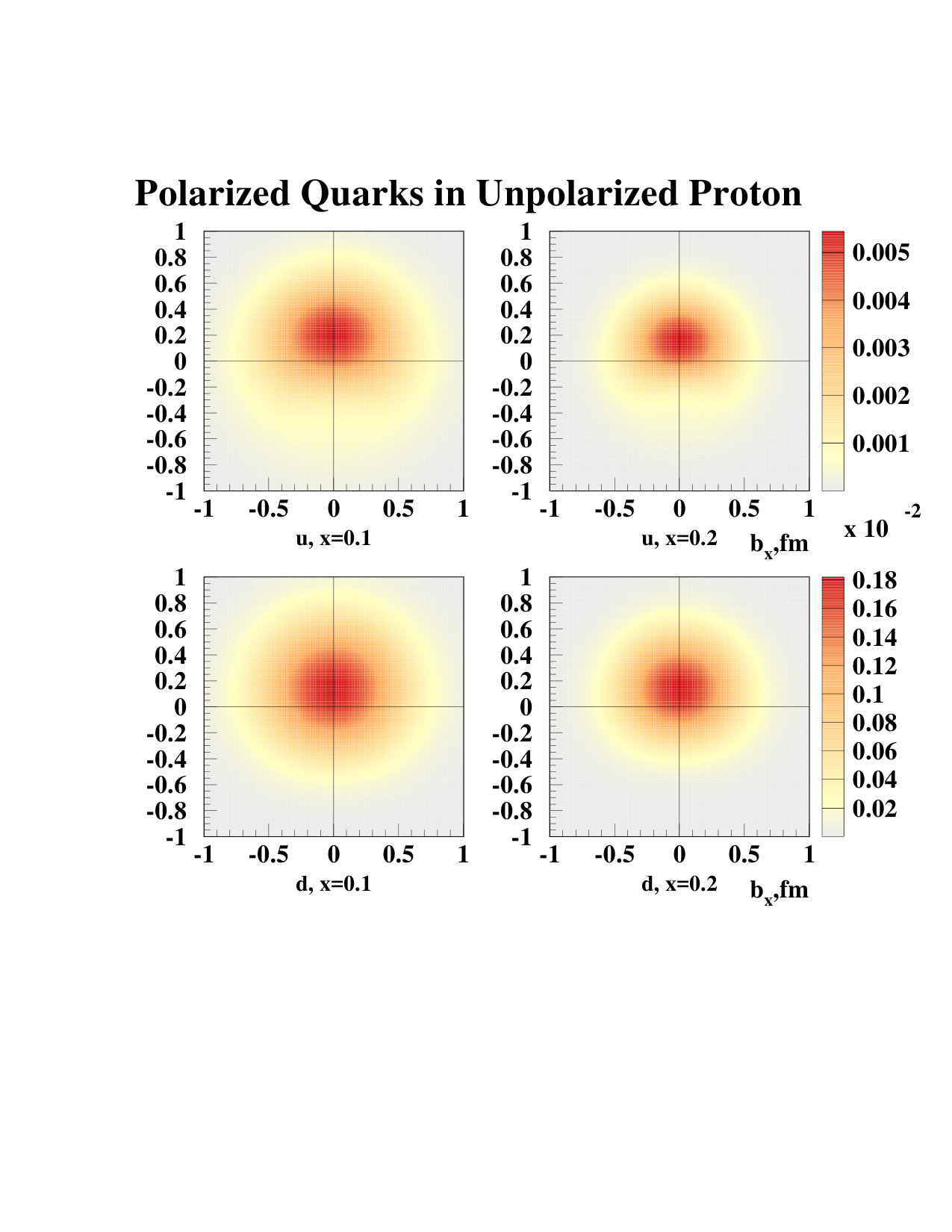 Figure 2
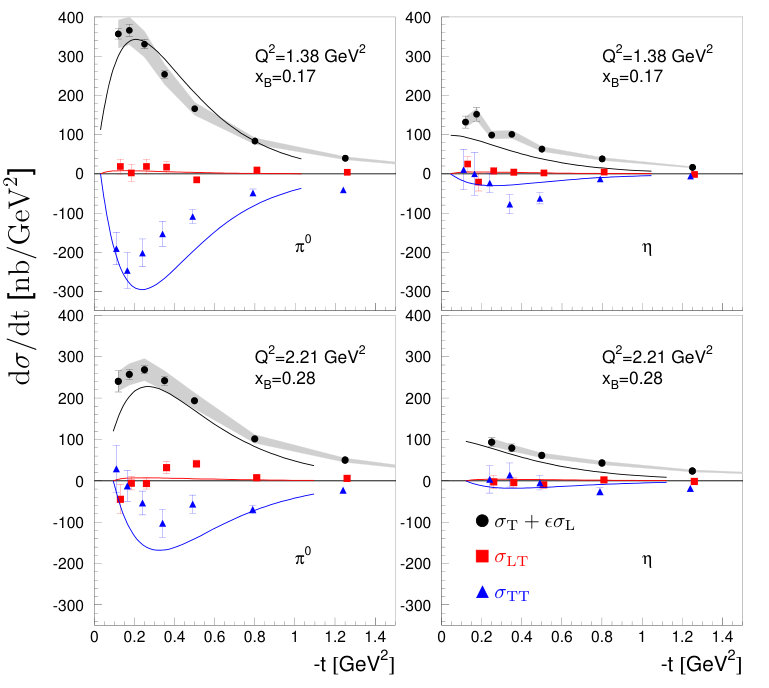 Figure 16
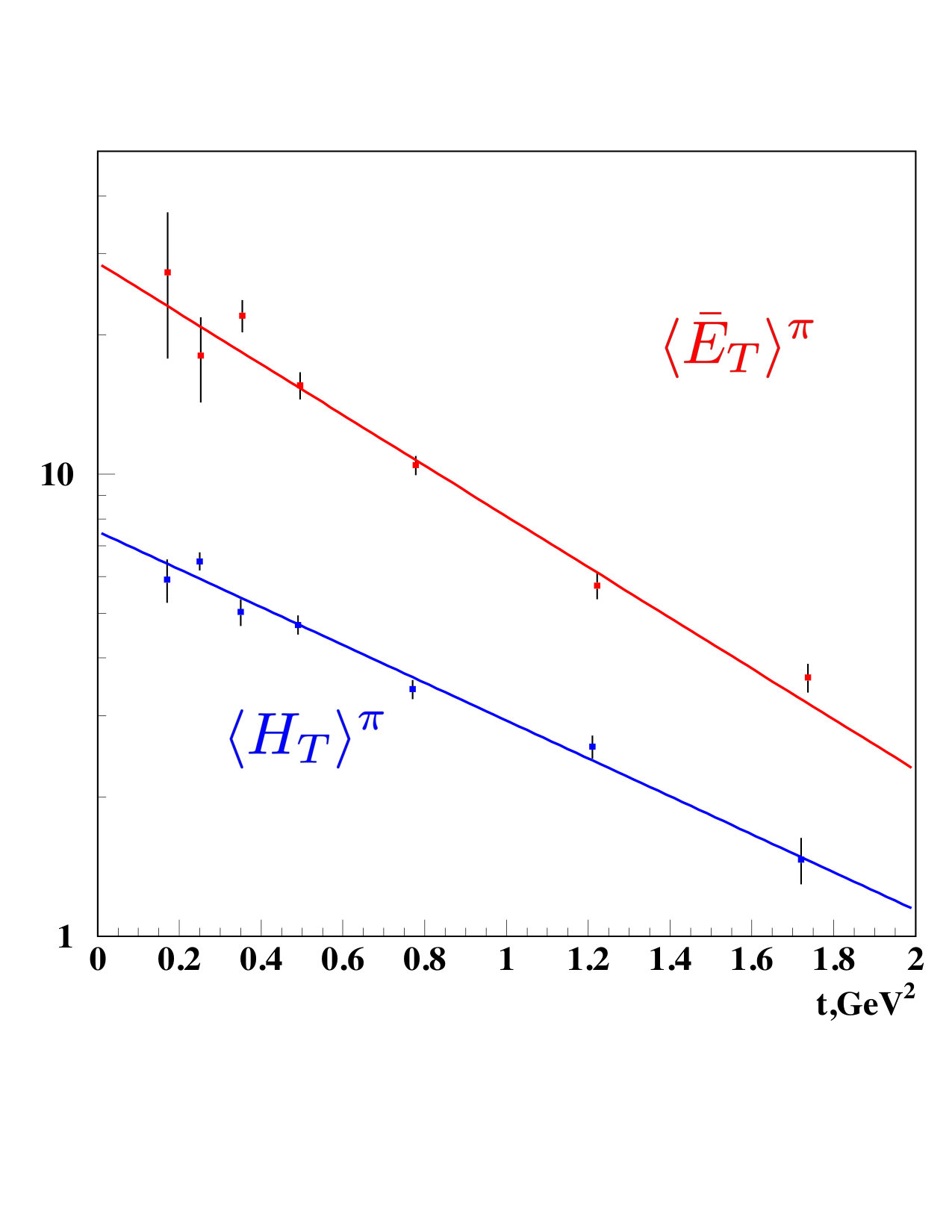 Figure 4
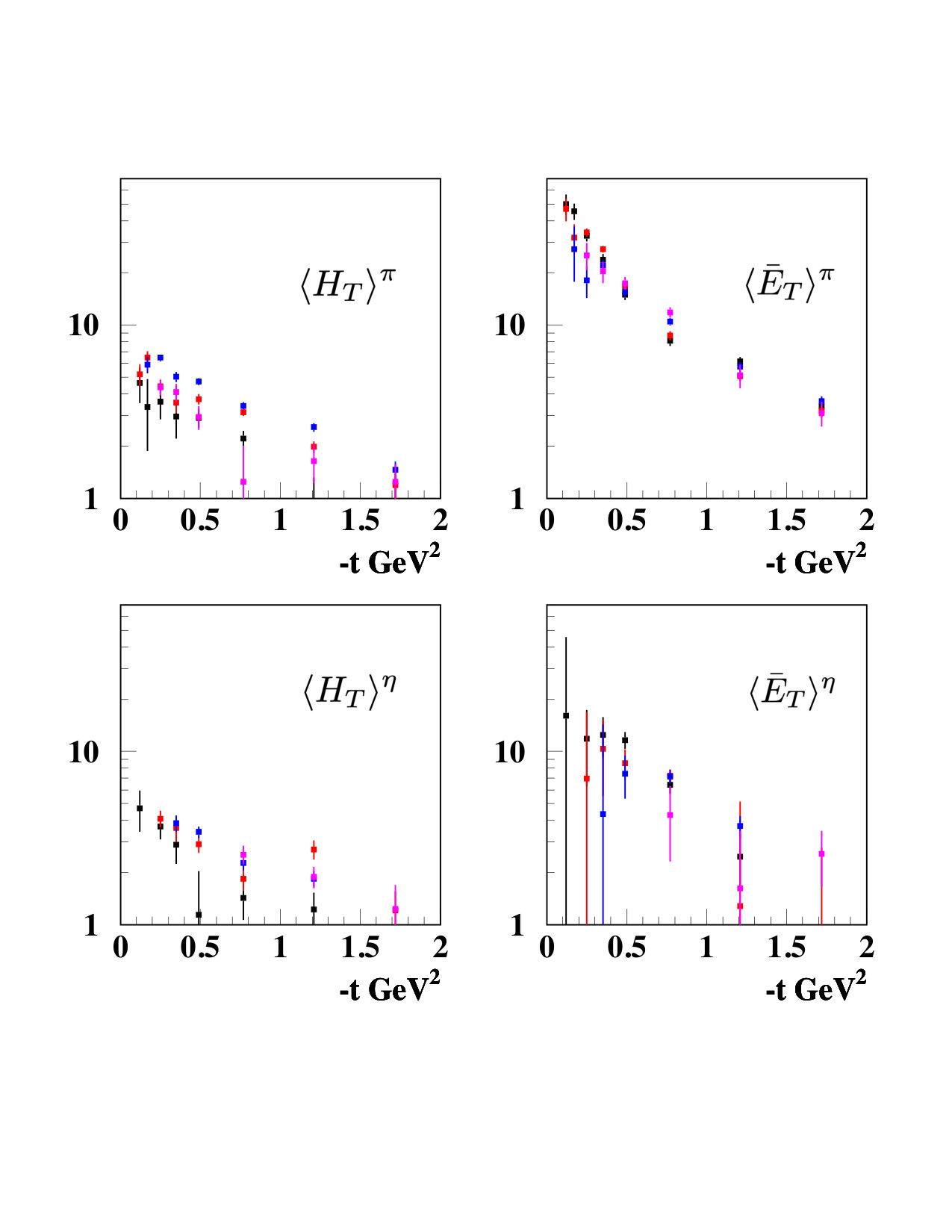 Figure 5
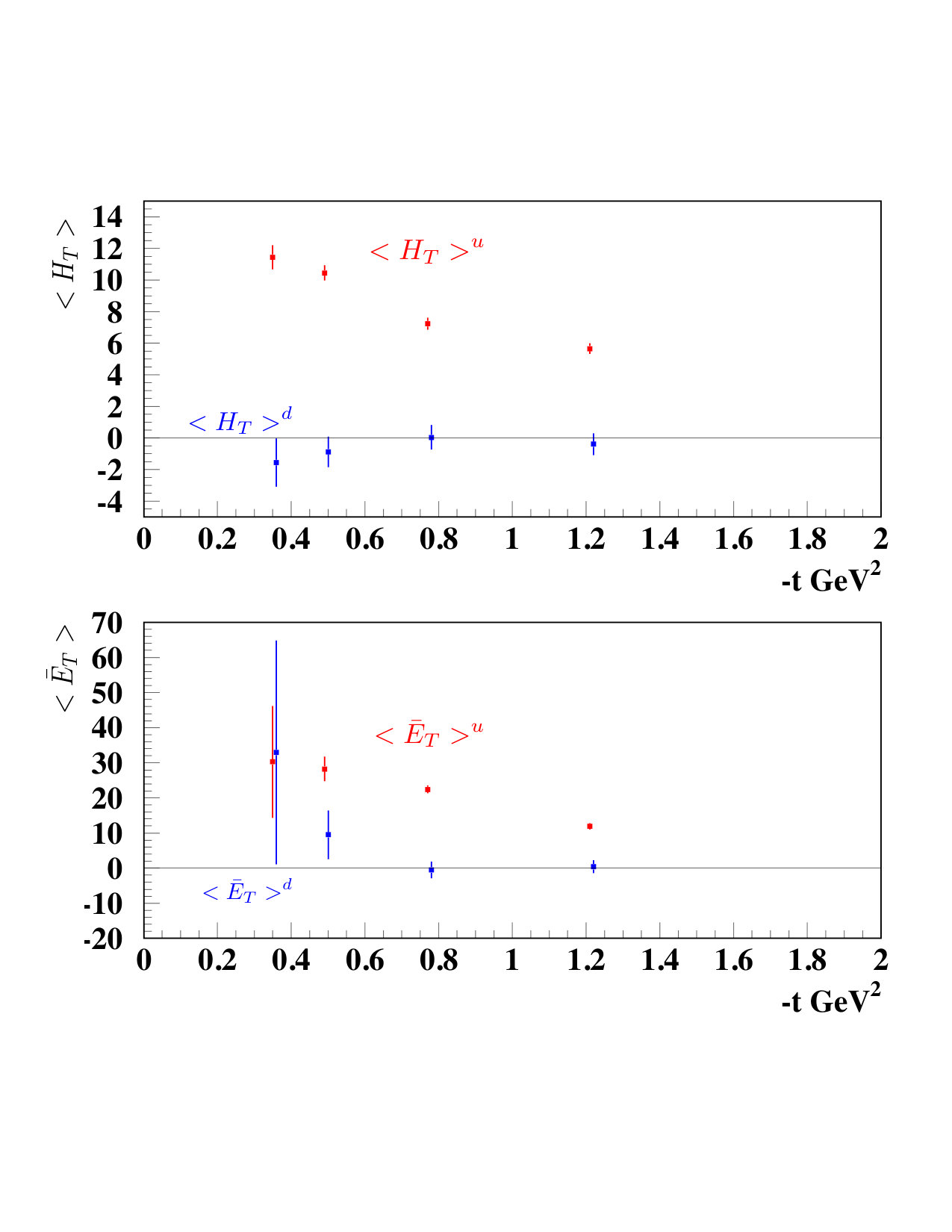 Figure 6
Peer Reviews
No public reviews on file for this paper yet. If you reviewed it on a platform where reviews are public (OpenReview, ICLR, NeurIPS, ICML), you can paste yours below so the community can read it here.
Videos
No videos yet. Explain this paper in a talk, walkthrough, or lecture? Add one.
Status of the Experimental Studies on DVMP and Transversity GPDs
and the CLAS collaboration
Thomas Jefferson National Accelerator Facility
Newport News, VA 23606, USA
Abstract:
The cross section of the exclusive and electroproduction reaction was measured at Jefferson Lab with a 5.75-GeV electron beam and the CLAS detector. Differential cross sections and structure functions and , as functions of were obtained over a wide range of and . At low , both and are described reasonably well by Generalized Parton Distributions (GPDs) in which chiral-odd transversity GPDs are dominant. Generalized form factors of the transversity GPDs and were directly extracted from the experimental observables. The combined and data opens the way for the flavor decomposition of the transversity GPDs. The first ever demonstration of this decomposition was done for the transversity GPDs and . GPD is connected with the density of the polarized quarks in an unpolarized nucleon in the impact parameter space. The spin density of polarized and -quarks was evaluated for different values of Feynman from the GPD model tuned to described the experimental data.
1 Introduction
Understanding nucleon structure in terms of the fundamental degrees of freedom of Quantum Chromodynamics (QCD) is one of the main goals in the theory of strong interactions. In recent years it became clear that exclusive reactions may provide information about hadron structure encoded in so-called Generalized Parton Distributions [1, 2] (GPDs). For each quark flavor there are eight GPDs. Four correspond to parton helicity-conserving (chiral-even) processes, denoted by , , and , and four correspond to parton helicity-flip (chiral-odd) processes [3, 4], , , and . The GPDs depend on three kinematic variables: , and . In a symmetric frame, is the average longitudinal momentum fraction of the struck parton before and after the hard interaction and (skewness) is half of the longitudinal momentum fraction transferred to the struck parton. The skewness can be expressed in terms of the Bjorken variable as . Here and , where and are the initial and final four-momenta of the nucleon.
When the theoretical calculations for longitudinal virtual photons were compared with the JLab and data[5, 6, 7] they were found to underestimate the measured cross sections by more than an order of magnitude in their accessible kinematic regions. The failure to describe the experimental results with quark helicity-conserving operators stimulated a consideration of the role of the chiral-odd quark helicity-flip processes. Deeply virtual meson electroproduction (DVMP), and in particular production in the reaction , was identified [8, 9, 10] as especially sensitive to the quark helicity-flip subprocesses. During the past few years, two parallel theoretical approaches - [8, 11] (GL) and [9, 10] (GK) have been developed utilizing the chiral-odd GPDs in the calculation of pseudoscalar meson electroproduction. The GL and GK approaches, though employing different models of GPDs, lead to transverse photon amplitudes that are much larger than the longitudinal amplitudes.
2 Definition of structure functions
The unpolarized reduced meson cross section is described by 4 structure functions , , and :
[TABLE]
References [10, 11] obtain the following relations for unpolarized structure functions:
[TABLE]
[TABLE]
[TABLE]
[TABLE]
Here is the mass of the proton, , where is the minimum value of corresponding to , is a phase space factor and . The brackets and denote the convolution of the elementary process with the GPDs and . They are called them generalized form factors.
3 Experimental data
The cross section of the reaction measured by the CLAS collaboration at Jlab in bins of , , and were published in Refs. [5, 6, 7]. Structure functions , and have been extracted from the angular distributions. These functions were compared with the predictions of the GPD models [10, 11]. The result confirmed that the measured unseparated cross sections are much larger than expected from leading-twist handbag calculations which are dominated by longitudinal photons. As an example, the comparison of the and structure functions is shown in Fig. 1 for two kinematical bins in and . The structure functions and for are, respectively, factors of 2.5 and 10 smaller than for . However, the GK GPD model [10] (curves) follows the experimental data. Taken together, the and results stringthen the statement about the transversity GPD dominance in the pseudoscalar electroproduction process.
4 Generalized form factors
The squared magnitudes of the generalized form factors and may be directly extracted from the experimental data (see Eqs. 3 and 5 ) in the framework of GPD models.
[TABLE]
[TABLE]
Figure 2 presents the modulus of the generalized form factors , , and for 4 different kinematics. Note the dominance of the over for both and . Generalized form factors and are shown in more detail in Fig. 3. The formfactor has steeper t-dependemce than . The t-slope parameters, obtained by an exponential fit of the form , are =1.27 and =0.98 .
5 Flavor decomposition
In electroproduction of and mesons the GPDs appears in the following combinations
[TABLE]
[TABLE]
The and GPDs contribute in the quark combinations . Hence there is no contribution from the strange quarks if we assume that . For flavor decomposition we have to take into account the decay constants and , the chiral condensate constants 2.57 GeV, 0.958 GeV and =2.32 GeV, and the contribution from singlet and octet states [10].
[TABLE]
where the mixing angles are: and . The octet and singlet wave functions are very similar and the decay constants are close as well and . The overall factor for the meson is . Using and we will end up with
[TABLE]
[TABLE]
Experimentally we have access only to the and (see Eq. 6-7). The final equation for the convolution reads
[TABLE]
[TABLE]
and simular equations for .
The solution of these equations will lead to the flavor decomposition of the generalized form factors and as well as and . However, the convolution integrals have real and imaginary parts. So it is impossible to solve these equations unambiguously with only two equations in hands. So, in order to estimate the form factors, we make an ad hoc assumption that the relative phace between and equals 0 or 180 degrees. Ignoring an overall phase, the form factors are then real, and we arbitrarily choose the solution with and positive. Fig. 4 presents , , and for one kinematic point calculated with this assumption. Note the different signs of and and the same sign of and .
6 Quark spin densities in the transverse plane and generalized transversity distributions
Two-dimensional Fourier transforms of GPDs and , where , define the spin density of the polarized quarks in an unpolarized proton [12].
[TABLE]
[TABLE]
The GPDs and were parametrized in the form [13]
[TABLE]
where and are the GPD forward limit and profile functions respectively. The Fourier transform for this parametrization reads
[TABLE]
For quarks polarized along -axis the impact parameter density reads [12]
[TABLE]
The GPD describes the density of unpolarized quarks and is related to the distortion of the polarized quark distribution in the transverse plane. We can map the and -quark transverse spin density distributions as a function of Feynman based on the GPD model [10] tuned to describe the CLAS data. For example, Fig. 5 shows the impact parameter density of transversely polarized quarks along the -axis in an unpolarized proton for Feynman =0.1 and =0.2. Note the distortion along -axis, similar for u and d-quarks. Looking at the transverse quark density distribution, we can say that this width is diminished as . This behavior is typical for the GPD models.
7 Conclusion
Differential cross sections of exclusive and electroproduction have been obtained in the few-GeV region at more than 1800 kinematic points in bins of , and . Virtual photon structure functions , and have been obtained. It is found that and are comparable in magnitude with each other, while is very much smaller than either. Generalized form factors of the transversity GPDs and were directly extracted from the experimental observables for the first time. It was found that the GPD dominates in pseudoscalar meson production. The combined and data opens the way for the flavor decomposition of the transversity GPDs. Within some simplifying assumptions, the decomposition has been demonstrated. The spin density of polarized and -quarks in the transverse plane was evaluated for different values of from the GPD model tuned to described the experimental data.
Acknowledgments
The author thanks G. Goldstein, S. Goloskokov, P. Kroll, S. Liuti and A. Radyushkin for many informative discussions and making available the results of their calculations. This material is based upon work supported by the U.S. Department of Energy, Office of Science, Office of Nuclear Physics under contract DE-AC05-06OR23177.
The reference list from the paper itself. Each links out to its DOI / PubMed record.
- 1[1] X. Ji, Phys. Rev. Lett. 78 , 610 (1997); Phys. Rev. D 55 , 7114 (1997).
- 2[2] A.V. Radyushkin, Phys. Lett. B 380 , 417 (1996); Phys. Rev. D 56 , 5524 (1997).
- 3[3] P. Hoodbhoy and X. Ji, Phys. Rev. D 58 , 054006 (1998).
- 4[4] M. Diehl, Phys. Rep. 388 , 41 (2003) and references within.
- 5[5] I. Bedlinskiy et al. (CLAS Collaboration), Phys. Rev. Lett. 109 , 112001 (2012).
- 6[6] I. Bedlinskiy et al. (CLAS Collaboration), Phys. Rev. C 90 , 025205 (2014).
- 7[7] I. Bedlinskiy et al. (CLAS Collaboration), Phys. Rev. C 95 , 035202 (2017).
- 8[8] S. Ahmad, G. R. Goldstein and S. Liuti, Phys. Rev. D 79 , 054014 (2009).