Entropy Bound for the Classical Capacity of a Quantum Channel Assisted by Classical Feedback
Dawei Ding, Yihui Quek, Peter W. Shor, Mark M. Wilde

TL;DR
This paper establishes an upper bound on the classical capacity of quantum channels with classical feedback, showing feedback does not enhance capacity for certain channels and introducing an information measure with key properties.
Contribution
It introduces a novel entropy-based upper bound for quantum channel capacity with feedback and demonstrates its implications for specific channels like erasure and bosonic channels.
Findings
Feedback does not increase capacity of quantum erasure channels.
Energy constraints imply no capacity improvement for pure-loss bosonic channels.
An information measure with specific properties underpins the entropy bound.
Abstract
We prove that the classical capacity of an arbitrary quantum channel assisted by a free classical feedback channel is bounded from above by the maximum average output entropy of the quantum channel. As a consequence of this bound, we conclude that a classical feedback channel does not improve the classical capacity of a quantum erasure channel, and by taking into account energy constraints, we conclude the same for a pure-loss bosonic channel. The method for establishing the aforementioned entropy bound involves identifying an information measure having two key properties: 1) it does not increase under a one-way local operations and classical communication channel from the receiver to the sender and 2) a quantum channel from sender to receiver cannot increase the information measure by more than the maximum output entropy of the channel. This information measure can be understood as the…
Click any figure to enlarge with its caption.
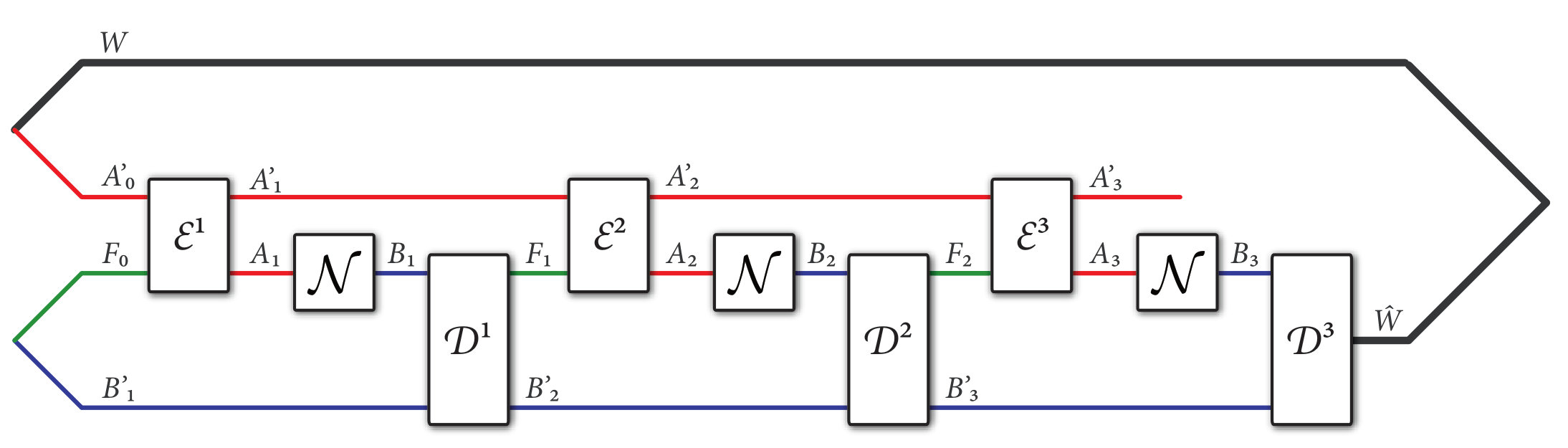 Figure 1
Peer Reviews
No public reviews on file for this paper yet. If you reviewed it on a platform where reviews are public (OpenReview, ICLR, NeurIPS, ICML), you can paste yours below so the community can read it here.
Videos
No videos yet. Explain this paper in a talk, walkthrough, or lecture? Add one.
Entropy Bound for the Classical Capacity of a Quantum Channel Assisted by Classical Feedback
Dawei Ding1, Yihui Quek2, Peter W. Shor3, and Mark M. Wilde4
1Stanford Institute for Theoretical Physics, Stanford University, Stanford, California 94305, USA, [email protected]
2Information Systems Laboratory, Stanford University, Stanford, California 94305, USA, [email protected]
3Center for Theoretical Physics, Massachusetts Institute of Technology, Cambridge, Massachusetts 02139, USA,
Department of Mathematics, Massachusetts Institute of Technology, Cambridge, Massachusetts 02139, USA, [email protected]
4Hearne Institute for Theoretical Physics, Department of Physics and Astronomy, Center for Computation and Technology,
Louisiana State University, Baton Rouge, Louisiana 70803, USA, [email protected]
Abstract
We prove that the classical capacity of an arbitrary quantum channel assisted by a free classical feedback channel is bounded from above by the maximum average output entropy of the quantum channel. As a consequence of this bound, we conclude that a classical feedback channel does not improve the classical capacity of a quantum erasure channel, and by taking into account energy constraints, we conclude the same for a pure-loss bosonic channel. The method for establishing the aforementioned entropy bound involves identifying an information measure having two key properties: 1) it does not increase under a one-way local operations and classical communication channel from the receiver to the sender and 2) a quantum channel from sender to receiver cannot increase the information measure by more than the maximum output entropy of the channel. This information measure can be understood as the sum of two terms, with one corresponding to classical correlation and the other to entanglement.
I Introduction
A famous result of Shannon is that a free feedback channel does not increase the capacity of a classical channel for communication [1]. That is, the feedback-assisted capacity is equal to the channel’s mutual information. Shannon’s result indicates that the mutual information formula for capacity is particularly robust, in the sense that, a priori, one might consider a feedback channel to be a strong resource for assisting communication.
With the rise of quantum information theory, several researchers have found variations and generalizations of Shannon’s aforementioned result, in the context of communication over quantum channels. For example, Bowen proved that the capacity of a quantum channel for sending classical messages, when assisted by a free quantum feedback channel, is equal to the channel’s entanglement-assisted capacity [2], which is in turn equal to the mutual information of a quantum channel [3, 4, 5]. This result indicates that the mutual information of a quantum channel is robust, in a sense similar to that mentioned above. The result also indicates that the best strategy, in the limit of many channel uses, is to use the quantum feedback channel once in order to establish sufficient shared entanglement between the sender and receiver, and to subsequently employ an entanglement-assisted communication protocol [3, 4, 5]. Bowen’s result was strengthened to a strong converse statement in [6, 7]. Bowen et al. proved that the capacity of an entanglement-breaking channel for sending classical messages is not increased by a free classical feedback channel [8], and this result was strengthened to a strong converse statement in [9]. Ref. [10] discussed several inequalities relating the classical capacity assisted by classical feedback to other capacities. At the same time, it is known that in general there can be an arbitrarily large gap between the unassisted classical capacity and the classical capacity assisted by classical feedback [11].
Our aim here is to go beyond [8] to establish an upper bound on the classical capacity of an arbitrary, not just entanglement-breaking, quantum channel assisted by a classical feedback channel. Due to the fact that a quantum feedback channel is a stronger resource than a classical feedback channel, an immediate consequence of Bowen’s result [2] is that the entanglement-assisted capacity is an upper bound on the classical capacity assisted by classical feedback. However, since a quantum channel can, in general, establish quantum entanglement [12, 13, 14] and entanglement can increase capacity [3, 4, 5], in such cases it may appear difficult to establish an upper bound on this capacity other than the entanglement-assisted capacity. Our main result is that the latter is actually possible: we prove here that the maximum output entropy of a quantum channel is an upper bound on its classical capacity assisted by classical feedback. As a generalization of this result, we find that the maximum average output entropy is an upper bound on the same capacity for a channel that is a probabilistic mixture of other channels.
The approach that we take for establishing the aforementioned bounds is similar in spirit to approaches used to bound other assisted capacities or protocols [15, 16, 17, 18]. We identify an information measure that has two key properties: 1) it does not increase under a free operation, which in this case is a one-way local operations and classical communication (1W-LOCC) channel from the receiver to the sender, and 2) a quantum channel from sender to receiver cannot increase the information measure by more than the maximum output entropy of the channel. This information measure can be understood as the sum of two terms, with one corresponding to classical correlation and the other to entanglement.
We organize the rest of the paper as follows. Section II provides a formal definition of a protocol for classical communication over a quantum channel assisted by classical feedback. Section III discusses explicitly how to purify such a protocol, which is an important conceptual step for our analysis. Section IV introduces our key information measure and several important supplementary lemmas regarding it. Section V then employs this information measure and the supplementary lemmas to establish the maximum output entropy bound for classical capacity assisted by classical feedback. We apply this bound to the erasure channel and pure-loss bosonic channel in Section VI. We conclude in Section VII.
II Protocol for classical communication over a quantum channel assisted
by classical feedback
To begin with, let , let , and let . Let be a quantum channel, and let be a Hamiltonian acting on the input system of . An protocol for classical communication over a quantum channel consists of uses of the quantum channel , along with the assistance of a classical feedback channel from the receiver Bob to the sender Alice, in order for Alice to send one of messages to Bob such that the error probability is no larger than . Furthermore, the average state at the input of each channel use should have energy no larger than , when taken with respect to the Hamiltonian .
In more detail, the protocol consists of an initial classical–quantum state , with classical and quantum, of the form
[TABLE]
It also involves encoding channels, with each one denoted by for , as well as decoding channels, with each of them denoted by for . Note that all systems are classical because the feedback channel is constrained to be a classical channel. So this means that each decoding channel is a quantum instrument. The final decoding is denoted by .
We now detail the form of such a protocol. It begins with Alice preparing the following classical–quantum state:
[TABLE]
for some set of quantum states. The global initial state is then . Alice then performs the encoding channel and the state becomes as follows:
[TABLE]
Alice transmits the system through the first use of the channel , resulting in the following state:
[TABLE]
Bob processes his systems with the decoding channel and Alice acts with the encoding channel , resulting in the state
[TABLE]
This process iterates more times, resulting in the following states:
[TABLE]
[TABLE]
for . The final decoding (measurement) channel results in the following state:
[TABLE]
Figure 1 depicts the above protocol for .
For an protocol, the following is satisfied
[TABLE]
where is the maximally classically correlated state. Note that , where here denotes the uniform random variable corresponding to the message choice and denotes the random variable corresponding to the classical value in the register of the state . Furthermore, the following energy constraint applies as well:
[TABLE]
which limits the energy of the average input state.
III Purified protocol
Our goal is to bound the rate of such a protocol. With this in mind, we can devise a protocol that simulates the above one. It consists of purifying each step of the above protocol and Bob keeping a copy of the classical feedback, such that at each time step, conditioned on the value of the message in and the feedback in the existing systems labeled by , the state is pure. To be clear, we go through the steps of the purified protocol. In order to simplify notation, we let be a joint system throughout, referring to both the original system as well as a purifying system, and we take the same convention for . The initial state of Alice is as follows:
[TABLE]
where is a purification of , such that tracing over a subsystem of gives . The initial state of Bob is as follows:
[TABLE]
where is a purification of , such that tracing over a subsystem of gives , and he keeps an extra copy of the classical data. Let denote an isometric channel extending the encoding channel , for . Since the system is classical, for , the decoding channel can be written explicitly as
[TABLE]
such that is a collection of completely positive maps such that the sum map is trace preserving. Let be a linear map such that tracing over a subsystem of gives the original map , and define the map
[TABLE]
Then we define the enlarged decoding channel as
[TABLE]
Note that this enlarged decoding channel keeps an extra copy of the classical feedback value for Bob in the register . The final decoding channel in the original protocol is equivalent to a measurement channel, and thus can be written as
[TABLE]
where is a POVM. We enlarge it as follows in the simulation protocol:
[TABLE]
where the meaning of the notation is that the map acts nontrivially on the subsystems in the original protocol and trivially on all other subsystems, while mapping all systems to a system large enough to accommodate all of them. In the simulation protocol, we also consider an isometric channel that simulates the original channel as follows: .
Thus, the various states involved in the purified protocol are as follows. The global initial state is . Alice performs the enlarged encoding channel and the state becomes as follows:
[TABLE]
Alice transmits the system through the first use of the extended channel , resulting in the following state:
[TABLE]
Bob processes his systems with the enlarged decoding channel and Alice acts with the enlarged encoding channel , resulting in the state . This process iterates more times, resulting in the following states:
[TABLE]
[TABLE]
for . The final enlarged decoding channel results in the following state: . Note that we recover each state of the original protocol from Section II by performing particular partial traces.
IV Information measure for analysis of protocol
The key information measure that we use to analyze this protocol is as follows:
[TABLE]
where is a classical–quantum state of the form
[TABLE]
The first term in (18) represents the classical correlation between system and systems , while the second term represents the average entanglement between the system of the state and a purifying reference system.
We now establish some properties of the information measure in (18). Let us first recall the following lemma from [19]:
Lemma 1
Let be a pure bipartite state, and let be an ensemble of pure bipartite states obtained from by means of a 1W-LOCC channel of the form
[TABLE]
where is a collection of completely positive trace non-increasing maps with and is a collection of isometric channels, so that
[TABLE]
Then the following inequality holds for .
The above lemma leads to the following one, which is the statement that the quantity in (18) is monotone with respect to 1W-LOCC channels:
Lemma 2
Let be a classical–quantum state, with classical systems and quantum systems pure when conditioned on , and let be a 1W-LOCC channel of the form in (20). Then the following holds
[TABLE]
where .
Proof:
The inequality holds from data processing. In more detail, consider that is equal to
[TABLE]
where the last equality follows because each map is trace preserving. So the state can be understood as arising from the action of the quantum instrument on the state , and since this is a channel from to , the data processing inequality applies so that . The inequality follows from an application of Lemma 1, by conditioning on the classical systems . ∎
The following lemma places an entropic upper bound on the amount by which the quantity in (18) can increase by the action of a channel :
Lemma 3
Let be a classical–quantum state of the following form:
[TABLE]
Then
[TABLE]
where .
Proof:
Consider that
[TABLE]
All inequalities follow from definitions and applying chain rules for mutual information and entropy. The final inequality follows because conditioning does not increase entropy. ∎
V Maximum output entropy bound
Now that we have identified a quantity that does not increase under 1W-LOCC from Bob to Alice and cannot increase by more than the output entropy of a channel under its action, we can use these properties to establish the following upper bound on the rate of a feedback-assisted communication protocol:
Theorem 4
For an protocol for classical communication over a quantum channel assisted by classical feedback, of the form described in Section II, the following bound applies
[TABLE]
Proof:
Let us consider the purified simulation of a given protocol, as given in Section III. We start with
[TABLE]
where we have applied the condition in (9) and standard entropy inequalities. Continuing, we find that
[TABLE]
The first inequality follows from data processing and non-negativity of entropy. The first equality follows because for the initial state (there is no classical correlation between and , and the state on system is pure when conditioned on ). The last equality follows by adding and subtracting the same term. Continuing, we find that the quantity in the last line above is bounded as
[TABLE]
The first inequality follows from Lemma 2. The first equality follows by collecting terms. The second inequality follows from Lemma 3. The third inequality follows from concavity of entropy and the definition of in (10). The final inequality follows from the energy constraint in (10), and by optimizing over all input states that satisfy this energy constraint. By combining (31)–(32) and (33)–(36), we arrive at (30). ∎
In Appendix A, we show how to extend this result to the maximum average output entropy:
Theorem 5
Let , where is a probability distribution and is a set of channels. For an protocol for classical communication over the channel assisted by classical feedback, of the form described in Section II, the following bound applies
[TABLE]
VI Examples
From the upper bound in Theorem 4, we conclude that the feedback-assisted capacity of a noiseless qudit channel of dimension is log.
Furthermore, consider a pure-loss bosonic channel [20] with transmissivity . Taking the Hamiltonian as the photon number operator and energy constraint , it is known from [20] that this channel’s energy constrained classical capacity and maximum output entropy are equal to , where . Applying these results and Theorem 4, we conclude that classical feedback does not increase the energy-constrained classical capacity of the pure-loss bosonic channel.
A quantum erasure channel is defined as for , where is the state of a -dimensional input system and is an erasure state orthogonal to all inputs. Applying Theorem 5, we conclude that the classical capacity of the erasure channel assisted by classical feedback is equal to , so that classical feedback does not increase the classical capacity of the erasure channel.
VII Conclusion
Our main result is that the maximum average output entropy of a quantum channel is an upper bound on its classical capacity assisted by classical feedback. Note that the bound is a weak converse bound. Going forward from here, it would be good to find strong converse and tighter bounds on the classical capacity assisted by classical feedback.
Acknowledgements. We acknowledge discussions with Xin Wang, Patrick Hayden, and Tsachy Weissman. DD is supported by a National Defense Science and Engineering Graduate Fellowship. YQ is supported by a Stanford Graduate Fellowship and a National University of Singapore Overseas Graduate Scholarship. PWS is supported by the NSF under Grant No. CCF-1525130 and through the NSF Science and Technology Center for Science of Information under Grant No. CCF0-939370. MMW acknowledges NSF grant no. 1350397. DD and MMW thank God for all His provisions.
Appendix A Maximum average output entropy bound for probabilistic mixture of channels
In this appendix, we provide a simple proof of Theorem 5. The main idea behind the proof is to observe that any feedback-assisted protocol of the form discussed in Section II, which is for communication over a probabilistic mixture channel , has a simulation of the following form:
Before the th use of the channel in the feedback-assisted protocol, Bob selects a random variable independently according to the distribution . He transmits over the classical feedback channel to Alice. 2. 2.
Each channel use from the original protocol is replaced by a simulation in terms of another channel , which accepts a quantum input on system and a classical input on system . Conditioned on the value in system , the channel applies to the quantum system . Thus, if the random variable is fed into the input system of , then the channel is indistinguishable from the original channel . 3. 3.
Alice feeds a copy of the classical random variable into the th use of the channel . 4. 4.
All other aspects of the protocol are executed in the same way as before. Namely, even though it would be an advantage to Alice to modify her encodings and Bob to modify later decodings based on the realizations of , they do not do so, and they instead blindly operate all other aspects of the simulation protocol as they are in the original protocol.
Our goal now is to establish the inequality in Theorem 5, relating the , , , parameters of the original protocol by using the above simulation.
The main observation to make from here is that the same proof from Lemma 3 gives the following bound:
[TABLE]
where is the following state:
[TABLE]
[TABLE]
This follows by grouping with , but then discarding only and at the end of the proof. We then apply this bound, and the same reasoning in the proof of Theorem 4, except that the variables are grouped together with the feedback variables and then the same reasoning in (33)–(35) applies. At this point, we invoke (37) and find that
[TABLE]
We can then bound the sum over entropies as follows:
[TABLE]
The first inequality is by concavity of conditional entropy, and the conditional entropy is defined on the averaged channel output state over uses , . The second equality is by definition of conditional entropy. The third inequality follows from optimizing over states that satisfy the energy constraint in (10). This concludes the proof of Theorem 5.
The reference list from the paper itself. Each links out to its DOI / PubMed record.
- 1[1] C. Shannon, “The zero error capacity of a noisy channel,” IRE Transactions on Information Theory , vol. 2, no. 3, pp. 8–19, September 1956.
- 2[2] G. Bowen, “Quantum feedback channels,” IEEE Transactions on Information Theory , vol. 50, no. 10, pp. 2429–2434, October 2004.
- 3[3] C. H. Bennett, P. W. Shor, J. A. Smolin, and A. V. Thapliyal, “Entanglement-assisted classical capacity of noisy quantum channels,” Physical Review Letters , vol. 83, no. 15, pp. 3081–3084, October 1999.
- 4[4] ——, “Entanglement-assisted capacity of a quantum channel and the reverse Shannon theorem,” IEEE Transactions on Information Theory , vol. 48, no. 10, pp. 2637–2655, October 2002.
- 5[5] A. S. Holevo, “On entanglement assisted classical capacity,” Journal of Mathematical Physics , vol. 43, no. 9, pp. 4326–4333, September 2002.
- 6[6] C. H. Bennett, I. Devetak, A. W. Harrow, P. W. Shor, and A. Winter, “The quantum reverse Shannon theorem and resource tradeoffs for simulating quantum channels,” IEEE Transactions on Information Theory , vol. 60, no. 5, pp. 2926–2959, May 2014.
- 7[7] T. Cooney, M. Mosonyi, and M. M. Wilde, “Strong converse exponents for a quantum channel discrimination problem and quantum-feedback-assisted communication,” Communications in Mathematical Physics , vol. 344, no. 3, pp. 797–829, June 2016.
- 8[8] G. Bowen and R. Nagarajan, “On feedback and the classical capacity of a noisy quantum channel,” IEEE Transactions on Information Theory , vol. 51, no. 1, pp. 320–324, January 2005.