Symmetry-controlled second-harmonic generation in a plasmonic waveguide
Tzu-Yu Chen, Julian Obermeier, Thorsten Schumacher, Fan-Cheng Lin,, Jer-Shing Huang, Markus Lippitz, Chen-Bin Huang

TL;DR
This paper introduces a novel approach for second-harmonic generation in plasmonic waveguides, demonstrating symmetry-based control of nonlinear optical processes in centro-symmetric structures.
Contribution
The study shows that optical mode symmetry alone can enable SHG in symmetric structures, with experimental validation using a plasmonic two-wire transmission line.
Findings
SHG occurs only in symmetric modes when fundamental modes are symmetric or anti-symmetric.
Emission can be switched to anti-symmetric mode by mixing fundamental modes.
The approach enables new design possibilities for nonlinear nanophotonic devices.
Abstract
A new concept for second-harmonic generation (SHG) in an optical nanocircuit is proposed. We demonstrate both theoretically and experimentally that the symmetry of an optical mode alone is sufficient to allow SHG even in centro-symmetric structures made of centro-symmetric material. The concept is realized using a plasmonic two-wire transmission-line (TWTL), which simultaneously supports a symmetric and an anti-symmetric mode. We first confirm the generated second-harmonics belong only to the symmetric mode of the TWTL when fundamental excited modes are either purely symmetric or anti-symmetric. We further switch the emission into the anti-symmetric mode when a controlled mixture of the fundamental modes is excited simultaneously. Our results open up a new degree of freedom into the designs of nonlinear optical components, and should pave a new avenue towards multi-functional…
Click any figure to enlarge with its caption.
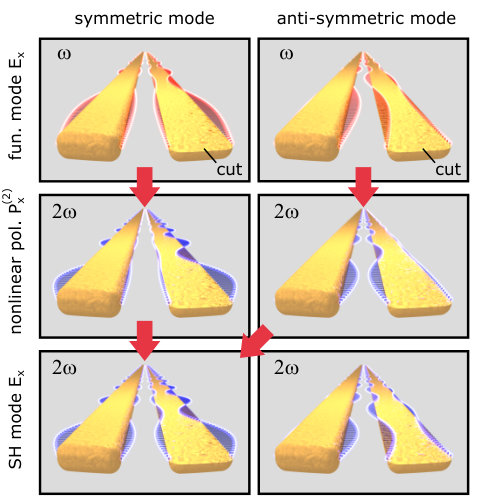 Figure 1
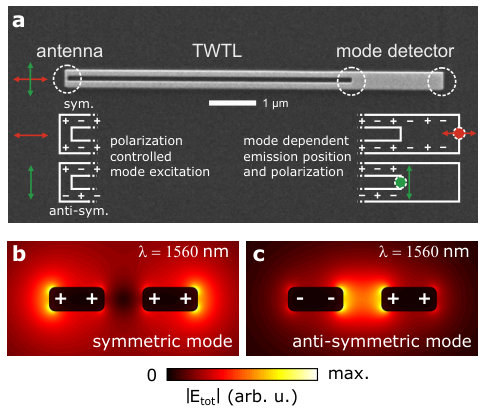 Figure 2
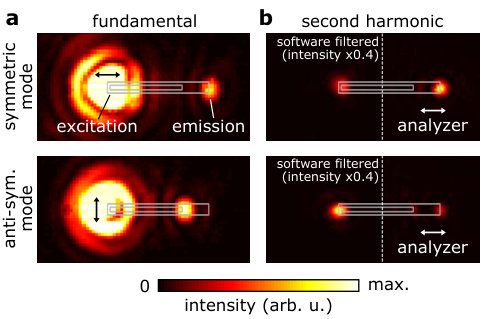 Figure 3
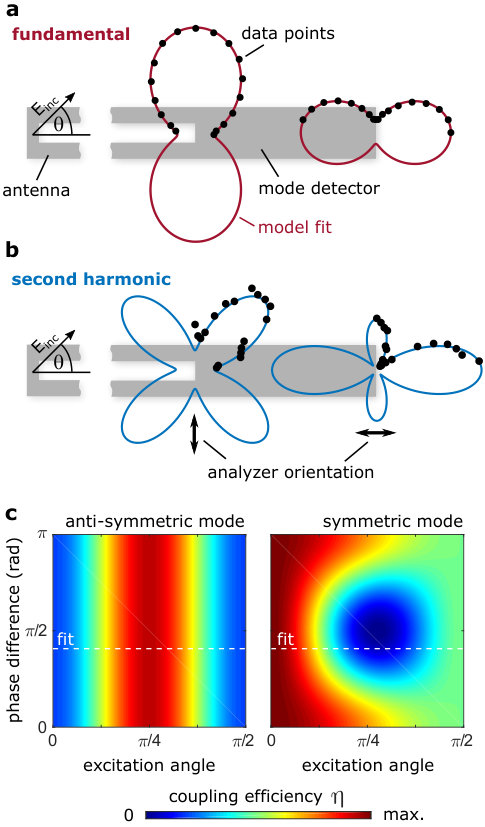 Figure 4
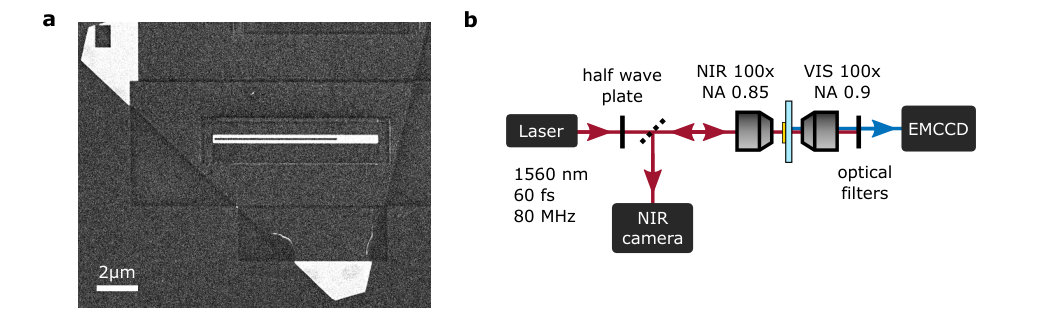 Figure 5
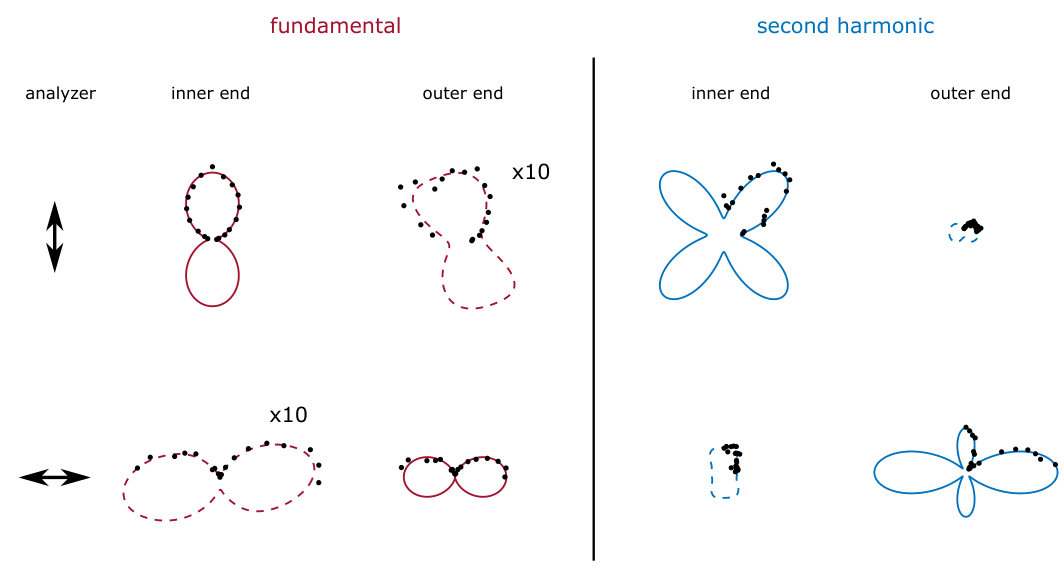 Figure 6
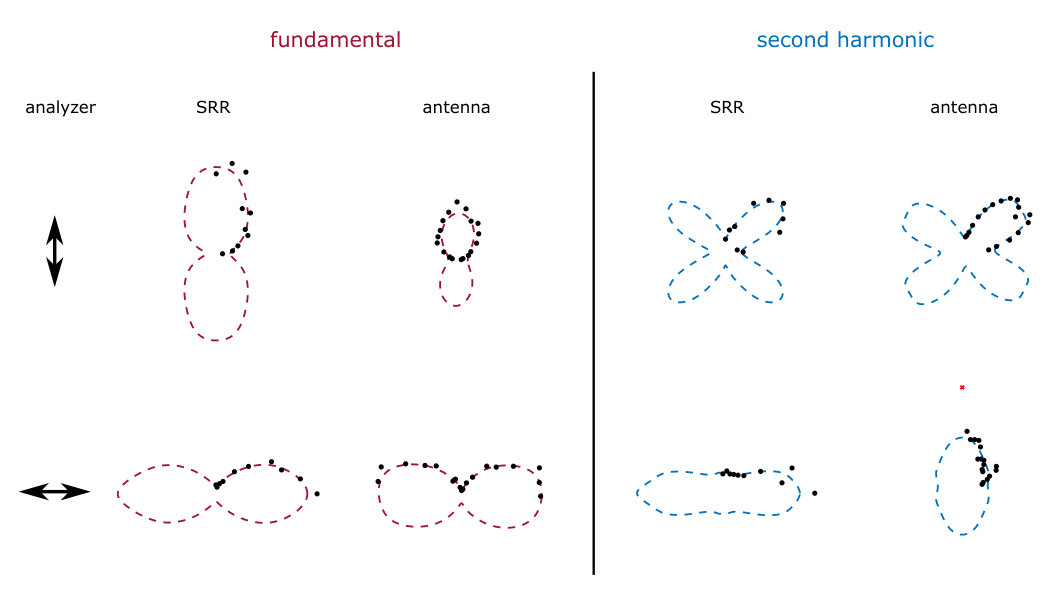 Figure 7
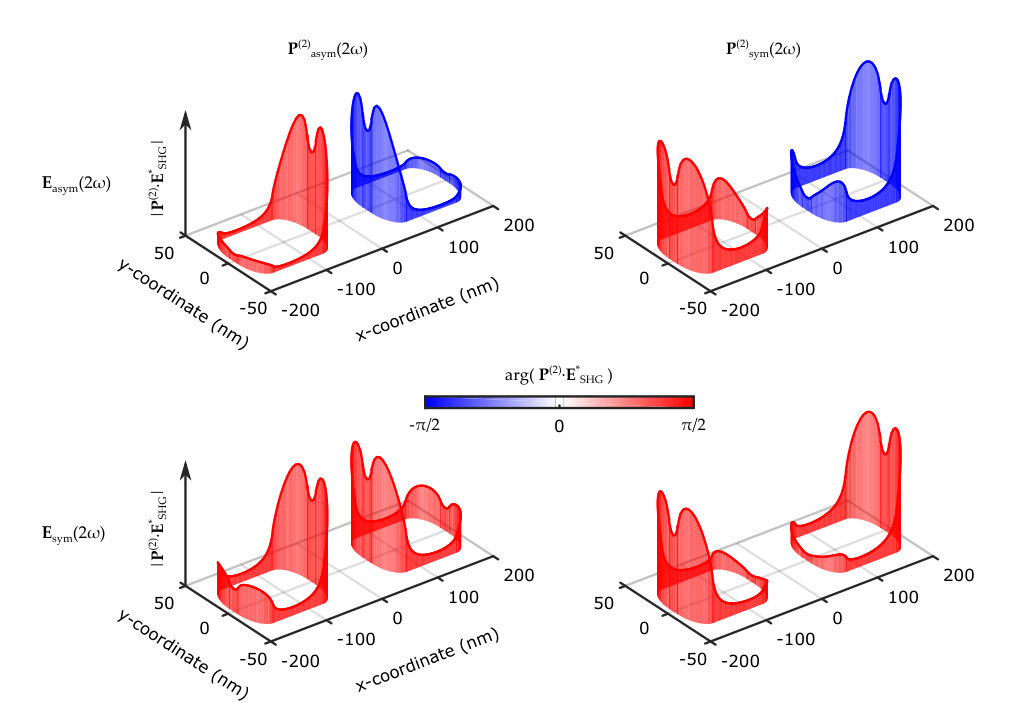 Figure 8
Peer Reviews
No public reviews on file for this paper yet. If you reviewed it on a platform where reviews are public (OpenReview, ICLR, NeurIPS, ICML), you can paste yours below so the community can read it here.
Videos
No videos yet. Explain this paper in a talk, walkthrough, or lecture? Add one.
Taxonomy
TopicsPlasmonic and Surface Plasmon Research · Photonic and Optical Devices · Photonic Crystals and Applications
Symmetry-controlled second-harmonic generation in a plasmonic waveguide
Tzu-Yu Chen
Institute of Photonics Technologies, National Tsing Hua University, Hsinchu 30013, Taiwan
International Intercollegiate PhD Program, National Tsing Hua University, Hsinchu 30013, Taiwan
Julian Obermeier
Department of Physics, University of Bayreuth, 95440 Bayreuth, Germany
Thorsten Schumacher
Department of Physics, University of Bayreuth, 95440 Bayreuth, Germany
Fan-Cheng Lin
Department of Chemistry, National Tsing Hua University, Hsinchu 30013, Taiwan
Jer-Shing Huang
Leibniz Institute of Photonic Technology, 07745 Jena, Germany
Department of Electrophysics, National Chiao Tung University, Hsinchu 30010, Taiwan
Research Center for Applied Sciences, Academia Sinica, Taipei 115-29, Taiwan
Markus Lippitz
Department of Physics, University of Bayreuth, 95440 Bayreuth, Germany
Chen-Bin Huang
Institute of Photonics Technologies, National Tsing Hua University, Hsinchu 30013, Taiwan
International Intercollegiate PhD Program, National Tsing Hua University, Hsinchu 30013, Taiwan
Research Center for Applied Sciences, Academia Sinica, Taipei 115-29, Taiwan
Abstract
A new concept for second-harmonic generation (SHG) in an optical nanocircuit is proposed. We demonstrate both theoretically and experimentally that the symmetry of an optical mode alone is sufficient to allow SHG even in centro-symmetric structures made of centro-symmetric material. The concept is realized using a plasmonic two-wire transmission-line (TWTL), which simultaneously supports a symmetric and an anti-symmetric mode. We first confirm the generated second-harmonics belong only to the symmetric mode of the TWTL when fundamental excited modes are either purely symmetric or anti-symmetric. We further switch the emission into the anti-symmetric mode when a controlled mixture of the fundamental modes is excited simultaneously. Our results open up a new degree of freedom into the designs of nonlinear optical components, and should pave a new avenue towards multi-functional nanophotonic circuitry.
As documented in all nonlinear optics textbooks, second-harmonic generation (SHG) from a bulk material requires a non-centro-symmetric crystal structure. Typical noble metals exploited for plasmonics, such as gold, silver and aluminum, are centro-symmetric and do not allow SHG in their bulk form. A strategy to circumvent this limitation is to make use of the non-vanishing second-order susceptibility at the surfaces, where the symmetry is automatically broken Brown et al. (1965); Bloembergen et al. (1968); Simon et al. (1974); Mäkitalo et al. (2011). However, when measured in the far-field, despite local SHG is permitted at the interface, contributions of two opposing surface elements cancel out provided the nanostructure is exhibiting centro-symmetry. Past efforts in plasmonic-assisted SHG circumvented this cancellation through designing asymmetric nanostructures where the amplitude of one surface contribution overwhelms that of the opposing surface. It is interesting to note that prior plasmonic-assisted SHGs were dominated by localized surface plasmons, i.e., the metallic nanostructures act as optical antennas Zhang et al. (2011); Konishi et al. (2014); O’Brien et al. (2015); Czaplicki et al. (2015); Celebrano et al. (2015); Gennaro et al. (2016); Gómez-Tornero et al. (2017); Yang et al. (2017); Chervinskii et al. (2018). On contrary, rare research attention has been paid to nonlinear frequency conversions using propagating plasmons Chen et al. (1979); Viarbitskaya et al. (2015); de Hoogh et al. (2016); Li et al. (2017); Lan et al. (2015). Despite an early demonstration of SHG in a two-dimensional metallic thin film Chen et al. (1979), to our best knowledge, only three works have employed three-dimensionally confined surface plasmon polaritons (SPPs) Viarbitskaya et al. (2015); de Hoogh et al. (2016); Li et al. (2017). We note here in Refs. Viarbitskaya et al. (2015) and Li et al. (2017), the generated second-harmonic signals were no longer guided by the plasmonic structures, but radiating into the far-field.
A key ingredient of our approach is a propagating plasmonic waveguide mode. In this letter, we demonstrate emission of second harmonic light which is thought to be forbidden, as the plasmonic nanocircuit is fully centro-symmetric in geometry and material. The structure we use is a two-wire transmission line (TWTL) and consists of two parallel gold nanowires of identical size and shape Geisler et al. (2013); Wu et al. (2017); Dai et al. (2014). Although the waveguide is still centro-symmetric, it supports a symmetric and an anti-symmetric mode (Fig. 1 top), similar to the bonding and anti-bonding orbital in a hydrogen molecule or the two eigenmodes of a coupled pendulum. However, due to the absence of any resonance condition, both modes are broadband and cover large parts of the optical and near-infrared spectrum. We label the two modes by the symmetry of the normal components of the electric field, which agrees with the symmetry of the charge distribution. During the propagation of the fundamental field, a nonlinear polarization is generated locally (Fig. 1 mid). It can emit into the waveguide modes available at the second-harmonic frequency (Fig. 1 bottom). While the fundamental ( nm) and second harmonic fields ( nm) are computed with a finite element solver (Comsol), the nonlinear polarization is calculated as Mäkitalo et al. (2011)
[TABLE]
where denotes the vector component normal to the surface. In second-harmonic generation at gold surfaces the tensor component dominates, i.e., only the vector components along the surface normal enter Mäkitalo et al. (2011).
The coupling efficiency of the nonlinear polarization to the waveguide modes, at the second harmonic, can be calculated as O’Brien et al. (2015); Roke et al. (2004)
[TABLE]
where the integral runs over the surface of the waveguide. The integral reduces to a line integral along the circumference in case phase matching and damping is neglected, as possible for waveguides of a fixed length. In case of symmetric and anti-symmetric field distributions the nonlinear polarization is always fully symmetric. In consequence, only emission into the symmetric mode is allowed, while the integral for the anti-symmetric mode vanishes. In analogy, this is what forbids second-harmonic emission from a small plasmonic sphere, as free space modes are anti-symmetric upon point inversion. Numerical calculations taking all details into account support the symmetry argument (see supplementary material).
We now set out to experimentally demonstrate these predictions. The waveguide consists of two identical single-crystalline gold wires of about 100 nm width and distance (Fig. 2a). A plasmonic nanoantenna that is connected to the transmisison line (left side of structure) allows to independently excite the two eigenmodes of the waveguide by controlling the polarization direction of the incoming laser beam. Here, the polarization along the antenna (vertical axis) leads to a dipolar charge distribution and launches the anti-symmetric mode (inset Fig. 2a). In case of the horizontal polarization, the antenna part acts as scattering edge launching the symmetric mode. For detection, we make use of the different modal distribution of the electric field-amplitude. The anti-symmetric mode is confined between the wires while the symmetric mode has a higher field amplitude outside the wire pair (Fig. 2b,c). This allows us to use a two-wire/single-wire interface (right side of structure) as mode detector Geisler et al. (2013); Dai et al. (2014); Rewitz et al. (2014). The emitted light has the identical polarization that was necessary to excite the mode.
The experimental results for linear and nonlinear propagation are shown in Figs. 3a and b. When exciting the antenna with horizontal polarization, the symmetric mode is launched leading to fundamental emission at the right end of the mode detector (top left panel). Rotating the polarization by , the excited mode changes and consequently also the emission point (bottom left panel). In the second harmonic images Fig. 3b the analyzer selects the emission from the symmetric mode at the right end of the mode detector. A discussion of the other polarization direction is presented in the supplementary material. We find locally generated second-harmonic emission from the input antenna, independent on the fundamental excitation polarization. In contrast to other publications, the waveguide itself appears dark, demonstrating high surface quality de Hoogh et al. (2016). Most important, we find second-harmonic emission for both excitation polarization directions at the right end of the mode detector, i.e., stemming from the symmetric mode only. The excitation of the anti-symmetric fundamental mode (bottom right panel) leads to a slightly lower emission intensity, in agreement with our numerical simulations, due to a reduced mode overlap. Regardless of which pure fundamental mode is excited, we always generate second-harmonic during propagation in the waveguide that is emitted into the symmetric mode at frequency . This process is symmetry-allowed and takes place although both the material as well as the structure is centro-symmetric.
Obviously the fundamental harmonic excitation and subsequently the second harmonic emission into purely symmetric and anti-symmetric modes are special cases of a more general behavior, that we want to study in the following. In general, each superposition of fundamental modes may be launched, leading to a nonlinear mode mixing during propagation and emission from different second harmonic modes. In case of our waveguide, the fundamental field can be written as a coherent superposition of the symmetric () and anti-symmetric () waveguide mode:
[TABLE]
with , the and -polarized excitation field components of the fundamental laser beam. The parameters and take into account that the antenna coupling efficiency differs in amplitude and phase between the two modes. When observing the fundamental wavelength, the mode detector projects the total field again on the two eigenmodes. We observe the expected () dependence for the symmetric (anti-symmetric) mode intensity, as depicted by the polar representation in Fig. 4a. The behavior gets more complex when observing the second harmonic emission (Fig. 4b). For the symmetric mode we find a deep minimum near 45 degree between the differing peak values at [math] and degree that were already discussed in Fig. 3b. Moreover, the anti-symmetric mode shows emission with a peak at 45 degree linear input polarization of the fundamental mode.
These results can be fully recovered by the model that we already introduced, taking only the dominating normal components of the fields into account. The total fundamental field gives rise to a nonlinear polarization (eq. 1) that is coupled with certain efficiency (eq. 2) into the target mode at second harmonic frequency. The nonlinear polarization can be separated into a symmetric and anti-symmetric part,
[TABLE]
As both and describe symmetric field distributions, only the cross term contributes to second-harmonic generation in the anti-symmetric mode. The model is fitted to the full dataset using and as free parameters as well as scaling parameters for the absolute intensity. The unknown exact spatial shape of the modes and for the coupling efficiency integral (eq. 2), as well as the influence of the second harmonic phase matching can be absorbed in the free parameters and (see supplementary material).
In Fig. 4c we explore the dependence of the mode intensities on the relative phase and the polarization direction . The anti-symmetric mode is excited at the second harmonic if both modes are present in the fundamental field. It scales with the product of both mode amplitudes, but it does not depend on the relative phase . The symmetric target mode in contrast shows interference between the nonlinear polarization that is generated by each fundamental mode. For a relative phase around this interference is destructive, causing the minimum around degree. The position and depth of this minimum depends on the value of . This makes it possible to switch the second harmonic emission fully from the symmetric to the anti-symmetric mode and back again by turning the fundamental polarization direction.
To conclude, the symmetry of plasmonic waveguide modes offers new opportunities not available in far-field optics. This allows us to demonstrate a novel scheme for nanoscale second-harmonic generation. Although both material and structure are fully symmetric, the propagating plasmon in a smooth two-wire transmission-line generates second-harmonic in the waveguide modes. When the traveling fundamental field is either purely symmetric or anti-symmetric, only the symmetric second-harmonic mode is excited. A coherent superposition of the fundamental modes allows to control the amplitude ratio in the emitting modes, up to fully switching to the anti-symmetric second-harmonic mode. Our finding could be extended to any generalized waveguide systems where modes of suitable symmetry are supported. Our results opens up a completely new degree of freedom into the designs of nonlinear optical components, and should path a new avenue towards multi-functional nanophotonic circuitry.
The authors thank the support from the Ministry of Science and Technology in Taiwan under Grants MoST 103-2112-M-007-017-MY3 and MoST 106-2112-M-007-004-MY3.
F.C.L. and J.S.H. prepared the samples. C.B.H. and T.Y.C. designed and performed the experiments. J.O., T.S. and M.L. performed numerical simulations and data processing. C.B.H., J.O., T.S., and M.L. wrote the manuscript. All authors commented on the manuscript. T.Y.C. and J.O. contributed equally.
The reference list from the paper itself. Each links out to its DOI / PubMed record.
- 1Brown et al. (1965) F. Brown, R. E. Parks, and A. M. Sleeper, Phys. Rev. Lett. 14 , 1029 (1965).
- 2Bloembergen et al. (1968) N. Bloembergen, R. K. Chang, S. S. Jha, and C. H. Lee, Phys. Rev. 174 , 813 (1968).
- 3Simon et al. (1974) H. J. Simon, D. E. Mitchell, and J. G. Watson, Phys. Rev. Lett. 33 , 1531 (1974).
- 4Mäkitalo et al. (2011) J. Mäkitalo, S. Suuriniemi, and M. Kauranen, Opt. Express 19 , 23386 (2011).
- 5Zhang et al. (2011) Y. Zhang, N. K. Grady, C. Ayala-Orozco, and N. J. Halas, Nano Letters 11 , 5519 (2011).
- 6Konishi et al. (2014) K. Konishi, T. Higuchi, J. Li, J. Larsson, S. Ishii, and M. Kuwata-Gonokami, Phys. Rev. Lett. 112 , 135502 (2014).
- 7O’Brien et al. (2015) K. O’Brien, H. Suchowski, J. Rho, A. Salandrino, B. Kante, X. Yin, and X. Zhang, Nature Materials 14 , 379 (2015).
- 8Czaplicki et al. (2015) R. Czaplicki, J. Mäkitalo, R. Siikanen, H. Husu, J. Lehtolahti, M. Kuittinen, and M. Kauranen, Nano Letters 15 , 530 (2015).