Search for heavy charged long-lived particles in the ATLAS detector in 36.1 fb$^{-1}$ of proton-proton collision data at $\sqrt{s} = 13$ TeV
ATLAS Collaboration

TL;DR
This paper reports a search for heavy charged long-lived particles in proton-proton collisions at 13 TeV using the ATLAS detector, setting new mass limits and cross-section constraints for various supersymmetric particles.
Contribution
It introduces model-independent search strategies for long-lived particles and provides the first limits on their production cross sections and masses at 13 TeV.
Findings
No significant excess over Standard Model background observed.
Set lower mass limits on long-lived gluino, sbottom, stop, staus, and charginos.
Provided upper limits on production cross sections at 95% confidence level.
Abstract
A search for heavy charged long-lived particles is performed using a data sample of 36.1 fb of proton-proton collisions at TeV collected by the ATLAS experiment at the Large Hadron Collider. The search is based on observables related to ionization energy loss and time of flight, which are sensitive to the velocity of heavy charged particles traveling significantly slower than the speed of light. Multiple search strategies for a wide range of lifetimes, corresponding to path lengths of a few meters, are defined as model-independently as possible, by referencing several representative physics cases that yield long-lived particles within supersymmetric models, such as gluinos/squarks (-hadrons), charginos and staus. No significant deviations from the expected Standard Model background are observed. Upper limits at 95% confidence level are provided on the…
Click any figure to enlarge with its caption.
 Figure 1
 Figure 2
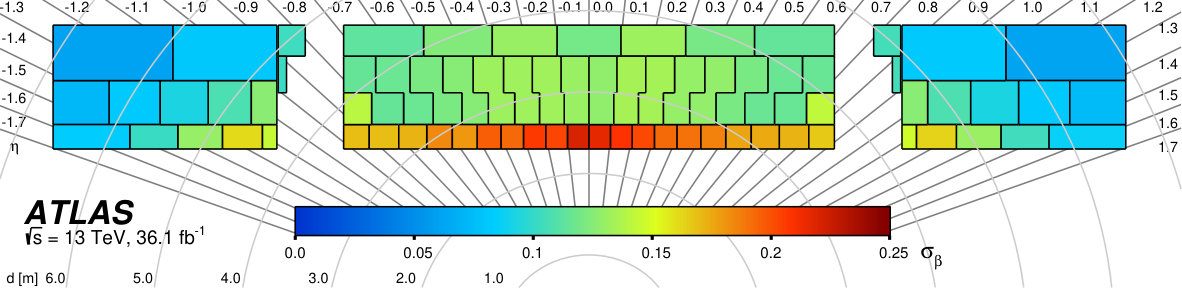 Figure 1
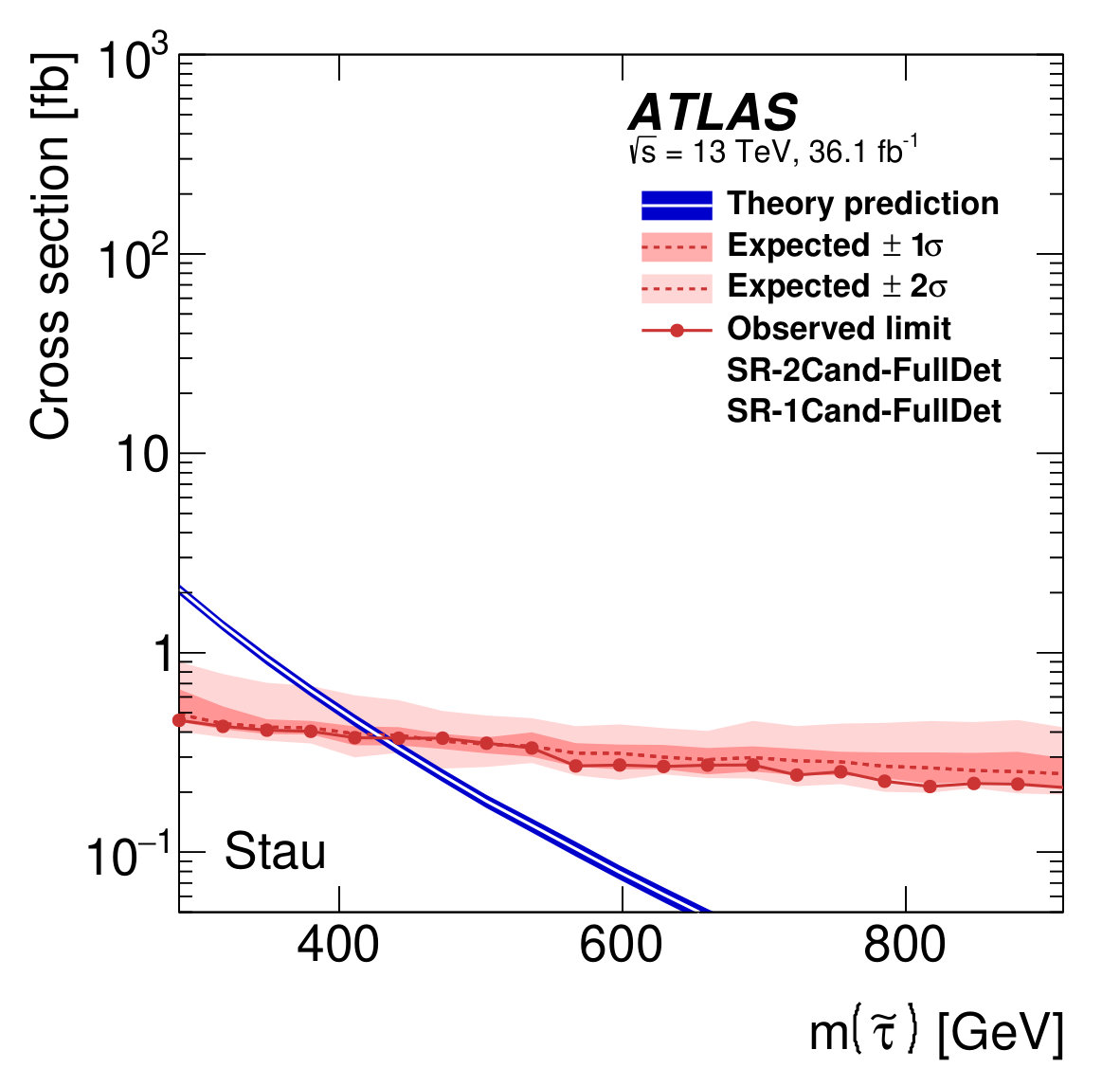 Figure 10
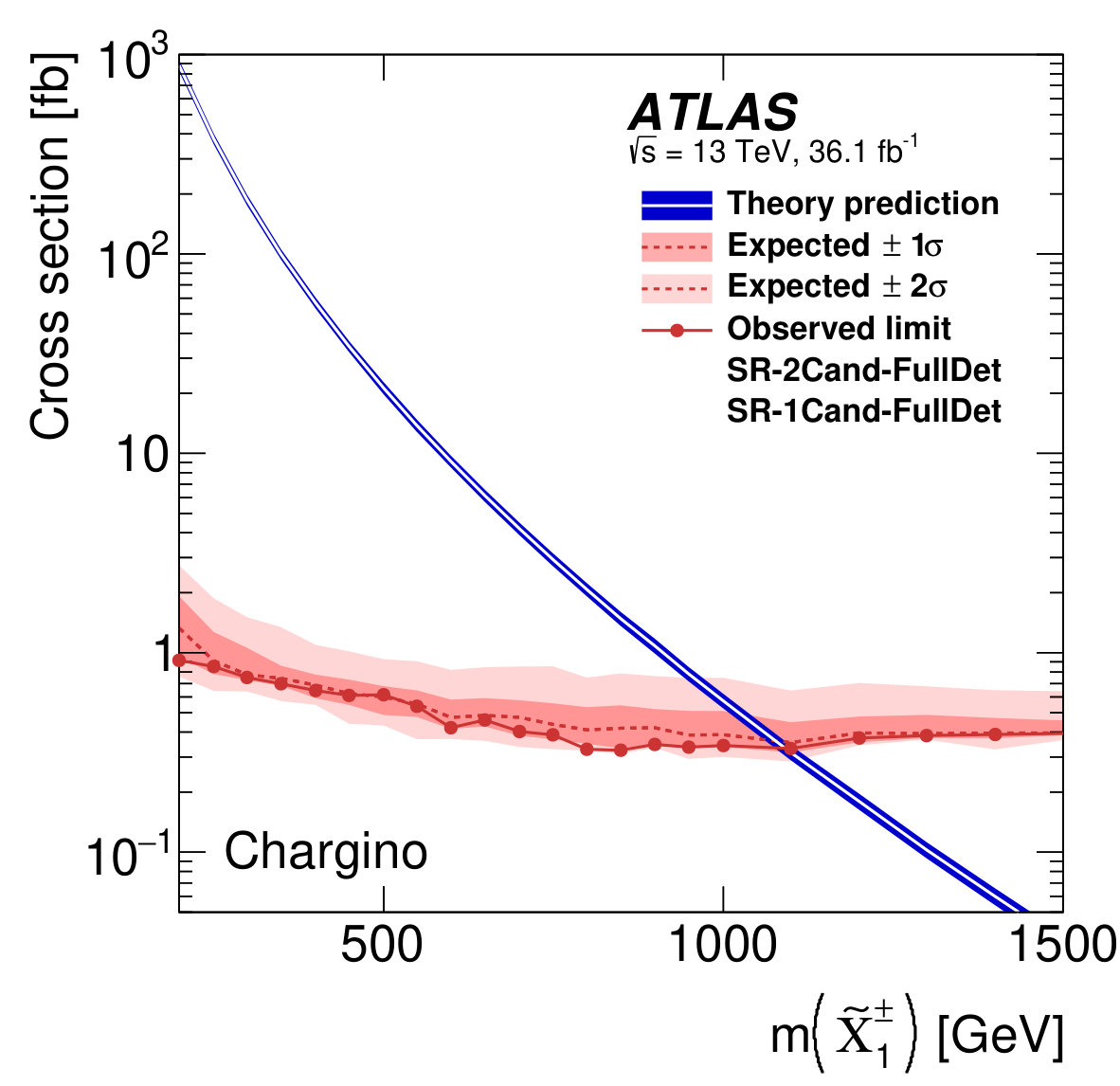 Figure 10
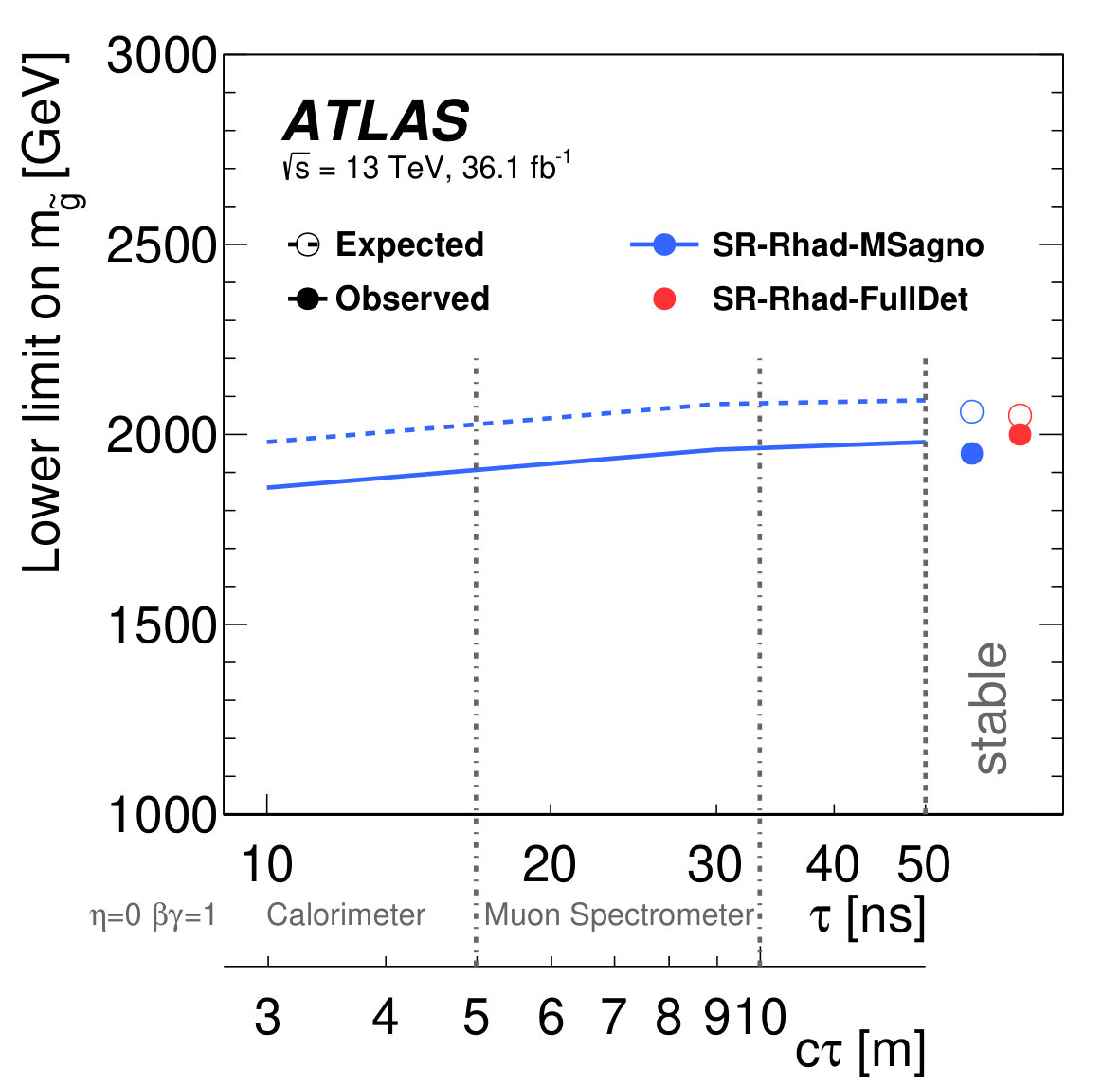 Figure 11
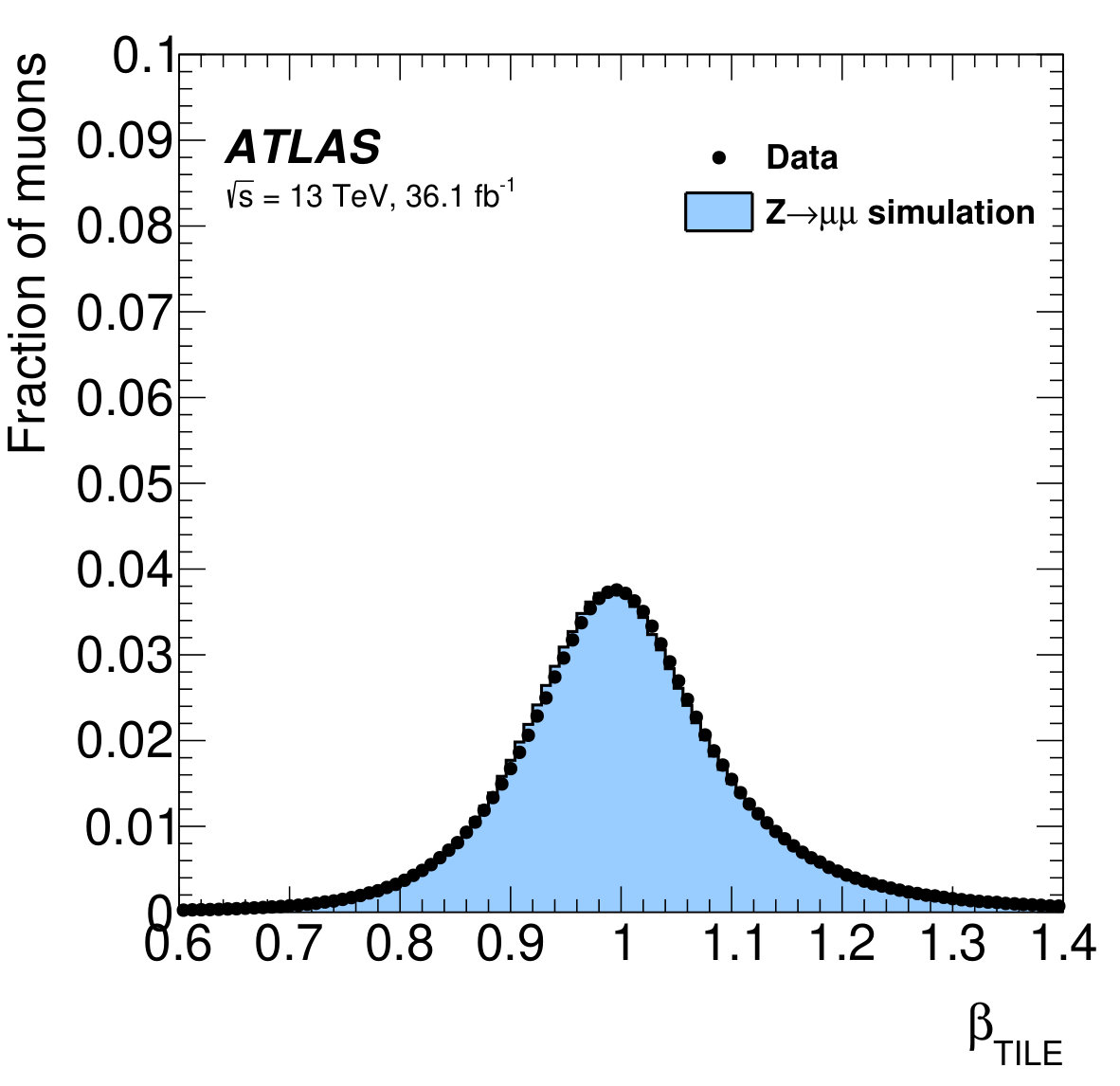 Figure 2
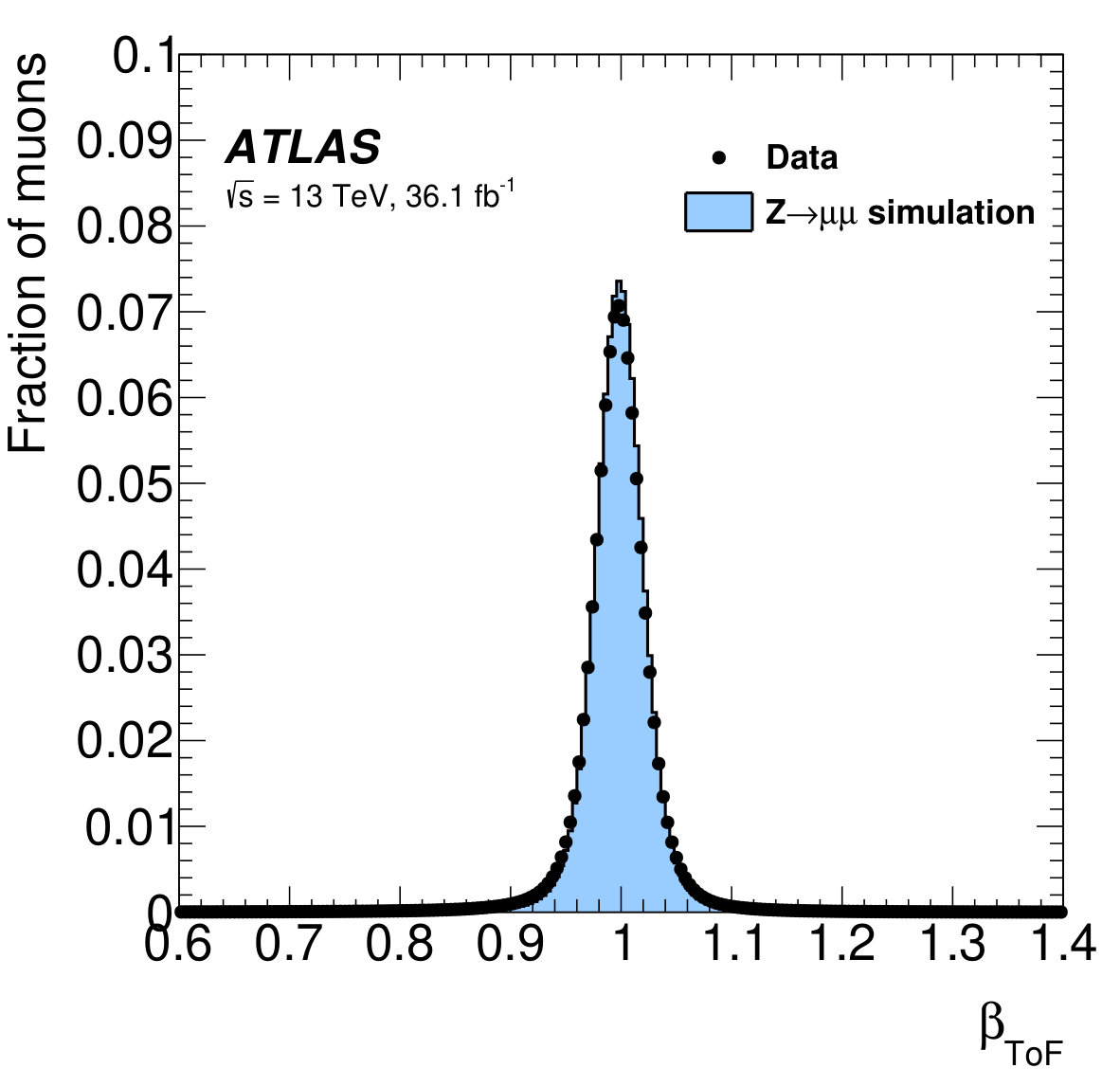 Figure 2
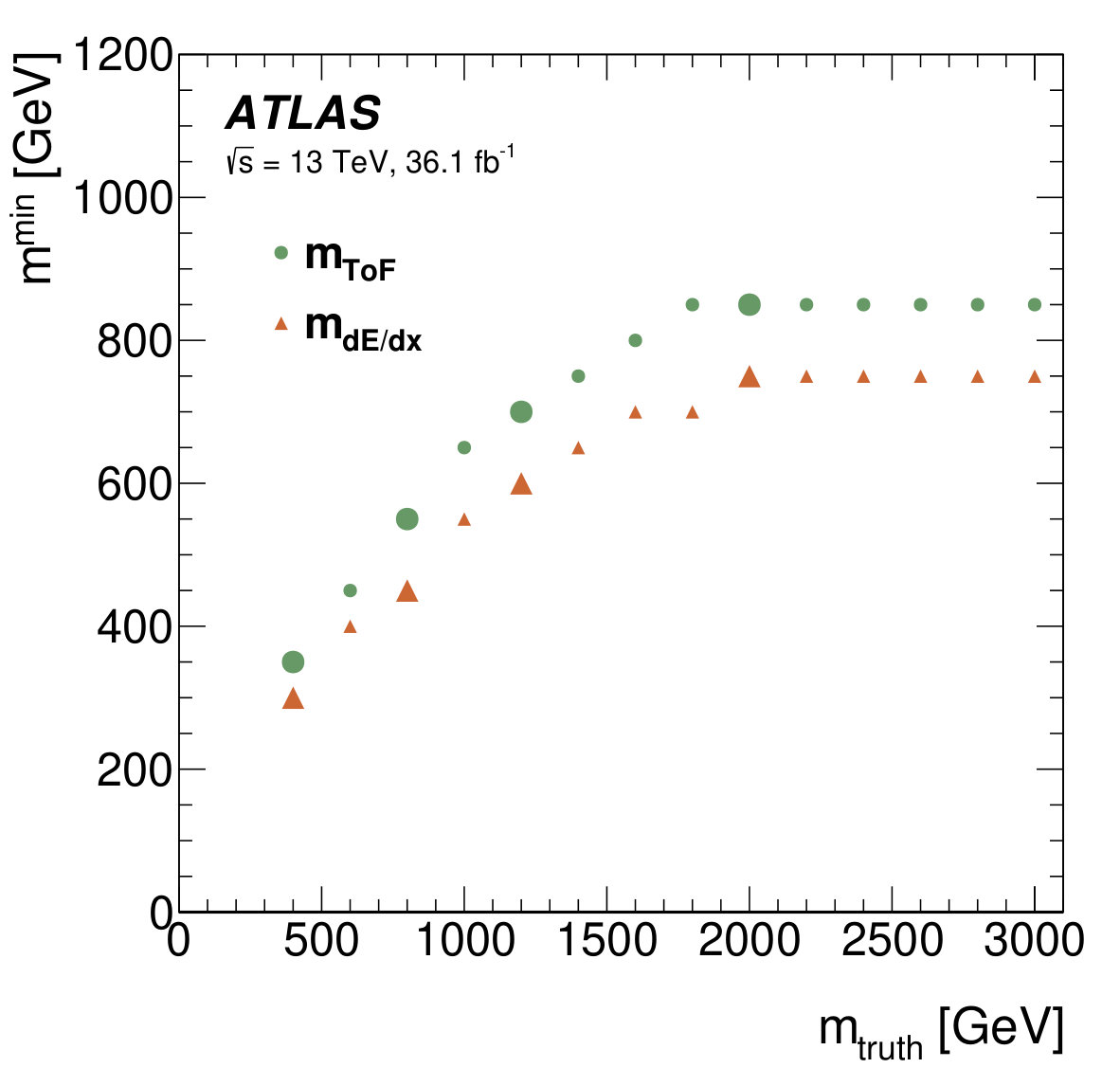 Figure 3
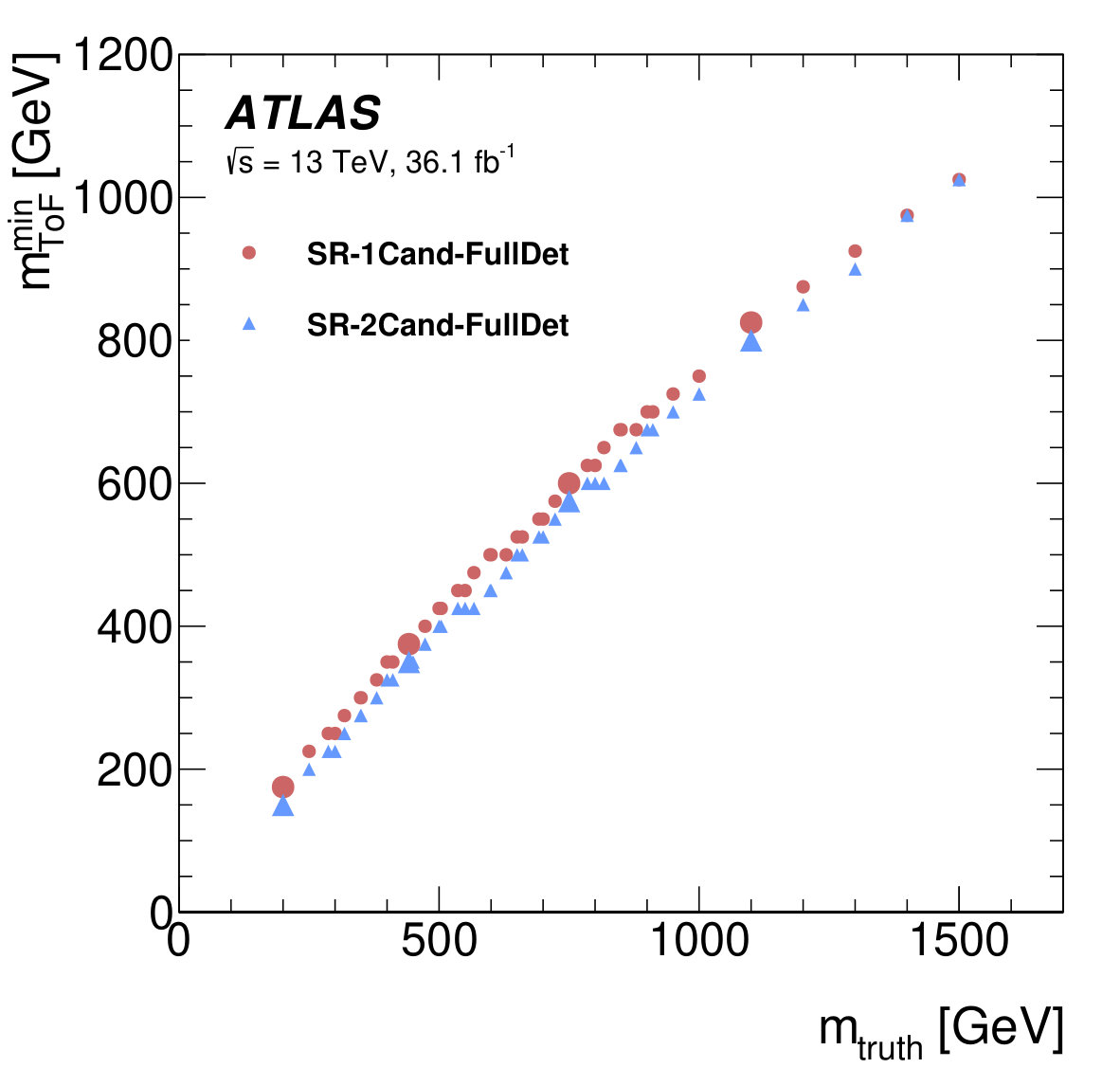 Figure 3
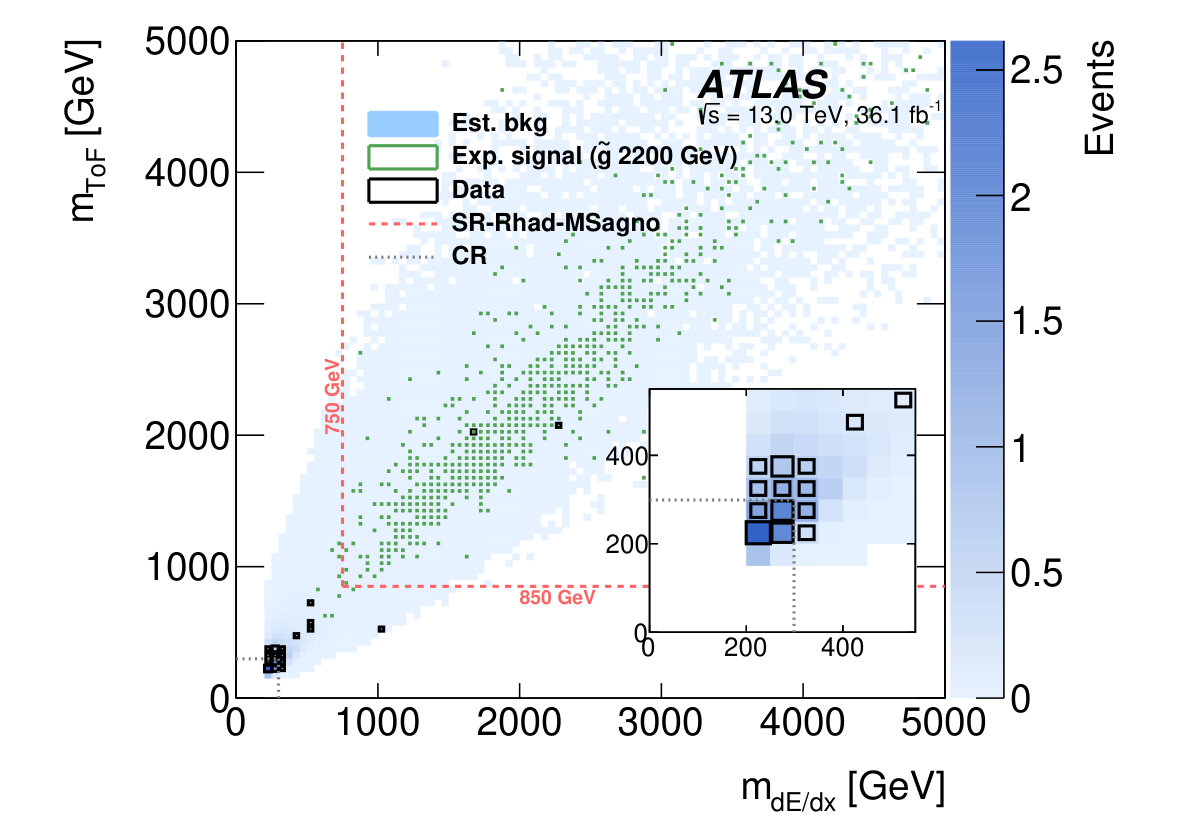 Figure 4
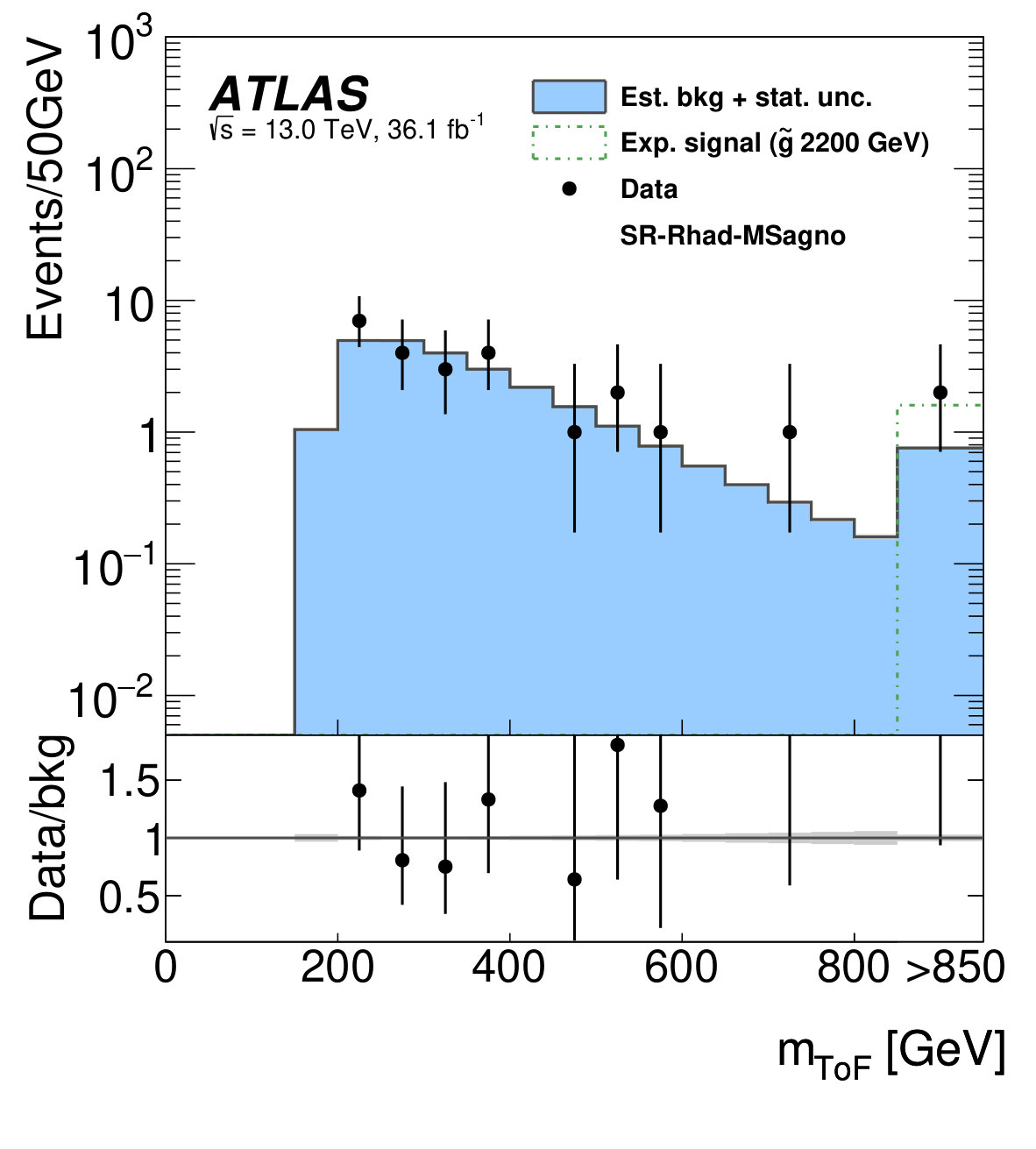 Figure 4
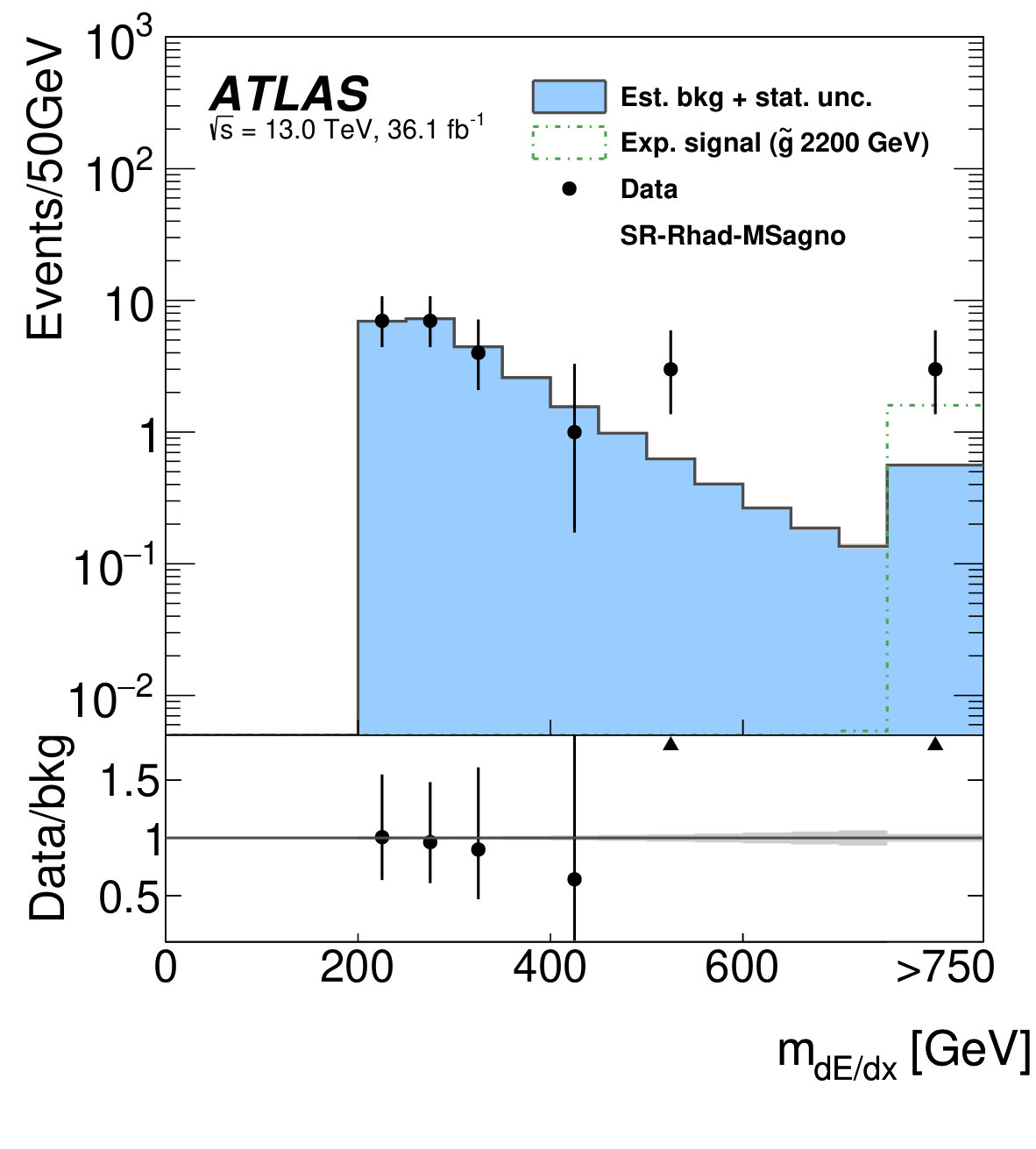 Figure 4
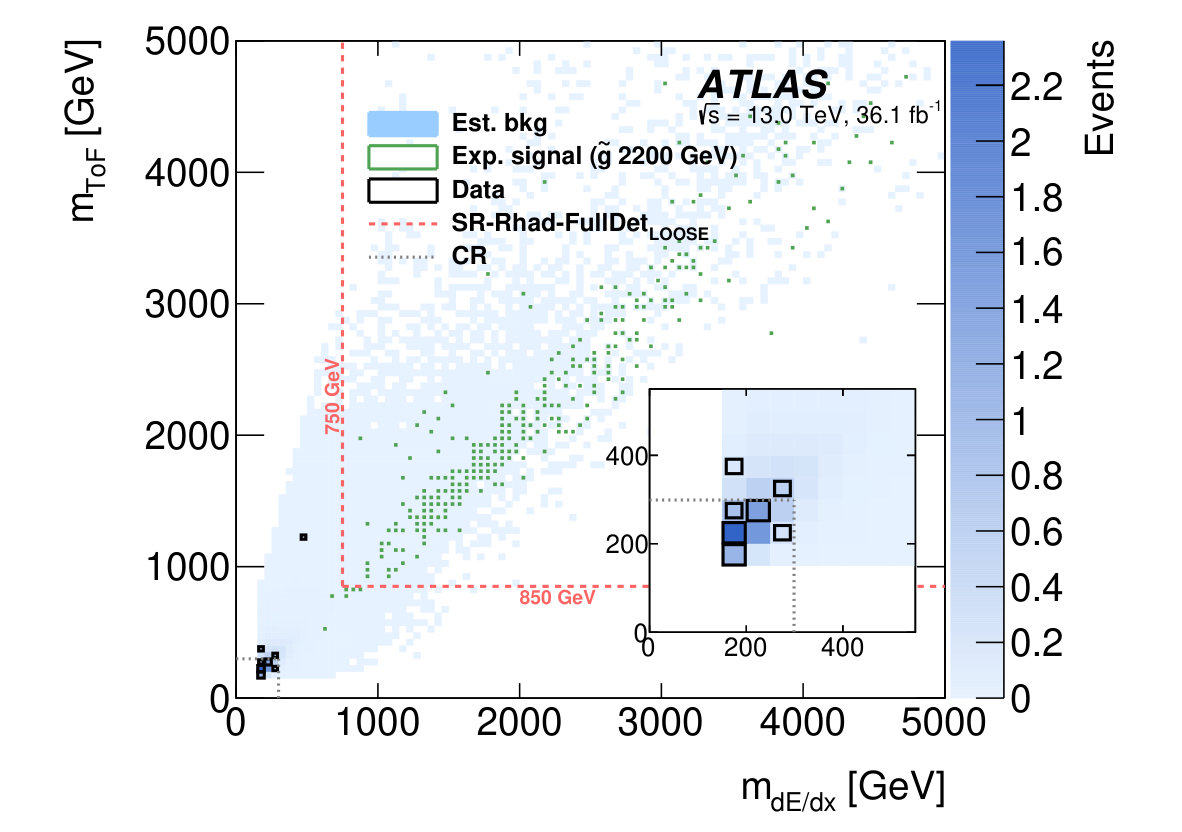 Figure 5
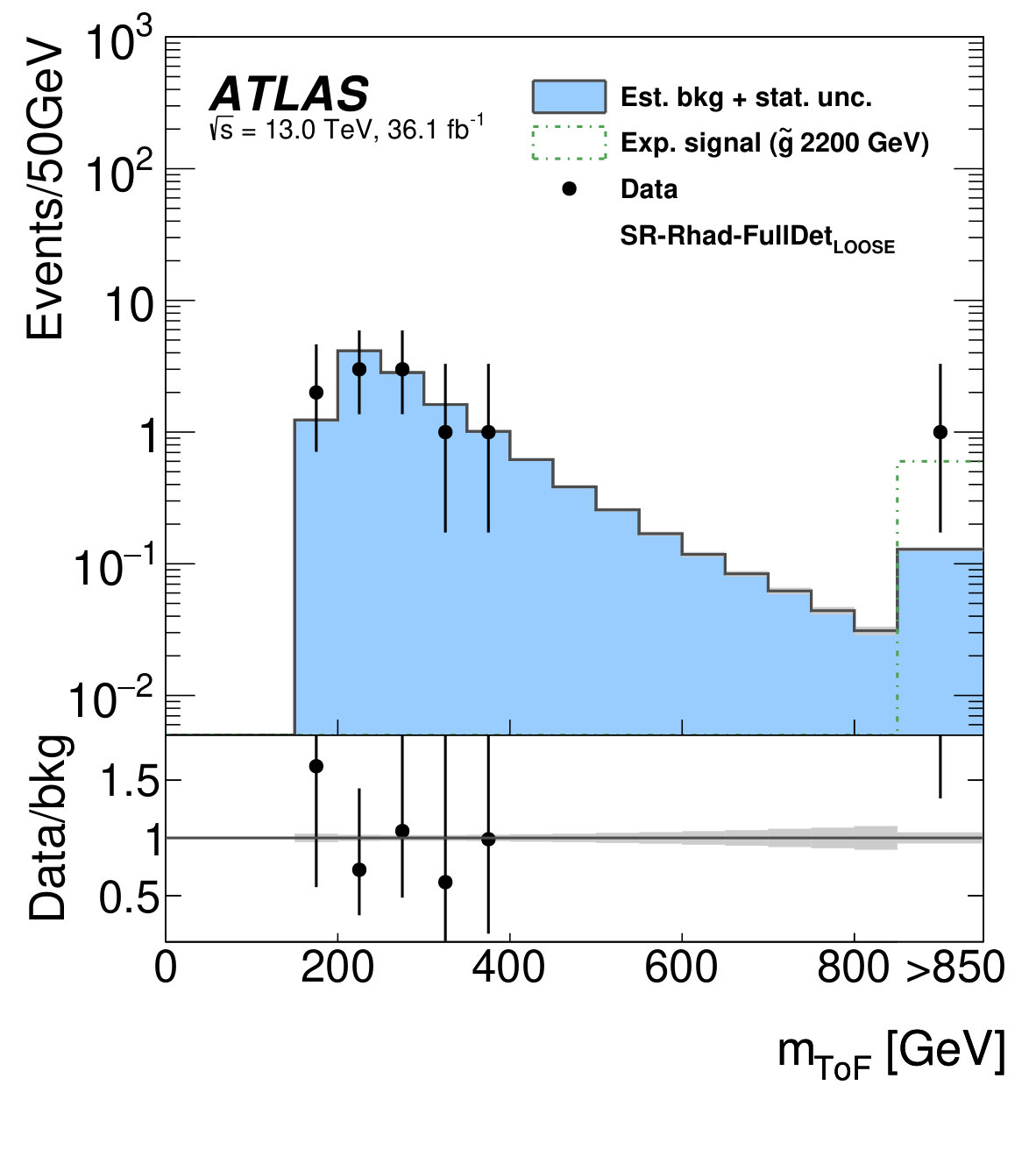 Figure 5
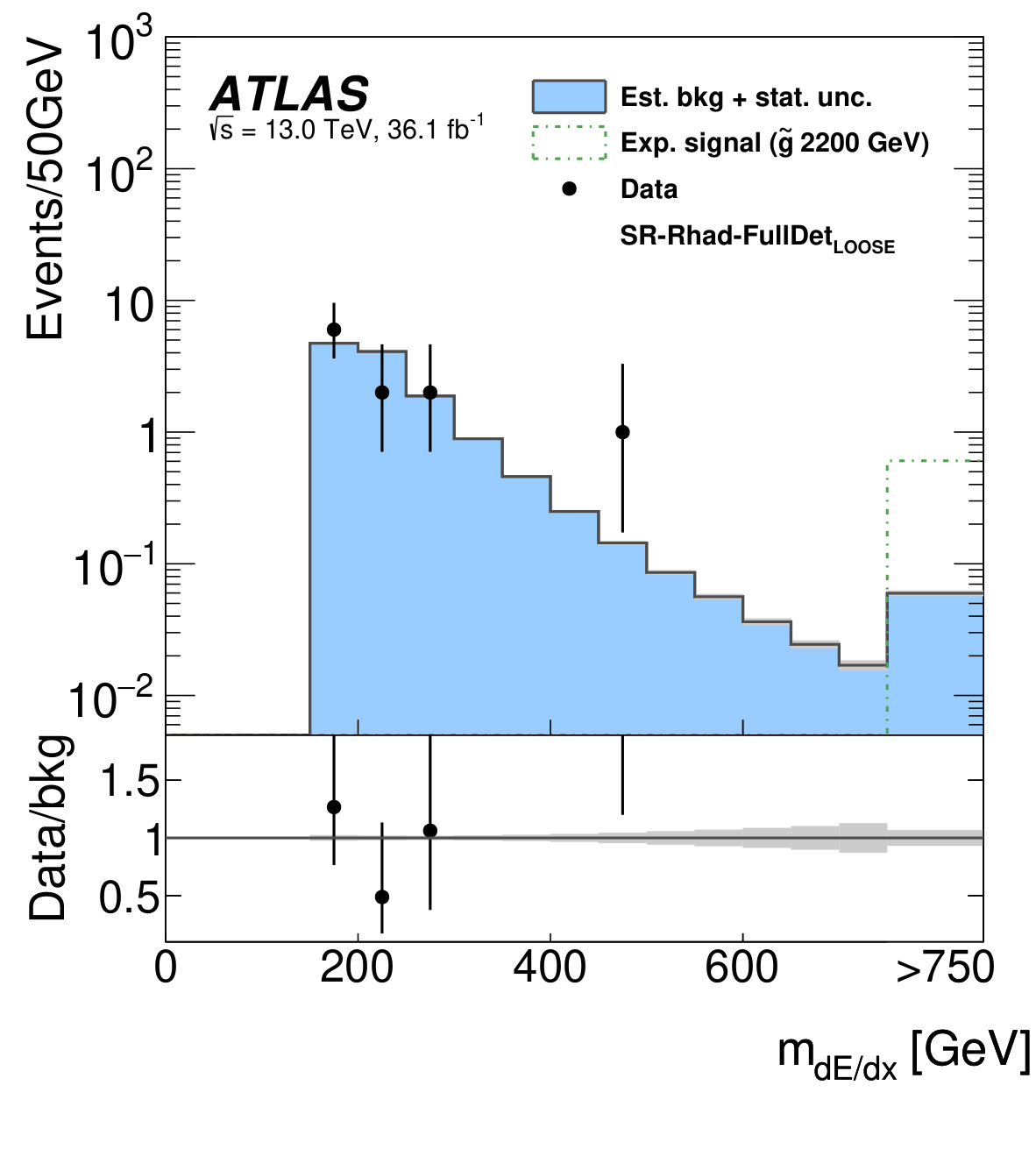 Figure 5
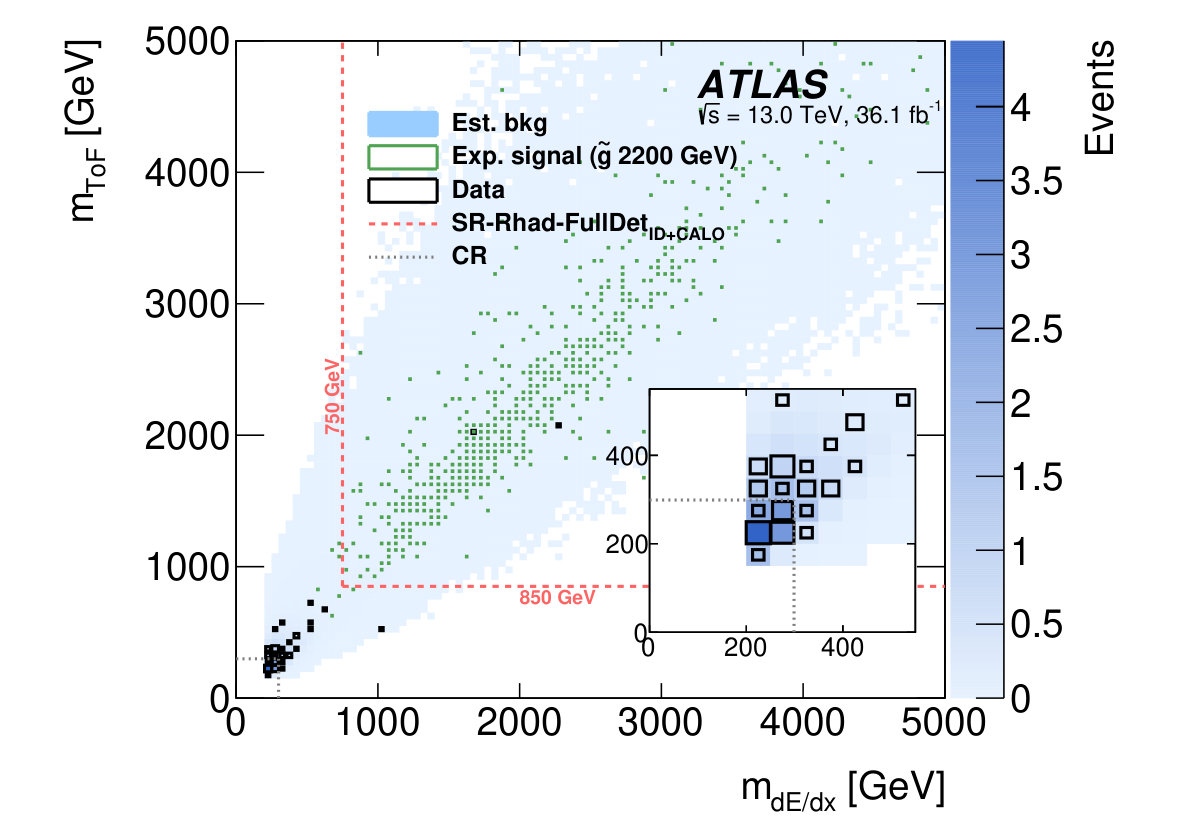 Figure 6
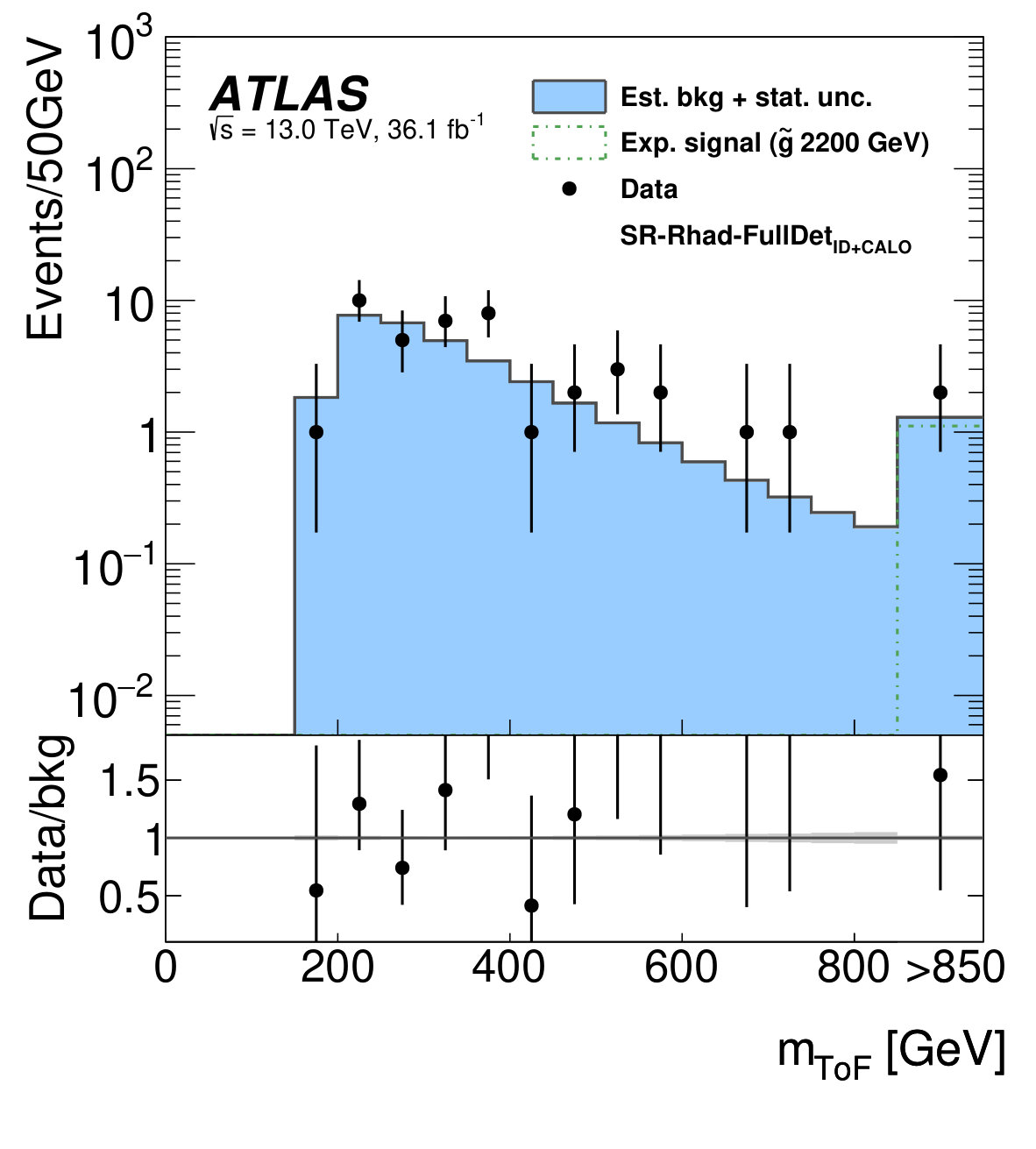 Figure 6
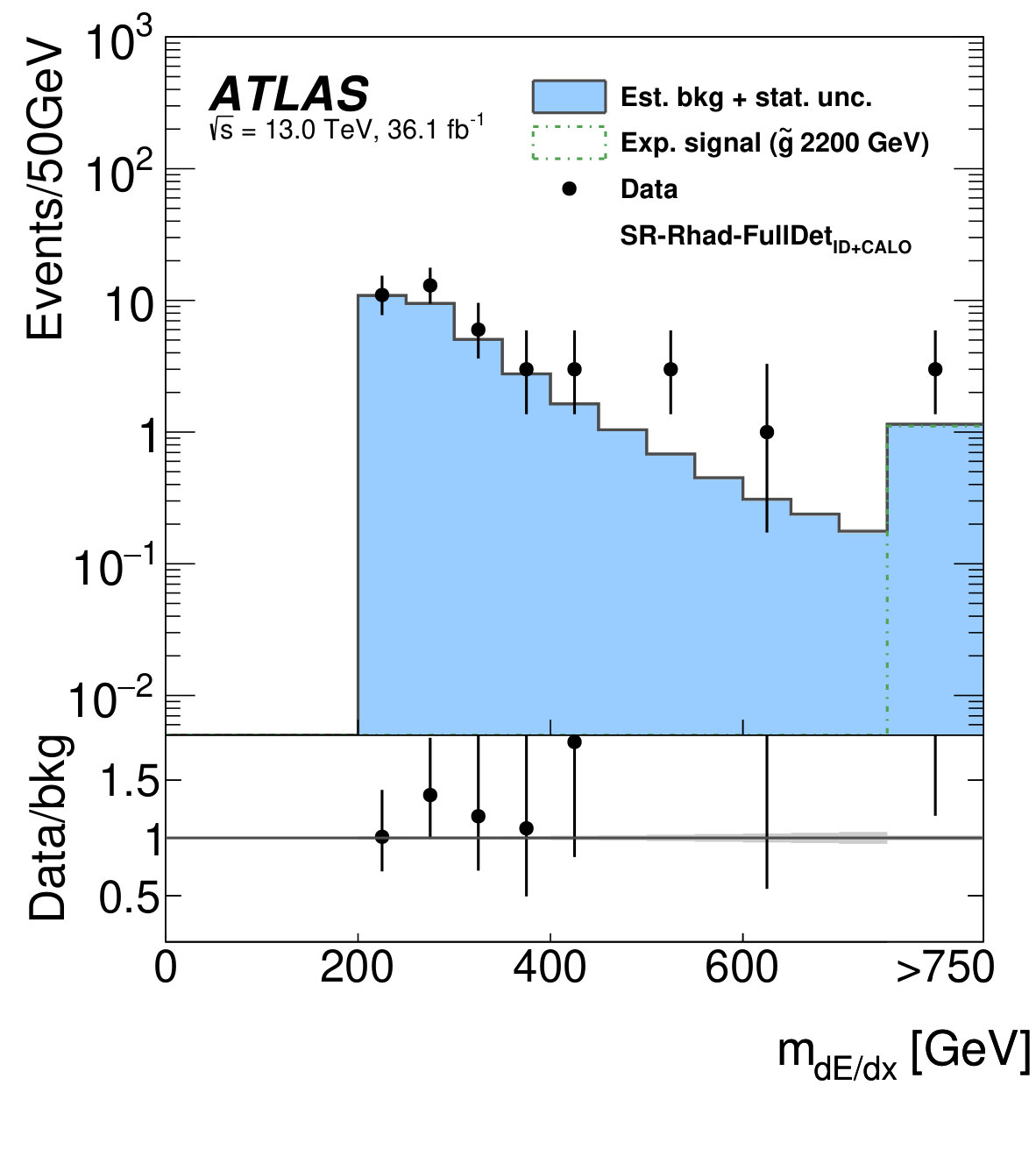 Figure 6
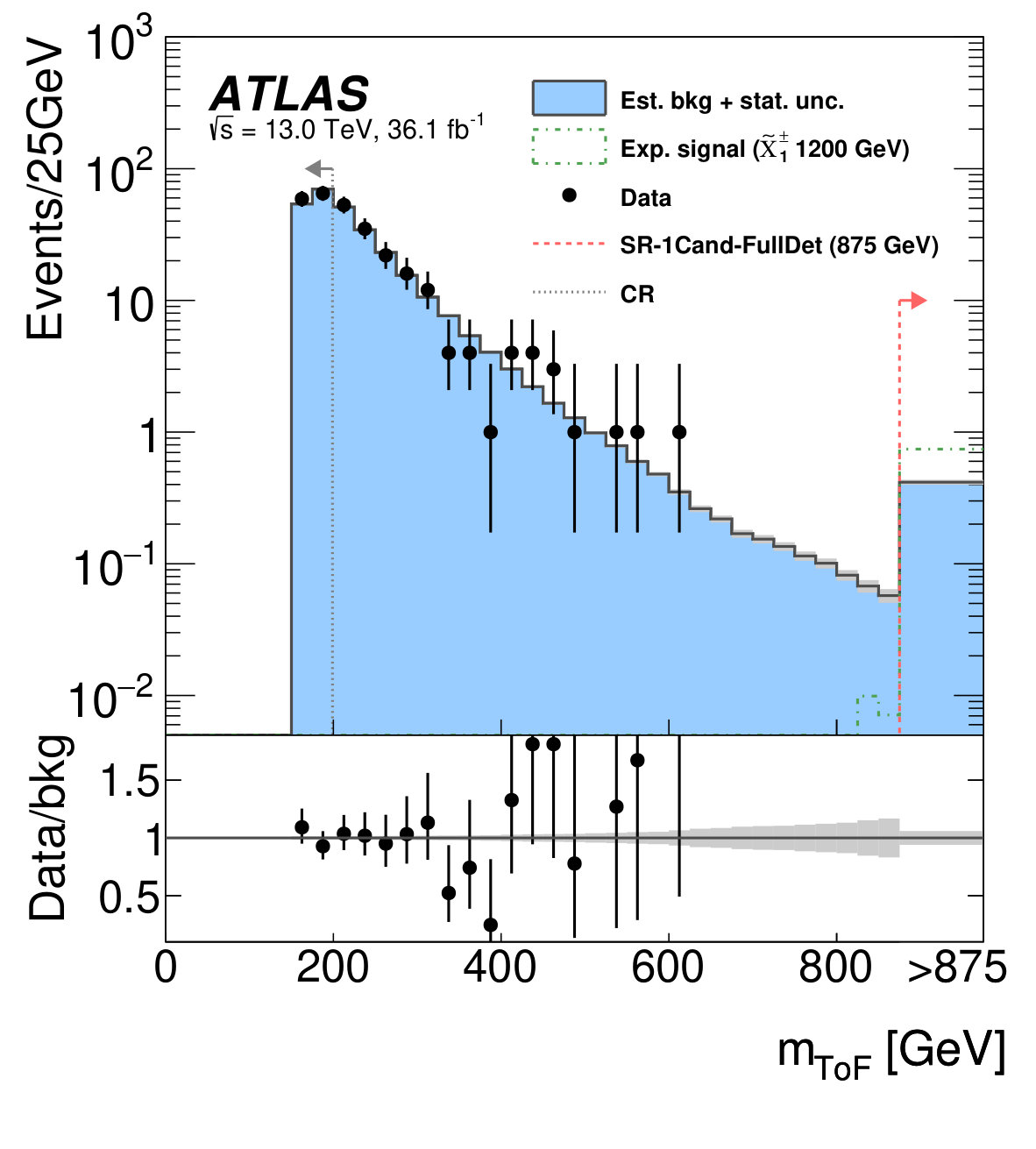 Figure 7
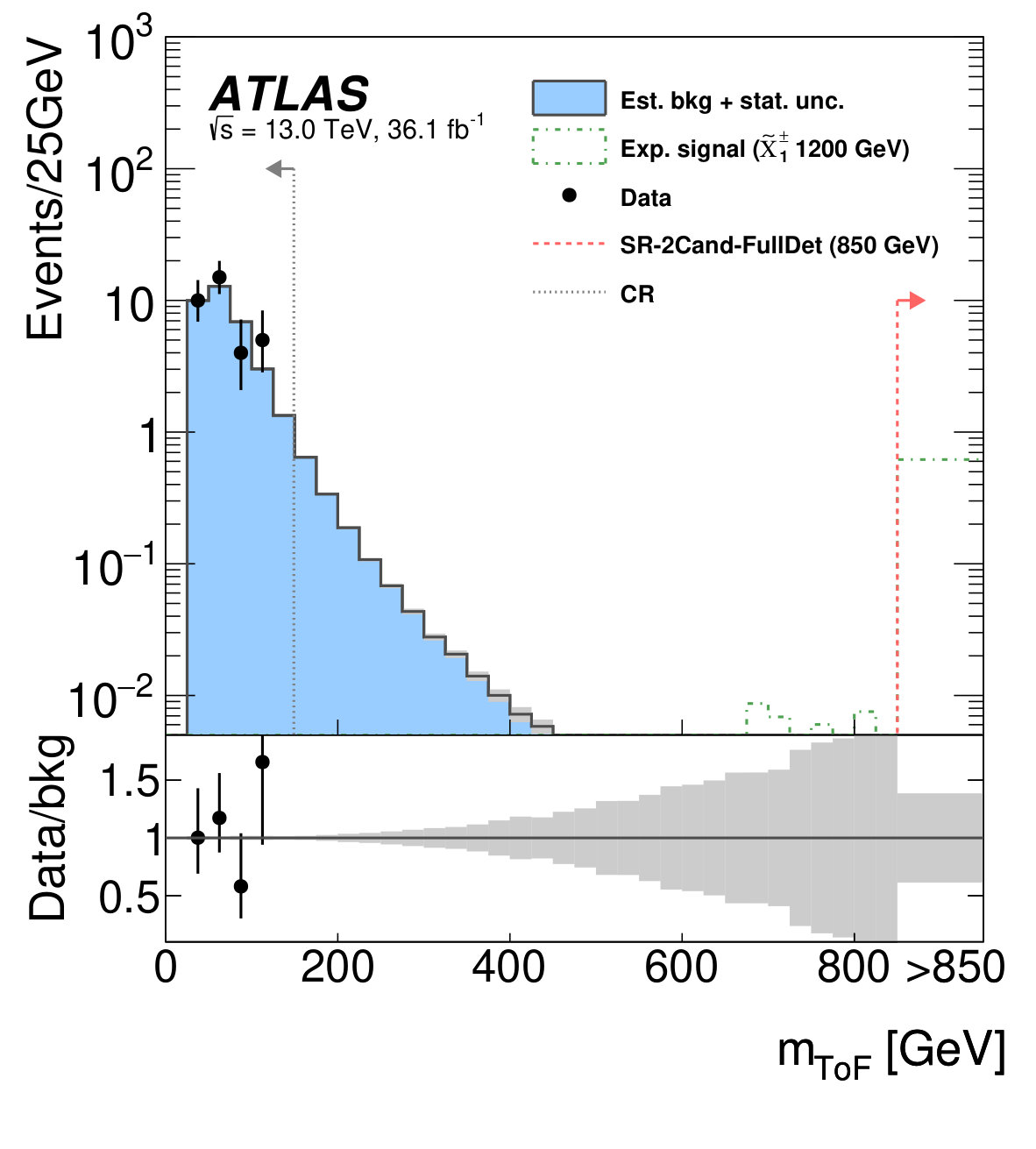 Figure 7
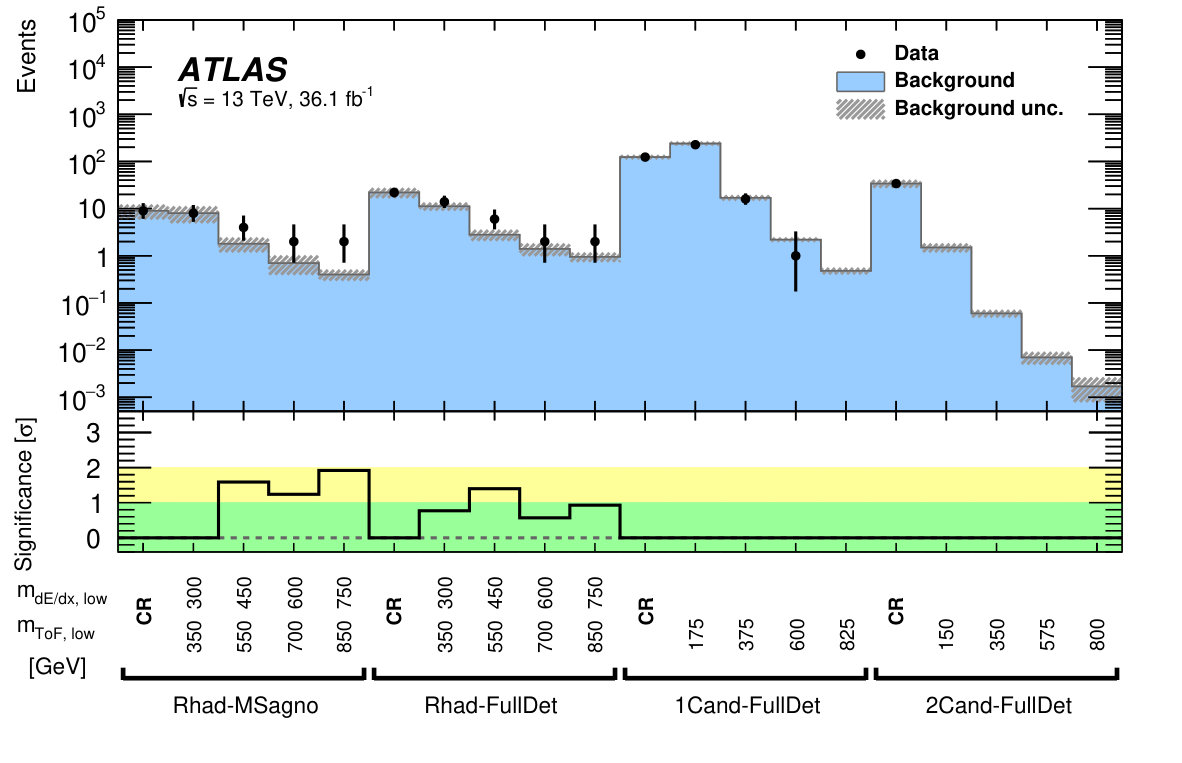 Figure 8
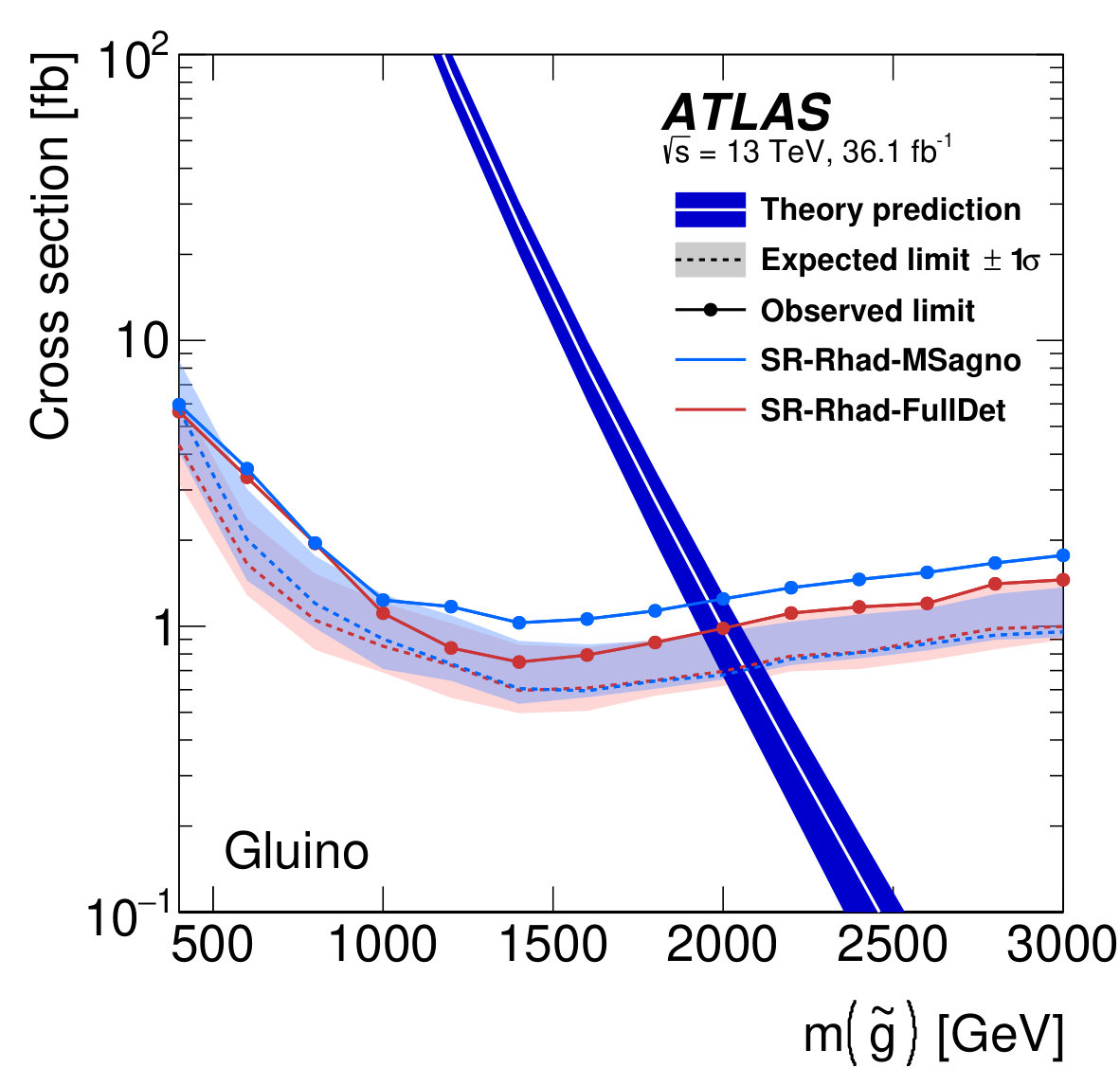 Figure 9
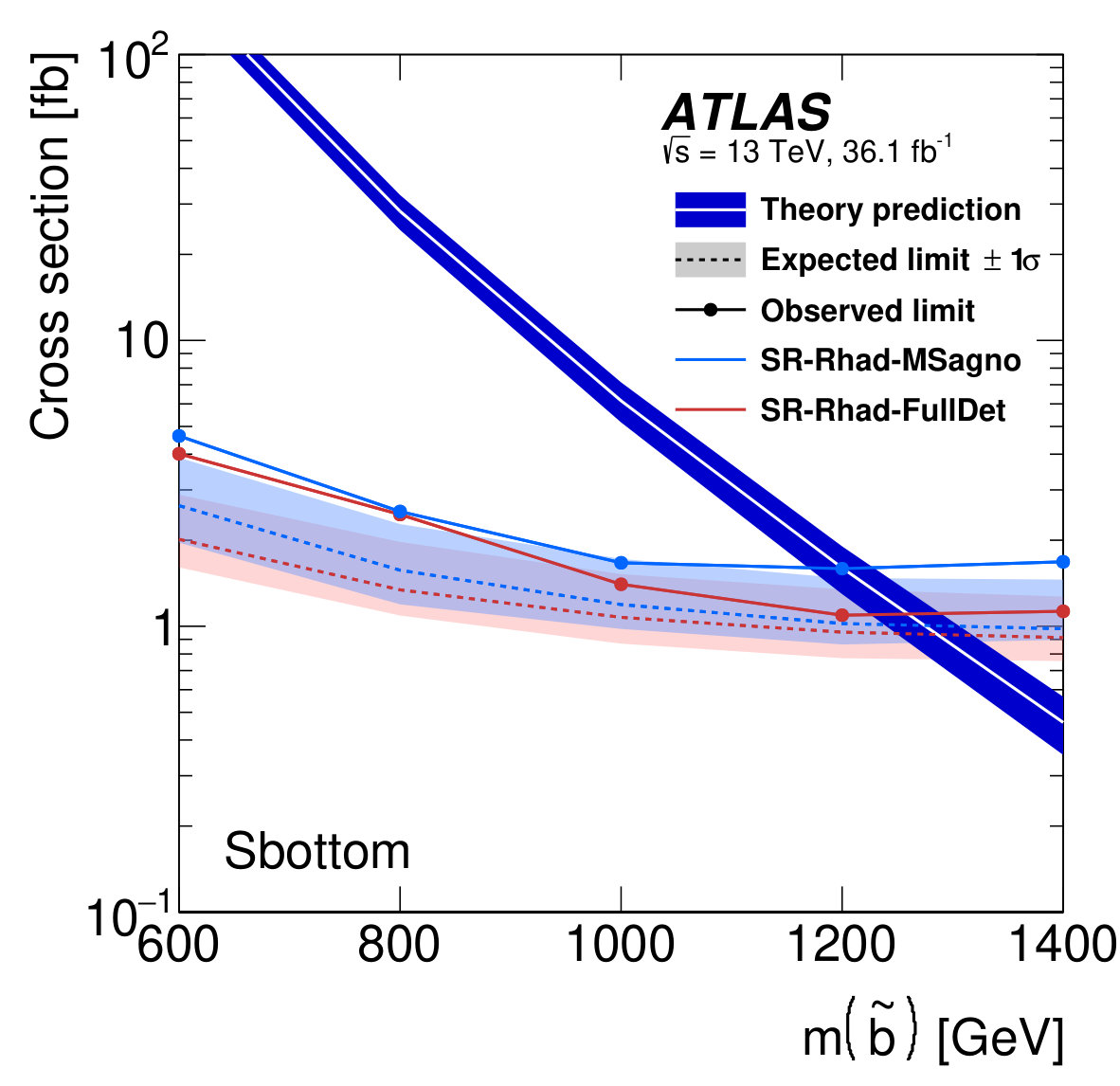 Figure 9
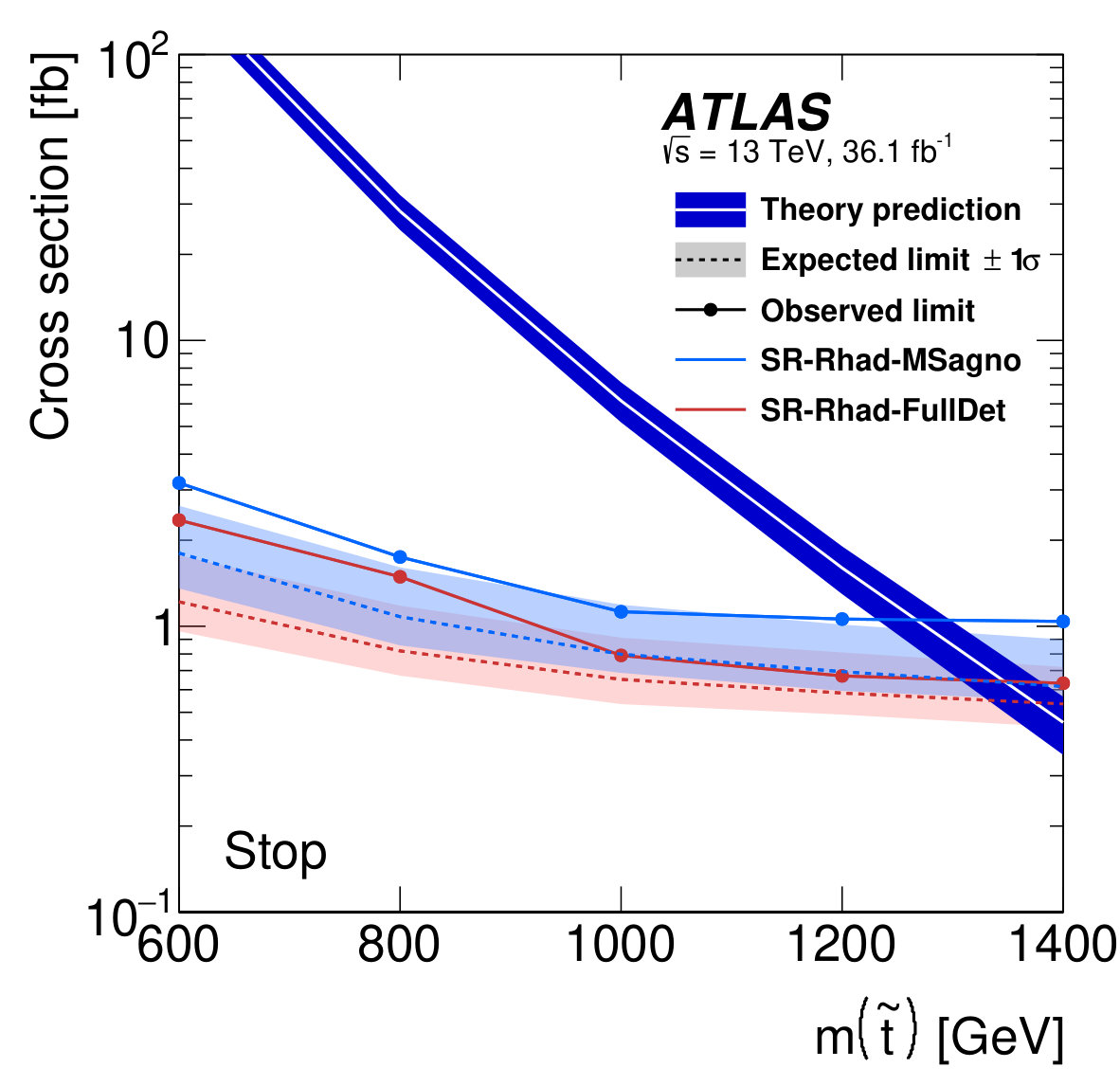 Figure 9
| Signal region | Trigger | Candidate | Candidates | Final requirements | ||||
| selection | per event | [ ] | Mass | |||||
| SR-Rhad-MSagno | id+calo | ToF & | ||||||
| SR-Rhad-FullDet | / | loose | ToF & | |||||
| SR-Rhad-FullDet | / | id+calo | ToF & | |||||
| SR-2Cand-FullDet | / | loose | - | ToF | ||||
| SR-1Cand-FullDet | / | tight | - | ToF | ||||
| Relative uncertainty [%] | ||||
| MS-agnostic | Full-detector | |||
| Source | -hadrons | -hadrons | Staus | Charginos |
| Theoretical inclusive cross section | 14–57 | 14–57 | 6–10 | 4–10 |
| Total uncertainty in signal efficiency | 17–19 | 18–30 | 7–15 | 9–18 |
| Trigger efficiency | 1.6 | 1.9 | 4.5 | 3.9 |
| 1.6 | 1.6 | 2.0 | 2.5 | |
| Single-muon | 1.0 | 4.0 | 3.0 | |
| Theoretical uncertainty (ISR/FSR) | 15 | 15 | 4 | 7 |
| Pileup | 0.2–3.8 | 0.3–5.5 | 0.1–3.1 | 0.2–4.4 |
| Full-detector track reconstruction | - | 1.7–14.8 | 0.2–12.8 | 0.8–13.0 |
| Track hit requirements | 2 | 2 | 2 | 2 |
| Pixel measurement | 6.0–11.6 | 6.0–13.0 | 0.5 | 0.5 |
| ToF measurement | 0.5–3.6 | 9.8–21.9 | 1.0–3.6 | 2.0–12.0 |
| Calorimeter measurement | 0.1–0.5 | 0.1–1.1 | 0.1–0.5 | 0.1–0.5 |
| Calorimeter OFA correction | 0.4–3.6 | 1.2–3.1 | 0.1–0.4 | 0.1–1.3 |
| MS measurement | - | 9.7–21.7 | 1.0–3.5 | 2.0–12.0 |
| Luminosity | 2.1 | 2.1 | 2.1 | 2.1 |
| Uncertainty in background estimate | 33–34 | 27–53 | 9–31 | 9–34 |
| SR-Rhad-MSagno (id+calo) | |||||||
|---|---|---|---|---|---|---|---|
| -hadron |
|
||||||
| Gluino | |||||||
| Sbottom | |||||||
| Stop | |||||||
| SR-Rhad-FullDet (loose) | SR-Rhad-FullDet (id+calo) | ||||||||||
|---|---|---|---|---|---|---|---|---|---|---|---|
| -hadron |
|
||||||||||
| Gluino | |||||||||||
| Sbottom | |||||||||||
| Stop | |||||||||||
| Lower mass requirements | |||||||||
|---|---|---|---|---|---|---|---|---|---|
| Selection | [ ] | [ ] | Significance [] |
|
|||||
| SR-Rhad-MSagno | |||||||||
| SR-Rhad-FullDet | |||||||||
| SR-1Cand-FullDet | |||||||||
| SR-2Cand-FullDet | |||||||||
| Gluino -hadron | SR-Rhad-MSagno (id+calo) | |||||||||
|---|---|---|---|---|---|---|---|---|---|---|
| Lifetime | 10 ns | 30 ns | 50 ns | |||||||
|
||||||||||
| SR-2Cand-FullDet | SR-1Cand-FullDet | |||||||||
|---|---|---|---|---|---|---|---|---|---|---|
|
||||||||||
| SR-2Cand-FullDet | SR-1Cand-FullDet | |||||||||
|---|---|---|---|---|---|---|---|---|---|---|
|
||||||||||
Peer Reviews
No public reviews on file for this paper yet. If you reviewed it on a platform where reviews are public (OpenReview, ICLR, NeurIPS, ICML), you can paste yours below so the community can read it here.
Videos
No videos yet. Explain this paper in a talk, walkthrough, or lecture? Add one.
\xspaceaddexceptions
]}
\AtlasTitleSearch for heavy charged long-lived particles in the ATLAS detector in 36.1 fb*-1* of proton–proton collision data at
\AtlasRefCodeSUSY-2016-32 \PreprintIdNumberCERN-EP-2018-339 \AtlasDate \AtlasJournalPhys. Rev. D \AtlasJournalRefPhys. Rev. D 99 (2019) 092007 \AtlasDOIDOI:10.1103/PhysRevD.99.092007 \AtlasAbstractA search for heavy charged long-lived particles is performed using a data sample of 36.1 fb*-1* of proton–proton collisions at collected by the ATLAS experiment at the Large Hadron Collider. The search is based on observables related to ionization energy loss and time of flight, which are sensitive to the velocity of heavy charged particles traveling significantly slower than the speed of light. Multiple search strategies for a wide range of lifetimes, corresponding to path lengths of a few meters, are defined as model-independently as possible, by referencing several representative physics cases that yield long-lived particles within supersymmetric models, such as gluinos/squarks (-hadrons), charginos and staus. No significant deviations from the expected Standard Model background are observed. Upper limits at 95% confidence level are provided on the production cross sections of long-lived -hadrons as well as directly pair-produced staus and charginos. These results translate into lower limits on the masses of long-lived gluino, sbottom and stop -hadrons, as well as staus and charginos of 2000 , 1250 , 1340 , 430 and 1090 , respectively.
1 Introduction
The search for heavy charged long-lived particles presented in this paper is based on a data sample of 36.1 fb*-1* of proton–proton () collisions at collected in 2015 and 2016. It utilizes observables related to large ionization energy loss () and time of flight (ToF), which are signatures of heavy charged particles traveling significantly slower than the speed of light. The mass of the particles is estimated using the () or ToF () measurements together with the reconstructed momentum. The background is estimated in a purely data-driven manner, and multiple signal regions are defined to address the different possible signatures of heavy long-lived particles (LLPs) that reach at least the ATLAS hadronic calorimeter, which corresponds to decay lengths of a few meters. Previous searches for LLPs that are stable within the detector were performed by the CMS Collaboration using 2.5 fb*-1* of data at 13 [1], as well as by the ATLAS Collaboration using 3.2 fb*-1* of data at 13 [2] and 19.8 fb*-1* of data at 8 [3].
LLPs are predicted in a variety of theories that extend the Standard Model (SM) [4]. Theories with supersymmetry (SUSY) [5, 6, 7, 8, 9, 10], which either violate [11, 12, 13] or conserve [14, 4, 15, 16, 17, 18, 19] -parity, allow for the existence of charged long-lived sleptons (), squarks (), gluinos () and charginos ().
Colored LLPs (e.g. and ) would hadronize forming so-called -hadrons [14], which are bound states composed of the LLP and light SM quarks or gluons, and may emerge from the collision as charged or neutral states. Through hadronic interactions of the light-quark constituents with the detector material, especially inside the calorimeters, -hadrons can change to states with a different electric charge. Thus they might not be reconstructed as a consistently charged track in the inner tracking detector (ID) and in the muon spectrometer (MS), even if the lifetime is long enough to traverse the entire detector. Searches for -hadrons are performed following two different approaches: using all available detector information (“full-detector -hadron search”), or disregarding all information from the muon spectrometer (“MS-agnostic -hadron search”) to minimize the dependence on the modeling of -hadron interactions with the material of the detector. Long-lived gluinos are motivated for example by split-SUSY models [18, 19], in which high-mass squarks can lead to very long gluino lifetimes. Long-lived squarks, in particular a light top squark (stop) as the next-to-lighest SUSY particle, is motivated for example by electroweak baryogenesis [20, 21], where non-universal squark mass terms can lead to a small mass difference between the stop and the neutralino as the lightest supersymmetric particle (LSP), and the lightest chargino is heavy, leading to suppressed radiative decays and long stop lifetimes.
If the charged LLP does not interact hadronically, it would predominantly lose energy via ionization as it passes through the ATLAS detector. Searches for long-lived charginos and sleptons (focusing on staus, as they are expected in most models to be the lightest) identified in both the ID and MS are therefore performed. The searches for staus are motivated by gauge-mediated SUSY breaking (GMSB) [22, 23, 24, 25, 26, 27, 15] assuming the LSP to be a gravitino and with the light stau () as an LLP, decaying to a -lepton and a gravitino with an unconstrained lifetime. While essentially all events in the GMSB models that include long-lived staus involve cascade decays that end in two LLPs, in this paper direct di-stau production through a Drell–Yan process is taken as a benchmark. Results for pair-produced charginos are motivated by a minimal anomaly-mediated supersymmetry breaking (mAMSB) model, where often the supersymmetric partners of the SM -boson fields, the wino fermions, are the lightest gaugino states. In this particular case, the lightest of the charged mass eigenstates, a chargino, and the lightest of the neutral mass eigenstates, a neutralino, are both almost pure wino and nearly mass-degenerate, resulting in long-lived charginos (see Refs. [28, 29] for details).
This paper is organized as follows. A brief description of the ATLAS detector is given in Section 2 with emphasis on the parts relevant for this analysis, followed by details of the calibration of key observables in Section 3. The dataset and simulated event samples and the subsequent event selection are described in Sections 4 and 5, respectively. Section 6 explains the method of background estimation and compares these estimates with data. Section 7 details the origin and estimation of systematic uncertainties. The results including upper cross-section limits are shown in Section 8, and finally the conclusions are summarized in Section 9.
2 ATLAS detector
The ATLAS detector [30] is a multipurpose particle detector consisting of the ID immersed in a 2 T solenoidal magnetic field, electromagnetic as well as hadronic calorimeters and a MS based on three large air-core toroid superconducting magnets with eight coils each. The ID comprises a silicon pixel detector, a silicon microstrip detector (SCT) and a transition-radiation tracker. With almost coverage in solid angle,111ATLAS uses a right-handed coordinate system with its origin at the nominal interaction point (IP) in the center of the detector and the -axis coinciding with the axis of the beam pipe. The -axis points from the IP to the center of the LHC ring, and the -axis points upward. Cylindrical coordinates (, ) are used in the transverse plane, being the azimuthal angle around the beam pipe. The pseudorapidity is defined in terms of the polar angle as . Object distances in the – plane are given by . the ATLAS detector is sensitive to the missing transverse momentum associated with each event. Several components are used to determine either or ToF in this search and are discussed in more detail below.
The innermost component of the ATLAS detector is the pixel detector, consisting of four radial layers of pixel-sensors in the barrel region and three disks on each side in the endcap region. The pixel detector measures the ionization energy loss of charged particles traversing it via a time-over-threshold (ToT) technique [31].
The ATLAS calorimeter in the central detector region consists of a liquid-argon electromagnetic calorimeter followed by a steel-absorber scintillator-tile sampling calorimeter. The latter serves as hadronic calorimeter covering the region up to . In the -direction the tile calorimeter is segmented into 64 wedges with a size of . In the – plane it is formed by three radial layers in the central barrel region and three in an extended barrel on each side, where each layer is further segmented into cells. The cells in the first and third layer in the barrel and in all layers in the extended barrel have a rectangular shape, while in the second layer of the barrel they are composed of two shifted rectangles (see Figure 1). Overall, the tile calorimeter consists of 73 cells in 64 -segments resulting in 4672 individual cells. The Optimal Filtering Algorithm (OFA) [32] used for the readout provides, besides a precise measurement of the energy deposits of particles and jets, a timing measurement. The resolution of the single-cell timing in the tile calorimeter is 1.3–1.7 ns.
The outermost part of the ATLAS detector is the MS. Immersed in toroidal magnetic fields, the MS provides particle tracking and momentum reconstruction for charged particles with , as well as triggering information in the range . Three layers of muon detectors are arranged in concentric shells at distances between 5 m and 10 m from the interaction point (IP) in the barrel region, and in wheels perpendicular to the beam axis at distances between 7.4 m and 21.5 m in the endcap regions where . Four different detector technologies are used in the MS. In the barrel region the muon trigger relies on resistive-plate chambers (RPCs), while thin-gap chambers are employed in the endcap wheels. High-precision tracking for the momentum measurements is performed by monitored drift tubes (MDTs), except for the innermost layer in the forward region of , where cathode-strip chambers are installed. A muon traversing the detector in the barrel region typically has around 20 hits in the MDTs and 14 hits in the RPCs. Both systems exhibit a sufficiently precise single-hit timing resolution (MDTs 3.2 ns, RPCs 1.8 ns) to distinguish relativistic muons traveling at almost the speed of light from slowly propagating stable massive particles. For the reconstruction of slow particles traversing the full detector, a dedicated tracking algorithm that treats the velocity as a free parameter is used [33, 34].
The ATLAS trigger system [35] consists of a hardware-based level-1 trigger followed by a software-based high-level trigger, which runs reconstruction and calibration software similar to the offline reconstruction, and reduces the event rate to about 1 kHz.
3 Calibration of main observables
To achieve optimal identification performance for heavy, charged, LLPs, measurements of the specific ionization energy loss and ToF have to be calibrated.
The pixel detector provides measurements of specific ionization energy losses. The is corrected for -dependence and on a run-by-run basis, to reduce the effect of the degradation of charge collection in the silicon sensor due to accumulated irradiation. Individual measurements resulting from a particle traversing the detector are combined in a truncated mean to reduce the effects of the Landau tails on the estimate of the most probable value (MPV). Finally, a value of the of the particle is estimated from the MPV and the momentum, using a three-parameter empirical function, calibrated using protons, kaons and pions with low transverse momentum (). The expected resolution for from the and momentum measurement is about 14%, which is taken as the uncertainty in the measured values. A detailed description of the estimation using the pixel detector can be found in Ref. [31].
The particle velocity, , is determined via ToF measurements in the tile calorimeter, the MDTs and the RPCs. To ensure an optimal resolution, a series of custom calibrations is performed. High- muons are used for the calibration as, given the timing resolutions, they travel effectively at the speed of light.
For the tile calorimeter, only cells with a minimum energy deposit of 500 MeV are used. The time difference () relative to a particle traveling at the speed of light from the IP to the cell center (cell distance) is not allowed to be larger than 25 ns to reduce the effect of out-of-time pileup. As the first calibration step, a bias introduced by the OFA is corrected. The signal simulation reproduces the OFA bias reliably. The correction is very small for an in-time signal, while for late-arriving particles it ranges up to 10 ns. This is followed by a correction for the particle path in the cell. An effective spatial position corresponding to the timing measurement is estimated using an extrapolation of the particle track from the production vertex to the respective cell in the tile calorimeter (effective distance). The difference between the effective distance and the cell distance is used as a correction for the timing calibrations, while the effective distance is used for the estimation of the individual measurements of the velocity (). The corresponding correction is largest (3 ns) for the edge regions of the largest cells in the tile calorimeter, which are located in the outermost layer of the extended barrel. This is followed by separate -dependent corrections for data and simulation, which accounts for small remaining -dependences of the timing for the outer parts of the cells in data, and ensures an -independent timing measurement in simulation. Furthermore, a calibration of the timing as a function of the energy deposit per -projected cell (averaging cells of identical geometry over ) is applied, which does not exceed ns. Additionally, calibration constants in data are estimated for each cell followed by a run-by-run correction of the overall timing. These calibrations account for differences between single-tile calorimeter cells and for misalignments of the ATLAS and LHC clocks. The cell-wise calibration factors are mostly well below 1 ns, while for some cells they range up to 2 ns. The run-by-run correction constants are between ns and 0.2 ns. A smearing of the timing obtained in simulation is applied to achieve the same resolution as observed in data. The width of a Gaussian parameterization of the distribution serves as the uncertainty. The uncertainties are estimated as a function of the energy deposit per -projected cell. Finally, the uncertainties are adjusted to achieve a unit Gaussian width for the pull distribution, which gives a correction of 1% to the uncertainty. The individual measurements of , with the -projected resolutions shown in Figure 1, are combined in a weighted average using the inverse squared uncertainties as weights. The final resolution achieved for is .222The resolutions () are determined by performing a Gaussian fit to the core of the respective distributions.
For the MDTs and RPCs, each of the drift tubes and RPC readout strips is calibrated individually by performing a Gaussian parameterization of the timing information, and correcting for the offset to the expected value for a particle traveling at the speed of light. The width of the fitted distribution is taken as the uncertainty for the measurements in the respective tube/strip. The uncertainties are, in a manner similar to the tile calorimeter, adjusted to give a unit Gaussian width for the pull distributions. The corrections to the uncertainties are 16% for the MDTs, less than 1% for the RPC -strips and 2% for the -strips. The squared inverse of the uncertainty is used as a weight for the calculation of a weighted-average . Time-dependent phase-shift variations between the ATLAS and LHC clocks are addressed similarly to the tile calorimeter in a separate correction of timing information for each LHC run, and separately for MDTs, RPC readout strips measuring and RPC strips measuring . The calibration results in a resolution of for the MDTs and for the RPCs (with single-hit resolutions of about 3.2 ns and 1.8 ns, respectively).
Finally, the ToF-based measurements in the different subsystems are combined into an overall , which is estimated as a weighted average of the measurements from the different subsystems using the inverse squared uncertainties as weights. Furthermore, the combined uncertainty and the probability of compatibility between the measurements from the different subsystems are calculated for each candidate. The final distributions of the measurements are shown in Figure 2 for muons from selected events in data and simulation. The final resolution achieved for is .
4 Data and simulated events
The analysis presented in this paper is based on a data sample of 36.1 fb*-1* of collisions at collected in 2015 and 2016, with a bunch spacing of 25 ns. Reconstructed events in data and simulation are used for timing resolution studies. Simulated signal events are used to study the expected signal behavior.
Pair production of gluinos (squarks), with masses between 400 and 3000 (600 and 1400 ), was simulated in Pythia6 [36] (version 6.427) with the AUET2B [37] tuned set of underlying event and hadronization parameters (tune) and the CTEQ6L1 [38] PDF set, incorporating specialized hadronization routines [39, 40] to produce final states containing -hadrons. The other SUSY particle masses, except that of the lightest neutralino, were set to very high values to ensure negligible effects on gluino or squark pair-production. The fraction of gluino-balls, i.e. bound states of a gluino and gluon, was conservatively set to 10% [39, 4], in order to account for the possibility of other (neutral and hence invisible) final states than those searched for. While the search is optimized for -hadrons long-lived enough to reach at least the hadronic calorimeter, samples with gluino lifetimes of 10, 30 and 50 ns, where a significant fraction of the LLPs will decay before the calorimeter, are also investigated.
Pythia6 relies on a parton shower to add additional high- partons to the event. To achieve a more accurate description of QCD radiative effects, the Pythia6 events were reweighted to match the transverse-momentum distribution of the gluino–gluino or squark–squark system to the distribution obtained in dedicated leading-order MG5_aMC@NLO (version 2.2.3) [41] simulations with one additional parton in the matrix-element calculation.
Pair production of staus in a GMSB scenario (, , , ) was simulated with two additional partons at leading order, using MG5_aMC@NLO (version 2.3.3) in combination with Pythia8 [42] (version 8.212) and EvtGen [43] (version 1.2.0) with the A14 [44] tune and NNPDF23LO [45] PDF set. The pair-produced lightest stau mass eigenstate is a mixture of the left-handed and right-handed superpartners of the -lepton, although it is the partner of the right-handed lepton at the 99% level in the model considered here.
Pair production of charginos in an mAMSB scenario (, ) was simulated with two additional partons at leading order, using MG5_aMC@NLO (version 2.3.3) in combination with Pythia8 (version 8.212) and EvtGen (version 1.2.0) with the A14 tune and NNPDF23LO PDF set.
Samples of events, which are used for general testing, calorimeter and MS timing calibrations as well as the evaluation of systematic uncertainties, were simulated using Powheg-Box [46] (r2856) in combination with Pythia8 (version 8.186) and EvtGen (version 1.2.0) with the AZNLO [47] tune and CTEQ6L1 PDF set.
All events were passed through a full detector simulation [48] based on the Geant4 framework [49]. For the -hadron simulations, hadronic interactions with matter were handled by dedicated Geant4 [49] routines based on different scattering models: the model used to describe gluino (squark) -hadron interactions is referred to as the generic (Regge) model [50]. The -hadrons interact only moderately with the detector material, as most of the -hadron momentum is carried by the heavy gluino or squark, which has a small interaction cross section. Typically, the energy deposit in the calorimeters is less than 10 .
All simulated events included a modeling of contributions from pileup by overlaying minimum-bias interactions from the same (in-time pileup) and nearby (out-of-time pileup) bunch crossings simulated in Pythia8 (version 8.186) and EvtGen (version 1.2.0) with the A2 [51] tune and MSTW2008LO [52] PDF set. The simulated events were reconstructed using the same software used for collision data, and were reweighted so that the distribution of the number of collisions per bunch crossing matched that of the data.
5 Event selection
Five dedicated signal regions (SRs), imposing requirements on the entire event and on the individual candidate tracks, are defined in this section, addressing differences in topology and expected interactions with the detector for three different benchmark scenarios: staus, charginos and -hadrons.
Events are selected by online triggers based on large missing transverse momentum (, with magnitude denoted by ) or signatures of single (isolated) high-momentum muons. Large values are produced mainly when QCD initial-state radiation (ISR) boosts the -hadron system, resulting in an imbalance between ISR and -hadrons whose momenta are not fully accounted for in the calculation. The adopted triggers impose thresholds from 70 to 110 on and 20 to 26 on single muons, depending on the data-taking period.
The offline event selection requires all relevant detector components to be fully operational, a primary vertex (PV) built from at least two well-reconstructed charged-particle tracks, each with , and at least one candidate track that meets the criteria specified below.
A ‘common track selection’ is implemented for candidates in all SRs and is described below. ID tracks (denoted by the superscript ‘trk’) are required to have a minimum of 50 and a momentum measurement . The candidate track is required to be matched to the PV using ‘loose’ requirements on the transverse () and longitudinal () impact parameters ( mm, mm).333The transverse impact parameter is defined as the distance of closest approach between a track and the beam-line in the transverse plane. The longitudinal impact parameter corresponds to the -coordinate distance between the primary vertex and the point along the track at which the transverse impact parameter is defined. To ensure good track reconstruction, the candidate track must have at least seven silicon clusters444The charge released by a moving charged particle is rarely contained within just one pixel; neighboring pixels/strips registering hits are joined together using a connected component analysis [53, 54] to form clusters. (), no shared or split clusters in the pixel detector () [55], and at least three clusters555This count includes the number of non-functional/dead modules traversed by the particle/track. in the SCT (). Mainly to ensure a reliable timing measurement in the calorimeters, it is required that the sum of the track- in a cone of around the candidate track is below 5 . Jets reconstructed in the calorimeter are used to veto electrons and SM hadrons. Jets are reconstructed with the anti- clustering algorithm [56] with radius parameter and using as inputs clusters of energy deposits in the calorimeter, calibrated such that the average response of an electron is unity. The jets are then calibrated using the method described in Ref. [57]. An electron veto is imposed by rejecting any candidate track for which the nearest jet with and within a cone around the track has at least 95% of its energy deposited in the electromagnetic calorimeter. A veto against SM hadrons is imposed by rejecting any candidate track for which any associated jet within a cone of the track has an energy larger than the track momentum. Candidate tracks are required to have a cluster in the innermost pixel-detector layer (if expected) or a cluster in the second layer (if the innermost is not expected, but the second layer is). A ‘cosmics veto’ rejects candidate tracks that have an opposite-sign track/muon on the other side of the detector, satisfying .666, with being the pseudorapidity of and the azimuthal angle between the particles in question. A ‘ veto’ rejects each candidate track that together with the highest- muon in the event forms an invariant mass within 10 of the -boson mass.
Three different selection criteria for each track in an event, hereafter referred to as id+calo, loose and tight, are defined. The id+calo selection, which does not use MS information, is designed for the -hadron searches. The loose and tight criteria are applied to ID–MS combined tracks in the search using the full detector information, with tight providing stricter requirements.
An id+calo candidate selection starts from an ID track that fulfills the requirements of the above-mentioned ‘common track selection’, and which has at least one timing measurement in the tile calorimeter. In addition, the candidate tracks need to have , to ensure a minimal sensitivity in the tile calorimeter. To obtain a reliable measurement in the pixel detector, the tracks are required to have at least two clusters used in the respective estimation (), a value between 0 and 20 , as well as an estimate of (). To ensure a reliable ToF measurement in the calorimeter, individual estimates and their individual uncertainties from calorimeter cells associated with the track are combined using a , and the resulting weighted average is required to be between 0.2 and 2, with an uncertainty and a probability .
A loose candidate selection starts from a combined ID–MS track with at least one timing measurement in the tile calorimeter or MS, and fulfilling the requirements of the above-mentioned ‘common track selection’ for its ID track. In addition, the candidate tracks need to have a large combined transverse momentum (), a combined momentum , , and hits in at least two MS stations. All ToF-based measurements must be consistent, i.e., for candidates with measurements in more than one ToF system (), the weighted means of all systems have to be consistent to within 5; and for candidates with only one system () the respective internal measurements have to be consistent to within 5. In cases where a measurement from the pixel detector exists, the estimates based on and ToF have to be consistent to within 5. The uncertainty in the final , whether from a single system or a weighted average of several systems, has to be below 0.025 () for the candidate to be accepted. At least one system has to yield a measurement and a final value for between 0.2 and 2 is required.
A tight candidate selection is identical to the loose selection, except for a tighter pseudorapidity requirement (), an additional requirement on the pixel measurement (), and requiring at least two systems to yield a measurement.
To target the three different benchmark scenarios this analysis uses five distinct selections, as shown in Table 1. Signal regions are defined by imposing requirements on estimated masses, in addition to the criteria in Table 1. The signal regions that are combined are designed to be orthogonal to allow for a combination in the statistical interpretation of the results.
The search for stable -hadrons is performed in both an MS-agnostic SR (SR-Rhad-MSagno) and a full-detector SR (SR-Rhad-FullDet) approach. The former is much less dependent on the hadronic-interaction model for -hadrons. It is based on events solely selected through triggers and candidates stemming from ID tracks fulfilling the id+calo selection plus the final selection requirements stated in Table 1. The full-detector search, on the other hand, takes full advantage of the MS, both in terms of triggering events and in using additional ToF measurements in the MDTs and RPCs.
Candidates originate from combined ID–MS tracks fulfilling the loose selection and passing the final requirements states in Table 1. If no loose candidate is found in the event, then it is checked whether there is any candidate satisfying the id+calo requirements with the additional selections of Table 1. The two selections are therefore mutually exclusive. In the rare case of events with more than one candidate, the candidate with the highest is chosen to improve background suppression.
The masses are derived from using momentum and ToF measurements to give , and, where applicable, ionization measurements to give . The final selection requirements on the masses are then obtained by fitting the reconstructed mass distribution in signal events for each simulated mass hypothesis with a Gaussian function, and taking the mean minus twice the width as the lower requirement on the respective mass hypothesis. The upper requirement on the mass is left open, and hence is constrained only by kinematics to be < 6.5 TeV. For the -hadron SRs the lower requirements are evaluated in the two-dimensional –-plane, while for SRs SR-2Cand-FullDet and SR-1Cand-FullDet only the distribution is used. This choice is based on the fact that especially for low-mass candidates a significant fraction of candidates have , at which point there is essentially no separation power between the various mass hypotheses. The final lower requirements on the masses are shown in Figure 3.
The searches for pair-produced stable staus and charginos are performed using two orthogonal SRs. The region SR-2Cand-FullDet contains events with exactly two candidates fulfilling the loose selection and the corresponding final selection requirements stated in Table 1, while SR-1Cand-FullDet contains events with exactly one candidate, which in this case must satisfy the tight selection and the corresponding final selection requirements stated in Table 1. For the region SR-2Cand-FullDet, which has precedence over SR-1Cand-FullDet in the event categorization, the candidate with the lower is used to derive limits.
A set of 16 ‘discovery regions’ (DRs) is defined for setting model-independent upper limits on cross sections and stating -values. These DRs are indicated by larger markers in Figure 3. The resulting DRs are: four for SR-Rhad-MSagno, four for SR-Rhad-FullDet (combined id+calo loose), as well as four each for exclusive SR-2Cand-FullDet and SR-1Cand-FullDet regions.
6 Background estimation
The background is estimated with a fully data-driven method. First, the probability density functions (pdfs) of the key variables are determined from data, using sideband regions where possible. The key variables are momentum, and for the -hadron SRs, and momentum and for the chargino and stau SRs. Distributions of expected background in (and ) are obtained by randomly sampling the pdfs and using the equation .
For this procedure to be valid, and must not be correlated with momentum. In principle this is true, as the primary background contribution is from high-momentum muons with mismeasured and , but there can be an implicit correlation via , in particular as the requirement for reconstructing candidates translates into a momentum requirement even for . This means that momentum is correlated with for due to the lack of low-momentum tracks. As and are correlated with due to the different resolutions in different detector regions, the result is some correlation of and with momentum. To remove the effect of these correlations, the pdfs are estimated in five (SR-Rhad-MSagno, SR-Rhad-FullDet, SR-1Cand-FullDet) or six (SR-2Cand-FullDet) bins. A variable binning is used to account for the different regions of the subsystems used. For the sampling of the background, from the candidate is used to get the corresponding pdfs. This is a safe procedure as effects from signal contamination are negligible.
To derive the SR-Rhad-MSagno and SR-Rhad-FullDet momentum pdfs, the final requirements on and are inverted, while for the and pdfs the final requirement on the momentum is inverted and a minimum momentum of 50 is required. For the SR-2Cand-FullDet, the momentum pdf can be estimated from a sideband in , but not the pdf, because in the high- region no candidates with are left. SR-1Cand-FullDet instead uses sidebands for the momentum pdfs, since for the tight candidates is required and hence tracks with for the full range are available. For the pdf in SR-1Cand-FullDet and SR-2Cand-FullDet, a minimum momentum of is required. The final requirements are summarized in Table 1.
The background yield is normalized to data using low-mass control regions (CRs). The number of estimated events is scaled, so that the number of events in the CR matches the number observed in data. In the -hadron searches, the CR is identical to the SR except that the minimum mass requirement is replaced by an upper limit on and , which both have to be below 300 . Similarly, in the chargino/stau search, the minimum mass requirement on is replaced by an upper limit of 150 and 200 for SR-2Cand-FullDet and SR-1Cand-FullDet, respectively.
The background estimates overlaid with MC signal events at the expected mass limit are shown in Figures 4 to 7. The statistical uncertainty from the pdfs is propagated to the background estimate and shown as gray bands. For all SRs, agreement between data and estimated background in the low-mass regions is found.
7 Systematic uncertainties
The two major uncertainties in the signal yields are from the theoretical cross section and the modeling of ISR, as well as the dedicated full-detector track reconstruction and the ToF-based measurement in the MS in some cases. All individual contributions are outlined below and summarized in Table 2.
Theoretical cross sections
-hadron production cross sections are calculated to next-to-leading order (NLO) in the strong coupling constant, adding the resummation of soft-gluon emission at next-to-leading-logarithm accuracy (NLO+NLL) [58, 59, 60, 61, 62]. Stau and chargino signal cross sections are calculated to NLO in the strong coupling constant (NLO) using Prospino2 [63]. The nominal cross section and the uncertainty is taken from an envelope of cross-section predictions using different PDF sets and factorization and renormalization scales, as described in Ref. [64]. This prescription results in an uncertainty in the cross section of between 14% (at 600 ) and 57% (at 3000 ) for gluino -hadrons, and between 14% (at 600 ) and 23% (at 1400 ) for squark -hadrons. For direct pair-production of staus and chargino pair-production the uncertainty is between 6% (at 290 ) and 10% (at 910 ) and between 4% (at 200 ) and 10% (at 1500 ), respectively.
Signal efficiency
Missing-transverse-momentum triggers used in these searches rely solely on calorimeter-energy deposits to calculate the transverse energy, and are thus largely blind to muons, which can therefore be used for calibration and systematic uncertainties. To evaluate the trigger efficiency, the trigger turn-on curve is obtained by fitting the measured efficiency as a function of in events, in both data and simulation. These efficiency turn-on curves are then applied to the spectrum from simulated events. The total uncertainty is estimated from four contributions: the relative difference between the efficiencies obtained using the fitted threshold curves from in data and simulation, the differences in efficiency obtained from independent variations in fit parameters relative to the unchanged turn-on-curve fit for both data and simulation, and a 10% variation of the to assess the scale uncertainty. The trigger is estimated to contribute a total uncertainty of 1.6% and 2% to the signal efficiency for -hadrons and staus/charginos, respectively.
To account for a possible mismodeling of the single-muon trigger timing in simulation, all simulated events were reweighted, depending on the and of the candidate, to match the data and to compute systematic uncertainties. Systematic uncertainties of 1%, 4% and 3% are assigned to -hadrons, staus and charginos, respectively, by taking the difference in signal trigger efficiency between unweighted and reweighted events.
To address a possible mismodeling of ISR, and hence in the signal events, half of the difference between the selection efficiency for the nominal Pythia6 events and those reweighted to match MG5_aMC@NLO predictions is taken as an uncertainty in the expected signal yield, and found to be below 15% in all cases. For staus and charginos, the uncertainties in the amount of ISR (and FSR) are evaluated by varying generator parameters in the simulation. The uncertainty from the choice of renormalizaton/factorization scale is evaluated by changing the default scale by a factor of two in MG5_aMC@NLO. The uncertainty from the choice of CKKW-L merging [65, 66] scale is evaluated by taking the maximum deviation from the nominal MC sample when varying it by a factor of two. The uncertainty from the parton-shower generator tuning is evaluated using Pythia8 tune variations. The systematic uncertainty on the ISR/FSR is calculated by adding all three components in quadrature. The uncertainties are evaluated for three mass points of staus and charginos and are estimated to be 4% and 5%, respectively. The latter procedure was also implemented for the MG5_aMC@NLO gluino–gluino and squark–squark samples, and the resulting uncertainties are similar to the nominal-vs-reweighted ones.
The uncertainty in the pileup modeling in simulation is found to affect the signal efficiency by between 0.1% and 5.5%, typically decreasing as a function of the simulated LLP mass and varying with benchmark model.
An additional systematic uncertainty in the signal efficiency is estimated for the dedicated tracking algorithm to cover all discrepancies between data and simulation, by randomly rejecting 10% of the reconstructed objects. The effect on the final signal efficiency is found to be between 0.2% and 14.8%
Uncertainties in the measurement of in the pixel detector result in uncertainties in the signal yield ranging from 6% to 13% for -hadrons and less than 0.5% for staus and charginos. They account for both the shape difference between the ionization distribution in data and simulation, and the scale shift in data due to radiation damage.
The systematic uncertainty in the calorimeter-based estimation is assessed by scaling the calorimeter-cell-time smearing of simulated events by 5% and by varying the cell-time correction introduced to correct for the bias due to the OFA by 50%, and is found to be below 2% in all cases.
The systematic uncertainty in the MS-based estimation is derived by varying the MDT smearing constants by 10% to bracket the distribution seen in data. By comparing the signal efficiency with and without the correction for incorrectly modeled timing behavior in the RPCs, the overall uncertainty is found to be between 1.0% and 21.7%.
Integrated luminosity
The uncertainty in the combined 2015+2016 integrated luminosity is 2.1%. It is derived, following a methodology similar to that detailed in Ref. [67], from a calibration of the luminosity scale using – beam-separation scans performed in August 2015 and May 2016.
Background estimation
To estimate the systematic uncertainty of the background estimate, three main contributions are considered: the systematic uncertainty of the normalization as well as the influence of the binning and the definition of the sidebands. The normalization uncertainty, derived by applying the relative statistical uncertainty in the number of data events in the CR to the estimated number of background events in the SR, is the dominant contribution for most SRs. Only at very high masses do the other contributions become significant and eventually take over. To test the stability of the choice of binning, the number of bins in the pdfs is varied from nominal five (six) to three (four) and six (nine) for SR-Rhad-MSagno, SR-Rhad-FullDet and SR-1Cand-FullDet (SR-2Cand-FullDet). For each pdf, the background is estimated and half the maximal difference in the number of background events in the SR is taken as a systematic uncertainty. To check for an influence of the sideband definition, the selection requirements are varied, the pdfs re-evaluated correspondingly, and half the maximal difference of background counts in the SR, using the nominal and varied pdfs, is taken as the systematic uncertainty.
8 Results
Mass distributions observed in data together with the background estimate, its statistical uncertainty and a representative expected signal are shown in Figures 4 to 7 for the MS-agnostic and full-detector -hadron, stau and chargino searches, respectively.
As can be seen in Tables 3 to 8, no significant excess of observed data events above the expected background is found in the examined mass ranges and signal regions. The yields are summarized for a subset of discovery regions (see Section 5) in Figure 8 and Table 5, the latter also showing the -values.
Upper limits at 95% confidence level (CL) are placed on the production cross sections for various benchmark models, as shown in Figures 9 and 10. These limits are obtained from the expected signal and the estimated background in signal region SR-Rhad-MSagno (SR-Rhad-FullDet or SR-1Cand-FullDet/ SR-2Cand-FullDet) using a one-bin (two-bin) counting experiment applying the prescription [68]. Model-independent upper limits defined as cross section acceptance efficiency for the above-mentioned discovery regions are shown in Table 5. Given the predicted theoretical cross sections, also shown in Figures 9 and 10, the cross-section limits are translated into lower limits on masses for the various benchmark models.
The MS-agnostic search yields expected lower limits at 95% CL on the -hadron masses of 2060 , 1270 and 1345 for the production of long-lived gluino, sbottom and stop -hadrons, respectively. The corresponding observed lower limits on the masses are 1950 , 1190 and 1265 . The expected signal yield () and efficiency, estimated background () and observed number of events in data () for the full range of simulated masses can be found in Table 3. The sensitivity first increases and then decreases with increasing -hadron mass. The same effect is visible in the total efficiency of the trigger, and is due to the change in production channel for gluino -hadrons from gluon-initiated to quark-initiated with increasing mass.
For metastable gluino -hadrons, the MS-agnostic search yields expected lower limits on mass of 1980 , 2080 and 2090 for lifetimes of 10 ns, 30 ns and 50 ns, respectively. The corresponding observed lower limits are 1860 , 1960 and 1980 . The expected signal yield () and efficiency, estimated background () and observed number of events in data () for the full range of simulated masses can be found in Table 6. As additional can arise from one of the gluino -hadrons decaying before the calorimeters, the sensitivity increases for mass regions that have limited trigger efficiency (low and high masses). With decreasing lifetime, and thereby increasing probability for both gluino -hadrons to decay before the calorimeters, the signal efficiency drops, as does the sensitivity of the search optimized for -hadrons long-lived enough to exit the detector. However, the expected lower limits on mass at lifetimes of 50 ns and 30 ns remain more stringent than those of the search targeting low-lifetime metastable gluino -hadrons [31]. Expected and observed lower limits on mass as a function of lifetime for both the MS-agnostic and full-detector searches for gluino -hadrons are shown in Figure 11.
Using the full-detector search, the expected (observed) lower limits on the mass are 2050 (2000 ), 1280 (1250 ) and 1370 (1340 ) for the production of long-lived gluino, sbottom and stop -hadrons, respectively. The expected signal yield () and efficiency, estimated background () and observed number of events in data () for the full range of simulated masses can be found in Table 4. The sensitivity of the -hadron full-detector search in mass regions with noticeable background yields is slightly better than that of the MS-agnostic search, due mainly to the increased signal efficiency when including the single-muon trigger and an improved -resolution when using full-detector candidates. However, this specific search is consequently slightly more model-dependent, especially on the modeling of hadronic interactions.
Expected (observed) lower limits on mass for direct production of staus and charginos are set at 420 (430 ) and 1070 (1090 ), respectively. The expected signal yield () and efficiency, estimated background () and observed number of events in data () for the full range of simulated masses can be found in Tables 7 and 8.
9 Conclusion
A search for heavy, charged, long-lived particles is performed using a data sample of 36.1 fb*-1* of proton–proton collisions at collected by the ATLAS experiment at the Large Hadron Collider at CERN. The search is based on observables related to large ionization losses, measured in the innermost tracking detector, and slow propagation velocities, measured in the tile calorimeter and muon spectrometer. Both observables are signatures of heavy charged particles traveling significantly slower than the speed of light. No significant deviations from the expected background are observed. Upper limits at 95% confidence level are provided on the production cross sections of long-lived -hadrons, as well as directly pair-produced staus and charginos. These results translate into lower limits on the masses of long-lived gluino, sbottom and stop -hadrons, as well as staus and charginos of 2000 , 1250 , 1340 , 430 and 1090 , respectively.
Acknowledgments
We thank CERN for the very successful operation of the LHC, as well as the support staff from our institutions without whom ATLAS could not be operated efficiently.
We acknowledge the support of ANPCyT, Argentina; YerPhI, Armenia; ARC, Australia; BMWFW and FWF, Austria; ANAS, Azerbaijan; SSTC, Belarus; CNPq and FAPESP, Brazil; NSERC, NRC and CFI, Canada; CERN; CONICYT, Chile; CAS, MOST and NSFC, China; COLCIENCIAS, Colombia; MSMT CR, MPO CR and VSC CR, Czech Republic; DNRF and DNSRC, Denmark; IN2P3-CNRS, CEA-DRF/IRFU, France; SRNSFG, Georgia; BMBF, HGF, and MPG, Germany; GSRT, Greece; RGC, Hong Kong SAR, China; ISF and Benoziyo Center, Israel; INFN, Italy; MEXT and JSPS, Japan; CNRST, Morocco; NWO, Netherlands; RCN, Norway; MNiSW and NCN, Poland; FCT, Portugal; MNE/IFA, Romania; MES of Russia and NRC KI, Russian Federation; JINR; MESTD, Serbia; MSSR, Slovakia; ARRS and MIZŠ, Slovenia; DST/NRF, South Africa; MINECO, Spain; SRC and Wallenberg Foundation, Sweden; SERI, SNSF and Cantons of Bern and Geneva, Switzerland; MOST, Taiwan; TAEK, Turkey; STFC, United Kingdom; DOE and NSF, United States of America. In addition, individual groups and members have received support from BCKDF, CANARIE, CRC and Compute Canada, Canada; COST, ERC, ERDF, Horizon 2020, and Marie Skłodowska-Curie Actions, European Union; Investissements d’ Avenir Labex and Idex, ANR, France; DFG and AvH Foundation, Germany; Herakleitos, Thales and Aristeia programmes co-financed by EU-ESF and the Greek NSRF, Greece; BSF-NSF and GIF, Israel; CERCA Programme Generalitat de Catalunya, Spain; The Royal Society and Leverhulme Trust, United Kingdom.
The crucial computing support from all WLCG partners is acknowledged gratefully, in particular from CERN, the ATLAS Tier-1 facilities at TRIUMF (Canada), NDGF (Denmark, Norway, Sweden), CC-IN2P3 (France), KIT/GridKA (Germany), INFN-CNAF (Italy), NL-T1 (Netherlands), PIC (Spain), ASGC (Taiwan), RAL (UK) and BNL (USA), the Tier-2 facilities worldwide and large non-WLCG resource providers. Major contributors of computing resources are listed in Ref. [69].
The reference list from the paper itself. Each links out to its DOI / PubMed record.
- 1[1] CMS Collaboration “Search for long-lived charged particles in proton-proton collisions at s = 𝑠 absent \sqrt{s}= 13 Te V” In Phys. Rev. D 94.11 , 2016, pp. 112004 DOI: 10.1103/Phys Rev D.94.112004 · doi ↗
- 2[2] ATLAS Collaboration “Search for heavy long-lived charged R 𝑅 R -hadrons with the ATLAS detector in 3.2 fb -1 of proton–proton collision data at s = 13 𝑠 13 \sqrt{s}=13 Te V” In Phys. Lett. B 760 , 2016, pp. 647–665 DOI: 10.1016/j.physletb.2016.07.042 · doi ↗
- 3[3] ATLAS Collaboration “Searches for heavy long-lived charged particles with the ATLAS detector in proton-proton collisions at s = 8 𝑠 8 \sqrt{s}=8 Te V” In JHEP 01 , 2015, pp. 068 DOI: 10.1007/JHEP 01(2015)068 · doi ↗
- 4[4] M. Fairbairn et al. “Stable massive particles at colliders” In Phys. Rept. 438 , 2007, pp. 1–63 DOI: 10.1016/j.physrep.2006.10.002 · doi ↗
- 5[5] Yu.. Gol’fand and E.. Likhtman “Extension of the algebra of Poincare group generators and violation of p invariance” [Pisma Zh. Eksp. Teor. Fiz. 13 , 452-455 (1971)] In JETP Lett. 13 , 1971, pp. 323–326
- 6[6] D.. Volkov and V.. Akulov “Is the neutrino a goldstone particle?” In Phys. Lett. B 46 , 1973, pp. 109–110 DOI: 10.1016/0370-2693(73)90490-5 · doi ↗
- 7[7] J. Wess and B. Zumino “Supergauge transformations in four-dimensions” In Nucl. Phys. B 70 , 1974, pp. 39–50 DOI: 10.1016/0550-3213(74)90355-1 · doi ↗
- 8[8] J. Wess and B. Zumino “Supergauge invariant extension of quantum electrodynamics” In Nucl. Phys. B 78 , 1974, pp. 1 DOI: 10.1016/0550-3213(74)90112-6 · doi ↗