TDHF Theory and Its Extensions for the Multinucleon Transfer Reaction: a Mini Review
Kazuyuki Sekizawa

TL;DR
This review discusses recent advances in Time-dependent Hartree-Fock (TDHF) theory and its extensions, focusing on their application to multinucleon transfer reactions for producing neutron-rich nuclei, highlighting future theoretical developments.
Contribution
It summarizes recent progress in TDHF and its extensions for nuclear dynamics, emphasizing their role in multinucleon transfer reactions and neutron-rich nuclei production.
Findings
TDHF effectively describes complex nuclear dynamics.
Extensions of TDHF improve accuracy in multinucleon transfer modeling.
Microscopic theories are vital for future nuclear reaction studies.
Abstract
Time-dependent Hartree-Fock (TDHF) theory has been a powerful tool in describing a variety of complex nuclear dynamics microscopically without empirical parameters. In this contribution, recent advances in nuclear dynamics studies with TDHF and its extensions are briefly reviewed, along the line with the study of multinucleon transfer (MNT) reactions. The latter lies at the core of this Research Topic, whose application for production of extremely neutron-rich nuclei has been extensively discussed in recent years. Having in mind the ongoing theoretical developments, it is envisaged how microscopic theories may contribute to the future MNT study.
Click any figure to enlarge with its caption.
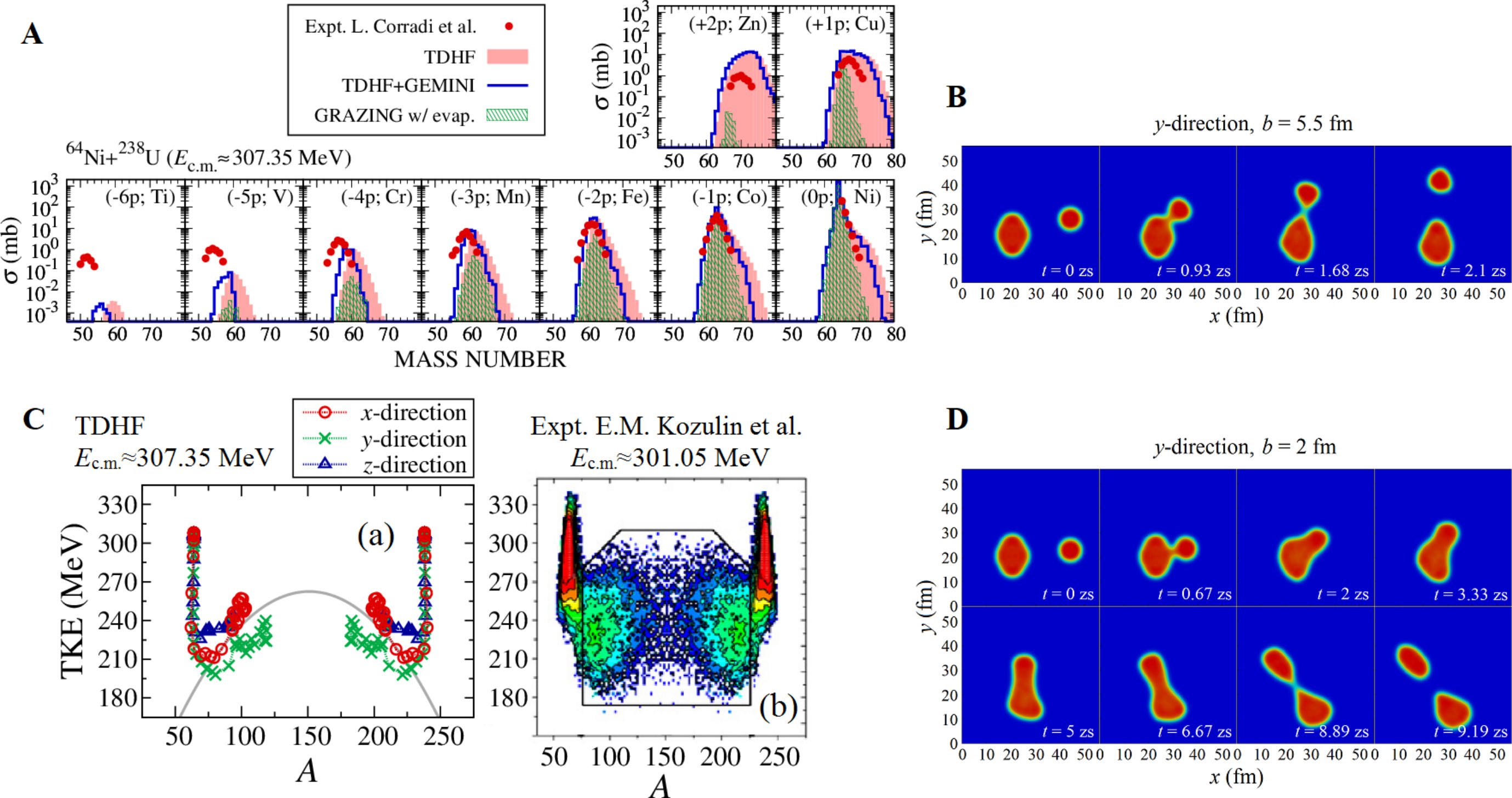 Figure 1
Peer Reviews
No public reviews on file for this paper yet. If you reviewed it on a platform where reviews are public (OpenReview, ICLR, NeurIPS, ICML), you can paste yours below so the community can read it here.
Videos
No videos yet. Explain this paper in a talk, walkthrough, or lecture? Add one.
TDHF Theory and Its Extensions for the Multinucleon Transfer Reaction:
a Mini Review
Kazuyuki Sekizawa
Center for Transdisciplinary Research, Institute for Research Promotion, Niigata University, Niigata 950-2181, Japan
(February 5, 2019)
Abstract
Time-dependent Hartree-Fock (TDHF) theory has been a powerful tool in describing a variety of complex nuclear dynamics microscopically without empirical parameters. In this contribution, recent advances in nuclear dynamics studies with TDHF and its extensions are briefly reviewed, along the line with the study of multinucleon transfer (MNT) reactions. The latter lies at the core of this Research Topic, whose application for production of extremely neutron-rich nuclei has been extensively discussed in recent years. Having in mind the ongoing theoretical developments, it is envisaged how microscopic theories may contribute to the future MNT study.
Low-energy heavy ion reactions, Multinucleon transfer, Quasi-fission, Fusion, Neutron-rich nuclei, TDHF, TDDFT (Time-Dependent Density Functional Theory) calculations
pacs:
I Introduction
The MNT reaction may be a promising means to produce yet-unknown neutron-rich unstable nuclei, whose production is difficult by other methods. This possibility makes the MNT study fascinating and important. For instance, besides the fundamental interest in nuclear structure such as shell evolution Otsuka(2018) and shape transitions Cejnar(2010) ; Heyde(2011) , properties of extremely neutron-rich nuclei are crucial to fully understand the detailed scenario of the -process nucleosynthesis r-process . Needless to say, the historic detection of gravitational waves from a merger of two neutron stars, GW170817 GW170817 , together with radiations from a short -ray burst, GRB 170817A GRB170817A , followed by a kilonova kilonova makes it a timely and imperative task to unveil inherent properties of the nuclei far away from the stability. Furthermore, superheavy nuclei produced so far are neutron-deficient ones, and the predicted island of stability has not been reached yet Hofmann(2000) ; Oganessian(2017) . The production of neutron-rich superheavy nuclei in the island is highly desired, as it would provide a new stringent constraint for microscopic theories. Therefore, the study of MNT reactions is listed as one of the key subjects at the current and future RI beam facilities, such as RIBF (RIKEN, Japan) Sakurai(2018) , HIRFL-CSR and HIAF (IMP, China) HIAF , RAON (RISP, Korea) RAON , DRIB (FLNR, Russia), SPIRAL2 (GANIL, France) Gales(2007) , FAIR (GSI, Germany) FAIR , SPES (INFN, Italy) SPES , FRIB (MSU, USA) FRIB , and so on.
This review briefly digests recent advances of microscopic reaction theories—to stimulate new ideas for the future study of MNT reactions. In Sec. II, the theoretical framework of TDHF is succinctly recalled. In Sec. III, the current status of the MNT study with TDHF is given. In Sec. IV, recent advances of theoretical approaches are outlined, along with a discussion on possible future applications. The article is concluded in Sec. V. The readers are intended to refer to other articles in this Research Topic for discussions on experimental as well as other theoretical studies.
II The TDHF theory
The TDHF theory was first proposed by Dirac in 1930 Dirac(1930) and its application to nuclear physics started in the 1970s BKN(1976) ; Cusson(1976) ; Koonin(1977) ; Davies(1978) ; Flocard(1978) ; Krieger(1978) ; Davies(1979) ; Negele(review) . The TDHF theory can be formally derived based on the time-dependent variational principle (various derivations can be found in a recent review TDHF-review(2018) ). In TDHF the wave function is a Slater determinant for all times, and the Pauli principle is thus automatically ensured. The TDHF equations read:
[TABLE]
where is the single-particle wave function of th nucleon at position with spin and isospin . is the single-particle Hamiltonian with being the one-body density. is the total energy, which may be regarded as an energy density functional (EDF) in the context of time-dependent density functional theory (TDDFT)111 Here a local EDF (like Skyrme) has been assumed, which makes the TDHF equations (1) local in space, as it is currently used in most of practical applications. In general, is composed of various local densities, , and the TDHF equations (1) should read: . In such a case, the single-particle Hamiltonian can have spin dependence as well as differential operators (for the explicit form, see, e.g., Refs. Engel(1975) ; Dobaczewski(1995) ; Stevenson(2019) ). DFT1 ; DFT2 ; DFT3 ; DFT4 ; Nakatsukasa(review) . The EDF is constructed so as to reproduce static properties of finite nuclei in a wide mass region and also the basic nuclear matter properties (see, e.g., Refs. Bender(review) ; UNEDF01 ; UNEDF2 ; SeaLL1 and references therein). There is no adjustable parameter in TDHF, once an EDF is given. The non-linearity arises because contains the mean-field potential which depends on densities generated by all the nucleons, e.g., . Such non-linear couplings between single-particle and collective degrees of freedom give rise to the so-called one-body dissipation mechanism (known as wall-and-window formulas Blocki(1978) ). Note that as is evident from a derivation of TDHF from the lowest order truncation of the Bogoliubov-Green-Kirkwood-Yvon (BBGKY) hierarchy TDHF-review(2018) , where two-body correlations are neglected, two-body dissipations associated with nucleon-nucleon collisions are absent in TDHF. They are, however, expected to play a minor role at low energy due to the Pauli exclusion principle.
TDHF is notably versatile—by changing initial condition, external potential, boundary condition, etc., one can study a wide variety of phenomena: not only collective excitations in the linear response regime NakatsukasaYabana(2005) ; UO(liner-responce) ; Maruhn(GDR) ; Ebata(2010) ; Fracasso(2012) ; Pardi(2013) ; Scamps(2013)LR ; Scamps(2014)LR ; Ebata(2014) , where TDHF is formally equivalent to the random phase approximation (RPA), but also induced fission Simenel(2014) ; Scamps(2015) ; Tanimura(2015) ; Goddard(2015) ; Goddard(2016) ; Scamps(2018)2 , dynamics of exotic configurations like -chain structure Umar(2010) , toroidal nucleus Ichikawa(2014)1 ; Ichikawa(2014)2 , nuclear pasta formation Schuetrumpf(2013) ; Schuetrumpf(2014) ; Schuetrumpf(2015)1 ; Schuetrumpf(2015)2 , as well as heavy-ion reactions, such as nucleon transfer Umar(2008) ; Iwata(2010) ; Evers(2011) ; Umar(2017) ; Projection ; KS_KY_MNT ; KS_KY_PNP ; Bidyut(2015) ; KS_KY_Maruhn ; KS_KY_Ni-U ; KS_SH_Kazimierz ; KS_GEMINI ; KS_U-Sn ; Bidyut(2017) , quasifission (QF) Golabek(2009) ; Kedziora(2010) ; Simenel(2012) ; Wakhle(2014) ; Oberacker(2014) ; Umar(2015)1 ; Hammerton(2015) ; Washiyama(2015) ; Umar(2015)3 ; Umar(2016)1 ; Yu(2017) ; Guo(2018)2 ; Zheng(2018) , and fusion Umar(2006) ; Umar(2009) ; Umar(2010)2 ; Oberacker(2010) ; Umar(2012)1 ; Oberacker(2012) ; Keser(2012) ; Oberacker(2013) ; Simenel(2013)1 ; Umar(2014) ; Steinbach(2014) ; Reinhard(2016) ; Godbey(2017) ; Guo(2018)3 ; Simenel(2007) ; Bourgin(2016) ; Vo-Phuoc(2016) , and so on (see, Refs. Negele(review) ; TDHF-review(2018) ; Stevenson(2019) ; Nakatsukasa(review) ; Simenel(review) ; Nakatsukasa(PTEP) , for review papers).
In the case of heavy-ion reactions, the initial wave function is composed of projectile and target nuclei in their ground state, which is obtained by self-consistently solving the static Hartree-Fock equations [ in Eq. (1)]. Those wave functions are placed in a computational box, with a sufficiently large relative distance, boosted with a proper relative momentum. The time evolution according to Eq. (1) then allows us to follow reaction dynamics in real space and real time. As the theory deals with the single-particle wave functions of nucleons, not only dynamic effects such as nucleon transfer and internal excitations, but also structural effects such as static/dynamic shell effects and shape evolution are naturally incorporated into the description. The spin-orbit coupling is known to play an important role in energy dissipation processes in heavy-ion reactions Umar(1986) ; Reinhard(1988) ; Umar(1989) ; Dai(2014)2 . The effects of the tensor term on nuclear dynamics were also investigated recently Guo(2018)3 ; Iwata(2011) ; Dai(2014)1 ; Stevenson(2016) ; Guo(2018)1 . TDHF enables us to study rich and complex physics of low-energy heavy-ion reactions from nucleonic degrees of freedom.
III TDHF theory for multinucleon transfer reactions
III.1 Multinucleon transfer reactions
The MNT reaction may be regarded as a non-equilibrium quantum transport process of nucleons during a collision. With the help of the particle-number projection technique Projection , transfer probabilities can be deduced from a TDHF wave function after collision. In Ref. KS_KY_MNT , a range of reactions at energies around the Coulomb barrier were studied within TDHF, for which precise experimental data are available Corradi(40Ca+124Sn) ; Corradi(48Ca+124Sn) ; Corradi(58Ni+208Pb) ; Szilner(40Ca+208Pb)2 . Those reactions are characterized by different neutron-to-proton ratio, , and charge product, . TDHF identified two distinct transfer mechanisms: 1) a fast isospin equilibration process and 2) transfer of many nucleons associated with dynamics of neck formation and its breaking. The neck breaking dynamics emerge at small impact parameters, especially in reactions with a large ( 1600). The latter may be regarded as a precursor to QF, where the system starts evolving towards the mass equilibrium. Comparisons with measured cross sections showed that TDHF works fairly well in accuracy comparable to other model predictions. However, effects of secondary neutron evaporation become substantial, when many protons are transferred. Combining TDHF with a statistical compound-nucleus deexcitation model, GEMINI++ GEMINI++ , it became possible to compute production cross sections after secondary deexcitation processes. With the method, dubbed TDHF+GEMINI, it was shown that the inclusion of deexcitation effects substantially improves agreement with the experimental data KS_GEMINI [See Fig. 1(A, B)]. (For more details, see, e.g., Refs. KS_KY_Maruhn ; KS_GEMINI .)
The description is still, however, not perfect, especially for channels where both neutrons and protons are removed. It would be improved when one includes missing one-body fluctuations into the description (cf. Sec. IV.2). Nevertheless, TDHF may be used, taking advantage of its non-empirical nature, to explore the optimal or novel reaction mechanism for producing new neutron-rich unstable nuclei, at least qualitatively. Recently, two groups have also implemented TDHF+GEMINI: production of neutron-rich nuclei was investigated for the 132Sn+208Pb reaction Jiang(2018) ; MNT processes in the 58Ni+124Sn reaction were studied obtaining good agreement with experimental data Wu(2018) .
III.2 Quasifission processes
To synthesize the heaviest elements and also to explore the predicted island of stability, it is crucial to establish deep understanding of the main competitive process, the quasifission. The QF process is characterized by a large amount of mass transfer, full energy dissipation, and a long contact time (typically several to tens of zeptoseconds). The characteristic observables of QF are correlations between fragment masses with scattering angles, known as mass-angle distribution (MAD), or with the total kinetic energy (TKE) of outgoing fragments, sometimes called mass-energy distribution (MED) (see, e.g., Refs. Kozulin(64Ni+238U) ; Toke(QF1985) ; Bock(1982) ; duRietz(2011) ; duReitz(2013) ). In recent applications of TDHF, it has been shown that TDHF can quantitatively describe main QF dynamics, consistent with experimental observations KS_KY_Ni-U ; Wakhle(2014) ; Umar(2015)1 ; Hammerton(2015) [See Fig. 1(C, D)]. An intriguing indication is that in collisions involving an actinide nucleus, TKE becomes larger (smaller energy dissipation) for tip collisions as compared to side collisions KS_KY_Ni-U ; Umar(2016)1 , perhaps due to shell effects of 208Pb Morjean(2017) . This may be in contrast to the naive consideration, where one expects a compact shape at scission for side collisions, which would result in larger TKE for side collisions.
The revival of interest in the MNT reaction was initiated by the seminal work by Zagrebaev and Greiner Zagrebaev(2005) ; Zagrebaev(2006) ; Zagrebaev(2007)1 ; Zagrebaev(2007)2 ; Zagrebaev(2008)1 ; Zagrebaev(2008)2 ; Zagrebaev(2011) ; Zagrebaev(2013) ; Zagrebaev(2014) ; Zagrebaev(2015) . In their work, the importance of shell effects in MNT processes was emphasized. For example, in the 238U+248Cm reaction, 238U tends to evolve towards doubly-magic 208Pb, giving the rest of 30 nucleons to the heavier partner, resulting in the production of transcurium nuclei as primary reaction products. The latter process is called inverse (anti-symmetrizing) QF (IQF), since the ordinary QF drives the system towards the mass equilibrium. Clearly, it is essential to correctly include static and dynamic effects of nuclear shells to describe IQF. The IQF was also observed in TDHF. In Ref. Kedziora(2010) , a typical “tip-on-side” orientation in collisions of two actinide nuclei, 232Th+250Cf, was found to result in IQF, where about 15 nucleons in the tip of 232Th were transferred to the side of 250Cf. Another type of IQF was reported in Ref. KS_U-Sn , where complex surface vibration modes are induced in tip collisions of 238U+124Sn at energies well above the Coulomb barrier, which resulted in an abrupt development of a neck, forming a smaller subsystem, leading to transfer of around 27 nucleons from 124Sn to 238U. An important message here is that those IQF processes emerge as a main reaction outcome in TDHF. Since larger effects of fluctuations and correlations, that give rise to a wider fragment mass distribution, are expected in such damped collisions Simenel(review) ; Ayik(2015)2 ; Ayik(2017) ; Ayik(2018) , novel IQF processes may pave new pathways to unexplored territories in the nuclear chart far away from the stability.
IV New techniques and extensions
IV.1 Extraction of macroscopic physical ingredients
The potential energy surface in a colliding nuclear system is often a key ingredient in phenomenological approaches. With the constrained Hartree-Fock technique Ring-Schuck , one can compute the adiabatic potential energy in a composite system. However, it differs, in general, from the potential in the entrance channel of a collision, where incident-energy-dependent dynamic effects come into play. Such a dynamic potential should be derived from microscopic theories, e.g. TDHF, where dynamic effects such as shape deformation (or necking), nucleon transfer, and inelastic excitations through the one-body dissipation mechanism are naturally taken into account. A method named dissipative-dynamics TDHF (DD-TDHF) DDTDHF1 ; DDTDHF2 ; DDTDHF3 allows us to extract from TDHF not only a dynamic potential, but also a friction coefficient, based on a mapping of TDHF trajectories onto a set of classical equations of motion. Density-constrained TDHF (DC-TDHF) Umar(2006) is another way to extract a potential. In the latter approach, the density distribution obtained from TDHF is used as a constraint for Hartree-Fock calculations, leading to an adiabatic potential along the TDHF dynamical trajectory (see, e.g., Refs. Umar(2010) ; Umar(2009) ; Umar(2010)2 ; Oberacker(2010) ; Umar(2012)1 ; Oberacker(2012) ; Keser(2012) ; Oberacker(2013) ; Simenel(2013)1 ; Umar(2014) ; Steinbach(2014) ; Reinhard(2016) ; Godbey(2017) ; Guo(2018)3 , for various applications). Energy dependence as well as transition from dynamic to adiabatic potentials may be important as well. Later, the idea of the density constraint was also applied to extract a bare (without density distortion) potential taking full account of the Pauli exclusion principle, which is named density-constrained frozen Hartree-Fock (DC-FHF) DCFHF(2017) . Such a bare potential can be applied to, e.g., coupled-channels calculations for fusion reactions CCFULL ; Hagino(2012) . Indeed, such a connection was established, where excitation energies of low-lying collective excitations were also determined by TDHF Simenel(2013) . This is a remarkable example of building a bridge between elaborated macroscopic or phenomenological frameworks and those rooted with microscopic degrees of freedom, that may enhance predictability of the former.
IV.2 Balian-Vénéroni variational principle and TDRPA
While there are, of course, limitations inherent in TDHF (e.g., the absence of many-body correlations, deterministic nature as well as spurious cross-channel couplings due to the single mean-field description Ring-Schuck ), some of them can nowadays be overcome with extended approaches. One such approach can be obtained from the variational principle of Balian and Vénéroni BV(1981) . The Balian-Vénéroni variational principle enables us to control the variational space according to not only the state in the Schrödinger picture, but also to the observable in the Heisenberg picture. For instance, a variation optimized for Slater determinant and one-body observable derives the TDHF equations Simenel(review) . By extending the variational space for fluctuations of a one-body observable, one obtains a formula that includes effects of one-body fluctuations on top of the TDHF mean-field trajectory, which may be regarded as time-dependent RPA (TDRPA). It has recently been shown that the description of the width of fragment mass distributions in deep-inelastic collisions, which is severely underestimated in TDHF Koonin(1977) ; Davies(1978) ; Dasso(1979) , is substantially improved Broomfield(2009) ; Simenel(2011) , or even quantitatively agrees with experimental data Williams(2018) , in TDRPA. It implies that one-body dissipation and fluctuations described by TDHF and TDRPA, respectively, are the predominant mechanisms in deep-inelastic collisions. Here, a caution is required: the TDRPA formula in the present form can only be applied to symmetric reactions Williams(2018) . To overcome this difficulty, one may extend the derivation based on the Balian-Vénéroni variational principle to include higher-order corrections, or derive a formula generalized for asymmetric reactions from, e.g., the stochastic mean-field (SMF) theory Ayik(2008) ; Lacroix(2014) , from which one can derive the TDRPA formula in the small fluctuation limit Ayik(2008) . Note that effects of two-body correlations were also indicated by the time-dependent density-matrix (TDDM) approach Shun-jin(1985) ; Gong(1990) ; Tohyama(2002) ; Tohyama(2016) ; Wen(2018) .
IV.3 Stochastic extensions
Another limitation of TDHF lies in its deterministic nature. To correctly describe abundant reaction outcomes as observed experimentally, one may need to introduce quantal, collisional or thermal fluctuations that induce bifurcations of dynamics, leading to, in the end, minor processes apart from the TDHF mean-field trajectory. In the SMF approach, extensively developed by Ayik and his coworkers Ayik(2015)2 ; Ayik(2017) ; Ayik(2018) ; Ayik(2008) ; Lacroix(2014) ; Ayik(2009) ; Washiyama(2009)1 ; Yilmaz(2011) ; Yilmaz(2014) ; Ayik(2015)1 ; Ayik(2016) ; Tanimura(2018) ; Yilmaz(2018) , initial fluctuations are introduced in a stochastic manner, which gives rise to an ensemble of final states after dynamic evolutions. For the MNT study, the SMF description can be cast into the Fokker-Planck equations, where transport (drift and diffusion) coefficients are determined by the single-particle orbitals in TDHF. In Ref. Yilmaz(2018) , the SMF approach was also applied to the Ni+Ni reaction, showing quantitative agreement with experimental data Williams(2018) , comparable to TDRPA. Recently, Bulgac et al. Bulgac(2018) proposed another way to introduce stochasticity by means of external potentials which are random in both space and time. The method was applied to describe induced fission processes, with a simplified orbital-free approach, getting a sufficient width of the fission fragment mass distribution Bulgac(2018) . Further applications of those approaches may be promising for exploring optimal reactions, especially for producing the most exotic isotopes, where correct description of rare processes may be essential.
IV.4 Inclusion of pairing
In spite of the known great importance of pairing in nuclear structure studies, the effect of pairing on nuclear reaction dynamics has rarely been investigated so far. While the BCS approximation has been employed to date Scamps(2012) ; Scamps(2013) ; Ebata(2014)2 ; Ebata(2015) , inclusion of dynamic effects of pairing became possible only quite recently with top-tier supercomputers. One may naively expect that pairing in the nucleus is so fragile and it would only affect tunneling phenomena below the Coulomb barrier, where clear effects of nucleon-nucleon correlations were indeed observed experimentally Evers(2011) ; Corradi(2011) ; Montanari(2014) ; Montanari(2016) . To the contrary, Magierski et al. MSW(2017) ; SMW(2017) ; SWM(2017) found unexpectedly large effects associated with the relative phase (or gauge angles) of colliding superfluid nuclei on the reaction outcomes, such as TKE and fusion cross section. In this context, experimental fusion cross sections were analyzed, which indicates fusion barrier width may be increased by the superfluid effect Scamps(2018)1 . In the work by Magierski et al., a local formulation of superfluid TDDFT, known as time-dependent superfluid local density approximation (TDSLDA) (see, e.g., Refs. Bulgac(2012) ; Bulgac(2013) ; Magierski(2016) ; Magierski(2018) ), was employed, which is formally similar to the time-dependent Hartree-Fock-Bogoliubov (TDHFB) approach Ring-Schuck . The TDSLDA has been extensively developed by Bulgac and his coworkers, which was successfully applied to the unitary Fermi gas Bulgac(2009) ; Bulgac(2011) ; Bulgac(2012)2 ; Bulgac(2014) ; Wlazlowski(2015) ; Wlazlowski(2018) , finite nuclei Stetcu(2011) ; Stetcu(2015) ; Bulgac(2016) ; Magierski(2017) ; Bulgac(2018)2 ; Stetcu(2018) , as well as interiors of neutron stars Wlazlowski(2016) . Hashimoto has developed a Gogny TDHFB code that works with 2D-harmonic-oscillator plus 1D-Lagrange-mesh hybrid basis Hashimoto(2013) , which could be applied for head-on collisions Hashimoto(2016) ; Scamps(2017) . Qualitatively the same effects of the relative phase as reported in Ref. MSW(2017) were observed with their code, although smaller in magnitude for heavier systems Hashimoto(2018) —further investigations are required. We have just entered a new era in which dynamic effects of pairing can be fully incorporated with microscopic nuclear dynamics studies. With the aforementioned sophisticated approaches with the usage of top-tier supercomputers, the dynamic effects of pairing in MNT and QF processes will be unveiled in the near future.
IV.5 Remarks on other theoretical approaches
There are a bunch of models developed so far for the MNT study, such as the semi-classical model, like GRAZING GRAZING-online ; GRAZING1 ; GRAZING2 ; Dasso(1994) ; Dasso(1995) ; Yanez(2015) ; GRAZING-code or CWKB Corradi(48Ca+124Sn) ; Corradi(58Ni+208Pb) ; Szilner(40Ca+208Pb)2 ; CWKB , the dinuclear system (DNS) model Adamian(2005) ; Penionzhkevich(2005) ; Penionzhkevich(2006) ; Feng(2009) ; Adamian(2010)1 ; Adamian(2010)2 ; Adamian(2010)3 ; Mun(2014) ; Mun(2015) ; Zhu(2015) ; Zhu(2016) ; Feng(2017) ; Zhu(2017)1 ; Li(2017) ; Zhu(2017)2 , the improved quantum molecular dynamics (ImQMD) model Zhao(2015) ; Li(2016) ; Wang(2016) ; Zhao(2016) , and the Langevin model Zagrebaev(2005) ; Zagrebaev(2006) ; Zagrebaev(2007)1 ; Zagrebaev(2007)2 ; Zagrebaev(2008)1 ; Zagrebaev(2008)2 ; Zagrebaev(2011) ; Zagrebaev(2013) ; Zagrebaev(2014) ; Zagrebaev(2015) ; Karpov(2017) ; Saiko(2018) . There are pros and cons in those approaches. For instance, on the one hand the semi-classical model can describe successive transfer processes at peripheral collisions, on the other hand it misses deep-inelastic components at small impact parameters. In contrast, the DNS model is capable of describing the dynamic evolution of a composite system, according to a master equation with a potential energy (including shell effects) for mass asymmetry and deformation of the subsystem, that gives rise to a probability distribution for massive nucleon transfer as well as fusion. By construction, however, the latter model assumes a formation of a ‘di-nucleus’ in a potential pocket, and thus it misses (quasi)elastic components at large impact parameters. Actually, a simple addition of those model predictions, DNS+GRAZING, was considered in the literature Welsh(2017) ; Wen(2017) . The ImQMD model is applicable for both peripheral and damped collisions. By taking into account stochastic nucleon-nucleon collisions, it provides distributions of observables accumulated in a number of simulations. To the author’s knowledge, however, the spin-orbit interaction has been neglected in ImQMD, that prevents a proper description of shell effects in MNT and QF processes. The elaborated Langevin model Karpov(2017) may be promising in describing complex processes of MNT, QF and fusion, in a unified way. The model contains, however, various parameters that have to be tuned carefully to reproduce available experimental data Karpov(2017) .
A possible future task is to non-empirically determine model ingredients based on microscopic theories: potential energy surface with respect to an arbitrary set of variables, drift, diffusion and friction coefficients, etc., can be derived from the microscopic approaches, that may lead to, e.g., kind of TDHF+Langevin approach.
V Summary and prospect
Production of neutron-rich heavy nuclei is listed as one of the high-priority important subjects of nuclear science today. In this contribution, recent advances in the MNT study, especially those based on microscopic dynamic theories, have been briefly reviewed. The traditional TDHF approach has shown remarkable successes in describing a variety of phenomena in nuclear systems. It has been shown that TDHF is capable of describing the main reaction channels, not only MNT processes in peripheral collisions, but also deep-inelastic and QF processes in damped collisions, placing it as a good starting point for building a fully microscopic theory for low-energy heavy-ion reactions. Moreover, the inclusion of one-body fluctuations significantly improves quantitative agreements of the width of fragment mass distributions with experimental data. With the use of top-tier supercomputers, studies of dynamic effects of pairing have just been started. One of the great advantages of microscopic approaches is its non-empirical nature—one may explore novel pathways towards the dreamed of production of yet-unknown neutron-rich nuclei. Another possible future direction is to use microscopic approaches to determine phenomenological parameters in other theoretical models. It may be the time to combine knowledge obtained with different approaches to construct the most reliable framework to lead future experiments to the successful production of extremely neutron-rich nuclei, the farthest from the continent of stability.
Acknowledgements.
The author acknowledges P.D. Stevenson, J.A. Maruhn, C. Simenel, Lu Guo, and A.S. Umar for careful reading of the manuscript and for providing valuable comments on this article.
The reference list from the paper itself. Each links out to its DOI / PubMed record.
- 1(1) T. Otsuka, A. Gade, O. Sorlin, T. Suzuki, and Y. Utsuno, Evolution of nuclear structure in exotic nuclei and nuclear forces , ar Xiv:1805.06501 [nucl-th].
- 2(2) P. Cejnar, J. Jolie, and R.F. Casten, Quantum phase transitions in the shapes of atomic nuclei , Rev. Mod. Phys. 82 , 2155 (2010).
- 3(3) K. Heyde and J.L. Wood, Shape coexistence in atomic nuclei , Rev. Mod. Phys. 83 , 1467 (2011); Ib id. 1655 (2011).
- 4(4) J.J. Cowan, C. Sneden, J.E. Lawler, A. Aprahamian, M. Wiescher, K. Langanke, G. Martínez-Pinedo, and F.-K. Thielemann, Making the Heaviest Elements in the Universe: A Review of the Rapid Neutron Capture Process , ar Xiv:1901.01410 [astro-ph.HE].
- 5(5) B.P. Abbott et al., GW 170817: Observation of Gravitational Waves from a Binary Neutron Star Inspiral , Phys. Rev. Lett. 119 161101 (2017).
- 6(6) B.P. Abbott et al., Gravitational Waves and Gamma-Rays from a Binary Neutron Star Merger: GW 170817 and GRB 170817 A , Astrophys. J. Lett. 848 , L 13 (2017).
- 7(7) B.P. Abbott et al., Estimating Contribution of Dynamical Ejecta in the Kilonova Associated with GW 170817 , Astrophys. J. Lett. 850 , L 39 (2017).
- 8(8) S. Hofmann and G. Münzenberg, The discovery of the heaviest elements , Rev. Mod. Phys. 72 , 733 (2000).