Improved bound for the dimension of posets of treewidth two
Michał T. Seweryn
Theoretical Computer Science Department
Faculty of Mathematics and Computer Science, Jagiellonian University, Kraków, Poland
[email protected]
Abstract.
Joret et al. proved that posets with cover graphs of treewidth at most 2 have dimension at most 1276.
Their proof is long and very complex.
We give a short and much simpler proof that the dimension of such posets is at most 12.
Michał Seweryn was partially supported by the National Science Center of Poland under grant no. 2015/18/E/ST6/00299.
1. Introduction
Partially ordered sets (posets for short) are one of the most often studied structures in combinatorics.
Perhaps the most important notion of complexity of posets is dimension.
Recall that the dimension of a finite poset P is the least non-negative integer d such that the partial order in P is the intersection of d linear orders.
For n≥2,
the standard example of order n is a poset Sn of height 2 with n minimal elements a1,…,an and n maximal elements b1,…,bn, such that for 1≤i≤n and 1≤j≤n, we have ai<bj if and only if i=j. The dimension of Sn is equal to n.
Posets are visualized by their diagrams.
A diagram of a poset P is a drawing on the plane, where each element of P is represented by a point, and each comparability x<y which is not
implied by transitivity is represented by a curve that goes upward from x to y.
The diagram of a poset seen as an abstract graph is its cover graph.
More formally, for two elements x and y of P, we say y covers x if x<y in P but there is no element z of P such that x<z<y in P. The cover graph of P is a (simple) graph, whose vertex set is the ground set of P and two vertices are joined with an edge if and only if one of them covers the other in P.
Connections between dimension of posets and structure of their cover graphs have been studied over years.
There is a common belief, that posets with a sufficiently “sparse” cover graph should have a small dimension.
For example, when the cover graph of a poset is a forest, then its dimension is at most 3 [6], while posets with outerplanar cover graphs have dimension at most 4 [3].
However, a famous construction by Kelly [5] gives for every n≥2 a poset with planar cover graph, which contains the standard example Sn as a subposet (see Figure 1). This construction shows that posets with planar cover graphs can have arbitrarily large dimension.
Biró, Keller, and Young [1] showed that posets with cover graphs of pathwidth at most 2 have dimension at most 17.
This bound was later improved to 6 with a short proof by Wiechert [7].
On the other hand, posets with cover graphs of pathwidth (and treewidth) 3 can have arbitrarily large dimension, as witnessed by posets in Kelly’s construction.
The question whether posets with cover graphs of treewidth at most 2 have bounded dimension was answered affirmatively by Joret et al. [4].
They gave a complex and technical proof that every poset with a cover graph of treewidth at most 2 has dimension at most 1276.
The main contribution of this paper is a much simpler proof improving this bound.
Theorem 1**.**
Every finite poset whose cover graph has treewidth at most 2 has dimension at most 12.
Let us briefly describe the idea of the proof.
Our proof is inspired by the proof by Felsner, Trotter and Wiechert [3] that posets with outerplanar cover graphs have dimension at most 4.
In their proof, the set of all pairs of incomparable elements of a poset is partitioned into 4 sets, and the partition heavily uses the linear order of elements along the outer face of the cover graph.
These 4 sets give rise to 4 linear orders, which witness that the dimension is at most 4.
To generalize the proof from the outerplanar case, we use a characterization of graphs of treewidth 2 as subgraphs of series-parallel graphs.
Series-parallel graphs have natural partial orderings of the vertices, and if a series-parallel graph is outerplanar, then this partial ordering can be chosen so that it coincides with the order of vertices on the outer face in some outerplanar drawing.
The recursive definition of series-parallel graph is not very convenient to work with, so instead using it directly in our proof, we use it to construct a special tree-decomposition, in which every bag has two distinguished vertices, which satisfy some additional properties.
Such a special tree-decomposition can be easily constructed without explicitly mentioning series-parallel graphs, but constructing it from the definition of series-parallel graphs allows to notice analogies to the proof for outerplanar cover graphs.
The bound 12 in our proof significantly improves the one from [4].
It is likely still not optimal because the largest known dimension of a poset with cover graph of treewidth 2 is 4.
However, we think that improving that bound is not of that much importance, and that the main advantage of our proof is its simplicity.
At this point it seems more interesting to improve the lower bound for the optimal constant in Theorem 1.
The best known lower bound 4 is reached by a poset with an outerplanar cover graph [3].
It seems that the class of outerplanar graphs is much more restricted than the class of graph of treewidth at most 2, and we believe that there should exist a poset with cover graph of treewidth 2 of dimension greater than 4.
2. Poset preliminaries
All posets considered in this paper are finite.
Let P be a poset.
For every element x of P, the upset of x in P, denoted UP(x), is the set of all elements y of P such that y≥x in P.
Similarly, the downset of x in P, denoted DP(x), is the set of all elements y of P such that y≤x in P.
In both cases, we drop subscript P when the poset is clear from the context.
The dual of P is the poset Pd with the same ground set as P, such that x≤y in Pd whenever y≤x in P.
Clearly, P and Pd have the same cover graph and dimension.
A chain in P is a set of linearly ordered elements of P.
For two comparable elements x and y of P such that x≤y in P, we define a covering chain from x to y as a chain consisting of points x1,…,xk such that x1=x, xk=y, and for every i∈{2,…,k}, the point xi covers xi−1 in P.
Every covering chain from x to y induces a path between x and y in the cover graph of P.
Every upset U(x) is a union of covering chains from x to the elements of U(x).
Hence every upset (and, by a dual argument, every downset) induces a connected subgraph of the cover graph.
An incomparable pair in P is an ordered pair (x,y) of incomparable elements in P.
The set of all incomparable pairs in P is denoted by Inc(P).
A linear extension of P is a linear order L on the ground set of P such that x≤y in L for any two elements x and y of P such that x≤y in P.
A set I⊆Inc(P) is reversible in P if there exists a linear extension L of P such that y<x in L for every (x,y)∈I. The set I is reversible in P if and only if the set I−1={(y,x):(x,y)∈I} is reversible in Pd.
Here is a common and useful rephrasing of the definition of poset dimension.
Observation 2**.**
If the dimension of a poset P is at least 2, then it is equal to the least positive integer d such that Inc(P) can be partitioned into d reversible sets.
For n≥2, an indexed family {(xi,yi):i∈{1,…,n}} of incomparable pairs in P is an alternating cycle in P if xi≤yi+1 for i∈{1,…,n} (in alternating cycles we always interpret indices cyclically, so xn≤y1 is required).
An alternating cycle {(xi,yi):i∈{1,…,n}} is strict if for any pair of indices i∈{1,…,n} and j∈{1,…,n}, we have xi≤yj if and only if j=i+1 (cyclically, as always).
The following is an easy and well-known characterization of reversible sets in terms of strict alternating cycles, originally observed by Trotter and Moore [6].
Observation 3**.**
A set I⊆Inc(P) is reversible in P if and only if there is no strict alternating cycle in P with all pairs from I.
3. Treewidth 2 and series-parallel graphs
All graphs considered in this paper are finite and simple. A tree-decomposition of a graph G is a pair (T,{Yu:u∈V(T)}), where T is a tree and {Yu:u∈V(T)} is an indexed family of subsets of V(G) called bags which satisfies the following conditions:
- (T1)
V(G)=⋃u∈V(T)Yu,
2. (T2)
for every edge xy of G there exists a node u of T
such that {x,y}⊆Yu, and
3. (T3)
for every three nodes u1, u2 and v of T, if v lies on the path between u1 and u2 in T, then Yu1∩Yu2⊆Yv.
By property (T3), for every vertex x of G, the nodes u such that x∈Yu induce a subtree of T.
In particular, if the tree T is rooted, then among all nodes u such that x∈Yu there exists a unique one closest to the root.
The width of a tree-decomposition (T,{Yu:u∈V(T)}) is
[TABLE]
The treewidth of a graph G is the least width of a tree-decomposition of G.
The following is a well-known property of tree-decompositions:
Observation 4**.**
Let (T,{Yu:u∈V(T)}) be a tree-decomposition of a graph G, let u1 and u2 be two nodes of T, let v1v2 be an edge on the path between u1 and u2 in T, and let H be a connected subgraph of G.
If V(H)∩Yu1=∅ and V(H)∩Yu2=∅, then V(H)∩(Yv1∩Yv2)=∅.
A two-terminal graph is a triple (G,s,t), where G is a graph, s is a vertex of G called source, and t is a vertex of G called sink.
Let (G1,s1,t1) and (G2,s2,t2) be two-terminal graphs such that E(G1)∩E(G2)=∅.
If V(G1)∩V(G2)={t1}={s2}, then the series composition of (G1,s1,t1) and (G2,s2,t2) is the two-terminal graph
[TABLE]
If s1=s2=s, t1=t2=t and V(G1)∩V(G2)={s,t}, then the parallel composition of (G1,s1,t1) and (G2,s2,t2) is the two-terminal graph
[TABLE]
A basic two-terminal series-parallel graph is a two-terminal graph (G,s,t) such that G is a complete graph on two vertices s and t.
A two-terminal series-parallel graph is a two-terminal-graph which can be constructed by a sequence of series and parallel compositions from basic two-terminal series-parallel graphs.
A graph G is series-parallel if one can choose a source s and a sink t so that (G,s,t) is a two-terminal series-parallel graph.
The proof of the following characterization of graphs of treewidth at most 2 can be found for example in [2].
Theorem 5**.**
A graph has treewidth at most 2 if and only if it is a subgraph of a series-parallel graph.
In this paper, by binary tree we mean a rooted tree T where every internal node u∈V(T) has two children: a left child denoted by ℓT(u) and a right child denoted by rT(u).
We omit subscript T when the tree is clear from context.
Let (G,s,t) be a two-terminal series-parallel graph.
An s-t tree-decomposition of (G,s,t) is a pair
(T,{(Yu,su,tu):u∈V(T)}) satisfying the following conditions:
- (1)
(T,{Yu:u∈V(T)}) is a tree-decomposition of G of width at most 2 such that T is a binary tree,
2. (2)
su and tu are distinct elements of Yu for u∈V(T),
3. (3)
sv=s and tv=t if v is the root of T,
4. (4)
for every leaf u of T, we have ∣Yu∣=2,
5. (5)
for every internal node u of T, if ∣Yu∣=2, then sℓ(u)=sr(u)=su and tℓ(u)=tr(u)=tu, and
6. (6)
for every internal node u of T, if ∣Yu∣=3, then sℓ(u)=su, tℓ(u)=sr(u)∈Yu and tr(u)=tu.
Lemma 6**.**
Every two-terminal series-parallel graph (G,s,t) has an s-t tree-decomposition.
Proof.
We prove the lemma by induction on the number of edges in G.
If (G,s,t) is a basic two-terminal series-parallel graph, then let T be a binary tree consisting of one node v, and let (Yv,sv,tv)=({s,t},s,t).
Clearly, (T,{(Yu,su,tu):u∈V(T)}) is an s-t tree-decomposition of (G,s,t).
Suppose that (G,s,t) is a series or parallel composition of two-terminal series-parallel graphs (G1,s1,t1) and (G2,s2,t2).
Each of the graphs G1 and G2 has less edges than G.
By induction hypothesis, for i∈{1,2} there exists an s-t tree-decomposition (Ti,{(Yui,sui,tui):u∈V(Ti)}) of (Gi,si,ti). We may assume that the trees T1 and T2 are disjoint. Let T be a tree with a root v such the subtree rooted at the left child of v is T1 and the subtree rooted at the right child of v is T2.
Let Yv={s1,t1}∪{s2,t2}, sv=s and tv=t.
In particular, if (G,s,t) is a series composition of (G1,s1,t1) and (G2,s2,t2), then ∣Yv∣=3, and if (G,s,t) is a parallel composition of (G1,s1,t1) and (G2,s2,t2), then ∣Yv∣=2.
For i∈{1,2} and a node u∈V(Ti), let (Yu,su,tu)=(Yui,sui,tui)
It is straight-forward to see that (T,{(Yu,su,tu):u∈V(T)}) is an s-t tree-decomposition of (G,s,t). This concludes the inductive proof.
∎
We consider a binary tree T as a partially ordered set where for two distinct nodes u and v of T, we have u<v if and only if u is an ancestor of v.
The lowest common ancestor of two nodes u and v, denoted u∧v, is the greatest node w in T such that w≤u and w≤v in T.
By ⪯T we denote the linear order on V(T) defined by the in-order tree traversal of T, that is for any two nodes u and v of T we have u⪯Tv
if and only if r(u∧v)≤u and ℓ(u∧v)≤v in T.
We omit subscript T in ⪯T when the tree is clear from context.
Lemma 7**.**
Let (T,{(Yu,su,tu):u∈V(T)}) be an s-t tree-decomposition of a two-terminal series-parallel graph (G,s,t), let x∈V(G)∖{s,t} and let w be the least node in T such that x∈Yw. Then x∈{sw,tw}.
Proof.
If w is the root of T, then sw=s and tw=t, so x∈{sw,tw}.
If w is not the root of T, then let v be the parent of w.
We have {sw,tw}⊆Yv, so by the choice of w, we have x∈{sw,tw}.
∎
Given an s-t tree-decomposition (T,{(Yu,su,tu):u∈V(T)}) of a two-terminal series-parallel graph (G,s,t), we can reverse it to obtain an s-t tree decomposition of (G,t,s).
The reversed s-t tree-decomposition is (T′,{(Yu′,su′,tu′):u∈V(T′)}), where T′ is a binary tree with the same nodes having the same children as in T, but for every internal node u, we have ℓT′(u)=rT(u) and rT′(u)=ℓT(u), and for every node u, we have (Yu′,su′,tu′)=(Yu,tu,su).
The partial order defined by the tree T′ is the same as the one defined by T, but the in-order ⪯T′ is the reverse of the in-order ⪯T.
Lemma 8**.**
Let (T,{(Yu,su,tu):u∈V(T)}) be an s-t tree-decomposition of a two-terminal series-parallel graph (G,s,t), let u1 and u2 be two nodes of T, and let H be a connected subgraph of G such that {su1,tu2}⊆V(H). If u1 and u2 are comparable in T, then there exists a node v on the path between u1 and u2 in T such that {sv,tv}⊆V(H).
Proof.
Suppose first that u1≤u2 in T.
Let v be the greatest node in T such that u1≤v≤u2 and sv∈V(H).
If v=u2, then {sv,tv}={sv,tu2}⊆V(H), so the node v satisfies the lemma.
Otherwise, let v′ denote the child of v such that u1≤v<v′≤u2 in T.
By the choice of v, we have sv′∈V(H).
In particular sv′=sv, which implies ∣Yv∣=3, v′=r(v) and tv=tv′.
The nodes v and v′ lie on the path between u1 and u2 in T.
By Observation 4 with u1=u1, u2=u2, v1=v, v2=v′ and H=H, we have V(H)∩(Yv∩Yv′)=∅.
Since Yv∩Yv′={sv′,tv′} and sv′∈V(H), we have tv′∈V(H).
Hence {sv,tv}={sv,tv′}⊆V(H), and the node v satisfies the lemma.
Now suppose that u2<u1 in T.
In the reversed s-t tree-decomposition (T′,{(Yu,su′,tu′):u∈V(T′)}) we have su2′=tu2∈V(H) and tu1′=su1∈V(H).
By applying the earlier case to (T′,{(Gu,su′,tu′):u∈V(T)}) and the nodes u2 and u1, we obtain a node v on the path between u1 and u2 such that {sv′,tv′}⊆V(H). Since sv′=tv and tv′=sv, this implies {sv,tv}⊆V(H), as required.
∎
4. The proof
Let P be a poset with a cover graph of treewidth at most 2.
By Theorem 5, the cover graph of P is a subgraph of a series-parallel graph.
Let (G,s,t) be a two-terminal series-parallel graph such that G contains the cover graph of P as a subgraph.
After replacing (G,s,t) with its series composition with two basic two-terminal series-parallel graphs we assume that neither s nor t is an element of P.
Fix an s-t tree-decomposition (T,{(Yu,su,tu):u∈V(T)}) of (G,s,t).
For every node u of T, such that ∣Yu∣=3, let mu denote the only element of Yu∖{su,tu}.
For every element x of P, let w(x) denote the least node in T containing x in its bag. By Lemma 7, for every element x of P, we have ∣Yw(x)∣=3 and x=mw(x). For every pair (x,y)∈Inc(P), let w(x,y)=w(x)∧w(y).
Let (x,y)∈Inc(P).
We say (x,y) is of type 1 if
[TABLE]
Otherwise, we have
[TABLE]
and we say (x,y) is of type 2.
Let I1 and I2 denote the sets of incomparable pairs in P of type 1 and type 2, respectively.
By Observation 2, to prove the theorem
it suffices to show that Inc(P) can be partitioned into 12 reversible sets.
We will show that I1 can be partitioned into 4 reversible sets and I2 can be partitioned into 8 reversible sets.
For every incomparable pair (x,y)∈Inc(P), we have mw(x)=x and mw(y)=y, so w(x)=w(y). Let
[TABLE]
Claim 9**.**
Let (x,y)∈Inc(P) be a pair such that α(x,y)=1, let u be a node of T, and let H be a connected subgraph of G such that V(H)∩Yu=∅.
- (1)
If x∈V(H) and ℓ(w(x,y))≤u in T, then V(H)∩{sℓ(w(x,y)),tℓ(w(x,y))}=∅.
2. (2)
If y∈V(H) and r(w(x,y))≤u in T, then V(H)∩{sr(w(x,y)),tr(w(x,y))}=∅.
Proof.
For the proof of item (1), suppose that x∈V(H) and ℓ(w(x,y))≤u in T.
Since α(x,y)=1, either w(x)=w(x,y) or ℓ(w(x,y))≤w(x) in T.
Let v denote the node ℓ(w(x)) if w(x)=w(x,y), or the node w(x) if ℓ(w(x,y))≤w(x) in T.
Either way, we have ℓ(w(x,y))≤v in T and x∈Yv.
Since ℓ(w(x,y))≤v and ℓ(w(x,y))≤u in T, the nodes ℓ(w(x,y)) and w(x,y) lie on the path between v and u in T.
By Observation 4 with u1=v, u2=u, v1=ℓ(w(x,y)), v2=w(x,y) and H=H, we have
V(H)∩{sℓ(w(x,y)),tℓ(w(x,y))}=V(H)∩(Yℓ(w(x,y))∩Yw(x,y))=∅, as required.
Now suppose that y∈V(H) and r(w(x,y))≤u in T.
In the reversed decomposition (T′,{(Yu′,su′,tu′):u∈V(T′)}), we have α(y,x)=1 since w(y)≺T′w(x). Moreover ℓT′(w(y,x))=rT(w(x,y))≤u in T′, so by item (1) applied to the pair (y,x), u and H, we have V(H)∩{srT(w(x,y)),trT(w(x,y))}=V(H)∩{sℓT′(w(x,y)),tℓT′(w(x,y))}=∅.
Item (2) follows.
∎
4.1. Pairs of type 1
For every pair (x,y)∈I1, we define
[TABLE]
The signature of a pair (x,y)∈I1 is
[TABLE]
To prove that I1 can be partitioned into 4 reversible sets, it remains to show that every set consisting of incomparable pairs of type 1 having the same signature is reversible.
Let I⊆Inc(P) be a set such that for every (x,y)∈I, we have σ1(x,y)=(α,β) for some (α,β)∈{1,2}2.
We aim to show that I is reversible.
First we will show that it is enough to consider the case (α,β)=(1,1).
Claim 10**.**
If β=2, then in the dual poset Pd with (T,{(Yu,su,tu):u∈V(T)}), each pair from I−1 is a pair of type 1 with signature (3−α,3−β).
Proof.
Suppose β=2, and let (y,x)∈I−1.
In P with (T,{(Yu,su,tu):u∈V(T)}), the pair (x,y) is of type 1 and β(x,y)=2, so DP(y)∩Yw(x,y)=∅.
Hence UPd(y)∩Yw(y,x)=∅. This implies that in Pd with (T,{(Yu,su,tu):u∈V(T)}), the pair (y,x) is of type 1 and β(y,x)=1=3−β.
The value of α(y,x) does not depend on the poset, just on the s-t tree-decomposition, and α(y,x)=3−α(x,y)=3−α.
∎
The set I is reversible in P if and only if I−1 is reversible in Pd.
Hence by Claim 10, after possibly replacing P with Pd and I with I−1, we may assume β=1.
Claim 11**.**
In P with the reversed s-t tree-decomposition (T′,{(Yu′,su′,tu′):u∈V(T′)}), each pair from I is a pair of type 1 with signature (3−α,β).
Proof.
Let (x,y)∈I.
We have Yw(x,y)′=Yw(x,y), so in P with (T′,{(Yu′,su′,tu′):u∈V(T′)}), the pair (x,y) is of type 1, and β(x,y)=β.
Moreover, since ≺T is the reverse of ≺T′, we have α(x,y)=3−α in P with (T′,{(Yu′,su′,tu′):u∈V(T′)}).
∎
By Claim 11, after possibly replacing (G,s,t) with (G,t,s) and (T,{(Yu,su,tu):u∈V(T)}) with (T′,{(Yu′,su′,tu′):u∈V(T′)}), we may assume (α,β)=(1,1).
We proceed to the proof that I is reversible.
Suppose to the contrary that I is not reversible.
By Observation 3, there is an alternating cycle {(xi,yi):i∈{1,…,n}} in P such that σ1(xi,yi)=(1,1) for i∈{1,…,n}.
Without loss of generality, we assume w(y1)⪯w(y2).
Since β(x1,y1)=1, we have
U(x1)∩{sℓ(w(x1,y1)),tℓ(w(x1,y1))}=∅.
Hence, by Claim 9 item (1) with (x,y)=(x1,y1), u=w(y2) and H=G[U(x1)],
we have ℓ(w(x1,y1))≤w(y2) in T.
Therefore w(y2)≺w(x1,y1)⪯w(y1), which contradicts the assumption w(y1)⪯w(y2).
Hence I is reversible.
This completes the proof that the set I1 can be partitioned into 4 reversible sets.
4.2. Pairs of type 2
For every pair (x,y)∈I2, we define
[TABLE]
Let (x,y)∈I2 be a pair such that ∣Yw(x,y)∣=2.
By definition of type 2,
the sets U(x)∩Yw(x,y) and D(y)∩Yw(x,y) are disjoint non-empty subsets of Yw(x,y)={sw(x,y),tw(x,y)}.
Hence, either sw(x,y)∈U(x) and tw(x,y)∈D(y), or tw(x,y)∈U(x) and sw(x,y)∈D(y).
For every pair (x,y)∈I2 we define
[TABLE]
The signature of a pair (x,y)∈I2 is
[TABLE]
To complete the proof of the theorem, it remains to show that every set consisting of pairs of type 2 having the same signature is reversible.
Let (α,γ,δ)∈{1,2}3 and let I⊆I2 be a set such that for every (x,y)∈I, we have σ2(x,y)=(α,γ,δ).
We aim to show that I is reversible in P.
First we will show that it is enough to consider the case (α,γ,δ)=(1,1,1).
Claim 12**.**
For every pair (x,y)∈Inc(P) there do not exist nodes u and u′ such that u≤w(x,y) and u′≤w(x,y) in T, {su,tu}⊆U(x) and {su′,tu′}⊆D(y).
Proof.
Toward a contradiction, suppose that there do exist such nodes u and u′ for a pair (x,y)∈Inc(P).
We have u≤w(x,y) and u′≤w(x,y) in T, so the nodes u and u′ are comparable in T.
Moreover, the nodes u and u′ are distinct, since U(x)∩D(y)=∅.
Suppose first that u<u′ in T, and let v denote the parent of u′.
In particular u≤v<u′≤w(x,y)≤w(x) in T.
By Observation 4 with u1=w(x), u2=u, v1=u′, v2=v and H=G[U(x)], we have U(x)∩(Yu′∩Yv)=∅. But Yu′∩Yv={su′,tu′}, so U(x)∩D(y)=∅, which is a contradiction.
By a symmetric argument, if u′<u in T, then the downset D(y) intersects the set {su,tu}, which is again a contradiction.
∎
Claim 13**.**
In the dual poset Pd with (T,{(Yu,su,tu):u∈V(T)}), each pair (y,x)∈I−1 is a pair of type 2 such that α(y,x)=3−α and δ(y,x)=3−δ. Moreover, if γ=2, then γ(y,x)=3−γ in Pd with (T,{(Yu,su,tu):u∈V(T)}).
Proof.
Let (y,x)∈I−1.
We have DPd(x)∩Yw(y,x)=UP(x)∩Yw(x,y) and UPd(y)∩Yw(y,x)=DP(y)∩Yw(x,y).
Since (x,y) is a pair of type 2 in P with (T,{(Yu,su,tu):u∈V(T)}), this implies (y,x) is a pair of type 2 in Pd with (T,{(Yu,su,tu):u∈V(T)}).
The value of α(y,x) does not depend on the poset P, just on the s-t tree-decomposition, and α(y,x)=3−α.
If ∣Yw(y,x)∣=2, then we have sw(x,y)∈DP(y)=UPd(y) and tw(x,y)∈UP(x)=DPd(x), so indeed δ(y,x)=3−δ in Pd with (T,{(Yu,su,tu):u∈V(T)}).
Suppose ∣Yw(x,y)∣=3.
In such case δ(x,y)=α(x,y) in P with (T,{(Yu,su,tu):u∈V(T)}), so δ=α.
Hence in Pd with (T,{(Yu,su,tu):u∈V(T)}) we have δ(y,x)=α(y,x)=3−α=3−δ.
Suppose γ=2.
We have γ(x,y)=2 in P with (T,{(Yu,su,tu):u∈V(T)}), so by Claim 12, there does not exist a node u′ of T such that u′≤w(x,y) in T and {su′,tu′}⊆DP(y)=UPd(y).
Hence γ(y,x)=1=3−γ in Pd with (T,{(Yu,su,tu):u∈V(T)}) if γ=2.
∎
The set I−1 is reversible in Pd if and only if the set I is reversible in P.
Hence by Claim 13, after possibly replacing P with Pd and I with I−1, we may assume γ=1.
Claim 14**.**
In P with the reversed s-t tree-decomposition (T′,{(Yu′,su′,tu′):u∈V(T′)}), each pair from I is a pair of type 2 with signature (3−α,γ,3−δ).
Proof.
Let (x,y)∈I.
Since Yw(x,y)′=Yw(x,y), the pair (x,y) is of type 2 in P with (T′,{(Yu′,su′,tu′):u∈V(T′)}).
The in-order ⪯T is the reverse of ⪯T′, so with (T′,{(Yu′,su′,tu′):u∈V(T′)}) we have α(x,y)=3−α.
The trees T and T′ differ only with the order of children and for every u∈V(T′) we have {su′,tu′}={su,tu}, so the value of γ(x,y) remains the same with the reversed decomposition.
If ∣Yw(x,y)∣=2, then sw(x,y)′=tw(x,y)∈U(x) and tw(x,y)′=sw(x,y)∈D(y), so indeed δ(x,y)=3−δ.
Suppose ∣Yw(x,y)∣=3.
In P with (T,{(Yu,su,tu):u∈V(T)}) we have δ(x,y)=α(x,y), so δ=α.
Hence in P with (T′,{(Yu′,su′,tu′):u∈V(T′)}), we have δ(x,y)=α(x,y)=3−α=3−δ.
∎
By Claim 14, after possibly replacing (G,s,t) with (G,t,s) and (T,{(Yu,su,tu):u∈V(T)}) with (T′,{(Yu′,su′,tu′):u∈V(T′)}), we may assume that γ=1 and δ=1.
Let T′′ denote a tree obtained from T by swapping the left and right children of every node u such that ∣Yu∣=2.
It is easy to observe that the pair (T′′,{(Yu,su,tu):u∈V(T′′)}) is again an s-t tree-decomposition of (G,s,t).
Claim 15**.**
If α=2 and δ=1, then in P with the s-t tree-decomposition (T′′,{(Yu,su,tu):u∈V(T′′)}), each pair from I is a pair of type 2 with signature (3−α,γ,δ).
Proof.
Suppose that α=2 and δ=1, and let (x,y)∈I.
Since the set Yw(x,y) remains the same in the new decomposition, the pair (x,y) is of type 2 in P with (T′′,{(Yu,su,tu):u∈V(T′′)}).
Since α(x,y)=δ(x,y), ∣Yw(x,y)∣=2.
Hence w(x)=w(x,y) and w(y)=w(x,y).
Therefore ℓT′′(w(x,y))=rT(w(x,y))≤w(x) and rT′′(w(x,y))=ℓT(w(x,y))≤w(y) in T′′.
Hence, in P with (T′′,{(Yu,su,tu):u∈V(T′′)}), we have α(x,y)=1=3−α.
Since the values γ(x,y) and δ(x,y) do not depend on the order of the children of the nodes with bags of size 2, we have γ(x,y)=γ and δ(x,y)=δ in P with (T′′,{(Yu,su,tu):u∈V(T′′)}).
∎
By Claim 15, after possibly replacing the tree T with T′′, we may assume (α,γ,δ)=(1,1,1).
We proceed to the proof that I is reversible.
Suppose to the contrary that I is not reversible.
By Observation 3, there exists a strict alternating cycle {(xi,yi):i∈{1,…,n}} in P such that for every i∈{1,…,n}, the pair (xi,yi) is of type 2 and σ2(xi,yi)=(1,1,1).
Claim 16**.**
Not all nodes w(xi,yi) for i∈{1,…,n} are the same.
Proof.
Suppose to the contrary that all nodes w(xi,yi) for i∈{1,…,n} are the same node w.
We break the argument into two cases.
Case 1:
Suppose that ∣Yw∣=2.
Let Q be a covering chain from x1 to y2.
Since α(x2,y2)=1, we have ℓ(w)≤w(y2) in T, so by Claim 9 item (1) with (x,y)=(x1,y1), u=w(y2) and H=G[Q], we have Q∩{sℓ(w),tℓ(w)}=∅.
We have ∣Yw∣=2, so sw∈Q or tw∈Q.
If sw∈Q, then Q∩U(x2)=∅, since δ(x2,y2)=1.
This contradicts (x2,y2)∈Inc(P).
Similarly, if tw∈Q, then Q∩D(y1)=∅, since δ(x1,y1)=1.
This contradicts (x1,y1)∈Inc(P).
Case 2:
Suppose that ∣Yw∣=3.
For i∈{1,2}, let Qi be a covering chain from xi to yi+1.
Since (x2,y2)∈Inc(P), the chains Q1 and Q2 are disjoint.
Hence at most one of the chains contains mw.
Let i∈{1,2} be such that mw∈Qi.
Since α(xi+1,yi+1)=1, we have ℓ(w)≤w(yi+1) in T, so by Claim 9 item (1) with (x,y)=(xi,yi), u=w(yi+1) and H=G[Qi], we have Qi∩{sℓ(w),tℓ(w)}=∅.
But tℓ(w)=mw∈Qi.
This implies sℓ(w)∈Qi, so sw∈U(xi).
Similarly, since α(xi,yi)=1, we have r(w)≤w(xi) in T, so by Claim 9 item (2) with (x,y)=(xi+1,yi+1), u=w(xi) and H=G[Qi], we have Qi∩{sr(w),tr(w)}=∅.
We have sr(w)=mw∈Qi, so tr(w)∈Qi, and thus tw∈U(xi).
Hence {sw,tw}⊆U(xi), which contradicts γ(xi,yi)=1.
∎
By Claim 16, we may (and do) assume without loss of generality
[TABLE]
Claim 17**.**
Let (x,y) and (x′,y′) be two pairs of type 2 such that α(x,y)=α(x′,y′)=1, δ(x,y)=δ(x′,y′)=1 and w(x,y)≺w(x′,y′), and let Q be a covering chain from x to y′. There exists a node w∈{w(x,y),ℓ(w(x,y)),r(w(x,y))} such that sw∈Q and tw∈Q.
Proof.
We will first show that ℓ(w(x,y))≤w(y′) in T.
Suppose to the contrary that ℓ(w(x,y))≤w(y′) in T.
We have w(x,y)≤ℓ(w(x,y))≤w(y′) and w(x′,y′)≤w(y′) in T, so the nodes w(x,y) and w(x′,y′) are comparable in T.
Since w(x,y)≺w(x′,y′), either r(w(x,y))≤w(x′,y′) in T or ℓ(w(x′,y′))≤w(x,y) in T.
In the former case we have r(w(x,y))≤w(x′,y′)≤w(y′) in T, which contradicts ℓ(w(x,y))≤w(y′) in T.
In the latter case we have ℓ(w(x′,y′))≤w(x,y)≤w(y′) in T, which contradicts α(x′,y′)=1.
Hence indeed ℓ(w(x,y))≤w(y′) in T.
By Claim 9 item (1) with (x,y)=(x,y), u=w(y′) and H=G[Q], we have Q∩{sℓ(w(x,y)),tℓ(w(x,y))}=∅.
Let z1∈Q∩{sℓ(w(x,y)),tℓ(w(x,y))}.
By Claim 9 item (2) with (x,y)=(x,y), u=w(x,y) and H=G[D(y)], we have D(y)∩{sr(w(x,y)),tr(w(x,y))}=∅.
Let z2∈D(y)∩{sr(w(x,y)),tr(w(x,y))}.
We have z2∈Q since otherwise x≤z2≤y, contradicting (x,y)∈Inc(P).
Suppose that ∣Yw(x,y)∣=2.
The vertices z1 and z2 are distinct elements of {sw(x,y),tw(x,y)}, so z1=sw(x,y) and z2=tw(x,y) since δ(x,y)=1.
Hence the node w=w(x,y) satisfies the claim.
Now suppose that ∣Yw(x,y)∣=3.
We have z1∈{sw(x,y),mw(x,y)} and z2∈{mw(x,y),tw(x,y)}.
If z1=sw(x,y) and z2=mw(x,y), then w=ℓ(w(x,y)) satisfies the claim.
If z1=sw(x,y) and z2=tw(x,y), then w=w(x,y) satisfies the claim.
Finally, if z1=mw(x,y) and z2=tw(x,y), then w=r(w(x,y)) satisfies the claim.
∎
Let Q be a covering chain from x1 to y2.
By Claim 17 with (x,y)=(x1,y1), (x′,y′)=(x2,y2) and Q=Q, there exists a node w1∈{w(x1,y1),ℓ(w(x1,y1)),r(w(x1,y1))} such that
[TABLE]
By Claim 13 and Claim 14, in the dual poset Pd with the reversed s-t tree-decomposition (T′,{(Yu′,su′,tu′):u∈V(T′)}), we have α(y2,x2)=α(y1,x1)=(3−(3−α))=1 and δ(y2,x2)=δ(y1,x1)=(3−(3−δ))=1.
Moreover w(y2,x2)≺T′w(y1,x1).
By applying Claim 17 to the dual poset and the reversed decomposition with (x,y)=(y2,x2), (x′,y′)=(y1,x1) and Q=Q, we obtain a node w2∈{w(x2,y2),ℓ(w(x2,y2)),r(w(x2,y2))} such that
[TABLE]
since tw2=sw2′ and sw2=tw2′.
Claim 18**.**
tu∈Q* for u≤w1 in T.*
Proof.
Suppose to the contrary that there exists a node u such that u≤w1 in T and tu∈Q.
By Lemma 8 with u1=w1, u2=u and H=G[Q], there exists a node v such that u≤v≤w1 and {sv,tv}⊆Q⊆U(x1).
Since tw1∈Q, we have v<w1 in T, and thus v≤w(x1,y1) in T, contradicting γ(x1,y1)=1.
∎
Claim 19**.**
There exists a node v such that v≤w(x1,y1) in T, v≤w(x2,y2) in T, and {sv,tv}⊆Q.
Proof.
Suppose first that w1≤w2 in T.
By Lemma 8 with u1=w1, u2=w2 and H=G[Q], there is a node v such that w1≤v≤w2 in T and {sv,tv}⊆Q.
Since tw1∈Q, we have w1<v in T.
The node w(x1,y1) is w1 or its parent, so w(x1,y1)<v in T.
Since sw1∈Q, we have v<w2 in T.
The node w(x2,y2) is w2 or its parent, so v≤w(x2,y2) in T, and thus the node v satisfies the claim.
If w2≤w1 in T, then by Claim 18, we have tw2∈Q, which is impossible.
Finally suppose that w1 and w2 are incomparable in T.
We claim that w1≺w2.
Suppose to the contrary that w2≺w1.
Since w1 and w2 are incomparable in T, we have ℓ(w1∧w2)≤w2 and r(w1∧w2)≤w1 in T.
Since w(xi,yi) is wi or its parent for i∈{1,2}, we have w(x2,y2)⪯w1∧w2⪯w(x1,y1) in T, which is a contradiction.
Hence indeed w1≺w2, and thus ℓ(w1∧w2)≤w1 and ℓ(w1∧w2)≤w2 in T.
By Observation 4 with u1=w1, u2=w2, v1=ℓ(w1∧w2), v2=w1∧w2 and H=G[Q], we have
Q∩{sℓ(w1∧w2),tℓ(w1∧w2)}=∅.
Hence by Claim 18, we have sw1∧w2=sℓ(w1∧w2)∈Q.
By Lemma 8 with u1=w1∧w2, u2=w2 and H=G[Q], there exists a node v such that w1≤v≤w2 and {sv,tv}⊆Q.
Since sw2∈Q, we have v<w2 in T and thus v≤w(x2,y2) in T.
We have tv∈Q, so by Claim 18, v≤w1 in T, so v≤w(x1,y1) in T.
Hence the node v satisfies the claim.
∎
Claim 20**.**
For every i∈{1,…,n}, we have v≤w(xi,yi) in T.
Proof.
To prove the claim it is enough to show that for every i∈{2,…,n}, if v≤w(xi,yi) in T, then v≤w(xi+1,yi+1) in T.
Let i∈{2,…,n} and suppose that v≤w(xi,yi) in T.
Since v≤w(x1,y1) in T, v is not the root of T.
Let v′ denote the parent of v.
We have xi∈D(yi+1)∩Yw(xi) and since (xi+1,yi+1) is of type 2, D(yi+1)∩Yw(xi+1,yi+1)=∅.
Moreover, by strictness of the alternating cycle we have D(yi+1)∩U(x1)=∅, so D(yi+1)∩{sv,tv}=∅.
Hence, by Observation 4 with u1=w(xi), u2=w(xi+1,yi+1), v1=v, v2=v′ and H=G[D(yi+1)], the edge vv′ does not lie on the path between w(xi) and w(xi+1,yi+1) in T.
Since v≤w(xi,yi)≤w(xi) in T, this implies v≤w(xi+1,yi+1) in T, as required.
The claim follows.
∎
By Claim 20, we have v≤w(x1,y1) in T.
The obtained contradiction completes the proof that the set I is reversible.
Hence the proof of Theorem 1 is complete.
Acknowledgments
I thank Piotr Micek for many helpful discussions.

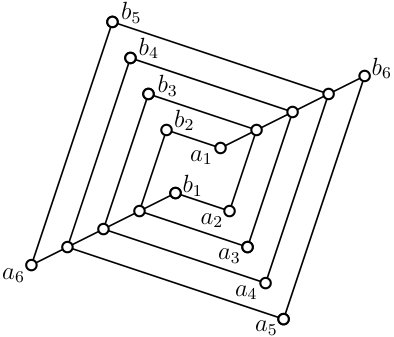 Figure 1
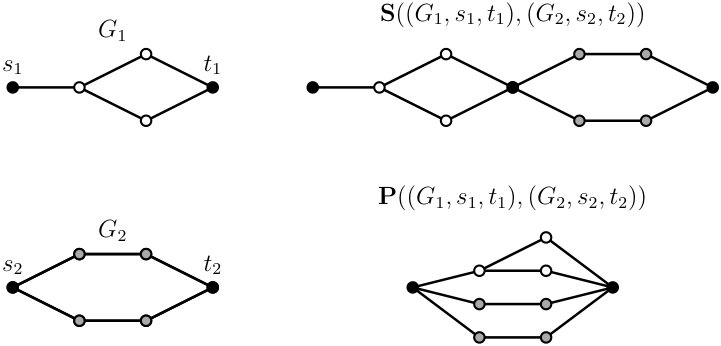 Figure 2
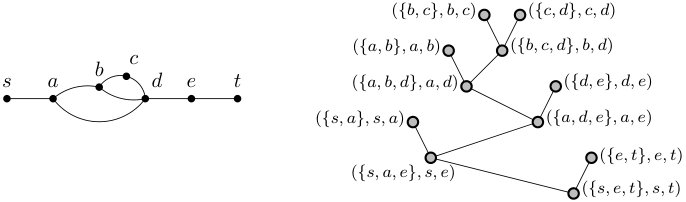 Figure 3