Regulating TNCs: Should Uber and Lyft Set Their Own Rules?
Sen Li, Hamidreza Tavafoghi, Kameshwar Poolla, Pravin Varaiya

TL;DR
This paper uses a queuing model to analyze proposed TNC regulations, finding that minimum wages can benefit drivers and passengers by reducing platform market power, while vehicle caps and congestion taxes have different impacts.
Contribution
It introduces a novel queuing theoretic equilibrium model to evaluate the effects of various TNC regulations on platform dynamics, driver wages, and passenger costs.
Findings
Minimum wage floors increase driver employment and reduce platform rents.
Vehicle caps harm drivers by limiting supply benefits.
Congestion taxes raise fares and decrease wages and platform revenue.
Abstract
We evaluate the impact of three proposed regulations of transportation network companies (TNCs) like Uber, Lyft and Didi: (1) a minimum wage for drivers, (2) a cap on the number of drivers or vehicles, and (3) a per-trip congestion tax. The impact is assessed using a queuing theoretic equilibrium model which incorporates the stochastic dynamics of the app-based ride-hailing matching platform, the ride prices and driver wages established by the platform, and the incentives of passengers and drivers. We show that a floor placed under driver earnings pushes the ride-hailing platform to hire more drivers and offer more rides, at the same time that passengers enjoy faster rides and lower total cost, while platform rents are reduced. Contrary to standard economic theory, enforcing a minimum wage for drivers benefits both drivers and passengers, and promotes the efficiency of the entire…
Click any figure to enlarge with its caption.
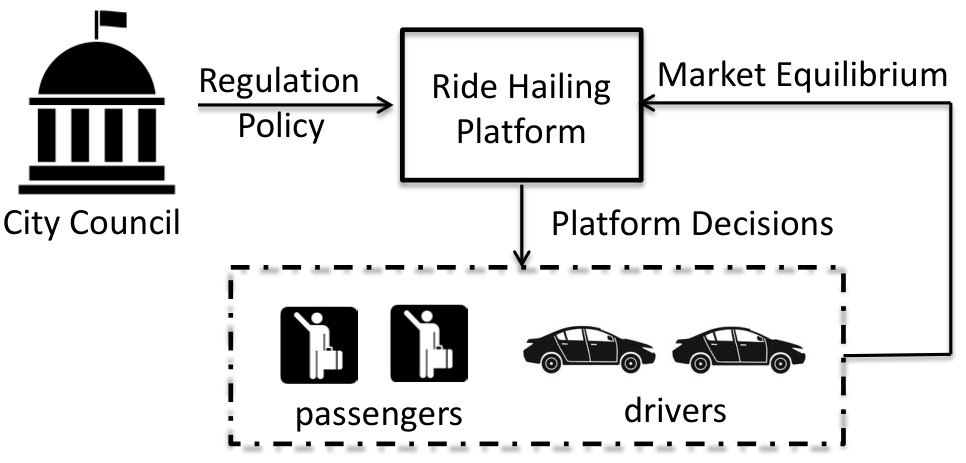 Figure 1
Peer Reviews
No public reviews on file for this paper yet. If you reviewed it on a platform where reviews are public (OpenReview, ICLR, NeurIPS, ICML), you can paste yours below so the community can read it here.
Videos
No videos yet. Explain this paper in a talk, walkthrough, or lecture? Add one.