Metallic glasses for biodegradable implants
Denise C. Ford, David Hicks, Corey Oses, Cormac Toher, Stefano, Curtarolo

TL;DR
This paper introduces a theoretical model within the AFLOW framework to predict glass-forming ability of metallic glasses, focusing on biologically relevant systems for biodegradable implants, and identifies promising alloy compositions for orthopedic applications.
Contribution
A new predictive model for glass-forming ability based on crystalline phase competition, applied to biologically relevant alloy systems for biodegradable implants.
Findings
Identified alloy families suitable for biodegradable orthopedic support.
Predicted elastic properties using rule of mixtures for bulk glass-formers.
Suggested specific alloy compositions for further experimental validation.
Abstract
Metallic glasses are excellent candidates for biomedical implant applications due to their inherent strength and corrosion resistance. Use of metallic glasses in structural applications is limited, however, because bulk dimensions are challenging to achieve. Glass-forming ability (GFA) varies strongly with alloy composition and becomes more difficult to predict as the number of chemical species in a system increases. Here we present a theoretical model - implemented in the AFLOW framework - for predicting GFA based on the competition between crystalline phases, and apply it to biologically relevant binary and ternary systems. Elastic properties are estimated based on the rule of mixtures for alloy systems that are predicted to be bulk glass-formers. Focusing on Ca- and Mg-based systems for use in biodegradable orthopedic support applications, we suggest alloys in the AgCaMg and AgMgZn…
Click any figure to enlarge with its caption.
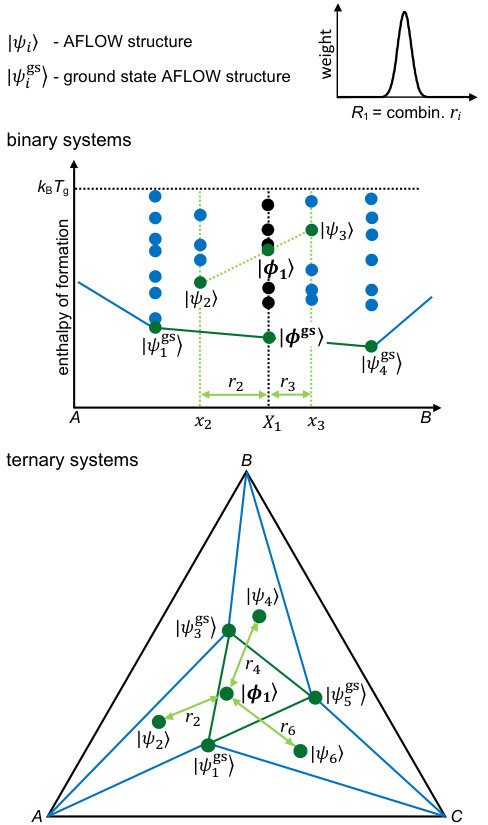 Figure 1
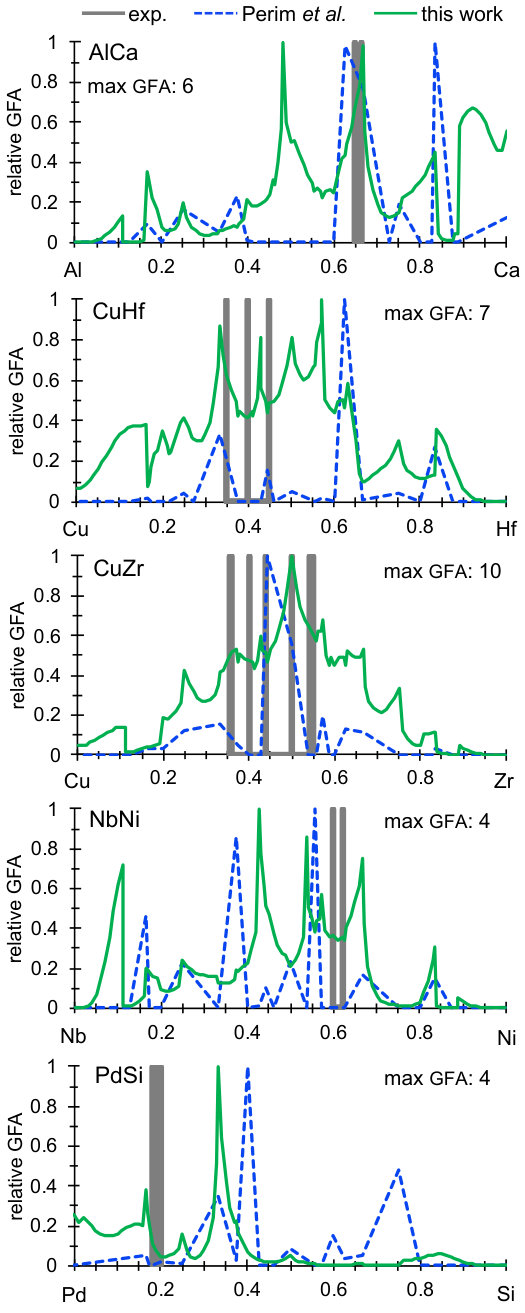 Figure 2
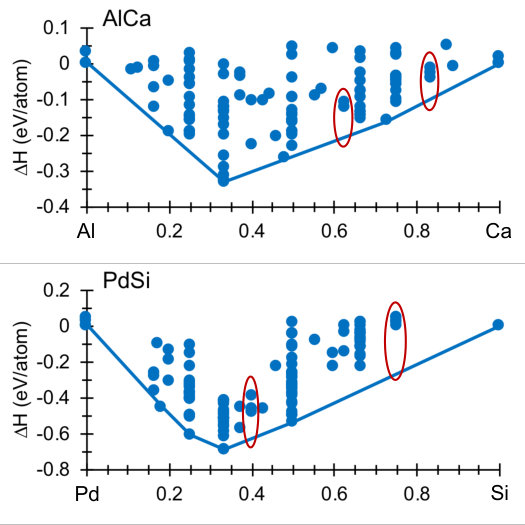 Figure 3
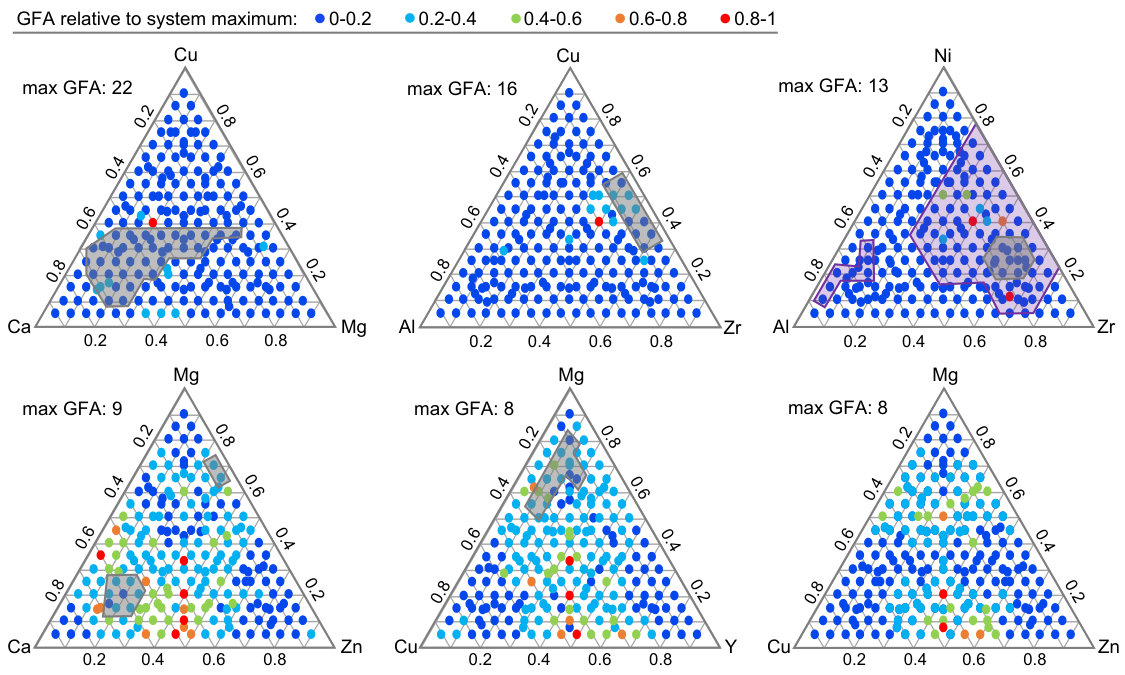 Figure 4
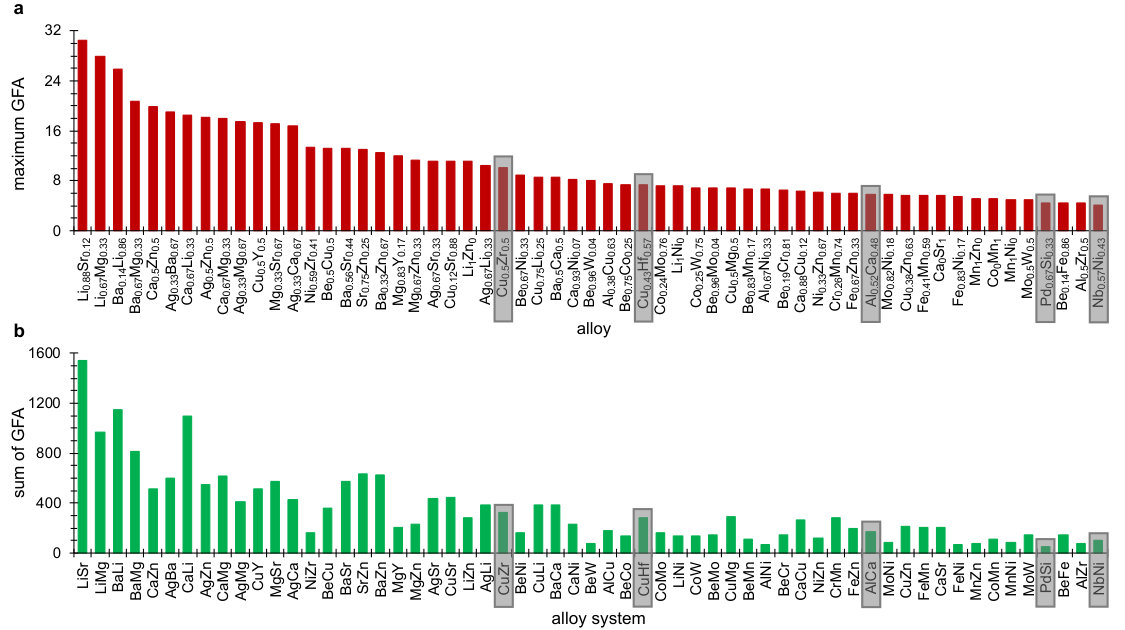 Figure 5
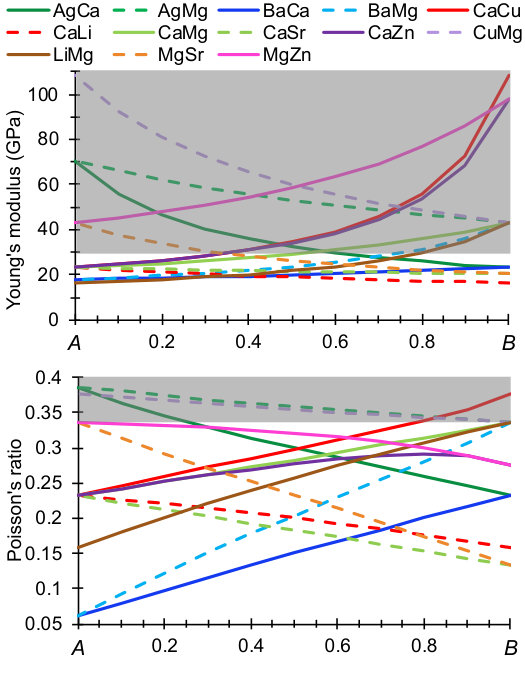 Figure 6
| Alloy | Relative GFA | Alloy | Relative GFA |
|---|---|---|---|
| Ag0.33Ca0.67 | 1 | Ca0.57Mg0.43 | 0.59 |
| AgnCa1-n, | 0.33-0.38 | Ca0.5Mg0.5 | 0.73 |
| Ag0.37Mg0.63 | 0.74 | Ca1Sr0 | 0.58 |
| Ag0.33Mg0.67 | 1 | Ca0.75Sr0.25 | 0.62 |
| Ag0.25Mg0.75 | 0.46 | Ca0.67Sr0.33 | 0.44 |
| Ag0.2Mg0.8 | 0.38 | Ca0.57Sr0.43 | 0.72 |
| AgnMg1-n, | 0.34-0.4 | Ca0.5Sr0.5 | 0.72 |
| Ba0.5Ca0.5 | 1 | Ca0.65Zn0.35 | 0.7 |
| Ba0.44Ca0.56 | 0.67 | Ca0.5Zn0.5 | 1 |
| Ba0.33Ca0.67 | 0.68 | Cu0.5Mg0.5 | 1 |
| Ba0.5Mg0.5 | 0.71 | Cu0.37Mg0.63 | 0.93 |
| Ba0.17Mg0.83 | 0.49 | Cu0.33Mg0.67 | 0.89 |
| Ca0.88Cu0.12 | 1 | Cu0.25Mg0.75 | 0.47 |
| Ca0.76Cu0.24 | 0.58 | CunMg1-n, | 0.4-0.54 |
| Ca0.67Cu0.33 | 0.6 | LinMg1-n, | 0.41-0.55 |
| Ca0.62Cu0.38 | 0.69 | MgnSr1-n, | 0.36-0.42 |
| CanLi1-n, | 0.43-0.51 | Mg0.83Sr0.17 | 0.55 |
| Ca0.75Li0.25 | 0.9 | Mg0.5Sr0.5 | 0.66 |
| Ca0.67Li0.33 | 1 | Mg0.75Zn0.25 | 0.4 |
| Ca0.5Li0.5 | 0.84 | Mg0.67Zn0.33 | 1 |
| Ca0.75Mg0.25 | 0.35 | Mg0.5Zn0.5 | 0.4 |
| Ca0.67Mg0.33 | 1 |
| Alloy | GFA | (GPa) | |
| Ca0.4Cu0.4Mg0.2 | 22 | 36 | 0.31 |
| Ca0.33Mg0.33Zn0.33 | 9 | 37 | 0.30 |
| Ca0.5Mg0.05Zn0.45 | 9 | 33 | 0.28 |
| Ca0.4Mg0.2Zn0.4 | 9 | 36 | 0.29 |
| Ca0.45Mg0.1Zn0.45 | 8 | 35 | 0.28 |
| Ca0.6Mg0.35Zn0.05 | 8 | 28 | 0.27 |
| Ca0.6Mg0.05Zn0.35 | 8 | 30 | 0.27 |
| Ca0.45Mg0.05Zn0.5 | 7 | 35 | 0.28 |
| Ca0.71Mg0.14Zn0.14 | 7 | 27 | 0.26 |
| Ca0.46Mg0.08Zn0.46 | 6 | 35 | 0.28 |
| Ca0.7Mg0.15Zn0.15 | 6 | 27 | 0.26 |
| Ca0.43Mg0.14Zn0.43 | 6 | 35 | 0.28 |
| Ca0.5Mg0.45Zn0.05 | 6 | 30 | 0.28 |
| Ca0.5Mg0.25Zn0.25 | 6 | 31 | 0.28 |
| Cu0.46Mg0.08Zn0.46 | 8 | 92 | 0.33 |
| Cu0.4Mg0.2Zn0.4 | 6 | 79 | 0.33 |
| Cu0.35Mg0.05Zn0.6 | 6 | 94 | 0.31 |
| Cu0.4Mg0.05Zn0.55 | 5 | 95 | 0.32 |
| Cu0.25Mg0.5Zn0.25 | 5 | 59 | 0.34 |
Peer Reviews
No public reviews on file for this paper yet. If you reviewed it on a platform where reviews are public (OpenReview, ICLR, NeurIPS, ICML), you can paste yours below so the community can read it here.
Videos
No videos yet. Explain this paper in a talk, walkthrough, or lecture? Add one.
Taxonomy
TopicsMetallic Glasses and Amorphous Alloys · Magnesium Alloys: Properties and Applications · High Entropy Alloys Studies
Metallic glasses for biodegradable implants
Denise C. Ford
Department of Mechanical Engineering and Materials Science and Center for Materials Genomics, Duke University, Durham, North Carolina 27708, USA
David Hicks
Department of Mechanical Engineering and Materials Science and Center for Materials Genomics, Duke University, Durham, North Carolina 27708, USA
Corey Oses
Department of Mechanical Engineering and Materials Science and Center for Materials Genomics, Duke University, Durham, North Carolina 27708, USA
Cormac Toher
Department of Mechanical Engineering and Materials Science and Center for Materials Genomics, Duke University, Durham, North Carolina 27708, USA
Stefano Curtarolo
Department of Mechanical Engineering and Materials Science and Center for Materials Genomics, Duke University, Durham, North Carolina 27708, USA
Departments of Electrical Engineering, Physics, and Chemistry, Duke University, Durham, North Carolina 27708, USA
Abstract
Metallic glasses are excellent candidates for biomedical implant applications due to their inherent strength and corrosion resistance. Use of metallic glasses in structural applications is limited, however, because bulk dimensions are challenging to achieve. Glass-forming ability (GFA) varies strongly with alloy composition and becomes more difficult to predict as the number of chemical species in a system increases. Here we present a theoretical model — implemented in the AFLOW framework — for predicting GFA based on the competition between crystalline phases, and apply it to biologically relevant binary and ternary systems. Elastic properties are estimated based on the rule of mixtures for alloy systems that are predicted to be bulk glass-formers. Focusing on Ca- and Mg-based systems for use in biodegradable orthopedic support applications, we suggest alloys in the AgCaMg and AgMgZn families for further study; and alloys based on the compositions: Ag0.33Mg0.67, Cu0.5Mg0.5, Cu0.37Mg0.63 and Cu0.25Mg0.5Zn0.25.
Metallic glasses demonstrate greater strength and corrosion resistance than their crystalline counterparts, and are therefore highly sought-after materials for a variety of applications, such as precision gears, sporting goods, and medical devices Johnson_BMG_2009 ; Kruzic_aem_BMGstruct_2016 ; Li_actabiomat_BmgAdv_2016 ; Kaur_jbmra_RevBioactiveGlass_2014 ; Inoue_imr_ironBMG_2013 . These properties are of particular importance for biomedical implant applications — as implant materials must maintain function and biocompatibility in a chemically and mechanically complex physiological environment. For example, stainless steel, which is well-known for strength, corrosion resistance, and biocompatibility, is commonly used in implantable devices (e.g. vascular stents, pacemakers, and total joint replacements) Thouas_mser_metalImplant_2015 . Materials-related failure of these devices, however, does occur and can necessitate a revision surgery. In particular, structural support implants are plagued by fatigue and stress corrosion cracking, despite optimization of the steel by alloying and surface treatments Thouas_mser_metalImplant_2015 . Ions are released during corrosion and structural failure, which can lead to allergic reaction, metallosis, or toxicity.
For applications where only temporary support is required, such as bone plates and coronary stents, an intentionally degradable material can be used; this reduces the occurrence of implant removal surgeries and eliminates concern over long-term embedding of a foreign object. Mg-based alloys are considered for orthopedic applications: densities and mechanical properties are similar to bone, and Mg is an essential nutrient for humans that is active in bone development Staiger_biomat_MgOrtho_2006 . Despite favorable characteristics and intense study over the last two decades Walker_jbmrb_MgBioPerspec_2014 ; Farraro_jbm_RevolOrtho_2014 ; Chen_actabiomat_MgAdv_2014 ; Jafari_jom_MgSCC-CF_2015 ; Agarwal_msec_MgRevCBS_2016 , Mg-based alloys are still not in wide-spread clinical use because they often degrade too quickly forming hydrogen gas. When the rate is too high, bubbles can interfere with tissue healing Narayanan_pms_MAO_2014 ; Kraus_actabiomat_Mginvivo_2012 ; Song_CS_BioDC_2007 ; Ibrahim_msec_PostFab_2017 , block the blood stream, or cause alkaline poisoning Narayanan_pms_MAO_2014 ; Song_CS_BioDC_2007 .
Alternative to traditional metallurgical approaches — alloying and heat treating — strength and corrosion resistance can be improved for a material by forming an amorphous structure. Since glasses lack grain boundaries and dislocations, galvanic couples are reduced and slip planes are eliminated. Ion diffusion may also be retarded by elimination of structural defects, enhancing corrosion resistance. Many studies indicate that metallic glasses have higher yield strength than their crystalline counterparts, and the yield strength increases with the glass transition temperature Cheng_pms_SPMG_2011 . Fe-based metallic glasses have been shown to passivate/repassivate quickly in aqueous solutions and have high resistance to pitting, potentially retarding stress corrosion cracking Scully_jmr_BMG-CMP_2007 . No hydrogen evolution could be clinically observed for a MgZnCa metallic glass studied for biomedical implant purposes Zberg_NMAT_MgZnCa_2009 . Elimination of structural defects, however, can be problematic for support applications because plastic deformation cannot occur. Many metallic glasses have been shown to undergo brittle fracture Cheng_pms_SPMG_2011 , and increasing ductility is currently an active research area Lewandowski_phml_plasticMG_2005 ; Chen_armr_MG-duct_2008 .
Discovery of new metallic glass-forming systems has also been vigorously pursued over the past few decades. The empirical rules devised by Inoue Inoue_stabilization_2000 have been heavily relied upon for experimental discovery. Further guidance is needed: recent works estimate that there are 3 million potential binary, ternary, and quaternary bulk metallic glasses based on empirical rules Li_acscombsci_numMG_2017 , and that it could take up to a decade to search the ternary space of the 30 common elements with high-throughput combinatorial experimentation Ren_sciadv_MGexpML_2018 . Physical models for glass-forming ability (GFA) have been suggested Vincent_jncs_thermoBMG_2011 ; Laws_ncomm_BMGmodel_2015 ; zhang2015origin ; LL_jap_compGFA_2010 , yet no complete, robust theory exists. Recently, the concept of structural confusion during cooling advanced by Greer in 1993 greer1993confusion has been explored computationally by Perim et al. curtarolo:art112 with reasonable success. A glass-forming descriptor was devised based on similarity between the formation enthalpies of compounds available in a given system (similar probability of occurrence) and between their crystal structures (large differences creating confusion). The descriptor was successfully applied to the AFLOW.org repository aflowlib ; curtarolo:art92 ; curtarolo:art75 of first-principles calculations of binary alloys. Extension to higher-order systems, however, is not trivial. Glass-forming ability is expected to increase with the number of species in a system because the configuration space grows LL_jap_compGFA_2010 , but this is not always the case Laws_ncomm_BMGmodel_2015 ; zhang2015origin . Since the GFA of a glass directly relates to the critical dimensions of a glassy alloy, it is of great technological interest to predict materials with high GFA for use in applications where bulk dimensions are required.
Here, we define and compute the GFA for binary and ternary alloy systems of interest for biomedical implant applications, extending the concept of structural frustration greer1993confusion and the approach of Perim et al. curtarolo:art112 . In the remainder of this article, we describe the formalism for the prediction of GFA and validate the approach against known bulk glass-forming systems found in the literature. We then present predictions for glass-formation in biologically relevant alloy systems and estimate their elastic properties based on the rule of mixtures. Finally, we recommend alloys for use in orthopedic support applications.
Calculation of glass-forming ability. The calculation of GFA is based on the formalism described in Ref. curtarolo:art112 , in which all of the metastable structures available at a given stoichiometry vector {} are compared to a reference state — the structure with the lowest enthalpy of formation at {}. An average structural similarity between metastable structures is also considered. Individual structures are represented by a vector of the local atomic environments (AE) villars:factors calculated for each unique atom. The AE of an atom is defined as the polyhedron formed by the atoms within the maximum gap in the radial distribution function. Functions describing the similarity between the structures , similarity between the formation enthalpies of a metastable structure and the reference state , and sampling are combined as:
[TABLE]
This works well as a first-order approximation for binary systems. Here it is further developed to include contributions from local variations in stoichiometry, and the chemical identity of the central atom in each AE. The reference state is also more accurately described by calculating the convex hull for each system using AFLOW-CHULL Oses_CHULL_JCIM-pub_2018 .
In Perim et al. curtarolo:art112 , only the competition between structures with the same stoichiometry was considered. In real systems, however, local variations in composition allow for structures with different stoichiometries to participate in the competition. Here, these structures are included as linear combinations of database structures with stoichiometry . A combination is designated as pseudostructure . Coefficients are assigned to balance the local stoichiometries, , with the global stoichiometry, :
[TABLE]
The concept is depicted in Fig. 1.
As in Ref. curtarolo:art112 , the are comprised of sets of AE calculated for each unique atom. Each carries a coefficient, which indicates the relative amount of the AE present in . Here, information about the amount of present in pseudostructure is also included in the coefficient, designated as . Mathematically, the combination is written as:
[TABLE]
where is the Kronecker , and is the number of times occurs in . Linear combinations of pairs and triplets are created for binary and ternary alloy systems, respectively. At {}, the convex hull defines the ground state, which may consist of one or more structures (decomposition products). Therefore, it is represented as a pseudostructure, , and defined in the same way as Eqn. (3).
The similarity between two pseudostructures, and , is quantified by the scalar product:
[TABLE]
The chemical identity of the central atom in each AE is retained, and only environments for the same chemical species are compared. The overall comparison is a linear combination of the individual comparisons:
[TABLE]
where are fractions of each species at {}.
The function which describes the structural similarity between a metastable state, , and the ground state, , is constructed to be a maximum when the pseudostructures have no AEs in common and zero when they are equivalent:
[TABLE]
where is the weight of each pair (triplet) contributing to the GFA. They follow a Gaussian distribution based on the dimensionless difference between the local and global stoichiometries, :
[TABLE]
and is a fitting factor set to 0.1. The structural similarity amongst pairs (triplets) of metastable states contributes as a weighted average:
[TABLE]
The GFA computed for each stoichiometry of a given alloy system is normalized by the sum of the weights of each contribution, .
The enthalpy proximity between a metastable state and the ground state is calculated by
[TABLE]
where is the formation enthalpy per atom of a pseudostructure, is the formation enthalpy per atom of the ground state, is the Boltzmann constant, and is room temperature.
Finally, the overall GFA at each global stoichiometry {} is calculated as:
[TABLE]
where 100 is an arbitrary scaling factor.
First-principles calculations of alloy prototypes. The crystal structures and enthalpies of formation of the alloys are taken from the AFLOW.org repository aflowlib ; curtarolo:art92 ; curtarolo:art75 . The original calculations were performed systematically using the AFLOW computational materials design framework aflow_fleet_chapter ; aflowPAPER18 ; curtarolo:art65 , with the AFLOW standard settings curtarolo:art104 . These include density functional theory as implemented in VASP kresse_vasp ; vasp_prb1996 , the GGA-PBE exchange-correlation functional PBE , PAW potentials PAW ; kresse_vasp_paw , at least 6,000 k-points per reciprocal atom, and a plane-wave cutoff of at least 1.4 times the largest recommended value for the VASP potentials of the constituents. The input crystal structures were built from the AFLOW library of common prototypes aflowANRL ; anrl_pt2_2018 .
Model validation. The GFA predictions made with the current model are shown in Fig. 2 for five binary alloy systems known to form bulk metallic glasses. The compositions where glasses have been produced with a critical diameter of greater than 1 mm Guo_apl_CaAl-BMG_2004 ; inoue2004formation ; xia2006glass ; wang2004bulk ; li2008matching ; Xia_jap_NbNi-BMG_2006 ; leonhardt1999solidification ; Chen_amet_PdSi-BMG_1969 are also marked. In all cases, GFA greater than 1/3 of the system maximum is predicted at or near the experimentally determined bulk glass-forming compositions. The predictions made using the method of Perim et al. curtarolo:art112 are shown for comparison, where peaks are often found at or near the experimental compositions. In some instances, there is a significant difference between the GFA predicted using the two computational methods which can be attributed to the change in reference state. These are highlighted in Fig. 3 for AlCa and PdSi. At each highlighted composition a large peak is predicted by the method in Ref. curtarolo:art112 , which uses the structure with the lowest enthalpy of formation at a given stoichiometry for the reference state. Because the convex hull calculation indicates a phase separation at these compositions, using it to find the reference state reduces the predicted GFA. Other improvements to the predictions can be attributed to including contributions from local off-stoichiometry clusters, and to a lesser extent, changes in the comparison of the AEs. The precision of the calculation is also increased by using the current model, since the GFA can be calculated at compositions where no structures are available in the database.
GFA predictions for the known bulk glass-forming systems — AlCuZr Kim_msea_AlCuZr-1_2006 ; Xu_prl_AlCuZr-2_2004 ; Inoue_mattrans_AlCuZr-3_1995 ; Wang_actamat_AlCuZr_2005 , AlNiZr Inoue_mattrans_AlNiZr-1_1990 ; Li_jac_AlNiZr-2_2012 , CaCuMg Senkov_jac_CaMgCu-BMG_2006 ; Laws_jac_AgCaCuMg_2012 , CaMgZn Gu_jmr_MgCaZn_2005 ; Senkov_jncs_CaMgZn-BMG_2005 ; Park_jmr_CaMgZn-2_2004 , and CuMgY Ma_jmr_CuMgY-1_2005 ; Inoue_mattrans_MgCuY_1991 — are shown in Fig. 4. To reduce calculation time, a cutoff of is imposed for including a pseudostructure in the GFA calculation. Testing was performed for the CaCuMg, CaMgZn, and CuMgY systems, which indicates an insignificant effect on the predictions. A maximum GFA of at least 4 is predicted for all five systems where bulk alloys have been produced, consistent with the results for binary alloy systems (Fig. 2). Regions where bulk glasses have been produced tend to be near compositions where high GFA is predicted, and additional compositions may be possible (Fig. 4). Experimentally, regions of potential bulk-glass formation in the AlNiZr system have been predicted by evaluating the supercooled liquid Inoue_mattrans_AlNiZr-1_1990 and are outlined in purple. Reports emphasize that GFA changes rapidly with composition Ma_jmr_CuMgY-1_2005 , and as little as 1% change in composition could change a result from amorphous to crystalline Wang_actamat_AlCuZr_2005 . Therefore, it is important to comprehensively search the phase space. A broad search is performed computationally, and high GFA compositions far from experimentally confirmed glasses are predicted. These compositions offer a guide for experimentalists, but are limited in precision due to the sampling grid and available crystal structures.
Calculation of elastic properties. The elastic properties of metallic glasses have been extensively reviewed and can be estimated from the rule of mixtures Wang_pms_elasticMG_2012 ; Zhang_jac_elastic-correlations_2007 . Here the following equation is used:
[TABLE]
where is the elastic constant of the system, and and are the molar fraction and elastic constant of the component elements in bulk form. The elastic properties for the elements are taken from Ref. webelements . This method generally under-predicts the bulk modulus and over-predicts the shear modulus, and , respectively. Performing a linear regression on data for the 18 binary and ternary systems available in Ref. Wang_pms_elasticMG_2012 which are relevant to the current study gives the equations:
[TABLE]
[TABLE]
Poisson’s ratio () can be used to assess brittle vs. ductile behavior, as metallic glasses with tend to exhibit brittle behavior Wang_pms_elasticMG_2012 ; Zhang_jac_elastic-correlations_2007 . Since metallic glasses are macroscopically isotropic, Poisson’s ratio is calculated as:
[TABLE]
Using the and calculated from Eqns. (12) and (13) in Eqn. (14) correlates well with the measured Poisson’s ratios reported in Ref. Wang_pms_elasticMG_2012 :
[TABLE]
Another commonly applied indicator of brittle vs. ductile behavior, the Pugh’s modulus ratio (/), is less reliably predicted from Eqns. (11-13). The Young’s modulus () correlates with fracture strength () as =, and is calculated as Wang_pms_elasticMG_2012 .
Application to biologically relevant systems. The GFA for binary combinations of macronutrient metals (Ca, Mg), trace metals in the human body (Ba, Be, Co, Cr, Cu, Fe, Li, Mn, Mo, Ni, Sr, Zn, W), and antibacterial Ag Thouas_mser_metalImplant_2015 ; Vasconcelos_biomat_twoface_2016 ; Kaur_jbmra_RevBioactiveGlass_2014 is calculated. Sampling for these binary systems ranges from 134 to 910 converged crystal structures. Upon removal of duplicates (one converged structure is equivalent to another converged structure aflowsym ; aflow_compare-updated_2018 ), structures with formation enthalpy greater than 0.05 eV (600 K, a typical critical temperature for glass formation), and structures for which AEs could not be determined; 4 to 567 structures remain for each system for calculation of the GFA. Finally, systems with less than 20 remaining structures are considered to have insufficient sampling and removed from the analysis. This leaves 55 systems, of which 49 have a maximum GFA > 4 (the smallest maximum for known binary bulk glass-forming systems) and 21 have a maximum GFA > 10 (the largest maximum for the known binary bulk glass-forming systems). The maximum GFA and the composition at which it occurs for these systems is shown in Fig. 5. Metallic glasses have been produced experimentally for ten of them — AgCa Amand_smet_CaSr-based-MG_1978 , CaCu Amand_smet_CaSr-based-MG_1978 , CaMg Amand_smet_CaSr-based-MG_1978 , CuMg Kim_mattrans_CuMg-MG_1990 , CaZn Amand_smet_CaSr-based-MG_1978 , MgSr Amand_smet_CaSr-based-MG_1978 , MgZn Calka_smet_MgZn-MG_1977 , and SrZn Amand_smet_CaSr-based-MG_1978 .
The ternary system CuMgZn is also studied. Sampling for the ternary systems ranges from 1276 to 1399 converged crystal structures. Upon removal of duplicates aflowsym ; aflow_compare-updated_2018 , structures with formation enthalpy greater than 0.05 eV, and structures for which AEs could not be determined; 399 to 580 structures remain for each system for calculation of the GFA. The predictions are shown in Fig. 4. CuMgZn has a maximum predicted GFA of 8, therefore is expected to be a bulk glass-forming system.
Because macronutrient Mg and Ca are known to be good glass-formers Senkov_jac_CaMgCu-BMG_2006 ; Laws_jac_AgCaCuMg_2012 ; Senkov_jncs_CaMgZn-BMG_2005 ; Amand_smet_CaSr-based-MG_1978 ; Calka_smet_MgZn-MG_1977 ; Park_jmr_CaMgZn-2_2004 ; Ma_jmr_CuMgY-1_2005 ; Inoue_mattrans_MgCuY_1991 ; Kim_mattrans_CuMg-MG_1990 ; Gu_jmr_MgCaZn_2005 and these elements are used by the human body for bone growth and repair Kaur_jbmra_RevBioactiveGlass_2014 , we focus the rest of this discussion on Mg- and Ca- based alloys for orthopedic applications. GFA peaks greater than 1/3 of the system maximum for Mg-rich and Ca-rich binary alloys are presented in Table 1. The Young’s moduli and Poisson’s ratios for these alloy systems are plotted in Fig. 6, and the Young’s moduli and Poisson’s ratios for the best glass-forming compositions of the relevant ternary alloy systems — CaCuMg, CaMgZn, and CuMgZn — are given in Table 2.
Many of the glasses presented in Tables 1 and 2 will be strong enough for orthopedic applications, as the Young’s modulus of bone ranges from 3 to 30 GPa Jafari_jom_MgSCC-CF_2015 . Most of these, however, are predicted to be brittle. This is not surprising, considering that the Poisson’s ratio of pure elemental Ca is 0.31 and Mg is 0.29 webelements ; and many of the Ca- and Mg- based metallic glasses studied experimentally exhibit brittle behavior Guo_scrmat_Mg-duct_2007 ; Widom_prb_CaMG-elastic_2011 ; Laws_actamat_MgDuct_2016 . Moreover, some glasses have shown bending ductility in ribbon form after production, but embrittle at room-temperature after only a few days or weeks Calka_smet_MgZn-MG_1977 ; Laws_actamat_MgDuct_2016 . Researchers have suggested alloying with elements that minimize charge transfer Widom_prb_CaMG-elastic_2011 ; Laws_actamat_MgDuct_2016 to increase ductility and elements with higher melting temperatures to increase stability Laws_actamat_MgDuct_2016 . We suggest alloys with high predicted Poisson’s ratios.
Following the analyses of GFA and elastic properties, Ag0.37Mg0.63, Ag0.33Mg0.67, Cu0.5Mg0.5, Cu0.37Mg0.63, Cu0.33Mg0.67, and Cu0.25Mg0.5Zn0.25 alloys are predicted to have high GFA, strength, and ductility. Therefore these alloys are recommended for further consideration as biomedical implant materials for orthopedic applications. Additional ternary systems are suggested based on the results of the binary system GFA calculation and estimation of elastic properties.
The sum of the predicted GFA values for each of the six ternary systems included in this study is found to correlate linearly with the sum of the GFA in their component binary systems. Since the sum of the GFA for a system comprises the aspects of maximum and breadth, it can be used as a rough indicator of potential good higher-order glass-forming systems. Considering ternary systems which can be created from the set {Ag, Ba, Be, Ca, Co, Cr, Cu, Fe, Li, Mg, Mn, Mo, Ni, Sr, Zn, W}, include Ca and/or Mg, and include only binary pairs with sufficient sampling and GFA > 4; there are 31 additional potential glass-forming systems available for further analysis. Including the six validation systems, the rank of GFA sum from best to worst is {LiMgSr, BaLiMg, CaLiSr, CaLiMg, BaCaLi, BaMgSr, AgCaLi, CaLiZn, AgBaMg, BaCaMg, AgLiMg, CaCuLi, BaMgZn, CuLiMg, BaCaZn, AgCaZn, LiMgZn, CaLiNi, AgCaMg, MgSrZn, AgMgSr, AgBaCa, CaMgSr, CaMgZn, CaSrZn, CuMgSr, AgMgZn, CaCuMg, BaCaSr, AgCaSr, CuMgY, CaCuZn, CaCuSr, CaNiZn, CuMgZn, AlCuZr, AlNiZr}. The GFA sums for their component binary systems are given in Fig. 5.
Estimations of Poisson’s ratios indicate that mostly Ag-rich alloys will fall into the ductile regime, although some Mg-rich alloys in the AgCaMg and AgMgZn systems have an estimated Poisson’s ratio greater than 0.33 and Young’s modulus greater than 40 GPa. Some experimental work has been performed for Ag addition to Ca- and Mg- based alloys. Partial substitution of Ag for Cu in Cu0.25Mg0.65Y0.1 increased the GFA Park_jncs_AgCuMgY_2001 , and substitution of 1-3% Ag for Zn in Ca0.04Mg0.66Zn0.3 decreased the GFA but increased the corrosion resistance Li_jncs_AgCaMgZn_2015 . A wide composition range of AgCaMg bulk metallic glasses have been produced Amiya_mattrans_AgCaCuMg_2002 ; Laws_jac_AgCaCuMg_2012 . Based on these promising theoretical and experimental results, we suggest further exploration of AgCaMg and AgMgZn alloy systems.
Conclusions. A model to predict the glass-forming ability (GFA) of binary and ternary alloys systems was developed based on the competition between crystalline phases, and implemented in the AFLOW framework. The model was applied to material systems relevant for biodegradable orthopedic support implants. Alloys predicted to have high GFA were further analyzed for elastic properties based on the rule of mixtures. Alloys predicted to have high GFA, a Young’s modulus at least as high as bone, and be ductile based on the Poisson’s ratio include: Ag0.33Mg0.67, Cu0.5Mg0.5, Cu0.37Mg0.63 and Cu0.25Mg0.5Zn0.25. Finally, the GFA of binary systems was correlated with the GFA of ternary systems. Based on this analysis and the analysis of elastic properties, the AgCaMg and AgMgZn alloy systems are recommended for further study.
Data availability. All of the ab-initio alloy data is freely available to the public as part of the AFLOW online repository and can be accessed through www.aflow.org following the REST-API interface curtarolo:art92 , and using the AFLUX search language curtarolo:art128 .
The reference list from the paper itself. Each links out to its DOI / PubMed record.
- 1(1) W. L. Johnson, Bulk Glass-Forming Metallic Alloys: Science and Technology , MRS Bull. 24 , 42–56 (1999).
- 2(2) J. J. Kruzic, Bulk Metallic Glasses as Structural Materials: A Review , Adv. Eng. Mater. 18 , 1308–1331 (2016).
- 3(3) H. F. Li and Y. F. Zheng, Recent advances in bulk metallic glasses for biomedical applications , Acta Biomater. 36 , 1–20 (2016).
- 4(4) G. Kaur, O. P. Pandey, K. Singh, D. Homa, B. Scott, and G. Pickrell, A review of bioactive glasses: Their structure, properties, fabrication, and apatite formation , J. Biomed. Mater. Res. Part A 102A , 254–274 (2014).
- 5(5) C. Suryanarayana and A. Inoue, Iron-based bulk metallic glasses , Int. Mater. Rev. 58 , 131–166 (2013).
- 6(6) Q. Chen and G. A. Thouas, Metallic implant biomaterials , Mat. Sci. Eng. R 87 , 1–57 (2015).
- 7(7) M. P. Staiger, A. M. Pietak, J. Huadmai, and G. Dias, Magnesium and its alloys as orthopedic biomaterials: A review , Biomaterials 27 , 1728–1734 (2006).
- 8(8) J. Walker, S. Shadanbaz, T. B. F. Woodfield, M. P. Staiger, and G. J. Dias, Magnesium biomaterials for orthopedic application: A review from a biological perspective , J. Biomed. Mater. Res. Part B 102B , 1316–1331 (2014).