
TL;DR
This paper demonstrates how cyclic unitary processes can extract work from equilibrium states of engineered quantum dissipative systems, effectively charging quantum batteries with considerations of thermodynamic costs and efficiencies.
Contribution
It introduces a method to use dissipative quantum processes for charging quantum batteries, highlighting the thermodynamic costs and optimal conditions for work extraction.
Findings
Work can be cyclically extracted from equilibrium states of dissipative quantum systems.
The process imposes a work cost according to the second law of thermodynamics.
Certain configurations maximize work extraction and efficiency.
Abstract
We show that a cyclic unitary process can extract work from the thermodynamic equilibrium state of an engineered quantum dissipative process. Systems in the equilibrium states of these processes serve as batteries, storing energy. The dissipative process that brings the battery to the active equilibrium state is driven by an agent that couples the battery to thermal systems. The second law of thermodynamics imposes a work cost for the process; however, no work is needed to keep the battery in that charged state. We consider simple examples of these batteries and discuss particular cases in which the extracted work or the efficiency of the process is maximal.
Click any figure to enlarge with its caption.
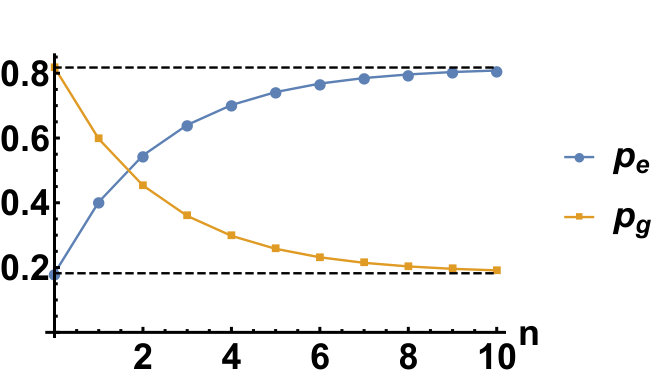 Figure 1
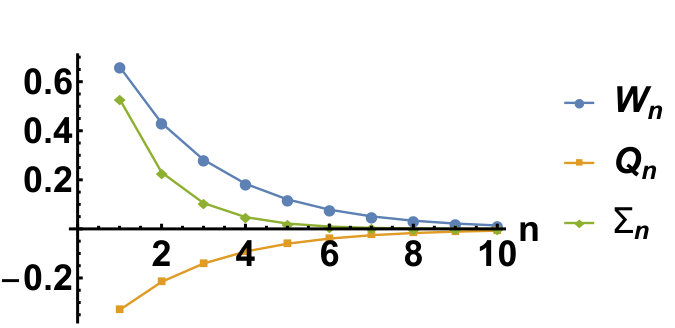 Figure 1
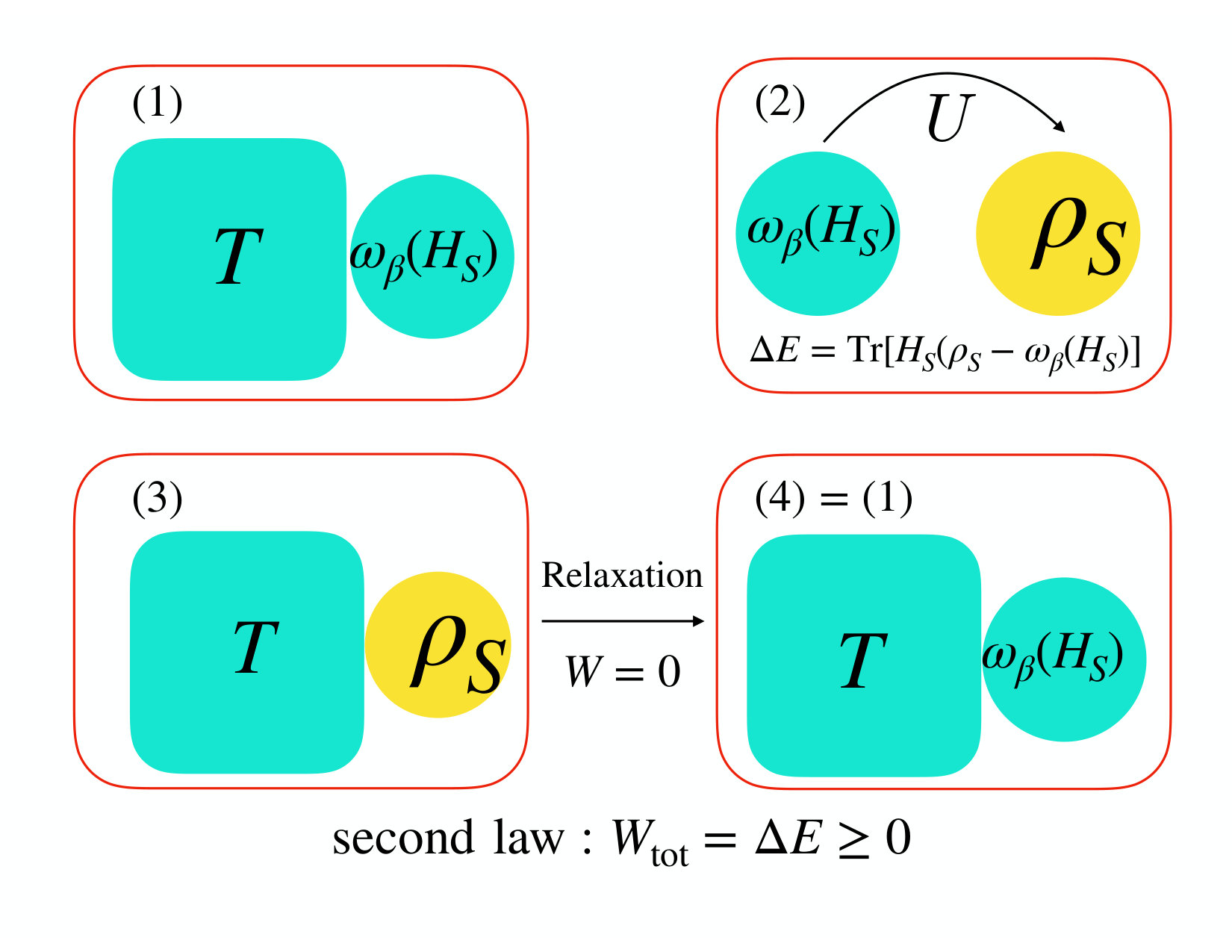 Figure 3
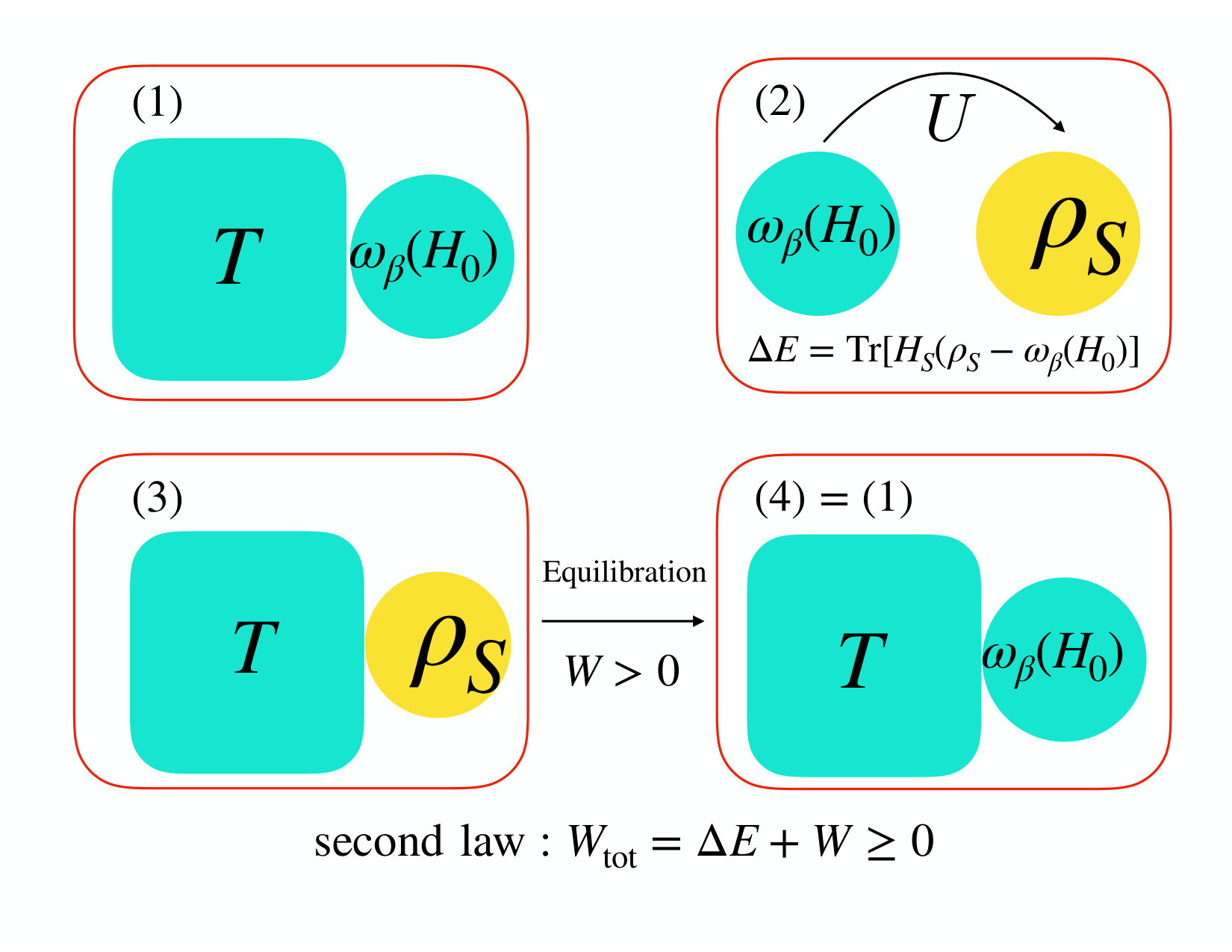 Figure 4
Peer Reviews
No public reviews on file for this paper yet. If you reviewed it on a platform where reviews are public (OpenReview, ICLR, NeurIPS, ICML), you can paste yours below so the community can read it here.
Videos
No videos yet. Explain this paper in a talk, walkthrough, or lecture? Add one.
Dissipative charging of a quantum battery
Felipe [email protected]
Departamento de Física, Facultad de Ciencias Físicas y Matemáticas, Universidad de Chile, Santiago, Chile
Abstract
We show that a cyclic unitary process can extract work from the thermodynamic equilibrium state of an engineered quantum dissipative process. Systems in the equilibrium states of these processes serve as batteries, storing energy. The dissipative process that brings the battery to the active equilibrium state is driven by an agent that couples the battery to thermal systems. The second law of thermodynamics imposes a work cost for the process; however, no work is needed to keep the battery in that charged state. We consider simple examples of these batteries and discuss particular cases in which the extracted work or the efficiency of the process is maximal.
Introduction: In a dissipative process, the state of a system converges asymptotically to an invariant or steady state Breuer . Thus, by engineering a dissipative-open-quantum-system dynamic, a system can be driven to a given target state. This idea has been explored in quantum computation, entanglement generation, and quantum sensing a1 ; a2 ; a3 ; b1 ; b2 ; c1 , thanks to the control achieved on the coupling and coherent dynamics of multipartite quantum systems JBarreiro ; HWeimer ; MMuller .
Another application relevant to future quantum technologies is charging a quantum battery. The process of charging a battery, i.e., storing energy in a quantum system for later use, has been studied in the context of unitary evolution while emphasizing the role of quantum correlations between its components firstQB ; otra bateria ; quantacell1 ; quantacell2 ; campisibatt . Because the target state is given, charging a battery by a unitary process requires fine tuning between the initial state of the battery and the unitary process. This step is avoided by resetting the battery before the charging process. Alternatively, in quantum reservoir engineering, an agent can run a protocol without the need of any information of the battery state and charge it. The question that arises is how efficient such a process can be.
An energetically efficient engineered process should have no work cost to the agent if the battery has already achieved the charged state; otherwise, he dissipates the same currency that he wants to store. From a thermodynamic point of view, steady states of dissipative dynamics are either nonequilibrium states and dissipate energy or are equilibrium states, which are dissipationless. Motivated by these considerations and recent progress in quantum thermodynamics QTh1 ; Qth2 ; Qth3 ; MHP , we consider the following question: Can we engineer a dissipative process for a battery, involving auxiliary systems in the thermal Gibbs states all at the same temperature, such that its invariant state is an equilibrium state where energy can be stored and then extracted? We will show that, for systems with finite dimensional Hilbert space, this is indeed the case. We will characterize the charged equilibrium state by its ergotropy ergotropy and the charging process by its efficiency.
The ergotropy of a state is the maximum work that can be extracted from it in a unitary cyclic process ergotropy . States with positive ergotropy are called active states and those with vanishing, passive states passivity1 ; passivity2 . Equilibrium states reached by a system in a relaxation process are passive; otherwise, a perpetuum mobile of the second kind could be built in contradiction with the Kelvin Planck statement of the second law termobook . However, equilibrium states are not necessarily passive. It is possible to engineer processes with active equilibrium states. The second law implies that there is a work cost implementing the protocol that drives the system to the active equilibrium state supmat .
When the optimal unitary cyclic process extracts the ergotropy, the battery is left in a corresponding passive state. We define the efficiency of the charging process by the ratio between the ergotropy of the equilibrium state and the work cost for the battery charging process from the corresponding passive state. If the battery is recycled after use, this will be the quantity of interest.
Usually, in thermodynamics, there is a tradeoff between the resource we are interested in and the efficiency of the process that produces it. We will show this tradeoff for the ergotropy of active equilibrium states. In particular, we find an engineered thermodynamic process that brings a battery to an equilibrium state with maximal ergotropy, as well as full population inversion but of low efficiency. A process of maximal efficiency with low ergotropy is illustrated with a two-qubit battery, and in supmat , we show that the efficiency generally goes to its maximal value only if the ergotropy goes to zero.
Thermodynamics of open quantum systems: We consider the following idealized scenario: we have a system of interest, the battery with a Hamiltonian and many copies of the same auxiliary system, each with the same Hamiltonian . Initially, all systems are uncorrelated, and every copy of the auxiliary system is in the same temperature Gibbs thermal state , where denotes the total trace. They play the role of a thermal bath. The initial state of the battery is . Systems in the Gibbs state are easy to prepare by coupling them weakly to the environment with inverse temperature (we consider units such that ). To implement the desired dissipative dynamics, an agent couples the battery to one auxiliary system for a lapse of time and then to another system for a subsequent lapse of time and so on, turning on and off the interaction between the battery and different copies of the auxiliary systems, in a repeated interaction process rep-int ; Barra ; Esposito rep. int. . At the th step, the battery interacts with the th member of the auxiliary systems through the time independent potential . This interaction vanishes at the initial , and final times where the interaction is off and the total Hamiltonian is simply . The state of the battery at time reads , where denotes a partial trace over the degrees of freedom of system , in this case the th auxiliary system, and
[TABLE]
where is the unitary time evolution operator for the composite system with the interaction on. Various dissipative processes are modeled in this way, such as streams of atoms moving across a quantum electrodynamic cavity cavities and a boundary driven system rep-int2 , to mention a few. Recently, the importance of the time-dependent coupling for a proper thermodynamic description of these processes was discussed in Barra (see also Chiara ), where the work performed by the agent due to switching on and off the interaction was taken into account.
Let us briefly analyze the thermodynamics of the elementary process of duration . The properties of the concatenated process are deduced from these, see StochPRE ; StochPRE2 for details. The energetics of the th step is characterized by the switching work , and the heat is the negative energy change of the th auxiliary bath system Barra ; Esposito rep. int. ; Chiara . These quantities read as follows:
[TABLE]
where . Their sum is the energy change of the battery (first law), calculated as
[TABLE]
Considering the von-Neumann entropy , the entropy change of the battery in the th step can be expressed as Esposito-NJP
[TABLE]
where
[TABLE]
is the entropy production with the relative entropy, which is nonnegative for any density matrices and Breuer . The inequality in Eq. (6) corresponds to the second law.
In each time step, the battery evolves under the completely positive trace preserving map , and we have characterized the thermodynamic properties for this elementary process. The engineered dissipative dynamics is obtained by concatenating this elementary process ().
We engineer a with a unique invariant state, , attractive due to the contractive character of the relative entropy under the action of the map Breuer . Concatenating it a large number of times, every initial state of the battery will converge to , i.e., ; the work, heat, and entropy produced in this process are the sum of the corresponding quantities, Eqs. (2), (3) and (6), for each step.
We can distinguish two kinds of maps, maps with or without equilibrium StochPRE ; StochPRE2 . If the action of over gives then is a nonequilibrium steady state sustained by dissipated work () performed by the agent. Conversely, if the action of the map over gives , then is an equilibrium state. In equilibrium, the heat, work, and entropy production vanish (): no work is needed to sustain the state . In this case, we say that is an equilibration process. The unitary time evolution operator of a map with equilibrium satisfies StochPRE
[TABLE]
with as an operator on the Hilbert space of the system, and the equilibrium state is .
Among the properties of maps with equilibrium, an important one is that the thermodynamic quantities Eqs. (2), (3) and (6) can be written in terms of system operators only. Heat, work and entropy production take the form
[TABLE]
We see that if , then and is a relaxation process. In this case, the equilibrium state is the passive Gibbs state. If is an operator different from , the equilibrium state may be an active state and the equilibration process has a total work cost , as follows from Eq. (9). Thus, a condition necessary to have a charged battery in an equilibrium state is to engineer a map with an equilibrium state with .
Ergotropy: To quantify the energy stored in a battery, we consider the ergotropy ergotropy
[TABLE]
of its state . This is the maximal amount of work that can be extracted in a unitary cyclic process, where the state evolves unitarily with , and is a time-dependent potential vanishing at the beginning and end of the process, accounting for a cyclic external work source. For passive ergotropy ; passivity2 states one has . States are active if .
If we order the eigenvalues of (assumed to be nondegenerate for simplicity) in increasing order, , and the eigenvalues of in decreasing order, , then the ergotropy of is given ergotropy by
[TABLE]
After the optimal work extraction process, the system is left in the corresponding passive state
[TABLE]
The ergotropy of can then be written as
[TABLE]
Condition for active equilibrium: Let us obtain the conditions for an active equilibrium state . First, note that the equilibrium condition with is satisfied if and . On the basis of common eigenvectors of the nondegenerate and , the equilibrium state is
[TABLE]
and if a pair exists such that , the state is active. Then, its ergotropy is extracted by a process described by a permutation unitary matrix associated to the permutation of such that leaving the battery in the passive state ergotropy
[TABLE]
Note that the total heat and work obtained by Eqs. (8) and (9) characterizing a recharging process are
[TABLE]
and we see that the ergotropy of the state , obtained from Eqs. (14) and (15) is
[TABLE]
and it is related to and by
[TABLE]
Note that (see Eq. (16)) because is the state with minimum average among states with the same entropy supmat . It follows that , and thus, no perpetuum mobile of the second kind can be built. We quantify the efficiency of the charging process by the ratio
[TABLE]
A protocol for active equilibrium: A particularly interesting equilibrating processes with an active equilibrium state is obtained with an interaction where the system operators and auxiliary bath operators satisfy and . In this case, , i.e., we have , and the corresponding process has the equilibrium state
[TABLE]
with .
Since different Hamiltonians with the same Bohr frequency spectrum , are unlikely, the process should be engineered with auxiliary baths that are copies of the system, i.e., . With this specific interaction we have a process with a remarkable thermodynamic equilibrium between a system in the state with copies of itself in the state . Replacing in Eqs. (16) and (17), we see that in the recharging process, , see Eq. (14), and the efficiency of this process is .
Since , the permutation that orders the spectrum in an increasing order is . Therefore, the ergotropy of is , which is positive, and at low temperature, , it is the maximal value .
In general, is upper bounded firstQB by with such that ; it is natural to ask under what conditions can saturate the bound. We found that batteries with symmetric spectrum with respect to some energy value , i.e., saturate the bound. Indeed, in this case, and with as the canonical partition function. Thus, the passive state of as given by Eq. (15) is
[TABLE]
i.e., the Gibbs state with the same temperature as the bath.
Single-qubit battery: For our first example, we consider the battery and auxiliary systems all identical qubits, i.e., the battery Hamiltonian is (with a symmetric spectrum), and the auxiliary systems Hamiltonians are , with . The coupling between the system and the auxiliary qubit is
[TABLE]
and is such that , i.e., . The ergotropy of the battery in the equilibrium state is , which achieves the maximal value in the low temperature regime . In the upper panel of Fig. 1, we plot the populations of the ground () and excited () states of the battery at each elementary step starting from the passive thermal state and in the lower panel, the thermodynamic quantities , and . The population inversion is achieved, and the work cost goes to zero when the system reaches its equilibrium state.
Two-qubit battery: With the previous protocol, we can achieve maximal ergotropy, especially in the low-temperature regime. We will now illustrate with another example that the maximal efficiency can also be achieved but with low ergotropy. In supmat , we show that this result is general.
We consider a two-qubit battery with Hamiltonian
[TABLE]
We take If we consider the process obtained by coupling auxiliary systems of Hamiltonian to the battery of Hamiltonian with
[TABLE]
the equilibrium state is found to be with , whose ergotropy is
[TABLE]
The work done in the dissipative process that recharges the battery is
[TABLE]
We see that the efficiency if for all , yet, to have a finite ergotropy, one would need . Note that if but is small , and for this system the state of maximum ergotropy is the pure state of maximal eigenenergy for which . Details can be found in supmat .
Conclusions: We have shown that by engineering the coupling between a battery and auxiliary systems prepared in Gibbs thermal states, the battery undergoes a thermodynamic process that drives it into an active equilibrium state. The process has a work cost for the agent due to the coupling and decoupling between the battery and auxiliary systems. As a consequence, work can be extracted from the equilibrium state, but no perpetuum mobile of the second kind could be built. The notable aspect of our result is that because the charged state is an equilibrium state, the agent does not waste energy (work) once the battery is in the equilibrium state. One can thus consider that continuing the process once the battery is charged is a convenient way of protecting the charged battery. If a perturbation changes its state, the process will charge the battery again, spending energy only when this happens.
We have characterized the activity of these equilibrium states by their ergotropy and the efficiency of the charging process; furthermore, we showed that in the low-temperature limit, either maximal ergotropy or efficiency could be obtained. We observe a tradeoff between ergotropy and the efficiency of the process that produces it. Interestingly, we have found a dissipative process in which the equilibrium state of the system is while the environment is in the state .
Finally, since all spin-spin 1/2 interactions are possible to implement with trapped ions QGate , the predictions for the qubit battery is testable with current experimental techniques.
Acknowledgements
F.B. gratefully acknowledges comments from C. Lledó and the financial support of FONDECYT grant 1151390 and of the Millennium Nucleus “Physics of active matter” of the Millennium Scientific Initiative of the Ministry of Economy, Development and Tourism (Chile).
The reference list from the paper itself. Each links out to its DOI / PubMed record.
- 1(1) H.-P. Breuer and F. Petruccione, The Theory of Open Quantum Systems (Oxford University Press, Oxford), 2002.
- 2(2) C. J. Myatt, et. al., Nature 403 , 269 (2000).
- 3(3) M. P. Almeida, et. al., Science 316 579 (2007)
- 4(4) O. Jiménez Farías, et. al.,Science 324 1414 (2009)
- 5(5) J. F. Poyatos, J. I. Cirac, and P. Zoller, Phys. Rev. Lett. 77 4728 (1996).
- 6(6) A. R. R. Carvalho, P. Milman, R. L. de Matos Filho, and L. Davidovich Phys. Rev. Lett. 86 , 4988 (2001).
- 7(7) G. Goldstein, et. al., Phys. Rev. Lett. 106 , 140502 (2011).
- 8(8) J. T. Barreiro et al., Nature 470 486 (2011).