Perfect crossed Andreev reflection in Dirac hybrid junctions in the quantum Hall regime
Song-Bo Zhang, Bj\"orn Trauzettel

TL;DR
This paper proposes a method to achieve perfect crossed Andreev reflection in Dirac semimetal junctions under quantum Hall conditions, enabling high-efficiency Cooper pair splitting and spin injection, with controllable parameters and measurable conductance signatures.
Contribution
It introduces two setups for quantum Hall-superconductor-quantum Hall junctions in Dirac materials that realize unity CAR probability without bias, advancing quantum transport control.
Findings
CAR probability can reach unity in proposed setups
CAR is controllable by magnetic field, geometry, and doping
Quantized spin injection per CAR event identified
Abstract
Perfect crossed Andreev reflection (CAR) is striking for high-efficiency Cooper pair splitting which bears promising applications in quantum communication. Recent experimental advances have disclosed the way to explore CAR in Dirac fermion systems under ultra-strong magnetic fields. We develop a scattering approach to study quantum Hall-superconductor-quantum Hall (QH-S-QH) junctions formed by a two-dimensional (2D) time-reversal symmetric Dirac semimetal. We propose two different setups of the hybrid junction in the quantum limit where only zeroth Landau levels are involved in transport to exploit perfect CAR. In both setups, the CAR probability can reach unity without applying bias voltage and is controllable by the magnetic field strength, junction width, length and doping of the superconductor. CAR dominates the nonlocal transport and is directly measurable by the differential…
Click any figure to enlarge with its caption.
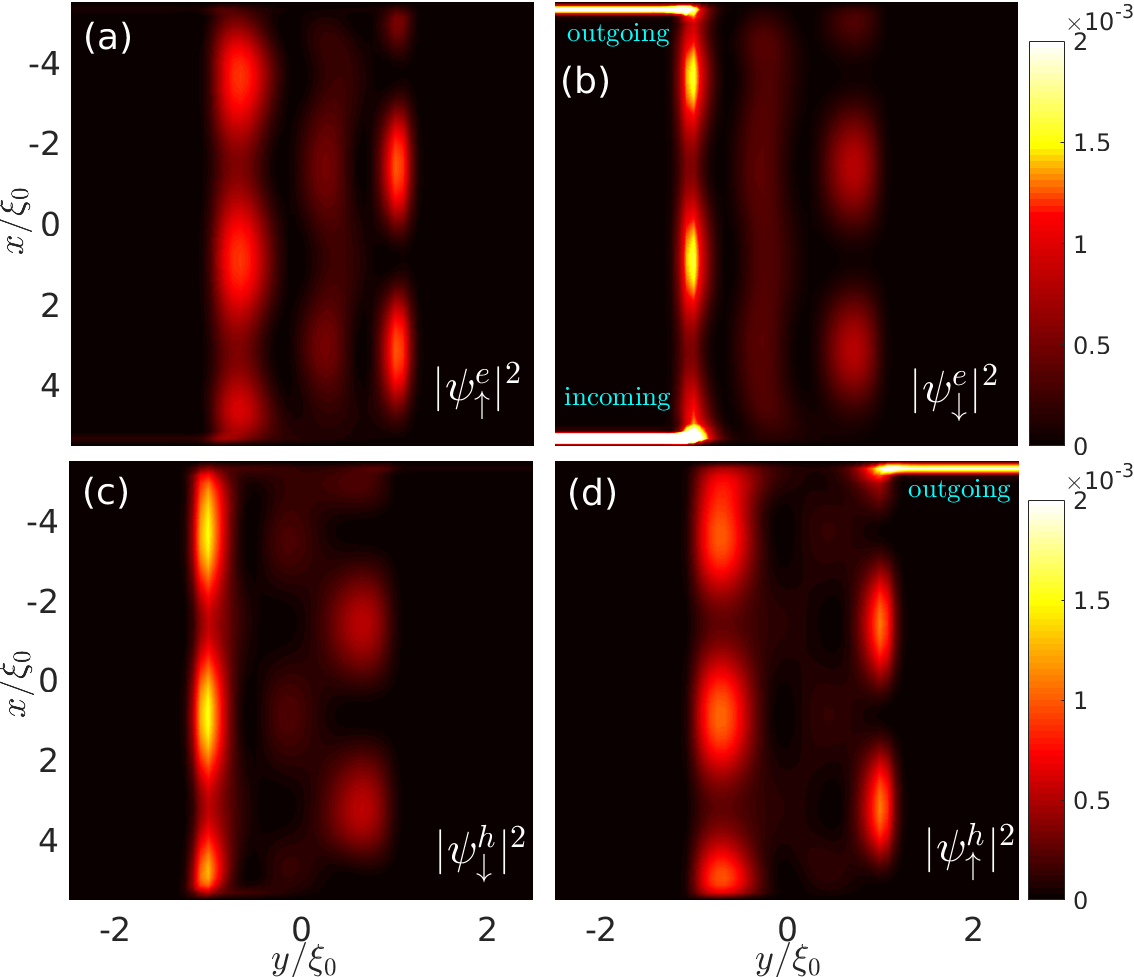 Figure 1
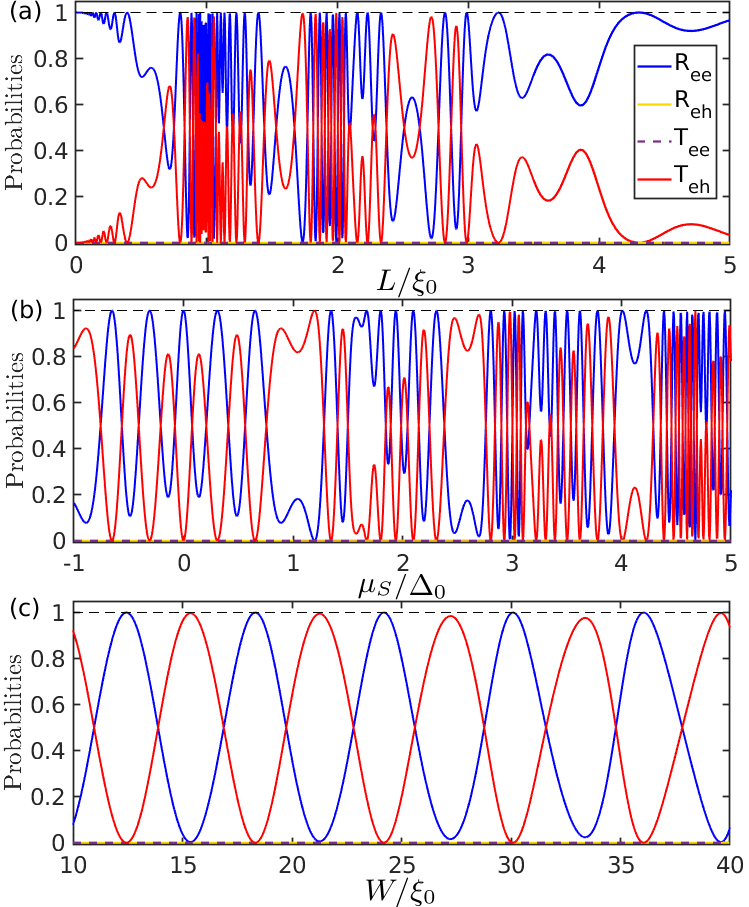 Figure 2
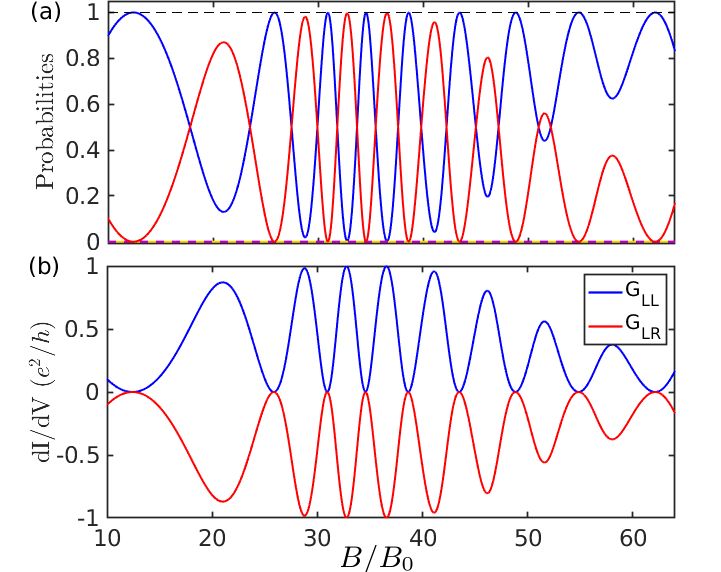 Figure 3
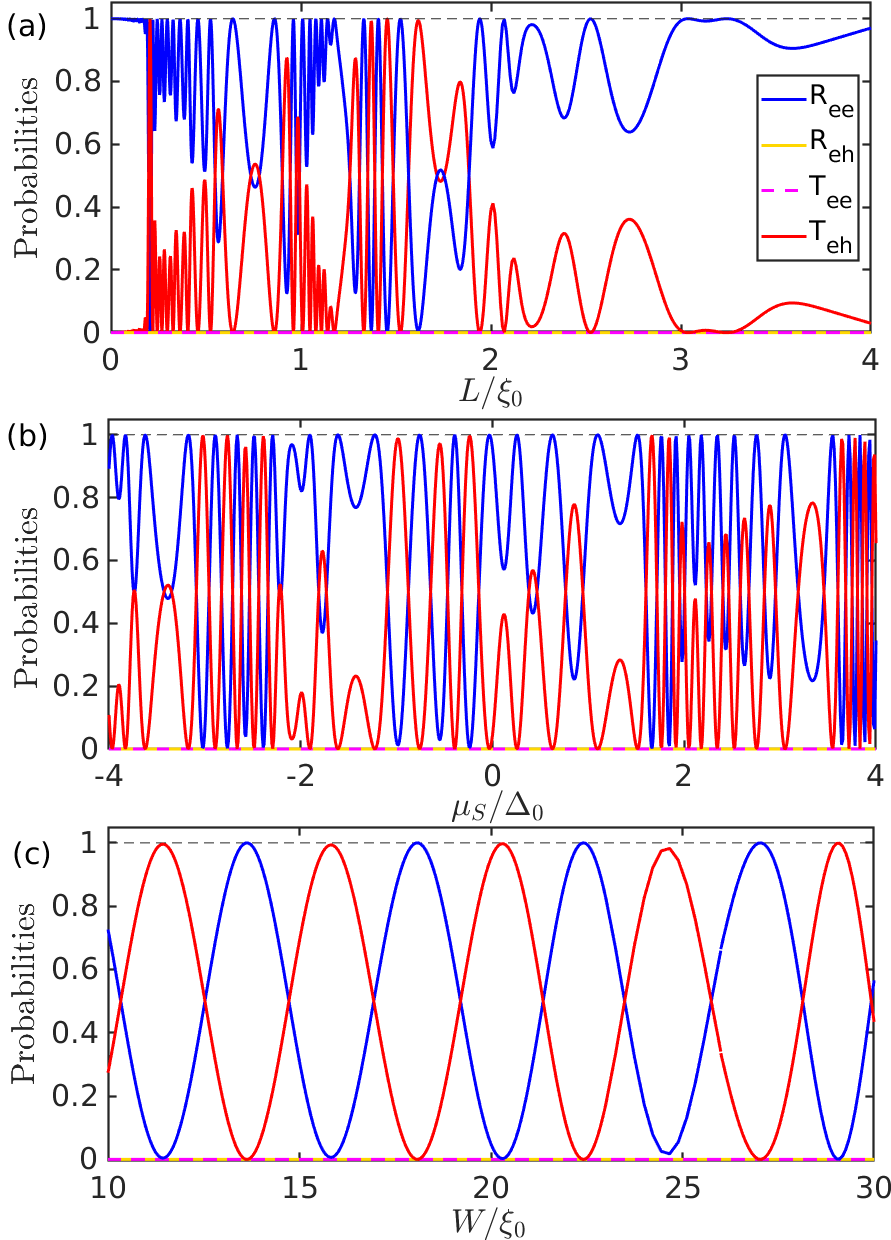 Figure 3
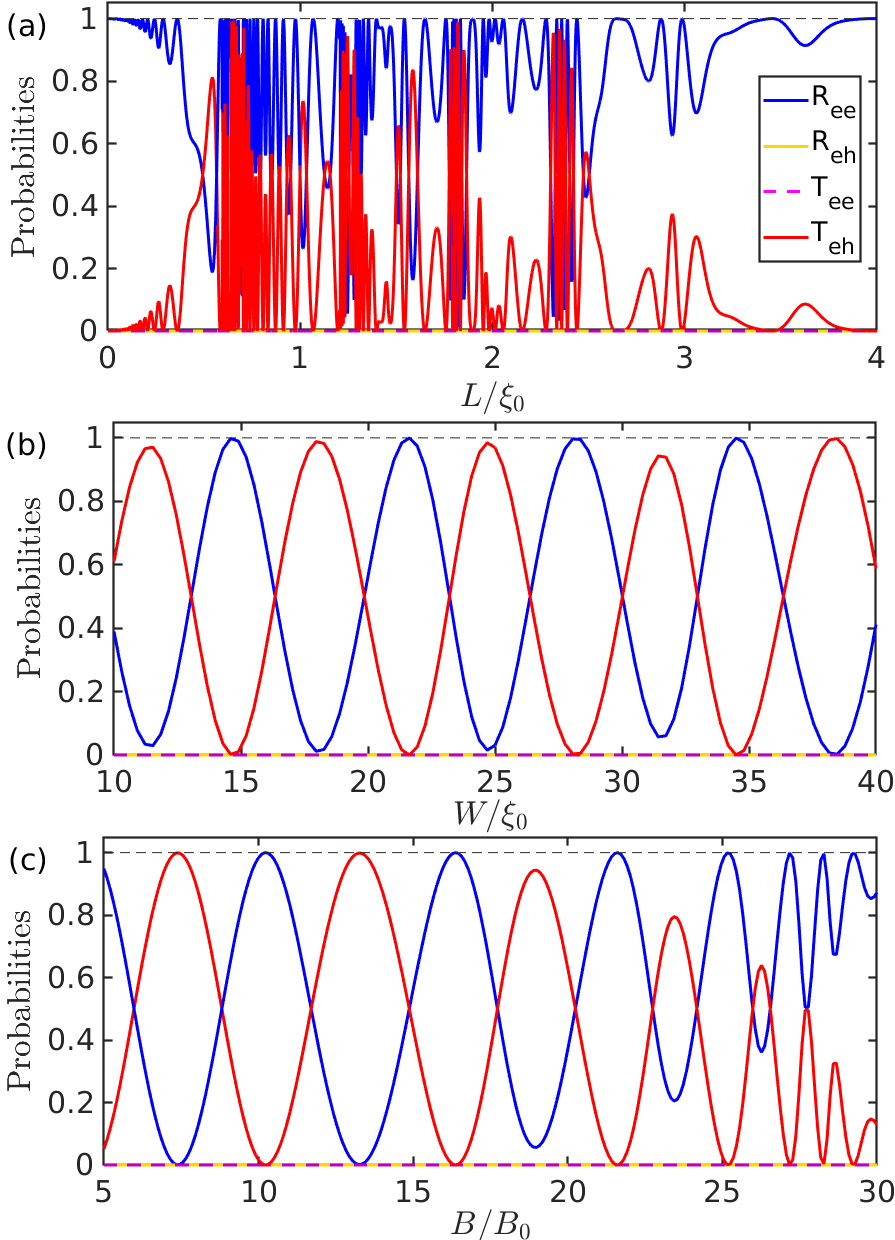 Figure 3
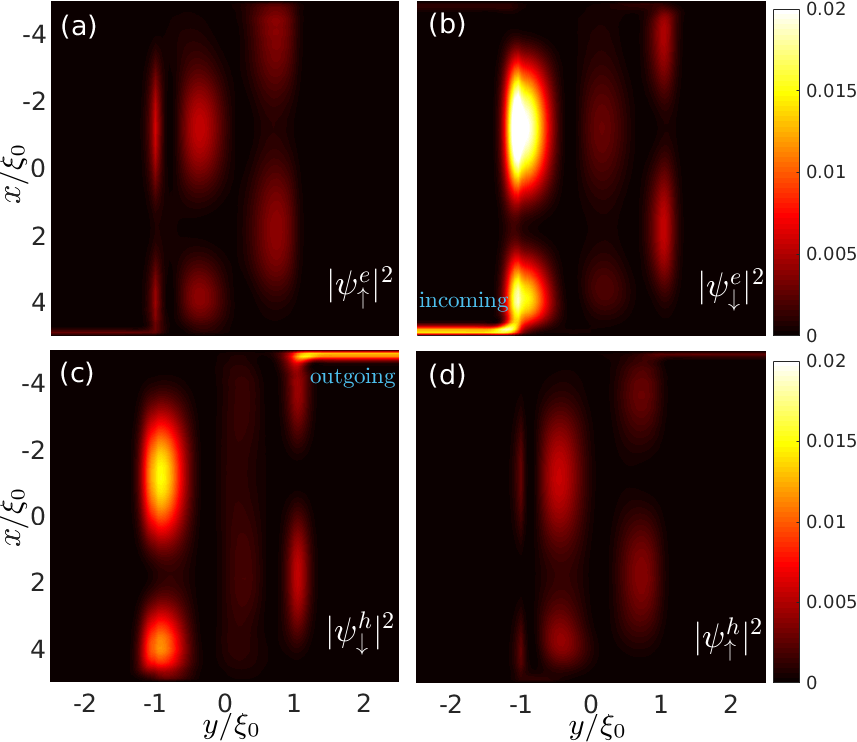 Figure 4
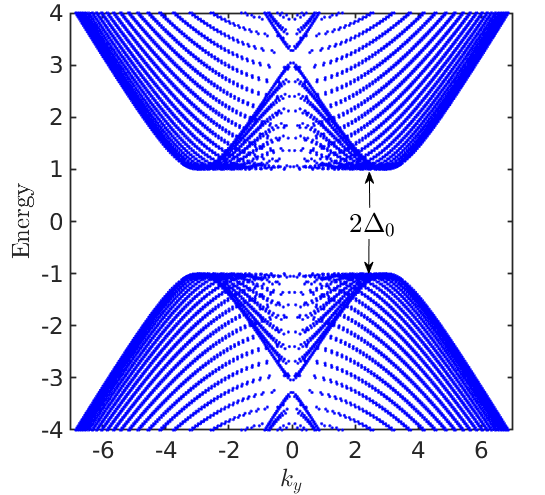 Figure 7
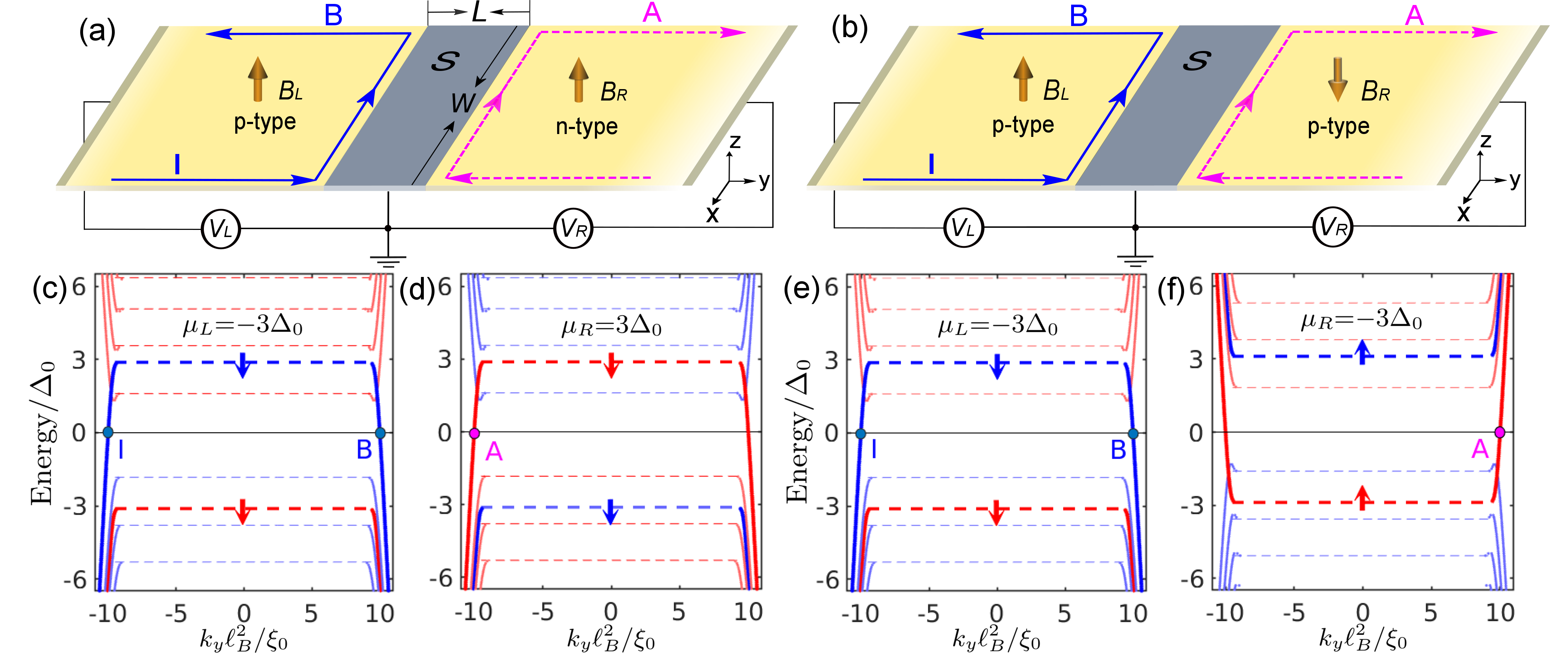 Figure 8
Peer Reviews
No public reviews on file for this paper yet. If you reviewed it on a platform where reviews are public (OpenReview, ICLR, NeurIPS, ICML), you can paste yours below so the community can read it here.
Videos
No videos yet. Explain this paper in a talk, walkthrough, or lecture? Add one.
Perfect Crossed Andreev Reflection in Dirac Hybrid Junctions in the
Quantum Hall Regime
Song-Bo Zhang
Institute for Theoretical Physics and Astrophysics, University of Würzburg, D-97074 Würzburg, Germany
Björn Trauzettel
Institute for Theoretical Physics and Astrophysics, University of Würzburg, D-97074 Würzburg, Germany
Würzburg-Dresden Cluster of Excellence ct.qmat, Germany
(March 17, 2024)
Abstract
Perfect crossed Andreev reflection (CAR) is striking for high-efficiency Cooper pair splitting which bears promising applications in quantum communication. Recent experimental advances have disclosed the way to explore CAR in Dirac fermion systems under ultra-strong magnetic fields. We develop a scattering approach to study quantum Hall-superconductor-quantum Hall (QH-S-QH) junctions formed by a two-dimensional (2D) time-reversal symmetric Dirac semimetal. We propose two different setups of the hybrid junction in the quantum limit where only zeroth Landau levels are involved in transport to exploit perfect CAR. In both setups, the CAR probability can reach unity without applying bias voltage and is controllable by the magnetic field strength, junction width, length and doping of the superconductor. CAR dominates the nonlocal transport and is directly measurable by the differential conductances. We also identify a quantized spin injection per CAR event in one of the two setups. Our proposal is experimentally feasible and will be helpful for exploring high-efficiency Cooper pair splitting and spin injection in Dirac materials.
Introduction.—Crossed Andreev reflection (CAR) is a process of converting an electron/hole from one lead to a hole/electron in another lead through a superconductor (S) Byers and Flatté (1995); Recher et al. (2001); Lesovik, G. B. et al. (2001). Via CAR, Cooper pairs, which are strongly entangled electron pairs, can in principle be split spatially Recher et al. (2001); Lesovik, G. B. et al. (2001); Samuelsson et al. (2003) and find fundamental interest and promising applications in quantum communication Burkard et al. (2000); Horodecki et al. (2009); Modi et al. (2012). Thus, searching for systems with a large probability and convenient manipulation of CAR is desirable. A variety of candidate systems for CAR have been proposed, which include ferromagnetic junctions Deutscher and Feinberg (2000); Beckmann et al. (2004); Linder et al. (2009); Li and Zhang (2016); Beiranvand, Hamzehpour, and Alidoust (2016), p-n junctions Cayssol (2008); Veldhorst and Brinkman (2010), topological systems Nilsson et al. (2008); Chen et al. (2011, 2012); Reinthaler et al. (2013); He et al. (2014); Wang et al. (2015), and other platforms Russo et al. (2005); Hofstetter et al. (2009); Cadden-Zimansky et al. (2009); Wei et al. (2010); Herrmann et al. (2010); Schindele et al. (2012); Das et al. (2012); Tan et al. (2015); Fülöp et al. (2015); Hou et al. (2016); Ang et al. (2016); Beconcini et al. (2016); Finocchiaro et al. (2016). Some of them have been experimentally implemented Beckmann et al. (2004); Russo et al. (2005); Hofstetter et al. (2009); Cadden-Zimansky et al. (2009); Wei et al. (2010); Herrmann et al. (2010); Schindele et al. (2012); Das et al. (2012); Tan et al. (2015); Fülöp et al. (2015). Nevertheless, most proposals require a fine tuning of electronic structure or a particular bias voltage. Usually, the processes of electron co-tunneling (EC) and local Andreev reflection (LAR) are inevitable, which tend to suppress and obscure CAR. It remains a challenge to have a system free of both detrimental processes.
The quantum Hall (QH) effect forces charged carriers to move along chiral edge channels which are robust against disorder Laughlin (1981); Halperin (1982). Recently, hybrid systems cooperating with the QH effect and superconductivity have been fabricated based on graphene Rickhaus et al. (2012); Amet et al. (2016); Lee et al. (2017); Park et al. (2017); Sahu et al. (2018); Seredinski et al. whose low-energy physics is governed by Dirac fermions. This paves a new way to explore CAR in Dirac materials. However, many physical properties of Dirac hybrid structures in the QH regime, particularly in the quantum limit where only lowest Landau levels contribute to transport, have yet to be explored.
In this Letter, we develop a scattering approach to investigate superconducting hybrid junctions in the QH regime, which are based on 2D time-reversal symmetric Dirac semimetals. In the quantum limit, the transport of the Dirac semimetal is governed by particular zeroth Landau levels which are spin polarized and chiral. Making use of this mechanism, we propose the QH-S-QH junction in two different setups of the quantum limit as a novel platform for perfect CAR. One setup is a p-S-n junction with the same magnetic field but different types of doping in the two QH regions, while the other one is an n-S-n junction with opposite magnetic fields but the same type of doping, as sketched in Figs. 1(a) and (b), respectively. Remarkably, in both setups, EC and LAR are completely blocked, and CAR can be enhanced without fine tuning of bias voltage. The CAR probability can reach unity and is influenced by the length and doping of the superconductor, magnetic field strength and junction width. Due to the particular properties of conducting channels, CAR dominates the nonlocal transport and can be directly measured by differential conductances. Moreover, we find that while there is no spin injection in the n-S-n junction, a quantized spin injection per CAR event occurs in the p-S-n junction, which suggests a new route for high-efficiency spin injection in superconducting spintronics.
QH-S-QH junction based on a 2D Dirac semimetal.—We start with a time-reversal symmetric Dirac semimetal in two dimensions, which is described at low energies by
[TABLE]
The basis function is with the indices labeling the two Dirac cones related by time-reversal symmetry and , the two spins. The effective Hamiltonian reads with the Fermi velocity, the wavevector operators and the Pauli matrices acting on spin space. A small quadratic correction is introduced to regulate the topological properties as and ensure definite edge states Shen (2012). is the time-reversal operator with the complex conjugation. The model (1) can be used to describe surface states of 3D topological insulators ZHang et al. (2009); Chen et al. (2009); Lu et al. (2010); Shan et al. (2010), and the transition phase between a quantum spin Hall insulator and a normal insulator Bernevig et al. (2006); Murakami et al. (2007); Büttner et al. (2007).
The QH-S-QH junction under study is formed by the Dirac semimetal in a strip geometry, as depicted in Figs. 1(a,b). Without loss of generality, we take the junction in direction and apply the magnetic field in direction in the left/right normal-metal lead. The junction (or strip) width is and the length of the S region is . We consider -wave superconductivity which is induced locally by the proximity effect Fu and Kane (2008); Stanescu et al. (2010); Zhang et al. (2011); Maier et al. (2012). Then, the junction can be described by two decoupled sets of Bogoliubov-de Gennes (BdG) equations. The one acting on the basis reads
[TABLE]
where the gate-voltage-tunable chemical potential is assumed to vary stepwise, \mu({\bf r})$$=$$\mu_{S} in S () and \mu({\bf r})$$=$$\mu_{L/R} in the left/right QH region (). with the Heaviside function is the pairing potential. It couples electron and hole excitations from different Dirac cones of time-reversal partners. The magnetic fields are taken into account via the vector potential and substitute the wavevector operators as Note (1), where is the elementary charge. The other BdG equation acting on the basis takes the same form as Eq. (2) but replacing by .
Scattering approach.—In the QH-S-QH junction, the simple way of wavefunction matching to study transport Blonder et al. (1982) is not longer applicable. Hence, we need to generalize the scattering approach Tamura and Ando (1991) for Dirac fermions under strong magnetic fields. We assume hard-wall boundary conditions in direction. In the QH regions, we expand the electron wavefunction by a complete set of quantum-well states
[TABLE]
where \chi_{j}(x)$$=$$\sqrt{2/W}\sin\left[j\pi\left(x/W+1/2\right)\right] for and [math] otherwise. are spinors with only electron components in the basis used in Eq. (2). The phase factor stems from the gauge transformation from to . distinguishes the left and right QH regions. Plugging Eq. (8) into the BdG equation, making use of the inner products between the and then solving an eigen equation Sup , we obtain the allowed and for a given . The real solutions of correspond to propagating channels. All the real together form the excitation energy spectrum of (quasi-)particles. Similarly, we find the basis wavefunction for holes taking into account the phase factor and only hole components in . In S, the electron and hole components are mixed and the wavefunction is also expanded in terms of but without a phase factor.
With the solutions of wavefunction in each individual region, we construct the scattering states in the junction. The expansion coefficients which measure scattering amplitudes between incident and outgoing channels are found by matching the wavefunction of the scattering state and its derivative at the QH-S interfaces. Summing the squared absolute values of the corresponding scattering amplitudes associated with propagating channels and normalized by the channel velocities, we obtain finally the probabilities of normal reflection (NR) , LAR , EC , and CAR , respectively Sup .
Landau level spectra in the QH regions.—We analyze the energy spectra in the QH regions, which can provide helpful insights into the transport properties of the junction and the search for perfect CAR. In the QH regions, the energy spectra for electrons and holes are decoupled and formed by a series of discrete Landau levels. The guiding centers of electron and hole wavefunctions are determined by , respectively. The Landau levels are flat when they are away from the edges at . In the limit , which corresponds to a small quadratic term in Eq. (1), the Landau levels in the bulk are given by
[TABLE]
The energies are measured from the Fermi level . These Landau levels can be found alternatively exploiting ladder operators Zhang et al. (2014, 2014). In contrast, when close to the edges, all Landau levels exhibit finite dispersion. The positive levels bend upward while the negative levels bend downward when approaching the edges. This behavior implies that electrons and holes move only in chiral channels close to the edges with their velocities given by . Interestingly, both the zeroth Landau levels of electrons and holes , which are particular for the Dirac fermions, bend either upward or downward, depending on the magnetic field direction. Moreover, they have the same spin polarization, as indicated by the arrows in Figs. 1(c-f), whose direction also depends on the sign of the magnetic field. For , the Landau level spectra of electrons and holes coincide. A finite , however, shifts the spectra oppositely by . As a result, in the quantum limit [math]<$$|\mu|$$<$$v\sqrt{2|eB|/\hbar} (Note, 3), only a single chiral electron channel is maintained at the Fermi level and contributes to transport in one BdG block, whereas only a single chiral hole channel with opposite spin polarization contributes in the other block. Note that the two BdG blocks are completely decoupled in our system. The remarkable single-channel mechanism is unique to this hybrid junction which is time-reversal symmetric in the absence of magnetic fields.
Perfect CAR.—The single-channel mechanism in the quantum limit (described above) is realized in two distinct setups of the QH-S-QH junction, namely, the p-S-n junction with \mu_{R}\mu_{L}$$<[math] and B_{L}B_{R}$$>[math] and the n-S-n junction with \mu_{R}\mu_{L}$$>[math] and B_{L}B_{R}$$<[math]. In these setups, for a given BdG block, only electron channels are allowed in one QH region whereas only hole channels in the other one. Thus, the processes of EC and LAR are completely suppressed. We are left with NR and CAR. If an electron stems from one Cooper pair in S and goes to one QH lead, then the other electron from the pair must go to the other lead. Note that, these setups are the counterparts to junctions formed by helical liquids, where NR and CAR are forbidden Adroguer et al. (2010); Crépin et al. (2015). As the chiral edge channels are topologically protected and prohibit backscattering, we expect the setups to be robust against weak disorder and non-ideal conditions regarding interfaces and potential variations (Note, 4). The two setups share many intriguing properties concerning CAR, which we discuss in the following.
We take the p-S-n junction for illustration. For definiteness but without loss of generality, we assume a positive magnetic field B_{L}$$=$$B_{R}$$\equiv$$B$$>[math] and negative/positive chemical potential in the left/right QH region. Then, a single chiral electron channel exists in the left QH region while a single anti-chiral hole channel in the right QH region. Thus, NR and CAR are cross-edge processes, i,e., the incident channels and reflected channels are at the different strip edges, see Figs. 1(a, b). To explore perfect CAR with , we calculate and present in Fig. 2(a) the zero-energy probabilities of the four processes as functions of the length . Here, we use , and as the units for energy, length and magnetic field, respectively. For the typical values meVnm (i.e., v_{F}$$\equiv$$v/\hbar$$=$$1.5$$\times$$10^{5} m/s) and meV Knez et al. (2015); Wang et al. (2015); Wiedenmann et al. (2017), we have nm and T which are in an experimentally accessible regime. In the limit , the system recovers an n-p junction, and electrons cannot be converted to holes due to the absence of superconductivity. In the opposite limit , the tunneling across S is exponentially suppressed. Thus, as well. However, at intermediate length scales, we can find a large or even perfect CAR. Interestingly, the large CAR persists in the junction where the length is longer than the superconducting coherence length .
We also observe Fabry-Prot oscillations with varying , which stem from the interference effect in S with a finite . Fabry-Prot oscillations also show up with respect to the doping of S and the magnetic field , see Figs. 2(b) and 3(a). The interference occurs not only along the junction in direction but also across the strip in direction. Thus, analogous oscillations appear with respect to the junction width , see Fig. 2(c). The pattern of oscillations is, however, more regular because the interference consists of a single pair of propagating modes in direction, in contrary to the interference in direction which also involves modes with decaying oscillation behavior. Therefore, we are able to obtain perfect CAR. It is possible to control CAR by length, doping of S, magnetic field strength, and junction width. Finally, we stress that the large CAR occurs at zero energy, which indicates the exempt from a fine tuning of bias voltage.
Next, we study the transport signature of CAR. We calculate the local and nonlocal differential conductances, which are defined as and , respectively, by using the extended Blonder-Tinkham-Kapwijk theory Lambert et al. (1993); Anantram and Datta (1996). Here, and are the measured current and applied bias voltage in the left/right QH region, respectively. S is grounded. In the two setups, LAR and EC are eliminated completely so that NR and CAR dominate the local and nonlocal transport, respectively. The conductances at zero temperature are
[TABLE]
Here, , as required by the particle conservation, and the bias voltage enters the conductances as excitation energy via . is negative and exactly opposite to , as shown in Fig. 3(b). Importantly, provides not only a transport signature but also a direct measurement of CAR.
Spin injection in the p-S-n junction.—The difference of the two setups manifests mainly in the spin injection into S, which we now clarify. In the n-S-n junction, the incident electron and reflected hole carry opposite spin, see Figs. 1(e,f). This implies that two electrons with opposite spin are absorbed into S to form a spin-singlet Cooper pair, as we expect for -wave superconductivity. Therefore, we have no spin transport between S and the QH regions.
However, this is not the case for the p-S-n junction. The reflected hole carries spin down which is remarkably the same as that carried by the incident electron, see Figs. 1(c,d). To further confirm this, we calculate the density distributions of the four components of a scattering state near the junction in Fig. S8. In S, the four components mix together due the presence of superconductivity and strong spin-orbit coupling, and they oscillate in both and directions, reflecting the aforementioned interference effect. We see clearly that the incident electron carrying spin down at the lower edge is converted through S as a hole carrying also spin down at the upper edge into the other region. Therefore, we have an equal-spin CAR which effectively pumps two equal spins into S. The equal-spin CAR implies the creation of equal-spin triplet Cooper pairs in S Benjamin (2006); Breunig et al. (2018); Fleckenstein et al. (2018); Note (2), which are of interest in superconducting spintronics Linder and Robinson (1996). Following the approach of Ref. Breunig et al. (2018), we predict the value of spin pumped into S explicitly as
[TABLE]
The spin injection is purely contributed by CAR. We have a quantized spin injection of per CAR event. For perfect CAR, we obtain a perfect spin injection.
Summary.—We have developed a scattering approach to investigate a 2D Dirac QH-S-QH junction. We have proposed two different setups, which exploit the particular properties of the zeroth Landau levels of the Dirac fermions in the quantum limit, for realizing high-efficiency and controllable CAR without fine tuning of bias voltage. The differential conductances provide a direct measurement of CAR. We have identified a quantized spin injection in the p-S-n junction.
Acknowledgements.
We thank C. Gould, L. W. Molenkamp, M. Stehno, and G. Tang for helpful discussions. This work was supported by the DFG (SPP1666, SFB1170 “ToCoTronics"), the Würzburg-Dresden Cluster of Excellence ct.qmat, EXC2147, project-id 39085490, and the Elitenetzwerk Bayern Graduate School on “Topological Insulators".
Appendix A
We start with the QH regions. The electrons and holes are decoupled. Thus, we calculate them separately. In the presence of a magnetic field perpendicular to the strip plane, the Dirac equation for electrons reads
[TABLE]
where the gauge for the magnetic field is adopted and . We assume hard-wall boundary conditions for the strip edges and expand the wavefunction in terms of quantum-well states
[TABLE]
where are two component spinors. The basis functions are given by
[TABLE]
Plugging Eq. (8) into Eq. (7), this leads to
[TABLE]
Multiplying both sides by and integrating over , we obtain
[TABLE]
where the inner products between the quantum-well states are given by
[TABLE]
Choosing a large number of basis functions, we recast the equation in a -dimensional matrix form
[TABLE]
where indicates that is a matrix. The elements of the relevant matrices are given by
[TABLE]
Diagonalizing the matrix in Eq. (13) for a given energy , we can find pairs of eigenvalues for the wavenumbers and the corresponding spinors (corresponding to positive eigenvalues ) and (corresponding to negative eigenvalues ). The real solutions of correspond to propagating channels. All real together form the electron spectrum.
The Dirac equation for holes is given by
[TABLE]
Similarly, we expand the wavefunction as
[TABLE]
and derive the following equation
[TABLE]
where
[TABLE]
In the superconductor, the wavefunction is taken as
[TABLE]
where are four-component spinors in Nambu space. Then, we have the BdG equation as
[TABLE]
Next, we multiply Eq. (20) by and integrate over . The BdG equation becomes
[TABLE]
where
[TABLE]
Similar to the QH regions, we find wavenumbers and spinors from the BdG Eq. (21). The energy spectrum of the superconductor is given by the real for all . A typical spectrum is presented in Fig. S5. The superconductor has a full gap of , as expected by time-reversal symmetry.
With the wavefunction in each individual region, we now calculate the scattering probabilities. We denote the wavefunctions for electron modes with and positive velocities, while the wavefunctions for electron modes with and negative velocities. Similarly, we have and for the right- and left-moving hole modes with wavenumbers , respectively. Here, distinguishes the left and right QH regions. Then, the wavefunction of a scattering state of an electron with the wavenumber incident from the left QH region to the superconductor is built up as
[TABLE]
where the matrix elements , , and represent the scattering amplitudes of local Andreev reflection, normal reflection, electron co-tunneling and crossed Andreev reflection, respectively. The phase factors stem from the gauge transformation of to for the transport problem. The wavefunction and its derivative are continuous at the two QH-S interfaces at , which yield the following equation to find the scattering amplitudes
[TABLE]
where and . The hat again indicates a matrix. are matrices formed by the spinors associated with positive in the left (right) lead. are matrices formed by the spinors associated with positive in the left (right) lead. and are similar to and but for the hole counterplart. and are matrices and is a matrix. On deriving Eq. (24), we have made use of the inner products of the quantum-well states. Solving Eq. (24), we find the matrices and . Then, the probabilities (multiplying the number of available incident channels) of the four scattering processes, normal reflection local Andreev reflection electron co-tunneling and crossed Andreev reflection , are calculated explicitly as
[TABLE]
where the sums run over all available channels with real wavenumbers. are the velocities in the th channel in the electron (hole) branch. The arrows indicate the propagating direction of channels. The velocities are calculated, respectively, as
[TABLE]
At zero temperature, the local and nonlocal differential conductances in the sub-gap regime (where ) are given by
[TABLE]
respectively, where counts the number of incident channels, and in the quantum limit. The particle conservation yields .
The main features of the zero-energy probabilities we discussed in the Letter, namely, 1) the complete suppression of local Andreev reflection and electron co-tunneling; 2) the accessibility of perfect CAR by tuning , , or (for the latter three kinds of tuning, an intermediate length is required); and 3) the oscillation behaviors due to the interference effects along and directions; are not restricted to specific values of and . In Fig. S6, we present the typical results for the case with significantly different from . For larger , the oscillations are more rapid as varying the length or magnetic field , as we can see by comparing Fig. S6 with Fig. 2(a) and 3(a) in the Letter.
For completeness, we present in Figs. S7 and S8 the typical results of the n-S-n junction. They have the same main features of those for the p-S-n junction. Although we choose the parameters for illustration, the results are general and not restricted to this choice. As shown in Fig. S8, an incident electron with spin down can be scattered back to the opposite edge of the same QH lead. It can also be crossed Andreev reflected into the hole channel with opposite spin in the other lead, which is different from the case of the p-S-n junction.
The reference list from the paper itself. Each links out to its DOI / PubMed record.
- 1Byers and Flatté (1995) J. M. Byers and M. E. Flatté, Probing Spatial Correlations with Nanoscale Two-Contact Tunneling, Phys. Rev. Lett. 74 , 306–309 (1995) . · doi ↗
- 2Recher et al. (2001) P. Recher, E. V. Sukhorukov, and D. Loss, Andreev tunneling, Coulomb blockade, and resonant transport of nonlocal spin-entangled electrons, Phys. Rev. B 63 , 165314 (2001) . · doi ↗
- 3Lesovik, G. B. et al. (2001) G. B. Lesovik, T. Martin, and G. Blatter, Electronic entanglement in the vicinity of a superconductor, Eur. Phys. J. B 24 , 287 (2001) . · doi ↗
- 4Samuelsson et al. (2003) P. Samuelsson, E. V. Sukhorukov, and M. Büttiker, Orbital Entanglement and Violation of Bell Inequalities in Mesoscopic Conductors, Phys. Rev. Lett. 91 , 157002 (2003) . · doi ↗
- 5Burkard et al. (2000) G. Burkard, D. Loss, and E. V. Sukhorukov, Noise of entangled electrons: Bunching and antibunching, Phys. Rev. B 61 , R 16303 (2000) . · doi ↗
- 6Horodecki et al. (2009) R. Horodecki, P. Horodecki, M. Horodecki, and K. Horodecki, Quantum entanglement, Rev. Mod. Phys. 81 , 865 (2009) . · doi ↗
- 7Modi et al. (2012) K. Modi, A. Brodutch, H. Cable, T. Paterek, and V. Vedral, The classical-quantum boundary for correlations: Discord and related measures, Rev. Mod. Phys. 84 , 1655 (2012) . · doi ↗
- 8Deutscher and Feinberg (2000) G. Deutscher and D. Feinberg, Coupling superconducting-ferromagnetic point contacts by Andreev reflections, Appl. Phys. Lett. 76 , 487 (2000) . · doi ↗