Neutron Star Interior Composition Explorer X-ray Timing of the Radio and Gamma-ray Quiet Pulsars PSR J1412+7922 AND PSR J1849-0001
Slavko Bogdanov, Wynn C. G. Ho, Teruaki Enoto, Sebastien Guillot,, Alice K. Harding, Gaurava K. Jaisawal, Christian Malacaria, Sridhar S., Manthripragada, Zaven Arzoumanian, Keith C. Gendreau

TL;DR
This paper presents detailed X-ray timing and spectral analyses of two pulsars, PSR J1412+7922 and PSR J1849-0001, using NICER, improving ephemerides and enabling gravitational wave search constraints.
Contribution
The study provides the first refined timing and spectral data for these pulsars, enhancing gravitational wave search sensitivity and understanding of their emission properties.
Findings
Improved pulse ephemerides for both pulsars.
Spectral fits consistent with blackbody and power-law models.
Constraints on neutron star deformation and oscillation from LIGO data.
Abstract
We present new timing and spectral analyses of PSR J1412+7922 (Calvera) and PSR J1849-0001, which are only seen as pulsars in X-rays, based on observations conducted with the Neutron Star Interior Composition Explorer (NICER). We obtain updated and substantially improved pulse ephemerides compared to previous X-ray studies, as well as spectra that can be well-fit by simple blackbodies and/or a power law. Our refined timing measurements enable deeper searches for pulsations at other wavelengths and sensitive targeted searches by LIGO/Virgo for continuous gravitational waves from these neutron stars. Using the sensitivity of LIGO's first observing run, we estimate constraints that a gravitational wave search of these pulsars would obtain on the size of their mass deformation and r-mode fluid oscillation.
Click any figure to enlarge with its caption.
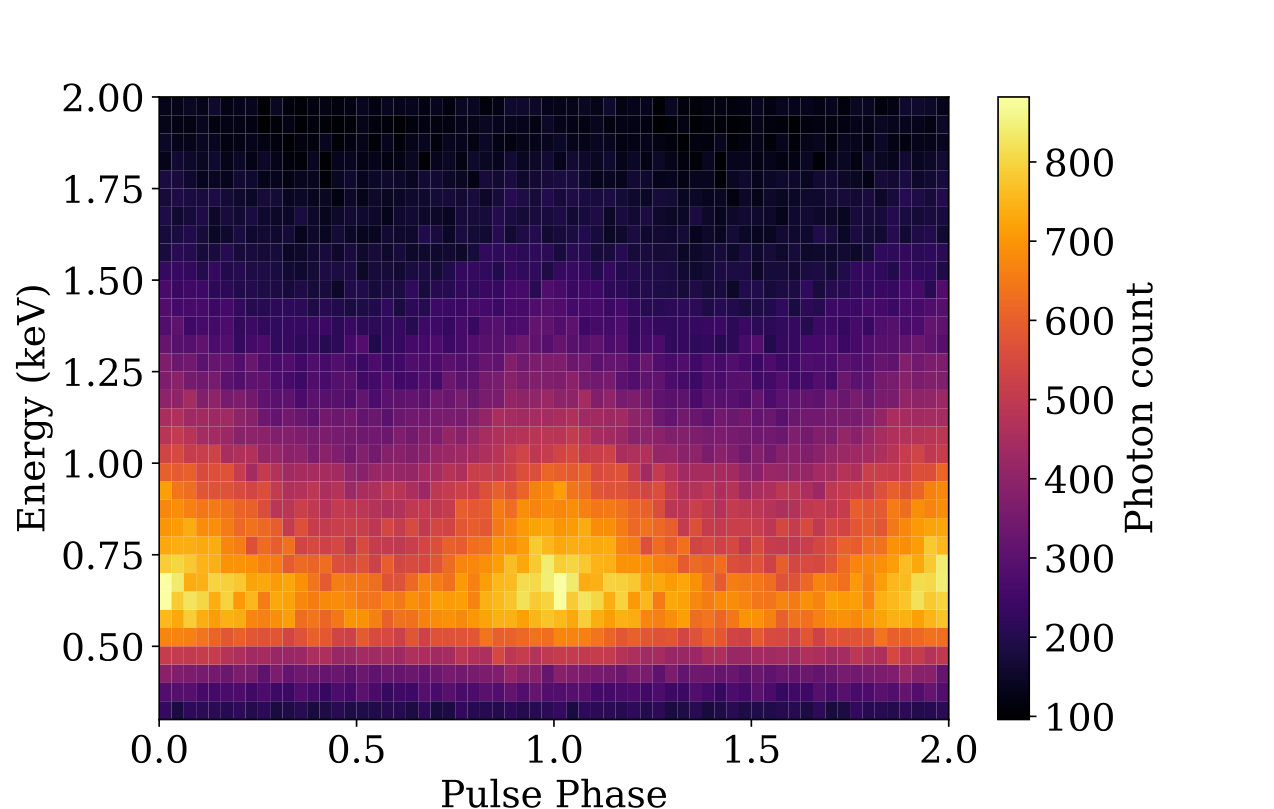 Figure 1
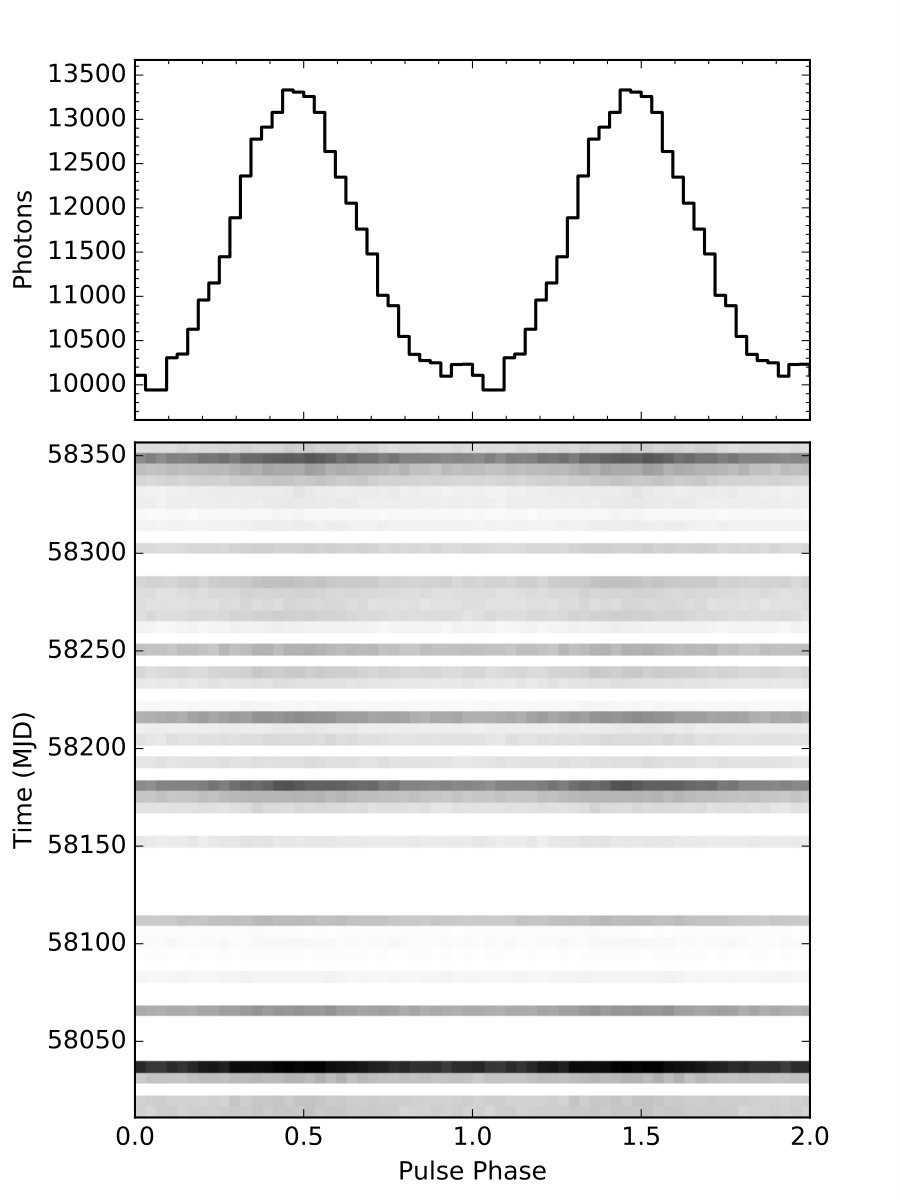 Figure 2
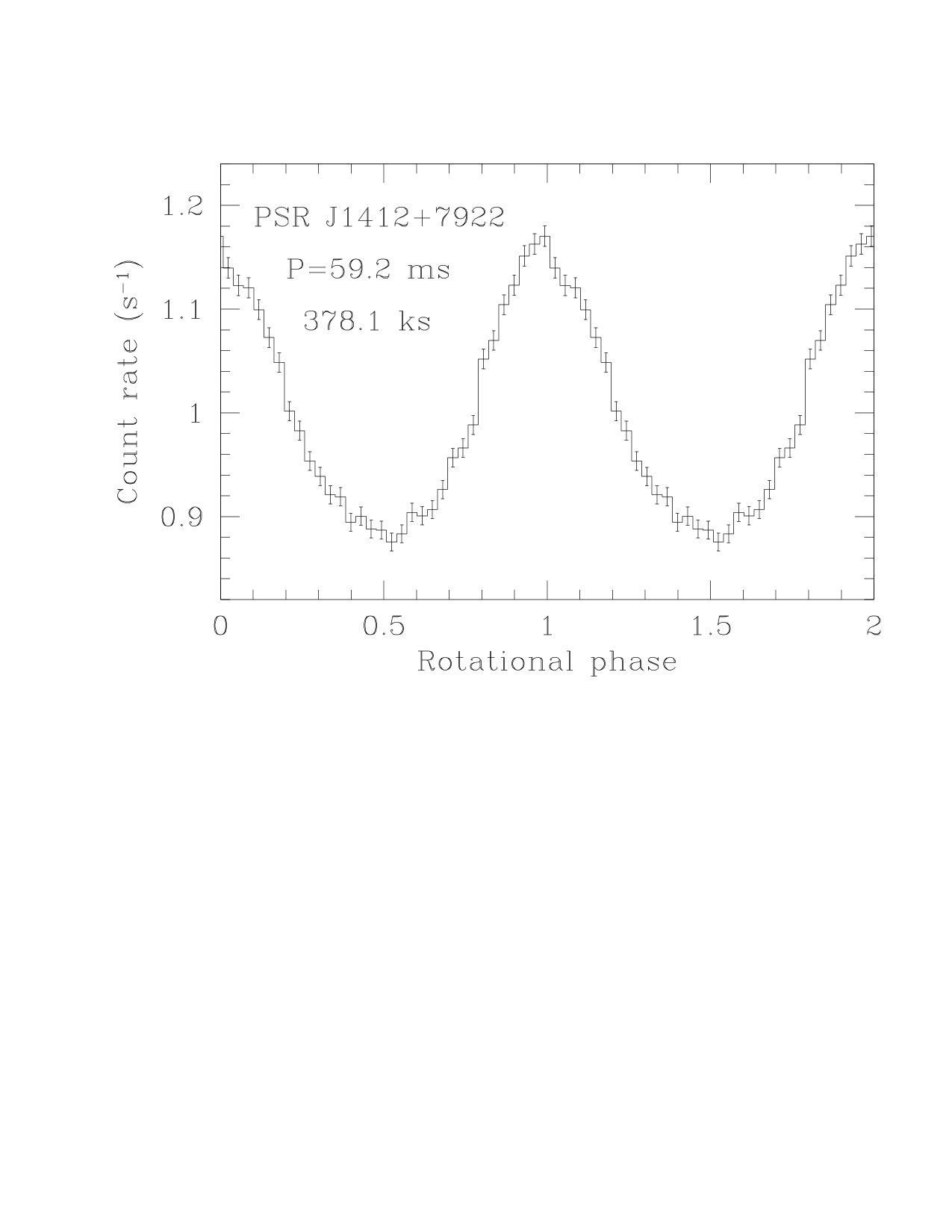 Figure 3
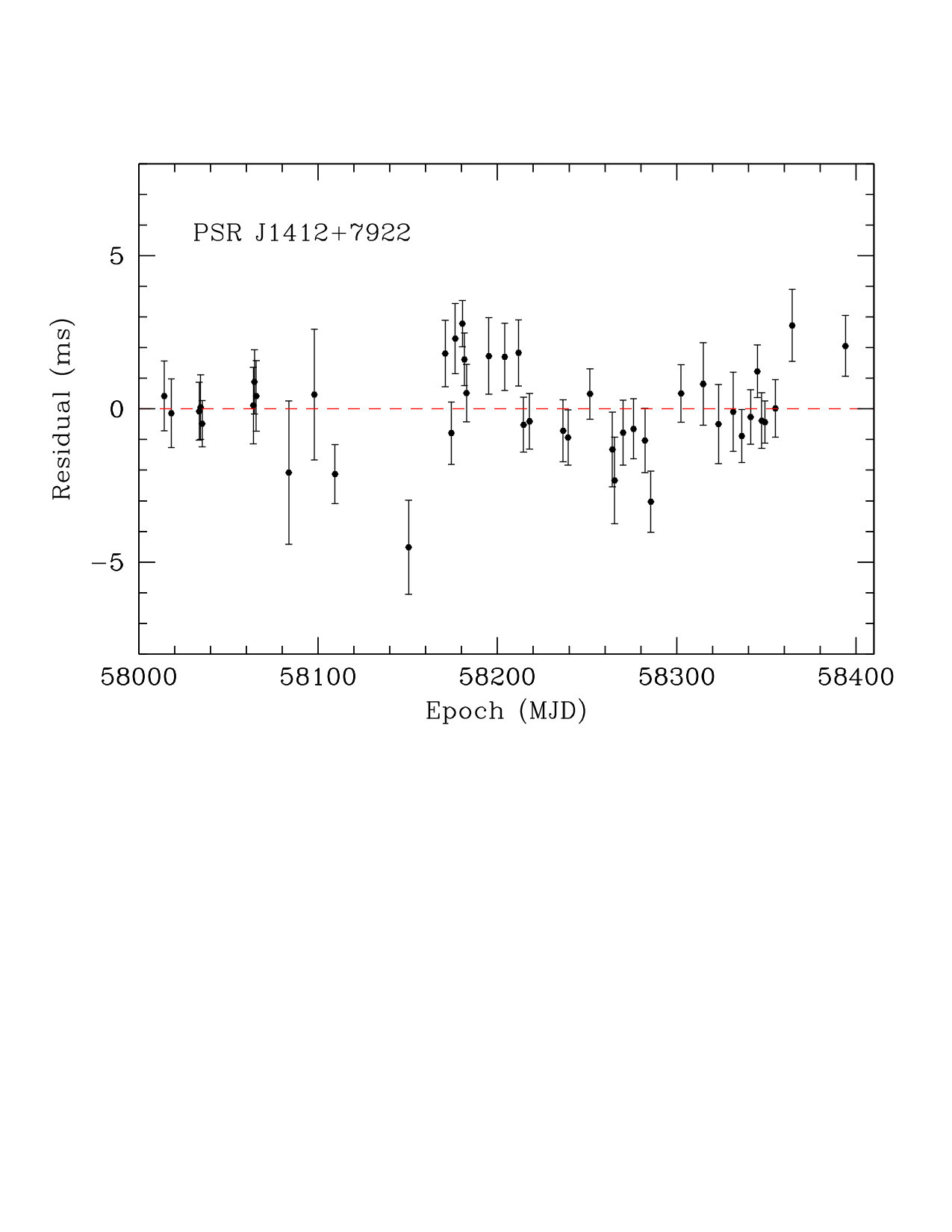 Figure 4
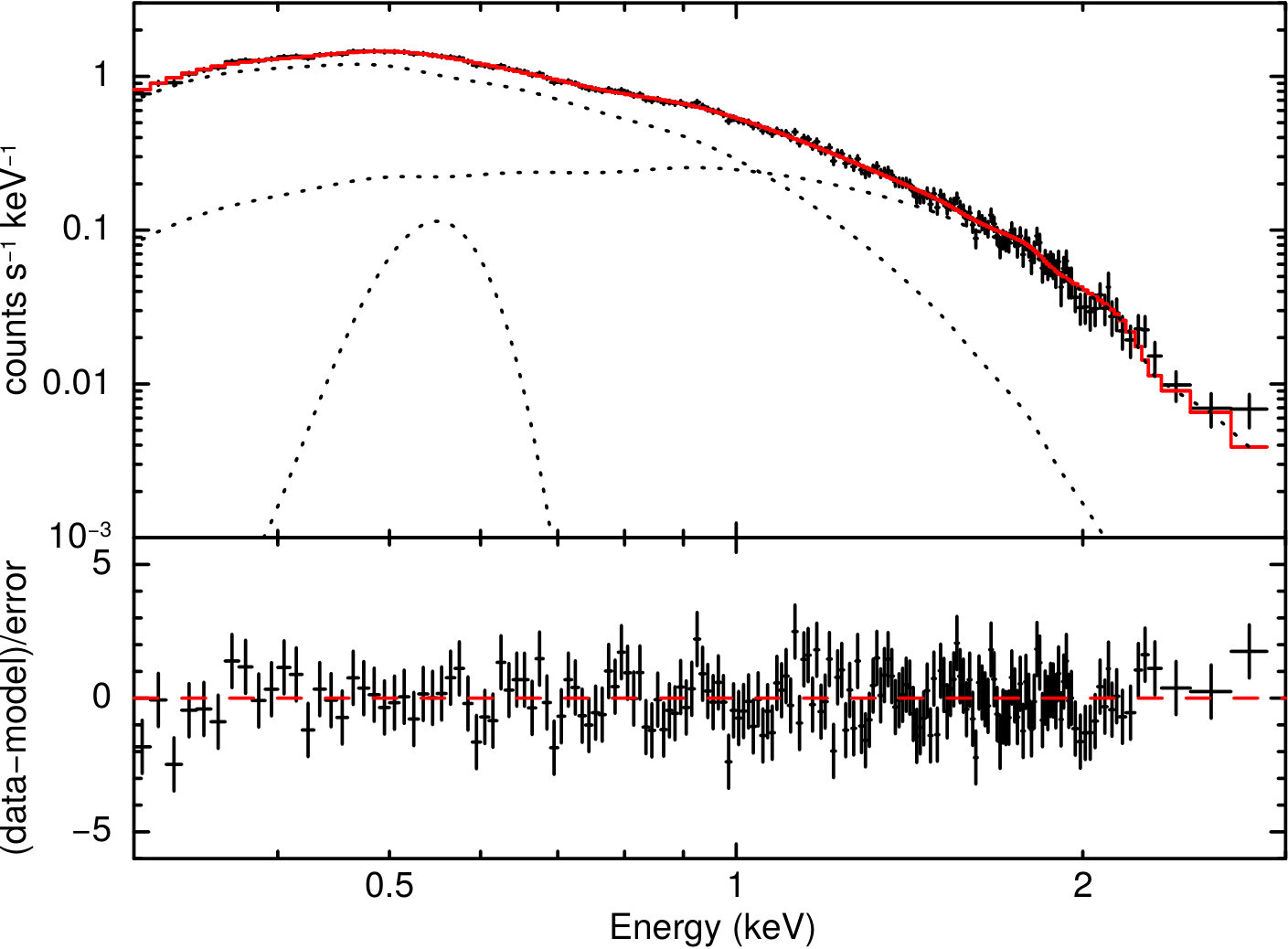 Figure 5
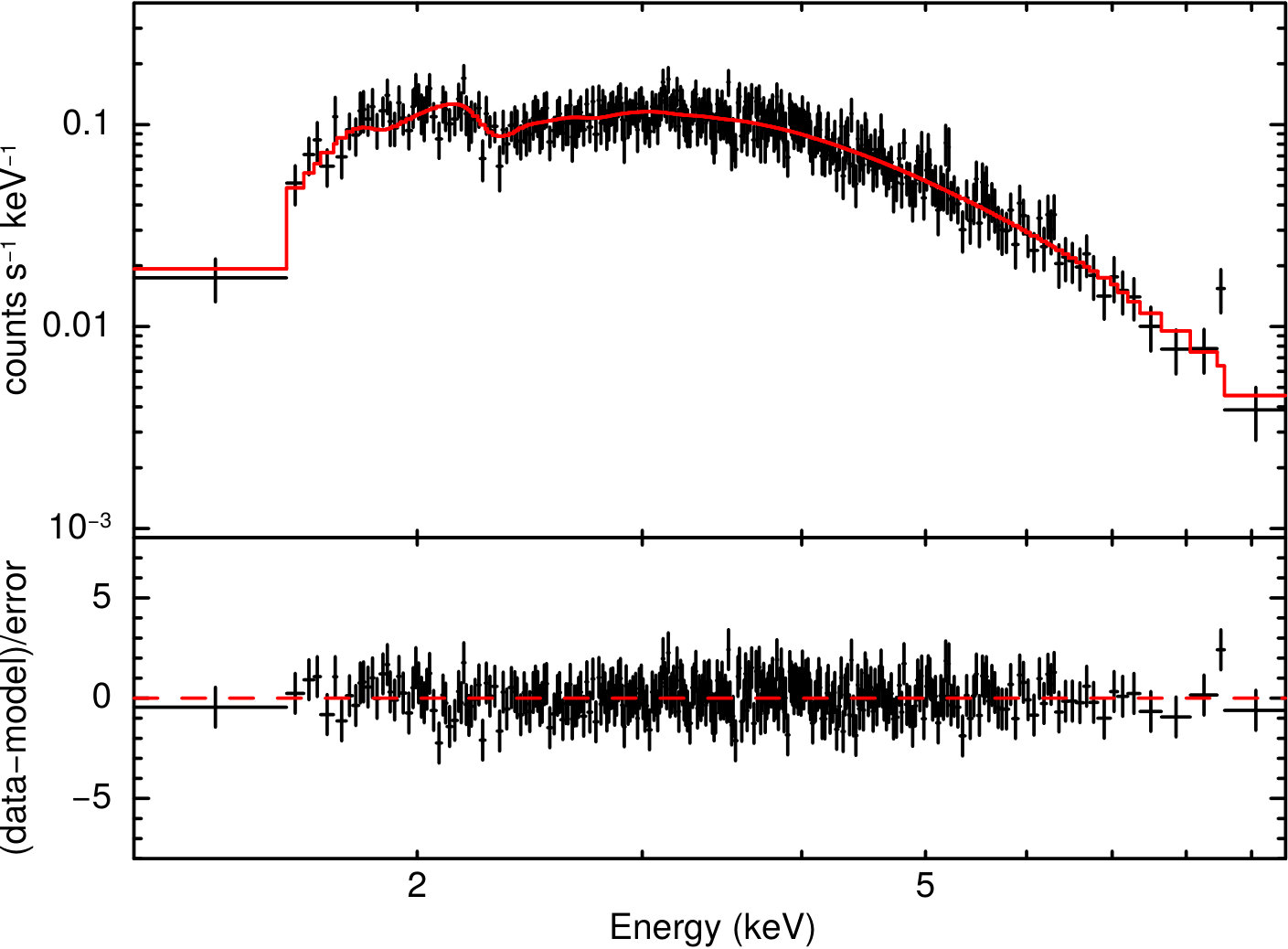 Figure 6
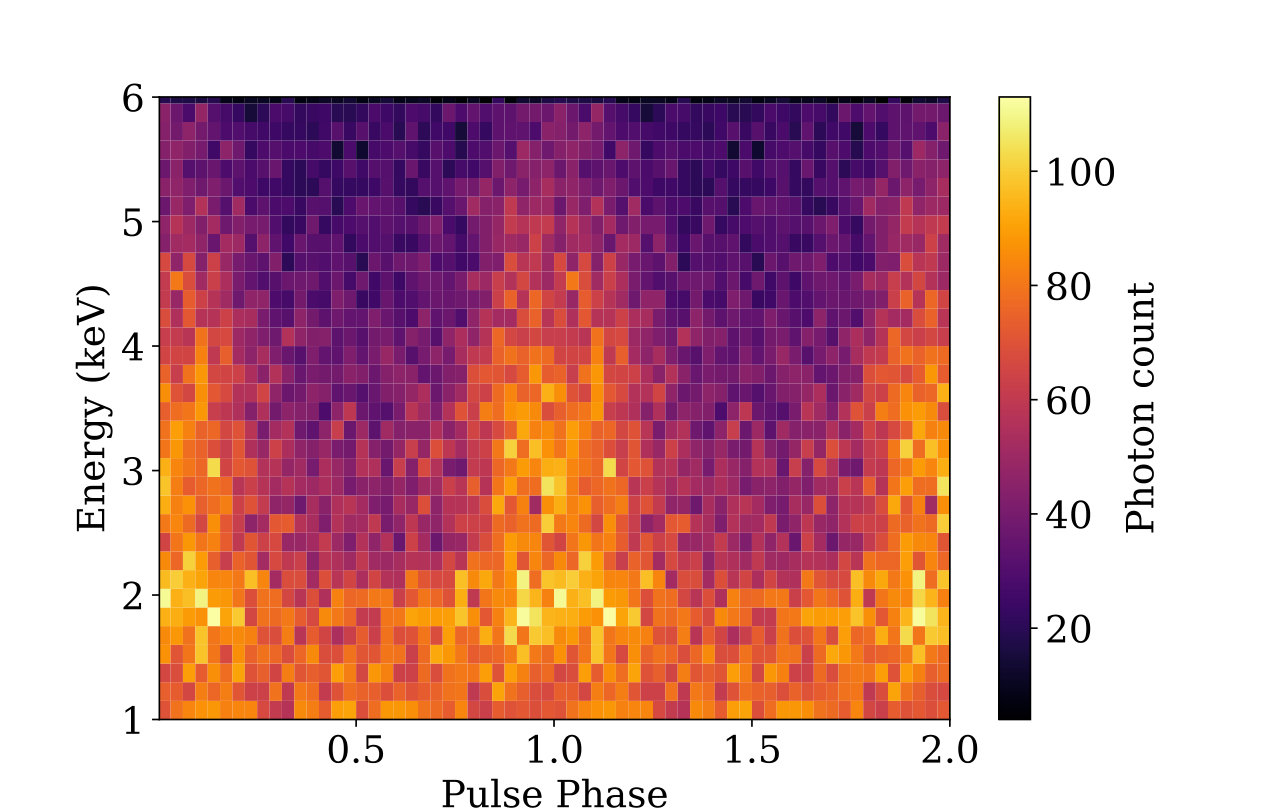 Figure 7
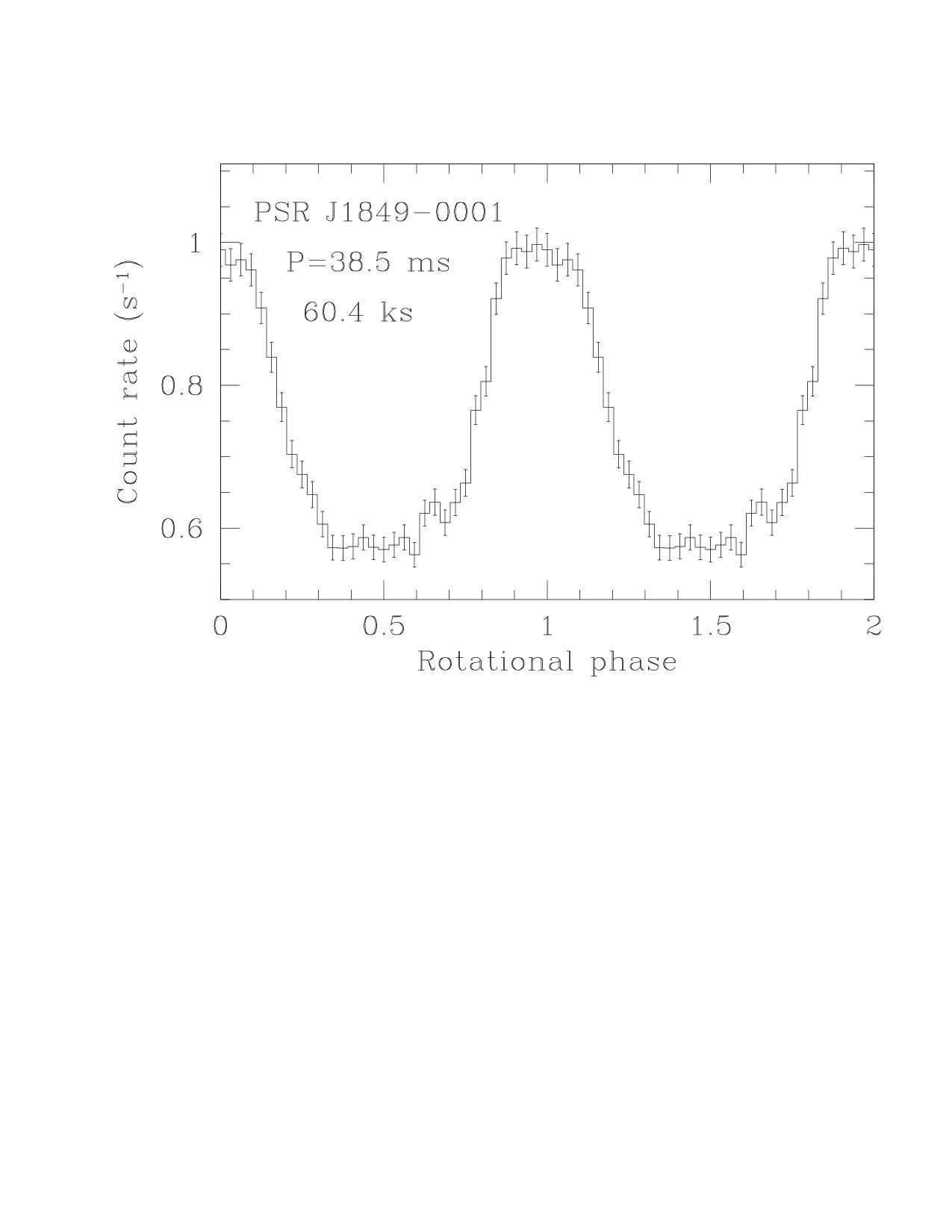 Figure 8
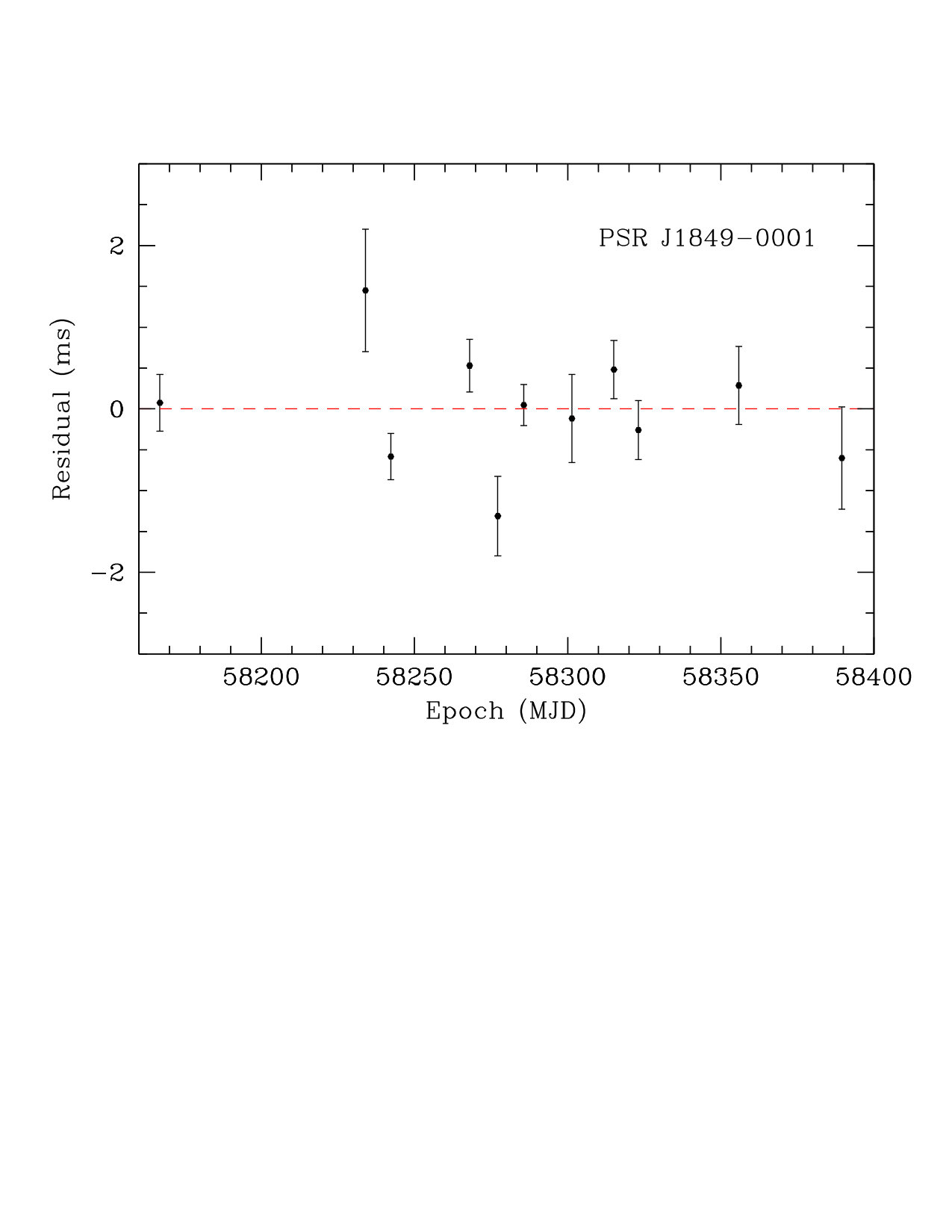 Figure 9
| Parameter | Value |
|---|---|
| Assumed parametersaaChandra position and proper motion from Halpern & Gotthelf (2015). | |
| R.A. (J2000.0) | |
| Decl. (J2000.0) | |
| (mas yr-1) | |
| (mas yr-1) | |
| Epoch of astrometric parameters (MJD) | |
| Derived parameters | |
| Epoch (MJD TDB) | |
| PeriodbbTempo2 uncertainties given in parentheses., (ms) | |
| Period derivativebbTempo2 uncertainties given in parentheses., (s s-1) | |
| Range of dates (MJD) | |
| Spin-down luminosity, (erg s-1) | |
| Characteristic age, (kyr) | |
| Surface dipole magnetic field, (G) | |
| Parameter | Value |
|---|---|
| Assumed parametersaaChandra position from Kuiper & Hermsen (2015). | |
| R.A. (J2000.0) | |
| Decl. (J2000.0) | |
| Derived parameters | |
| Epoch (MJD TDB) | |
| PeriodbbTempo2 uncertainties given in parentheses., (ms) | |
| Period derivativebbTempo2 uncertainties given in parentheses., (s s-1) | |
| Range of dates (MJD) | |
| Spin-down luminosity, (erg s-1) | |
| Characteristic age, (kyr) | |
| Surface dipole magnetic field, (G) | |
| Component | Parameter | BB+PL | BB+BB |
|---|---|---|---|
| tbabs | () | ||
| pegpwrlw (PL) | |||
| Norm. ( ergs s-1 cm-2) aaThe normalization of the pegpwrlw model is given in units of 2–10 keV unabsorbed flux. | 0.110.01 | ||
| bbodyrad (BB) | (keV) | ||
| (km) bbDistance of 2 kpc assumed. | |||
| bbodyrad (BB) | (keV) | ||
| (km) bbDistance of 2 kpc assumed. | |||
| gabs | (keV) | ||
| (keV) | |||
| strengthccThe line strength is defined by , where is the optical depth. | |||
| () | |||
| /dof | 165.5/173 | 183.8/177 | |
| Component | Parameter | PL | BB |
|---|---|---|---|
| tbabs | () | ||
| pegpwrlw (PL) | |||
| Norm. ( ergs s-1 cm-2) aaThe normalization of the pegpwrlw model is given in units of 2–10 keV unabsorbed flux. | |||
| bbodyrad (BB) | (keV) | ||
| (km) bbDistance of 7 kpc assumed. | |||
| () | |||
| /dof | 225.4/309 | 257.3/309 | |
| Observation | Start time | Exposure | TOA |
|---|---|---|---|
| ID | (UTC) | (s) | Number |
| 1020290101 | 2017-09-15T00:03:43 | 2329 | 1 |
| 1020290102 | 2017-09-18T05:03:20 | 4072 | 1 |
| 1020290103 | 2017-09-19T07:16:00 | 726 | 1 |
| 1020290104 | 2017-09-20T03:19:20 | 1256 | 1 |
| 1020290105 | 2017-09-21T08:56:55 | 2521 | 2 |
| 1020290106 | 2017-09-22T04:42:58 | 5693 | 2 |
| 1020290107 | 2017-10-07T07:29:20 | 10070 | 3 |
| 1020290108 | 2017-10-08T02:02:40 | 10399 | 4 |
| 1020290109 | 2017-10-08T23:34:40 | 18025 | 5 |
| 1020290110 | 2017-10-10T00:16:17 | 6426 | 6 |
| 1020290111 | 2017-11-06T22:27:00 | 221 | 6 |
| 1020290112 | 2017-11-06T23:51:04 | 7983 | 7 |
| 1020290113 | 2017-11-08T00:42:00 | 6540 | 8 |
| 1020290114 | 2017-11-25T17:05:40 | 268 | 9 |
| 1020290115 | 2017-11-26T16:06:40 | 1006 | 9 |
| 1020290116 | 2017-11-26T23:50:00 | 533 | 9 |
| 1020290117 | 2017-12-10T08:26:04 | 962 | 10 |
| 1020290118 | 2017-12-11T04:33:00 | 436 | 10 |
| 1020290119 | 2017-12-21T19:27:36 | 338 | 11 |
| 1020290120 | 2017-12-22T02:54:17 | 9258 | 11 |
| 1020290121 | 2018-02-01T11:05:14 | 3650 | 12 |
| 1020290122 | 2018-02-21T00:23:20 | 6154 | 13 |
| 1020290123 | 2018-02-22T07:17:33 | 2214 | 13 |
| 1020290124 | 2018-02-23T09:28:40 | 3154 | 14 |
| 1020290125 | 2018-02-24T16:25:00 | 2147 | 14 |
| 1020290126 | 2018-02-25T03:15:00 | 1040 | 14 |
| 1020290127 | 2018-02-26T00:50:00 | 2817 | 14 |
| 1020290128 | 2018-02-27T05:50:40 | 7033 | 15 |
| 1020290129 | 2018-03-03T01:11:40 | 14462 | 16 |
| 1020290130 | 2018-03-04T03:10:00 | 11346 | 17 |
| 1020290131 | 2018-03-05T01:06:00 | 7839 | 18 |
| 1020290132 | 2018-03-06T00:15:40 | 1796 | 18 |
| 1020290133 | 2018-03-17T22:57:33 | 821 | 19 |
| 1020290134 | 2018-03-18T00:30:10 | 5450 | 19 |
| 1020290135 | 2018-03-26T01:34:40 | 2163 | 20 |
| 1020290136 | 2018-03-27T00:42:16 | 4741 | 20 |
| 1020290137 | 2018-03-31T23:41:00 | 461 | 21 |
| 1020290138 | 2018-04-01T18:14:40 | 480 | 21 |
| 1020290139 | 2018-04-02T00:24:00 | 3198 | 21 |
| 1020290140 | 2018-04-03T18:06:00 | 629 | 21 |
| 1020290141 | 2018-04-04T17:05:00 | 778 | 21 |
| 1020290142 | 2018-04-05T00:58:20 | 2915 | 21 |
| 1020290143 | 2018-04-06T00:06:40 | 8892 | 22 |
| 1020290144 | 2018-04-07T00:49:40 | 6788 | 23 |
| 1020290145 | 2018-04-08T02:49:20 | 1514 | 23 |
| 1020290146 | 2018-04-09T11:10:20 | 818 | 23 |
| 1020290147 | 2018-04-10T19:37:38 | 856 | 23 |
| 1020290148 | 2018-04-11T11:07:37 | 419 | 23 |
| 1020290149 | 2018-04-12T07:17:20 | 374 | 23 |
| 1020290150 | 2018-04-27T00:34:39 | 6866 | 24 |
| 1020290151 | 2018-04-28T13:31:40 | 329 | 24 |
| 1020290152 | 2018-05-01T00:17:37 | 12147 | 25 |
| 1020290153 | 2018-05-13T05:23:17 | 14394 | 26 |
| 1020290154 | 2018-05-22T22:17:37 | 478 | 27 |
| 1020290155 | 2018-05-23T01:22:58 | 1342 | 27 |
| 1020290156 | 2018-05-24T02:04:54 | 1120 | 27 |
| 1020290157 | 2018-05-26T03:25:40 | 1387 | 27 |
| 1020290158 | 2018-05-27T01:03:20 | 3954 | 28 |
| 1020290159 | 2018-05-28T00:13:00 | 3183 | 29 |
| 1020290160 | 2018-05-29T00:55:00 | 1001 | 29 |
| 1020290161 | 2018-06-01T01:25:20 | 1287 | 29 |
| 1020290162 | 2018-06-02T02:13:20 | 2053 | 29 |
| 1020290163 | 2018-06-03T13:47:00 | 1468 | 30 |
| 1020290164 | 2018-06-04T02:07:35 | 796 | 30 |
| 1020290165 | 2018-06-05T02:49:35 | 1287 | 30 |
| 1020290166 | 2018-06-06T20:24:43 | 1681 | 30 |
| 1020290167 | 2018-06-07T05:53:13 | 426 | 30 |
| 1020290168 | 2018-06-08T01:57:14 | 4238 | 30 |
| 1020290169 | 2018-06-09T02:37:33 | 1767 | 31 |
| 1020290170 | 2018-06-10T04:58:19 | 2928 | 31 |
| 1020290171 | 2018-06-13T06:56:00 | 1941 | 31 |
| 1020290172 | 2018-06-13T23:55:20 | 2161 | 31 |
| 1020290173 | 2018-06-15T16:04:20 | 620 | 32 |
| 1020290174 | 2018-06-16T04:25:40 | 5708 | 32 |
| 1020290175 | 2018-06-17T02:02:40 | 2841 | 32 |
| 1020290176 | 2018-07-02T03:10:20 | 4201 | 33 |
| 1020290177 | 2018-07-03T05:23:00 | 5897 | 33 |
| 1020290178 | 2018-07-04T13:45:40 | 739 | 33 |
| 1020290179 | 2018-07-12T17:33:00 | 346 | 34 |
| 1020290180 | 2018-07-15T19:41:40 | 1429 | 34 |
| 1020290181 | 2018-07-17T01:06:20 | 3690 | 34 |
| 1020290182 | 2018-07-20T04:45:40 | 895 | 35 |
| 1020290183 | 2018-07-23T15:52:00 | 436 | 35 |
| 1020290184 | 2018-07-24T07:19:00 | 495 | 35 |
| 1020290185 | 2018-07-26T17:58:38 | 1731 | 35 |
| 1020290186 | 2018-07-27T01:41:38 | 1681 | 35 |
| 1020290187 | 2018-07-28T08:33:00 | 824 | 36 |
| 1020290188 | 2018-07-28T23:55:40 | 2910 | 36 |
| 1020290189 | 2018-08-01T11:17:42 | 1751 | 36 |
| 1020290190 | 2018-08-03T15:53:00 | 580 | 37 |
| 1020290191 | 2018-08-05T09:56:20 | 1016 | 37 |
| 1020290192 | 2018-08-06T07:34:00 | 1780 | 37 |
| 1020290193 | 2018-08-07T21:47:56 | 1328 | 37 |
| 1020290194 | 2018-08-08T00:52:56 | 7480 | 37 |
| 1020290195 | 2018-08-09T07:48:59 | 956 | 38 |
| 1020290196 | 2018-08-10T20:53:33 | 1324 | 38 |
| 1020290197 | 2018-08-10T23:58:52 | 3082 | 38 |
| 1020290198 | 2018-08-12T00:38:40 | 6129 | 38 |
| 1020290199 | 2018-08-13T01:22:53 | 6696 | 39 |
| 1020290201 | 2018-08-14T23:34:19 | 610 | 39 |
| 1020290202 | 2018-08-15T01:06:59 | 2480 | 39 |
| 1020290203 | 2018-08-16T14:07:40 | 2469 | 39 |
| 1020290204 | 2018-08-17T00:57:59 | 9688 | 40 |
| 1020290205 | 2018-08-18T04:50:59 | 9448 | 41 |
| 1020290206 | 2018-08-19T01:00:01 | 10341 | 41 |
| 1020290207 | 2018-08-23T03:44:00 | 354 | 42 |
| 1020290208 | 2018-08-24T00:04:59 | 2252 | 42 |
| 1020290209 | 2018-08-25T00:33:00 | 4883 | 42 |
| 1020290210 | 2018-08-26T01:28:20 | 1832 | 42 |
| 1020290211 | 2018-08-29T07:51:20 | 3708 | 43 |
| 1020290212 | 2018-09-03T08:33:20 | 1084 | 43 |
| 1020290213 | 2018-09-04T19:59:40 | 1544 | 43 |
| 1020290214 | 2018-10-02T00:32:59 | 3882 | 44 |
| 1020290215 | 2018-10-03T01:16:16 | 6154 | 44 |
| Observation | Start time | Exposure | TOA |
|---|---|---|---|
| ID | (UTC) | (s) | Number |
| 1020660101 | 2018-02-13T23:49:40 | 187 | 1 |
| 1020660102 | 2018-02-14T01:22:20 | 504 | 1 |
| 1020660103 | 2018-02-15T03:38:40 | 978 | 1 |
| 1020660104 | 2018-02-16T02:45:20 | 1333 | 1 |
| 1020660105 | 2018-02-17T00:49:28 | 1486 | 1 |
| 1020660106 | 2018-02-19T06:35:00 | 896 | 1 |
| 1020660107 | 2018-02-20T10:30:17 | 980 | 1 |
| 1020660108 | 2018-02-21T05:09:40 | 498 | 1 |
| 1020660109 | 2018-03-22T04:11:20 | 188 | |
| 1020660110 | 2018-03-24T08:34:58 | 677 | |
| 1020660113 | 2018-04-21T08:17:58 | 1176 | 2 |
| 1020660115 | 2018-04-26T01:01:20 | 319 | 2 |
| 1020660116 | 2018-05-01T21:53:40 | 351 | 3 |
| 1020660117 | 2018-05-02T01:01:40 | 746 | 3 |
| 1020660118 | 2018-05-03T00:08:20 | 2481 | 3 |
| 1020660119 | 2018-05-04T00:50:00 | 5489 | 3 |
| 1020660120 | 2018-05-05T09:16:00 | 1442 | 3 |
| 1020660121 | 2018-05-06T00:43:40 | 34 | 3 |
| 1020660122 | 2018-05-22T18:12:20 | 866 | 4 |
| 1020660123 | 2018-05-23T01:55:20 | 3985 | 4 |
| 1020660124 | 2018-05-24T16:45:20 | 152 | 4 |
| 1020660126 | 2018-05-29T22:54:49 | 545 | 4 |
| 1020660127 | 2018-05-30T00:27:29 | 2678 | 4 |
| 1020660128 | 2018-06-01T00:19:30 | 2250 | 5 |
| 1020660129 | 2018-06-02T04:36:00 | 210 | 5 |
| 1020660130 | 2018-06-06T22:54:00 | 558 | 5 |
| 1020660131 | 2018-06-08T05:38:40 | 145 | 5 |
| 1020660132 | 2018-06-12T01:57:16 | 1898 | 6 |
| 1020660133 | 2018-06-15T18:00:37 | 1387 | 6 |
| 1020660134 | 2018-06-16T00:20:40 | 1406 | 6 |
| 1020660135 | 2018-06-17T01:03:40 | 4147 | 6 |
| 1020660136 | 2018-06-18T01:34:40 | 3007 | 6 |
| 1020660137 | 2018-06-19T00:44:20 | 1533 | 6 |
| 1020660138 | 2018-06-24T09:38:00 | 252 | 7 |
| 1020660139 | 2018-06-25T05:43:20 | 595 | 7 |
| 1020660140 | 2018-06-26T20:23:20 | 105 | 7 |
| 1020660141 | 2018-06-27T04:04:20 | 1691 | 7 |
| 1020660142 | 2018-06-28T07:54:00 | 262 | 7 |
| 1020660143 | 2018-07-02T09:14:40 | 147 | 7 |
| 1020660144 | 2018-07-03T08:23:20 | 423 | 7 |
| 1020660145 | 2018-07-10T03:50:40 | 72 | |
| 1020660146 | 2018-07-12T03:42:52 | 1933 | 8 |
| 1020660147 | 2018-07-13T13:54:00 | 371 | 8 |
| 1020660148 | 2018-07-14T03:28:41 | 1397 | 8 |
| 1020660149 | 2018-07-15T02:49:40 | 832 | 8 |
| 1020660150 | 2018-07-16T03:22:20 | 2096 | 8 |
| 1020660151 | 2018-07-19T16:38:29 | 994 | 8 |
| 1020660153 | 2018-07-22T18:21:40 | 984 | 9 |
| 1020660154 | 2018-07-24T01:22:21 | 5167 | 9 |
| 1020660155 | 2018-08-21T15:02:35 | 2142 | 10 |
| 1020660156 | 2018-08-25T22:35:57 | 985 | 10 |
| 1020660157 | 2018-08-26T00:08:37 | 288 | 10 |
| 1020660158 | 2018-09-26T20:50:23 | 748 | 11 |
| 1020660159 | 2018-09-26T23:55:43 | 1057 | 11 |
| 1020660160 | 2018-09-28T11:28:37 | 587 | 11 |
| 1020660161 | 2018-09-29T02:55:39 | 79 | 11 |
Peer Reviews
No public reviews on file for this paper yet. If you reviewed it on a platform where reviews are public (OpenReview, ICLR, NeurIPS, ICML), you can paste yours below so the community can read it here.
Videos
No videos yet. Explain this paper in a talk, walkthrough, or lecture? Add one.
NEUTRON STAR INTERIOR COMPOSITION EXPLORER X-RAY TIMING OF THE
RADIO AND -RAY QUIET PULSARS PSR J1412+7922 AND PSR J18490001
Slavko Bogdanov
Columbia Astrophysics Laboratory, Columbia University, 550 West 120th Street, New York, NY, 10027, USA
Wynn C. G. Ho
Department of Physics and Astronomy, Haverford College, 370 Lancaster Avenue, Haverford, PA 19041, USA
Mathematical Sciences, Physics and Astronomy, and STAG Research Centre, University of Southampton, Southampton SO17 1BJ, UK
Teruaki Enoto
The Hakubi Center for Advanced Research and Department of Astronomy, Kyoto University, Kyoto 606-8302, Japan
Sebastien Guillot
IRAP, CNRS, 9 avenue du Colonel Roche, BP 44346, F-31028 Toulouse Cedex 4, France
Université de Toulouse, CNES, UPS-OMP, F-31028 Toulouse, France
Alice K. Harding
Astrophysics Science Division, NASA Goddard Space Flight Center, Greenbelt, MD 20771, USA
Gaurava K. Jaisawal
National Space Institute, Technical University of Denmark, Elektrovej 327-328, DK-2800 Lyngby, Denmark
Christian Malacaria
NASA Marshall Space Flight Center, NSSTC, 320 Sparkman Drive, Huntsville, AL 35805, USA
Universities Space Research Association, NSSTC, 320 Sparkman Drive, Huntsville, AL 35805, USA
Sridhar S. Manthripragada
Instrument Systems and Technology Division, NASA Goddard Space Flight Center, Greenbelt, MD 20771, USA
Zaven Arzoumanian
X-Ray Astrophysics Laboratory, NASA Goddard Space Flight Center, Greenbelt, MD 20771, USA
Keith C. Gendreau
X-Ray Astrophysics Laboratory, NASA Goddard Space Flight Center, Greenbelt, MD 20771, USA
Abstract
We present new timing and spectral analyses of PSR J14127922 (Calvera) and PSR J18490001, which are only seen as pulsars in X-rays, based on observations conducted with the Neutron Star Interior Composition Explorer (NICER). We obtain updated and substantially improved pulse ephemerides compared to previous X-ray studies, as well as spectra that can be well-fit by simple blackbodies and/or a power law. Our refined timing measurements enable deeper searches for pulsations at other wavelengths and sensitive targeted searches by LIGO/Virgo for continuous gravitational waves from these neutron stars. Using the sensitivity of LIGO’s first observing run, we estimate constraints that a gravitational wave search of these pulsars would obtain on the size of their mass deformation and r-mode fluid oscillation.
pulsars: general — pulsars: individual (PSR J14127922, PSR J18490001) — stars: neutron — X-rays: stars — gravitational waves
††journal: The Astrophysical Journal††facilities: NICER††software: Tempo2 (Hobbs et al., 2006)††thanks: NASA Postdoctoral Fellow
1 Introduction
The vast majority of the 2600 known rotation-powered pulsars have been discovered and have had their spin parameters determined using observations at radio wavelengths (Manchester et al., 2005). However, an appreciable subset of pulsars in the Galaxy are observationally inaccessible in the radio due to severe dispersion/scattering or unfavorable viewing geometry such that the radio emission beams never intersect our line of sight. In addition, it is possible that some pulsars are intrinsically radio quiet. Regardless of the reason, sensitive observations for such objects at other wavelengths such as X-rays provide the only means of discovering them and characterizing their spin behavior.
The high Galactic latitude () X-ray source 1RXS J141256.0792204 (also known as Calvera or PSR J14127922) was identified by Rutledge et al. (2008) and Shevchuk et al. (2009) as a strong neutron star candidate based on its soft X-ray spectrum and lack of optical counterpart. It was revealed with XMM-Newton to be a relatively nearby ms pulsar with nearly sinusoidal pulsations (Zane et al., 2011). The X-ray emission from Calvera can be described by either a purely thermal spectrum or a composite thermal plus non-thermal model. Halpern et al. (2013) subsequently determined its period derivative to be s s*-1*, which corresponds to characteristic age yr, spin-down luminosity erg s*-1*, and surface dipole magnetic field strength G. While these inferred properties are not unusual for a rotation-powered pulsar, radio searches have failed to detect pulsations down to fairly deep limits (0.05 mJy; see Hessels et al., 2007; Zane et al., 2011). PSR J14127922 does not appear to be a -ray source either, despite its likely proximity ( kpc) and relatively high spin-down luminosity (Halpern, 2011; Halpern et al., 2013). Based on these characteristics, this pulsar is speculated to be a possible descendant of the Central Compact Object (CCO) class, a population of enigmatic radio-quiet young neutron stars in supernova remnants (see, e.g., Gotthelf et al., 2013; De Luca, 2017). Most recently, using Chandra HRC, Halpern & Gotthelf (2015) measured a proper motion for PSR J14127922 of mas yr*-1*, with a direction away from the Galactic plane.
The 38.5 ms X-ray pulsar PSR J18490001 was discovered in a targeted Rossi X-ray Timing Explorer (RXTE) observation of the soft -ray/TeV source IGR J184900000/HESS J1849000 (Gotthelf et al., 2011). The measured spin-down rate s s*-1* implies that PSR J18490001 is quite an energetic ( ergs s*-1*) and young ( kyr) rotation-powered pulsar (Gotthelf et al., 2011; Kuiper & Hermsen, 2015). The source exhibits a non-sinusoidal single pulse per rotation with width in rotation phase at both low energies (0.06–10 keV) and high energies (2–28 keV) and pulsed fractions of and , respectively (also in the 2–10 keV band; Kuiper & Hermsen 2015). The hard non-thermal spectrum from a 23 ks 2012 Chandra ACIS-S observation can be fit with absorption N_{\rm H}=(4.30\pm 0.16)\times 10^{22}\mbox{ cm{}^{-2}} and power law index . A 54 ks 2011 XMM-Newton spectrum can be fit with N_{\rm H}=(4.5\pm 0.1)\times 10^{22}\mbox{ cm{}^{-2}} and and yields a 2–10 keV unabsorbed flux ergs cm*-2* s*-1*, which implies X-ray luminosity ergs s*-1* for an assumed distance of kpc (Kuiper & Hermsen 2015; see also Vleeschower Calas et al. 2018, who analyzed the same data and obtain similar results). The ACIS-S data and a 25 ks 2011 HRC-S observation do not show evidence of extended emission from a pulsar wind nebula (PWN) at soft energies (0.1–2 keV and 0.5–2 keV, respectively) around PSR J18490001, but the ACIS-S data shows diffuse (2–10 keV) emission in extent and several 0.5–10 keV point sources from the pulsar. The 2011 XMM-Newton observation shows much fainter diffuse emission – from PSR J18490001; this emission contributes 13% of the total flux around the pulsar and has a spectrum that can be fit by a power law with (Kuiper & Hermsen, 2015); note that Vleeschower Calas et al. (2018) find a larger diffuse contribution (23%), but this is likely due to different regions considered (–) and . Finally, we note that Fermi LAT does not detect pulsed emission from PSR J18490001 (Abdo et al., 2013).
These two pulsars are of additional interest as potential sources of continuous gravitational waves (GWs) that may be detectable by the Laser Interferometer Gravitational-Wave Observatory (LIGO) and Virgo. Neutron stars can be sources of continuous GWs at 2 or times the pulsar spin frequency, depending on the GW emission mechanism, and stars with significant asymmetry and faster spin are stronger GW emitters (see, e.g., Glampedakis & Gualtieri 2017; Riles 2017). Previous GW searches of known pulsars used timing information from primarily radio and -ray observations (Aasi et al., 2014; Abbott et al., 2017a, b). Because PSR J14127922 and PSR J18490001 are only seen to be pulsed in X-rays, the timing models presented here will enable LIGO/Virgo to search for GWs from these two pulsars.
Herein we present X-ray studies of PSR J14127922 (Calvera) and PSR J18490001 using NICER. The paper is organized as follows. In Section 2, we present details of the observations and data reduction procedures. We present the X-ray timing analysis in Section 3 and spectral analysis in Section 4. We provide conclusions in Section 5.
2 Observations
NICER observations of a given target are typically carried out in segments lasting hundreds to 2000 seconds. All exposures of a target during the same UTC day are grouped into a single Observation ID (ObsID). The set of NICER observations of PSR J14127922 and PSR J18490001 analyzed here are summarized in Tables A1 and A2 of the Appendix. The NICER observations of these targets were often opportunistic, filling gaps in the schedule around higher-priority targets, such as transients. For PSR J14127922, the resulting data span 380 days from 2017 September 15 to 2018 October 3, while for PSR J18490001 the data span 223 days from 2018 February 13 to 2018 September 29.
3 Timing Analysis
Data processing and filtering were accomplished using HEASoft 6.24111https://heasarc.nasa.gov/lheasoft/ and NICERDAS 2018-04-13_V004. The event data were first filtered to exclude any portions of the exposure accumulated during passages of the ISS through the South Atlantic Anomaly (SAA). For the purposes of producing event lists optimized for timing analysis, the data were further screened for instances of elevated count rates on a per detector basis, which revealed that detector 34 frequently showed count rates well above the median count rate of all active detectors. After excluding all events from this “hot” detector, a final pass was made to excise any time intervals of enhanced background affecting all detectors. This was done by constructing a light curve binned at 8 seconds and removing the time bins in which the count rate was in excess of 4.5 and 5.0 counts s*-1* for PSR J14127922 and PSR J18490001, respectively, in the full NICER band (0.25–12 keV). These relatively high thresholds were selected in order to remove only periods strongly contaminated by background flaring. Using these filtering criteria, we obtained total clean exposures of ks and ks for the two sources for use in pulse timing analyses.
Since PSR J14127922 is known to be a soft thermal source, only events in the 0.3–3 keV range were considered in the timing analysis presented below. PSR J18490001, on the other hand, suffers from strong interstellar absorption ( cm*-2*) so nearly all source emission is above 1 keV. Based on this, we selected only events in the 1–6 keV range for timing purposes. To correct for the telescope motion and make the transformation between Terrestrial Time (TT), used for the NICER event time stamps, and Barycentric Dynamical Time (TDB) we assumed the JPL DE421 solar system ephemeris. For both sources, as free pulsar parameters in the timing model we only consider the period and period derivative . The sky positions for both pulsars were fixed at the values previously measured to sub-arcsecond precision with Chandra. Although PSR J14127922 has a measured proper motion, we only use it to correct for the resulting shift in position over time and do not fit for it.
Following standard pulsar timing procedures, we started by combining exposures taken on adjacent days to produce a single pulse time of arrival (TOA) measurement. The data were combined such that there is sufficient exposure to confidently detect the pulsar (typically 6-8 ks for both pulsars), while restricting the time span of each TOA to less then seven days. The ObsID groupings of these TOAs are listed in the last column of Tables A11 and A22. This resulted in 44 and 11 NICER TOAs for PSR J14127922 and PSR J18490001, respectively. For both pulsars, we searched each ObsID grouping for pulsations around the known spin parameters to produce a folded and binned pulse profile at the detected periodicity. We fitted the profiles from the TOA where the pulsar is detected with the highest statistical significance (TOAs #16 and #3 for the two pulsars, respectively) as determined by the H-test (de Jager et al., 1989), with a single-peaked symmetric Gaussian template to determine the fiducial phase corresponding to the peak of the pulse (which we designate as ). This template profile was used to generate a set of TOAs that were fit with a timing model using Tempo2 (Hobbs et al., 2006). In a final iteration, an improved template was generated using the entire refolded data set and with energy cuts that maximize the pulsation detection significance (0.37–1.97 keV for PSR J14127922 and 1.89–6 keV for PSR J18490001), photon phases were reassigned using the improved solution, and new TOAs were produced and refit to arrive at the final timing solution summarized in Tables 1 and 2. The root mean square post-fit timing residuals for the two pulsars are 1.36 ms and 0.525 ms, respectively, which are the expected levels given the broad pulses. Adding a second period derivative () in the timing model for either pulsar does not result in a statistically significant improvement in the residuals and its value is consistent with zero.
The NICER timing residuals for PSR J14127922 and PSR J18490001 are shown in Figure 1, while the NICER pulse profiles of both pulsars folded using the new timing solutions are presented in Figure 2. The derived spin parameters ( and ) for both pulsars are fully consistent with previous measurements but with substantially reduced uncertainties, with the values of in particular being improved by two orders of magnitude. We note that some of the scatter evident in the TOA residuals may be due to unpredictable “timing noise” commonly seen in young pulsars.
4 Spectral analysis
Figure 3 shows two-dimensional count maps versus pulse phase and energy for the two pulsars. These plots illustrate that PSR J1412+7922 is bright only in soft X-rays, while PSR J18490001 is relatively hard and detected in the higher energy band up to at least 6 keV. We carried out NICER spectral analyses with the calibration database (CALDB) version 20181105 and gain solution version optmv7. Cleaned events were extracted from Good Time Intervals (GTIs) defined by the standard filtering criteria, together with additional constraints based on a space-weather background model developed within the NICER team: , where KP corresponds to the geomagnetic activity index; , where COR_SAX is the magnetic cut-off rigidity (in units of GeV/c); and , where FPM_UNDERONLY_COUNT represents the rate of “undershoot” resets per enabled FPM per second, a measure of optical light-loading. In the following spectral studies, we do not use the filtering criteria to exclude time bins with high count rates described in §2. The corresponding background spectra are estimated using the space-weather background model and observations of seven “blank sky” fields adopted from RXTE studies (Jahoda et al., 2006). Three FPMs (DET_IDs 14, 34, and 54) are excluded from our spectral analyses because they sometimes exhibit higher background rates in the low-energy band compared to the other FPMs. We used a standard response matrix file (RMF; version 1.01) in the CALDB and an ancillary response file (ARF) scaled to account for the three excluded detector modules.
We measure background-subtracted source count rates of 0.94 and 0.41 counts s*-1* for PSR J14127922 (0.3–3.0 keV) and PSR J18490001 (1–10 keV), respectively. Derived spectra are binned so that individual bins have either detection significance or up to 50 counts and 100 counts for PSR J14127922 and PSR J18490001, respectively. Figure 4 shows the data and best-fit spectral models for these two pulsars.
The soft X-ray bright source PSR J14127922 was detected below 2 keV (top panel of Figure 4). We performed fits of its spectrum in the 0.22–2.1 keV band with models that include photoelectric absorption (tbabs in XSPEC; Wilms et al. 2000) and two additional components, either two blackbodies (bbodyradbbodyrad) or a blackbody plus power-law (bbodyradpegpwrlw) because a single blackbody model can not reproduce the data; we note that Shibanov et al. (2016) obtain a good fit to rotation phase-averaged Chandra and XMM-Newton spectra using a single atmosphere model. Both sets of spectral models show fit residuals that can be modeled by an emission feature at 0.55 keV and an absorption feature at 0.76 keV. The former is thought to be a foreground feature due to solar wind charge exchange or a local hot bubble along the line of sight, but it could be related to a 0.5 keV emission feature reported in the Chandra spectrum (Shevchuk et al., 2009). We added a Gaussian emission model (gaussian) to take it into account. The latter absorption feature was previously seen in an XMM-Newton spectrum (Shibanov et al., 2016), and we find it in our NICER data to be phase-dependent with an energy shift over the pulse rotation. To account for it, we added a Gaussian absorption model (gabs in XSPEC). The best fit parameters are summarized in Table 3. Detailed phase-resolved spectral analysis with more realistic spectral models is the subject of ongoing work.
The 1.5–9 keV spectrum of PSR J18490001 (bottom panel of Figure 4) is well-fit by a photoelectric absorption model (tbabs) and either a single blackbody or power-law model. The best-fit parameters are listed in Table 4. We favor the power-law model, which was used in analyzing previous RXTE and XMM-Newton observations (Gotthelf et al., 2011; Kuiper & Hermsen, 2015; Vleeschower Calas et al., 2018), because it is a better fit than the blackbody model, with an improvement of , and the very high blackbody temperature is likely unrealistic. Our derived X-ray flux (F_{2-10}^{\rm unabs}=(6.8\pm 0.1)\times 10^{-12}\mbox{ erg cm{}^{-2}{}^{-1}}), absorption (N_{\rm H}=6.2\times 10^{22}\mbox{ cm{}^{-2}}), and photon index () are different from previous XMM-Newton values (F_{2-10}^{\rm unabs}\approx 4.8\times 10^{-12}\mbox{ erg cm{}^{-2}{}^{-1}}, N_{\rm H}=4.5\times 10^{22}\mbox{ cm{}^{-2}}, and ; Kuiper & Hermsen 2015). However, as discussed in Section 1, there is notable diffuse emission around the pulsar due to its PWN, and the non-imaging detectors of NICER cannot resolve these two components.
5 Conclusions
We presented new X-ray timing and spectroscopic analyses of the X-ray-only pulsars PSRs J14127922 and J18490001 based on NICER data. We obtain phase-connected timing solutions spanning 380 and 223 days for the two pulsars, respectively. The NICER timing campaigns enable a two orders of magnitude improvement in the spin-down rate measurements compared to previous studies of the two pulsars.
The LIGO Scientific Collaboration and Virgo Collaboration perform targeted searches of known pulsars whose accurately measured position and spin properties reduce the parameter space for GW searches. With an accurate timing model, phase-coherent GW searches can be performed over long periods of time, thereby maximizing the potential for detection. Past targeted searches primarily used timing models obtained by radio telescopes and Fermi to place constraints on GW emission from some 200 radio and -ray pulsars (Abbott et al. 2017a; see also Aasi et al. 2014; Abbott et al. 2017b).
The GW strain amplitude that is produced at GW frequency (, where ) by a quadrupolar mass deformation with ellipticity , where , , and are the triaxial components of the stellar moment of inertia, is (see, e.g., Aasi et al. 2014)
[TABLE]
For the dominant r-mode fluid oscillation of dimensionless amplitude , (Andersson et al., 2014; Idrisy et al., 2015; Jasiulek & Chirenti, 2017) and the equivalent GW strain amplitude (see, e.g., Owen 2010) is
[TABLE]
An upper bound on the GW strain that can be produced by a pulsar with known and () is obtained by assuming that the pulsar rotational energy loss is due entirely to GW emission (i.e., neglecting electromagnetic losses). In such an idealized case, the “spin-down limit” on GW strain for a quadrupolar mass deformation is
[TABLE]
while the spin-down limit for a r-mode fluid oscillation is 3/2 that given by equation (3) (Owen, 2010). Thus, as GW searches become more sensitive (pushing the measured to lower values, such that ), the constraint on ellipticity improves as
[TABLE]
Similarly, the constraint on r-mode amplitude is
[TABLE]
For an assumed (maximum) distance of 2 kpc to PSR J1412+7922 (Halpern et al., 2013; Halpern & Gotthelf, 2015), we find that the GW spindown limit is . For an assumed distance of 7 kpc to PSR J18490001 (Gotthelf et al., 2011), we find . These can be approximately compared to the estimated GW strain sensitivity of the LIGO O1 run given in Abbott et al. (2017a); in particular, , , and . Thus O1 data is at or two times the spindown limit for PSR J1412+7922 and is lower than the spindown limit for PSR J18490001. The timing models obtained from NICER data and presented here enable future GW observations to obtain constraints for each X-ray pulsar. For example, a GW search at O1 sensitivity would limit the ellipticity of both PSR J1412+7922 and PSR J18490001 at and, for PSR J18490001, r-mode amplitude at and GW contribution to the pulsar’s rotational energy loss at . Of course, future GW searches will have greatly improved sensitivities (see, e.g., Abbott et al. 2018), such that much stronger limits will be achieved. While neither pulsar has been seen to glitch, glitch activity is known to correlate with age (e.g., Fuentes et al. 2017). Young pulsars also tend to exhibit spin fluctuations (timing noise), which only contemporaneous observations can track. Thus it is important to continue monitoring these relatively young pulsars in X-rays (and other X-ray-only pulsars) with NICER to maintain the accuracy of each timing model in order to complement GW searches.
Appendix A Log of NICER Observations of PSR J14127922 and PSR J18490001
The set of NICER observations of PSR J14127922 and PSR J18490001 are summarized in Tables A11 and A22, respectively. The tables list the ObsIDs, the start time of the exposure in UTC units, the good exposure time after excluding intervals during SAA passage, and the TOA number in which the observation was included for the timing analysis.
S.B. thanks E.V. Gotthelf for numerous insightful discussions concerning X-ray timing of pulsars. W.C.G.H. thanks G. Woan for discussions and K. Riles for comments. This work was supported in part by NASA through the NICER mission and the Astrophysics Explorers Program. W.C.G.H. acknowledges partial support through grant ST/R00045X/1 from Science and Technology Facilities Council (STFC) in the UK. S.G. acknowledges the support of the Centre National d’Etudes Spatiales (CNES). This research has made use of data and software provided by the High Energy Astrophysics Science Archive Research Center (HEASARC), which is a service of the Astrophysics Science Division at NASA/GSFC and the High Energy Astrophysics Division of the Smithsonian Astrophysical Observatory. We acknowledge extensive use of the NASA Abstract Database Service (ADS) and the ArXiv.
The reference list from the paper itself. Each links out to its DOI / PubMed record.
- 1Aasi et al. (2014) Aasi, J., Abadie, J., Abbott, B. P., et al. 2014, Ap J, 785, 119
- 2Abbott et al. (2017 a) Abbott, B. P., Abbott, R., Abbott, T. D., et al. 2017 a, Ap J, 839, 12
- 3Abbott et al. (2017 b) —. 2017 b, Phys. Rev. D, 96, 122006
- 4Abbott et al. (2018) —. 2018, Living Reviews in Relativity, 21, 3
- 5Abdo et al. (2013) Abdo, A. A., Ajello, M., Allafort, A., et al. 2013, Ap JS, 208, 17
- 6Andersson et al. (2014) Andersson, N., Jones, D. I., & Ho, W. C. G. 2014, MNRAS, 442, 1786
- 7de Jager et al. (1989) de Jager, O. C., Raubenheimer, B. C., & Swanepoel, J. W. H. 1989, A&A, 221, 180
- 8De Luca (2017) De Luca, A. 2017, in Journal of Physics Conference Series, Vol. 932, Journal of Physics Conference Series, 012006