$t\bar{t}$ + $Z$ / $W$ / $t\bar{t}$ at ATLAS
Clara Nellist

TL;DR
This paper summarizes recent ATLAS measurements of top-quark pair production with Z/W bosons and four top quarks using 36.1 fb$^{-1}$ of 13 TeV LHC data, providing insights into top quark interactions.
Contribution
It presents the latest experimental results on top-quark associated productions and four-top processes at the LHC, enhancing understanding of top quark physics.
Findings
Measurements of top-quark pair with Z/W bosons
Observation of four top quark production
Data consistent with Standard Model predictions
Abstract
The newest results from the ATLAS Collaboration for the production of a top-quark pair in association with a or boson, and for the production of four top quarks, are summarised in these proceedings. The measurements were performed with 36.1 fb of proton-proton collision data from the Large Hadron Collider at a centre-of-mass energy of 13 TeV.
Click any figure to enlarge with its caption.
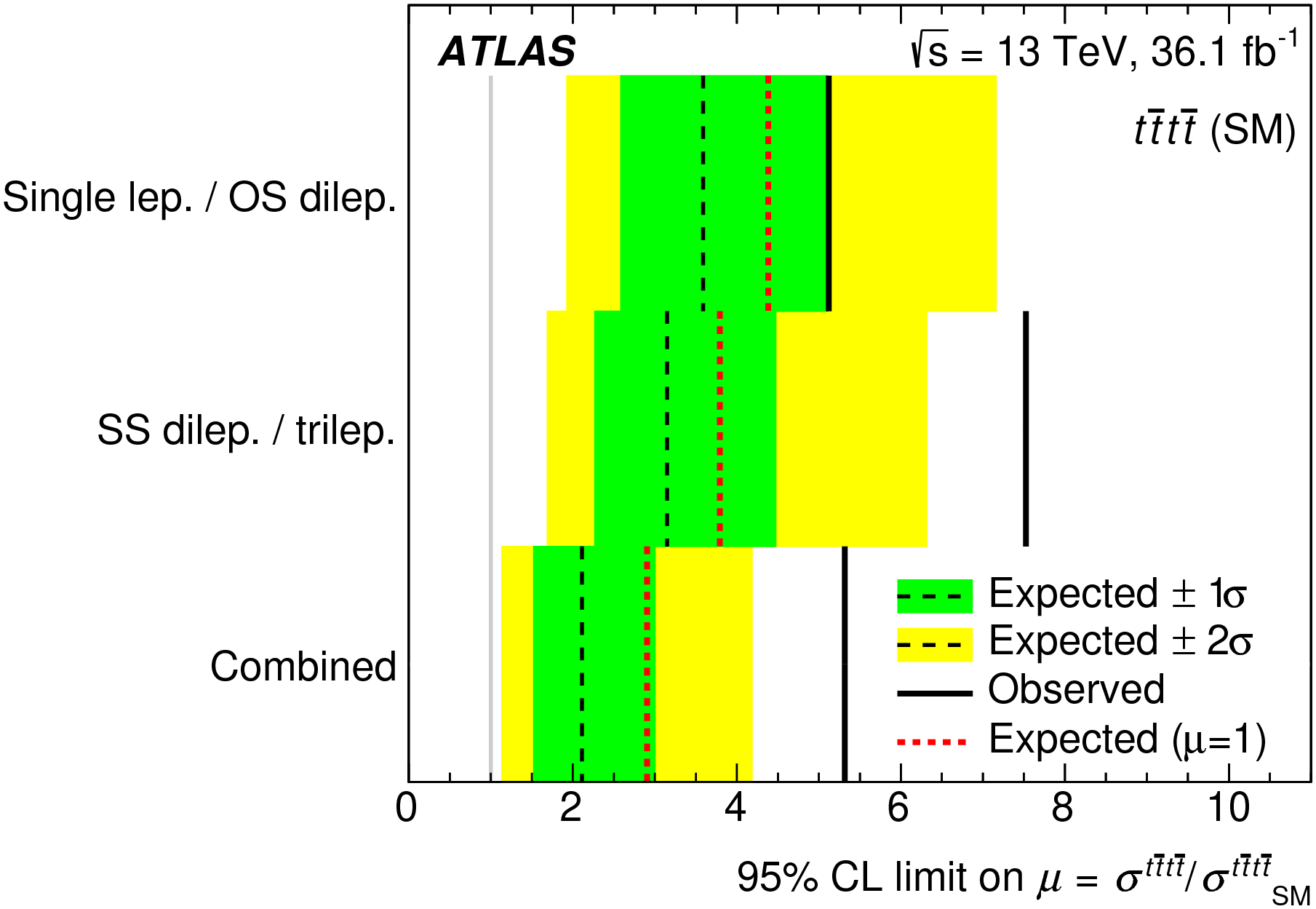 Figure 9
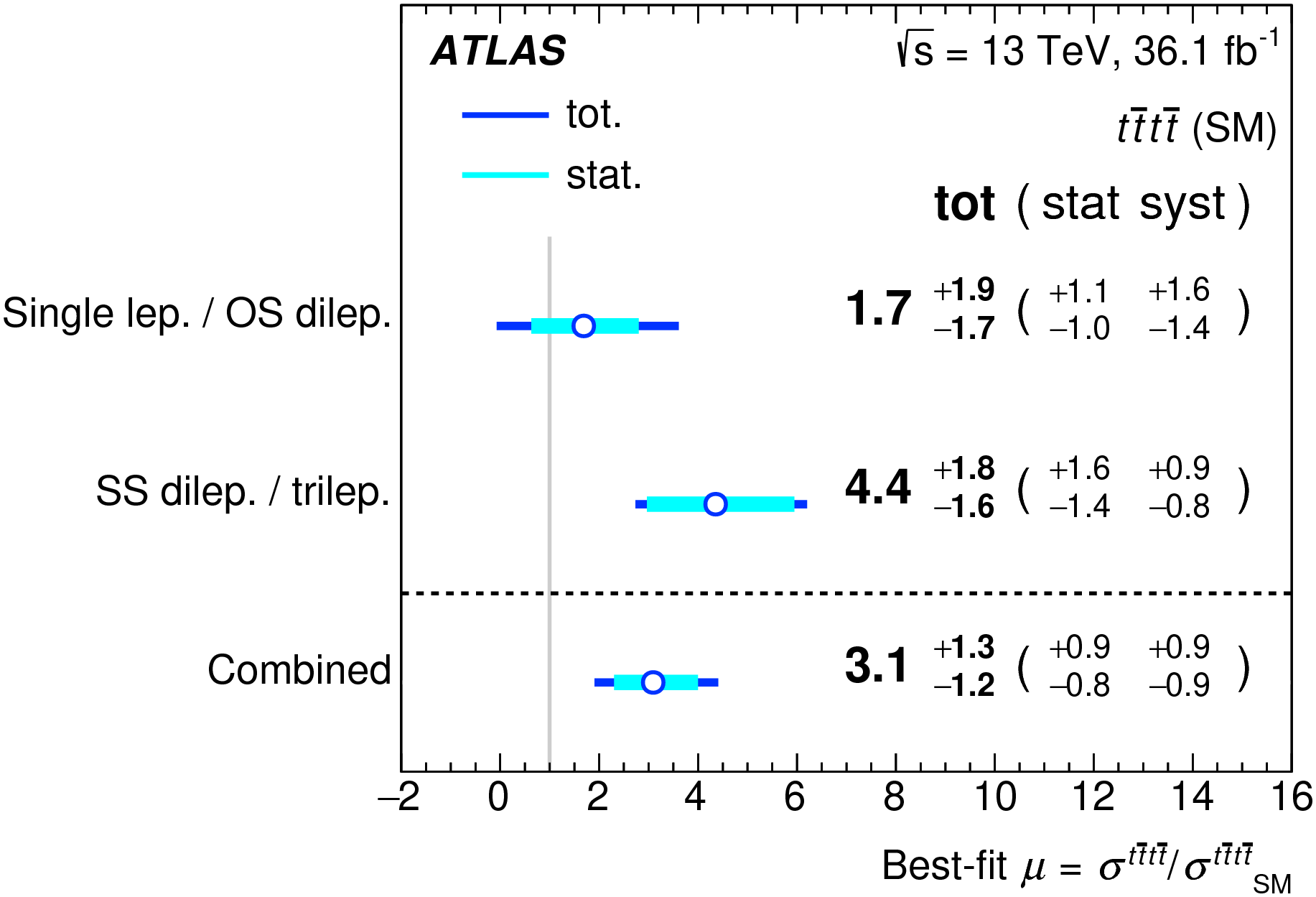 Figure 9
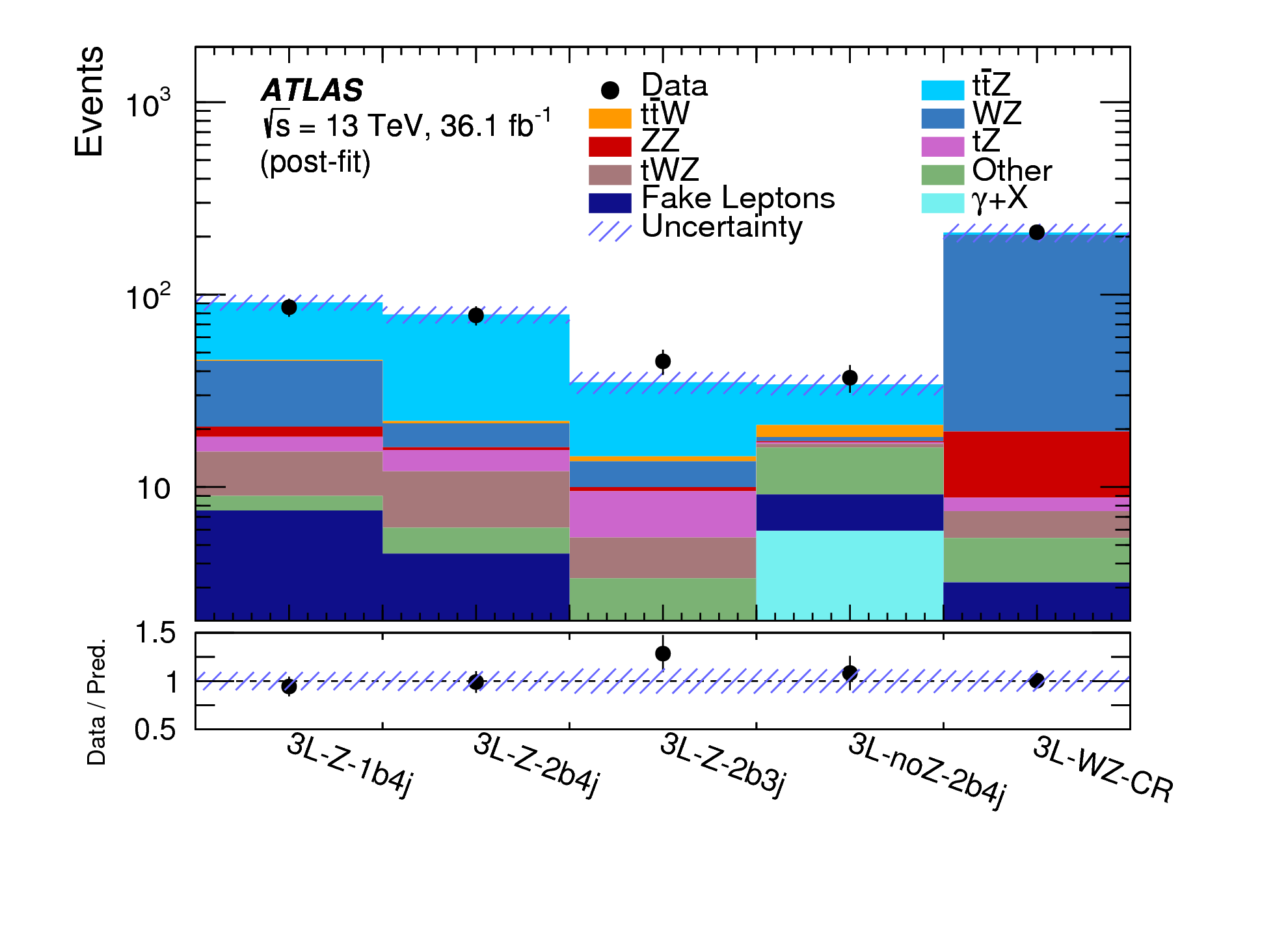 Figure 11
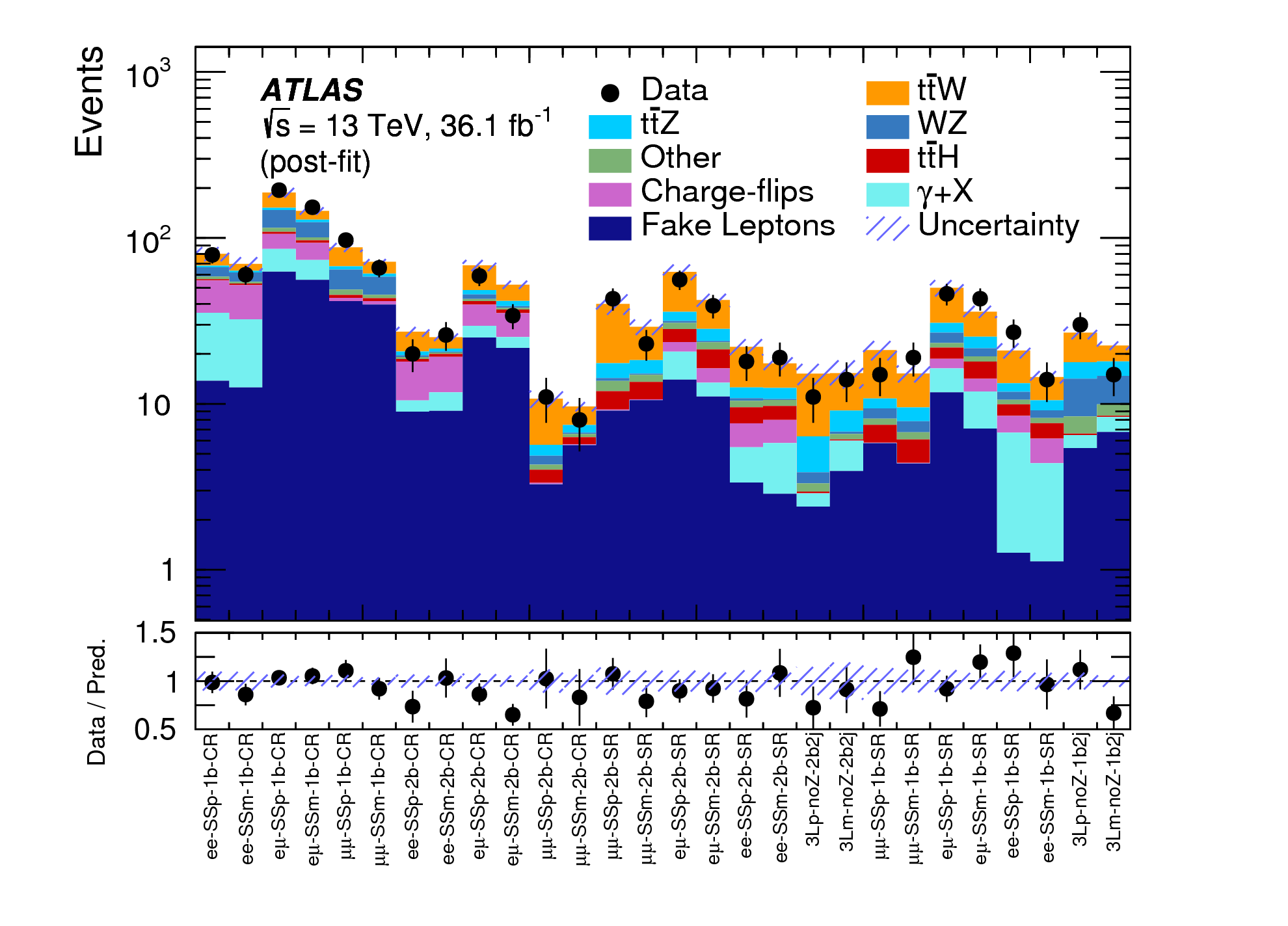 Figure 12
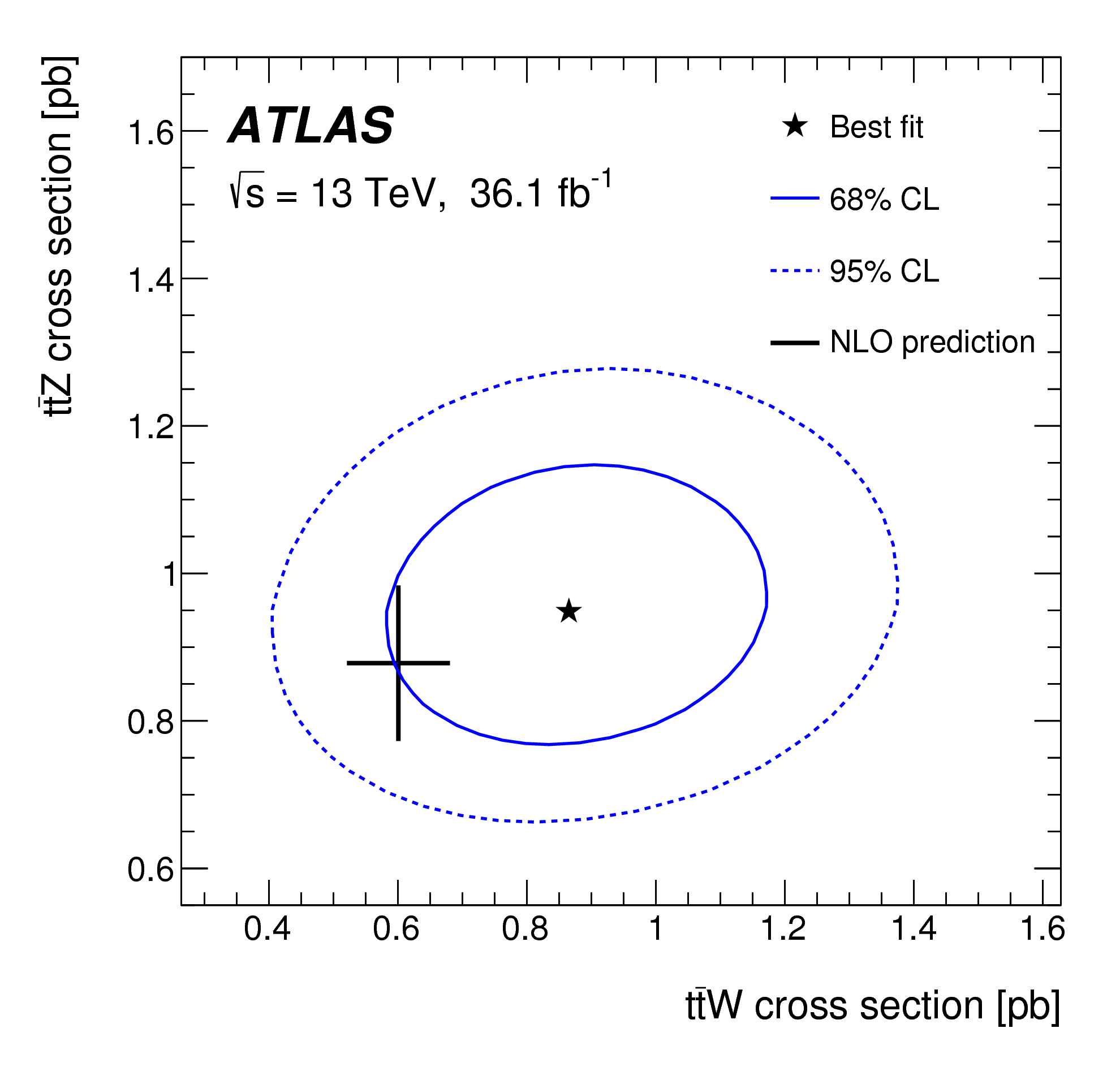 Figure 13
| Uncertainty | ||
|---|---|---|
| Total systematic | 10% | 16% |
| Statistical | 8.4% | 15% |
| Total | 13% | 22% |
Peer Reviews
No public reviews on file for this paper yet. If you reviewed it on a platform where reviews are public (OpenReview, ICLR, NeurIPS, ICML), you can paste yours below so the community can read it here.
Videos
No videos yet. Explain this paper in a talk, walkthrough, or lecture? Add one.
Taxonomy
TopicsParticle physics theoretical and experimental studies · High-Energy Particle Collisions Research · Particle Detector Development and Performance
SNSN-323-63
+ / / at ATLAS
Clara Nellist, on behalf of the ATLAS Collaboration
*Georg-August-Universität Göttingen
Göttingen, Germany
The newest results from the ATLAS Collaboration for the production of a top-quark pair in association with a or boson, and for the production of four top quarks, are summarised in these proceedings. The measurements were performed with 36.1 fb*-1* of proton-proton collision data from the Large Hadron Collider at a centre-of-mass energy of 13 TeV.
PRESENTED AT
International Workshop on Top Quark Physics
Bad Neuenahr, Germany, September 16–21, 2018
©2019 CERN for the benefit of the ATLAS Collaboration.
Reproduction of this article or parts of it is allowed as specified in the CC-BY-4.0 license.
1 Introduction
The study of the production of a pair of top quarks in association with a or boson is referred to as . The process provides a direct probe of the weak couplings of the top quark. In the Standard Model of particle physics (SM), the process is only possible through initial state radiation from the incoming light quarks, and therefore an enhancement of the process could be an indication of Beyond the Standard Model (BSM) physics. It is also an important background for BSM physics searches with various final states, such as stop searches and electroweak Super Symmetry productions. Deviations from the SM can be probed with Effective Field Theory. The process is also an important background for multi-lepton searches and four-top production.
The measurement of the SM four-top cross section is now becoming possible with current LHC statistics. Possible enhancements of SM cross sections from new physics through the production of heavy objects in association with a top-quark pair are also possible. The theoretical SM cross section for four-top production at a centre-of-mass (CoM) of 13 TeV is 9.2 fb at NLO precision [1], which means that top-quark pairs are produced at the LHC at TeV for every four-top event.
The ATLAS experiment [2] at the Large Hadron Collider at CERN, is a multi-purpose particle detector with a forward-backward symmetric cylindrical geometry and a near coverage in solid angle.
2
Previous measurements of the cross section with the full ATLAS 8 TeV dataset [3] measured a significance of 5.0 (4.2) over the background-only hypothesis for () production. There were a number of limiting factors for this measurement, including its statistical uncertainty. For the fit, the dominant systematic uncertainty was the modelling of fake leptons and background processes with misidentified charge. For the fit, the dominant systematic uncertainty source was the modelling of backgrounds from simulation.
Performing the analysis at 13 TeV, instead of 8 TeV, was more advantageous for than for due to the rapidly increasing background for with respect to the more moderate increase in signal cross section.
2.1 at 13 TeV
A simultaneous measurement of the and production cross sections in final states with two, three or four isolated electrons or muons, using 36.1 fb*-1* of data from 2015 and 2016 was performed [4]. Each channel is further divided into multiple regions to maximise the sensitivity of the measurement. The signal regions for the channel with three charged leptons in the final state can be seen as an example in Figure 1 (left), and for regions targeting the process in Figure 1 (right).
Background events containing prompt leptons were estimated from the Monte Carlo (MC) simulation. Normalisation corrections were obtained from the control regions included in the log likelihood fit. A data-driven approach was taken for the background in the channel with two charged leptons of opposite sign in the final state (2LOS). The validation region was selected by inverting the requirement that the charged leptons have the same flavour. Contributions from charge-flip events, significant for events with electrons in the final state, were estimated from data. This background in events with two muons in the final state was deemed to be negligible since the probability of misidentifying the charge of a muon in the transverse momentum range is very small. Backgrounds with greater than or equal to one fake charged lepton were modelled using data in dedicated control regions.
In the analysis and the channel with three charged leptons in the final state (3L), the fake lepton background was estimated using the matrix method. For the region with four charged leptons in the final state, the semi data-driven fake factor method was used. Correction factors accounting for potential data / MC simulation discrepancies were extracted in a dedicated control region and are enriched with processes that contain greater than one fake electron or muon.
2.1.1 Simultaneous fit
The result of the combined fit, shown in Figure 2, measured = 0.95 0.13 pb and = 0.87 0.19 pb. This yielded a significance of : 4.3 (3.4) observed (expected). The result has a significance of greater than 5.
A summary of the systematic and statistical uncertainties for the combined fit can be found in Table 1.
2.1.2 Constraints on BSM
Interpretations of the inclusive cross section measurement in terms of Effective Field Theory (EFT) were performed. Constraints were set on the five operators which modify the vertex. The first two enter the vertex as a linear combination, as the measurement is sensitive to the difference. However, only one operator was considered at a time.
3 Four-tops
The four top signal is very busy, since there are many jets in the final signature, including those that originated from a -quark.
The previous ATLAS measurement was performed with 3.2 fb*-1* of data taken at TeV [5]. Limits on the observed (expected) upper limit of 21 (16) times the four-top standard model cross section at 95% confidence level were obtained. This measurement was performed in the single lepton channel only.
The measurements presented here are with 36.1 fb*-1* data taken in 2015 and 2016 with TeV. The analysis was split into different channels depending on the decay of the boson (either hadronically or leptonically) from each top quark and combined afterwards. Broadly the separation is to one charged lepton or two charged leptons of opposite sign (1L & 2LOS, respectively) [6] and two charged leptons with the same sign or three charged leptons (2LSS & 3L, respectively) [7]. Again, charged leptons are only referring to electrons or muons.
3.1 1L and 2LOS
Events were categorised according to jet, -tagged jet and mass-tagged reclustered large- jet multiplicities. Both channels were dominated by the background, which is not expected to be modelled well, therefore a data-driven approach was used for its estimation.
For the 1L channel, the background from events with a fake or non-prompt lepton was estimated directly from data using the matrix method. The method called Tag Rate Function (ttTRF) was used to estimate + jets and gives the probability that a jet is -tagged.
In the 2LOS channel, the background was estimated from the MC simulation.
A simultaneous fit was performed in the twenty signal regions and resulted in an observed (expected) ( ) of 47 fb (33 fb) with 95% CL upper limit. Consequently, the upper limit on was measured to be 5.1 (3.6) times the SM prediction.
For four-top production via an EFT model with a four-top-quark contact interaction, an observed (expected) upper limit on of 21 fb (22 fb) at 95% CL was measured. In this case the SM four-top production was considered as a background. This result is lower than SM as the contact interaction tends to result in final state objects with larger momenta.
3.2 2LSS and 3L
These channels were dominated by lepton fakes and background. Data driven techniques were used for fake and non-prompt lepton backgrounds, which was estimated with the matrix method, and charge misidentification in the 2LSS channel. Irreducible backgrounds (e.g. ) were modelled by the MC simulation. This measurement used a cut and count analysis in eight signal regions and six validation regions. The SM upper limit was 69 fb (29 fb) for the observed (expected).
3.3 Combination
For the combination, all experimental systematic uncertainties were treated as fully correlated between channels. Background modelling uncertainties were treated as uncorrelated. An excess of events over the SM background prediction, excluding the SM production, was observed (expected) at 2.8 (1.0 ). Observed (expected) at a 95% CL upper limit on of 49 fb (19 b). Corresponding to an upper limit on of 5.3 (2.1) times the SM prediction.
4 Summary
Measurement with 36 fb*-1* 13 TeV data. Combined fit measured = 0.95 0.13 pb = 0.87 0.19 pb and yields significance of 4.3 (4.3) observed (expected) for . The significance of was measured to be greater than 5. No significant excess above the SM expectation was observed. Limits were set on EFT coefficients, which matched or exceeded previous measurements.
The four-tops combined result with all channels using 36 fb*-1* of 13 TeV data was presented. An observed (expected) upper limit of 5.3 (2.1) times the four-top SM cross section at 95% confidence limit was measured. A slight excess above the SM expectation is observed (expected) at 2.8 (1.0 ), which is driven by the 2LSS / 3L channel. The kinematic properties of the 2LSS / 3L channel events were compared with expectations from BSM four-tops and found to agree poorly. The analysis is still statistically dominated; consequently more data is expected to improve the result.
The reference list from the paper itself. Each links out to its DOI / PubMed record.
- 1[1] G. Bevilacqua and M. Worek,“Constraining BSM physics at the LHC: four top final states with NLO accuracy in perturbative QCD”, JHEP 07 (2012) 111
- 2[2] ATLAS Collaboration, “The ATLAS Experiment at the CERN Large Hadron Collider”, JINST 3 (2008) S 08003
- 3[3] ATLAS Collaboration, “Measurement of the t t ¯ W 𝑡 ¯ 𝑡 𝑊 t\overline{t}{W} and t t ¯ Z 𝑡 ¯ 𝑡 𝑍 t\overline{t}{Z} production cross sections in pp collisions at s = 8 𝑠 8 \sqrt{s}=8~{} Te V with the ATLAS detector”, JHEP 11 (2015) 172
- 4[4] ATLAS Collaboration, “Measurement of the t t ¯ Z 𝑡 ¯ 𝑡 𝑍 t\overline{t}{Z} and t t ¯ W 𝑡 ¯ 𝑡 𝑊 t\overline{t}{W} cross sections in proton-proton collisions at s = 13 𝑠 13 \sqrt{s}=13 Te V with the ATLAS detector”, ar Xiv:1901.03584
- 5[5] ATLAS Collaboration, “Search for four-top-quark production in final states with one charged lepton and multiple jets using 3.2 fb -1 of proton-proton collisions at s = 13 𝑠 13 \sqrt{s}=13 Te V with the ATLAS detector at the LHC”, ATLAS-CONF-2016-020, https://cds.cern.ch/record/2144537
- 6[6] ATLAS Collaboration, “Search for four-top-quark production in the single-lepton and opposite-sign dilepton final states in pp collisions at s = 13 𝑠 13 \sqrt{s}=13 Te V with the ATLAS detector”, ar Xiv:1811.02305
- 7[7] ATLAS Collaboration, “Search for new phenomena in events with same-charge leptons and b-jets in pp collisions at s = 13 𝑠 13 \sqrt{s}=13 Te V with the ATLAS detector”, JHEP 1812 (2018) 039