Generalized uncertainty principle in graphene
Alfredo Iorio, Pablo Pais

TL;DR
This paper explores how extending the low-energy approximation in graphene leads to a generalized Dirac field theory aligned with a modified uncertainty principle, with implications for noncommutative geometry and physical realization.
Contribution
It introduces a generalized Dirac Hamiltonian for graphene that incorporates a modified uncertainty principle beyond the linear dispersion approximation.
Findings
Derived a generalized Dirac Hamiltonian for graphene
Linked the Hamiltonian to a generalized uncertainty principle
Discussed potential physical realizations and noncommutative geometry
Abstract
We show that, by going beyond the low-energy approximation for which the dispersion relations of graphene are linear, the corresponding emergent field theory is a specific generalization a Dirac field theory. The generalized Dirac Hamiltonians one obtains are those compatible with specific generalizations of the uncertainty principle. We also briefly comment on the compatibility of the latter with noncommuting positions, , and on their possible physical realization.
Click any figure to enlarge with its caption.
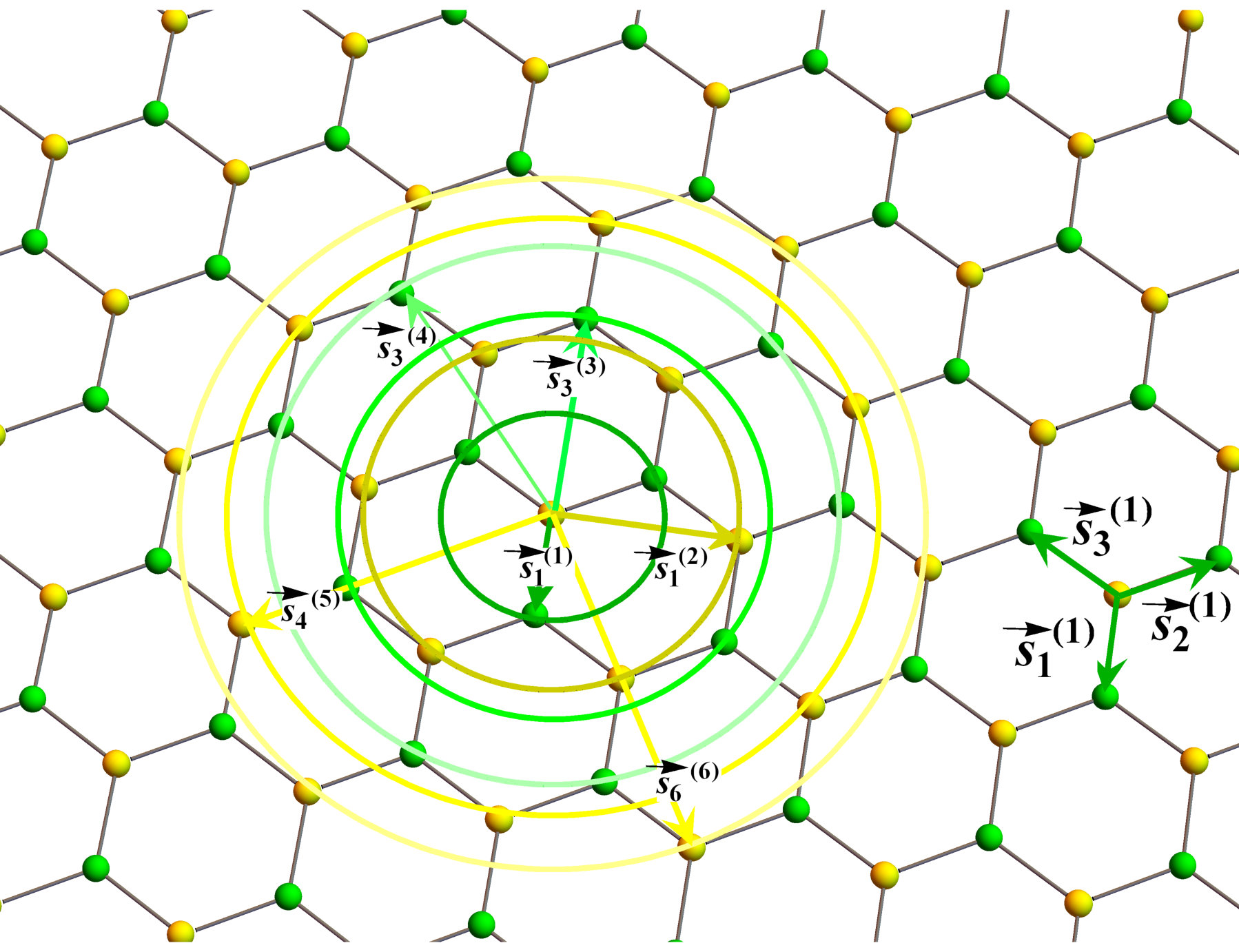 Figure 1
Peer Reviews
No public reviews on file for this paper yet. If you reviewed it on a platform where reviews are public (OpenReview, ICLR, NeurIPS, ICML), you can paste yours below so the community can read it here.
Videos
No videos yet. Explain this paper in a talk, walkthrough, or lecture? Add one.
Generalized uncertainty principle in graphene
A. Iorio
Faculty of Mathematics and Physics, Charles University, V Holešovičkách 2, 18000 Prague 8, Czech Republic
P. Pais
Faculty of Mathematics and Physics, Charles University, V Holešovičkách 2, 18000 Prague 8, Czech Republic
Abstract
We show that, by going beyond the low-energy approximation for which the dispersion relations of graphene are linear, the corresponding emergent field theory is a specific generalization a Dirac field theory. The generalized Dirac Hamiltonians one obtains are those compatible with specific generalizations of the uncertainty principle. We also briefly comment on the compatibility of the latter with noncommuting positions, , and on their possible physical realization.
Quantum Gravity Phenomenology, Generalized Uncertainty Principle, Noncommutativity, Graphene Correspondence.
I Introduction
At low energy, the quasiparticles of graphene responsible for its transport properties, have a well know description in terms of an emergent Dirac field theory, both in flat and curved spacetimes. See Semenoff (1984) for the original theory, Novoselov et al. (2005) for the first experiments, and the reviews Castro Neto et al. (2009); Iorio (2015). Recently Iorio et al. (2018), the possibility that a deformed Dirac structure could still exist was explored, in a range of energies beyond such linear regime.
Indeed, as we shall recall later, it was found in Iorio et al. (2018) that a Dirac structure of a generalized kind is present, beyond the linear approximation, and it is precisely of the specific kind obtained earlier in quantum gravity scenarios with a minimal length, see Amelino-Camelia (2013) for a review. This is as it must be: the higher the energy (or, equivalently, the shorter the wavelength) of the -electron quasiparticles, the more the space they see while they propagate looses its smoothness, and the effects of the discrete honeycomb lattice (see Fig. 1) show-up111In fact, even in the continuum/large-wavelength regime, memories of the lattice are not completely gone. On this see, e.g., Iorio and Pais (2015).. This is also consistent with doubly special relativity Amelino-Camelia (2013) (DSR), with its maximal Planck energy scale, where the smooth manifold structure of spacetime breaks down, along with the local Lorentz invariance.
These scenarios, in fundamental research, are also the stage for certain generalized uncertainty principles (GUPs) stemming from the presence in the theory of a fundamental length scale Das and Vagenas (2008); Ali et al. (2009); Das et al. (2010); Ali et al. (2011). Those differ considerably from other GUPs in the literature, see, e.g. Maggiore (1993). Noticeably, the latter GUPs would not apply here, while the former do.
We shall also show that noncommutativity, either of coordinates or of momenta, is supported by such GUPs. In particular, we shall comment on the fact that a specific kind of (or of ) can be accommodated in this context, and shall point to the role of an external magnetic field for its realization.
It is important to appreciate that these features of graphene can be useful for high energy theoretical research, because there are many open questions there that could be addressed in this way. For instance, previous work Iorio (2011); Iorio and Lambiase (2012, 2014); Iorio and Pais (2018); Taioli et al. (2016), has extensively explored the possibility to realize on graphene black hole physics within the standard description of a quantum field on (nearly everywhere) continuous spacetimes. The present approach could open the way to explore what happens to such physics when the granular effects of space(time) are taken into account, see, e.g., Scardigli et al. (2017). One key example that comes to the mind is the experimental realization of quantum or noncommutative (or both) corrections to the Bekenstein formula for the black-hole entropy.
In the following, we shall recall how the Dirac structure survives beyond the linear regime, in the hypothesis that . We then briefly comment on the compatibility of such structures with noncommutativity, and close with some conclusions.
II Dirac structure beyond the linear regime
The honeycomb lattice of graphene, see Fig. 1, has two atoms per unit cell. The quantum state associated to such configuration is . Here labels the crystal quasi-momentum, and are complex functions, and , with , are Block functions, with periodic orbital wave-functions localized at the sites of the Bravais sublattices, either or .
From the Schrödinger equation , we obtain
[TABLE]
We rewrite the overall interaction as a sum of interactions between subsequent orders of neighbors, and go up to the -near neighbors. It can be shown Iorio et al. (2018) that the field Hamiltonian (1) becomes
[TABLE]
where and are the overlapping and the hopping parameters, respectively, and . We have
[TABLE]
where is the lattice spacing, and the important relation , holds Iorio et al. (2018).
By setting the zero of to , the Schrödinger equation becomes where , and the Hamiltonian matrix is , while the overlapping matrix is , with and the standard Pauli matrices. Evidently, it is the concurrence of two atoms per unit cell, and of the Hermiticity of the Hamiltonian, that are behind the emergence of the Pauli matrices, although this is not enough to have a Dirac structure, as we need to focus on the two solutions, , to the secular equation .
This gives an involved expression in terms of the s, and in general there is no Dirac structure behind such dispersion relations, but the occurrence that , allows us to write , where is a dimensionless parameter222Here we are entitled to consider one Dirac point only Iorio and Pais (2018), we shift the zero of the energy again, , and we drop terms of the kind and or higher.. By defining , , and333Notice that the Fermi velocity is usually defined as , that is . See Castro Neto et al. (2009). we arrive at
[TABLE]
This, including the important minus sign in front of , is precisely what obtained in Ali et al. (2009); Das et al. (2010); Ali et al. (2011) when generalizing the Dirac dispersion relations, to accommodate the effects of a GUP with a minimal fundamental length , the honeycomb lattice spacing here.
By introducing a new generalized momentum , of which the former, , is the low-energy approximation, we have the Dirac Hamiltonian
[TABLE]
where we used the Pauli matrices properties to write . When
[TABLE]
then
[TABLE]
that is precisely the GUP of Ali et al. (2009); Das et al. (2010); Ali et al. (2011). As long those phase space variables are concerned, this is it. Nonetheless, it is crucial to notice that here we have three regimes, with a different kind of momentum at any given regime: two generalized momenta, and (with low-energy with respect to ), and the standard momentum (that is low-energy with respect to , hence with respect to ).
At the first level of the ladder, , full Lorentz symmetry is preserved, see (4). At the second level, , the Hamiltonian preserves rotation symmetry, in this case, but full Lorentz is gone (see in (6)). At the last level in the ladder, , not even rotation symmetry of the Hamiltonian survives (see the so-called ”trigonal warping” Castro Neto et al. (2009), that here we naturally reproduce).
Therefore, in the hypothesis that , and since the low energy momenta are the s (i.e., ), by expanding to we have
[TABLE]
In Iorio et al. (2018) the result up to order is given. This is a rich algebraic structure, worth investigating, especially in relation to the possibility for noncommutativity.
III GUP algebra and noncommutativity in graphene
Noncommutativity of position and momentum is at the core of quantum mechanics, hence, as such, a well accepted fact of Nature. On the other hand, noncommutativity of positions among themselves still seems quite a radical and fully theoretical hypothesis.
In fact, such a possibility has been studied from many perspectives, starting from the early days of quantum mechanics with the Lorentz-symmetry-preserving model of Snyder Snyder (1947). It then went through different stages of fortune, from the ground-breaking mathematical framework of Connes’s Noncommutative Geometry Connes (1994), to Doplicher et al’s hypothesis of a necessary outcome of the reconciliation between general relativity and quantum mechanics Doplicher et al. (1995), to the noncommutative gauge theory as a possible low-energy limit of string theory, obtained via the Seiberg-Witten map444String theory is actually not necessary to obtain the Seiberg-Witten map, as shown by Wess and coworkers Madore et al. (2000). Seiberg and Witten (1999). The latter results, in the past decade, ignited research on the emergence of such phenomenon in condensed matter systems Jackiw (2002), especially impacts on Lorentz symmetry, e.g., in electrodynamics Guralnik et al. (2001); Castorina et al. (2004).
Let us then comment here on whether this radical idea can find some room in these settings, and what could this possibly mean from the physical point of view. For the sake of simplicity and generality of the discussion, here we do not follow too closely the notation of the previous Section, and we call the coordinates , and the momenta , without explicit reference to what is high-energy and what is low-energy. It should not be difficult to reconstruct the right correspondence, though.
In the previous Section, we saw that, by considering terms beyond the linear approximation, a modified Heisenberg algebra emerges. In there, we assumed that the coordinates (and momenta) commute among themselves. Indeed, the algebra (6) is computed by employing Jacobi identities where the commutators and are demanded to be zero Ali et al. (2011). If we allow for noncommutativity, we have many more possibilities. Here we merely explore which noncommutative algebra is compatible with the GUP emerged in graphene, see (6), up to quadratic contributions.
Suppose we have a general Weyl-Heisenberg algebra of the kind studied in Ali et al. (2009); Das et al. (2010); Ali et al. (2011)
[TABLE]
where , and s and s must be dimensionfull constants, , , for . Imposing the Jacobi identity,
[TABLE]
leads to the relation Ali et al. (2011)
[TABLE]
with .
Equation (10) can be solved by demanding both its sides to be zero, which gives Ali et al. (2009); Das et al. (2010); Ali et al. (2011) and , with , on the one hand, and commuting coordinates, on the other hand. The final expression for the GUP is then
[TABLE]
that, at order , is what we obtain in graphene too, see (6).
Noticeably, this GUP does not rule out the possibility of a noncommutative algebra, when
[TABLE]
and is a constant, antisymmetric, number valued quantity. Indeed, in this case, the left side of (10) is still zero, so then is the right side, and the previous argument leading to (11) just goes through.
On the other hand, a more general noncommutativity needs more drastic changes. For instance, one well known model is the Lie-algebra model Madore et al. (2000),
[TABLE]
where are number valued structure constants. With a noncommutativity of the kind (13), the left side of (10) is no longer zero, and one cannot find a set of constant s and s satisfying the equation.
Another popular realization of noncommutativity is the -deformed algebra Madore et al. (2000), based on deformed operators and commutators
[TABLE]
with , and a number valued quantity. This approach lead, for instance, to the interesting twisted coproduct model of Balachandran et al Balachandran et al. (2006). For this kind of noncommutativity based on -deformation, all the commutators need be, at least in principle, modified. Hence, to study whether the latter approach can find room in the graphene scenario, an analysis deeper than the one carried on here is necessary.
Similarly, one can work-out from the Jacobi for , that noncommutativity of the momenta is also allowed along a similar pattern as for coordinates.
Therefore, we conclude that there is indeed room for noncommutativity in this graphene scenario, surely in the settings provided by (12). The questions are then: What physical situation are we describing this way? What corresponds to in graphene?
We shall not answer fully these questions here, but shall only point to a scenario that could be easily realized with graphene, and that is known to have noncommutativity of the kind we are looking for. The scenario is that of planar electrons in the lowest Landau level. The energy levels of such electrons, moving within an external magnetic field of strength , perpendicular to the plane, are the well-known Landau levels. In graphene, Landau levels have been realized in experiments and studied, see, e.g., Jiang et al. (2007).
When the magnetic field is strong the dynamics is effectively projected to the lowest such levels555This is because the Landau levels have a separation proportional to or to , depending on whether we are dealing with relativistic or non-relativistic fermions., giving rise to Jackiw (2002)
[TABLE]
that in our context would mean .
IV Conclusions
We have shown that, by going beyond the linear dispersion relations of graphene, a generalized Dirac field theory survives, and it is compatible with GUPs that require a minimal fundamental length scale. This is also consistent with Amelino-Camelia’s DSR, where the smooth manifold structure of spacetime breaks down, along with the local Lorentz invariance.
While it may be surprising that some sort of field theory description still holds in graphene at higher energies (a fact due to the fortuitus occurrence ), the correspondence of the latter with fields in a granular spacetime scenarios is something one should expect. In fact, the shorter the wavelength of the -electron quasiparticles, the more the granular structure of the honeycomb lattice affects their dynamics.
It is important for high energy theory to have found here these features, because there are many open theoretical questions that could be addressed this way. To cite a key one: the experimental realization of quantum corrections to the Bekenstein formula for the black-hole entropy. Many more are, of course, possible to envisage.
We also briefly commented here on the compatibility of noncommutativity with the obtained GUP. We concluded that the simplest compatibility with the GUP modified by the graphene granular structure is given by , with a constant, antisymmetric, number valued quantity. The Lie-algebra noncommutativity is not compatible, while compatibility with -deformation needs further analysis. We then pointed to a possible physical set-up, where the presence of a strong perpendicular external magnetic field could create the conditions for such noncommutativity, with , by projecting the dynamics of the -electron quasiparticles on the lowest Landau level.
Interesting would be to compare the Lorentz violation emerging in graphene in the commutative case of Section II (see the violation in (6), and the even stronger violation in (II)), with the Lorentz violation due to noncommutativity in the approach of Iorio (2008); Iorio and Sykora (2002); Álvarez-Gaumé and Vázquez-Mozo (2003).
Acknowledgments
The authors are indebted to Mir Faizal, Ahmed Ali and Ibrahim Elmashad for their collaboration on these exciting matters, and thank Gaetano Lambiase and Fabio Scardigli for lively and informative discussions. P. P. acknowledges the warm hospitality of the Centro de Estudios Científicos (CECs) in Valdivia, Chile, at the final stage of this work.
The reference list from the paper itself. Each links out to its DOI / PubMed record.
- 1Semenoff (1984) G. W. Semenoff, Phys. Rev. Lett. 53 , 2449 (1984).
- 2Novoselov et al. (2005) K. S. Novoselov, A. K. Geim, S. V. Morozov, D. Jiang, M. I. Katsnelson, I. V. Grigorieva, S. V. Dubonos, and A. A. Firsov, Nature 438 , 197 (2005), ar Xiv:cond-mat/0509330 [cond-mat.mes-hall] .
- 3Castro Neto et al. (2009) A. H. Castro Neto, F. Guinea, N. M. R. Peres, K. S. Novoselov, and A. K. Geim, Rev. Mod. Phys. 81 , 109 (2009), ar Xiv:cond-mat/0709.1163 [cond-mat.mes-hall] .
- 4Iorio (2015) A. Iorio, Int. J. Mod. Phys. D 24 , 1530013 (2015), hep-th/1412.4554 .
- 5Iorio et al. (2018) A. Iorio, P. Pais, I. A. Elmashad, A. F. Ali, M. Faizal, and L. I. Abou-Salem, Int. J. Mod. Phys. D 27 , 1850080 (2018), physics.gen-ph/1706.01332 .
- 6Amelino-Camelia (2013) G. Amelino-Camelia, Living Rev. Relat. 16 , 5 (2013).
- 7Iorio and Pais (2015) A. Iorio and P. Pais, Phys. Rev. D 92 , 125005 (2015), hep-th/1508.00926 .
- 8Das and Vagenas (2008) S. Das and E. C. Vagenas, Phys. Rev. Lett. 101 , 221301 (2008).