Ground-state properties of doubly magic nuclei from the unitary-model-operator approach with the chiral two- and three-nucleon forces
T. Miyagi, T. Abe, M. Kohno, P. Navratil, R. Okamoto, T. Otsuka, N., Shimizu, and S. R. Stroberg

TL;DR
This study applies the unitary-model-operator approach with chiral two- and three-nucleon forces to calculate ground-state energies and radii of doubly magic nuclei, demonstrating consistency with other ab initio methods and SRG scale independence.
Contribution
First UMOA calculation incorporating both nucleon-nucleon and three-nucleon interactions based on chiral EFT with SRG evolution.
Findings
Ground-state energies and radii agree with recent ab initio results.
Calculated radii are largely independent of SRG resolution scale.
SRG evolution minimally affects the radius operator.
Abstract
The ground-state energies and radii for He, O, and Ca are calculated with the unitary-model-operator approach (UMOA). In the present study, we employ the similarity renormalization group (SRG) evolved nucleon-nucleon () and three-nucleon () interactions based on the chiral effective field theory. This is the first UMOA calculation with both and interactions. The calculated ground-state energies and radii are consistent with the recent {\it ab initio} results with the same interaction. We evaluate the expectation values with two- and three-body SRG evolved radius operators, in addition to those with the bare radius operator. With the aid of the higher-body evolution of radius operator, it is seen that the calculated radii tend to be SRG resolution-scale independent. We find that the SRG evolution gives minor modifications for the radius operator.
Click any figure to enlarge with its caption.
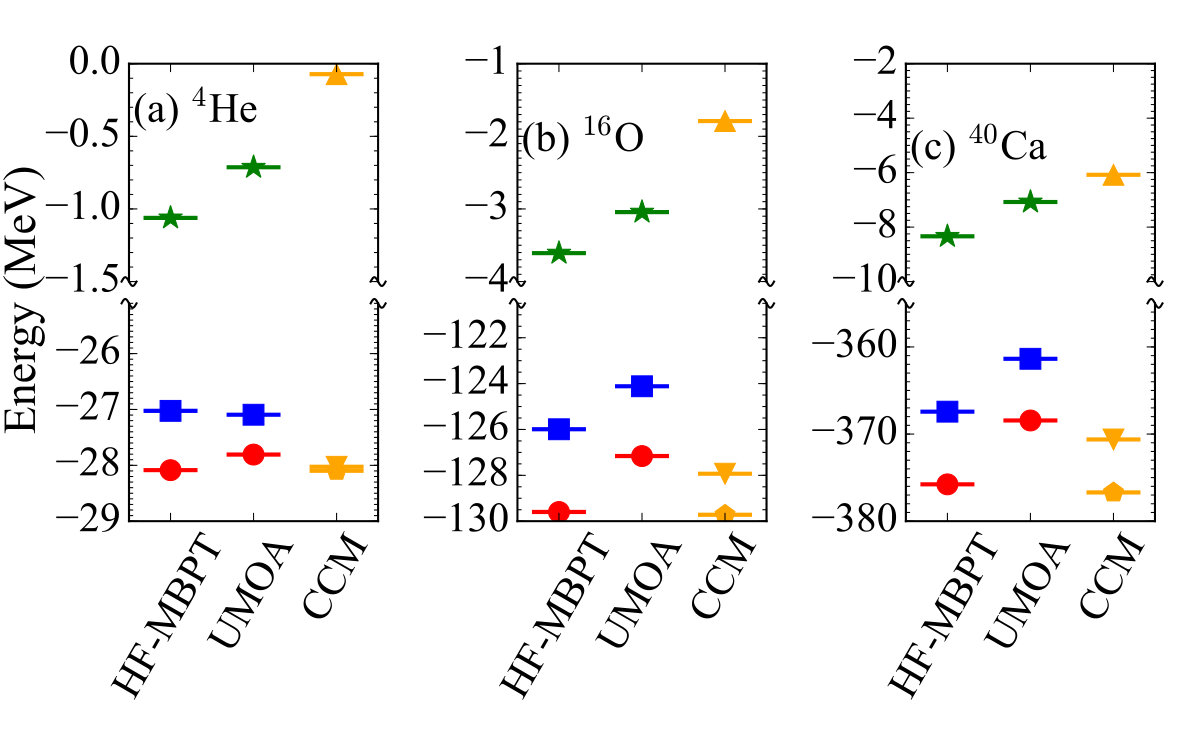 Figure 1
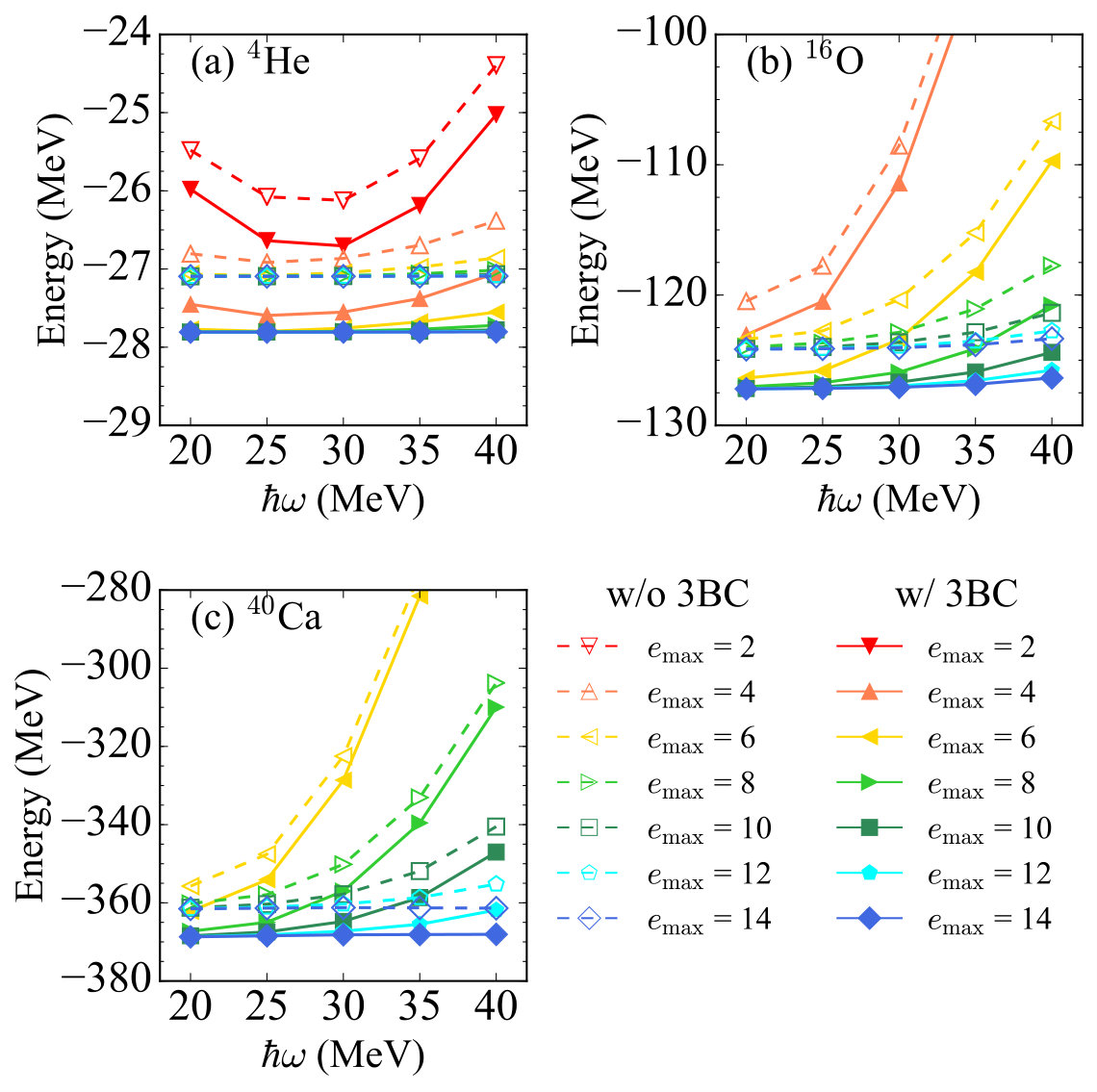 Figure 2
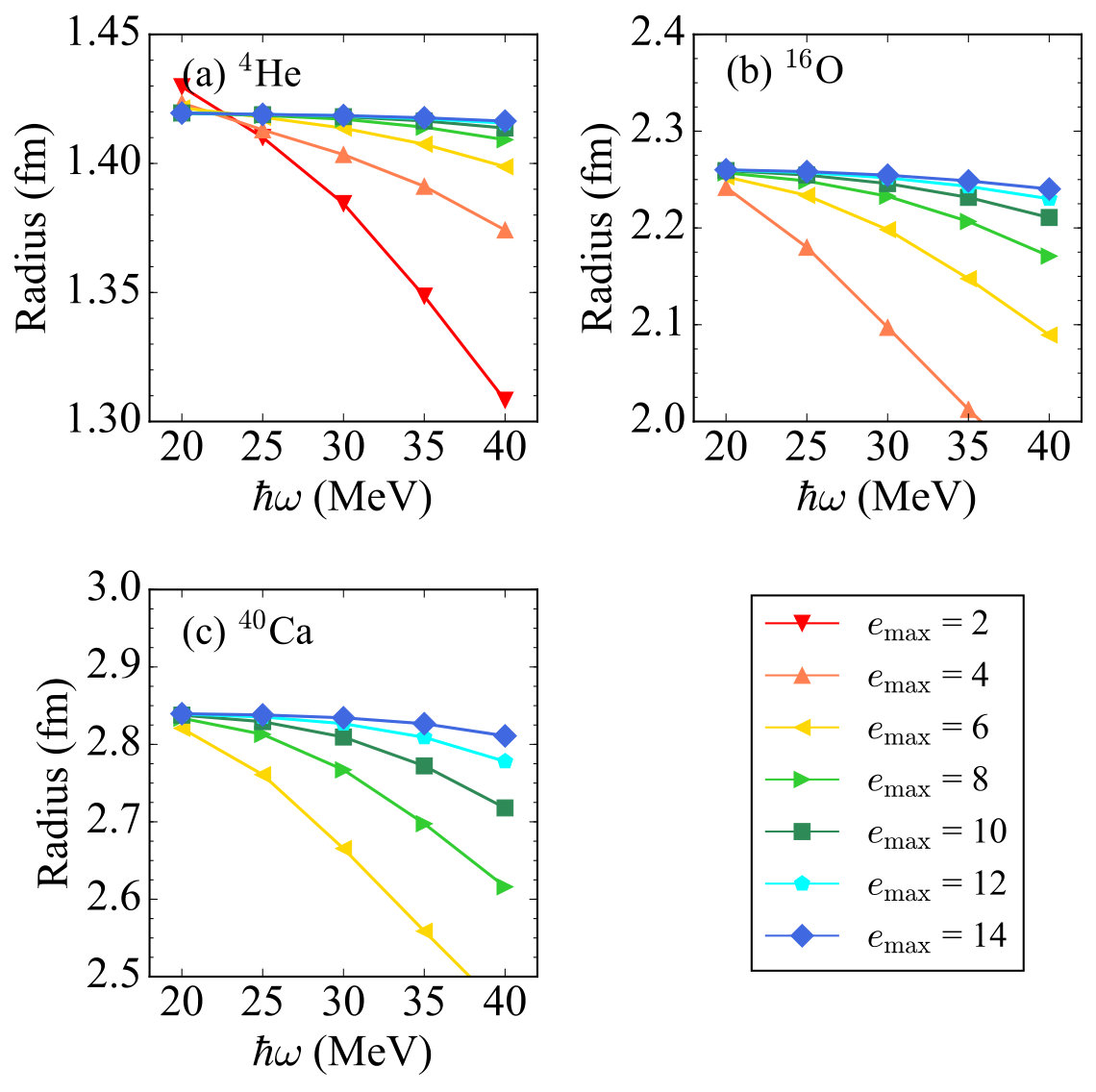 Figure 3
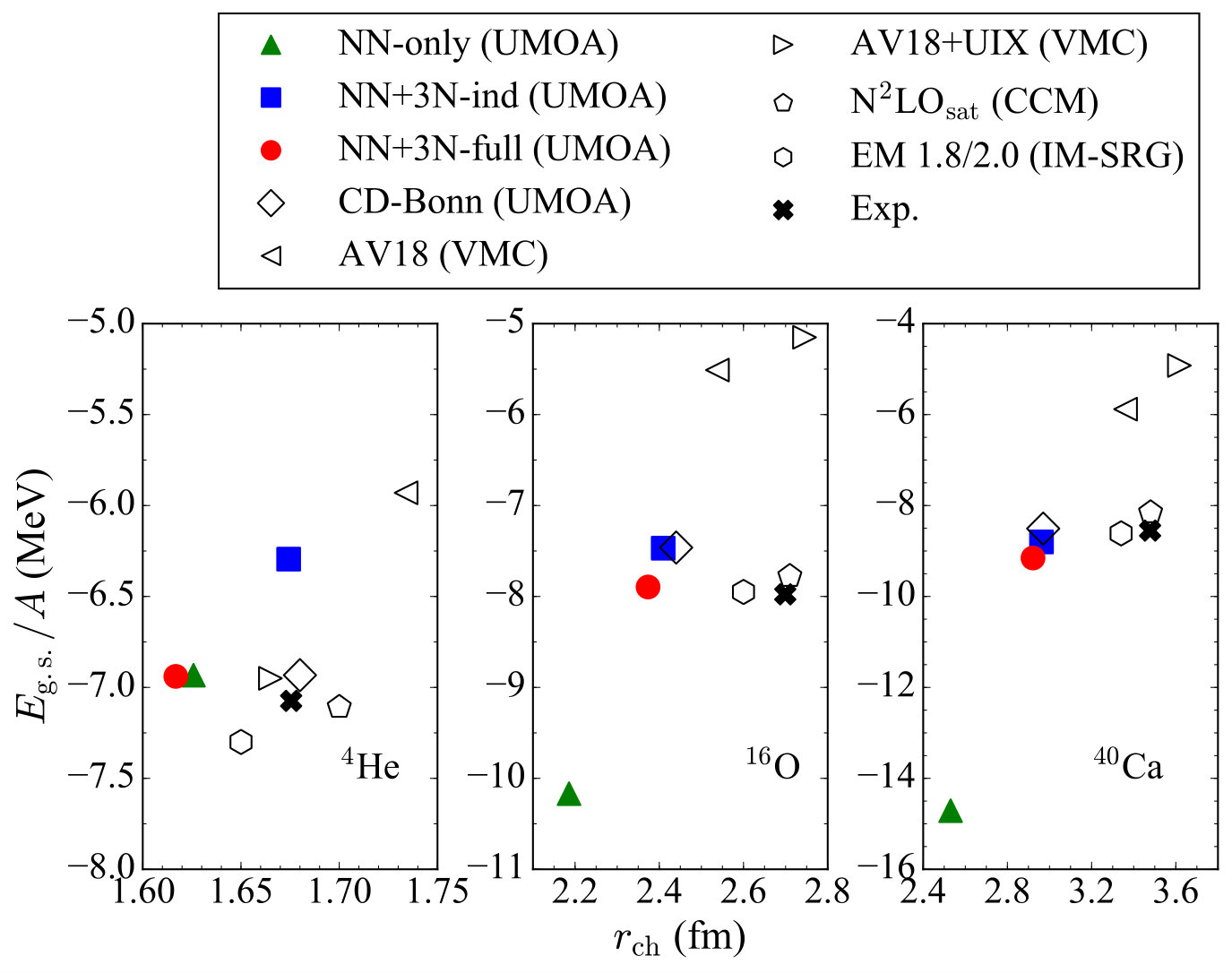 Figure 4
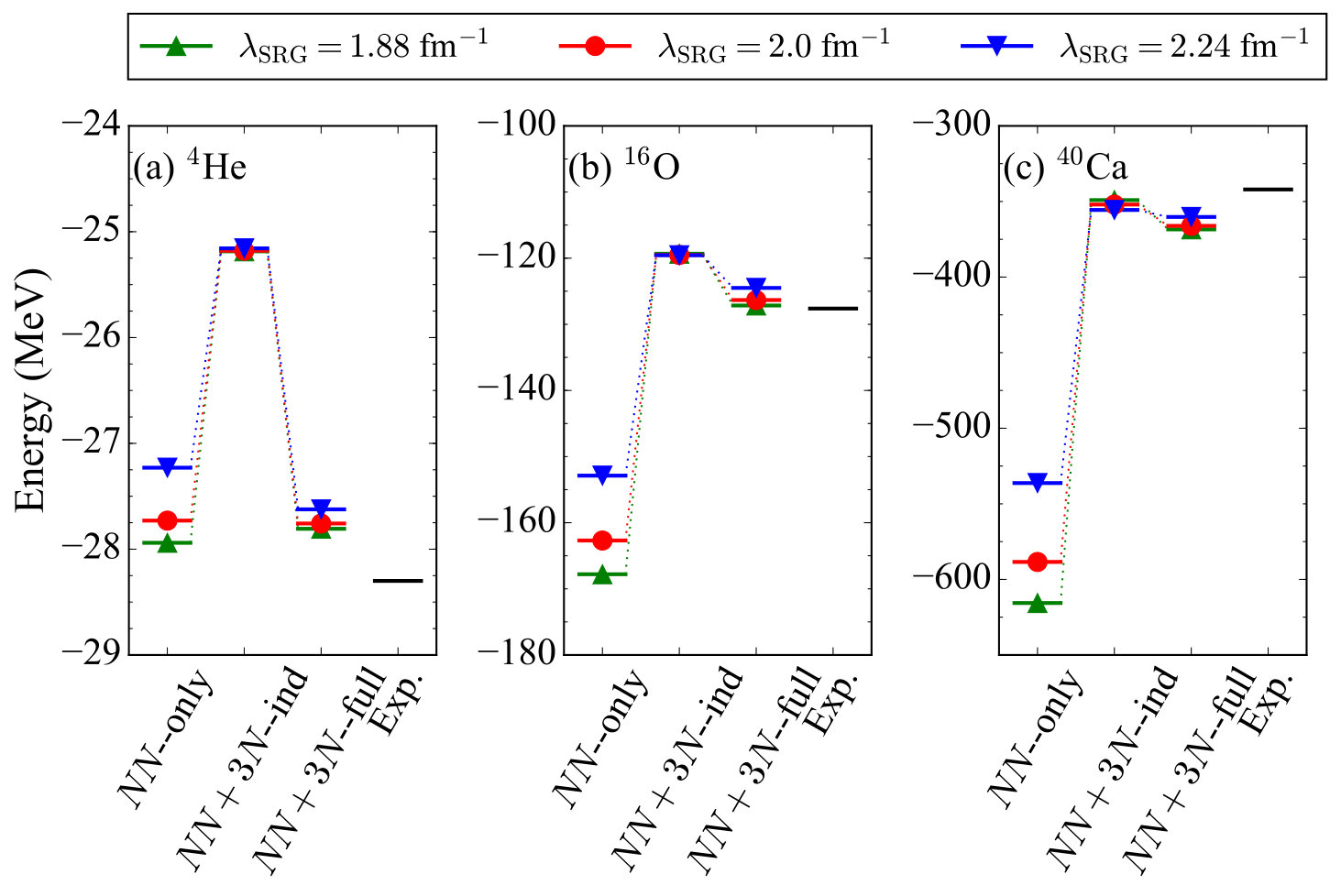 Figure 5
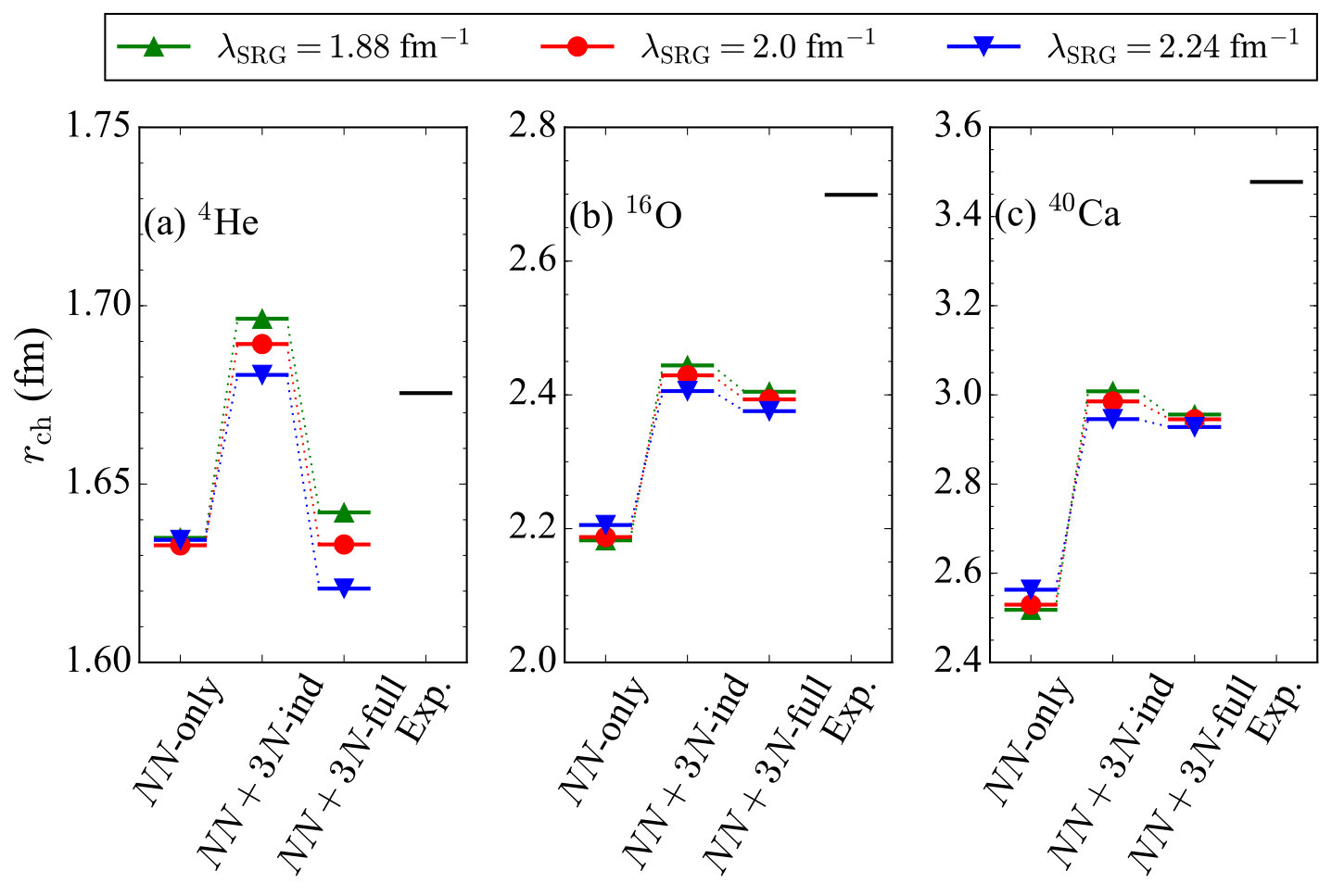 Figure 6
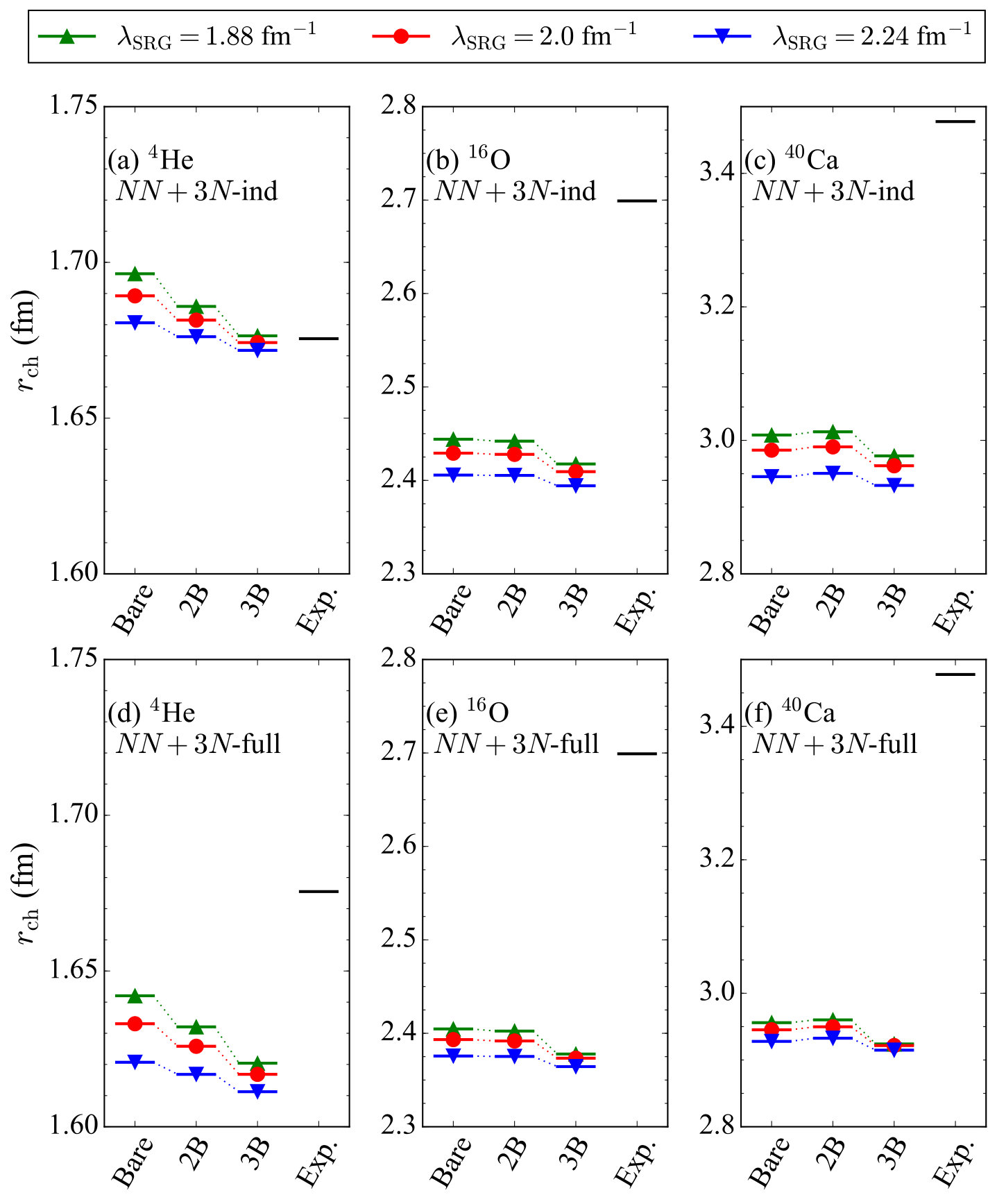 Figure 7
| Second order | |||
| {fmfgraph}(50,50) \fmfstraight\fmfsetarrow_len0.25cm \fmfsetarrow_ang15 \fmftopv1 \fmfrighth1,h2 \fmfbottomv2 \fmffermion,left=0.5v1,v2 \fmffermion,left=0.5v2,v1 \fmfdashes,dash_len=0.01cmh1,v2 \fmfdashes,dash_len=0.01cmh2,v1 \fmfvdecor.shape=cross,decor.size=0.25cmh1,h2 | {fmfgraph}(50,50) \fmfstraight\fmfsetarrow_len0.25cm \fmfsetarrow_ang15 \fmftopv1 \fmfbottomv2 \fmffermion,left=0.5v1,v2 \fmffermion,left=0.8v1,v2 \fmffermion,left=0.5v2,v1 \fmffermion,left=0.8v2,v1 \fmfdotv1,v2 | ||
| Third order | |||
| {fmfgraph}(50,50) \fmfstraight\fmfsetarrow_len0.25cm \fmfsetarrow_ang15 \fmftopv1 \fmfbottomv3 \fmfrighth3,h2,h1 \fmffermion,tension=100v1,v2 \fmffermion,tension=100v2,v3 \fmffermion,left=0.5v3,v1 \fmfdashesh1,v1 \fmfdashesh2,v2 \fmfdashesh3,v3 \fmfvdecor.shape=cross,decor.size=0.25cmh1,h2,h3 | {fmfgraph}(50,50) \fmfstraight\fmfsetarrow_len0.25cm \fmfsetarrow_ang15 \fmftopv1 \fmfbottomv3 \fmfrighth3,h2,h1 \fmffermion,tension=100v2,v1 \fmffermion,tension=100v3,v2 \fmffermion,right=0.5v1,v3 \fmfdashesh1,v1 \fmfdashesh2,v2 \fmfdashesh3,v3 \fmfvdecor.shape=cross,decor.size=0.25cmh1,h2,h3 | {fmfgraph}(50,50) \fmfstraight\fmfsetarrow_len0.25cm \fmfsetarrow_ang15 \fmftopv1 \fmfbottomv3 \fmfrighth3,h2,h1 \fmfphantom,tension=100v1,v2 \fmfphantom,tension=100v2,v3 \fmffermion,left=0.5v3,v1 \fmffermion,left=0.5v1,v3 \fmffermion,left=0.5v3,v2 \fmffermion,left=0.5v2,v3 \fmfdotv3 \fmfdashesh1,v1 \fmfdashesh2,v2 \fmfvdecor.shape=cross,decor.size=0.25cmh1,h2 | {fmfgraph}(50,50) \fmfstraight\fmfsetarrow_len0.25cm \fmfsetarrow_ang15 \fmftopv1 \fmfbottomv3 \fmfrighth3,h2,h1 \fmfphantom,tension=100v1,v2 \fmfphantom,tension=100v2,v3 \fmffermion,left=0.8v2,v1 \fmffermion,left=0.8v1,v2 \fmffermion,left=0.8v3,v2 \fmffermion,left=0.8v2,v3 \fmfdotv2 \fmfdashesh1,v1 \fmfdashesh3,v3 \fmfvdecor.shape=cross,decor.size=0.25cmh1,h3 |
| {fmfgraph}(50,50) \fmfstraight\fmfsetarrow_len0.25cm \fmfsetarrow_ang15 \fmftopv1 \fmfbottomv3 \fmfrighth3,h2,h1 \fmfphantom,tension=100v1,v2 \fmfphantom,tension=100v2,v3 \fmffermion,left=0.5v2,v1 \fmffermion,left=0.5v1,v2 \fmffermion,left=0.5v3,v1 \fmffermion,left=0.5v1,v3 \fmfdotv1 \fmfdashesh2,v2 \fmfdashesh3,v3 \fmfvdecor.shape=cross,decor.size=0.25cmh2,h3 | {fmfgraph}(50,50) \fmfstraight\fmfsetarrow_len0.25cm \fmfsetarrow_ang15 \fmftopv1 \fmfbottomv3 \fmfrighth3,h2,h1 \fmffermion,left=0.8v3,v1 \fmffermion,tension=100v1,v2 \fmffermion,tension=100v2,v3 \fmffermion,left=0.5v3,v2 \fmffermion,left=0.5v2,v3 \fmfdotv2,v3 \fmfdashesh1,v1 \fmfvdecor.shape=cross,decor.size=0.25cmh1 | {fmfgraph}(50,50) \fmfstraight\fmfsetarrow_len0.25cm \fmfsetarrow_ang15 \fmftopv1 \fmfbottomv3 \fmfrighth3,h2,h1 \fmffermion,right=0.8v1,v3 \fmffermion,tension=100v2,v1 \fmffermion,tension=100v3,v2 \fmffermion,left=0.5v3,v2 \fmffermion,left=0.5v2,v3 \fmfdotv2,v3 \fmfdashesh1,v1 \fmfvdecor.shape=cross,decor.size=0.25cmh1 | {fmfgraph}(50,50) \fmfstraight\fmfsetarrow_len0.25cm \fmfsetarrow_ang15 \fmftopv1 \fmfbottomv3 \fmfrighth3,h2,h1 \fmffermion,right=0.8v1,v3 \fmffermion,tension=100v2,v1 \fmffermion,tension=100v3,v2 \fmffermion,left=0.5v3,v1 \fmffermion,left=0.5v1,v3 \fmfdotv1,v3 \fmfdashesh2,v2 \fmfvdecor.shape=cross,decor.size=0.25cmh2 |
| {fmfgraph}(50,50) \fmfstraight\fmfsetarrow_len0.25cm \fmfsetarrow_ang15 \fmftopv1 \fmfbottomv3 \fmfrighth3,h2,h1 \fmffermion,left=0.8v3,v1 \fmffermion,tension=100v1,v2 \fmffermion,tension=100v2,v3 \fmffermion,left=0.5v3,v1 \fmffermion,left=0.5v1,v3 \fmfdotv1,v3 \fmfdashesh2,v2 \fmfvdecor.shape=cross,decor.size=0.25cmh2 | {fmfgraph}(50,50) \fmfstraight\fmfsetarrow_len0.25cm \fmfsetarrow_ang15 \fmftopv1 \fmfbottomv3 \fmfrighth3,h2,h1 \fmffermion,left=0.8v3,v1 \fmffermion,tension=100v1,v2 \fmffermion,tension=100v2,v3 \fmffermion,left=0.5v2,v1 \fmffermion,left=0.5v1,v2 \fmfdotv1,v2 \fmfdashesh3,v3 \fmfvdecor.shape=cross,decor.size=0.25cmh3 | {fmfgraph}(50,50) \fmfstraight\fmfsetarrow_len0.25cm \fmfsetarrow_ang15 \fmftopv1 \fmfbottomv3 \fmfrighth3,h2,h1 \fmffermion,right=0.8v1,v3 \fmffermion,tension=100v2,v1 \fmffermion,tension=100v3,v2 \fmffermion,left=0.5v2,v1 \fmffermion,left=0.5v1,v2 \fmfdotv1,v2 \fmfdashesh3,v3 \fmfvdecor.shape=cross,decor.size=0.25cmh3 | {fmfgraph}(50,50) \fmfstraight\fmfsetarrow_len0.25cm \fmfsetarrow_ang15 \fmftopv1 \fmfbottomv3 \fmffermion,left=0.8v1,v3 \fmffermion,right=0.8v1,v3 \fmffermion,left=0.5v2,v1 \fmffermion,right=0.5v2,v1 \fmffermion,left=0.5v3,v2 \fmffermion,right=0.5v3,v2 \fmfdotv1,v2,v3 |
| {fmfgraph}(50,50) \fmfstraight\fmfsetarrow_len0.25cm \fmfsetarrow_ang15 \fmftopv1 \fmfbottomv3 \fmffermion,left=0.8v3,v1 \fmffermion,right=0.8v3,v1 \fmffermion,left=0.5v1,v2 \fmffermion,right=0.5v1,v2 \fmffermion,left=0.5v2,v3 \fmffermion,right=0.5v2,v3 \fmfdotv1,v2,v3 | {fmfgraph}(50,50) \fmfstraight\fmfsetarrow_len0.25cm \fmfsetarrow_ang15 \fmftopv1 \fmfbottomv3 \fmffermion,left=0.8v3,v1 \fmffermion,left=0.8v1,v3 \fmffermion,left=0.5v2,v1 \fmffermion,left=0.5v1,v2 \fmffermion,left=0.5v3,v2 \fmffermion,left=0.5v2,v3 \fmfdotv1,v2,v3 | ||
| (MeV) | |||||
|---|---|---|---|---|---|
| Nuclide | (fm-1) | –only | –ind | –full | Exp.Wang et al. (2012) |
| 1.88 | |||||
| 4He | 2.0 | ||||
| 2.24 | |||||
| 1.88 | |||||
| 16O | 2.0 | ||||
| 2.24 | |||||
| 1.88 | |||||
| 40Ca | 2.0 | ||||
| 2.24 | |||||
| (fm) | |||||||
|---|---|---|---|---|---|---|---|
| +–ind | +–full | ||||||
| Nuclide | (fm-1) | Bare | 2B | 3B | Bare | 2B | 3B |
| 1.88 | |||||||
| 4He | 2.0 | ||||||
| 2.24 | |||||||
| 1.88 | |||||||
| 16O | 2.0 | ||||||
| 2.24 | |||||||
| 1.88 | |||||||
| 40Ca | 2.0 | ||||||
| 2.24 | |||||||
Peer Reviews
No public reviews on file for this paper yet. If you reviewed it on a platform where reviews are public (OpenReview, ICLR, NeurIPS, ICML), you can paste yours below so the community can read it here.
Videos
No videos yet. Explain this paper in a talk, walkthrough, or lecture? Add one.
Ground-state properties of doubly magic nuclei from the unitary-model-operator approach
with the chiral two- and three-nucleon forces
T. Miyagi
Center for Nuclear Study, The University of Tokyo, 7-3-1 Hongo, Bunkyo, Tokyo 113-0033, Japan
TRIUMF, 4004 Wesbrook Mall, Vancouver, British Columbia, V6T 2A3 Canada
T. Abe
Department of Physics, The University of Tokyo, 7-3-1, Hongo, Bunkyo, Tokyo 113-0033, Japan
Center for Nuclear Study, The University of Tokyo, 7-3-1 Hongo, Bunkyo, Tokyo 113-0033, Japan
M. Kohno
Research Center for Nuclear Physics, Osaka University, Japan
P. Navrátil
TRIUMF, 4004 Wesbrook Mall, Vancouver, British Columbia, V6T 2A3 Canada
R. Okamoto
Senior Academy, Kyushu Institute of Technology, Tobata, Kitakyushu 804-0015, Japan
T. Otsuka
RIKEN Nishina Center, 2-1 Hirosawa, Wako, Saitama 351-0198, Japan
Department of Physics, The University of Tokyo, 7-3-1, Hongo, Bunkyo, Tokyo 113-0033, Japan
National Superconducting Cyclotron Laboratory, Michigan State University, East Lansing, Michigan 48824, USA
Instituut voor Kern- en Stralingsfysica, KU Leuven, B-3001 Leuven, Belgium
N. Shimizu
Center for Nuclear Study, The University of Tokyo, 7-3-1 Hongo, Bunkyo, Tokyo 113-0033, Japan
S. R. Stroberg
TRIUMF, 4004 Wesbrook Mall, Vancouver, British Columbia, V6T 2A3 Canada
Physics Department, Reed College, Portland, Oregon, 97202 USA
Abstract
The ground-state energies and radii for 4He, 16O, and 40Ca are calculated with the unitary-model-operator approach (UMOA). In the present study, we employ the similarity renormalization group (SRG) evolved nucleon-nucleon () and three-nucleon () interactions based on the chiral effective field theory. This is the first UMOA calculation with both and interactions. The calculated ground-state energies and radii are consistent with the recent ab initio results with the same interaction. We evaluate the expectation values with two- and three-body SRG evolved radius operators, in addition to those with the bare radius operator. With the aid of the higher-body evolution of radius operator, it is seen that the calculated radii tend to be SRG resolution-scale independent. We find that the SRG evolution gives minor modifications for the radius operator.
pacs:
I Introduction
Recent nuclear ab initio studies are encouraged by the development, in particular, of the nuclear interactions from the chiral effective field theory (EFT) Epelbaum et al. (2008); Machleidt and Entem (2011). In the EFT, nuclear interactions are obtained through the perturbation expansion of the chiral Lagrangian which is the effective Lagrangian of the quantum chromodynamics. By taking into account the higher-order expansion terms, the systematic improvement of the nuclear interactions can be expected, for recent example, see Refs. Binder et al. (2016); Entem et al. (2017); Binder et al. (2018). As another advantage of employing the EFT, the consideration of higer-order terms in the perturbation series allows us the systematic derivation of the three-nucleon () interaction. With the development of the EFT interactions, the impacts of the force on nuclear structure calculation have been discussed extensively, for example, in light nuclei Navratil et al. (2007); Hupin et al. (2014a); Langhammer et al. (2015); Hupin et al. (2014b), medium-mass nuclei Otsuka et al. (2009); Hagen et al. (2012a, b); Hergert et al. (2013a, b, 2014); Somà et al. (2014); Cipollone et al. (2015); Binder et al. (2014), and infinite nuclear matter Hebeler et al. (2011); Kohno (2013); Hagen et al. (2014a); Tews et al. (2016).
Besides the progress in nuclear forces, the advancement in many-body method is also necessary. To deal with nuclear many-body problems, one can use the ab initio calculation methods such as no-core shell model (NCSM) Barrett et al. (2013), quantum Monte Carlo methods Carlson et al. (2015), nuclear lattice EFT calculations Lee (2009), coupled-cluster method Hagen et al. (2014b), self-consistent Green’s function method Dickhoff and Barbieri (2004), in-medium similarity renormalization group approach Hergert et al. (2016), and many-body perturbation theory Tichai et al. (2016); Hu et al. (2016). Over the past decade, the tremendous advancements were made in nuclear ab initio studies. Nowadays, the capability of the ab initio calculations has reached mass region Binder et al. (2014); Tichai et al. (2016); Morris et al. (2018). In addition to these methods, we can apply the unitary-model-operator approach (UMOA) Suzuki and Okamoto (1994); Miyagi et al. (2017) to solve the nuclear many-body Schrödinger equation. In the UMOA, a unitary transformation of the Hamiltonian is constructed so that the the one-particle-one-hole and two-particle-two-hole excitations are limitated from the transformed Hamiltonian. So far, we calculated the ground-state energies and radii for some closed shell nuclei with only the nucleon-nucleon () interactions. In this work, we include the interaction effect to the UMOA calculation for the first time.
Due to the non-perturbative nature of the nuclear force, in most cases, it is not possible to apply directly the nuclear interactions to the many-body calculations. To bridge the gap between nuclear forces and many-body calculations, we evolve the nuclear Hamiltonian with the similarity renormalization group (SRG) flow equation Bogner et al. (2007). Through the SRG evolution, we obtain the Hamiltonian whose coupling between low- and high-momentum regions is suppressed. With such nuclear interactions, recent ab initio results significantly underestimate the nuclear radii, see for instance Refs. Lapoux et al. (2016); Cipollone et al. (2015); Somà et al. (2014); Hergert et al. (2016). Since the nuclear size can affect the single-particle level structure of a nucleus, the reproduction of nuclear radii is one of the fundamental issues to discuss the nuclear structure. As seen in NCSM calculations for few-body systems Schuster et al. (2014, 2015), we should also evolve consistently other operators than the Hamiltonian. In this work, we demonstrate the effect of the SRG evolution on radius operator.
This paper is organized as follows. The Hamiltonian and radius operators employed in this work are introduced in Sec. II. Section III describes briefly the formalism of the UMOA. In Sec. IV, the numerical results for 4He, 16O, and 40Ca are given. After comfirming convergence and consistency with the other ab initio results, the effects of the SRG evolution on radius operator are discussed. The summary of the present work is given in Sec. V.
II Hamiltonian and Radius Operators
Our starting Hamiltonian is composed of the kinetic, , and terms:
[TABLE]
Here, is the kinetic energy operator. The and indicate the and interactions, respectively. Usually, the bare Hamiltonian is too ”hard” to apply for many-body calculation methods. It causes the slow convergence with respect to the size of model space and calculations demand the huge amount of computational resources. To obtain the converged results from the feasible model-space calculations, the similarity-renormalization group (SRG) evolution Bogner et al. (2007) is employed in this work. We consider the unitary transformation of the original Hamiltonian:
[TABLE]
Here, is the unitary transformation operator and is evolved by the flow equation:
[TABLE]
The is the resolution scale parameter of the flow equation in unit of fm4. The is called the generator of the SRG evolution and is taken as . Note that the initial condition for is . Alternative to , it is common to use for controlling the flow equation Eq. (3). The Hamiltonian is transformed by Eq. (2) from fm*-1* to lower values where the interaction is ”soft” enough for convergence of the many-body calculation methods. As discussed, for example in Ref. Jurgenson et al. (2009), the SRG evolution, however, induces the many-body forces:
[TABLE]
Consequently, during the SRG evolution, we should keep many-body terms, as many as possible, even if the starting Hamiltonian does not include the many-body interactions. In this work, three types of Hamiltonians are used. First one, labeled by ”–only”, is obtained by keeping only the interaction during the SRG evolution starting without the genuine interaction. Second one ”–ind” is obtained by keeping the and interactions during the SRG evolution starting without the genuine interaction. Third one ”–full” is obtained by keeping the and interactions during the SRG evolution starting with the genuine interaction.
To evaluate nuclear root-mean-squared radii, we should transform the radius operator in the same manner as the Hamiltonian:
[TABLE]
The original radius operator is defined as
[TABLE]
with the coordinate vector of the –th nucleon and number of nucleon . In the same manner as the Hamiltonian, the many-body radius operator can be induced through the SRG evolution:
[TABLE]
Following to Refs. Schuster et al. (2014, 2015), we keep up to three-body terms.
To perform many-body calculations, it is numerically efficient to transform to the laboratory frame. Then, our Hamiltonian and radius operators can be rewritten as
[TABLE]
Here, we use with the –th nucleon momentum and nucleon mass , , and . Note that is chosen so that goes in the limit of . In the second quantization form, they are
[TABLE]
Here, () is the annihilation (creation) operator of the nucleon at the state . In Eqs. (II) and (II), shorthand notations,
[TABLE]
are used for one-body-kinetic-term, two-body-interaction, three-body-interaction, one-body-radius, two-body-radius, and three-body-radius matrix elements, respectively. The factor in two-body-radius matrix element is due to the normalization when a one-body operator is used as a two-body operator. Because of the computational limitation, however, the direct treatment of the three-body matrix elements is still challenging. Therefore, we follow the recent nuclear ab initio studies and introduce the normal-ordered two-body (NO2B) approximation Roth et al. (2012); Binder et al. (2013a). The key of the approximation is a rearrangement of the three-body term with respect to a reference state . After the rearrangement, the zero-, one-, two-, and three-body pieces show up. In the NO2B approximation, the residual three-body piece is discarded. To apply to the UMOA framework, we take normal order again with respect to the nucleon vacuum state. Then, the Hamiltonian is
[TABLE]
with
[TABLE]
Here, is an occupation number for the orbit , i.e. () where is below (above) the Fermi level. To minimize the effect of the truncated residual three-body piece, the choice of is crucial. In this work, we use the Hartree-Fock state as . Same as the Hamiltonian, we employ the NO2B approximated radius operator:
[TABLE]
with
[TABLE]
III unitary-model-operator approach
{fmffile}
MBPT
To solve the many-body Schrödinger equation associated with the Hamiltonian Eq. (18), the UMOA Suzuki et al. (1987); Suzuki (1988); Suzuki and Okamoto (1994); Miyagi et al. (2017) is employed in this work. In the UMOA, we construct the effective Hamiltonian with the unitary transformation:
[TABLE]
The is defined by the product of two exponential operators,
[TABLE]
where and are anti-hermitian one- and two-body correlation operators, respectively. Note that the sole use of () reduces the UMOA to the Hartree-Fock (HF) theory. The and are specified by applying iteratively the Okubo-Lee-Suzuki method Ôkubo (1954); Lee and Suzuki (1980); Suzuki and Lee (1980) so that does not induce the one-particle-one-hole and two-particle-two-hole excitations from the reference state . Since the unitary transformation (26) can induce many-body interactions, can include many-body operators even if the original Hamiltonian is restricted up to the two-body interaction. In actual calculations, we decompose with the cluster expansion and truncate the effect of the four- and higher-body cluster terms:
[TABLE]
where , , and are the one-, two-, and three-body matrix elements, respectively (see, for example, Ref. Miyagi et al. (2017) for more details). Then, the ground-state energy can be obtained approximately by
[TABLE]
Since the direct treatment of three-body term demands huge computational resources, however, the contribution of three-body cluster term is approximately evaluated up to second order of Suzuki and Okamoto (1994):
[TABLE]
The is the matrix element of the two-body correlation operator and is used. To clarify the contribution of each cluster term, the comparison with the many-body perturbation theory (MBPT) would be useful. Table 1 shows the diagrams for the ground-state energy from the third-order MBPT. Following to the perturbative derivation of correlation operators, shown for example in Refs Suzuki and Okamoto (1983, 1984), the contribution of each cluster term to the ground-state energy can be derived. In terms of the many-body perturbation theory, , , and are
[TABLE]
Here, and are the second- and third-order contributions shown in Table 1, respectively, and is the first order ground-state energy. At one-plus-two-body cluster level, the third-order diagrams are not completed. The three-body cluster term contributions compensate the third order Suzuki and Okamoto (1986). Note that and to vanishes when the HF basis is employed.
To evaluate the expectation value of the radius operator obtained in Eq. (22), the effective operator is used:
[TABLE]
Similarly to the Hamiltonian, the unitary transformation of the radius operator induces the many-body terms. However, results examined here are calculated keeping up to two-body terms and does not include any contributions from three- and higher-body terms Miyagi et al. (2017):
[TABLE]
Then, the mean-squared radius is approximately evaluated as
[TABLE]
IV Results and discussions
In this work, we use the next-to-next-to-next-to leading order (N3LO) interaction by Entem and Machleidt Entem and Machleidt (2003) and local form N2LO interaction Navrátil (2007) from EFT. Both two- and three-body SRG evolutions are done in the harmonic-oscillator (HO) space. The two-body interactions are obtained from the space calculations. Here, is the boundary of the HO quantum number for the two-body relative coordinate and is with the radial quantum number and angular momentum . Following Ref. Roth et al. (2014), the three-body SRG evolution is done in ramp A model space defined in Fig. 3 in Ref Roth et al. (2014). To obtain the three-body matrix element, the frequency conversion technique Roth et al. (2014) is used with the parent HO energy MeV matrix elements. For N2LO interaction, we use , , and MeV Roth et al. (2012), so as to compare with the other ab initio calculation results. Note that the low-energy constant used here does not fit the 3H half-life as claimed in the past Gazit et al. (2009); Marcucci et al. (2012). The impact of the modification of the force with the that fits 3H half-life will be discussed in the forthcoming publications. The size of the contributions from induced many-body forces can be estimated from the SRG resolution scale, , dependence of calculated results. To do so, we employ three SRG resolution scales , , and fm*-1*. The NO2B approximated Hamiltonian is obtained through the HF calculations at . Here, is introduced to handle the three-body matrix element and is with the single-particle radial quantum number and angular momentum . We checked that the changing from to affects less than 1% of total ground-state energies for nuclei calculated in the present work. UMOA calculations are done in the model space defined by Miyagi et al. (2017).
IV.1 Ground-state energies
Figure 1 shows the convergence property of the ground-state energies for 4He, 16O, and 40Ca calculated with the –full interaction from EFT evolved up to fm*-1*. Our calculations are done with varying and to see the numerical convergence. Note that the final results should not depend on because the initial Hamiltonian Eq. (1) does not include . Similar to other ab initio calculations, our ground-state energies show parabolic -dependence at small and gain with increasing . For all cases examined here, - and -independent results are obtained . The results with and MeV are used in the following discussion.
To investigate the contributions of the cluster expansion, in Fig. 2, it is illustrated that the comparison among UMOA, Hartree-Fock basis many-body perturbation theory (HF-MBPT), and coupled-cluster method (CCM) energies. In terms of HF-MBPT, the energies , , and are evaluated as
[TABLE]
with the Hartree-Fock energy . Note that is the third-order HF-MBPT energy. In the figure, the UMOA and HF-MBPT energies are reasonably close to each other and it can be seen that the main contributions of are from the third order hole-hole () and particle-hole () ladder diagrams. Also, it is shown that the sum of the higher order terms taken into account in the UMOA is repulsive. Comparing to CCM energies, total UMOA energies (circle) look closer to the CCSD energies (down triangle) than to the CR-CC(2,3) energies (pentagon). The are , , and MeV for 4He, 16O, and 40Ca, respectively, and are only a few percent of the total energies. Since the contributions from four- and higher-body cluster terms are expected to be smaller than those from the three-body cluster term, the UMOA results are converged with respect to the cluster expansion. For 16O, our ground-state energy MeV is slightly underbound compared to the experimental energy ( MeV), while the recent ab initio calculation results show milidly overbound to the experiment, for example, MeV from in-medium SRG approach Hergert et al. (2013b) and MeV from CCM Binder et al. (2014). Again, this disagreement between our and other ab initio results is same order of the size of the perturbative three-body-cluster contribution and consistent with the accuracy of the UMOA calculations.
As for calculations with –only and –ind interactions, we observe the similar convergence pattern and find the converged results at calculations. In Figure 3, the calculated ground-state energies are summarized together with the comparisons to the experimental data. In case of –only interaction results, as the mass number increases, the ground-state energies show overbinding and -dependence becomes considerable. By taking the SRG induced interaction into account, the -dependence is drastically reduced and ground-state energies rise. This -independence of ground-state energies implies that the contributions from SRG induced four- and many-body interactions are negligible. With the genuine EFT N2LO interaction, the calculated ground-state energies are comparable to the experimental data for 4He and 16O, while overbinding is seen for 40Ca. The current choice of the genuine interaction gives 9%, 6%, and 4% attractions for 4He, 16O, and 40Ca, respectively. The energies presented in Fig. 3 are also displayed in Table 2. Our ground-state energies show reasonable agreement with the other ab initio results from the same interaction Hergert et al. (2013b); Roth et al. (2012); Tichai et al. (2016); Cipollone et al. (2013); Somà et al. (2014); Binder et al. (2013a). The explicit treatment of the three-body cluster term seems to be necessary to discuss more precisely the accuracy of the UMOA calculation. Such works are on going and will be reported in the future publication.
IV.2 Root-mean square radii
In the same as the ground-state energy calculations, we calculate the expectation values of the bare root-mean-squared radius operator with the chiral –full interaction at fm -1 varying both of and to examine the convergence. The results for 4He, 16O, and 40Ca are illustrated in Fig. 4. As demonstrated in the figure, calculated radii become - and -independent with increasing . At MeV, we find the converged radii within fm for all nuclei calculated here. Note that our converged radius of fm for 40Ca from the interaction evolved up to fm*-1* shows reasonable agreement with the SCGF result of fm Somà et al. (2014) from the same interaction.
We also calculate radii for 4He, 16O, and 40Ca with the –only and –ind interactions in the same manner as with the –full interaction. Then, we find converged results at and MeV within fm. The results are summarized in Fig. 5 with the comparison to the experimental charge radii Angeli and Marinova (2013). To compare with the experimental charge radii, our charge radii are evaluated as Friar and Negele (1975),
[TABLE]
Here, we use fm Patrignani et al. (2016), fm2 Patrignani et al. (2016), and fm2, with the averaged nucleon mass MeV. Note that we assume the equivalence of point-proton and point-nucleon distributions in Eq. (42). This assumption would be reasonable because our targets are stable nuclei. In Fig. 6, the charge radii from –only interactions are obviously smaller than experimental data, especially for 16O and 40Ca and consistent with overbinding ground-state energies from those. The SRG induced three-body operator contributes to spread the nuclear distribution out. Then, the -dependence is slightly enhanced. With this particular Hamiltonian, the genuine interaction shrinks nuclei and the calculated radii are clearly smaller than the experimental data.
As a possible reason for the calculated small radii, for example, the nuclear interaction can be considered. In fact, the simultaneous reproduction of ground-state energies and radii were accomplished with the EFT N2LO interaction fitted by using some selected data of nuclei up to Ekström et al. (2015). In addition, the saturation property of infinite nuclear matter was reproduced with the combinations of the softened N3LO and bare N2LO interactions whose low-energy constants are fitted to reproduce data of the few body systems Hebeler et al. (2011). The simultaneous reproduction of ground-state energies and radii for finite nuclei with such interactions were compensated by the recent ab initio calculations Simonis et al. (2017). As another possibility, we can consider amending the treatment of radius operator. In earlier no-core shell model (NCSM) studies Schuster et al. (2014, 2015), the effect of the SRG evolution to several operators were investigated for few-body systems. However, such effects for medium-mass nuclei have not been clarified yet. In this work, we investigate the effect of the SRG evolution to the radius operator.
We calculate the expectation value with the bare, two-body evolved, and three-body evolved mean-squared radius operators. In the same as the bare radius operator cases, we check the convergence pattern and find the root-mean-squared radius results converged within fm. Evaluated charge radii are illustrated in Fig. 6. Corresponding to Fig. 6, final results for root-mean-squared radii from –ind and –full interactions are exhibited in Table 3. For all nuclei, as we calculate with higher-body evolved operator, the radii tend to be small and go opposite direction to the data. This behavior is consistent with the earlier NCSM results Schuster et al. (2014). Also, similar to the role of the SRG induced three-body interaction, consistently evolved operator moderately reduces the -dependence of radii. Therefore, it can be concluded that the consistent SRG evolution of the radius operator does not give the significant change compared to the experimental data. This is consistent with the long-range nature of the radius operator Schuster et al. (2014). There are some insights about the effect of consistent SRG evolution of radius operator Miller et al. . In this work, however, we do not observe the enhancement of radii discussed in Ref. Miller et al. . The quantitative reproduction of nuclear size is still an open question.
Finally, let us see the saturation plot of the ground-state energies and radii from this work and from other calculations. In Figure 7, the ground-state energies per nucleon and charge radii for 4He, 16O, and 40Ca with various nuclear interactions are plotted. In the figure, the results obtained in the present work are shown by solid symbols. The triangles, squares, and circles are the results with the –only, –ind, and –full interactions, respectively. For visibility, only the results at fm*-1* are marked in the figure. The open symbols are from other calculations Miyagi et al. (2015); Lonardoni et al. (2017); Ekström et al. (2015); Simonis et al. (2017). The experimental data are indicated by thick crosses Wang et al. (2012); Angeli and Marinova (2013). The results with the interactions, –only (triangle), –ind (square), CD-Bonn (diamond), and AV18 (left triangle), fail to reproduce the experimental data. The inclusion of 3N interactions, +3N full (circle) and AV+UIX (right triangle), does not help the calculated radius come close to the experimental data for 16O and 40Ca. On the other hand, the other type of chiral interactions (pentagon and hexagon) show nice agreement with the data. As seen in the figure, calculation results are scattered even if the and interactions are used, and further investigations are indispensable how both of the and interactions can be determined.
V Conclusion
In the present work, we have calculated the ground-state energies and radii for 4He, 16O, and 40Ca with the UMOA from and interactions based on the EFT for the first time. To obtain the computationally tractable Hamiltonian in the UMOA, we employed the SRG evolution and the NO2B approximation.
The resulting ground-state energies and radii agree with the recent ab initio calculation results within a few percent. To discuss the accuracy of the UMOA calculation more precisely, we are going to extend the UMOA framework and directly treat the three-body cluster term beyond the NO2B approximation. The results will be discussed in the future publication.
In addition to expectation values for the bare radius operator, in the present work, we have evaluated those for the two- and three-body SRG evolved radius operators. By taking higher-body evolved operator into account, calculated radii slightly shrink, while the -dependence of radii is reduced as we keep up to three-body terms. Therefore, it is unlikely to reproduce the nuclear radii with the interactions employed in this work, even if we continue to include many-body terms induced by SRG evolution. The simultaneous reproduction of the ground-state energies and radii strongly depend on empolyed nuclear interactions. To specify the proper choice of nuclear interactions, further investigations are needed.
Acknowledgements.
We thank R. Roth for providing us the coupled-cluster calculation results. This work was supported in part by JSPS KAKENHI Grant No. JP16J05707 and by the Program for Leading Graduate Schools, MEXT, Japan. This work was also supported in part by MEXT as ”Priority Issue on post-K computer” (Elucidation of the Fundamental Laws and Evolution of the Universe) and JICFuS (Projects No. hp160211 and No. hp170230) and CNS-RIKEN joint project for large-scale nuclear structure calculations, and the NSERC Grant No. SAPIN-2016-00033. TRIUMF receives federal funding via a contribution agreement with the National Research Council of Canada. A part of numerical calculations were done on Oakforest-PACS, Supercomputing Division, Information Technology Center, the University of Tokyo.
The reference list from the paper itself. Each links out to its DOI / PubMed record.
- 1Epelbaum et al. (2008) E. Epelbaum, H.-W. Hammer, and U.-G. Meißner, Rev. Mod. Phys. 81 , 1773 (2008) , ar Xiv:0811.1338 . · doi ↗
- 2Machleidt and Entem (2011) R. Machleidt and D. Entem, Phys. Rep. 503 , 1 (2011) , ar Xiv:1105.2919 . · doi ↗
- 3Binder et al. (2016) S. Binder, A. Calci, E. Epelbaum, R. J. Furnstahl, J. Golak, K. Hebeler, H. Kamada, H. Krebs, J. Langhammer, S. Liebig, P. Maris, U.-G. Meißner, D. Minossi, A. Nogga, H. Potter, R. Roth, R. Skibiński, K. Topolnicki, J. P. Vary, and H. Witała, Phys. Rev. C 93 , 044002 (2016) , ar Xiv:1505.07218 . · doi ↗
- 4Entem et al. (2017) D. R. Entem, R. Machleidt, and Y. Nosyk, Phys. Rev. C 96 , 024004 (2017) , ar Xiv:1703.05454 . · doi ↗
- 5Binder et al. (2018) S. Binder, A. Calci, E. Epelbaum, R. J. Furnstahl, J. Golak, K. Hebeler, T. Hüther, H. Kamada, H. Krebs, P. Maris, U.-G. Meißner, A. Nogga, R. Roth, R. Skibiński, K. Topolnicki, J. P. Vary, K. Vobig, and H. Witała, Phys. Rev. C 98 , 014002 (2018) , ar Xiv:1807.02848 . · doi ↗
- 6Navratil et al. (2007) P. Navratil, V. G. Gueorguiev, J. P. Vary, W. E. Ormand, and A. Nogga, Phys. Rev. Lett. 99 , 042501 (2007) , ar Xiv:0701038 [nucl-th] . · doi ↗
- 7Hupin et al. (2014 a) G. Hupin, S. Quaglioni, J. Langhammer, P. Navrátil, A. Calci, and R. Roth, Few-Body Syst. 55 , 1013 (2014 a) , ar Xiv:1401.0365 . · doi ↗
- 8Langhammer et al. (2015) J. Langhammer, P. Navrátil, S. Quaglioni, G. Hupin, A. Calci, and R. Roth, Phys. Rev. C 91 , 021301 (2015) , ar Xiv:1411.2541 . · doi ↗