Coherent two-octave-spanning supercontinuum generation in lithium-niobate waveguides
Mengjie Yu, Boris Desiatov, Yoshitomo Okawachi, Alexander L. Gaeta,, and Marko Loncar

TL;DR
This paper reports the generation of a coherent supercontinuum spanning over two octaves in lithium-niobate waveguides, enabling direct detection of the carrier-envelope offset frequency with high signal-to-noise ratio.
Contribution
It demonstrates for the first time a monolithic lithium-niobate waveguide producing a two-octave supercontinuum with integrated dispersion engineering for fCEO detection.
Findings
Achieved over two octaves of bandwidth in a 0.5-cm waveguide.
Enabled direct fCEO detection with 30-dB SNR.
Utilized second- and third-order nonlinear effects for supercontinuum generation.
Abstract
We demonstrate coherent supercontinuum generation (SCG) in a monolithically integrated lithium-niobate waveguide, under the presence of second- and third-order nonlinear effects. We achieve more than two octaves of optical bandwidth in a 0.5-cm-long waveguide with 100-picojoule-level pulses. Dispersion engineering of the waveguide allows for spectral overlap between the SCG and the second harmonic which enables direct detection of the carrier-envelope offset frequency fCEO using a single waveguide. We measure the fCEO of our femtosecond pump source with a 30-dB signal-to-noise ratio.
Click any figure to enlarge with its caption.
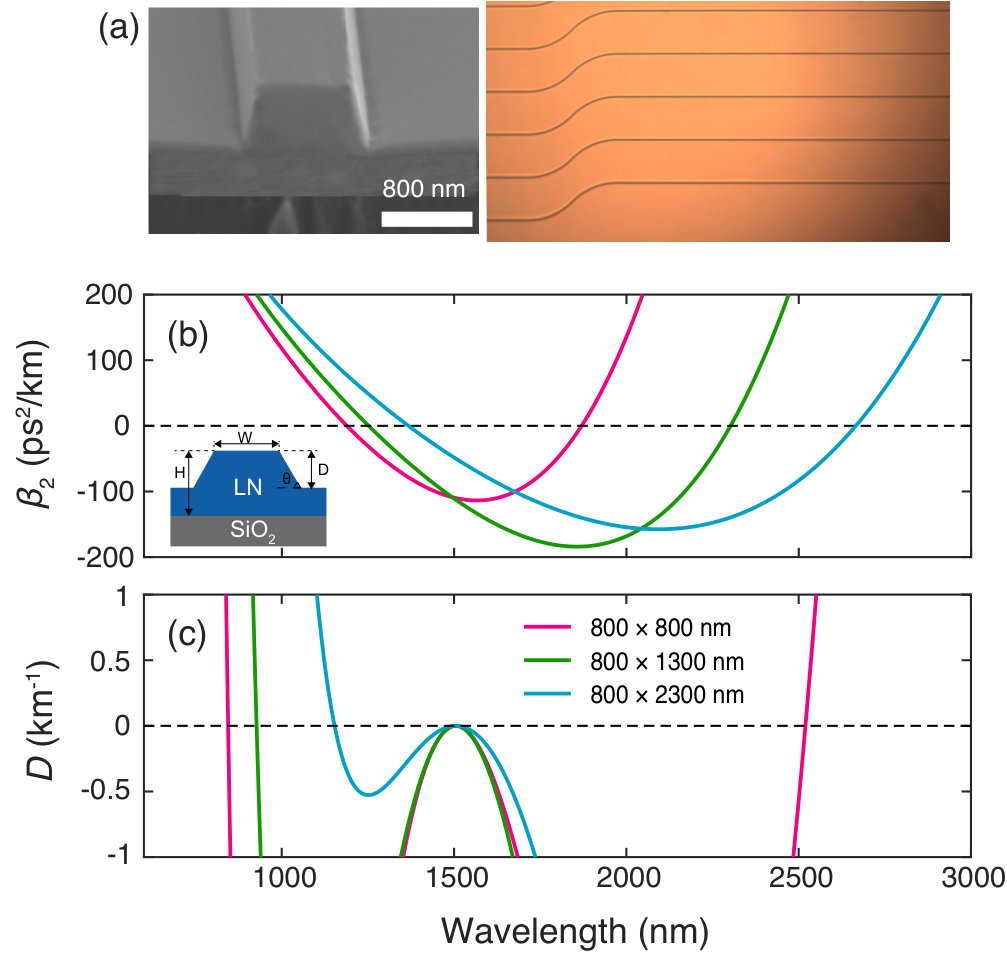 Figure 1
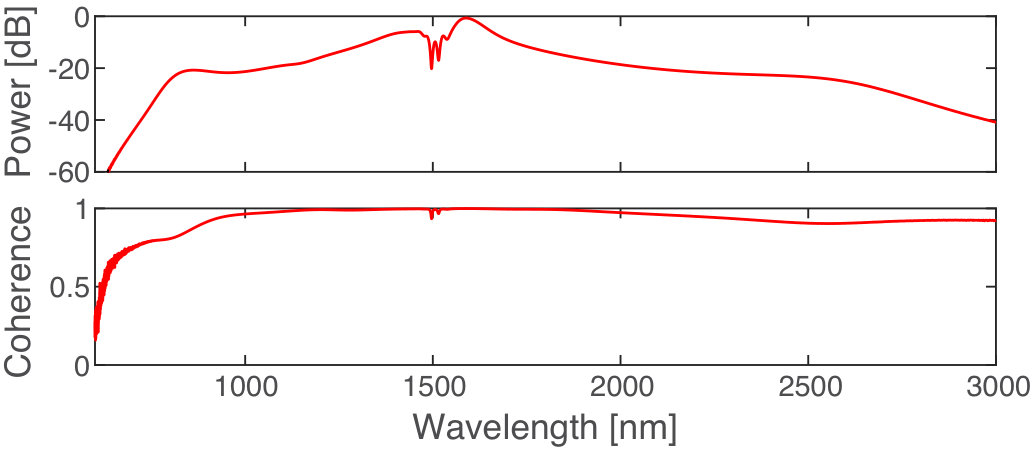 Figure 2
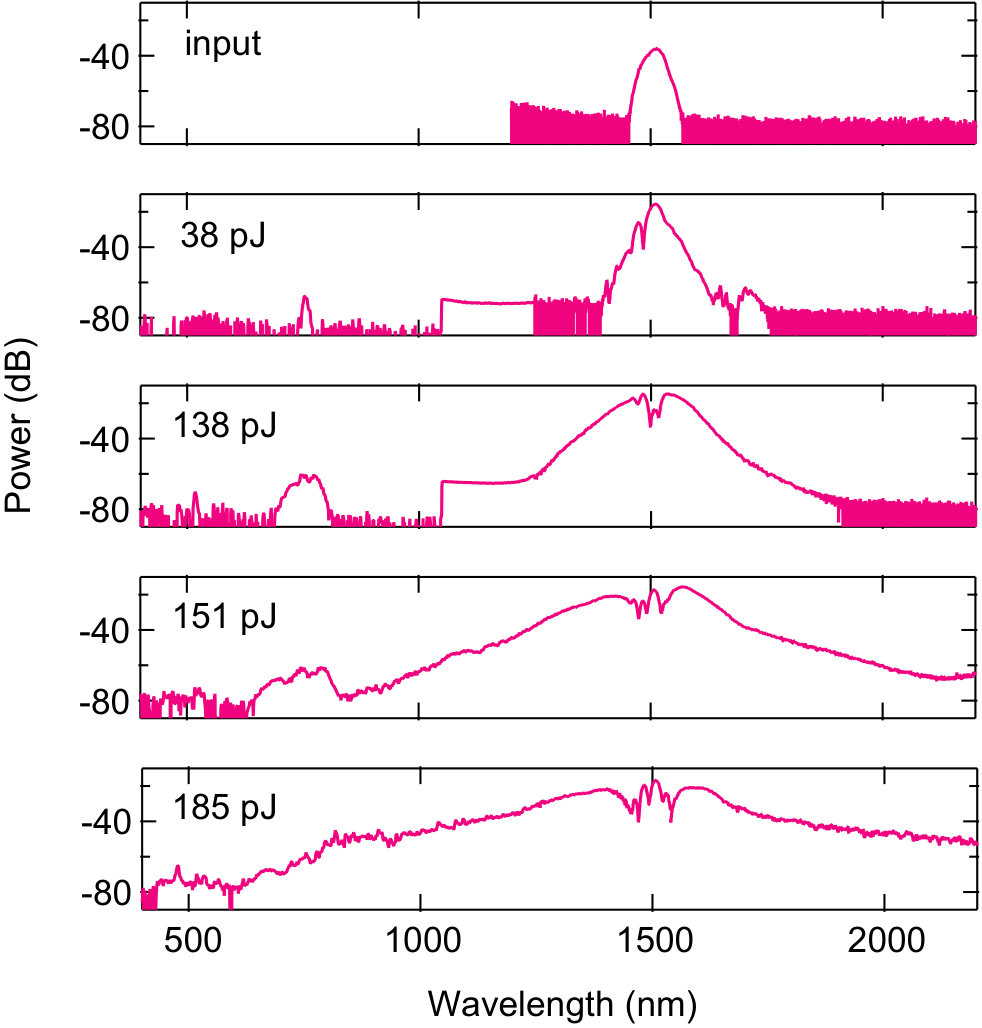 Figure 3
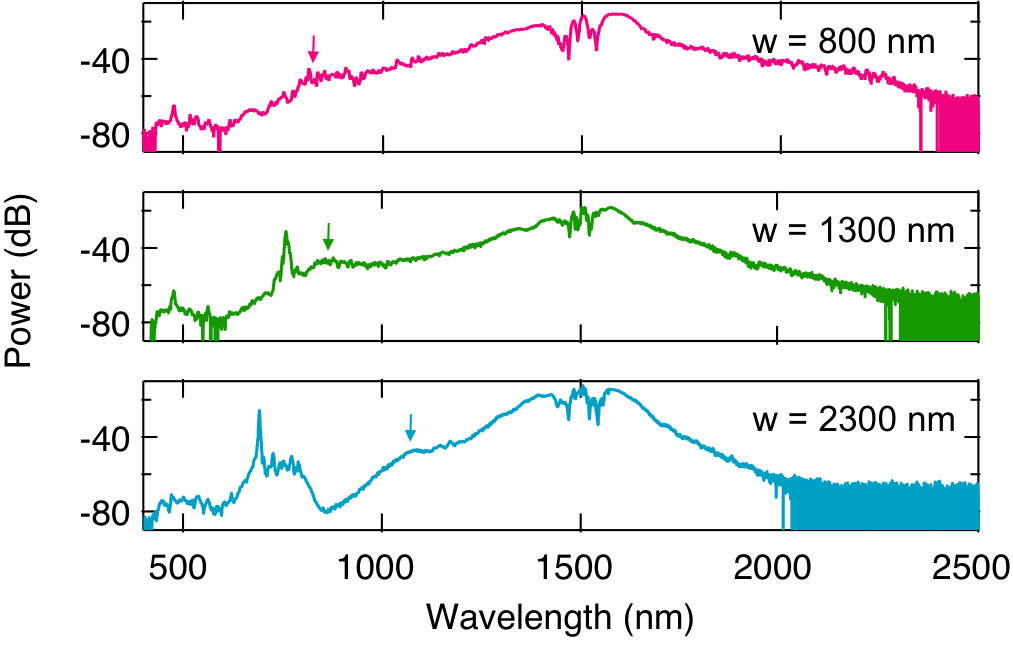 Figure 4
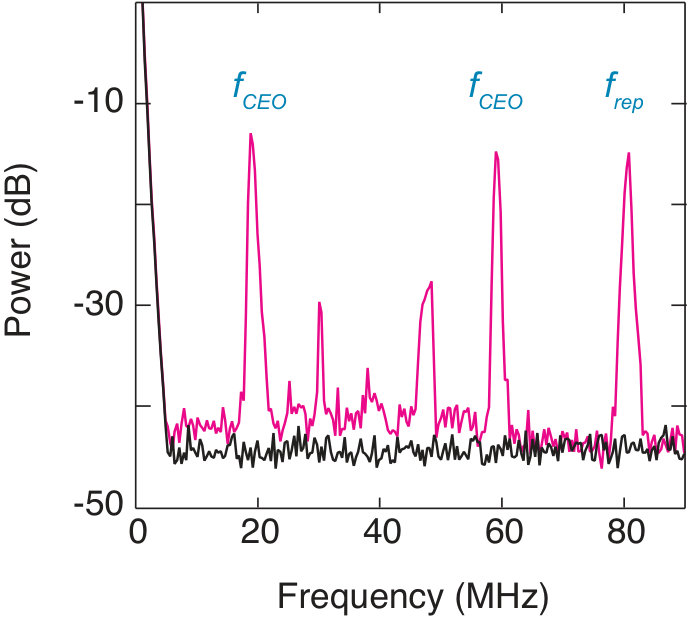 Figure 5
Peer Reviews
No public reviews on file for this paper yet. If you reviewed it on a platform where reviews are public (OpenReview, ICLR, NeurIPS, ICML), you can paste yours below so the community can read it here.
Videos
No videos yet. Explain this paper in a talk, walkthrough, or lecture? Add one.
Coherent two-octave-spanning supercontinuum generation in lithium-niobate waveguides
Mengjie Yu
Corresponding author: [email protected]
John A. Paulson School of Engineering and Applied Sciences, Harvard University, Cambridge, MA 02138
Boris Desiatov
John A. Paulson School of Engineering and Applied Sciences, Harvard University, Cambridge, MA 02138
Yoshitomo Okawachi
Department of Applied Physics and Applied Mathematics, Columbia University, New York, NY 10027
Alexander L. Gaeta
Department of Applied Physics and Applied Mathematics, Columbia University, New York, NY 10027
Marko Lončar
John A. Paulson School of Engineering and Applied Sciences, Harvard University, Cambridge, MA 02138
Abstract
We demonstrate coherent supercontinuum generation (SCG) in a monolithically integrated lithium-niobate waveguide, under the presence of second- and third-order nonlinear effects. We achieve more than two octaves of optical bandwidth in a 0.5-cm-long waveguide with 100-picojoule-level pulses. Dispersion engineering of the waveguide allows for spectral overlap between the SCG and the second harmonic which enables direct detection of the carrier-envelope offset frequency using a single waveguide. We measure the of our femtosecond pump source with a 30-dB signal-to-noise ratio.
pacs:
(320.6629) Supercontinuum generation; (190.2620) Harmonic generation and mixing; (190.4390) Integrated optics.
The generation of a coherent supercontinuum spectrum with modelocked laser pulses is critical for many frequency-comb-based applications, including time and frequency metrology, optical frequency synthesis, microwave generation, all-optical clocks, and spectroscopy Diddams . A coherent octave-spanning supercontinuum spectrum allows for the detection of the carrier-envelope offset frequency through self-referenced - interferometry Telle ; Diddams00 ; Dudley , allowing for a stabilized frequency comb. Over the past decade, there has been significant advances in nanofabrication technology that have led to the development of various chip-based platforms for supercontinuum generation (SCG) Kuyken ; Duchesne ; Halir ; Epping ; Leo ; Kuyken15 ; Singh15 ; Mayer ; Johnson ; Klenner ; Liu ; Oh ; Porcel ; Carlson ; Hickstein ; Okawachi ; Singh ; Guo ; Sinobad ; Okawachi18 ; Hickstein18 . Previously, detection and stabilization was demonstrated in silicon nitride Mayer ; Klenner ; Carlson ; Hickstein ; Okawachi18 ; Hickstein18 , and more recently, simultaneous SCG and second harmonic generation (SHG) has allowed for on-chip - interferometry Okawachi18 ; Hickstein18 . However since silicon nitride is a centrosymmetric material, it is only possible to achieve modest second-harmonic efficiencies. Alternatively, simultaneous SCG and SHG has been demonstrated in aluminum nitride using 800-pJ pulse energies Hickstein . Lithium niobate (LN, LiNbO3) is a promising nonlinear material for realizing an - interferometer as it possesses a large nonlinear index ( = 2.5 10*-19* m2/W) and has a stronger nonlinearity ( = 3 10*-11* m/V) Nikogosyan ; Guarino ; Wolf ; Rao ; Kowligy ; He . Previous demonstrations have shown supercontinuum spectra exceeding an octave in periodically-poled lithium niobate (PPLN) Phillips ; Iwakuni ; Kowligy . However, these devices typically suffer from low index contrast between the core and the cladding resulting in low optical confinement and large device dimensions and requires ¿ 1 nJ pulse energies. Recently, Zhang, ZhangOptica , has demonstrated ultralow-loss monolithically integrated LN waveguides with 2.7 dB/m propagation loss using thin-film LN-on-insulator technology. This platform has been leveraged to realize integrated PPLN devices, Kerr-combs and electro-optic combs WangOptica ; WangArXiv ; Zhang .
In this paper, we build on these results and demonstrate coherent SCG in a monolithically integrated LN waveguide that spans over two octaves using picojoule-level pulses. Our work represents the broadest supercontinuum spectrum generated, to our knowledge, in an integrated LN waveguide with a total bandwidth spanning 2.58 octaves from 400 to 2400 nm. In addition, the high effect in LN waveguides allows for efficient SHG. We theoretically and experimentally investigate the dispersion in LN waveguides and perform dispersion engineering to allow for spectral overlap between the SCG and second harmonic signal, allowing for detection in the same device with a 30-dB signal-to-noise ratio of the beatnote. Our results illustrate the potential of LN as an efficient nonlinear photonic platform for chip-scale SCG.
The LN devices are fabricated using 800-nm-thick X-cut LN thin films on top of a 2-m silicon dioxide (SiO2) layer on silicon substrates (NanoLN). First, the photonic structures are patterned with electron beam lithography (EBL) using the Elionix ELS-F125 tool with a HSQ resist. Next, the patterns are transferred onto the LN thin film using an optimized Ar+ plasma etching recipe in the reactive ion etching (RIE) tool. Finally, the residual EBL mask is removed by a buffered oxide etch (BOE). Figure 1(a) shows a scanning electron micrograph (SEM) image of an air-cladded LN waveguide. The propagation loss of the LN waveguides is estimated to be 3 dB/m.
To allow for broadband coherent SCG, we examine dispersion engineering of the LN waveguide Turner . We simulate the dispersion of the waveguide using a finite-element mode solver. Figure 1(b) shows the simulated group-velocity dispersion (GVD) for the fundamental transverse electric (TE) mode of three different waveguide top widths of 800, 1300 and 2300 nm, while Fig. 1(c) shows the corresponding dispersion operator for a pump centered at 1506 nm. The operator is expressed as Dudley ; Okawachi ,
[TABLE]
where corresponds to the -th order dispersion coefficient, and is the pump frequency. The spectral position where the dispersive wave (DW) occurs can be predicted from the around-zero-crossing of the dispersion operator. To allow for spectral overlap between the supercontinuum and the second harmonic signal, we choose the cross section 800800 nm.
Next, we theoretically consider the propagation dynamics in LN waveguides. We simulate the generated spectrum by numerically solving the nonlinear envelope equation using the split-step Fourier method Gaeta with the inclusion of third-order nonlinearity, higher-order dispersion, and self-steepening. We neglect the contributions from and Raman to isolate DW generation. The LN waveguide is 0.5 cm long with a cross section of 800800 nm. We use 160-fs pulses with a pulse energy of 187 pJ in the waveguide (peak power = 1.17 kW). To characterize the coherence, we calculate the first-order mutual coherence function Gu ; Ruehl by simulating 128 individual spectra where the input pulses are seeded with simulated quantum noise. Figure 2(top) shows the averaged supercontinuum spectrum which shows a DW near 800 nm in agreement with the dispersion operator prediction in Fig. 1. Figure 2(bottom) shows the calculated coherence function, and we verify that the coherence is near unity over most of the generated spectrum.
In our experiment, we send pulses from a femtosecond optical parametric oscillator centered at 1506 nm with an 80-MHz repetition rate into a monolithically integrated air-clad LN waveguide. The LN waveguide is fabricated to be 0.5 cm long with a top width of 800 nm, similar to the conditions of the previous simulation. The pump is launched along the y-axis of LN thin-film crystal at the fundamental TE mode of the waveguide, which has the strongest component. The output is collected using a lensed fiber and sent to three different optical spectrum analyzers covering 400 – 2500 nm. We measure the coupling loss to be 8.5 dB at the input facet. Figure 3 shows the input spectrum along with the generated SCG spectra for various pulse energies in the waveguide which are extrapolated from the input coupling loss. At 38 pJ of pulse energy, we observe the onset of SHG at 750 nm and two spectral features near 1660 nm and 1730 nm which we attribute to Raman scattering corresponding to the optical phonon modes of A(TO4) and A(LO4), respectively. As the pump pulse energy is further increased, we observe further spectral broadening around the pump, which is largely due to self-phase modulation, and broadening of the SHG component. At 151 pJ, SCG and the SHG components begin to spectrally overlap, and we observe broadening of a spectral component around 500 nm due to sum frequency generation (SFG) between the SCG and SHG components. Finally, at 185 pJ of pulse energy, both SHG and SFG cover the entire visible spectrum, and together with SCG, span 2.58-octaves of bandwidth (630THz) from 400 nm to 2400 nm [Fig.4 (top)]. Moreover, the DW is generated around 800 nm which merges with the broadened SHG component.
We experimentally verify the ability to dispersion engineer in integrated LN waveguides by investigating three different waveguide cross sections, 800800 nm, 8001300 nm, and 8002300 nm, and Fig. 4 shows the generated SCG spectra. We observe that the DW spectrally shifts to longer wavelengths as the waveguide width is increased, which agrees well with the dispersion operator predictions in Fig 1 (c). The SCG of the 800-nm-width waveguide yields better overlap with SHG as compared to the other two widths, and its spectral bandwidth extends further due to the second DW as shown in Fig 1 (c). The discrepancy in the spectrum at high wavelengths compared to our simulation can be attributed to linear loss and wavelength-dependent coupling loss of the collection silica lensed fiber. In addition, for the 8001300 nm, and 8002300 nm widths, we observe a sharp SHG peak which we attribute to phase matching with a 4th-order spatial mode at visible wavelengths Okawachi18 . The difference in the position of the DW compared to the dispersion operator prediction in Fig. 1 can be attributed to the deviation of the actual waveguide dimension from the simulation due to waveguide fabrication tolerances.
Finally, we directly measure the beatnote by measuring the spectral component near 800 nm where the SCG and SHG components spectrally overlap. For our measurement, we filter the generated supercontinuum using a shortpass filter with a cut-off wavelength of 900 nm and detect the RF spectrum using an avalanche photodiode (Thorlabs APD120A) and an RF spectrum analyzer. Figure 5 shows that the is at 80 MHz, and the and - is 20 and 60 MHz (both labelled due to indistinguishability). The other two peaks at 30 and 50 MHz are still under investigation. We measure a beatnote with a 30-dB signal-to-noise ratio (SNR) at a 1-MHz resolution bandwidth. The high SNR is enabled due to the spectral overlap between the DW and the SHG signal. Efforts are ongoing to further improve the coupling and propagation losses to allow for efficient SCG and enhancement of the SNR of the signal.
In conclusion, we demonstrate a 2.58-octave-spanning supercontinuum in a monolithically integrated LN waveguide. Dispersion engineering of the LN waveguide allows for high spectral overlap between the SCG and SHG components allowing for beat detection with a high SNR of 30 dB. By increasing the waveguide length to 2-cm, the required pump energy could be reduced to 30 pJ while maintaining the spectral coherence. Alternatively, by using a monolithically integrated PPLN waveguide, we can further enhance the SHG efficiency and the third order nonlinearity through the cascaded effect. Since the electro-optic effect is dispersive, electrical tuning can be explored for the second harmonic conversion efficiency. Our results offer promise for the development of a monolithic LN photonic platform for chip-scale optical clocks.
Funding. National Science Foundation (NSF) (ECCS1609549, ECCS-1740296 E2CDA); Defense Advanced Research Projects Agency (DARPA) (W31P4Q-15-1-0013); Air Force Office of Scientific Research (AFOSR) (FA9550-15-1-0303).
Acknowledgment. Device fabrication is performed at the Harvard University Center for Nanoscale Systems (CNS), a member of the National Nanotechnology Coordinated Infrastructure Network (NNCI), which is supported by the National Science Foundation under NSF ECCS award no.1541959. M.Y. and B.D. contributed equally to this work.
The reference list from the paper itself. Each links out to its DOI / PubMed record.
- 1(1) S. A. Diddams, J. Opt. Soc. Am. B 27 , B 51 (2010).
- 2(2) H.R. Telle, G. Steinmeyer, A.E. Dunlop, J. Stenger, D.H. Sutter, and U. Keller, Appl. Phys. B 69 , 327 (1999).
- 3(3) S. A. Diddams, D. J. Jones, J. Ye, S. T. Cundiff, J. L. Hall, J. K. Ranka, R. S. Windeler, R. Holzwarth, T. Udem, and T. W. Hänsch, Phys. Rev. Lett. 84 , 5102 (2000).
- 4(4) J. M. Dudley, G. Genty, and S. Coen, Rev. Mod. Phys. 78 , 1135 (2006).
- 5(5) D. Duchesne, M. Peccianti, M. R. Lamont, M. Ferrera, L. Razzari, F. Légaré, R. Morandotti, S. Chu, B. E. Little, and D. J. Moss, Opt. Express 18 , 923 (2010).
- 6(6) B. Kuyken, X. Liu, R. M. Osgood, Y. A. Vlasov, R. Baets, G. Roelkens, and W. M. Green, Opt. Express 19 , 20172 (2011).
- 7(7) R. Halir, Y. Okawachi, J. S. Levy, M. A. Foster, M. Lipson, and A. L. Gaeta, Opt. Lett. 37 , 1685 (2012).
- 8(8) F. Leo, J. Safioui, B. Kuyken, G. Roelkens, and S.-P. Gorza, Opt. Express 22 , 28997 (2014).