A Triple Origin for Twin Blue Stragglers in Close Binaries
Simon Portegies Zwart, Nathan W. C. Leigh

TL;DR
This paper proposes a new formation mechanism for twin blue stragglers in close binaries involving mass transfer from an outer tertiary star, successfully explaining observed properties of such systems like Binary 7782.
Contribution
The study introduces a novel triple-origin model for twin blue stragglers, linking their formation to mass transfer from an evolved tertiary companion via a circumbinary disk.
Findings
The model reproduces the properties of the observed twin BS system Binary 7782.
Predicts specific orbital period ranges and WD masses for the outer tertiary.
Suggests twin BSs are more common in certain clusters and field environments.
Abstract
We propose a formation mechanism for twin blue stragglers (BSs) in compact binaries that involves mass transfer from an evolved outer tertiary companion on to the inner binary via a circumbinary disk. We apply this scenario to the observed double BS system Binary 7782 in the old open cluster NGC 188, and show that its observed properties are naturally reproduced within the context of the proposed model. We predict the following properties for twin BSs: (1) For the outer tertiary orbit, the initial orbital period should lie between 220 days P 1100 days, assuming initial masses for the inner binary components of M and 0.9 M and an outer tertiary mass of M. After Roche-lobe overflow, the outer star turns into a white dwarf (WD) of mass 0.43 to 0.54\,\MSun. There is a…
Click any figure to enlarge with its caption.
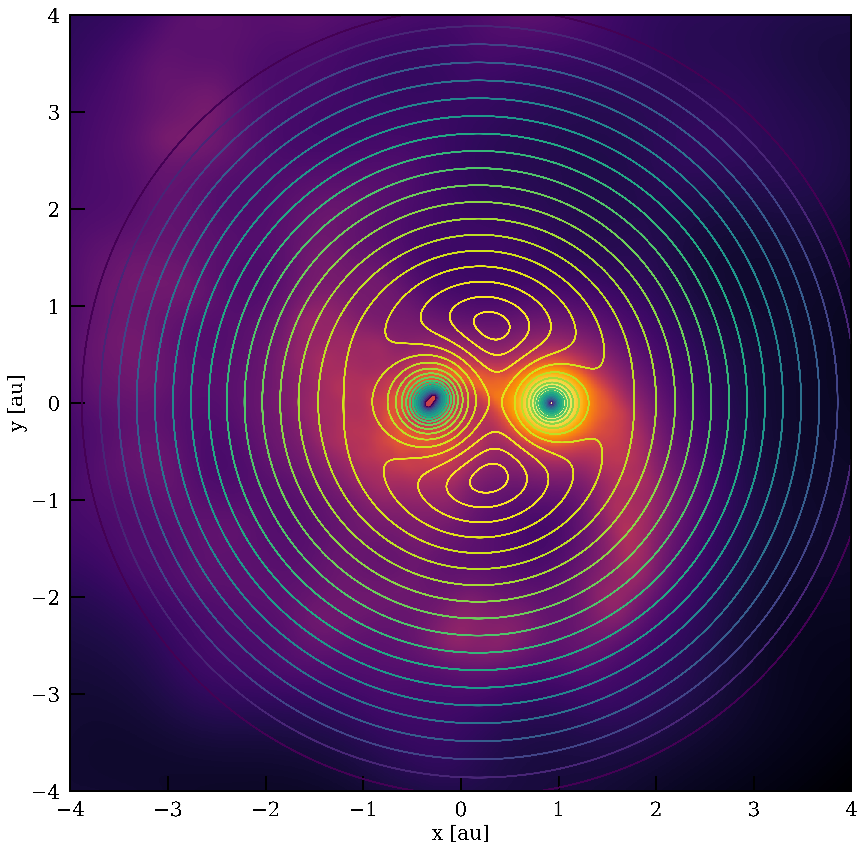 Figure 1
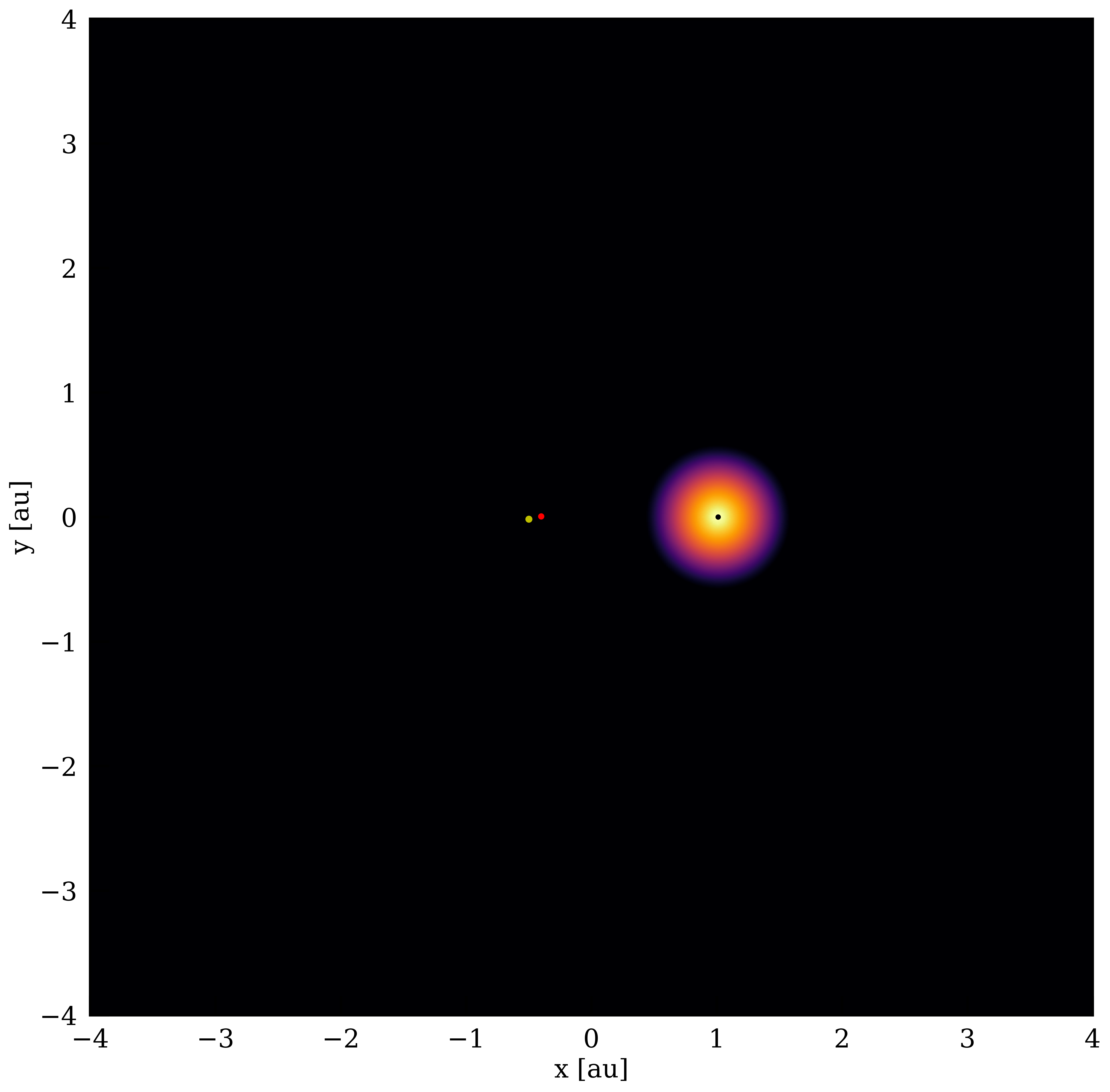 Figure 2
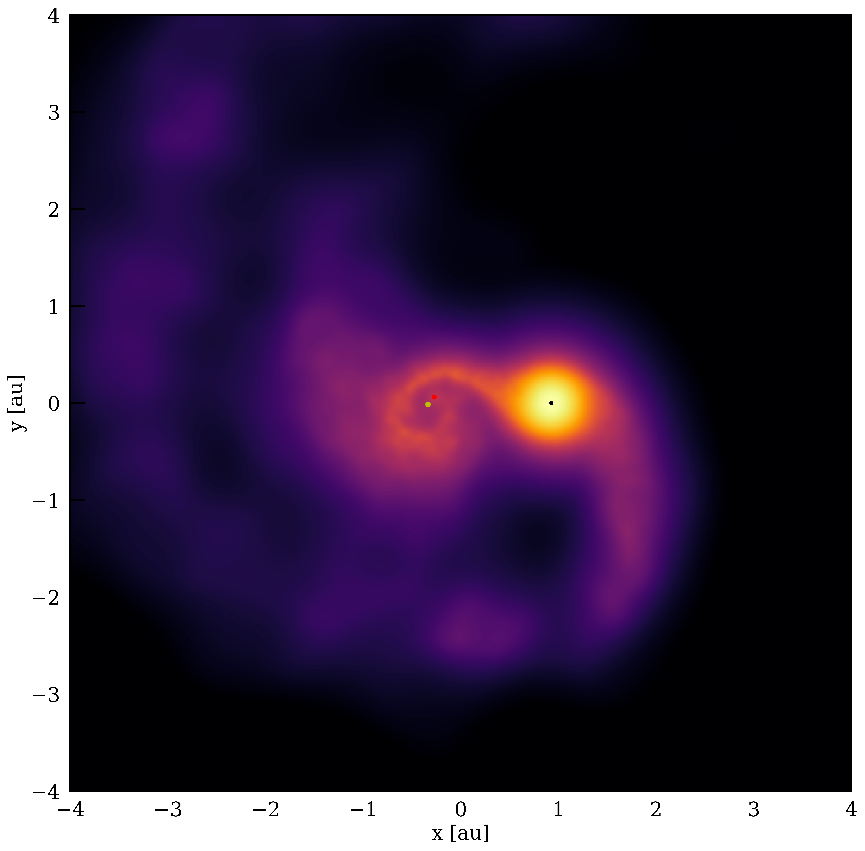 Figure 3
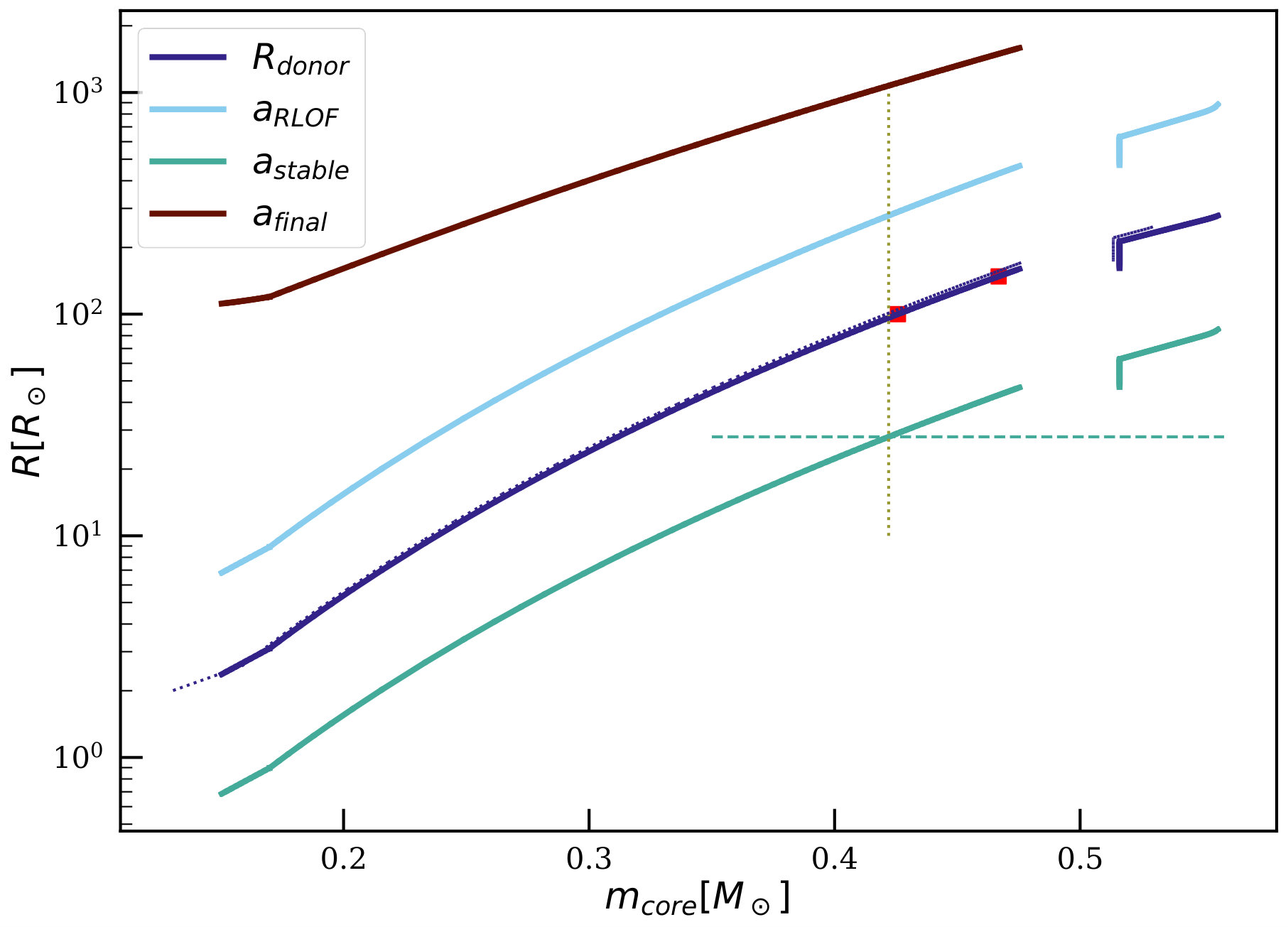 Figure 4
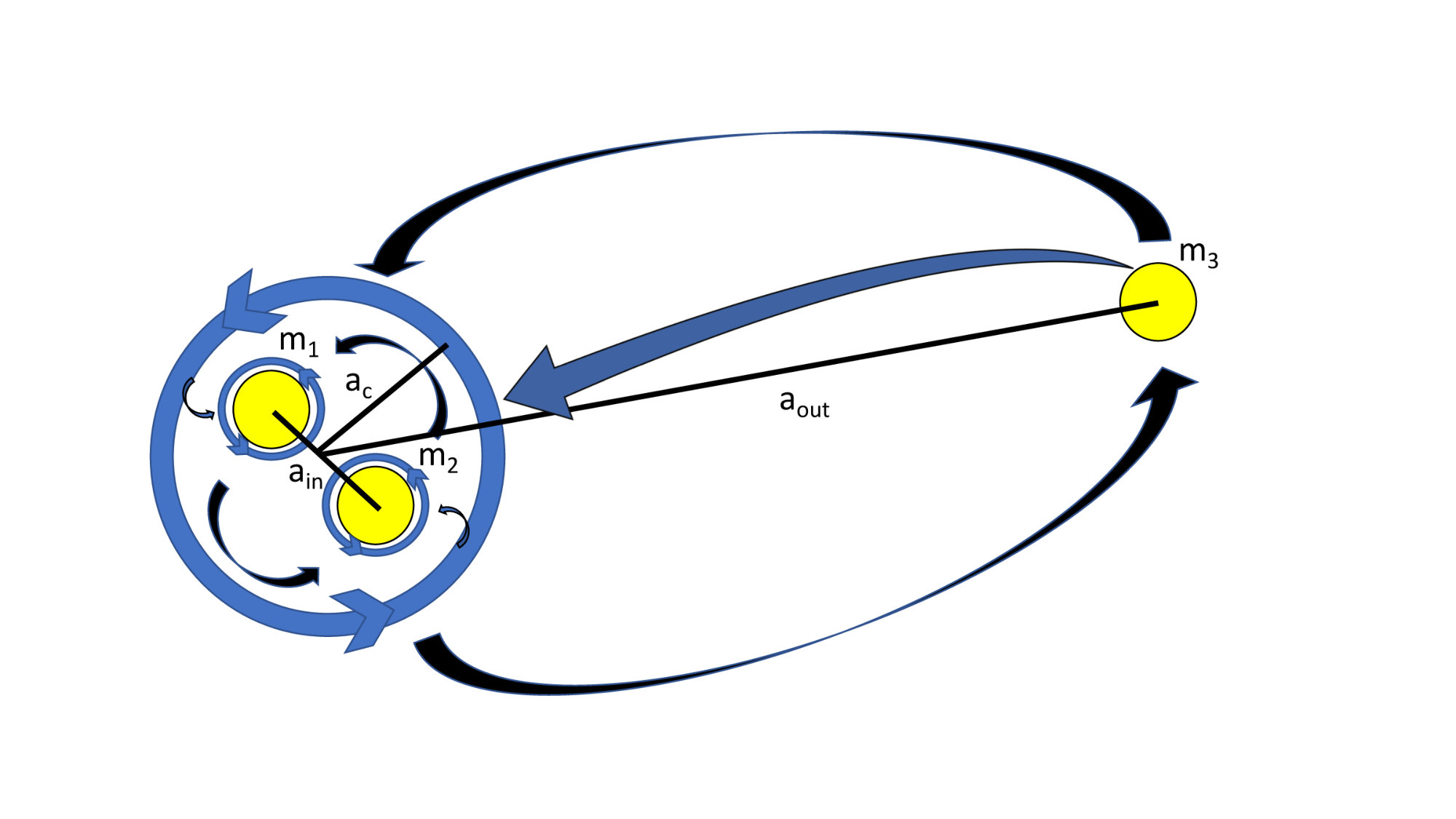 Figure 5
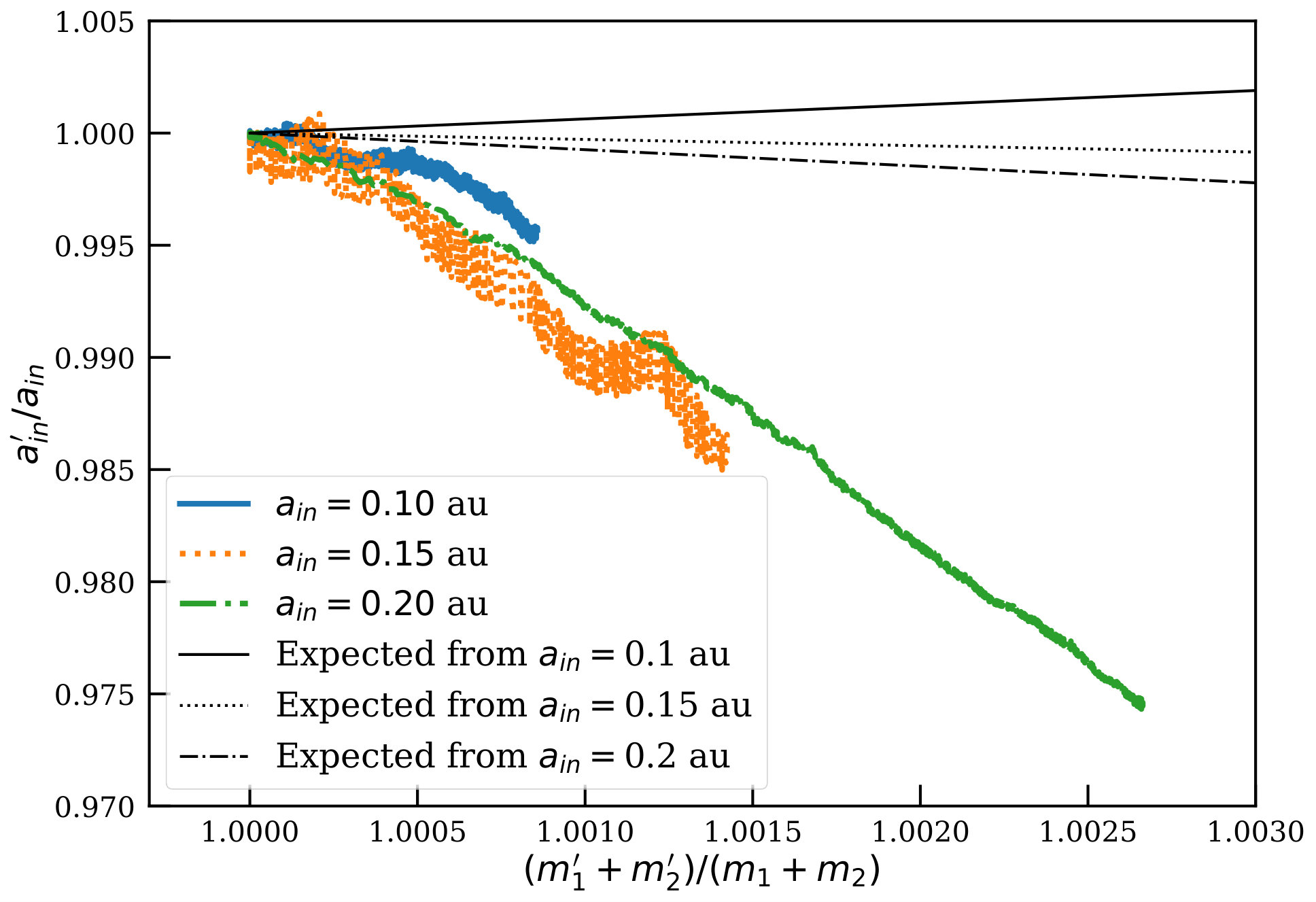 Figure 6
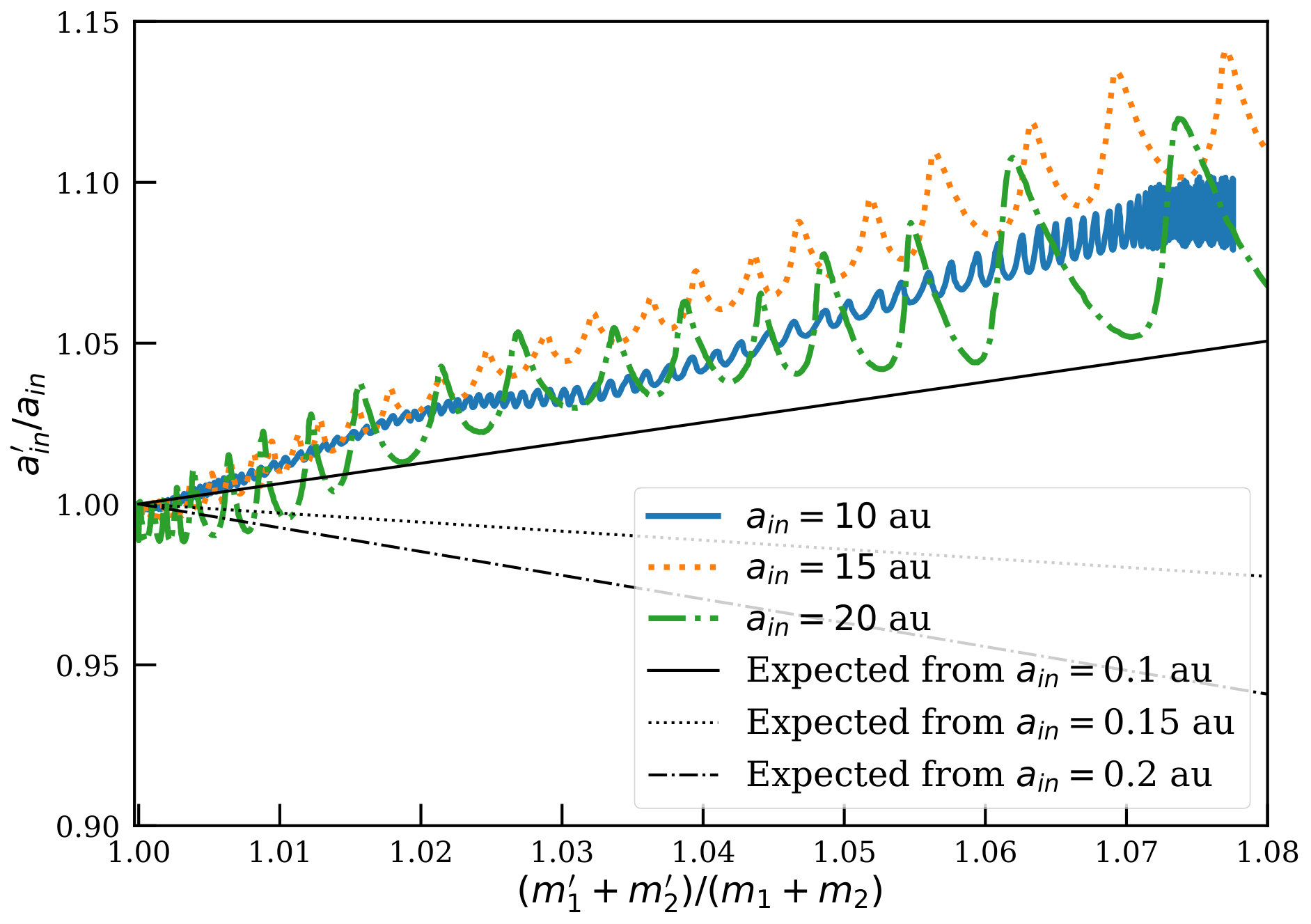 Figure 7
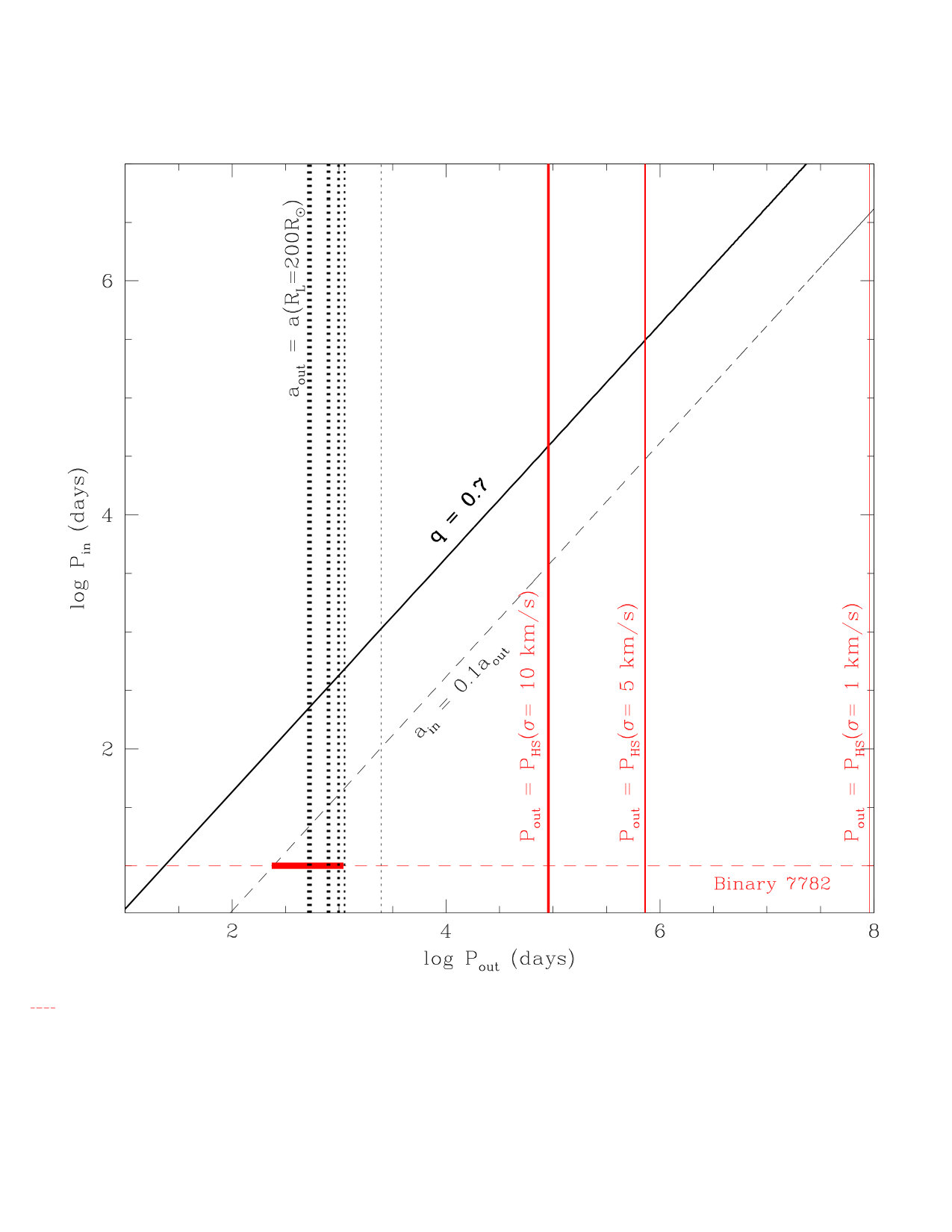 Figure 8
Peer Reviews
No public reviews on file for this paper yet. If you reviewed it on a platform where reviews are public (OpenReview, ICLR, NeurIPS, ICML), you can paste yours below so the community can read it here.
Videos
No videos yet. Explain this paper in a talk, walkthrough, or lecture? Add one.
A Triple Origin for Twin Blue Stragglers in Close Binaries
Simon Portegies Zwart
Leiden Observatory
Leiden University
PO Box 9513, 2300 RA
Leiden, the Netherlands
Nathan W. C. Leigh
American Museum of Natural History
Department of Astrophysics
79th Street at Central Park West
New York, NY 10024-5192, USA
Stony Brook University
Department of Physics and Astronomy
Stony Brook, NY 11794-3800, USA
Departamento de Astronomía
Facultad de Ciencias Físicas y Matemáticas
Universidad de Concepción
Concepción, Chile
(Received January 1, 2018; Revised January 7, 2018)
Abstract
We propose a formation mechanism for twin blue stragglers (BSs) in compact binaries that involves mass transfer from an evolved outer tertiary companion on to the inner binary via a circumbinary disk. We apply this scenario to the observed double BS system Binary 7782 in the old open cluster NGC 188, and show that its observed properties are naturally reproduced within the context of the proposed model. Based on this model, we predict the following properties for twin BSs: (1) For the outer tertiary orbit, the initial orbital period should lie between 220 days Pout 1100 days, assuming initial masses for the inner binary components of M*⊙* and 0.9 M*⊙* and an outer tertiary mass of M*⊙*. After Roche-lobe overflow, the outer star turns into a white dwarf (WD) of mass 0.43 to 0.54 M⊙. There is a correlation between the mass of this WD and the outer orbital period: more massive WDs will be on wider orbits. (3) The rotational axes of both BSs will be aligned with each other and the orbital plane of the outer tertiary WD. (4) The BSs will have roughly equal masses, independent of their initial masses (since the lower mass star accretes the most). The dominant accretor should, therefore, be enriched more effectively by the accreted material. As a result, one of the BSs will appear to be more enriched by either He, C and O or by s-process elements, depending on if the donor started to overflow its Roche lobe on, respectively, the red giant or asymptotic giant branch. (5) Relative to old dense clusters with high-velocity dispersions, twin BSs in close binaries formed from the proposed mechanism should be more frequent in the Galactic field and younger open clusters with ages 4-6 Gyr, since then the donor will have a radiative envelope. (6) the orbit of the binary BS will have a small semi-major axis (typically \ {\raise-2.15277pt\hbox{\buildrel<\over{\sim}}}\ 0.3 au) and be close to circular (e\ {\raise-2.15277pt\hbox{\buildrel<\over{\sim}}}\ 0.2).
stars: blue stragglers – binaries: general – globular clusters: general – scattering
††journal: ApJ
1 Introduction
Blue straggler stars are brighter and bluer than the main-sequence (MS) turn-off in a cluster colour-magnitude diagram (e.g. Sandage, 1953; Leonard, 1989; Simunovic & Puzia, 2014). Two primary channels for BS formation have been proposed: mass transfer from an evolved donor on to a MS star in a binary star system (e.g. McCrea, 1964; Portegies Zwart et al., 1997a; Knigge et al., 2009; Leigh & Sills, 2011; Geller & Mathieu, 2011), and direct stellar collisions involving MS stars likely mediated via binaries (e.g. Hills, 1975; Portegies Zwart et al., 1997b; Leigh et al., 2007, 2013; Hypki & Giersz, 2013; Portegies Zwart, 2019). The first mechanism predicts BSs in binaries with WD companions, whereas the second predicts MS companions in a wide and eccentric binary. Other possible, albeit related, formation mechanisms include mergers of close MS-MS binaries (Portegies Zwart, 2019), and mergers of the inner binaries of hierarchical triple star systems induced by Lidov-Kozai oscillations coupled with tidal damping (e.g. Perets & Fabrycky, 2009).
In spite of these specific predictions for the expected properties of BSs formed from each of the above production mechanisms, many BSs exist with observed properties that defy these simple scenarios. For example, in the old open cluster (OC) M67, there lurks a candidate triple system that is posited to host two BSs (van den Berg et al., 2001; Sandquist et al., 2003). The observations suggest that the outer tertiary is itself a BS, with a mass 1.7 M*⊙* and orbiting the inner binary with a period of days (Sandquist et al., 2003). The inner binary has a period of only days (van den Berg et al., 2001), and hosts a BS of mass M*⊙*. In order to reproduce the total system mass we require at least five stars (Leigh & Sills, 2011). This is strongly indicative of a dynamical origin for the system, and a single direct interaction involving a binary and a triple that resulted in two separate collisions is the most probable explanation for its origin (instead of back-to-back direct binary-binary interactions) (Gualandris et al., 2004; Leigh & Sills, 2011).
Even more curious, there exists in the old OC NGC 188 a double BS binary, called Binary 7782. The BS population in NGC 188 has a bi-modal period-eccentricity distribution. As discussed in Leigh & Sills (2011), this could be hinting at a triple origin for at least some subset of the total BS population. As for Binary 7782, Mathieu & Geller (2009) observed a compact and mildly eccentric (i.e., ) binary star system with an orbital period of 10 days hosting two roughly equal-mass BSs. During a given binary-binary interaction, the probability that not one but two direct (MS-MS) collisions will occur is less than (Leonard, 1989; Leigh & Sills, 2011; Leigh & Geller, 2012). Plus, binaries with collision products typically have relatively long orbital periods Fujii & Portegies Zwart (2011). Dynamically, it is difficult to form a short-period binary composed of two collision products during a collisional interaction in a star cluster (Leigh & Sills, 2011; Fujii & Portegies Zwart, 2011). So, how did Binary 7782 form?
We propose a formation channel for Binary 7782, and compact double BS binaries in general, which involves mass transfer from an outer tertiary companion on to an inner binary composed of two MS stars. In section 2, we constrain the range of initial (i.e., pre-mass transfer) orbital parameters for a hypothetical outer tertiary companion, using a combination of dynamical and stellar evolution-based constraints. In Section 3 we present the numerical simulations used to study the mass transfer process in this triple system. We adopt orbital parameters that, according to our expectations, are most promising for the progenitors of the twin BS 7782. The calculations are performed using the Astrophysical Multipurpose Software Environment (AMUSE for short, see Portegies Zwart et al., 2013b; Portegies Zwart & McMillan, 2018) with a combination of stellar evolution, hydrodynamical and gravitational simulations. With these calculations we further constrain the possible range of initial parameters that naturally lead to twin BSs with orbital parameters similar to the 7782 system. We summarize and discuss the implications of our results for compact double BS binaries and, more generally, mass transfer in stellar triples in Section 5.
2 Constraints on the present-day orbital parameters for a hypothesized
tertiary companion in the compact BS Binary 7782
In our scenario, we start with a binary star with component masses and that is orbited by a tertiary of mass . The inner and outer binary orbital semi-major axes are denoted ain and aout, respectively. For clarity we assume both orbits, the inner as well as the outer, to have negligible eccentricity and low inclination. These assumptions are also supported by the population of observed low-mass triples (Tokovinin, 2010; Moe & Kratter, 2018). This initial configuration for our assumed formation scenario for Binary 7782, described below, is depicted in figure 1.
According to our scenario and the outer orbit is sufficiently small that the tertiary star is filling its Roche lobe and transfers mass to the inner binary before it leaves the asymptotic giant branch. We constrain the inner orbit by requiring the triple system to be dynamically stable, for which we adopt eq. 1 in Mardling & Aarseth (1999). While transferring mass, the accretion stream gathers around the inner binary at the circularization radius ac, and forms a circumbinary disk (Frank et al., 2002). Using conservation of angular momentum, we equate the specific angular momentum of the accreted mass at the inner Lagrangian point of the (outer) donor star to the final specific angular momentum of the accretion stream at the circularization radius about the inner binary, this results in
[TABLE]
where RL is the radius of the Roche lobe of the outer tertiary companion, is the semi-major axis of the orbit about the inner binary corresponding to the circularization radius and vorb,c is the orbital velocity at . The distance from the centre of mass corresponding to the tertiary defined by the Roche lobe is given by eq. 2 in Eggleton (1983). Combining eq. 2 in Eggleton (1983) (with mass ratio q m3/(mm2)) with eq. 1, we solve for the circularization radius as a function of aout and the assumed stellar masses:
[TABLE]
In order for a circumbinary disk to form around the inner binary, we require that a ac.
Figure 2 shows the parameter space in the Pout-Pin-plane for Binary 7782. We assume initial component masses of M⊙ and M⊙ for the inner binary components, and M⊙ for the outer tertiary. We compare the circularization radius to the semi-major axis of the inner binary, for which we require , after folding in all constraints from the requirements for dynamical stability (listed in the caption of figure 2), and the assumption of an outer tertiary that is Roche lobe-filling. Note that the range of plotted orbital periods Pin corresponding to a contact state for the inner binary lies outside the range of plotted values for (for components with radii of 1 R*⊙), since it does not contribute to constraining the outer orbital properties. The thick horizontal solid red line shows the allowed range of outer semi-major axes, after folding in all of the aforementioned criteria. These constraints result in a rather narrow range of initial conditions for the outer orbit, namely 2.2 102* days Pout 1.1 103 days.
Adopting a mass for the tertiary star of M⊙, we can constrain the initial parameters for the inner binary as well as the orbit of the outer star after mass transfer. We first calculate the stellar radius as a function of core mass. In figure 3 we present this relation calculated using the SeBa stellar evolution code (Portegies Zwart & Verbunt, 1996) as the dark blue curve. The interruption in this curve, around a core mass of M⊙ is a result of the evolution along the horizontal branch, where the core of the star continues to grow but the radius actually shrinks. Roche-lobe overflow in this phase is not expected to happen, because it would already have happened in an earlier evolutionary state of the donor star, when it was bigger.
Adopting masses for the inner binary M⊙ and M⊙ we can calculate the outer orbital separation at the onset of Roche-lobe overflow , and subsequently the maximum orbital separation for the inner binary for which the orbit is stable and a circumbinary disk can form. These two limits are presented as the light blue and light green curves in figure 3. The allotted region of parameter space is then above the dashed horizontal line and to the right of the vertical dotted line.
With the adopted parameters, we can also estimate the final orbital period of the left-over core from the tertiary star after mass transfer. The change in orbital separation due to non-conservative mass transfer can be expressed in terms of the mass of the outer star before and after mass transfer, i.e. and respectively, the total mass in the inner binary before () and after accretion () and the amount of angular momentum lost per unit mass . Adopting the relation between the orbital separation before mass transfer () and after mass transfer () from Portegies Zwart (1995)
[TABLE]
we arrive at the top brown curve in figure 3. This curve provides a prediction for the current orbital separation of the WD around the twin BS 7782. Tidal effects during mass tranfer have probably circularized the orbit, although some slight eccentricity due to turbulent motion in the outer layers of the donor star may have induced a small eccentricity.
Having limited parameter space for the formation of the twin BS 7782, we continue by performing a series of simulations to investigate the accretion and changes to the inner orbits of triple systems in this range of parameters.
3 Numerical Simulations
We perform simulations of a triple star system for which the outer star overfills its Roche lobe while the inner binary remains detached. The calculations start by evolving the three stars to the same age, which is selected such that the outer-most star fills its Roche lobe. First order constraints for the initial conditions are derived in the previous §. In the following two sections we describe how we set up these simulations and then discuss the results. The calculations are performed using the Astrophysical Multipurpose Software Environment using a combination of stellar evolution, gravitational dynamics and hydrodynamics.
3.1 Setting-up the simulations
We adopt initial masses of M⊙ and M⊙ for the inner binary components, and between and M⊙ for the tertiary star. We evolve the tertiary star using the MESA stellar-evolution code Paxton et al. (2011) to a radius of about 100 R⊙ and 150 R⊙, at which point we assume it to overfill it’s Roche lobe (see red square in figure 3). We perform calculations for an inner orbital separation of au, au and au. In total we performed 12 calculations at a resolution of 40k SPH particles and 12 at 80k.
The stellar-evolution model, including the structure, temperature and composition profiles are turned into a smoothed-particles representation using the module StellarModelInSPH in AMUSE (see chapter 4 in Portegies Zwart & McMillan (2018)). We follow the same procedure as described in de Vries et al. (2014) for simulating the future of the triple system Tau (HD 97131) in which the outer-most star overfills its Roche lobe and transfers mass to an inner binary. After generating the hydrodynamical representation of the donor star we replace the stellar core by a point mass to prevent the majority of the resolution to be confined in the star’s central regions. In a following step we relax the star using the hydrodynamics solver. This relaxation process is realized in 100 steps during which we reduce the velocity dispersion of individual SPH particles to a glasses structure (see, for example, § 3.3 on page 40 in White (1995)). During this procedure, the gaseous envelope of the star tends to expand by about 20%. To determine the radius of the evolving star we calculate Lagrangian radii and use the distance to the stellar center which contains 90% of its mass. From this 90% mass-radius relation we obtain the stellar radius and match it with the Roche-lobe of the outer orbit.
With these parameters the orbital separation of the outer binary becomes R⊙for the 100 R⊙donor star and about 430 R⊙ for the more evolved donor star. We adopt the outer orbit to be circular and in the plane of the inner binary. In figure 4 we present a top view of the initial conditions for one of these calculations.
Roche-lobe overflow in triples is modelled using a coupled integrator to follow the complex hydrodynamics of mass transfer from the Roche-lobe filling outer star to the inner binary, while keeping track of the gravitational dynamics of the stars. The equations of motion of the inner binary are solved using the symplectic direct N-body integrator Huayno (Pelupessy et al., 2012). The hydrodynamics are performed with the smoothed-particles hydrodynamics code Gadget2 (Springel, 2000), using an adiabatic equation of state. The two inner binary stars are treated as point masses, but we allow them to accrete mass and angular momentum from the gas liberated by the outer star. This is realized using spherical sink-particles that co-move with the mass points in the gravity code. While the inner two stars accrete mass, they also accrete the corresponding amount of angular momentum from the gas (see chapter 5 in Portegies Zwart & McMillan (2018)). The N-body integrator correctly accounts for this. For the radius of the sink particles, we adopt for both stars.
The N-body code, as well as the hydrodynamics solver, operate using their own internal time-steps. The coupling between the two codes is realized using the Bridge method in the AMUSE framework (see Sect.4̇.3.1 in Portegies Zwart et al., 2013a). This coupled integrator is based on the splitting of the Hamiltonian, much in the same way as is done with two different gravity solvers by Fujii et al. (2007). With the adopted scheme, the hydrodynamical solver is affected by the gravitational potential of its own particles, as well as the gravitational potential of the inner binary. The hydrodynamics affects the orbits of the two inner stars and the accretion onto the two stars affects the hydrodynamics. With Bridge we realize a second order coupling between the gravitational dynamics and the hydrodynamics. The interval at which the gravity and hydrodynamics interact via Bridge depends on the parameters of the system we study, but typically we achieve converged solutions when this time step is about 1/100 that of the inner binary orbital period.
4 Results of the hydrodynamical simulations
To test the hypotheses that (1) the secondary in the inner binary accretes more effectively than the primary star and to measure the change to the inner orbit due to the Roche-lobe overflow of the outer star, we perform a series of calculations in which we take the self gravity and the hydrodynamical effects of the triple into account. The results of these simulations are presented in figure 5 and figure 6. The first figure (figure 5) shows the top view of the same initial realization for which we presented the initial conditions in figure 4 but now at an age of 1091 days after the onset of mass transfer. We add, to the left panel, the equipotential surfaces in the orbital plane.
It is apparent that the mass transfer in the adopted triples leads to a rather untidy evolution, since much of the donor mass is lost through the second Lagrangian point to the right side of the donor star in figure 5. A considerable amount of mass is also lost through the third Lagrangian point (to the left of the inner binary), although it is hard to actually quantize the amount of material los, becuase an appreciable fraction is expected to rain back onto the triple system. One remaining question is how much mass is eventually ejected altogether from the triple system and is therefore not accreted to any of the two inner stars. This value is hard to estimate from the simulations, but an accretion efficiency of \ {\raise-2.15277pt\hbox{\buildrel>\over{\sim}}}\ 0.6 is necessary to make the scenario feasible. Over the time scale for which we performed the calculations, this efficiency is reached, but it is not clear how the system responds at later stages.
The evolution of the inner orbit presented for several simulations in figure 6 is complicated. This is caused by the complex transport of mass, energy and angular momentum through the accretion stream and throughout the system. It is therefore hard to quantify distinct trends in the evolution of the triple system. In simulations of the response of an inner binary on accretion from a circumbinary disk, Mösta et al. (2018) conclude that the complexity of angular momentum transport between the outer star and the accretion stream onto the individual inner stars, is complicated and without clear trends. For most of our calculations we agree with this statement, but in figure 6 we nevertheless present the results of 6 of our calculations, three for a 1.2 M⊙ donor star and three for a 1.4 M⊙ donor. The various coloured curves give the resulting evolution of the inner orbit as a function of the total mass in the inner binary. As the inner two stars accrete, the orbit shrinks for a 1.2 M⊙ donor. These systems are expected to result in a contact binary, that eventually may merge to form a single BS with a mass more than twice the turn off. The required evolution in order to explain the observed twin BS 7782 is indicated by the three black curves; the simulated path clearly deviates from these. We, therefore, argue that a 1.2 M⊙ donor has difficulty explaining the observed orbital separation of au in BSS 7782.
In the right-hand panel in figure 6 we present the evolution of the orbit for the 1.4 M⊙ donor for several initial orbits of the inner binary. A more massive donor appears to be more effective in producing a twin BS with parameters consistent with the observed system 7782. There is more mass available in the envelope of the donor star, and the orbital evolution of the inner binary matches better with the anticipated evolution. A more massive donor may therefore have a lower accretion efficiency while still accomodating the observed constraints. The longer thermal time scale of the stellar envelope of the higher-mass donor at the same stellar radius eventually leads to a higher mass-transfer rate, and therefore to a lower accretion efficiency. However, the larger mass budget in the envelope appears to compensate.
The orbit of the inner binary expands in these cases as a result of accretion onto the inner two stars. All three cases for the 1.4 M⊙ donor presented in figure 6 the inner orbit expands at about the same rate. Consequently, the inner binaries that start with au and au eventually become dynamically unstable. The binary with an initial separation of au expands to reach a separation of about 0.126–0.145 au for final masses for the inner two stars of 1.4 M⊙, which is consistent with the observed twin BS 7782. In our simulations the eccentricity of the inner binary grows to about .
With the accretion of mass, both stars in the inner binary also accrete angular momentum. By the end of the simulation the spins of the two BSs are aligned along the orbital angular momentum axis with an angle of for the primary star and for the secondary star with respect to the argument of pericenter of the inner orbit. By the end of the simulations the spin of the primary is about 50.5 rotations per day, and 41.5 rotations per day for the secondary star.
5 Discussion
In this paper, we consider the formation of twin BSs in tight binaries. These systems may form through mass transfer from an outer Roche-lobe filling tertiary star. Once this star ascends the giant branch, part of its envelope is transferred to the inner binary, and accreted by the two inner stars which are still on the MS.
As illustrated via SPH simulations, the mass transfer stream forms a circumbinary disk, from which the inner binary stars accrete, driving the inner binary toward a mass ratio close to unity. Our simulations indicate that the inner binary orbital separation can decrease or expand depending on the details of the transfer of mass and angular momentum. More work is certainly needed in order to fully understand mass transfer in triples.
We summarize the results of these simulations as follows: for a 1.2 M⊙ tertiary donor mass, we expect the inner two stars to eventually merge and form a single BS. This reduces the system to a binary with a primary BS and an outer WD in a relatively wide orbit. Such a BS will distinguish itself from other BSs by potentially being more than twice the turn-off mass in a star cluster. An example could be the M⊙ BS S1237 in the Galactic cluster M67 (Leiner et al., 2016). It is the primary of a day binary with an eccentric orbit of .
With an original outer star of mass M⊙, the inner orbit tends to expand. This eventually leads to a dynamically unstable system resulting either in a collision or in the ejection of (probably) the lowest mass star. This evolution could result in a single ejected BS, with the other BS left in a relatively close and eccentric orbit with a WD (the left-over core of the tertiary star). These “imposter” BS-WD binaries would in principle mimic what is expected theoretically for BSs formed from mass transfer in binary stars. If such a dynamical instability engages relatively late in the mass-tranfer phase, the white dwarf (maybe with a little left-over envelope) is expected to be ejected. This would lead to a relatively wide twin blue-straggler binary and a single low-mass white dwarf.
When we adopt an inner orbit of au the expansion eventually matches the observed orbital separation (i.e., au) of the observed twin BS 7782 and the observed masses of the two stars of about 1.4 M⊙.
In order to study the T-tauri binaries V4046 Sgr and DQ Tau, de Val-Borro et al. (2011) perform a series of 2D hydrodynamical simulations of circumbinary disks. These authors studied the two observed T-tauri systems V4046 Sgr and DQ Tau, to which we compare our results here. For V4046 Sgr, for which the two stars have comparable masses as in our calculation for a circular orbit with a period of only 2.4 days, they find that the inner binary accretes at a rate of M⊙/Myr. For DQ Tau, which is composed of lower-mass stars ( M⊙) in an eccentric () orbit of days, they find an accretion rate onto the inner binary of M⊙/Myr. These values are in the same range as in our calculations, which results in an accretion rate for the inner binary of 0.027–0.058 M⊙/Myr (i.e., the average measured over a period of about 3000 days in our simulations). Interestingly, however, de Val-Borro et al. (2011) find that the primary star in V4046 Sgr accretes at an 8% higher rate than the secondary star, whereas in our case the secondary star accretes at a higher rate than the primary star by about 1% to 12%. Higher accretion rates in the secondary star are realized for eccentric and retrogade inner orbits. We performed an extra series of calculations to further study this, but they all lead to the merger of the inner binary.
6 Summary
In this paper, we propose a formation scenario for twin equal-mass blue stragglers in tight binaries, as observed for Binary 7782 in the old OC NGC 188. The proposed scenario involves mass transfer from an evolved outer tertiary companion, part of this mass is accreted by the inner binary via a circumbinary disk the rest escapes through the second and third Lagrangian points in the potential of the triple system. Our scenario makes several predictions for the observed properties of a hypothetical outer triple companion, now a WD. These are:
For the predicted outer tertiary orbit, the initial orbital period should lie between 220 days Pout 1100 days, assuming initial masses for the inner binary components of M*⊙* and M*⊙* and an initial outer tertiary mass of M*⊙*. 2. 2.
Larger final WD masses, and hence larger core masses for the donor at the time of mass transfer should correspond to larger final outer orbital periods for the tertiary. This is because the Roche radius is larger for larger outer orbital periods, such that the donor must evolve to larger radii, and hence core masses, before the onset of mass transfer. We expect the orbital separation to range from \ {\raise-2.15277pt\hbox{\buildrel>\over{\sim}}}\ 6.4 yr for a M⊙ white dwarf to \ {\raise-2.15277pt\hbox{\buildrel>\over{\sim}}}\ 11.2 yr for a M⊙ white dwarf. 3. 3.
For the inner binary, the rotational axes of both the BSs should be aligned with each other and the orbital plane of the outer tertiary WD. This is because accretion onto the BS progenitors proceeds via an accretion disk, that forms at the circularization radius and that has an orbital plane aligned with that of the outer tertiary. 4. 4.
The BSs in the inner binary should have roughly equal masses, independent of their initial masses. This is because it is the lowest mass object that typically accretes the fastest, since its orbital velocity and distance relative to the circumbinary disk is typically the lowest (e.g. Bate, 2000; Shi et al., 2012; Miranda et al., 2017). The mass ratio of the inner binary, therefore grows to unity. As a consequence, the initially lower mass MS star should accrete the most, and therefore be more enriched by accreted material. This could be observable in the surface layers of a radiative star. If the donor is an RGB star, the accretors will be enriched in mostly carbon, oxygen and helium, but if the donor is an AGB star the enrichment will be mostly in s-process elements. 5. 5.
We expect twin BSs in compact binaries formed from the mechanism proposed here to be more frequent in younger clusters with ages 4-6 Gyr. This is because clusters with a MS turn-off mass 1.2 M*⊙* have convective envelopes (e.g. Iben, 1991; Maeder, 2009), and a radiative envelope for the donor in a mass transferring binary ensures stable accretion on to the accretor. Note that part of the mass liberated from the triple system through the second and third Lagrangian points may eventually be accreted back onto the system. This could have interesting consequences for the enrichment of the low-mass white dwarf.
We emphasize, in closing, that the choice for the initial mass of the outer tertiary may be rather critical. Mass transfer in our proposed scenario proceeds from the most massive tertiary to a binary of lower total mass. This may result in an unstable phase of mass transfer, in particular if the donor has a convective envelope (e.g. Maeder, 2009). A radiative envelope of the donor ensures that the mass transfer will be maximally conservative, such that the accretion stream will be maximally stable, accreting at a stable and roughly constant rate (e.g. Iben, 1991). This stability regime may also be of interest for explaining very massive twins, of \ {\raise-2.15277pt\hbox{\buildrel>\over{\sim}}}\ 20 M⊙ which could be promising sources for gravitational wave detectors once both twins evolve to a binary black hole (de Mink & Mandel, 2016).
N.W.C.L. acknowledges support from a Kalbfleisch Fellowship at the American Museum of Natural History. SPZ would like to thank Norm Murray and CITA for their hospitality during my long-term visit. This work was supported by the Netherlands Research School for Astronomy (NOVA). In this work we use the matplotlib (Hunter, 2007), numpy (Oliphant, 2006), AMUSE (Portegies Zwart et al., 2018), SeBa (Portegies Zwart & Verbunt, 2012), Huayno (Pelupessy et al., 2012), MESA (Paxton et al., 2010), and GadGet2 (Springel, 2000) packages. The calculations ware performed using the LGM-II (NWO grant
621.016.701) and the Dutch National Supercomputer at SURFSara
(grant # 15520).
The reference list from the paper itself. Each links out to its DOI / PubMed record.
- 1Bate (2000) Bate, M. R. 2000, MNRAS, 314, 33
- 2de Mink & Mandel (2016) de Mink, S. E., & Mandel, I. 2016, MNRAS, 460, 3545
- 3de Val-Borro et al. (2011) de Val-Borro, M., Gahm, G. F., Stempels, H. C., & Pepliński, A. 2011, MNRAS, 413, 2679
- 4de Vries et al. (2014) de Vries, N., Portegies Zwart, S., & Figueira, J. 2014, MNRAS, 438, 1909
- 5Eggleton (1983) Eggleton, P. P. 1983, Ap J, 268, 368
- 6Frank et al. (2002) Frank, J., King, A., & Raine, D. J. 2002, Accretion Power in Astrophysics: Third Edition, 398
- 7Fujii et al. (2007) Fujii, M., Iwasawa, M., Funato, Y., & Makino, J. 2007, PASJ, 59, 1095
- 8Fujii & Portegies Zwart (2011) Fujii, M. S., & Portegies Zwart, S. 2011, Science, 334, 1380