Dark Matter Production during the Thermalization Era
Keisuke Harigaya, Kyohei Mukaida, Masaki Yamada

TL;DR
This paper analyzes non-thermal dark matter production during the universe's thermalization era, focusing on how different collision processes dominate based on the energy dependence of the cross section.
Contribution
It provides a detailed calculation of dark matter abundance from various collision processes during reheating, highlighting the conditions under which each process dominates.
Findings
High-energy particle collisions dominate for cross sections with n ≥ 4.
Ambient plasma collisions are dominant for n ≤ 3 when reheating temperature is high.
Mixed collisions are significant for n ≤ 2 at low reheating temperatures.
Abstract
We revisit the non-thermal dark matter (DM) production during the thermalization and reheating era after inflation. The decay of inflaton produces high-energy particles that are thermalized to complete the reheating of the Universe. Before the thermalization is completed, DM can be produced from a collision between the high-energy particles and/or the ambient plasma. We calculate the DM abundance produced from these processes for the case where the cross section of the DM production is proportional to the -th power of the center of mass energy. We find that the collision between the high-energy particles is almost always dominant for while it is subdominant for . The production from the ambient plasma is dominant when and the reheating temperature is of the order of or larger than the DM mass. The production from a collision between the…
Click any figure to enlarge with its caption.
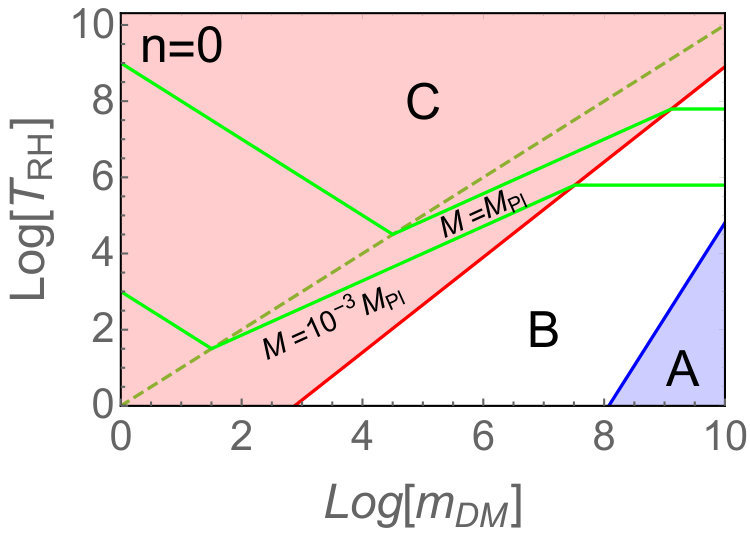 Figure 1
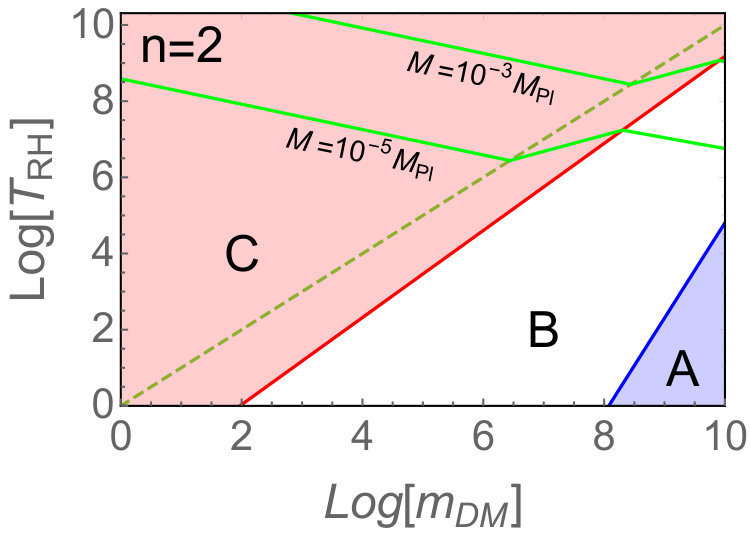 Figure 2
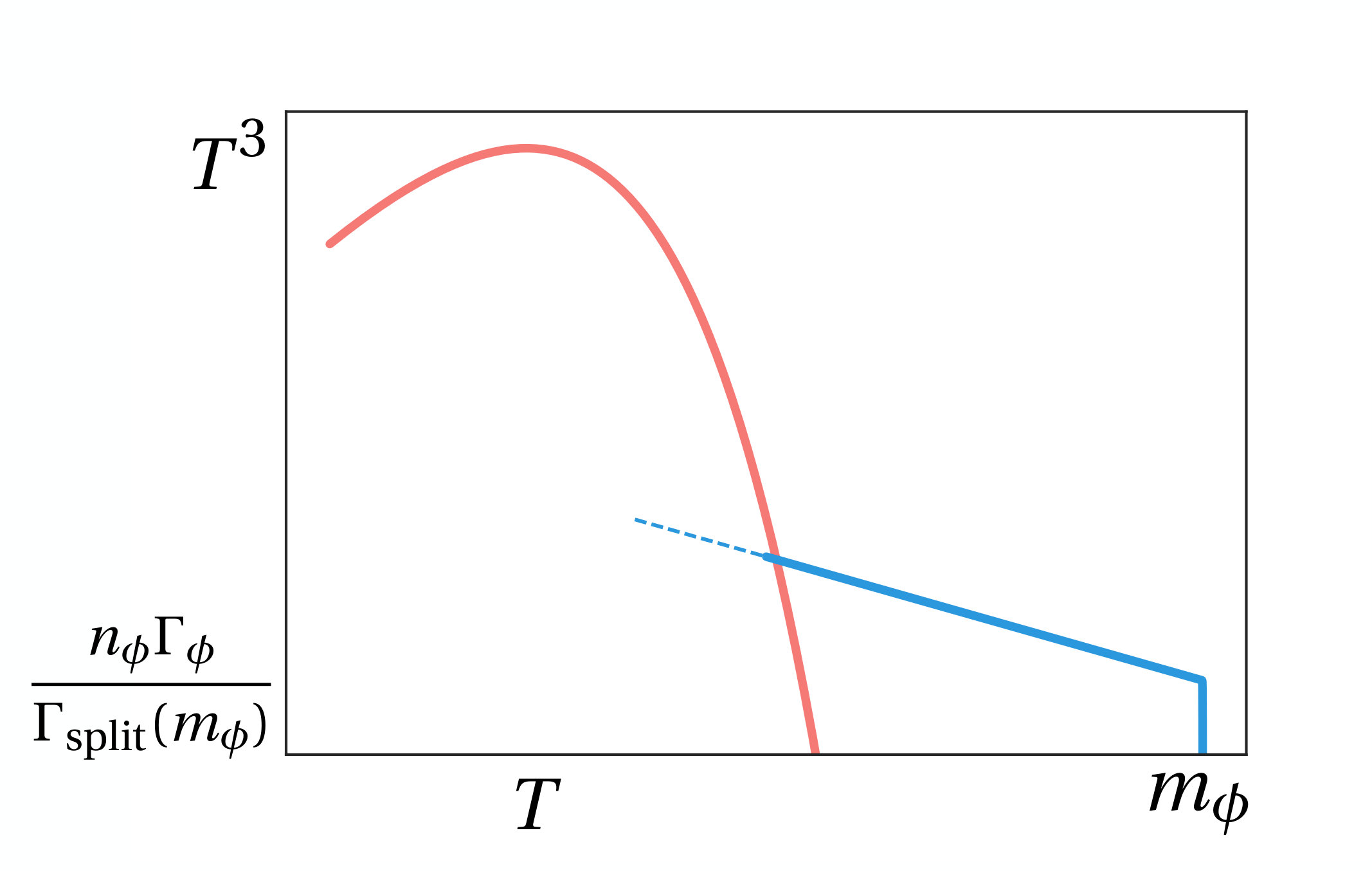 Figure 3
Peer Reviews
No public reviews on file for this paper yet. If you reviewed it on a platform where reviews are public (OpenReview, ICLR, NeurIPS, ICML), you can paste yours below so the community can read it here.
Videos
No videos yet. Explain this paper in a talk, walkthrough, or lecture? Add one.
DESY 19-014
**Dark Matter Production
during the Thermalization Era
**
Keisuke Harigaya♮, Kyohei Mukaida♯, Masaki Yamada♭
[TABLE]
We revisit the non-thermal dark matter (DM) production during the thermalization and reheating era after inflation. The decay of inflaton produces high-energy particles that are thermalized to complete the reheating of the Universe. Before the thermalization is completed, DM can be produced from a collision between the high-energy particles and/or the ambient plasma. We calculate the DM abundance produced from these processes for the case where the cross section of the DM production is proportional to the -th power of the center of mass energy. We find that the collision between the high-energy particles is almost always dominant for while it is subdominant for . The production from the ambient plasma is dominant when and the reheating temperature is of the order of or larger than the DM mass. The production from a collision between the high-energy particle and the ambient plasma is important for and the reheating temperature is much lower than the DM mass.
1 Introduction
Weakly interacting dark matter (DM) with its abundance determined by the freeze-out process [1] has been intensively studied, especially in connection with solutions to the hierarchy problem. The Large Hadron Collider so far has not found any particles beyond the Standard Model (SM), which encourages us to also consider broader classes of dark matter candidates and production mechanisms. In this paper, we focus on the non-thermal DM production during the thermalization of inflaton decay products, which has been pointed out in Ref. [2]. We will not attempt to apply the production mechanism to a specific model, but the computation presented in this paper should be useful for many models.
In most models of inflation and dark matter, the mass of inflaton is many orders of magnitude larger than the electroweak scale. For example, the inflaton mass in the Starobinsky inflation model [3] is of order . The heavy inflaton decays into high-energy particles in the SM so that the Universe is reheated after the end of inflation. The decay products, whose energy is of the same order as the inflaton mass, lose their energy to be thermalized to form thermal plasma.
In the very early stage of reheating, the parametric resonance may take place [4, 5, 6, 7]. There high-energy particles are produced non-perturbatively owing to the high occupation number of the inflaton. Particle production in this stage has been investigated in the literature [8]. However, typically, if the reheating proceeds via a very tiny coupling of the inflaton with radiation, e.g., Planck-suppressed operators, the resonance is soon shut off by the cosmic expansion. Afterwards, the reheating process is well described perturbatively. Even in this regime, there is a non-trivial way to create DM which we will investigate in this paper.
The thermalization process via a perturvative reheating has been studied in detail in Refs. [9, 10] (see also Refs. [11, 12] for earlier works and Refs. [13, 14, 15, 16, 17] in a different context). The high-energy particles emit soft particles, which have relatively small energy, via inelastic scattering processes. The soft particles interact among them to form thermalized ambient plasma. As the temperature of the ambient plasma increases, the interaction between the high-energy particles and the soft particles becomes efficient. Eventually, the high-energy particles become completely thermalized. This is the time when the temperature is maximum after inflation. Still, the inflaton does not decay completely, so that the high-energy decay products are continuously produced from the inflaton decay. When the Hubble parameter becomes comparable to the inflaton decay rate, the reheating process is completed and the Universe becomes dominated by the thermal plasma.
The most important process in the thermalization era is the inelastic scattering process. This process results in the splitting of a high-energy particle, whose energy is larger than the temperature of the ambient plasma, into two high-energy particles. Here we assume .111 If the temperature of ambient plasma becomes larger than the mass of inflaton, i.e. , we cannot compute the inflaton decay rate by just computing it in zero temperature field theory. This is because the dispersion relation of decay products get modified, and in particular, they acquire the thermal mass. For , it is possible that the thermal mass exceeds the inflaton mass term, indicating that the inflaton cannot decay into quasi particles in thermal plasma. However, it does not mean that inflaton cannot convert its energy into the plasma because inflaton can lose its energy by (multiple) scatterings from these quasi particles [18, 19, 20, 21].
A high-energy particle with an energy as large as the inflaton mass splits into two particles whose typical energy is about the half of the initial one. Continuing this splitting process, the original high-energy particle splits into particles with a typical energy of order . This process continues until the energy drops to the temperature of the ambient plasma. This means that numerous high-energy particles are produced during the thermalization process from the decay of a single inflaton. The DM may be efficiently produced from those high-energy particles before they are completely thermalized [2].
The thermalization via the splitting does not occur instantaneously. There are two important consequences of the finiteness of thermalization time scale. Frist, the maximal temperature of the Universe is overestimated if one assumes the instantaneous thermalization [9, 10]. Second, the inflaton decay products, whose initial energy is of the same order as the inflaton mass, survive for a finite time until they lose their energy. These high-energy particles may be relevant for the DM production [2], particularly in the case where the cross section depends positively on the center of mass energy.
Non-thermal production of DM was extensively discussed in Refs. [22, 23, 24, 25, 26] under the assumption of instantaneous thermalization. Ref. [22] discusses thermal production during the reheating era. Since there is an ambient plasma before the reheating completes, the DM can be produced from the scattering in the ambient plasma even if the reheating temperature is lower than the freeze-out temperature. Refs. [23, 24, 25, 26] discuss the non-thermal production of DM from the inflaton (or moduli) decay. If the branching ratio is large enough, the number density of produced WIMPs is determined by the annihilation process. On the other hand, if the branching ratio is small, the number density is determined simply by the branching ratio and the decay temperature. There are also recent works in the literature [27, 28, 29, 30, 31, 32]. These works except for Ref. [30] do not take into account the finiteness of the thermalization time scale and estimate the DM production from the scattering of particles in the thermal plasma before the reheating is completed. Ref. [30] takes into account the correct maximal temperature, which is much lower than the one obtained in the instantaneous thermalization approximation. Still, they omit the second effect we discussed above and may underestimate the DM production rate.
In this paper, we take into account the finiteness of thermalization time scale. There are three processes to produce DM during the thermalization and reheating era: (A) a collision between high-energy particles, (B) a collision between a high-energy particle and a particle in the ambient plasma, and (C) a collision between particles in the ambient plasma. We calculate DM abundance from these contributions and show the conditions to figure out the dominant process. We will see that the contribution (A) is dominant when the cross section of DM production depends positively and strongly on the center of mass energy as considered in Ref. [30]. The contribution (B) is important when the cross section is mildly dependent on the center of mass energy and the reheating temperature is much lower than the DM mass. This includes the case considered in Ref. [2].
2 Thermalization era
In this section, we briefly review the thermalization process of inflaton decay products, which is relevant to the computation of the non-thermal production rate of dark matter in the post-reheating era. Throughout this paper, we assume that the reheating proceeds via a perturbative decay of inflaton. This is the case where the coupling between inflaton and radiation is tiny, e.g., Planck-suppressed operators, because the resonance tends to be shut off immediately due to the cosmic expansion.
As we explained in the introduction, the thermalization of high-energy particles proceeds via the splitting into lower energy particles. This process is the bottleneck of the thermalization if the energy of the high-energy particles, , is larger than the would-be temperature of radiation after thermalization, i.e., . The rate of the splitting process is suppressed by the destructive interference effect between the parent particle and the daughter particle, which is known as the LPM effect [33, 34, 35, 36, 37, 38, 39]. Once the splitting occurs, the subsequent process does not occur until a phase factor, , varies significantly (), where is the 4-momentum of a daughter particle and is the position of the parent particle. Denoting the emission angle of the daughter particle as (, where is the perpendicular momentum), we obtain . Here we have assumed that all the particles are relativistic, . This inequality puts a minimum time so as to emit particles, known as a formation time, .
Now we need to estimate how the squared perpendicular momentum of the daughter particle, , evolves in the medium.222 If there is no ambient plasma, is kept intact. Thus the emitting occurs only for where we expect DGLAP vacuum shower dominates the splittings. See Ref. [17] for the classification of splittings processes.
When the daughter particle is scattered by elastic scattering processes, it evolves as a random walk as [14]
[TABLE]
where we used the elastic scattering rate
[TABLE]
Here, denotes a phase space distribution and generically represents fine-structure constants for the SM gauge interactions. In the last similarity in Eq. (2), we assume that the number density is dominated by the thermalized sector.333 In fact one may show that this is the case for which we will focus on throughout this paper. See Refs. [9, 10].
Inserting these Eqs. (1) and (2) into , one may estimate the formation time
[TABLE]
which is the minimum time to emit particles. If this is longer than the time scale of elastic scatterings, , the splitting rate is suppressed. As a result, we obtain
[TABLE]
In the following we focus on the latter rate i.e., the LPM suppressed rate, dominates the splitting, which implies . Note that the splitting rate via the LPM effect does not depend on the energy of the parent particle in non-Abelian gauge theories. The energy loss rate for the parent particle is dominated by the largest possible energy for the daughter particle , which is equal to half of the parent energy. This means that the high-energy particles continuously lose their individual energy via the splitting into high-energy particles.
When is satisfied, the inflaton decay products lose their energy within a Hubble time and are thermalized soon after they are produced. The threshold of this regime, which we denote as , is the time when the temperature reaches its maximal value after inflation. The corresponding temperature turns out to be [9, 10]
[TABLE]
where is the decay rate of the inflaton. After this happens , the energy and number density of radiation is dominated by the thermalized sector. The estimation of the maximum temperature is valid only when which we assume in the following. Our estimation of the DM abundance is valid without this assumption if the production is dominated at the temperature much below .
High-energy particles are continuously produced from the inflaton decay until the Hubble parameter decreases to the decay rate: . This is the time when the reheating is completed and the Universe becomes to be dominated by thermal radiation. We denote the time as . From to , the temperature of the Universe decreases according to
[TABLE]
The temperature at , which is commonly called as the reheating temperature, is given by
[TABLE]
Now we are in a position to discuss a tail of cascading particles which can play an essential role for the non-thermal DM production. Let us emphasize that the high-energy particles are continuously produced from the inflaton decay during the reheating. The time scale of the thermalization of these high-energy particles is given by the splitting rate , which is finite. As a result, although this process is completed within a Hubble time for , there remains a tail of cascading particles because the inflaton continuously sources the high-energy particles. The spectrum of these cascading particles can be estimated as follows. For later convenience, we define the number density with energy denoted by as follows:
[TABLE]
The number density of high-energy particles right after the inflaton decay is . These primary particles with energy cascade down to some energy by splittings. The energy conservation naively implies . However this population never stays the same energy for the time interval , rather they further cascade within . By taking this effect into account, we can estimate the spectrum [2] (see also [17]):
[TABLE]
for (for a detailed calculation, see Appendix in Ref. [2]). Here () is the number density of the inflaton. The characteristic power-law of shows the LPM suppression. After cascading down to , the daughter particles get thermalized by their own interactions which results in
[TABLE]
for . Here denotes the thermal distribution with the temperature .
The whole spectrum, , is shown in Fig. 1. One can see that taking (i.e., assuming the instantaneous thermalization), results in no high energy population. We also note that the high energy tail is inevitable even if as long as is finite. Note again that the high-energy tail in the spectrum never dominates the energy and number density of radiation. Nevertheless this tail can dominate the production of heavy particles such as DM because its energy is much larger than the temperature for . As we will see, the scattering involving particles in the high-energy tail is actually the dominant process when the cross section of DM production process positively depends on the center of mass energy and/or the reheating temperature is smaller than the DM mass.
3 DM production during the thermalization era
Now we shall take into account the production of DM from those particles. We assume that DM is produced from a pair of SM particles. We also assume that the direct decay of the inflaton into DM is negligible. (This process tends to be non-negligible when DM is charged under the SM gauge group, as DM is necessarily produced by the showering process [40, 41].)
We parametrize the cross section for the DM production as
[TABLE]
where is the center of mass energy and is a parameter with a mass dimension . This kind of cross section comes from a higher dimensional operator with a cutoff of order [42, 43, 44, 45, 46, 47], where we absorb a coupling constant in the definition of without loss of generality. The operator comes from an interaction mediated by a mediator of a mass of order . Note that the dependence of the cross section on is modified for to recover the unitarity. We should replace it by for . This overestimates the production rate for , but practically the production is dominated at . In the following discussion, we assume for simplicity. The estimation in the opposite case is obtained by taking in the following calculation.
Suppose that the DM is produced from a collision of a particle with energy and a particle with energy . The rate of DM production for the former particle is then given by
[TABLE]
The total number density of DM generated per a Hubble time is obtained by performing integrals over the energies
[TABLE]
where
[TABLE]
The rest of this paper is devoted to the determination of the dominant contribution of in the integral (14) by inserting in Eqs. (10) and (11). In the following calculation, we assume . We also assume that the annihilation of produced DM is negligible.
3.1 (A) Collisions of particles with and ()
In this subsection, we calculate the DM abundance produced from the collision between the high-energy particles with . The DM number density produced during one Hubble time in the thermalization era at the temperature of () is given by
[TABLE]
The subscript (NT) implies that the production involves the high-energy tail, i.e., or . Here we normalize the number density by the effective “entropy density” . We define by during the reheating era so that is proportional to and is equal to the entropy density at . In other words, the entropy production via the inflaton decay is already factored out in its definition. By using this definition of , the combination of is constant in time if there is no additional source of DM nor the entropy.
Equation (16) is the formula derived in Ref. [2]. This contribution is missed if one takes a limit of , which corresponds to the limit of instantaneous thermalization. From Eq. (17), we can see that the maximal values, and , dominate the integral (14) for . For the lowest possible values, , are dominant. If we set or , the resulting DM abundance is proportional to . Therefore, DM with energy of order is produced dominantly at the time when the temperature reaches its maximal value . Then we obtain
[TABLE]
with the dominant contribution coming from
[TABLE]
Here, must be larger than by assumption, which requires for . Otherwise the contribution B or C is dominant. The result in the latter case () is obtained in Ref. [30], although the contributions from is not discussed and it is not clear if they are subdominant. For , where the dependence of the DM abundance on vanishes, the integration over yields logarithmic factors. This is also true for the other contributions B and C when the dependence on and/or vanishes. In this paper, we neglect these factors for simplicity.
Finally, we comment that the contribution coming from the time before the temperature reaches the maximal value (i.e., the time when ) is always subdominant. In this case, the number of high-energy particles is given by Eq. (10) with the replacement of . The factor of from is larger for a later epoch, so that the contribution is maximized when the temperature reaches the maximal value.
3.2 (B) Collisions of particles with () and
In this subsection, we calculate the DM abundance produced from the interaction between the high-energy particle with energy of and the thermal plasma . We assume that . Otherwise the produced DM abundance is exponentially suppressed. The result is given by
[TABLE]
Here we have already utilized the fact that the thermal population is dominated by . The dominant contribution comes from
[TABLE]
and
[TABLE]
Here, we should note that must be larger than by assumption, which may be violated for and . Otherwise the contribution C is dominant.
The ratio between the contribution A and B is given by
[TABLE]
where we assumed . Under the assumption of , which is the case for , the contribution A is dominant for . One can check that the contribution B is dominant for because .
3.3 (C) Collisions of particles in the thermal plasma
Finally, we calculate the DM abundance produced from the thermal plasma. We assume that . Otherwise the contribution is exponentially suppressed.
The DM number density produced from the thermal plasma at () is calculated in Ref. [27]. The result is given by
[TABLE]
where we used Eqs. (8) and (11). Here we implicitly assumed that so that DM can be produced from the thermal plasma. The main contribution comes from
[TABLE]
When and , the production dominantly occurs after reheating at , with the abundance given by
[TABLE]
The ratio between the contributions A and C is given by
[TABLE]
for and . This implies that the contribution C is less important for .
We compare the contributions B and C for and find that the contribution C dominates when
[TABLE]
where we assume a large .
Fig. 2 shows which contribution is dominant for and . Here we take and . We can see that the contribution dominates over for a low-reheating temperature, , as we discussed in Ref. [2]. In the figure, we show the parameter region which explains the observed amount of DM () with or for and or for . For a guide to the eye, we show a dashed line representing , which is the threshold determining the dominant contribution for in Eq. (25).
We have checked that the contribution A is almost always dominant for . The contribution C can be dominant for , where the threshold is given by Eq. (27). For , the contributions B or C are dominant depending on and , where the threshold is given by Eq. (28) or Eq. (29). The contribution A is dominant for only in the case where as one can see at the right-bottom corner in Fig. 2.
4 Conclusions and discussion
We have calculated the abundance of DM produced during the thermalization and reheating era after inflation, taking into account the finiteness of thermalization time for high-energy particles from the inflaton decay. The thermalization proceeds via splitting into high-energy particles, whose rate is suppressed by the LPM effect. There are two important effects that are missed in the instantaneous thermalization approximation. First, the temperature of the Universe does not reach its maximal value until the thermalization is completed. This means that the maximal temperature is overestimated in the instantaneous thermalization approximation. Second, the high-energy particles that are continuously produced from inflaton decay can produce DM before they lose their energy to be thermalized. This process is important when the DM production cross section is positively dependent on the center of mass energy and/or when the DM mass is larger than the reheating temperature.
There are three processes to produce DM during the reheating era: A) a collision between high-energy particles, B) a collision between a high-energy particle and a particle in the ambient plasma, and C) collision between particles in the ambient plasma. The first one is discussed in Ref. [30] though the second contribution is omitted. The second one is discussed in Ref. [2] only for the case of . In this paper, we have generalized the discussion in these papers and have determined the conditions for each contribution to be dominant. We have checked that the first contribution is dominant for the case of , where is the power of the dependence of the DM production cross section on the center of mass energy. The second contribution is dominant for the case where the reheating temperature is much lower than the DM mass. These results are consistent with the results in Refs. [2, 30] when overlapped. The resulting DM abundance is many orders of magnitude larger than the one calculated in the instantaneous thermalization approximation in most cases.
Acknowledgements
The work was supported in part by the DoE grant DE-SC0009988 (K.H.). KH thanks Raymond Co and Aaron Pierce for fruitful discussion during which an error in Eq. (28) of the previous version of the paper was spotted.
The reference list from the paper itself. Each links out to its DOI / PubMed record.
- 1[1] B. W. Lee and S. Weinberg, “Cosmological Lower Bound on Heavy Neutrino Masses,” Phys. Rev. Lett. 39 (1977) 165–168 . · doi ↗
- 2[2] K. Harigaya, M. Kawasaki, K. Mukaida, and M. Yamada, “Dark Matter Production in Late Time Reheating,” Phys. Rev. D 89 no. 8, (2014) 083532 , ar Xiv:1402.2846 [hep-ph] . · doi ↗
- 3[3] A. A. Starobinsky, “A New Type of Isotropic Cosmological Models Without Singularity,” Phys. Lett. B 91 (1980) 99–102 . · doi ↗
- 4[4] J. H. Traschen and R. H. Brandenberger, “Particle Production During Out-of-equilibrium Phase Transitions,” Phys. Rev. D 42 (1990) 2491–2504 . · doi ↗
- 5[5] L. Kofman, A. D. Linde, and A. A. Starobinsky, “Reheating after inflation,” Phys. Rev. Lett. 73 (1994) 3195–3198 , ar Xiv:hep-th/9405187 [hep-th] . · doi ↗
- 6[6] Y. Shtanov, J. H. Traschen, and R. H. Brandenberger, “Universe reheating after inflation,” Phys. Rev. D 51 (1995) 5438–5455 , ar Xiv:hep-ph/9407247 [hep-ph] . · doi ↗
- 7[7] L. Kofman, A. D. Linde, and A. A. Starobinsky, “Towards the theory of reheating after inflation,” Phys. Rev. D 56 (1997) 3258–3295 , ar Xiv:hep-ph/9704452 [hep-ph] . · doi ↗
- 8[8] G. N. Felder, L. Kofman, and A. D. Linde, “Instant preheating,” Phys. Rev. D 59 (1999) 123523 , ar Xiv:hep-ph/9812289 [hep-ph] . · doi ↗