Broadband microwave spectroscopy of semiconductor nanowire-based Cooper-pair transistors
Alex Proutski, Dominique Laroche, Bas van 't Hooft, Peter Krogstrup,, Jesper Nyg{\aa}rd, Leo P. Kouwenhoven, Attila Geresdi

TL;DR
This study demonstrates control over the energy structure of a semiconductor nanowire-based Cooper-pair transistor, revealing insights into its quantum dynamics and parity occupation, with implications for superconducting and topological qubits.
Contribution
It provides the first direct mapping of the energy level structure of an indium arsenide nanowire-based CPT with detailed quantum modeling and temperature-dependent parity measurements.
Findings
Controlled the Josephson energy via gate-tunable semiconductor channels.
Mapped the energy level structure of the nanowire CPT.
Measured the parity occupation ratio as a function of temperature.
Abstract
The Cooper-pair transistor (CPT), a small superconducting island enclosed between two Josephson weak links, is the atomic building block of various superconducting quantum circuits. Utilizing gate-tunable semiconductor channels as weak links, the energy scale associated with the Josephson tunneling can be changed with respect to the charging energy of the island, tuning the extent of its charge fluctuations. Here, we directly demonstrate this control by mapping the energy level structure of a CPT made of an indium arsenide nanowire (NW) with a superconducting aluminum shell. We extract the device parameters based on the exhaustive modeling of the quantum dynamics of the phase-biased nanowire CPT and directly measure the even-odd parity occupation ratio as a function of the device temperature, relevant for superconducting and prospective topological qubits.
Click any figure to enlarge with its caption.
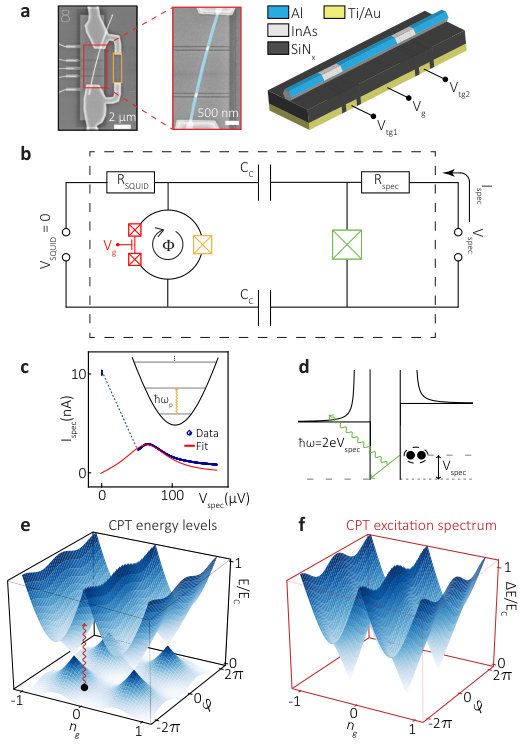 Figure 1
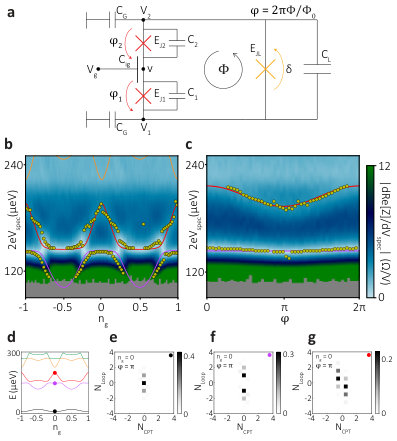 Figure 2
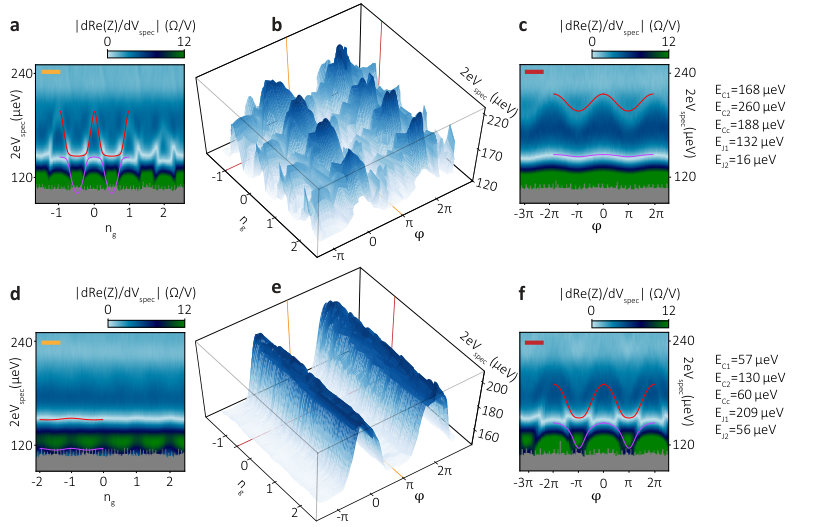 Figure 3
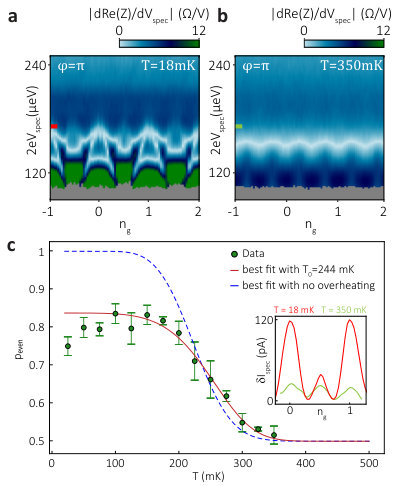 Figure 4
 Figure 5
Peer Reviews
No public reviews on file for this paper yet. If you reviewed it on a platform where reviews are public (OpenReview, ICLR, NeurIPS, ICML), you can paste yours below so the community can read it here.
Videos
No videos yet. Explain this paper in a talk, walkthrough, or lecture? Add one.
††thanks: These authors contributed equally to this work.††thanks: These authors contributed equally to this work.
Broadband microwave spectroscopy of semiconductor nanowire-based
Cooper-pair transistors
Alex Proutski
Dominique Laroche
Bas van ’t Hooft
QuTech and Kavli Institute of Nanoscience, Delft University of Technology, 2600 GA Delft, The Netherlands
Peter Krogstrup
Microsoft Quantum Materials Lab Copenhagen, Niels Bohr Institute, University of Copenhagen, 2100 Copenhagen, Denmark
Center for Quantum Devices, Niels Bohr Institute, University of Copenhagen, 2100 Copenhagen, Denmark
Jesper Nygård
Center for Quantum Devices, Niels Bohr Institute, University of Copenhagen, 2100 Copenhagen, Denmark
Leo P. Kouwenhoven
Microsoft Quantum Lab Delft, 2600 GA Delft, The Netherlands
QuTech and Kavli Institute of Nanoscience, Delft University of Technology, 2600 GA Delft, The Netherlands
Attila Geresdi
QuTech and Kavli Institute of Nanoscience, Delft University of Technology, 2600 GA Delft, The Netherlands
Abstract
The Cooper-pair transistor (CPT), a small superconducting island enclosed between two Josephson weak links, is the atomic building block of various superconducting quantum circuits. Utilizing gate-tunable semiconductor channels as weak links, the energy scale associated with the Josephson tunneling can be changed with respect to the charging energy of the island, tuning the extent of its charge fluctuations. Here, we directly demonstrate this control by mapping the energy level structure of a CPT made of an indium arsenide nanowire (NW) with a superconducting aluminum shell. We extract the device parameters based on the exhaustive modeling of the quantum dynamics of the phase-biased nanowire CPT and directly measure the even-odd parity occupation ratio as a function of the device temperature, relevant for superconducting and prospective topological qubits.
The energy landscape of a Cooper-pair transistor (CPT), a mesoscopic superconducting island coupled to superconducting leads via two Josephson junctions, is determined by the interplay of the electrostatic addition energy of a single Cooper pair, Averin and Likharev (1991); Grabert and Devoret (1991), and the coherent tunneling of Cooper pairs, characterized by the Josephson energy Josephson (1962); Ambegaokar and Baratoff (1963).
The electronic transport through CPTs has mostly been studied for metallic superconducting islands enclosed between tunnel junctions by voltage bias spectroscopy Fulton and Dolan (1987); Geerligs et al. (1990); Tuominen et al. (1992), switching current measurements Joyez et al. (1994); Eiles and Martinis (1994); Aumentado et al. (2004); van Woerkom et al. (2015), microwave reflectometry Ferguson et al. (2006); Shaw et al. (2008), and broadband microwave spectroscopy Billangeon et al. (2007a, b). Recent material developments Krogstrup et al. (2015); Gazibegovic et al. (2017) made it possible to investigate superconducting transport in semiconductor nanowire (NW) weak links, which lead to Andreev level quantum circuits van Woerkom et al. (2017); Hays et al. (2018); Tosi et al. (2019) and gate-tunable superconducting quantum devices Larsen et al. (2015); de Lange et al. (2015); Luthi et al. (2018); Casparis et al. (2019). In addition, hybrid superconductor-semiconductor island devices, which are the atomic building blocks of proposed topological quantum bits based on Majorana zero-energy modes Hyart et al. (2013); Aasen et al. (2016); Karzig et al. (2017); Plugge et al. (2017), have been fabricated and measured using normal metallic leads Albrecht et al. (2016); Shen et al. (2018), but thus far there is very limited experimental work on hybrid CPTs with superconducting leads van Veen et al. (2018).
Such applications require the control of the Josephson coupling via the semiconductor weak link Zuo et al. (2017). In addition, the charging energy of a NW CPT can deviate from the predictions of the orthodox theory Averin and Likharev (1991); Grabert and Devoret (1991) due to renormalization effects arising because of finite channel transmissions Averin (1999). Therefore, understanding the quantum dynamics of CPTs with semiconductor weak links is crucial for these hybrid device architectures.
Here we directly measure the transitions between the energy levels of a NW CPT. The CPT is embedded in the circuit shown in Fig. 1(a). The superconducting island is created from an indium arsenide (InAs) nanowire with an epitaxial layer of aluminium (Al) Krogstrup et al. (2015) between two Josephson junctions, formed by removing two sections of the Al shell with a wet chemical etch. We investigated two devices, both with nm long junctions and island lengths of nm and m for device 1 and device 2 [enclosed in the red box in Fig. 1(a)], respectively. The junctions are tuned via their respective local electrostatic gates, and . The gate charge, , is set by the gate voltage and the effective gate capacitance, (see the right panel in Fig. 1(a) and the supplementary information sup ). The nanowire CPT is embedded in a superconducting quantum interference device (SQUID) with an Al/AlOx/Al tunnel junction [in the yellow box in Fig. 1(a)] which exhibits a much higher Josephson energy than the CPT. This asymmetry ensures that the applied phase drops mostly over the CPT. Here, is the applied flux and is the superconducting flux quantum.
We utilized a capacitively coupled Al/AlOx/Al superconducting tunnel junction as a broadband on-chip microwave spectrometer [green box in Fig. 1(b)] Billangeon et al. (2007a); Bretheau et al. (2013); van Woerkom et al. (2017), where inelastic Cooper-pair tunneling gives rise to a dc current contribution in a dissipative environment Holst et al. (1994):
[TABLE]
Here, is the critical current of the spectrometer tunnel junction and is the impedance of the environment at the frequency , determined by the spectrometer dc voltage bias, [Fig. 1(d)]. This dc to microwave conversion allowed us to directly measure the excitation energies of the hybrid SQUID, where exhibits a local maximum Kos et al. (2013). To reduce microwave leakage, we applied the bias voltages to the hybrid SQUID and to the spectrometer junctions via on-chip resistors, yielding and . The chip [in black dashed box in Fig. 1(b)] was thermally anchored to the mixing chamber of the dilution refrigerator with a base temperature of mK. Full details of the fabrication process and device geometry are given in the supplementary information sup .
We begin by analyzing the circuit while keeping both nanowire junctions in full depletion by applying large negative gate voltages and . The curve of the spectrometer of device 1 is shown in Fig. 1(c). A clear peak is observed with an amplitude of nA centered at eV. We attribute this peak to the plasma resonance of the tunnel junction in the SQUID at . Here eV is the Josephson energy Ambegaokar and Baratoff (1963), with eV being the measured superconducting gap and the normal state resistance of the junction, acquired at a voltage bias much higher than . This value yields eV and a shunt capacitance fF. Fitting the resonant peak using Eq. (1), we find a quality factor and a characteristic impedance , which together ensure the validity of Eq. (1) describing a direct correspondence between the measured and . We note that we found very similar values for device 2 as well (see supplementary information for a detailed analysis and a list of parameters sup ).
Next, we investigate the spectrometer response to the applied gate voltage and phase [Fig. 2(b) and (c)] when the Josephson junctions are opened by setting positive gate voltages and . The excitations of the CPT are superimposed on that of the plasma resonance, so we display to reach a better visibility of the transitions (see the supplementary information for a comparison sup ). Note that we show the excitation energy on the vertical axis for all spectra. This measurement yields clear oscillations as a function of both and , consistent with the expected periodic behavior of the CPT energy levels Joyez et al. (1994). We note that the finite load resistance of the spectrometer prevented us from measuring the transitions below eV.
We model our device with the schematics depicted in Fig. 2(a) and build the Hamiltonian of the circuit based on conventional quantization procedures Blais et al. (2004); Vool and Devoret (2017). We use the conjugate charge and phase operators which pairwise obey and note that :
[TABLE]
Here, the charging of the circuit is described by the effective parameters , and set by the capacitance values , , , and with a functional form provided in the supplementary information sup . The Cooper-pair tunneling is characterized by the Josephson energies of the three junctions, , and , respectively. We note that we set eV for the analysis below.
To calculate the excitation spectrum, we solve the eigenvalue problem to find , where , and compute the transition energies , with being the ground state energy of the system. This model allows us to fit the excitation spectra simultaneously as a function of and based on the first two transitions (red and purple solid lines for and , respectively) against the measured data (yellow circles in Fig. 2). For illustration, we also display (orange line) in Fig. 2(b) using the same fit parameters, however, this transition was not observed in the experiment.
To understand the nature of the excited levels, we calculate the energy bands of the hybrid SQUID using the fitted parameters [Fig. 2(d)] and evaluate the probability distribution , where and form the charge computational basis. However, it is more instructive to use the charge numbers and . Intuitively, and represent the excess number of Cooper pairs on the island and in the loop, respectively. Indeed, the ground state wavefunction is centered around [Fig. 2(e)]. Conversely, the probability distribution of the first excited state [Fig. 2(f)] exhibits a bimodal distribution in , consistently with the first plasma mode excitation but no excess charge on the CPT [purple circle in Fig. 2(d)]. This is in contrast with the wavefunction of the next energy level [Fig. 2(g) and red circle in Fig. 2(d)], which is centered around . This analysis demonstrates the coupling between the plasma and localized charge degrees of freedom Wallraff et al. (2004).
Next, we investigate the impact of and on the CPT spectrum. In Fig. 3, we show the measured spectra for two distinct gate settings. Remarkably, almost a full suppression of the charge dispersion is achieved by an V increase in and , showcasing the feasibility of topological quantum bit designs relying on the modulation of the charge dispersion in superconductor-semiconductor hybrid devices Aasen et al. (2016). Furthermore, we observe a strong renormalization of the characteristic charging energies in the open regime Averin (1999); Pikulin et al. (2019), which does not exist for the case of fully metallic CPTs with tunnel junctions, where the charging energy is fully determined by the device geometry. In addition, we find an increase in the Josephson energies , further contributing to the suppression of the charge dispersion of the CPT in the limit of Koch et al. (2007).
Thus far, we only considered the even charge occupation of the island, where all electrons are part of the Cooper-pair condensate, and a single quasiparticle occupation is exponentially suppressed in , where is the superconducting gap Averin and Nazarov (1992). However, a residual odd population is typically observed in the experiments, attributed to a non-thermal quasiparticle population in the superconducting circuit. In our experiment, we also find an additional spectral line, shifted by [see Figs 2(b) and 3(a)], substantiating a finite odd number population of the island. We investigate this effect as a function of the temperature, and find that above a typical temperature of mK, the measured signal is fully periodic [Fig. 4(b)], in contrast to the periodic data taken at mK [Fig. 4(a)].
To quantify the probability of the even and odd occupations, we extract the gate-charge dependent component of the measured spectra to evaluate and , see the inset in Fig. 4(c). We now make the assumption that the microwave photon frequency is much higher than the parity switching rate of the CPT. We evaluate the current response at eV [see Figs. 4(a) and (b)] corresponding to GHz, well exceeding parity switching rates measured earlier on similar devices Albrecht et al. (2017); van Veen et al. (2018). In this limit, the time-averaged spectrometer response is the linear combination of the signals corresponding to the two parity states and , respectively. From this linear proportionality, follows.
We plot the extracted in Fig. 4(c). We find that above a crossover temperature mK, approaches , in agreement with the commonly observed breakdown of the parity effect at as a result of the vanishing even-odd free energy difference Lafarge et al. (1993); van Woerkom et al. (2015); Higginbotham et al. (2015),
[TABLE]
Here, at a temperature of with the island volume being . We use the density of states at the Fermi level in the normal state for aluminium Ferguson et al. (2006). Then the even charge parity occupation is given by .
While this analysis describes the breakdown of the even-odd effect [see blue dashed line as the best fit in Fig. 4(c)], it fails to account for the observed saturation in the low temperature limit, at mK. This saturation can be be phenomenologically understood based on a spurious overheating of the island. We assume that the electron temperature , where the chip (phonon) temperature is , and the electron saturation temperature is due to overheating and weak electron-phonon coupling at low temperatures Giazotto et al. (2006).
The resulting best fit is shown as a solid red line in Fig. 4(c). We find a metallic volume of , consistent with the micrograph shown in Fig. 1(a). The fit yields a superconducting gap eV, slightly lower than the that of bulk aluminum, which is expected due to the presence of induced superconductivity in the semiconductor. The fitted saturation temperature mK and limiting demonstrates the abundance of non-equilibrium quasiparticles, in agreement with recent experimental findings Serniak et al. (2018); Mannila et al. (2018) on metallic devices. However, the unpaired quasiparticle density Higginbotham et al. (2015) m*-3* is orders of magnitude higher than typical values for all-metallic devices, falling in the range m*-3* Ferguson et al. (2006); van Woerkom et al. (2015); Mannila et al. (2018). The same analysis was also performed on device 1 yielding similar results, see the supplementary information sup . Our results substantiate the importance of controlling the quasiparticle population for hybrid semiconductor-superconductor CPTs in prospective topological quantum bits to decrease their rate of decoherence Rainis and Loss (2012).
In conclusion, we performed broadband microwave spectroscopy on the gate charge and phase-dependent energy dispersion of InAs/Al hybrid CPTs, utilizing an on-chip nanofabricated circuit with a superconducting tunnel junction as a frequency-tunable microwave source. We understand the observed spectra based on the Hamiltonian of the circuit and find the characteristic charging and Josephson tunneling energy scales, both exhibiting strong modulation with the electrostatic gates coupled to the semiconductor channels. This broad tunability demonstrates the feasibility of prospective topological qubits relying on a controlled suppression of the charge modulation. Finally, we directly measure the time-averaged even and odd charge parity occupation of the CPT island, yielding a residual odd occupation probability and unpaired quasiparticle density which are much higher than typical values acquired earlier for all-metallic devices. This can be a limiting factor for topological quantum bit architectures that rely on charge parity manipulation and readout.
The analyzed raw data sets and data processing scripts for this publication are available at the 4TU.ResearchData repository Proutski et al. .
The authors gratefully acknowledge O. Benningshof and R. Schouten for technical assistance as well as D. J. van Woerkom, D. Bouman and B. Nijholt for fruitful discussions. This work was supported by the Netherlands Organization for Scientific Research (NWO) as part of the Frontiers of Nanoscience program, Microsoft Corporation Station Q, the Danish National Research Foundation and a Synergy Grant of the European Research Council. P. K. acknowledge funding from the European Research Council (ERC) under the grant agreement No. 716655 (HEMs-DAM).
The reference list from the paper itself. Each links out to its DOI / PubMed record.
- 1Averin and Likharev (1991) D. V. Averin and K. K. Likharev, Single electronics: a correlated transfer of single electrons and Cooper pairs in systems of small tunnel junctions, in Mesoscopic phenomena in solids , edited by B. V. Alltshuler, P. A. Lee, and R. A. Webb (Elsevier BV, 1991) p. 173.
- 2Grabert and Devoret (1991) H. Grabert and M. H. Devoret, eds., Single charge tunneling (Plenum, New York, 1991).
- 3Josephson (1962) B. D. Josephson, Possible new effects in superconductive tunnelling, Phys. Lett. 1 , 251 (1962) . · doi ↗
- 4Ambegaokar and Baratoff (1963) V. Ambegaokar and A. Baratoff, Tunneling between superconductors, Physical Review Letters 10 , 486 (1963).
- 5Fulton and Dolan (1987) T. A. Fulton and G. J. Dolan, Observation of single-electron charging effects in small tunnel junctions, Phys. Rev. Lett. 59 , 109 (1987) . · doi ↗
- 6Geerligs et al. (1990) L. J. Geerligs, V. F. Anderegg, J. Romijn, and J. E. Mooij, Single Cooper-pair tunneling in small-capacitance junctions, Phys. Rev. Lett. 65 , 377 (1990) . · doi ↗
- 7Tuominen et al. (1992) M. Tuominen, J. Hergenrother, T. Tighe, and M. Tinkham, Experimental evidence for parity-based 2e periodicity in a superconducting single-electron tunneling transistor, Physical Review Letters 69 , 1997 (1992).
- 8Joyez et al. (1994) P. Joyez, P. Lafarge, A. Filipe, D. Esteve, and M. Devoret, Observation of parity-induced suppression of Josephson tunneling in the superconducting single electron transistor, Physical Review Letters 72 , 2458 (1994).