Finitely many physical measures for sectional-hyperbolic attracting sets and statistical stability
Vitor Araujo

TL;DR
This paper proves that sectional-hyperbolic attracting sets have finitely many physical measures with basins covering almost all points, and these measures depend continuously on the flow, establishing statistical stability.
Contribution
It establishes the finiteness and statistical stability of physical measures for sectional-hyperbolic attracting sets in $C^1$ flows.
Findings
Finitely many physical measures cover almost all points in the basin.
Physical measures depend continuously on the flow in the $C^1$ topology.
Central-unstable disks expand to contain uniformly sized balls.
Abstract
We show that a sectional-hyperbolic attracting set for a H\"older- vector field admits finitely many physical/SRB measures whose ergodic basins cover Lebesgue almost all points of the basin of topological attraction. In addition, these physical measures depend continuously on the flow in the topology, that is, sectional-hyperbolic attracting sets are statistically stable. To prove these results we show that each central-unstable disk in a neighborhood of this class of attracting sets is eventually expanded to contain a ball whose inner radius is uniformly bounded away from zero.
Click any figure to enlarge with its caption.
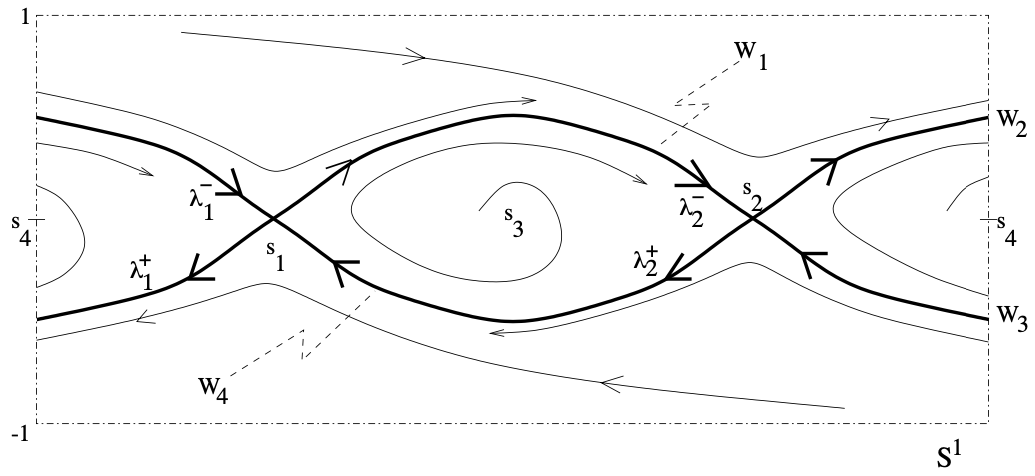 Figure 1
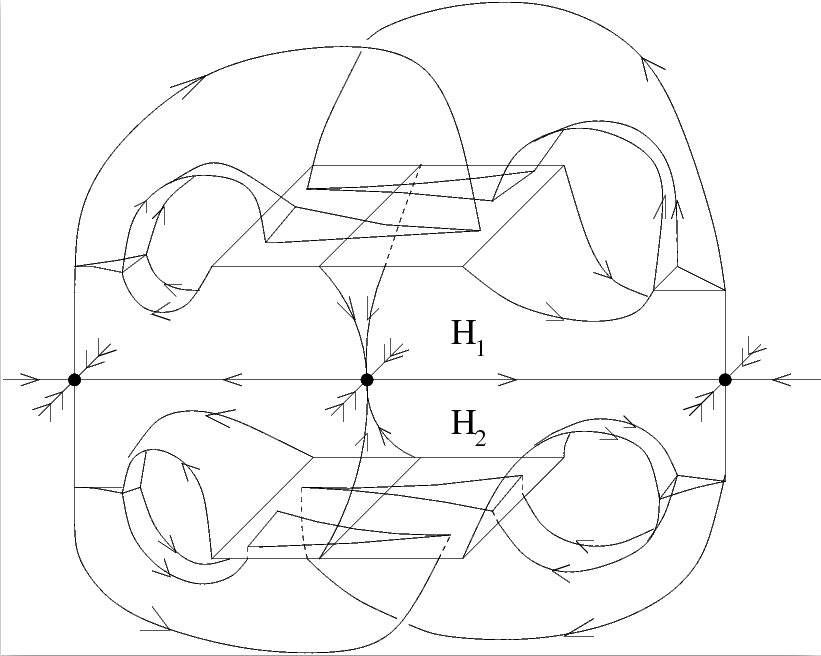 Figure 2
Peer Reviews
No public reviews on file for this paper yet. If you reviewed it on a platform where reviews are public (OpenReview, ICLR, NeurIPS, ICML), you can paste yours below so the community can read it here.
Videos
No videos yet. Explain this paper in a talk, walkthrough, or lecture? Add one.
Finitely many physical measures for
sectional-hyperbolic attracting sets and statistical stability
Vitor Araujo
[email protected] https://sites.google.com/site/vdaraujo99/ Instituto de Matemática e Estatística, Universidade Federal da Bahia, Av. Ademar de Barros s/n, 40170-110 Salvador, Brazil.
Abstract.
We show that a sectional-hyperbolic attracting set for a Hölder- vector field admits finitely many physical/SRB measures whose ergodic basins cover Lebesgue almost all points of the basin of topological attraction. In addition, these physical measures depend continuously on the flow in the topology, that is, sectional-hyperbolic attracting sets are statistically stable. To prove these results we show that each central-unstable disk in a neighborhood of this class of attracting sets is eventually expanded to contain a ball whose inner radius is uniformly bounded away from zero.
Key words and phrases:
sectional-hyperbolicity, physical/SRB measures, ergodic basin, statistical stability, topological basin
2010 Mathematics Subject Classification:
Primary: 37D25. Secondary: 37D30, 37D20.
The author was partially supported by CNPq-Brazil (grant 300985/2019-3).
Contents
-
2 Preliminary results on sectional-hyperbolic attracting sets
-
2.2 Extension of the stable bundle and center-unstable cone fields
-
2.4.2 Hyperbolicity of the extensions of the Poincaré maps at smooth strips
-
4 Finitely many ergodic physical measures for sectional hyperbolic attracting sets
-
5 Statistical stability of sectional-hyperbolic attracting sets
1. Introduction and statements of the results
The term statistical properties of a dynamical system refers to the statistical behavior of typical trajectories of the system. It is well known that this relates to the properties of the evolution of measures by the dynamics. Statistical properties are often a better object to be studied than pointwise behavior. In fact, the future behavior of initial data can be unpredictable, but statistical properties are often regular and their description simpler.
Arguably one of the most influential concepts in the theory of Dynamical Systems has been the notion of physical (or ) measure. We say that an invariant probability measure for a flow is physical if the set
[TABLE]
has non-zero volume, with respect to any volume form on the ambient compact manifold . The set is by definition the basin of . It is assumed that time averages of these orbits be observable if the flow models a physical phenomenon.
The study of the existence of these special measures and their statistical properties for uniformly hyperbolic diffeomorphisms and flows has a long and rich history, starting with the works of Sinai, Ruelle and Bowen [17, 18, 47, 48, 52]. Some classes of systems that not satisfy all the basic assumptions of uniform hyperbolicity have been shown to possess physical measures much more recently: sectional-hyperbolicity is a generalization of Smale’s notion of Axiom A [53] that allows for the inclusion of equilibria (also known as singularities or steady-states) and incorporates the classical Lorenz attractor [29] as well as the geometric Lorenz attractors of [1, 24]. For three-dimensional flows, sectional hyperbolic attractors are precisely the ones that are robustly transitive, and they reduce to Axiom A attractors when there are no equilibria [38].
For arbitrary dimensions this notion was established first in [32] and the first concrete example provided by [15]. Sectional-hyperbolic attractors are those robustly transitive attracting sets for which the flow in a star flow in the trapping region, that is, there are no bifurcations of singularities or periodic orbits for all nearby dynamics (also known as “strongly homogeneous flows”). Again these sets reduce to Axiom A attractors if there are no equilibria.
Sectional-hyperbolic attractors in -manifolds were shown to have a unique physical measure in [8, 7] and sectional-hyperbolic attracting sets have finitely many ergodic physical measures whose basins cover a full volume subset of a neighborhood of the attracting set; see [51, 9]. The study of statistical properties of these measures is well developed program, we mention the recent works [30, 25, 50, 23, 10, 3, 6, 4, 5, 12] among others.
Recently it was shown the existence of a unique physical measure for sectional-hyperbolic attractors for flows in manifolds with any finite dimension in [28] using the Thermodynamical Formalism and assuming certain properties of a stable foliation in a neighborhood of the attracting set, common to the above mentioned works in the -dimensional setting; see also [33] for a different proof using stochastic stability of such attractors.
Various issues regarding the existence and smoothness of the stable foliation in a neighborhood of sectional-hyperbolic attracting sets are clarified in [4]; a topological foliation always exists, and an analytic proof of smoothness of the foliation for the classical Lorenz attractor (and nearby attractors) is given in [4, 6]. In [5] sufficient conditions are provided for these foliations to have absolutely continuous holonomy maps, a crucial technical feature to obtain many statistical properties in dynamics. For higher differentiability properties of these foliations for geometric Lorenz attractors, see [54].
Here we pave the way to further study of statistical properties of sectional-hyperbolic attracting sets. We solve the basin problem for sectional-hyperbolic attracting sets, that is, we show that an open dense and full measure subset of points in a neighborhood of these sets is exponentially asymptotic to some orbit inside the set. More precisely: given a neighborhood of an invariant sectional-hyperbolic attracting set of a smooth flow , there exists and an open and dense subset with full Lebesgue measure () so that for any given there exists satisfying for all .
Moreover, coupled with recent results from [20] on weak limits of time averages for almost all orbits in partially hyperbolic sets with applications to sectional-hyperbolic attracting sets, we complement [28] proving the existence of finitely many ergodic physical measures for sectional-hyperbolic attracting sets in any dimension. In addition, the basins of these measures cover a full Lebesgue measure subset of a neighborhood of the sectional-hyperbolic attracting set.
Having this, we use recent results from [40] on robust entropy expansiveness for sectional-hyperbolic attracting sets to prove that the physical measures depend continuously on the flow, showing that asymptotic time averages for Lebesgue almost all points in a neighborhood of such attracting sets are robust under small perturbations of the dynamics. This is known as statistical stability and our proof provides a far-reaching extension of the results already obtained for the -flows having geometric Lorenz attractors in [2] and the classical Lorenz attractor in [11].
1.1. Preliminary definitions
Let be a compact Riemannian manifold with induced distance and volume form . Let be the set of vector fields on and denote by the flow generated by . We say that is Hölder- if on any local chart the derivative is -Hölder for some fixed . We write for the vector space of all Hölder- vector fields over .
Given a compact invariant set for , we say that is isolated if there exists an open set such that . If can be chosen so that for all , then we say that is an attracting set.
A compact invariant set is partially hyperbolic if the tangent bundle over can be written as a continuous -invariant sum where and for , and there exist constants , such that for all , , we have
- •
uniform contraction along : and
- •
domination of the splitting:
We say that is the stable bundle and the center-unstable bundle. A partially hyperbolic attracting set is a partially hyperbolic set that is also an attracting set.
We say that the center-unstable bundle is sectional expanding if for every two-dimensional subspace ,
[TABLE]
If and , then is called an equilibrium or singularity in what follows and we denote by the family of all such points. An invariant set is nontrivial if it is neither a periodic orbit nor an equilibrium.
We say that a compact invariant set is a sectional hyperbolic set if is partially hyperbolic with sectional expanding center-unstable bundle and all equilibria in are hyperbolic. A sectional hyperbolic set which is also an attracting set is called a sectional hyperbolic attracting set.
A singular hyperbolic set is a compact invariant set which is partially hyperbolic with volume expanding center-unstable subbundle and all equilibria within the set are hyperbolic. A sectional hyperbolic set is singular hyperbolic and both notions coincide if, and only if, .
Remark 1.1**.**
- (1)
A sectional hyperbolic set with no equilibria is necessarily a hyperbolic set, that is, the central unstable subbundle admits a splitting for all where is uniformly contracting under the time reversed flow; see e.g. **[7]**. 2. (2)
A sectional hyperbolic attracting set cannot contain isolated periodic orbits. For otherwise such orbit must be a periodic sink, contradicting volume expansion.
We recall that a subset is transitive if it has a full dense orbit, that is, there exists such that .
A nontrivial transitive sectional hyperbolic attracting set is a sectional hyperbolic attractor. For more details on these notions, see e.g. [7] and references therein.
1.2. Statement of the results
The definition of singular-hyperbolicity ensures that every invariant probability measure supported in a singular-hyperbolic set is a hyperbolic measure. Moreover, if the vector field is smooth (at least Hölder-) from the proof of [8, Theorem B, Section 4] or explicitly from [51, Theorem 1.5], we get that every singular-hyperbolic attracting set admits finitely many ergodic physical/SRB invariant measures; and the union of the ergodic basins of these measures covers a full Lebesgue measure subset of the topological basin of attraction of , i.e. .
We show here that the same result is true in higher dimensions for sectional-hyperbolic attracting sets.
Theorem A**.**
*Every sectional-hyperbolic attracting set for a Hölder- vector field admits finitely many ergodic physical/SRB invariant probability measures. Moreover, the union of the ergodic basins of these measures covers a full Lebesgue measure subset of the topological basin of attraction of . *
In [28] existence a uniqueness of the physical measure was obtained for sectional-hyperbolic attractors of vector fields. We extend the argument from [28] avoiding the use of a dense orbit taking advantage of the recent results from [20] which hold in the topology.
By robustness of partial hyperbolicity and sectional expansion, given a sectional-hyperbolic attracting set with trapping region , then there exists a neighborhood of so that is a trapping region and is sectional-hyperbolic for all . It is then natural to study the stability of the physical measures under small perturbation of the vector field .
Theorem B**.**
Let be a vector field having a trapping region whose attracting set is sectional-hyperbolic. Then there exists a neighborhood of so that, for each choice of and a physical measures for supported in such that when , each weak∗ accumulation point of is a linear convex combination of the ergodic physical measures of provided in Theorem A:
[TABLE]
In other words, the convex hull of the ergodic physical measures of a sectional-hyperbolic attracting set depends continuously on the vector field, with respect to the topology of vector fields and weak∗ topology of probability measures on a manifold.
Statistical stability means that time averages of continuous observables in a neighborhood of the sectional-hyperbolic attracting sets, well-defined Lebesgue almost everywhere in , depend continuously on the vector field generating the flow , so that we can assure that is small as long has is small enough.
Theorem B improves both [2] and [11] since, although not dealing with the density of the invariant probability of the quotient map along stable leaves on global cross-section of the geometric Lorenz attractor, its statement and proof applies to a much larger family of sectional-hyperbolic attracting sets.
In particular, the attracting sets appearing as small perturbations of singular-hyperbolic attractors as in Morales [36], which must have a singular component, are statistical stable whatever the number of singularities involved.
We note that there are many examples of singular-hyperbolic attracting sets, non-transitive and containing non-Lorenz-like singularities; see Figure 1 for an example obtained by conveniently modifying the geometric Lorenz construction, and many others in [37]. statistical stability follows for all these examples.
Moreover Theorem B applies to the multidimensional Lorenz attractor described in [15] without further ado.
In addition, the open families of Lorenz-like attractors obtained after bifurcating saddle-connections by many authors [44, 49, 27, 21, 35, 34, 45, 46, 39] are automatically endowed with statistical stability after Theorem B, that is, in the (generic) unfolding of double (resonant) homoclinic cycle or saddle-connections, the physical measure for the ensuing Lorenz-like attractors depends continuously on the parameters.
We mention that in the preprint [33] the authors prove stochastic stabilty for transitive sectional-hyperbolic attracting sets which, in particular, provides an alternative proof of the existence of a unique SRB measure for sectional-hyperbolic attractors. This is a different kind of stability which is in general unrelated to statistical stability. Whereas statistical stability compares the SRB measures of close vector fields, stochastic stability considers random perturbations of a given vector field, usually though a diffusion, and checks whether the stationary measure for the randomly perturbed vector field converges to some special invariant measure for the orinal unperturbed vector field when the size of the diffusion vanishes. The results strongly depend on the type of random perturbation chosen, see e.g. [14, Appendix D].
The proofs of Theorems A and B use a construction of adapted cross-sections, generalizing the one presented in the -flow setting in [8] and in the codimension setting in [5], which has been used to prove many delicate statistical properties of these flows; a similar construction (but built in a different way) of higher-dimensional adapted cross-sections was recently proposed in the work [19]. This enables us to solve the basin problem, as follows; see e.g. [13] for a similar but more delicate instance in a highly non-uniformly hyperbolic setting.
For a periodic point of we write for its compact orbit where the minimal satisfying this is the period of any point . Moreover, we write
[TABLE]
for the stable manifold of and for a given we write
[TABLE]
for the local unstable manifold of of size . There are analogous and dual notions of local stable manifolds and unstable manifolds.
We say that a periodic point is hyperbolic if admits three -invariant subspaces forming a splitting , where is an eigenspace with eigenvalue ; is contracted and expanded. The (Un)Stable Manifold Theorem ensures that is an embedded manifold with and is an immersed submanifold with , for each . We write for the union and analogously . For more details on these notions from Hyperbolic Dynamics, see e.g. [41].
Theorem C**.**
Let be a vector field having a trapping region whose attracting set is sectional-hyperbolic. Then there are and finitely many (hyperbolic) periodic points of so that
[TABLE]
is open and dense in {\mathcal{U}}=\{y\in M:d\big{(}\phi_{t}y,\Lambda\big{)}\xrightarrow[t\to+\infty]{}0\}\supset U. In particular, is dense in .
*In addition, if , then contains the basin of any physical probability measure supported in and has full volume: . *
Recently [56] obtains a similar structure for sectional-hyperbolic attractors, showing that they are homoclinic classes.
We conjecture that in this setting is the entire basin, as follows.
Conjecture 1**.**
For any sectional-hyperbolic attracting set the topological basin of attraction coincides with the family of stable manifolds through the points of local unstable leaves of finitely many periodic orbits, that is, .
The following example shows that partially hyperbolic attracting sets which are not sectional-hyperbolic do not necessarily satisfy the conclusions of Theorem C.
Example 1**.**
Consider Bowen’s example flow (see [55] for the not very clear reason for the name) is a folklore example showing that Birkhoff averages need not exist almost everywhere. Indeed, in the system pictured in Figure 2 time averages only exist for the sources , and for the set of separatrixes and saddle equilibria , which is an attracting set.
The orbit under this flow of every point not in accumulates on either side of the separatrixes, as suggested in the figure, if we impose the condition on the eigenvalues of the saddle fixed points and ; for more specifics on this see e.g. [55] and references therein.
Due to the very long sojourn times around and , future time averages of continuous functions with do not exist; see e.g. [26]. However, time averages do exist for points in .
Hence, no point in belongs to the stable manifold of any point of . That is, we have that but the union of the stable manifolds of the points of is simply .
To obtain an example with Lorenz-like singularities, just multiply this system by the North-South flow on so that the derivative of the flow at the sink in the south pole has an eigenvalue so that ; and then take the attracting set in .
1.3. Organization of the text
In Section 2 we present precise statements of the main properties of sectional-hyperbolic attracting sets together with a precise description of the construction of a family of adapted cross-sections and a corresponding piecewise smooth and uniformly hyperbolic global Poincaré return map (with singularities) on a subset of , which might be of independent interest for further work on statistical properties of these systems.
In Section 3 we consider the basin of a sectional-hyperbolic attracting set proving the topological part of the statement of Theorem C as a consequence of showing that every center-unstable disk contains subdisks which are sent by arbitrarily large iterates of the Poincaré map to center-unstable disks with inner radius uniformly bounded away from zero accumulating the local unstable manifold of a hyperbolic periodic orbit from a finite subset of such orbits in the attracting set. In Subsection 4.1 we obtain as a consequence of the previous result that every positively invariant subset of containing -a.e. point of a central-unstable disk must contain a central-unstable disk with uniform inner radius.
This enables us to complete the proof of Theorem A in Subsection 4.2 by using and completing the relevant steps presented in [28] together with the results from Subsection 4.1 and the more recent results from [20], under the assumption that the vector field is Hölder-. Following this, a proof of the measure theoretic part of the statement of Theorem C is presented in Subsection 4.3.
Finally, we present a proof of Theorem B on statistical stability in Section 5, coupling the previous results with robust entropy expansiveness of sectional hyperbolic attracting sets obtained in [40].
Acknowledgement
I thank the Mathematics Department at UFBA and CAPES-Brazil for the basic support of research activities; and also the anonymous referee for many suggestions that helped to improve the text.
2. Preliminary results on
sectional-hyperbolic attracting sets
Let be a vector field admitting a singular-hyperbolic attracting set with isolating neighborhood . Given we denote the omega-limit set
[TABLE]
and the alpha-limit set which are non-empty on a compact ambient space .
2.1. Lorenz-like singularities
We first recall some properties of sectional-hyperbolic attracting sets extending some results from [4, 5] which hold for .
Proposition 2.1**.**
Let be a sectional hyperbolic attracting set and let be an equilibrium. If there exists so that , then is generalized Lorenz-like: that is, has a real eigenvalue and satisfies and so the index of is .
Remark 2.2**.**
- (1)
If is a generalized Lorenz-like singularity and is its local stable manifold, then at we have since is -invariant and contains (because is -invariant) and the dimensions coincide. 2. (2)
If an equilibrium is not generalized Lorenz-like, then is not in the limit set of , i.e. there is no so that . An example is provided by the pair of equilibria of the Lorenz system of equations away from the origin: these are saddles with an expanding complex eigenvalue which belong to the attracting set of the trapping ellipsoid already known to E. Lorenz; see e.g. **[7, Section 3.3]** and references therein.
Proof of Proposition 2.1.
It follows from sectional-hyperbolicity that is a hyperbolic saddle and that at most eigenvalues have positive real part. If there are only such eigenvalues, then the constraints on and follow from sectional expansion.
Let be the local stable manifold for . If for some , it remains to rule out the case .
In this case, for all and in particular . On the one hand, (see e.g. [7, Lemma 6.1]), so we deduce that for all and so .
On the other hand, if (the case is analogous), then by the local behavior of orbits near hyperbolic saddles, there exists which, as we have seen, is impossible. ∎
2.2. Extension of the stable bundle and
center-unstable cone fields
Let denote the -dimensional open unit disk and let denote the set of embeddings endowed with the distance. We say that the image of any such embedding is a -dimensional disk.
Proposition 2.3**.**
[4*, Proposition 3.2, Theorem 4.2 and Lemma 4.8]**
Let be a partially hyperbolic attracting set.*
- (1)
The stable bundle over extends to a continuous uniformly contracting -invariant bundle on an open positively invariant neighborhood of . 2. (2)
There exists a constant , such that
- (a)
for every point there is a embedded -dimensional disk , with , such that ; and for all , and . 2. (b)
the disks depend continuously on in the topology: there is a continuous map such that and . Moreover, there exists such that for all . 3. (c)
the family of disks defines a topological foliation of : every admits a neighborhood and a homeomorphism so that where is the canonical projection.
Remark 2.4**.**
For any two close enough -disks contained in and transverse to there exists an open subset of so that is a singleton. This defines the holonomy map and Proposition 2.3 ensures that is continuous.
The splitting extends continuously to a splitting where is the invariant uniformly contracting bundle in Proposition 2.3 (however is not invariant in general). Given and , we define the center-unstable cone field as .
Proposition 2.5**.**
Let be a partially hyperbolic attracting set.
- (1)
There exists such that for any , after possibly shrinking , for all , . 2. (2)
Let be given. After possibly increasing and shrinking , there exist constants such that for each -dimensional subspace and all , .
Proof.
For item (1) see [4, Proposition 3.1]. Item (2) follows from the robustness of sectional expansion; see [5, Proposition 2.10] with straightforward adaptation to area expansion along any two-dimensional subspace of . ∎
2.3. Global Poincaré map on adapted
cross-sections
We assume that is a partially hyperbolic attracting set and recall how to construct a piecewise smooth Poincaré map preserving a contracting stable foliation . This largely follows [8] (see also [7, Chapter 6]) and [5, Section 3] with slight modifications to account for the higher dimensional set up.
We write for the injectivity radius of the exponential map for all , so that is a diffeomorphism with and and also for all .
2.3.1. Construction of a global adapted
cross-section
Let be a regular point (). Then there exists an open flow box containing . That is, if we fix small, then we can find a diffeomorphism with such that . Define the cross-section .
Remark 2.6**.**
We assume that and for all without loss of generality.
For each , let . This defines a topological foliation of . We can also assume that is diffeomorphic to by reducing the size of the if needed. The stable boundary is a regular topological manifold homeomorphic to a cylinder of stable leaves, since is a topological foliation; i.e. denotes only the existence of a homeomorphism and the subspace topology of induced by coincides with the manifold topology.
Let denote the open disk of radius in . Define the sub-cross-section , and the corresponding sub-flow box consisting of trajectories in which pass through . In what follows we fix .
For each equilibrium , we let be an open neighborhood of on which the flow is locally conjugated by a homeomorphism to a linear flow (Hartman-Grobman Theorem). Let and denote the local stable and unstable manifolds of within ; trajectories starting in remain in for all future time if and only if they lie in .
Define . We shrink the neighborhoods so that they are disjoint; ; and for some regular point .
By compactness of , there exists and regular points such that . We enlarge the set to include the points mentioned above; adjust the positions of the cross-sections if necessary to ensure that they are disjoint; and define the global cross-section and its smaller version for each .
In what follows we modify the choices of and . However, , and remain unchanged from now on and correspond to our current choice of and . All subsequent choices will be labeled and . In particular . We set where is the boundary of the submanifold of , , and .
2.3.2. The Poincaré map
By Proposition 2.3, for any we can choose such that , for all , and . We fix for in what follows and define and . If , then cannot remain inside so there exists and such that . Since , there exists such that .
For each , we choose a center-unstable disk which crosses and is transversal to , that is, every stable leaf intersects transversely at only one point, for each . Then, for every given , we define
[TABLE]
We note that by the choice of we have and so the disk , although not necessarily contained in any , is certainly contained in some by construction. Thus we can define
[TABLE]
for each . This defines and on .
We define the topological foliation of with leaves passing through each . From the uniform contraction of stable leaves together with the choice of , and the definition of and flow invariance of we obtain
Proposition 2.7**.**
[5*, Proposition 3.4]**
For big enough , for all .*
Remark 2.8**.**
The definition of in [5] is pointwise, viz. and this allowed discontinuities of the return time and return map along stable leaves, i.e., a pair of indexes and of close points so that and . So the statement of [5, Proposition 3.4] (which is the analogous to Proposition 2.7 with ) does not make sense in this set up, since we would have with elements in distinct cross-sections.
The definition of first on the points of a fixed collection of center-unstable leaves (2.1), and then the smooth extension to the stable leaves through each of these points (2.2), provides for the crucial property stated in Proposition 2.7.
The rest of the features of the global Poincaré map stated and used in [4, 9, 5] remain valid with the same proofs.
In this way we obtain a piecewise global Poincaré map with piecewise roof function , and deduce the following standard result.
Lemma 2.9**.**
[5, Lemma 3.2]** If contains no equilibria (i.e. ), then . In general, there is so that for all ; in particular, as .
We define and and then set . Clearly .
Lemma 2.10**.**
- (1)
* is a -submanifold of given by a finite union of stable leaves ; and* 2. (2)
* is a regular embedded -topological submanifold foliated by stable leaves from with finitely many connected components.*
Remark 2.11**.**
Note that is a (smooth) submanifold of with codimension , so it separates only if ; while is a regular topological codimension submanifold of and so it separates .
Proof.
It is clear that for all , so is foliated by stable leaves. We claim that is precisely the set of those points of which are sent to the boundary of or never visit in the future.
Indeed, if , then for some . For close to , it follows from continuity of the flow that (with close to ). Hence and since , then the claim is proved and, moreover, is closed.
For item (1), we note that \Gamma_{0}\subset\Xi\cap\phi^{-1}_{[0,T_{1}+1]}\big{(}\bigcup_{\sigma}\gamma^{s}_{\sigma}\big{)} and we may assume without loss of generality that the above union comprises only generalized Lorenz-like equilibria; cf. Remark 2.2(2). Hence for ; see Remark 2.2(1). Thus is contained in the transversal intersection between a compact -submanifold and a compact -manifold, so is a compact differentiable -submanifold of and . In addition, since is foliated by stable leaves which are -dimensional, then has only finitely many connected components in .
For item (2), note that for each we have that . Thus there exists a neighborhood of in and of in so that is a diffeomorphism. Hence is homeomorphic to a -dimensional disk. Moreover, this shows that the topology of is the same as the subspace topology induced by the topology of . We conclude that is a regular topological -dimensional submanifold.
It remains to rule out the possibility of existence of infinitely many connected components of in . Since contains finitely many sections only, then there exists cross-sections in and, taking a subsequence if necessary, an accumulation set within so that for all . By the continuity of the stable foliation, is an union of stable leaves.
We claim that the Poincaré times for are uniformly bounded from above. For otherwise the trajectory intersects for some and accumulates . Hence, by the local behavior of trajectories near saddles and the choice of the cross-sections near , we get that is not contained in the boundary of the cross-section. This contradiction proves the claim. Let be an upper bound for .
Then, for an accumulation point of we have that the trajectories converge in the topology (taking a subsequence if necessary) to a limit curve and so . Thus we can find neighborhoods of and of in so that for arbitrarily large we have that is a diffeomorphism and , which contradicts the regularity of as topological submanifold.
This concludes the proof of item (2) and the lemma. ∎
Let us set from now on. Then for some , where each is a connected smooth strip, homeomorphic to either (i) if ; or (ii) otherwise. The latter are singular (smooth) strips.
We note that is a diffeomorphism onto its image, is smooth for each , on non-singular strips and also on a neighborhood of for singular strips . The foliation restricts to a foliation on each .
Remark 2.12**.**
In what follows it may be necessary to increase leading to changes to , , and (and the constant in Lemma 2.9). However, the global cross-section is fixed throughout the argument.
Remark 2.13**.**
Since sends into , there are smooth extensions of , where .
2.4. Hyperbolicity of the global Poincaré map
We assume from now on that is a sectional hyperbolic attracting set with and proceed to show that, for large enough , the global Poincaré map is piecewise uniformly hyperbolic (with discontinuities and singularities).
2.4.1. Hyperbolicity at each smooth strip
Let be one of the smooth strips. Then there are cross-sections , so that and . The splitting induces the continuous splitting , where and for ; and analogous definitions apply to .
Proposition 2.14**.**
The splitting is
**invariant: **
* for all , and for all .*
**uniformly hyperbolic: **
for each given there exists so that if , then for each ; and \|\big{(}Df\mid E^{u}_{x}(\Sigma)\big{)}^{-1}\|\geq\lambda_{1}^{-1} for all .
Moreover, there exists so that, for all on a non-singular strip , or for on a neighborhood of of a singular strip we have \widetilde{\lambda_{1}}<\|\big{(}Df\mid E^{s}_{x}(\Sigma)\big{)}^{-1}\| and .
Proof.
See [5, Proposition 4.1] with straightforward adaptation to use area expansion along each two-dimensional subspaces within in order to obtain uniform expansion; cf. [7, Lemma 8.25]. The last statement follows from the boundedness of on the designated domains; cf. Lemma 2.9. ∎
2.4.2. Hyperbolicity of the extensions of the
Poincaré maps at smooth strips
For a given , and we define the unstable cone field at as
Remark 2.15**.**
We assume that for all and each without loss of generality; recall Remark 2.6. Consequently, letting be the canonical projection, we get for all , where we implicitly identify with a subcone of , for and .
Proposition 2.16**.**
For any , , we can increase and shrink such that, if and and so that , then
- •
; and
- •
* for all .*
Moreover for in a non-singular or in a neighborhood of for a singular .
Proof.
See [5, Proposition 4.2], use from Proposition 2.14 and the estimate on from Remark 2.15. ∎
Considering the union of the smooth strips , the previous results shows that we obtain a global continuous uniformly hyperbolic splitting in the following sense.
Theorem 2.17**.**
For given and we obtain a global Poincaré map so that the stable bundle and the restricted splitting are -invariant; and and for all and .
Remark 2.18**.**
The extensions of mentioned in Remark 2.13 are such that on the map behaves as in Propositions 2.14 and 2.16. In particular, .
3. The basin of sectional-hyperbolic
attracting sets
Here we prove the topological part of the statement of Theorem C using first the following technical result. The measure theoretic part is dealt with in the next section; see Subsection 4.3.
Theorem 3.1**.**
There are finitely many (hyperbolic) periodic points of in so that is open and dense in and, in particular, is dense in .
This is enough to deduce the topological part of Theorem C, since this implies that is open and dense in . In the rest of the section we prove Theorem 3.1.
3.1. Denseness of stable leaves of on
Proof of Theorem 3.1.
In what follows we say that a -dimensional disk such that for all is a center-unstable disk, or just a -disk. A -disk is an unstable disk, or just a -disk, if for any given there exists a sequence of smooth extensions of together with a subsequence and so that satisfies and for all 111Note that an unstable disk is necessarily contained in the attracting set ..
From Remark 2.15, if for some , then where is a open subset of and is a map such that . Indeed, is transverse to and each is the graph of which is and depends continuously on in the topology; and the tangent space at any point of is contained in .
We define as the inner radius of any given -disk .
We use uniform expansion along center-unstable cones by the extension of to obtain
Proposition 3.2**.**
There exist and finitely many periodic points of in so that any given center-unstable disk contains a nested sequence of disks admitting
- •
*a sequence of smooth extensions and; *
- •
a subsequence so that satisfies:
[TABLE]
Moreover, accumulates a -disk in the topology which
- •
contains the local unstable manifold with respect to of a point of of the orbit of for some ; and
- •
whose inner radius is uniformly bounded away from zero: .
We prove Proposition 3.2 in the next subsection. Since is transversal to any -disk and the nested disks with vanishing diameter intersect in a unique point , then this shows that every center-unstable disk in any smooth strip contains the transversal intersection of the stable manifold of all points in the local unstable manifold of a periodic point of , completing the proof of Theorem 3.1. ∎
3.2. Local uniform expansion of -disks
Here we fix a -disk in and prove Proposition 3.2.
We obtain by induction a sequence of disks in as follows. First, the inner radius of any -disk contained in a smooth strip is uniformly expanded by the global Poincaré map.
Lemma 3.3**.**
If satisfies and is a -disk contained in some extension of a smooth strip , then
[TABLE]
where is the extension of .
Proof.
Let . From Remark 2.18, is a -disk contained in some and we can write where is an open subset. Then for a ball and curve there exists a unique curve such that , where . By Theorem 2.17 and Remark 2.18 together with the choice of in Remark 2.6
[TABLE]
Then the bound on the inner radius follows by the choice of , since is any curve joining to the boundary inside . For the diameter, note that for all and account the effect of on distances, cf. Remark 2.6. ∎
We let be as in the statement of Lemma 3.3 in what follows; fix and assume without loss of generality that . We assume that -disks have already been obtained so that there are smooth strips satisfying and , .
Letting we consider the balls and corresponding disks . We set and . Then we have the following cases.
- (1)
If , then we choose some . There exists a smooth section so that and we reset and define . 2. (2)
Otherwise: either or .
- (a)
If , then we choose and a ball of radius so that, resetting , we have
[TABLE]
We then define . 2. (b)
Otherwise, we have and consider the subfamily of those disks which intersect both and for some .
- (i)
If , then we choose some and so that ; reset ; and define , where is the extension of to . 2. (ii)
Otherwise, we choose . There exists a subdisk such that and by Remark 2.18 and definition of and . We reset and define , with denoting the extension of to .
This complete the inductive step of the construction of a sequence of -disks in . Lemma 3.3 ensures that and by the choice of .
Since is bounded by a uniform constant for all smooth strips , the expansion of the inner radius implies that the induction cannot go through cases (1), (2a) or (2b-i) above consecutively infinitely many times. Each time we are in case (2b-ii) we restart the algorithm choosing a subdisk of with half the inner radius.
We conclude that, starting with any disk as above, we obtain a subsequence so that is in case (2b-ii) and for all . Moreover, there exists a subdisk with and an iterate so that is a diffeomorphism. In addition, the uniform bound on the diameter also ensures that is bounded: .
Finally, since contains finitely many cross-sections, we can assume without loss of generality that for (possibly a subsequence of) all . This is a sequence of graphs of functions with uniformly bounded derivative and domains given by balls with radius uniformly bounded away from zero. It follows that there exists a subsequence of such disks uniformly converging to a -disk in the -topology.
In particular, for big enough we have that the stable holonomy map within is well-defined by the choice of with half of the inner radius of and, moreover, is a continuous map; see Remark 2.4. Hence has a fixed point by Brower’s Fixed Point Theorem, that is, there exists a stable leaf satisfying . The contraction of stable leaves implies the existence of a fixed point of which is a periodic point for the flow whose stable manifold crosses . Since we can take as big as needed, we obtain that transversely crosses also.
To complete the proof, since by construction, if we set , then we can find so that and , . Since uniformly as graphs, for there are such that . By uniform expansion on -disks, for any given we get for all . Thus, for an accumulation pair of and sequence of as , we get and . Hence is a -disk as claimed.
In addition, by the Inclination Lemma (“-lemma” [41, Chap. 2, §7]), we can assume without loss of generality that are multiples of for all large enough and that is a piece of the local unstable manifold of the hyperbolic periodic orbit of , whose period is a divisor of . In particular, is a hyperbolic periodic orbit for the flow whose period is bounded: .
This ensures the uniform size of the unstable manifold of the periodic orbits obtained by the previous algorithm and, moreover, since their period is bounded, that the possible periodic orbits are finite in number, by hyperbolicity and compactness.
This completes the proof of Proposition 3.2.
4. Finitely many ergodic physical measures for
sectional hyperbolic attracting sets
Here we prove Theorem A. We first obtain an auxiliary result consequence of the previous arguments on -disks contained in adapted cross-sections.
4.1. Uniformly center-unstable size of invariant
subsets
We prepare the proof of Theorem A obtaining a result on uniform size of positively flow-invariant subsets along the center-unstable direction.
We say that a -dimensional disk is a -disk if for all (observe that such is not contained in any cross-section ).
Proposition 4.1**.**
For a sectional hyperbolic attracting set of a vector field , there exists so that, given a positively -invariant subset having a -disk such that has full Lebesgue induced measure in , then there exists a -disk whose inner radius is larger than and such that has full Lebesgue induced measure in . Moreover, there exists so that for any we can find as above --close to the local unstable manifold of , where the periodic point is given by Proposition 3.2.
Proof.
This is a consequence of Proposition 3.2. Indeed, if and are as stated, then we project into through the flow to the nearest cross-section, that is, for any we consider and .
We claim that contains a -disk inside some and moreover has full Lebesgue induced measure in .
Assuming this claim, then also has full Lebesgue induced measure in for each of the disks provided by Proposition 3.2. Moreover, since the Poincaré map is a piecewise diffeomorphism as well as its extensions, then is such that also has full Lebesgue induced measure in by invariance of under all transformations . The statement of Proposition 4.1 follows since, by construction, (i) the -disks have inner radius larger than some inside ; (ii) fixing some we have that is a -dimensional center-unstable disk for the flow of with inner radius bounded away from zero; and (iii) by smoothness of the flow and invariance of we have that also has full Lebesgue induced measure inside . Moreover, the -closeness to the local unstable manifold of one of the hyperbolic periodic orbits provided by Proposition 3.2 follows, using the transversal intersection of the stable manifold of this orbit with together with the Inclination Lemma.
We are left to prove the claim. Since we have for all and we fix and , for some adapted cross-section in what follows, where we assume without loss of generality that is not a singularity.
We take a cross-section to at and note that since is a -disk for the flow, then there exists a neighborhood of in such that (i) and (ii) is transversal to . So is a submanifold of of codimension . Hence, is a submanifold of of dimension and a -disk inside , that is, according to the definition of the induced center-unstable cone fields on a cross-section . Consequently, is a -disk inside and contained in . We are left to show that has full Lebesgue induced measure in .
We now conveniently choose coordinates on a local chart of at so that , and , and also is the graph of a map . Since is a diffeomorphism and has full Lebesgue induced measure in , then has full Lebesgue measure in .
However does not necessarily intersect in a full Lebesgue induced measure subset. But Fubbini’s Theorem ensures that has full Lebesgue measure for Lebesgue almost every .
Thus we can choose as close to [math] as needed so that is a cross-section to ; is a -disk inside and has full Lebesgue induced measure in . Moreover, we also have that is a -disk inside and has full Lebesgue induced measure in , since is a diffeomorphism as smooth as .
This completes the proof of the claim with and Proposition 4.1 follows. ∎
4.2. Uniform volume of ergodic basis of physical
measures
We now extend the steps presented in [28] together with Proposition 4.1 and the following result.
Theorem 4.2**.**
[20, Appendix: Corollary B.1& Theorem I]** A vector field having a sectional hyperbolic attracting set supports an SRB measure. More precisely, for Lebesgue almost every point in the trapping region of , any weak∗ limit measure of the family is an SRB measure. Moreover, if the vector field is Hölder-, then each limit measure is a physical measure.
The above result states that any weak∗ accumulation point of the empirical measures along the orbit of a Lebesgue generic point in is an equilibrium state for the logarithm of the center-unstable Jacobian, that is
[TABLE]
the positiveness being a consequence of sectional-hyperbolicity.
Moreover, if the flow is Hölder-, then this SRB measure is also a physical measure since its support contains the (Pesin) unstable manifold through -a.e. point and the stable foliation is absolutely continuous222This is a consequence of the partial hyperbolicity of the attracting set, that the vector field is Hölder- and Proposition 2.3; this can be seen adapting known arguments from [43, 42]., following standard geometric and ergodic arguments; see e.g. [28, Sections 2&3] and the proof of [20, Theorem I]. In particular, the center unstable manifold through -a.e. is a -disk contained in the attracting set .
Remark 4.3**.**
From Proposition 4.1, since the support of any SRB measure is a forward invariant closed subset and contains a -disk, then there exists a periodic orbit contained in for some . The stable leaves through the points of the local unstable manifold , for all small enough , intersect each center-unstable manifold through -a.e. point in an open subset, which contains -generic points by the absolute continuity property of the stable foliation. In particular, this shows that no such periodic orbit can be shared by distinct SRB measures of a sectional-hyperbolic attracting subset.
Proof of Theorem A.
From Theorem 4.2 we have that any sectional hyperbolic attracing set for a flow admits some physical/SRB probability measure which we can assume, without loss of generality, to be ergodic. Indeed, using ergodic decomposition, by Ruelle’s Inequality [31] we have and so if satisfies (4.1), then each ergodic component of also satisfies (4.1)
Now we use that the ergodic basin of contains a full Lebesgue measure subset of some center-unstable disk inside the sectional-hyperbolic attracting set together with Proposition 4.1.
Corollary 4.4**.**
Every sectional hyperbolic attracting set for a Hölder- vector field admits so that the volume of the ergodic basin of any ergodic measure supported in is uniformly bounded away from zero: .
Proof.
By assumption, is an ergodic -measure and, as explained above, in our setting the stable holonomies are absolutely continuous. Then by [28, Lemma 3.2] we have that there exists a open subset of the basin of attraction of so that -a.e. is -generic, that is, .
Hence there exists a -disk such that has full Lebesgue induced measure in . Proposition 4.1 implies that the positively invariant subset contains a -disk with for some uniform depending only on . The same proof of [28, Lemma 3.2], using the uniform size of local stable leaves of and the angle between and at uniformly bounded away from zero (due to domination), implies that the set is open, diffeomorphic to a cylinder of uniform height. So for some uniform . In addition, -a.e belongs to by the absolute continuity of the stable foliation. ∎
We are now ready to complete the proof of Theorem A: let be a trapping region for . If , then is the unique physical/SRB measure supported in . Otherwise, let and since is such that we can use [20, Theorem I] to ensure that -a.e. belongs to the ergodic basin of some SRB measure . This measure is a physical measure, satisfies by Corollary 4.4 and and .
Again, if {\rm Leb}\big{(}U\setminus(B(\mu_{1})\cup B(\mu_{2}))\big{)}=0, then supports exactly the pair of ergodic physical measures whose ergodic basins cover the topological basin of except perhaps a Lebesgue zero subset. Otherwise is such that and we can repeat the argument.
Since the ergodic basins of distinct ergodic physical probability measures are disjoint subsets of the trapping region which has finite volume, and each ergodic basin has a minimum volume bounded away from zero, this inductive process stops with finitely many ergodic physical/SRB measures supported on , whose basis cover the trapping region , . This completes the proof of Theorem A. ∎
4.3. Full volume of stable leaves in the topological
basin
Here we prove the measure-theoretic part of the statement of Theorem C.
Let be an ergodic SRB measure supported in for a Hölder- vector field, that is, a physical measure. Let be the hyperbolic periodic orbit contained in ; see Remark 4.3. Let be an open neighborhood of and a non-negative continuous function supported in , so that . Hence
[TABLE]
Thus for some and so . This ensures that for some , that is, for each .
Finally, from Theorem A, there are finitely many ergodic SRB measures whose basis cover -a.e. point of . This ensures that {\rm Leb}\big{(}{\mathcal{U}}\setminus{\mathcal{W}}^{cs}\big{)}=0, and completes the proof of the measure-theoretic part of the statement of Theorem C.
5. Statistical stability of sectional-hyperbolic
attracting sets
Statistical stability is essentially a consequence of the existence of finitely many physical measures whose basins cover -a.e points of the trapping region together with recent results from [40] on robust entropy expansiveness of sectional hyperbolic attractors on their trapping regions. We recall some relevant notions in what follows to be able to present a proof of Theorem B in Subsection 5.4.
5.1. Entropy expansiveness
Let be a continuous map and a not necessarily invariant subset of . For and , the -dynamical ball around is A subset is a -generator for if, given , there exists so that for each . Equivalently, the dynamical ball are an open cover of .
Let be the cardinality of the smallest -generator for and The topological entropy of on is given by
[TABLE]
and the topological entropy of is defined by .
For and we define the two-sided -dynamical ball at as and say that is -entropy expansive if all these infinite dynamical balls have zero topological entropy, that is, \sup_{x\in M}h_{top}\big{(}g,B(x,\varepsilon,\infty)\big{)}=0.
5.2. Upper semicontinuity of metric entropy
Let be a -invariant measure and a finite measurable partition. The metric entropy of with respect to the partition is given by
[TABLE]
and is the th dynamical refinement of : . The metric entropy of is and the supremum is taken over all finite measurable partitions.
If is -entropy expansive, then every finite partition with is generating, that is, it satisfies for all , where is the family of all -invariant probability; measures see e.g. [16].
The metric entropy of a vector field is the metric entropy of the time-one map of its induced flow. A vector field is -entropy expansive if the time-one map of its induced flow is -entropy expansive.
Entropy expansiveness is a sufficient condition to ensure upper semicontinuity of the entropy map , as follows.
Lemma 5.1**.**
[16]** If is entropy expansive, then the metric entropy function is upper semicontinuous.
5.3. Equilibrium states and physical measures
Since the family of -invariant probability measures is compact in the weak∗ topology, then for entropy expansive vector fields there exist some measure which maximizes the function for any given continuous function , known as an equilibrium state for .
In order to use equilibrium states to obtain statistical stability, we relate equilibrium states for the potencial with physical measures in the same way as for hyperbolic attracting sets; see e.g. [18].
Theorem 5.2**.**
Let be a sectional-hyperbolic attracting set for a Hölder- vector field with the open subset as trapping region. Then
- (1)
Each -invariant ergodic probability measure supported in the following are equivalent
- (a)
; 2. (b)
* is a measure, that is, admits an absolutely continuous disintegration along unstable manifolds;* 3. (c)
* is a physical measure, i.e., its basin has positive Lebesgue measure.* 2. (2)
In addition, the family of all -invariant probability measures which satisfy item (a) above is the convex hull
We recall that from sectional hyperbolicity together with Ruelle’s Inequality [48] we have for all . Hence, the set defined above is formed by equilibrium states for . The proof of Theorem 5.2 can be found in [9, Section 2.3] where the same properties were stated and proved in the setting (singular-hyperbolic attracting sets). However, the proof presented there also holds in the present setting without change.
5.4. Statistical stability
Here we prove Theorem B.
We consider vector fields on a subset of with a trapping region of a sectional hyperbolic attracting set so that each is -entropy expansive. Then the map is continuous, where is the family of compact subsets of with the Hausdorff distance between compact subsets of a metric space given by (see e.g. [22])
[TABLE]
Lemma 5.3**.**
[7*, Lemma 2.3]**
For every there is a neighborhood of in such that and for all .*
Moreover the map is also continuous, where is the family of probability measures in with the weak∗ topology. In addition, the domination of the splitting implies its continuity for nearby vector fields; see e.g. [14, Appendix B.1].
For any fixed and any sequence such that when , we let be equilibrium states for , where \psi_{n}=\psi_{G_{n}}=\log\big{|}\det D\phi_{1}^{G_{n}}\mid E^{cu}_{\Lambda_{G_{n}}(U)}\big{|}, and be a weak∗ limit point of . We assume that restricting to a subsequence if necessary. Since the splitting is continuous, we can deal with its continuous extension to define on the whole of .
The continuity of dominated splittings for nearby vector fields means that for each there exists and a neighborhood of so that
[TABLE]
where the distance between two subspaces of is defined to be
[TABLE]
and for each subspace of and any .
Moreover, since converges to uniformly in when , then uniformly by definition of the topology, in the following sense: for any given there is and a neighborhood of so that for all and each .
Proof of Theorem B.
Using the compactness of the manifold , we construct a finite open cover for some such that , ; and obtain the partition with diameter smaller than and the boundaries of each atom with zero -measure. Hence, for each , we have that since by continuity we have
[TABLE]
Now for each fixed we find
[TABLE]
where and is the flow induced by .
Lemma 5.4**.**
For each fixed we have where .
Assuming the lemma, since is arbitrary and (possibly taking a subsequence) we have in the weak∗ topology, we have
[TABLE]
Consequently, we deduce that
[TABLE]
and so achieves the maximum of . From Theorem 5.2 we have that is a convex linear combination of the finitely many ergodic physical measures supported in provided by Theorem A. ∎
To complete the proof of Theorem B we present the proof of the lemma.
Proof of Lemma 5.4.
Observe that \sup_{|t|<k}d\big{(}\phi_{t}^{G_{n}}(x),\phi_{t}^{G}(x))\xrightarrow[n\to\infty]{u}0 for all fixed and uniformly in . Moreover, we may assume without loss of generality that each has non-empty interior by construction.
Thus for each and atom there exists such that for all and
- •
and ; and
- •
;
where is the -neighborhood of the set . Let be chosen to satisfy the previous relations for all simultaneously.
For let be such that
[TABLE]
and, for each , let be such that and
[TABLE]
Since , let be such that for all .
Now, we take in the previous choices, and for we have for each that there exists so that
[TABLE]
which ensures by the choice of the pair that
[TABLE]
for all big enough depending on . Since is arbitrary, this shows that
[TABLE]
and completes the proof of the lemma ∎
The reference list from the paper itself. Each links out to its DOI / PubMed record.
- 1[1] V. S. Afraimovich, V. V. Bykov, and L. P. Shil’nikov. On the appearence and structure of the Lorenz attractor. Dokl. Acad. Sci. USSR , 234:336–339, 1977.
- 2[2] J. Alves and M. Soufi. Statistical stability of geometric lorenz attractors. Fundamenta Mathematicae , 224(3):219–231, 0 2014.
- 3[3] V. Araujo, S. Galatolo, and M. J. Pacifico. Decay of correlations for maps with uniformly contracting fibers and logarithm law for singular hyperbolic attractors. Mathematische Zeitschrift , 276(3-4):1001–1048, 2014.
- 4[4] V. Araujo and I. Melbourne. Existence and smoothness of the stable foliation for sectional hyperbolic attractors. Bulletin of the London Mathematical Society , 49(2):351–367, 2017.
- 5[5] V. Araujo and I. Melbourne. Mixing properties and statistical limit theorems for singular hyperbolic flows without a smooth stable foliation. Advances in Mathematics , 349:212 – 245, 2019.
- 6[6] V. Araujo, I. Melbourne, and P. Varandas. Rapid mixing for the lorenz attractor and statistical limit laws for their time-1 maps. Communications in Mathematical Physics , 340(3):901–938, 2015.
- 7[7] V. Araujo and M. J. Pacifico. Three-dimensional flows , volume 53 of Ergebnisse der Mathematik und ihrer Grenzgebiete. 3. Folge. A Series of Modern Surveys in Mathematics [Results in Mathematics and Related Areas. 3rd Series. A Series of Modern Surveys in Mathematics] . Springer, Heidelberg, 2010. With a foreword by Marcelo Viana.
- 8[8] V. Araujo, M. J. Pacifico, E. R. Pujals, and M. Viana. Singular-hyperbolic attractors are chaotic. Transactions of the A.M.S. , 361:2431–2485, 2009.