Resonant multiple peaks in the induced gravitational waves
Rong-Gen Cai, Shi Pi, Shao-Jiang Wang, Xing-Yu Yang

TL;DR
This paper analytically demonstrates that induced gravitational waves from primordial scalar perturbations with multiple peaks exhibit a multi-peak structure in their energy-density spectrum, with resonance effects leading to predictable peak patterns.
Contribution
It provides an analytical framework for understanding the multi-peak structure in induced GWs from multi-peaked primordial perturbations, including non-Gaussian cases.
Findings
The spectrum shows at most C(n+1,2) peaks due to resonance.
The peaks occur at wave-vectors (k_{*i}+k_{*j})/√3.
Universal factors relate to momentum conservation under narrow-width approximation.
Abstract
We identify analytically a multiple-peak structure in the energy-density spectrum of induced gravitational waves (GWs) generated at second-order from a primordial scalar perturbations also with multiple() peaks at small scales . The energy-density spectrum of induced GWs exhibits at most and at least peaks at wave-vectors due to resonant amplification, and, under the narrow-width approximation, it contains an universal factor that can be interpreted as a result of momentum conservation. We also extend these discussions to the case of non-Gaussian perturbations.
Click any figure to enlarge with its caption.
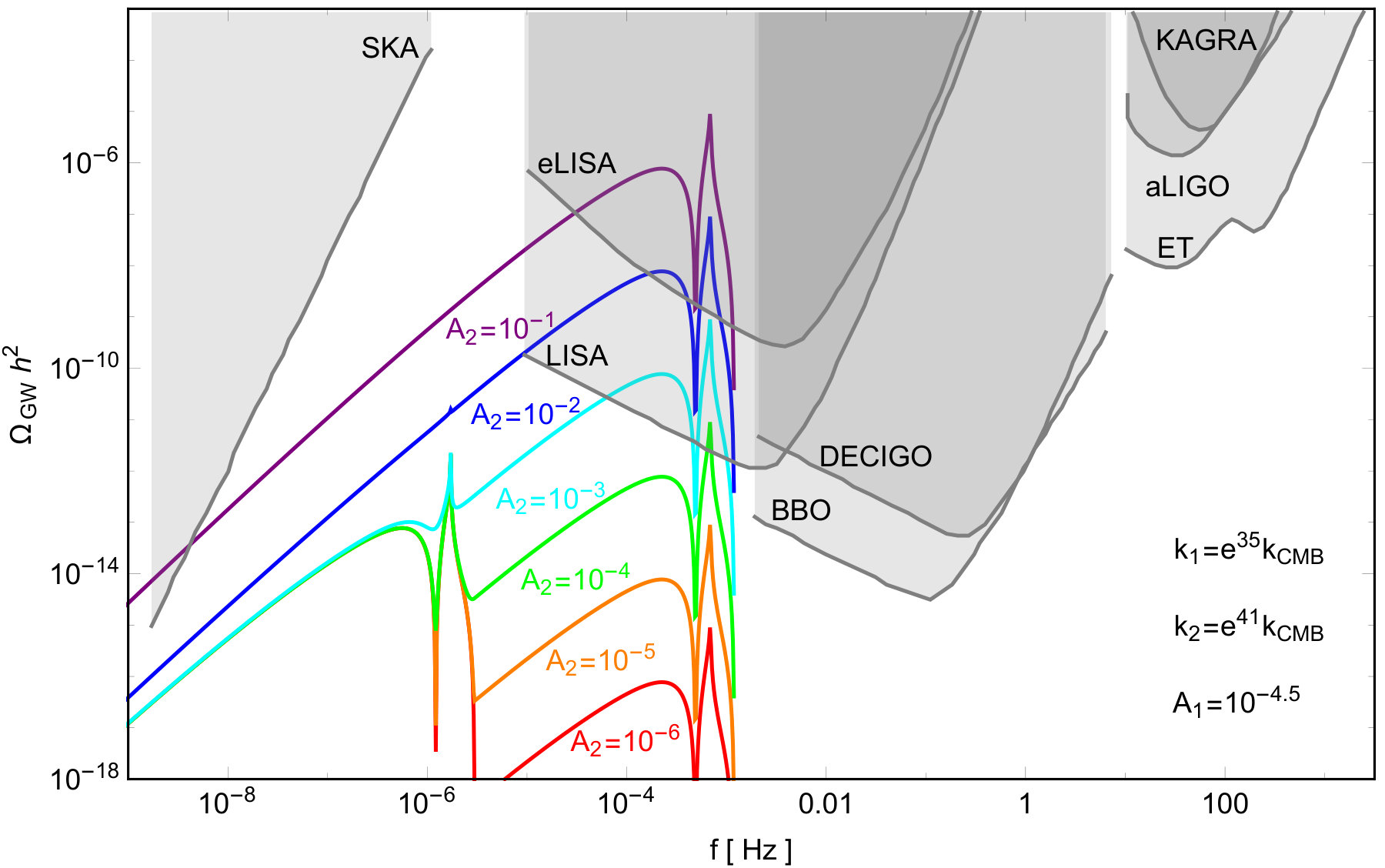 Figure 1
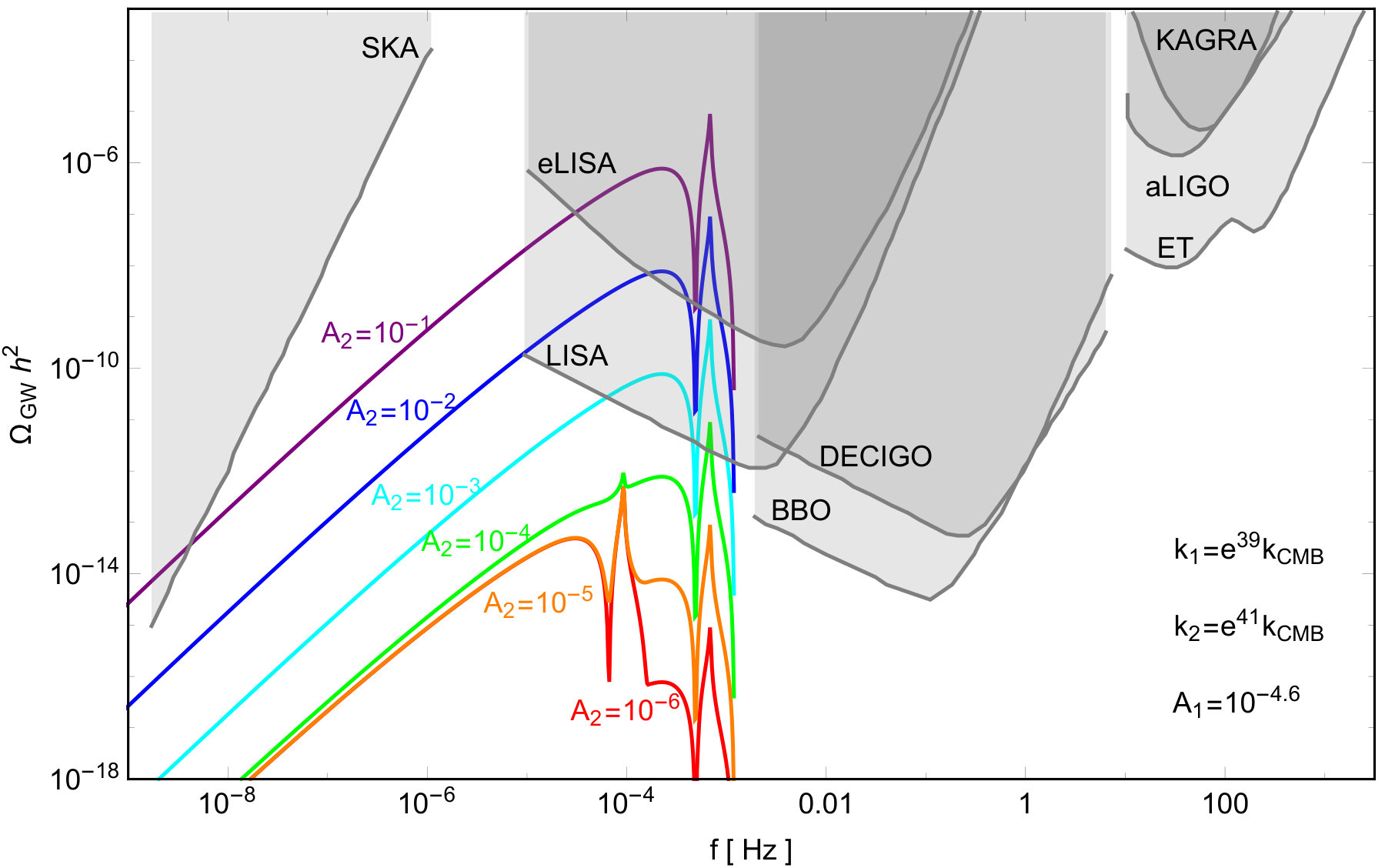 Figure 2
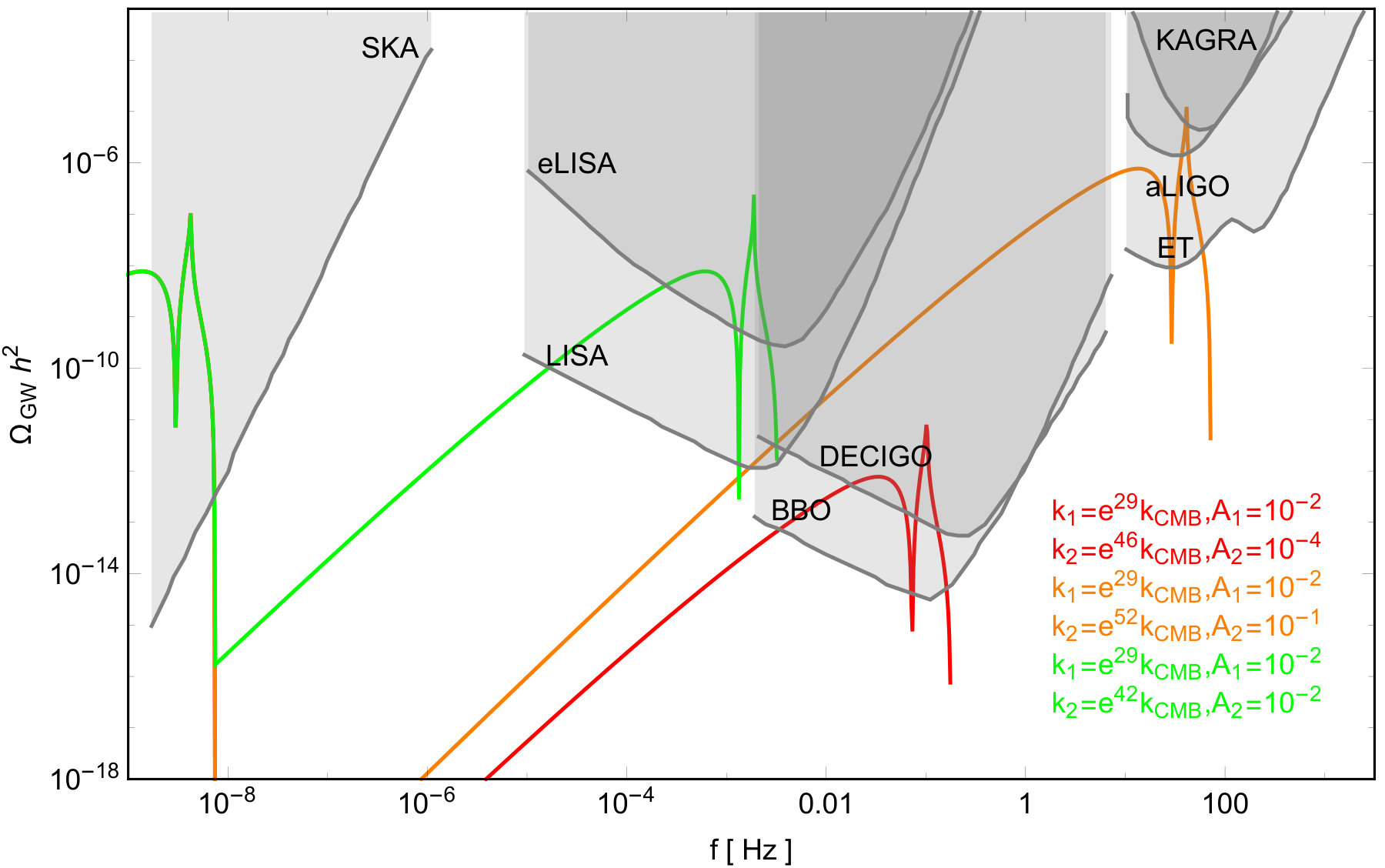 Figure 3
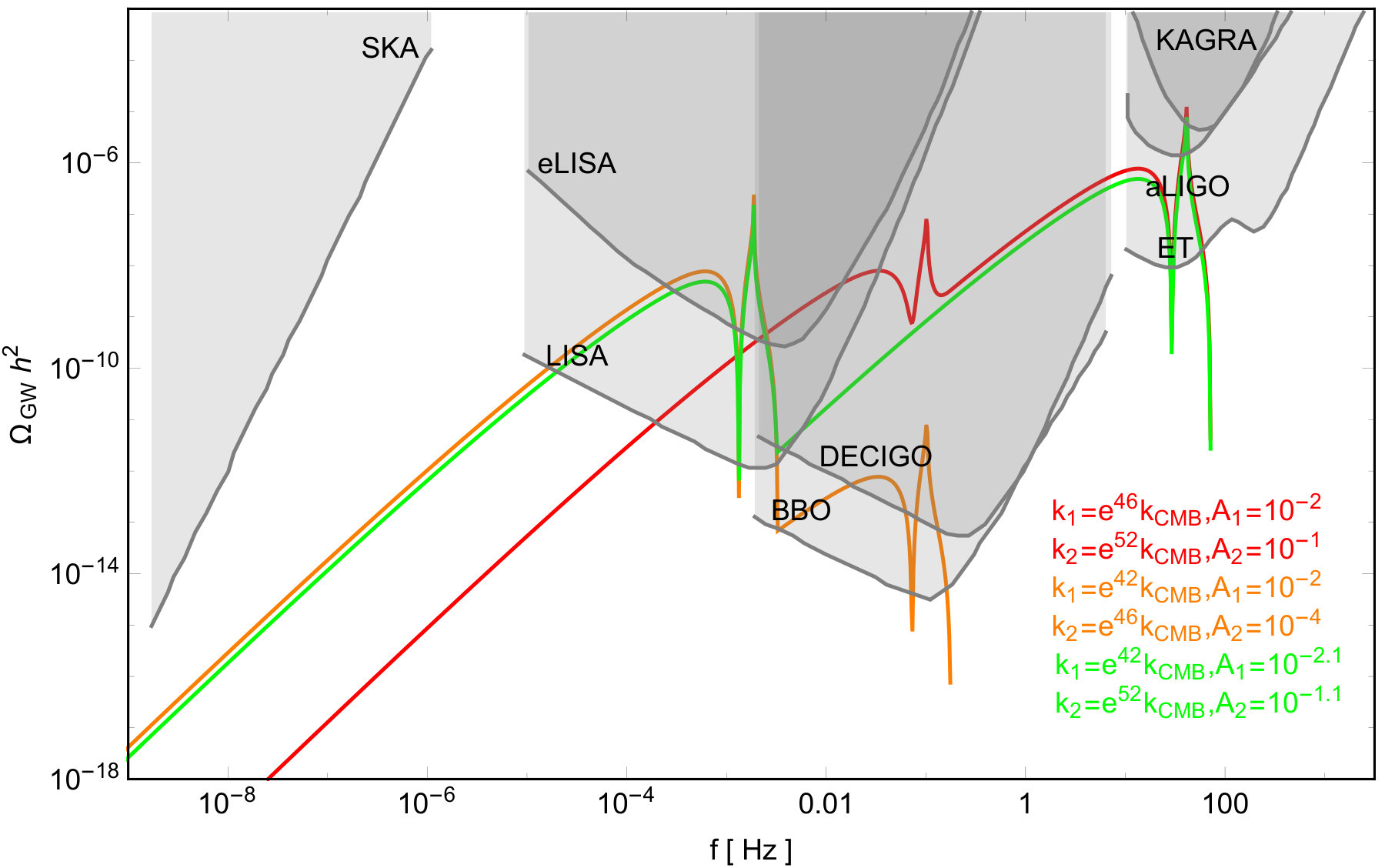 Figure 4
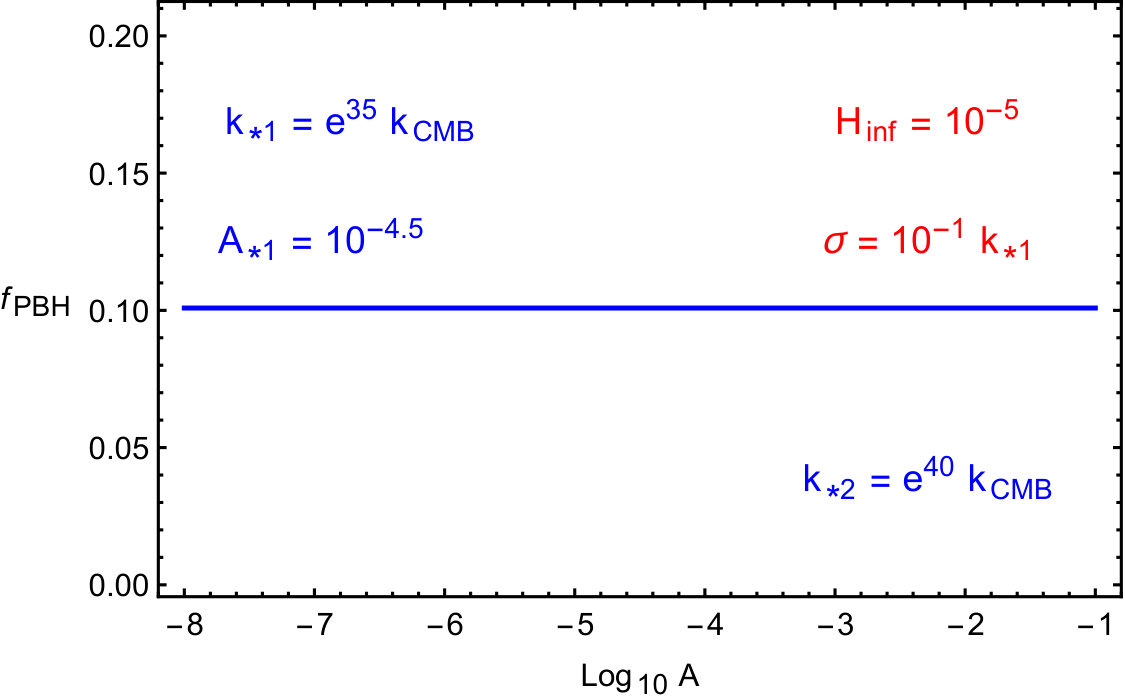 Figure 5
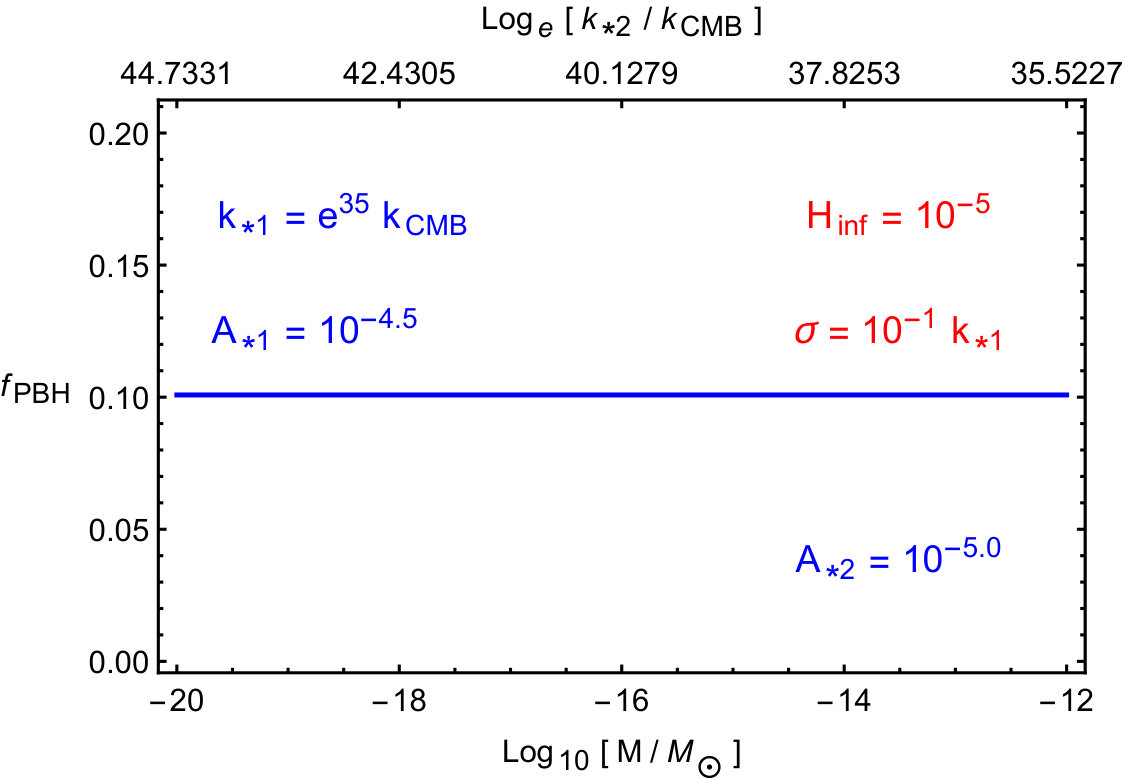 Figure 6
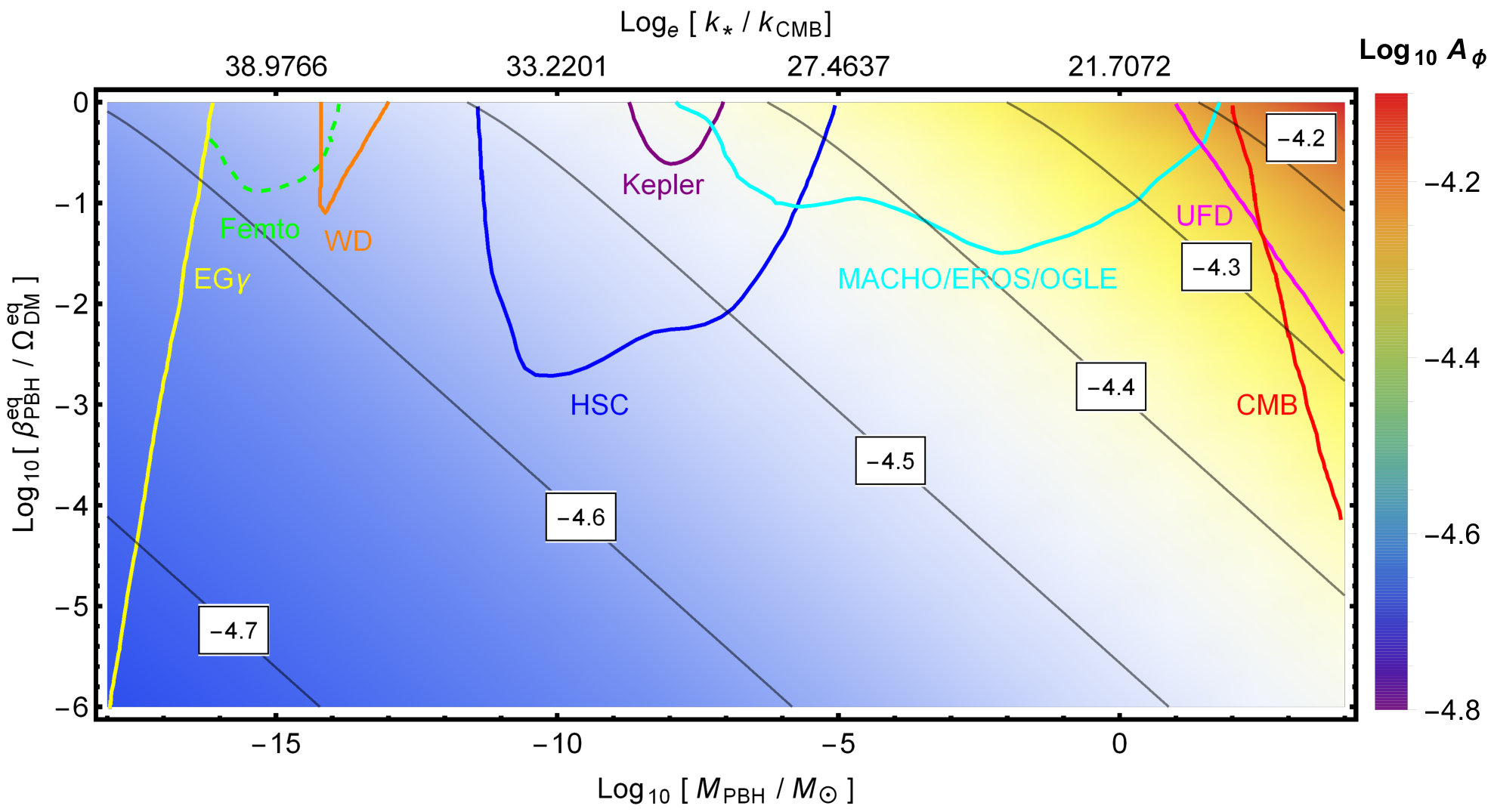 Figure 7
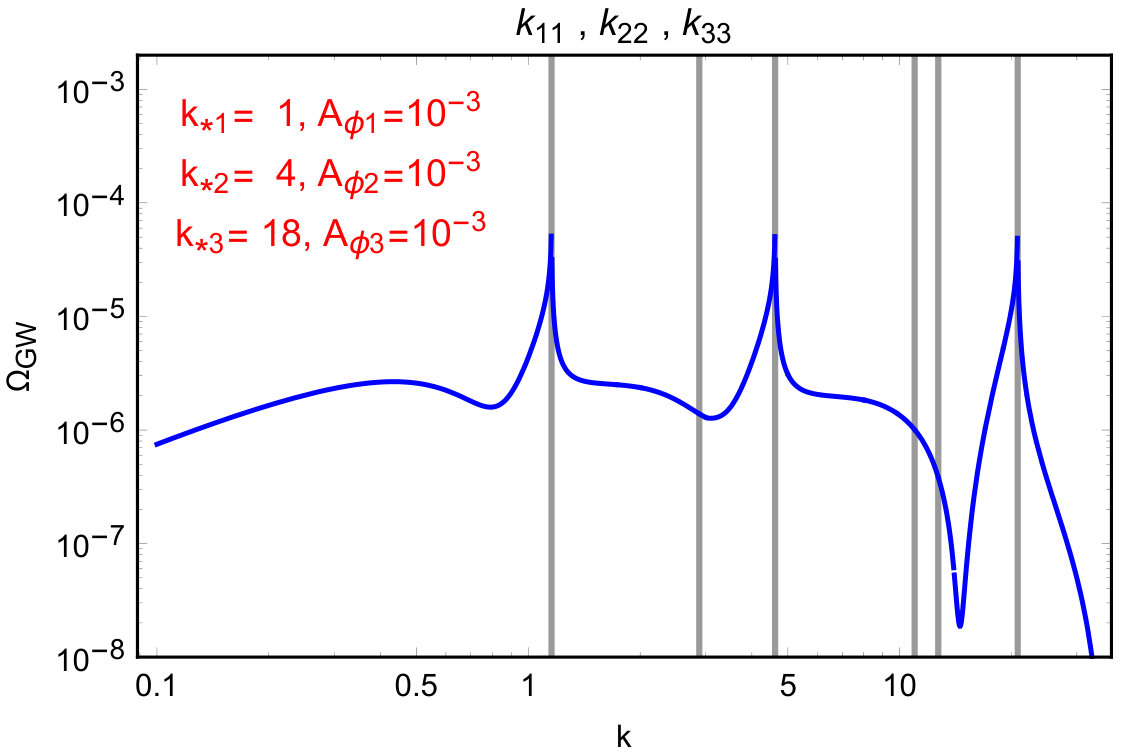 Figure 8
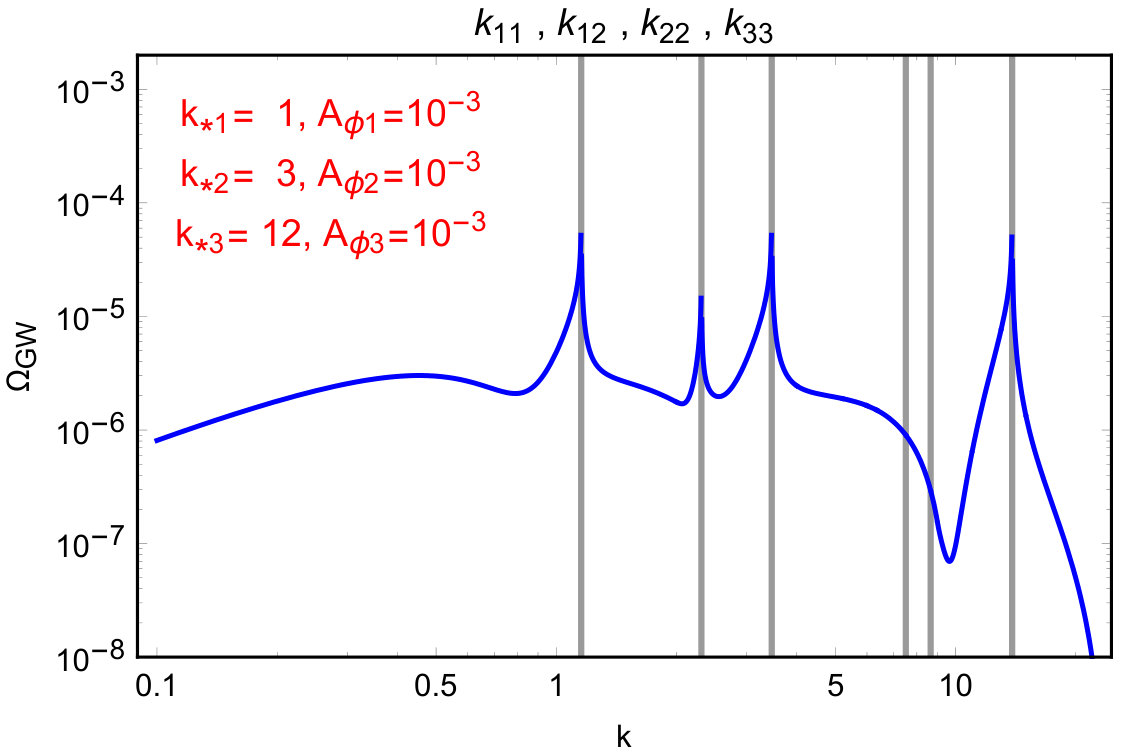 Figure 9
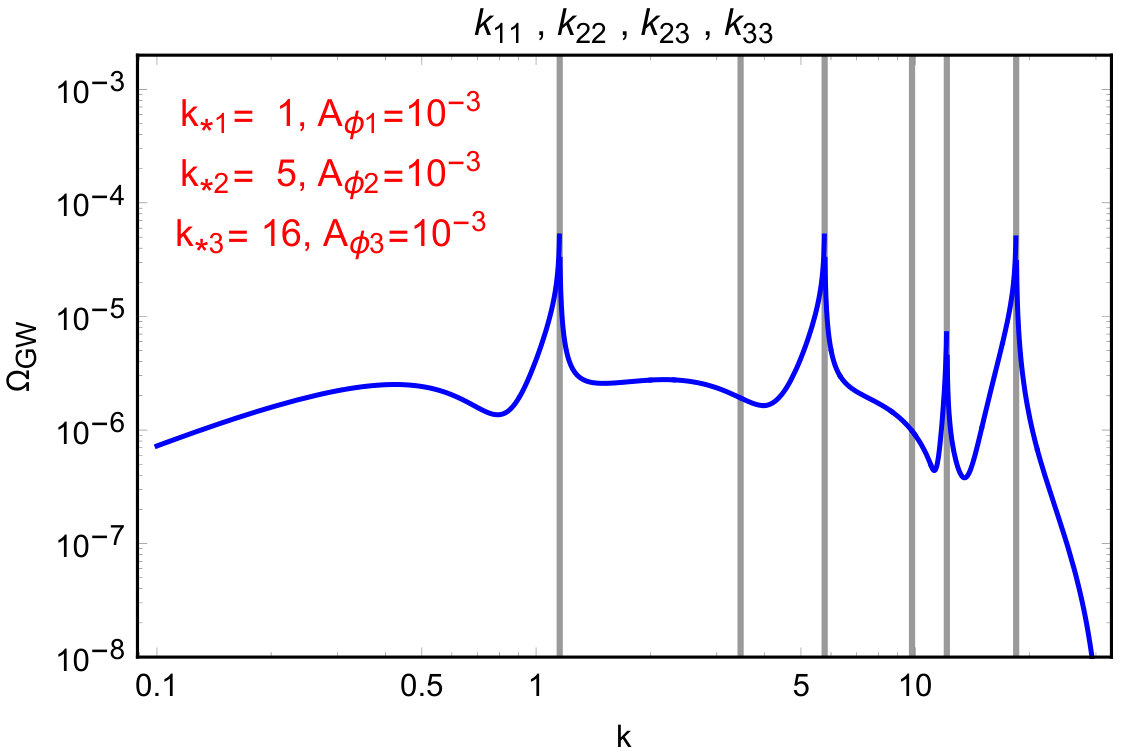 Figure 10
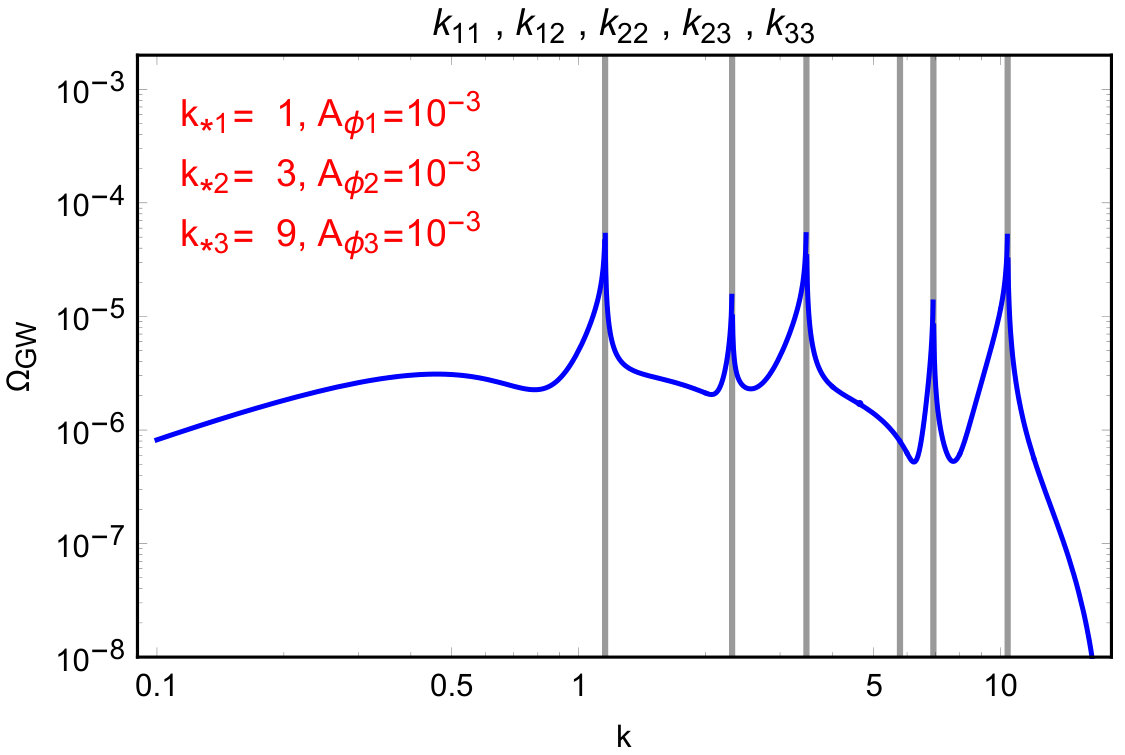 Figure 11
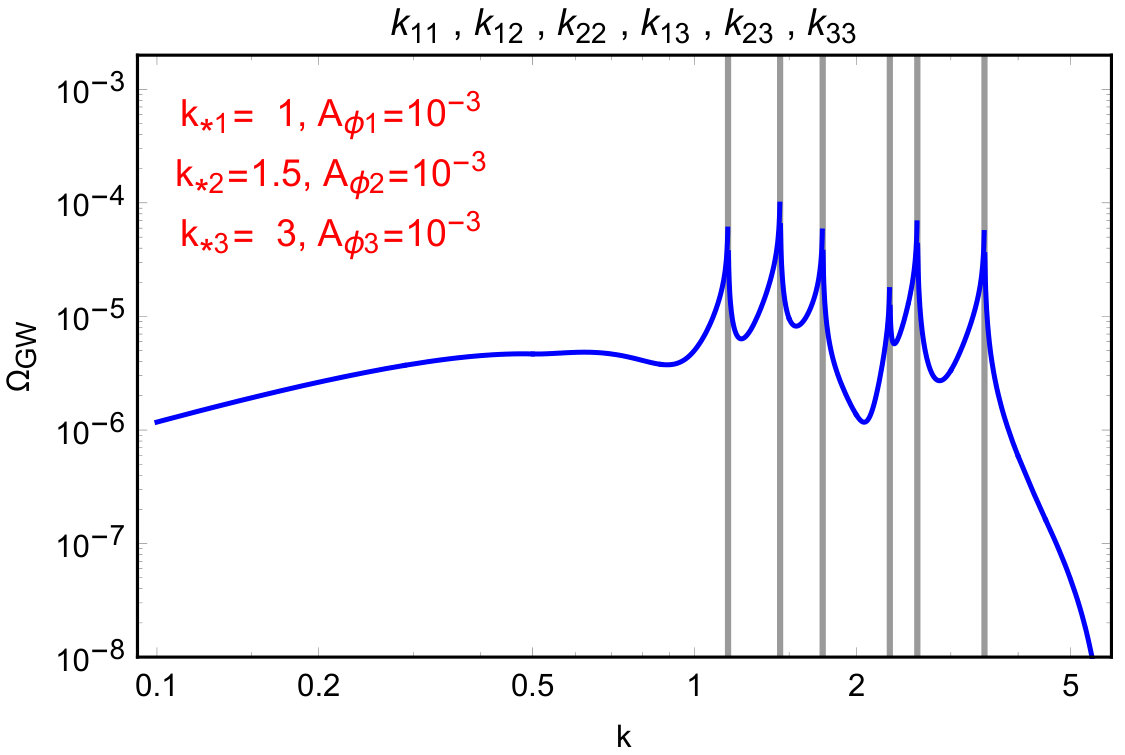 Figure 12
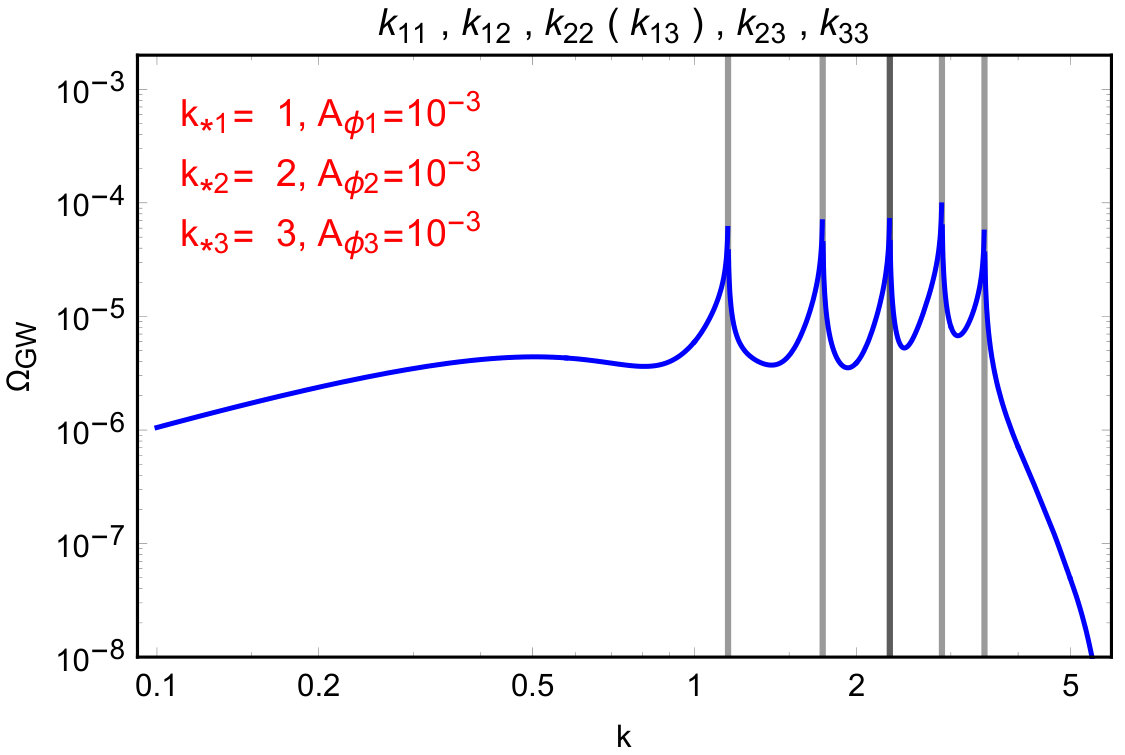 Figure 13
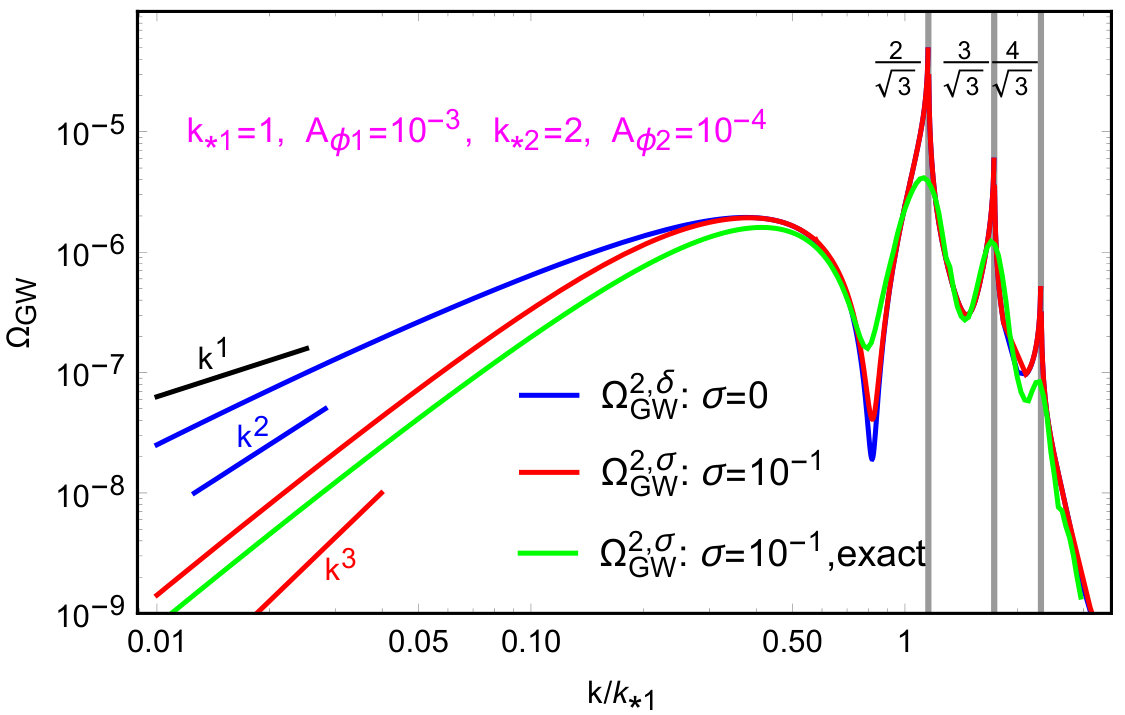 Figure 14
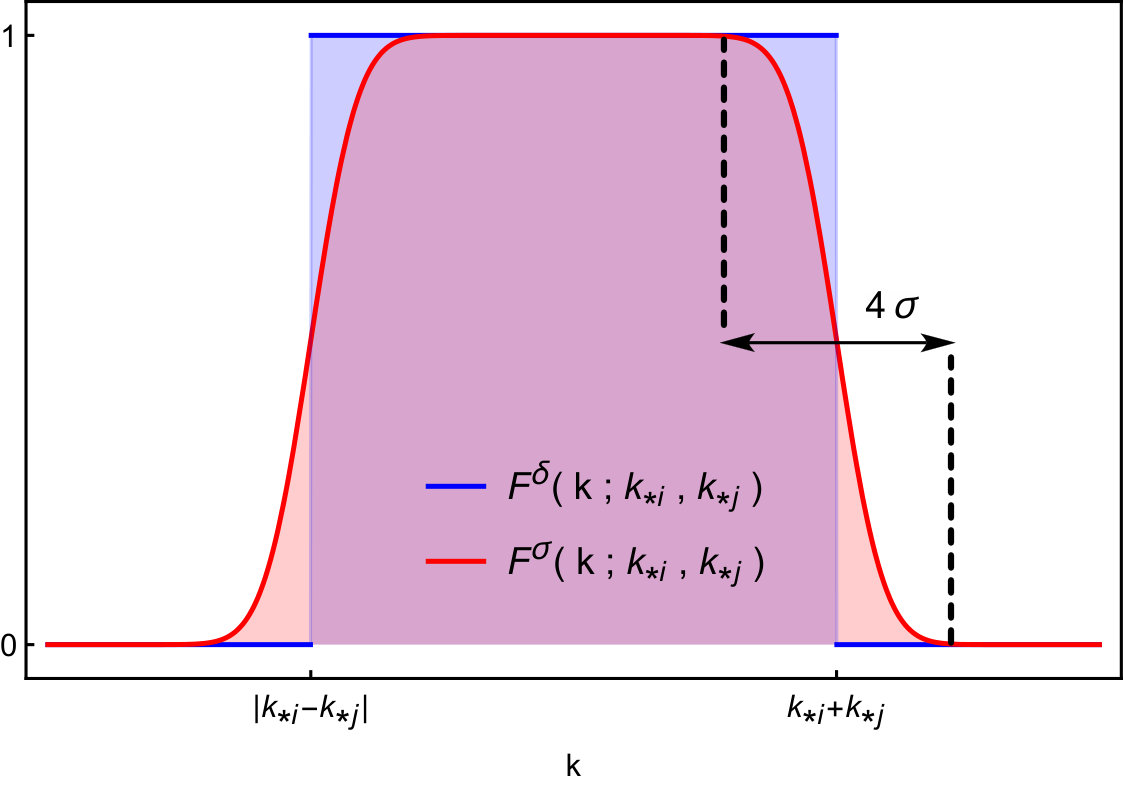 Figure 15
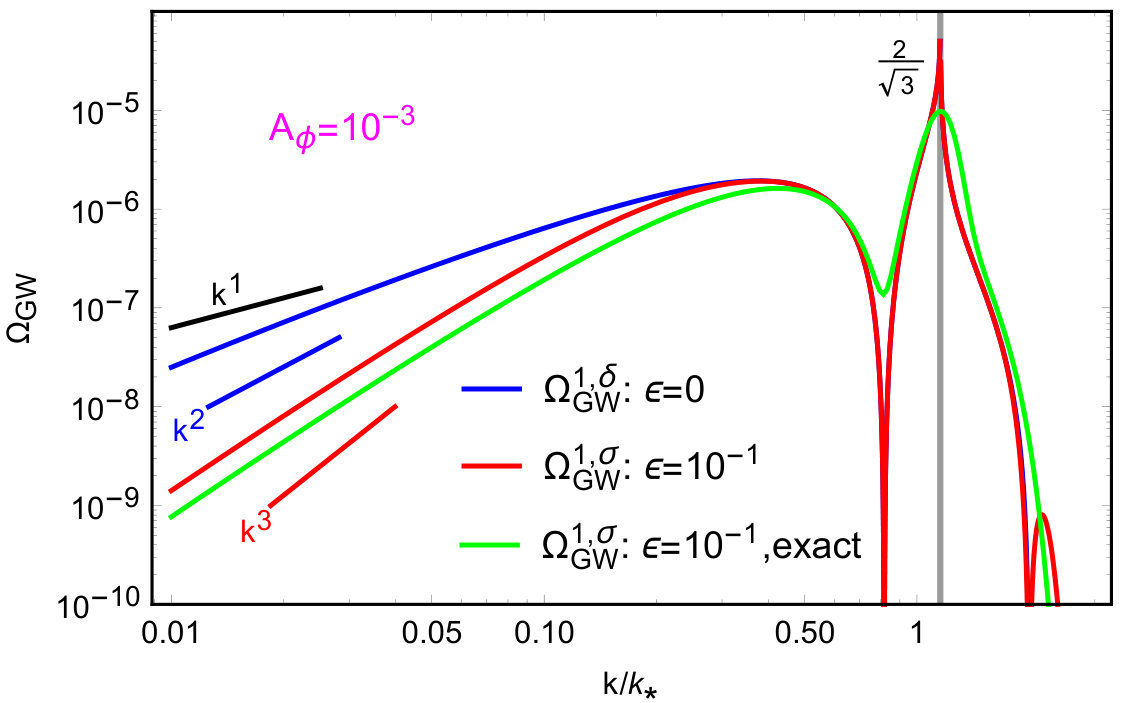 Figure 16
Peer Reviews
No public reviews on file for this paper yet. If you reviewed it on a platform where reviews are public (OpenReview, ICLR, NeurIPS, ICML), you can paste yours below so the community can read it here.
Videos
No videos yet. Explain this paper in a talk, walkthrough, or lecture? Add one.
Resonant multiple peaks in the induced gravitational waves
Rong-Gen Cai
Shi Pi
Shao-Jiang Wang
Xing-Yu Yang
Abstract
We identify analytically a multiple-peak structure in the energy-density spectrum of induced gravitational waves (GWs) generated at second-order from a primordial scalar perturbations also with multiple () peaks at small scales . The energy-density spectrum of induced GWs exhibits at most and at least peaks at wave-vectors due to resonant amplification, and, under the narrow-width approximation, it contains an universal factor that can be interpreted as a result of momentum conservation. We also extend these discussions to the case of non-Gaussian perturbations.
1 Introduction
The current march on the detections of gravitational waves (GWs) with astrophysical origin from compact binary merger[1, 2] has renewed rich perspectives of other sources of GWs preferably from the early Universe[3] that could probe fundamental physics at an unprecedented level[4]. For example, the primordial GWs from inflation era[5] could fix the benchmark scale of inflation[6] and possibly rule out[7] other alternative of cosmological scenarios[8, 9, 10, 11, 12]; the GWs from preheating/reheating era[13, 14] could further constrain the inflation model; the GWs from cosmological first-order phase transition[15, 16] could pave the road beyond the standard model (SM) of particle physics; and the GWs from topological defects[15] such as cosmic string could be the first smoking gun for string theory.
Recently, the renewed interest[17, 18, 19, 20, 21, 22, 23, 24, 25, 26, 27, 28, 29, 30] in the induced GWs from primordial scalar perturbations has drawn a lot of attention. Although the primordial scalar perturbations on large scales have been elaborately probed in a well-established manner[31], the primordial tensor perturbations are still at large from the current scope of detections. Since the primordial tensor perturbations on CMB scales are small due to the current constraint for the tensor-to-scalar ratio [32, 33, 34], it is difficult to be detected in the near future[35, 36, 37, 38]. However, even though the scalar and tensor perturbations are decoupled at first order in perturbation theory, they are coupled at second order and induced GWs could be sourced by two scalar perturbations in the radiation dominated (RD) universe[17, 18]. Furthermore, if the scalar perturbations are peaked at some small scales which will not affect the well-constrained density perturbations on CMB scales, the induced GWs could be large and detectable in pulsar timing array or future interferometers[39, 40, 41, 42, 43, 35, 36, 37, 38, 44, 45]. Such enhanced scalar perturbations at small scales could also lead to the formation of primordial black holes (PBHs) at the horizon reentry of the corresponding wavelengths[46, 47, 48], which could serve as an appealing candidate for dark matter (DM)[49, 50, 51] as well as explaining the large merger rate of binary black holes observed in LIGO detections of GWs[52, 53, 54, 55].
There are many works on the induced GWs recently[21, 22, 23, 24, 25, 28, 30]. [21, 22] investigate the possiblity of detecting the induced GWs from those inflationary models that could also generate PBHs as DM. [23] explores the possibility of detecting the induced GWs from SM due to Higgs meta-stability during inflation. [24] makes a great progress in analytically solving the equation of motion for the induced tensor perturbation. In[25] some of the authors of this paper extrapolate the scalar perturbation to be non-Gaussian, and forecast a distinctive observational perspective in the induced GWs for such non-Gaussianity. They further claim that if PBHs can serve as all the DM in the current affordable window g to g, the induced GWs must be detectable by LISA like interfereometers. [29, 30] further constrain the curvature perturbations at small scales from the induced GWs probed by the existing and planned GW experiments. In these works, we noticed that the shape of the energy-density spectrum of induced GWs is sensitive to the shapes and positions of the peaks in the scalar perturbation. This motivates us to study the GWs induced by multiple peaks, which can be easily generated by inflation model with multiple fields or multiple inflection points[56, 57]. We identify a multiple-peak structure of induced GWs from primordial scalar perturbations with multiple-peak.
The outline for this paper is as follows: In section 2, the formalism of induced GWs is reviewed for the clarity of our notation; In section 3, we obtain the energy-density spectrum of induced GWs from Gaussian scalar perturbations with -peak, and a multiple-peak structure is analytically identified; In section 4, we find the same multiple-peak structure for the energy-density spectrum of induced GWs from Gaussian scalar perturbations with Gaussian peak. In section 5, we further extend our discussion into the case of non-Gaussian scalar perturbations. The section 6 is devoted to conclusion.
2 Induced GWs from Gaussian scalar perturbations
To set the notation, we first review the formalism of induced GWs, and we will follow closely the reference[24].
2.1 Source term
To compute the induced GWs, one starts with the following metric
[TABLE]
where is the conformal time, is the first-order scalar perturbation and is the induced GWs. The first-order GWs, the vector perturbations, and the anisotropic stress ([18, 58, 59] showed its effect turns out to be small) are neglected here. Then the equation of motion for the GWs can be derived from the Einstein equation straightforwardly.
The Fourier transform of GWs is defined as usual by
[TABLE]
where the two time-independent polarization tensors and can be written as
[TABLE]
[TABLE]
and and are orthonormal basis vectors with respect to . The source term is defined as
[TABLE]
where is the equation of state parameter of pressure and energy density , and is the conformal Hubble parameter, and denotes a derivative with respect to conformal time . Then the equation of motion of induced GWs in Fourier space reads
[TABLE]
where
[TABLE]
This equation of motion can be solved by Green’s function method, and the solution is
[TABLE]
where the Green’s function satisfies
[TABLE]
One then splits the Fourier transformation of first-order scalar perturbations into transfer function and primordial fluctuations ,
[TABLE]
so that the transfer function approaches unity well before the horizon entry. Now the source term of the equation of motion can be written as
[TABLE]
where
[TABLE]
[TABLE]
2.2 Power spectrum
The dimensionless power spectrum of GWs is defined by
[TABLE]
and the energy-density spectrum is defined as
[TABLE]
where the two polarization modes have been summed over, and the overline means oscilllation average or time average[60]. The energy-density spectrum denotes the fraction of the GWs energy density in total energy density per unit logarithmic frequency.
In order to get the observationally relevant quantity , one starts with the calculation of the two-point correlation function of ,
[TABLE]
where the reference time hereafter. After defining
[TABLE]
one gets
[TABLE]
Assuming is Gaussian, one can utilize the relation of four-point correlator and two-point correlator
[TABLE]
and the definition of dimensionless power spectrum of primordial scalar perturbations
[TABLE]
to simplify (2.18). One obtains
[TABLE]
Here one introduces three dimensionless variables , and , and compare (2.21) with (2.14). Finally one has [24]
[TABLE]
where
[TABLE]
The time evolution information of power spectrum is contained in the transfer function , which satifies the following constraint equation
[TABLE]
in the absence of entropy perturbations.
2.3 Radiation era
In the RD era, the solution to (2.9) and (2.24) are
[TABLE]
and
[TABLE]
where and .
Since our interset is mainly focused on the GW spectrum observed today, one could take the late-time limit or . Following the methods in[24], one has
[TABLE]
where is defined as
[TABLE]
In the late-time limit, the energy-density spectrum is given by
[TABLE]
where
[TABLE]
3 Toy model with -peak
We start with a toy model where the dimensionless power spectrum of scalar perturbations exhibits multiple -peaks at wave-vectors with proper dimensionless normalization ,
[TABLE]
Hereafter is set to meet .
3.1 Single -peak
The energy-density spectrum of induced GWs from scalar perturbations with a single -peak in power spectrum can be computed directly from
[TABLE]
which, after noting that with , becomes
[TABLE]
namely,
[TABLE]
In the left panel of Fig.1,
the energy-density spectrum of induced GWs from scalar perturbations with a single -peak in power spectrum is presented with blue line. As one can see, there is a peak at wave-vector of , which can be easily found from the pole of , namely, in the logarithmic factor. It is worth noting that the low-frequency growth of is around , consistent with the observations in[25, 29].
3.2 Double -peaks
If there are double -peaks in the power spectrum of scalar perturbations,
[TABLE]
the corresponding energy-density spectrum of induced GWs can be computed directly as
[TABLE]
In the right panel of Fig.1, the energy-density spectrum of induced GWs from scalar perturbations with double -peaks in power spectrum is presented with blue solid line. As one can see, there is a triple-peak structure at around , whose wave-vectors can be inferred from the pole of ,
[TABLE]
i.e.,
[TABLE]
If one further requires and , then the pole of would be simply from the condition . Therefore, for our double -peaks, the three poles of
[TABLE]
are given by the conditions
[TABLE]
respectively, namely,
[TABLE]
A special case is that for our double -peaks in scalar perturbations. The energy-density spectrum of induced GWs would produce the triple-peak structure
[TABLE]
which has the similar structure for GW energy-density spectrum induced by sclar perturbations with a single narrow peak and primordial non-Gaussianities[25].
3.3 Multiple -peaks
The general case of multiple() -peaks in the scalar perturbations
[TABLE]
goes parallel to the double -peaks, and the corresponding energy-density spectrum of induced GWs reads
[TABLE]
namely,
[TABLE]
with peaks given by
[TABLE]
It is worth noting that, there are at most and at least peaks, because some of could be identical for the combination , and some of peaks at vanish due to if . The obtained multiple-peak structure can be understood as resonant amplification, which can be easily seen from the equation of motion (2.6) of form
[TABLE]
here is resonantly amplified when
[TABLE]
For convenience, we introduce here the dubbed wave-vector factor
[TABLE]
that will be interpreted as result of momentum conservation in the next section.
4 Realistic model with -peak
-function peak has infinitesimal width which seems not natural, as usual inflation models predict primordial scalar perturbations with finite peaks. Therefore, we turn to more realistic Gaussian peaks with finite width , dubbed -peak model, which can be parameterized as
[TABLE]
Here, we require that the width of the peak is narrow, i.e. , and is a dimensionless amplitude,
[TABLE]
whose precise value is not of our concern as for our purpose to show.
4.1 Single -peak
Using the rescaled dimensionless parameters and , one can also rewrite the primordial scalar power spectrum as a dimensionless form,
[TABLE]
The energy-density spectrum of induced GWs from scalar perturbations with a single -peak in power spectrum can thus be computed as
[TABLE]
For a sufficiently narrow width of -peak (), the energy-density spectrum of induced GWs can be approximated (narrow-width approximation) as
[TABLE]
After turning to the new variables and , the energy-density spectrum of induced GWs
[TABLE]
can be integrated analytically as
[TABLE]
namely,
[TABLE]
In the vanishing width limit () of -peak,
[TABLE]
the energy-density spectrum of induced GWs (4.8) recovers the result of single -peak as expected,
[TABLE]
Note that the difference of and does not affect the result since .
In the left panel of Fig.1, the energy-density spectrum of induced GWs from a single -peak with width in scalar perturbations is presented as a red solid line, which manifests exactly the same peak structure around the scale as in the case of single -peak. As a comparison, we also present with green solid line the induced GWs from a single -peak with the same width in scalar perturbations but without using the narrow-width approximation (4.5). As one can see, the small-scale peak position remains unchanged but becomes less cuspy, and the slightly suppressed large-scale growth behaves exactly the same -law as found in the case with non-Gaussianity[25].
4.2 Multiple -peaks
Now we generalize above derivation into the case of multiple() -peaks with . The dimensionless power spectrum of scalar perturbation is defined by
[TABLE]
and the corresponding energy-density spectrum of induced GWs from scalar perturbations with such multiple -peaks in power spectrum reads
[TABLE]
For a sufficiently narrow width () and sufficiently distant () -peak, the energy-density spectrum of induced GWs can be approximated (narrow-width approximation) as
[TABLE]
After turning to the new variables and , the GWs energy-density spectrum
[TABLE]
can be integrated analytically as
[TABLE]
namely
[TABLE]
where we have introduced the wave-vector factor of -peak
[TABLE]
showed in the Fig.2 along with previously defined wave-vector factor of -peak.
In the right panel of Fig.1, the energy-density spectrum of induced GWs from scalar perturbations with double -peaks in power spectrum is presented as red solid line. The wave-vectors of peak position are set at and with width and amplitude and , respectively. As one can see, the peak structure of induced GWs is exactly the same as in the case of double -peaks, which also reproduces exactly the same triple-peak structure at the scales observed recently in the case of single -peak in scalar perturbation with non-Gaussianity. We also present with green solid line the induced GWs from double -peaks with the same width in scalar perturbations but without using the narrow-width approximation (4.13). As one can see, the small-scale peak positions remain unchanged but becomes less cuspy, and the slightly suprressed large-scale growth behaves exactly the same -law as found in[25].
4.3 Wave-vector factor
In the vanishing width limit () of -peak, the wave-vector factor can be obviously reduced to the previously defined wave-vector factor , both of which describe some kind of constraint condition on . We will show below that such a constraint of wave-vector factor comes from momentum conservation.
Since the GWs () are induced by the scalar perturbations and there are two scalar perturbations and in the source term of the equation of motion (2.6), the momentum conservation requires
[TABLE]
namely
[TABLE]
where
[TABLE]
For dimensionless power spectrum of scalar perturbations with multiple -peaks,
[TABLE]
the probability density of scalar perturbations with momentum is assumed as
[TABLE]
and then the probability of GWs with momentum can be given by
[TABLE]
Setting and , we have
[TABLE]
which immediately gives rise to
[TABLE]
Similarly, for scalar perturbation with multiple -peaks, we also have
[TABLE]
Therefore, the wave-vector factor of both -peak and -peak can be interpreted as the probability of having wave-vector of GWs to obey the momentum conservation.
5 Induced GWs from non-Gaussian scalar perturbations
The induced GWs from non-Gaussian scalar perturbations with a single peak was studied in[25]. In this section, we take an analytical investigation of GWs induced by multiple peaks of scalar perturbations with non-Gaussianity.
5.1 Energy-density spectrum
In order to get the energy-density spectrum of induced GWs, we start from (2.18). For a non-Gaussian , the four-point correlator can be written as
[TABLE]
since the one-point correlator is zero, where is the connected moment. Note that[61, 62]
[TABLE]
where is a function of different momenta. In comparison to correlators like , the key point of is that, it contains only one overall -function of , which gives
[TABLE]
since now the two integrals on the azimuth angles are independent thus gives zero result. Therefore, the energy-density spectrum of induced GWs can be computed by
[TABLE]
where the (dimensionless) power spectrum for a non-Gaussian is defined as
[TABLE]
5.2 Multiple -peaks
For simplicity, we consider non-Gaussian scalar perturbations with local type non-Gaussianity
[TABLE]
where is the Gaussian perturbation. We get the corresponding (dimensionless) power spectrum
[TABLE]
Then the dimensionless power spectrum reads
[TABLE]
After introducing new variables and , one finds the dimensionless power spectrum of form
[TABLE]
Consider the case of multiple() -peaks in the power spectrum of a non-Gaussian scalar perturbation,
[TABLE]
then the power spectrum (5.10) with non-Gaussianity reads
[TABLE]
Now the product of can be computed directly as
[TABLE]
To obtain the final integral of (5.4), one can compute each term in (5.2). Then, the energy-density spectrum of induced GWs from non-Gaussian scalar perturbations with multiple -peaks can be analytically obtained as
[TABLE]
Here we have introduced the following abbreviations
[TABLE]
and the definition of wave-vector factor
[TABLE]
which come from the momentum conservation as we have discussed in the last section.
6 Conclusions
In this paper, the energy-density spectrum of induced GWs from a Gaussian scalar perturbations is studied analytically in details for two different type of peaks at small scales,
[TABLE]
where and are given by (3.19) and (4.17), respectively. A multiple-peak structure in the energy-density spectrum of induced GWs is analytically identified at , which can be interpreted as a consequence of resonant amplification. Under the narrow-width approximation, the energy-density spectrum of induced GWs contains an universal factor that can be interpreted as the result of momentum conservation. These observations also hold in the case of non-Gaussian scalar perturbations with multiple -peaks, whose analytical expression of energy-density spectrum of induced GWs can be similarly obtained in a compact form.
Acknowledgments
SP and SJW want to thank the Institute of Theoretical Physics of CAS for the hospitality during their visit. RGC is supported by the National Natural Science Foundation of China Grants Nos.11435006, 11647601, 11690022, 11821505, 11851302, and by the Strategic Priority Research Program of CAS Grant No.XDB23030100, and by the Key Research Program of Frontier Sciences of CAS. SP is supported by the MEXT KAKENHI No.15H05888, and by the World Premier International Research Center Initiative (WPI Initiative), MEXT, Japan. SJW is supported by the postdoctoral scholarship of Tufts University.
Appendix A Triple -peaks
We present in Fig.3 all the possible cases of induced GWs from Gaussian scalar perturbations with triple -peaks at , where the gray lines denote the positions of those would-be peaks at
[TABLE]
The purpose of this appendix is to show that, there are at most and at least peaks in the energy-density spectrum. In the first panel, the peaks at position of , and are vanish because they violate the momentum conservation condition , similar cases also occur in the other panels for the vanishing peaks. In the last panel, , which makes these two peaks overlap.
Appendix B Constraints from PBH and GW
So far the peak position and corresponding amplitude of scalar perturbation are left as free parameters, which could be constrained by the current non-detection of PBH. For scalar perturbation with a single -peak at of width , the required peak amplitude for the formation of PBH can be constrained in the mass-fraction plane as shown in the top panel of Fig.4. The details and conventions for this calculation can be found in, e.g.[72](see also[73]), where we have assumed a constant inflationary scale , an illustrative e-folding number , an instantaneous reheating history and a PBH formation threshold [74]. As one can see, there are currently two windows for PBH making up all DM with following choices for the parameters:
[TABLE]
One can also show that the PBH abundance is insensitive to the second peak in the scalar perturbations. To see this, we first fix the position and amplitude of the first peak in the scalar perturbations at . Then one can change separately the position and amplitude of the second peak in the scalar perturbations, respectively. The PBH abundance is unchanged as shown in the bottom panels of Fig.4. The reason for this insensitivity lies in the configuration of peak width for all peaks, then the relative width of second peak is more narrow than the first peak , namely , therefore, the PBH abundance (the area below the curve in the PBH constraint plane) is primarily determined by the first peak in the scalar perturbations. However, the second peak could play a more important role when the width of each peak could be configured separately, which will be explored in future.
Nevertheless, the effect of second peak in the scalar perturbation could manifest itself on the induced GWs, which is illustrated in the Fig.5 for a scalar perturbation with double -peaks. In the first two panels, the first peak of scalar perturbation is fixed to meet the PBH constraint in Fig.4, where the first panel is subjected to the mass window , and the second panel is subjected to the mass window . With increasing amplitude of the second peak in scalar perturbation, the first peak in the induced GWs becomes invisible. In the last two panels that are not subjected to any PBH constraint, both the position and amplitude of each peak of scalar perturbation are free to choose so that the resulting induced GWs could overlap with each sensitivity range of all GW detectors.
The reference list from the paper itself. Each links out to its DOI / PubMed record.
- 1[1] Virgo, LIGO Scientific collaboration, B. P. Abbott et al., Observation of Gravitational Waves from a Binary Black Hole Merger , Phys. Rev. Lett. 116 (2016) 061102 , [ 1602.03837 ]. · doi ↗
- 2[2] Virgo, LIGO Scientific collaboration, B. Abbott et al., GW 170817: Observation of Gravitational Waves from a Binary Neutron Star Inspiral , Phys. Rev. Lett. 119 (2017) 161101 , [ 1710.05832 ]. · doi ↗
- 3[3] C. Caprini and D. G. Figueroa, Cosmological Backgrounds of Gravitational Waves , Class. Quant. Grav. 35 (2018) 163001 , [ 1801.04268 ]. · doi ↗
- 4[4] R.-G. Cai, Z. Cao, Z.-K. Guo, S.-J. Wang and T. Yang, The Gravitational-Wave Physics , National Science Review 4 (2017) 687–706 , [ 1703.00187 ]. · doi ↗
- 5[5] C. Guzzetti, M., N. Bartolo, M. Liguori and S. Matarrese, Gravitational waves from inflation , Riv. Nuovo Cim. 39 (2016) 399–495 , [ 1605.01615 ]. · doi ↗
- 6[6] N. Bartolo et al., Science with the space-based interferometer LISA. IV: Probing inflation with gravitational waves , JCAP 1612 (2016) 026 , [ 1610.06481 ]. · doi ↗
- 7[7] L. A. Boyle, P. J. Steinhardt and N. Turok, The Cosmic gravitational wave background in a cyclic universe , Phys. Rev. D 69 (2004) 127302 , [ hep-th/0307170 ]. · doi ↗
- 8[8] M. Gasperini and G. Veneziano, The Pre - big bang scenario in string cosmology , Phys. Rept. 373 (2003) 1–212 , [ hep-th/0207130 ]. · doi ↗