
TL;DR
This paper demonstrates that for any given group, there exists a 4-manifold with that fundamental group whose trisection genus attains the lower bound established by Chu and Tillmann, advancing understanding of 4-manifold topology.
Contribution
It constructs 4-manifolds with prescribed fundamental groups that achieve the minimal possible trisection genus according to Chu and Tillmann's bound.
Findings
Existence of 4-manifolds with any fundamental group and minimal trisection genus
Validation of Chu-Tillmann's lower bound as sharp
Contribution to classification of 4-manifolds by genus and fundamental group
Abstract
In 2018, M. Chu and S. Tillmann gave a lower bound for the trisection genus of a closed 4-manifold in terms of the Euler characteristic of and the rank of its fundamental group. We show that given a group , there exist a 4-manifold with fundamental group with trisection genus achieving Chu-Tillmann's lower bound.
Click any figure to enlarge with its caption.
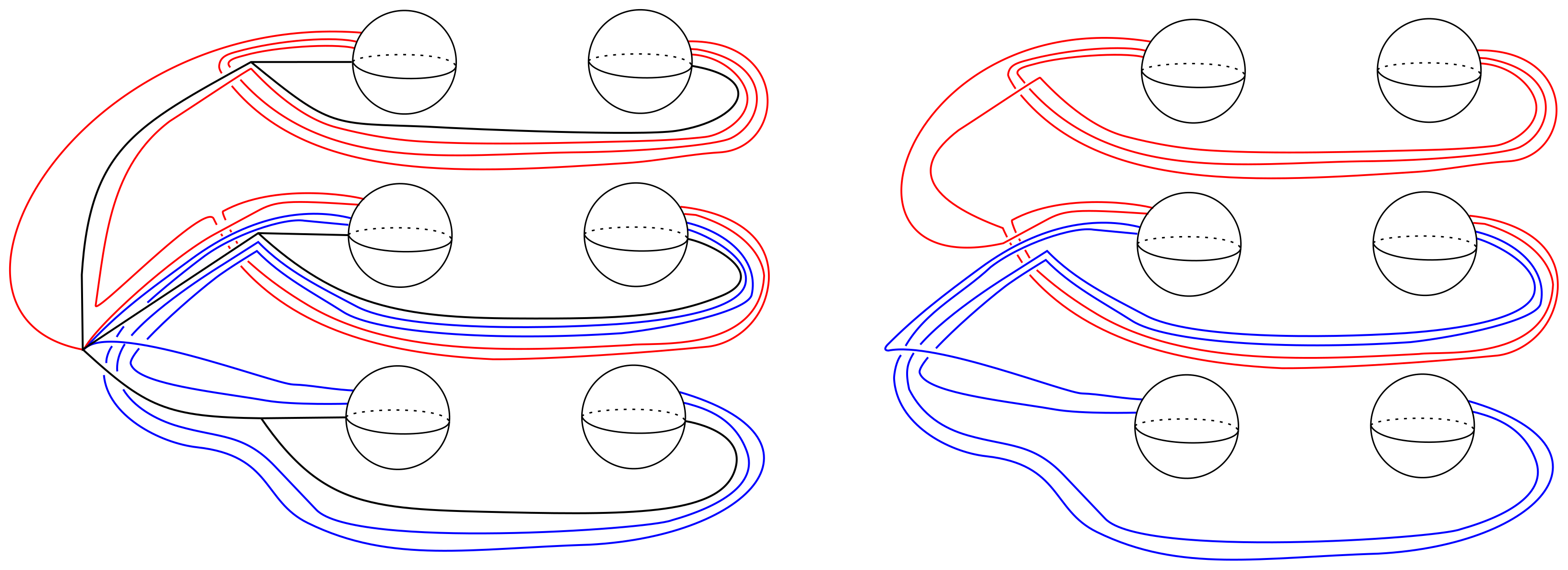 Figure 1
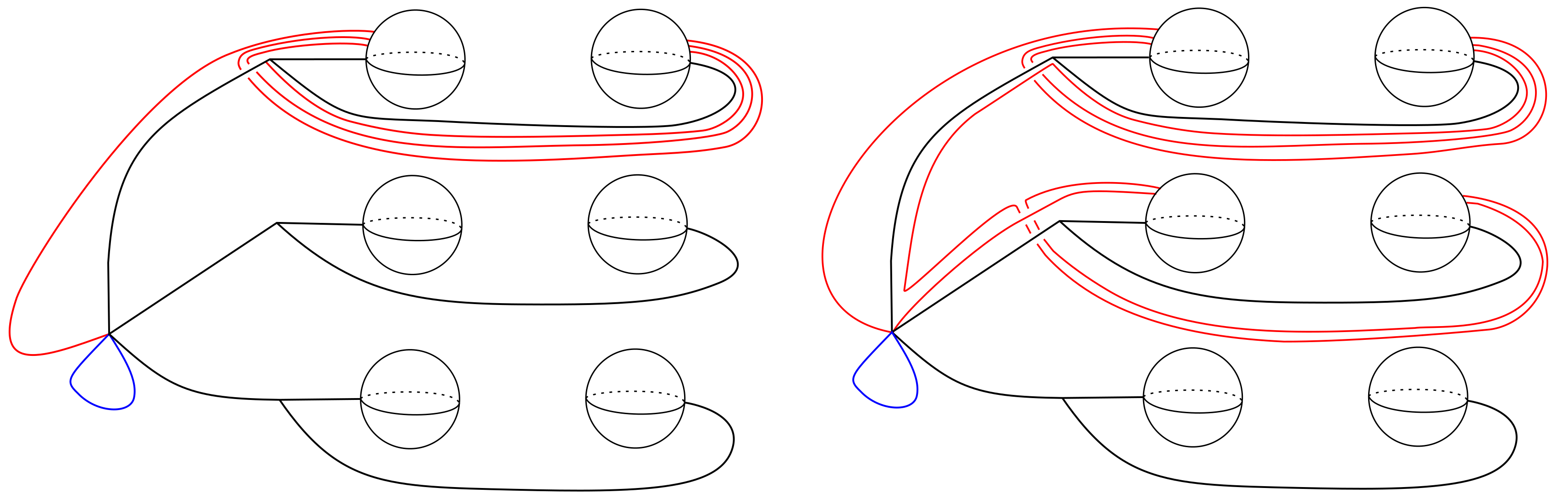 Figure 2
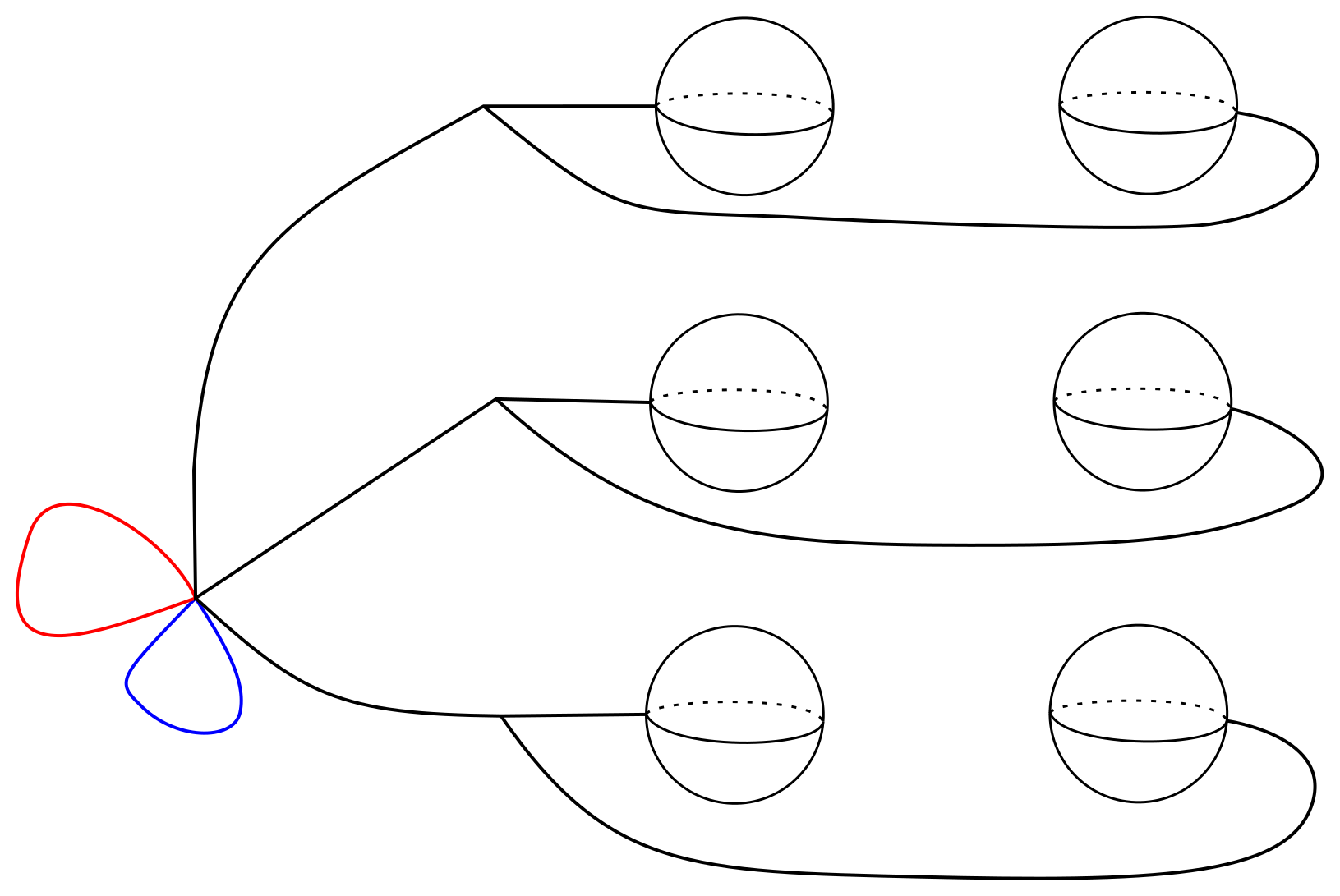 Figure 3
Peer Reviews
No public reviews on file for this paper yet. If you reviewed it on a platform where reviews are public (OpenReview, ICLR, NeurIPS, ICML), you can paste yours below so the community can read it here.
Videos
No videos yet. Explain this paper in a talk, walkthrough, or lecture? Add one.
Taxonomy
TopicsGeometric and Algebraic Topology · Advanced Combinatorial Mathematics · Homotopy and Cohomology in Algebraic Topology
Minimal genus four manifolds
Román Aranda
January 2019
Abstract
In 2018, M. Chu and S. Tillmann gave a lower bound for the trisection genus of a closed 4-manifold in terms of the Euler characteristic of and the rank of its fundamental group. We show that given a group , there exist a 4-manifold with fundamental group with trisection genus achieving Chu-Tillmann’s lower bound.
1 Introduction
Let be a smooth, oriented, closed 4-manifold. D. Gay and R. Kirby showed in [2] that can be written as the union of three 4-dimensional 1-handlebodiesiiiA 1-handlebody of dimension four is a 4-ball with 1-handles attached along its boundary; i.e. . of genus , and , respectively; with pairwise intersections 3-dimensional connected handlebodies and triple intersection a connected surface of genus . This is called a trisection of . The trisection genus of a 4-manifold , denoted by , is the smallest such that admits a trisection.
Let be a trisection of ; i.e. . Each 1-handlebody can be used to span the fundamental group and the first homology of . In [1], M. Chu and S. Tillmann used this to give a lower bound to the trisection genus of a closed 4-manifold. They showed that if admits a trisection then
[TABLE]
Question 1** (From [1]).**
Given any finitely presented group , is there a smooth, oriented closed 4-manifold with such that ?
In this note, we will give a positive answer of Question 1.
Fix a finitely presented group . We divide the answer in two steps as follows: (1) We state an equivalent version of Question 1 in terms of Kirby diagrams of closed 4-manifolds, which translates into a knot theory problem; and then (2) we show the existence of a special type of links.
Along this note, all 4-manifolds will be smooth, oriented and compact. For a link in a 3-manifold , will denote the tunnel number of in . We will omit the sub-index if there is no confusion of the ambient manifold.
2 The proof
Let be a closed 4-manifold and be a trisection of . In [1], M. Chu and S. Tillmann showed the inequality
[TABLE]
Since and for , equality of Equation (1) is equivalent to
[TABLE]
The following lemma is an application of Lemmas 13 and 14 of [2]. It shows that Question 1 is equivalent to finding links with the correct homotopy class and “small” tunnel number.
Lemma 2.1**.**
Let be a finitely presented group of rank . The following are equivalent:
- (a)
There is a smooth, oriented closed 4-manifold with such that
[TABLE] 2. (b)
There is a smooth, oriented closed 4-manifold with having a handle decomposition with one 0-handle, 1-handles, 2-handles, 3-handles and one 4-handle such that the attaching region of the 2-handles is a link in of tunnel number . 3. (c)
There is a link in of tunnel number at most such that the link , thought of as a set of homotopy classes of loops based at a point, gives relations for a rank group presentation for .
Proof.
(a) (b). Let be a 4-manifold with such that . Let be a trisection with . In particular, satisfies Equation (2); i.e., is a trisection of . Lemma 13 of [2] asserts that admits a handle decomposition with one 0-handle, 1-handles, 2-handles, 3-handles and one 4-handle such that the attaching region of the 2-handles is a framed link contained in the core of one of the handlebodies of a genus Heegaard splitting for . In particular, . The latter must be an equality since Proposition 4.2 of [4] states that admits a new -trisection and will give us ; contradicting the fact that . Hence and, (b) holds taking .
(b) (a). Let be a 4-manifold satisfying (b) with the given handlebody decomposition. By taking the tubular neighborhood of the attaching region of the 2-handles and the tunnels, we obtain a Heegaard surface for of genus satisfying the assumptions of Lemma 14 of [2]. By the lemma, admits a -trisection. In particular, Equation (2) holds and Equation (1) becomes an equality, thus (a).
(b) (c). Take to be the attaching region of the 2-handles.
(c) (b). Let be such link and let be any fixed vector. Consider to be the smooth 4-manifold with a handle decomposition given by one 0-handle, 1-handles and 2-handles attached along with framing with respect to the blackboard. Take to be the double of . By assumption, and so . Turning the handle decomposition of upside-down gives a handle decomposition with one 0-handle, 1-handles, 2-handles, 3-handles and one 4-handle, where half of the 2-handles are attached along and for each component of there is a 0-framed unknot linked once along the given component and unlinked from the rest of the diagram.
Let be the attaching region for the 2-handles of . Notice that
[TABLE]
By a version of Lemma 14 of [2] for unbalanced trisections (see Proposition 4.2 of [4]), admits a trisection. Using Equation (1) with we obtain
[TABLE]
Thus, and is the desired 4-manifold. Hence (b). ∎
Remark 2.2**.**
We have shown in Lemma 2.1 that to answer Question 1 in the positive, is enough to find a link in with tunnel number at most such that the homotopy classes of the components of , together, read a rank presentation for the given group . The closed 4-manifold answering Question 1 will be the double of a 4-manifold with a Kirby diagram with 1-handles and 2-handles attached along with any framing.
The following proposition shows how to build links satisfying (c) in Lemma 2.1.
Proposition 2.3**.**
Let be a finitely presented group of rank with a presentation . There exists an -component link in with tunnel number at most such that the words read by the components of in agree with the words in .
Corollary 2.4**.**
Given a finitely presented group , there is a closed 4-manifold with fundamental group isomorphic to satisfying .
Proof of Proposition 2.3.
Take an unknotted graph in made by loops, denoted by , generating and unknotted loops around a neighborhood of ; see Figure 1. For each relation , take the -th unknotted circle and slide one of its ends along the loops on so that now reads the word as an element of . Each component of will be a circle , and the rest of the graph can be homotoped to be a system of tunnels for .
We have described how to build a link in with . ∎
The following figures ilustrate the construction of for the group .
Remark 2.5**.**
Note that the knot type of the link doesn’t change the final 4-manifold built in Corollary 2.4. This happens since, when taking double of the 4-manifold, the 0-framed unknots around each component of allow us to slide the handlebody 2-handles and so to change the crossings of the link. The same reason explains why we only care about the framing of the components of modulo . In any case, one can consider connected sums of our manifolds with copies of and to build infinitely many 4-manifolds solving Question 1.
One of the two 4-manifolds appearing when running the construction with finite cyclic groups is the spun lens space trisected by J. Meier in [3]. One can check this by comparing the Kirby diagram we construct with the one drawn by J. Montesinos in [5].
The reference list from the paper itself. Each links out to its DOI / PubMed record.
- 1[1] Chu, M., & Tillmann, S. Reflections on trisection genus. ar Xiv preprint ar Xiv:1809.04801, 2018.
- 2[2] Gay, David, and Robion Kirby. Trisecting 4–manifolds. Geometry & Topology 20.6 (2016): 3097-3132.
- 3[3] Meier, Jeffrey. Trisections and spun 4-manifolds. ar Xiv preprint ar Xiv:1708.01214, 2017.
- 4[4] Meier, Jeffrey, Trent Schirmer, and Alexander Zupan. Classification of trisections and the generalized property R conjecture. Proceedings of the American Mathematical Society 144.11 (2016): 4983-4997.
- 5[5] Montesinos, José María. “Heegaard diagrams for closed 4-manifolds.” Geometric Topology. 1979. 219-237.