A Micro-Simulation Study of the Generalized Proportional Allocation Traffic Signal Control
Gustav Nilsson, Giacomo Como

TL;DR
This study evaluates the effectiveness of the Generalized Proportional Allocation (GPA) traffic signal controller through micro-simulation, demonstrating its advantages over static and MaxPressure controllers in various scenarios.
Contribution
The paper introduces and tests discretized versions of the GPA controller in realistic traffic simulations, showing its practical implementation and performance benefits.
Findings
GPA outperforms static controllers in Luxembourg scenario.
GPA performs better than MaxPressure at low demands in Manhattan grid.
Discretized GPA versions are feasible for real-world implementation.
Abstract
In this paper, we study the problem of determining phase activations for signalized junctions by utilizing feedback, more specifically, by measure the queue-lengths on the incoming lanes to each junction. The controller we are investigating is the Generalized Proportional Allocation (GPA) controller, which has previously been shown to have desired stability and throughput properties in a continuous averaged dynamical model for queueing networks. In this paper, we provide and implement two discretized versions of the GPA controller in the SUMO micro simulator. We also compare the GPA controllers with the MaxPressure controller, a controller that requires more information than the GPA, in an artificial Manhattan-like grid. To show that the GPA controller is easy to implement in a real scenario, we also implement it in a previously published realistic traffic scenario for the city of…
Click any figure to enlarge with its caption.
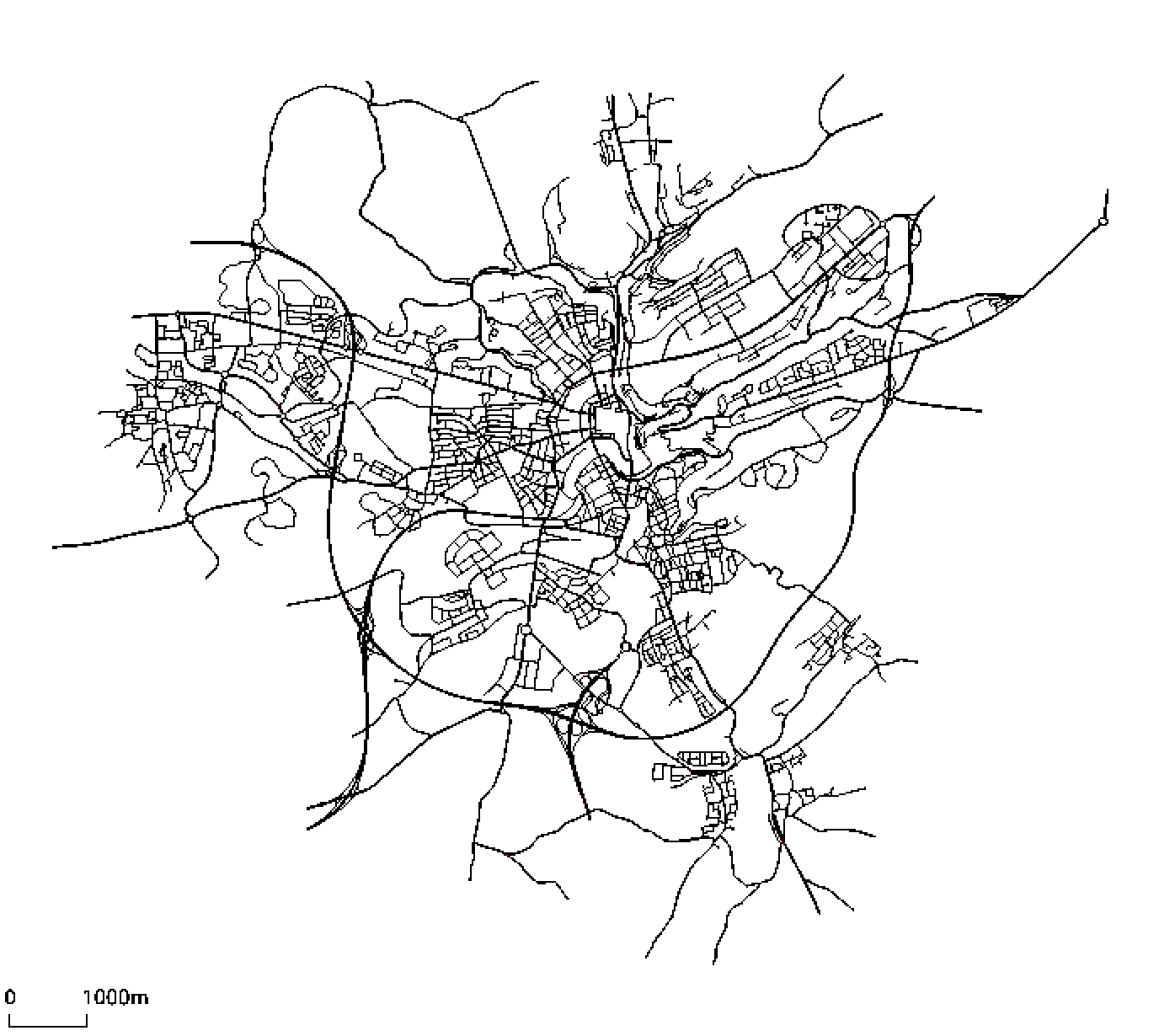 Figure 1
 Figure 2
 Figure 3
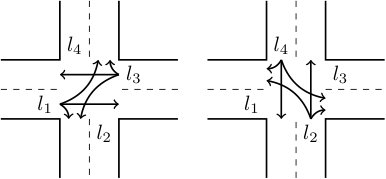 Figure 0
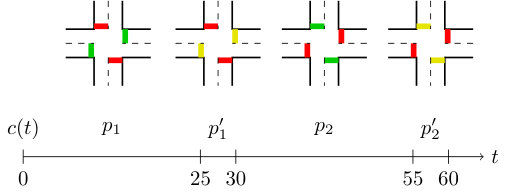 Figure 1
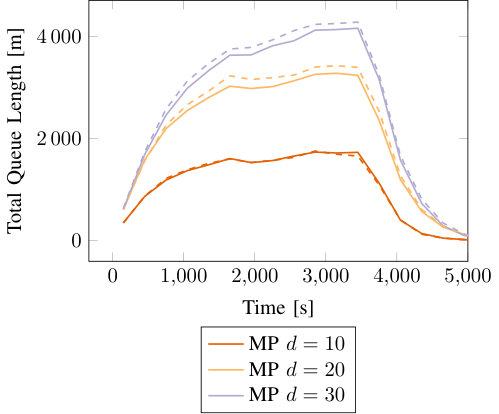 Figure 10
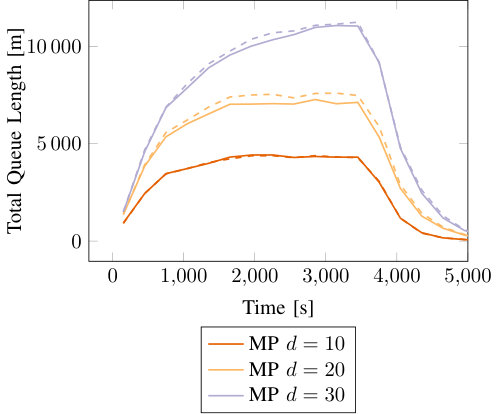 Figure 11
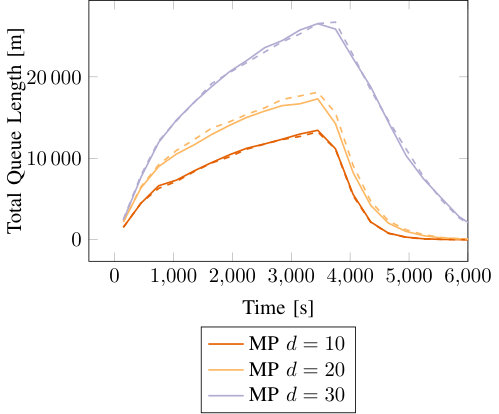 Figure 12
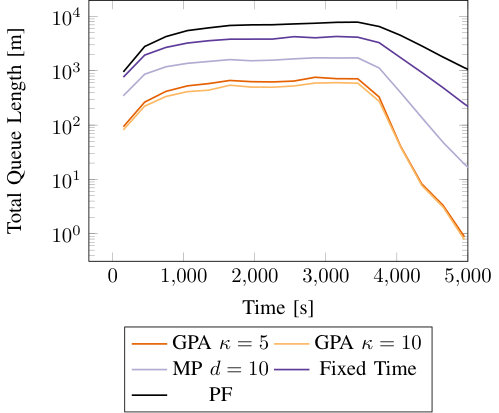 Figure 13
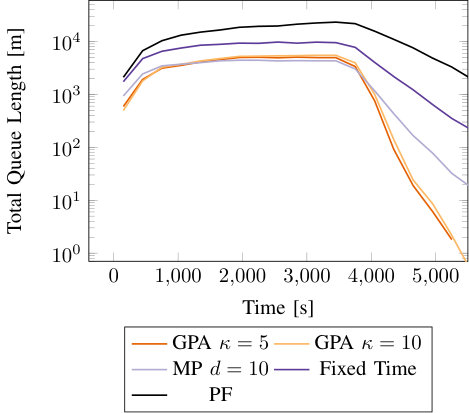 Figure 14
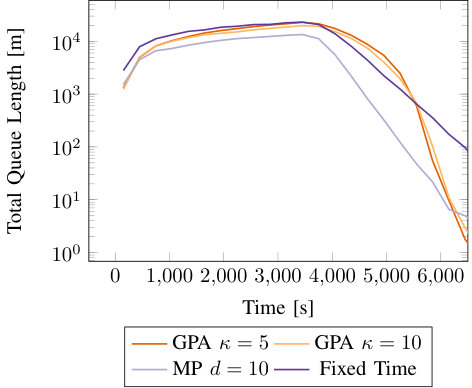 Figure 15
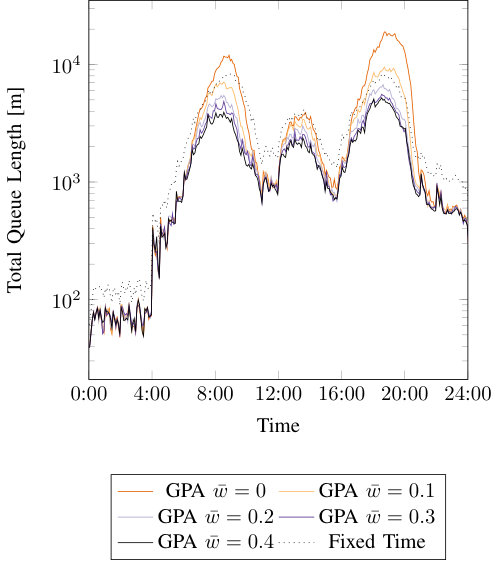 Figure 16
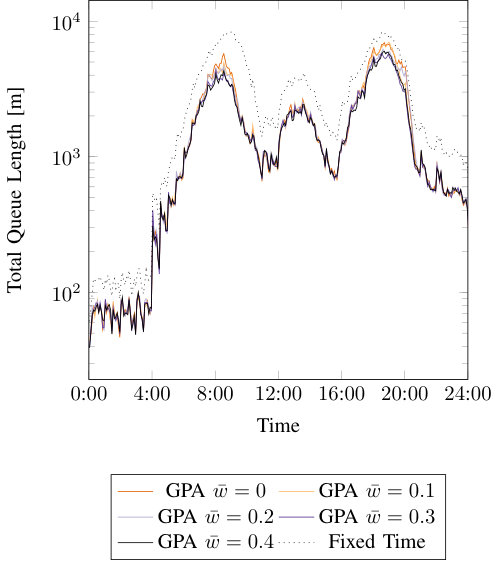 Figure 17
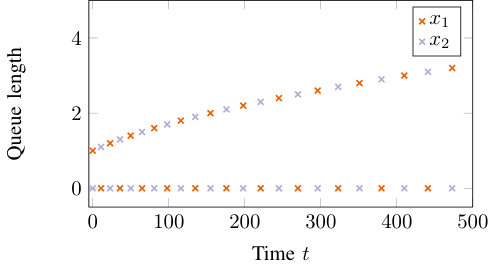 Figure 2
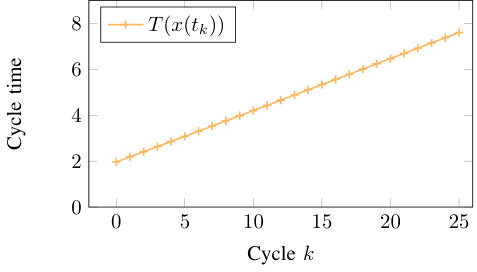 Figure 3
 Figure 4
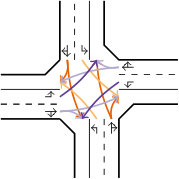 Figure 5
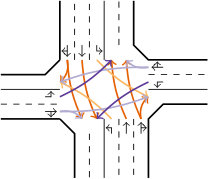 Figure 6
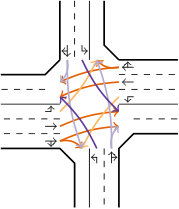 Figure 7
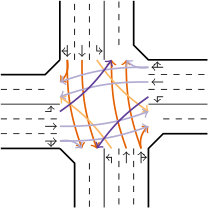 Figure 8
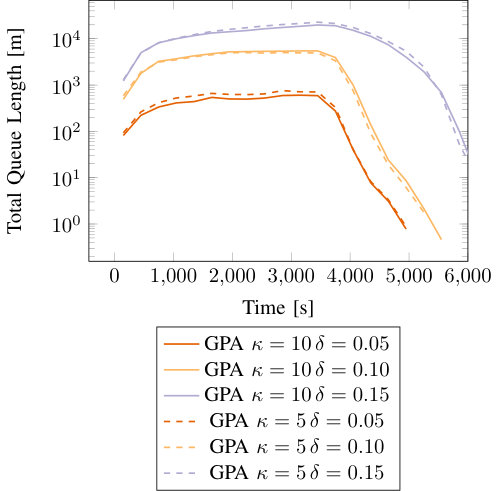 Figure 9
| Total Travel Time [h] | ||
|---|---|---|
| 0 | ||
| 0 | ||
| 0 | ||
| 0 | ||
| TTT correct TR [h] | TTT incorrect TR [h] | ||
|---|---|---|---|
| 858 | 856 | ||
| 1 079 | 1 102 | ||
| 1 172 | 1 193 | ||
| 1 865 | 1 864 | ||
| 2 254 | 2 312 | ||
| 2 690 | 2 718 | ||
| 3 511 | 3 488 | ||
| 3 992 | 4 102 | ||
| 5 579 | 5 590 |
| Controller | Total Travel Time [h] | |
|---|---|---|
| FT | ||
| FT | ||
| FT | ||
| PF | ||
| PF | ||
| PF |
| Teleports (jam) | Total Travel Time [h] | |||
|---|---|---|---|---|
| GPA | 76 (6) | 49 791 | ||
| GPA | 65 (1) | 49 708 | ||
| GPA | 37 (0) | 49 519 | ||
| GPA | 57 (19) | 49 408 | ||
| GPA | 50 (10) | 49 380 | ||
| GPA | 35 (0) | 49 265 | ||
| GPA | 30 (0) | 48 930 | ||
| GPA | 25 (1) | 48 922 | ||
| GPA | 51 (0) | 48 932 | ||
| GPA | 49 (5) | 49 076 | ||
| GPA | 42 (15) | 49 383 | ||
| GPA | 668 (76) | 57 249 | ||
| GPA | 234 (62) | 54 870 | ||
| GPA | 68 (10) | 52 038 | ||
| GPA | 47 (9) | 50 696 | ||
| GPA | 50 (6) | 49 904 | ||
| GPA | 41 (3) | 49 454 | ||
| GPA | 23 (0) | 48 964 | ||
| GPA | 30 (1) | 48 643 | ||
| GPA | 35 (5) | 48 445 | ||
| GPA | 39 (1) | 48 503 | ||
| GPA | 42 (10) | 48 772 | ||
| Fixed time | – | – | 122 (80) | 54 103 |
Peer Reviews
No public reviews on file for this paper yet. If you reviewed it on a platform where reviews are public (OpenReview, ICLR, NeurIPS, ICML), you can paste yours below so the community can read it here.
Videos
No videos yet. Explain this paper in a talk, walkthrough, or lecture? Add one.
\tikzexternalize\tikzsetexternalprefix
./tikzcache/
A Micro-Simulation Study of the Generalized Proportional Allocation Traffic Signal Control
Gustav Nilsson and Giacomo Como G. Nilsson is with the Department of Automatic Control, Lund University, Sweden. [email protected]. Como is with the Department of Mathematical Sciences, Politecnico di Torino, Italy, and the Department of Automatic Control, Lund University, Sweden. [email protected] authors are members of the excellence centers LCCC and ELLIT. This reasearch was carried on within the framework of the MIUR-funded Progetto di Eccellenza of the Dipartimento di Scienze Matematiche G.L. Lagrange, CUP: E11G18000350001, and was partly supported by the Compagnia di San Paolo and the Swedish Research Council (VR).
Abstract
In this paper, we study the problem of determining phase activations for signalized junctions by utilizing feedback, more specifically, by measure the queue-lengths on the incoming lanes to each junction. The controller we are investigating is the Generalized Proportional Allocation (GPA) controller, which has previously been shown to have desired stability and throughput properties in a continuous averaged dynamical model for queueing networks. In this paper, we provide and implement two discretized versions of the GPA controller in the SUMO micro simulator. We also compare the GPA controllers with the MaxPressure controller, a controller that requires more information than the GPA, in an artificial Manhattan-like grid. To show that the GPA controller is easy to implement in a real scenario, we also implement it in a previously published realistic traffic scenario for the city of Luxembourg and compare its performance with the static controller provided with the scenario. The simulations show that the GPA performs better than a static controller for the Luxembourg scenario, and better than the MaxPressure pressure controller in the Manhattan-grid when the demands are low.
Index terms: Decentralized Traffic Signal Control, Microscopic Traffic Simulation
I Introduction
While the first traffic signals were controlled completely in open loop, various approaches have been taken to adjust the green light allocation based on the current traffic situation. To mention a few, SCOOT [1], UTOPIA [2] and SCATS [3]. Also, learning based approaches have been taken, e.g., [4].
However, these approaches lack of formal stability, optimality, and robustness guarantees. In [5, 6], a decentralized feedback controller for traffic control was proposed, refereed to as Generalized Proportional Allocation (GPA) controller, which has both stability and maximal throughput guarantees. In those papers, an average control action for traffic signals in continuous time is given. Since the controller has several desired properties, it is motivated to investigate if this controller performs well in a micro-simulator with more realistic traffic dynamics. First of all, under the assumptions that the controller can measure the whole queue lengths at each junction, the averaged controller is throughput optimal from a theoretical perspective. With this, we mean that when the traffic dynamics is modeled as a simple system of point queues there exists no controller that can handle larger constant exogenous inflows to a network than this controller. This property of throughput-optimality also means that there are formal guarantees that the controller will not create gridlock situations in the network. As exemplified in [7], feedback controllers that perform well for a single isolated junction may cause gridlock situations in a network setting.
At the same time, this controller requires very little information about the network topology and the traffic flow propagation. All information the controller needs to determine the phase activation in a junction is the queue lengths on the incoming lanes to a junction and the static set of phases. Those requirements on information make the controller fully distributed, i.e., to compute the control action in one junction, no information is required about the state in the other junctions.
The proposed traffic signal controller also has the property that it adjusts the cycle lengths depending on the demand. The fact that during higher demands, the cycle lengths should be longer to waste less service time due to phase shifts, has been suggested previously for open loop traffic signal control, see e..g [8].
Another feedback control strategy for traffic signal control is the MaxPressure controller [9, 7]. The MaxPressure controller utilizes the same idea as the BackPressure controller, proposed for communication networks in [10]. While the BackPressure controller controls both the routing (to which packets the should proceed after received service) and the scheduling (which subset of queues that should be severed), the MaxPressure controller only controls the latter, i.e., the phase activation but not the routing. More recently, due to the rapid development of autonomous vehicles, it has been proposed in [11] to utilize the routing control from the BackPressure controller in traffic networks as well. The MaxPressure controller is also throughput optimal, but it requires information about the tuning ratios at each junction, i.e., how the vehicles (in average) propagate from one junction to the neighboring junctions. Although various techniques for estimating those turning ratios have been made, for example [12], with more and more drivers or autonomous vehicles doing their path planning through some routing service, it is likely to believe that the turning ratios can change in an unpredictable way when a disturbance occurs in the traffic network.
If the traffic signal controller has information about the turning ratios, other control strategies are possible as well, for instance, MPC-like as proposed in [13, 14, 15] and robust control as proposed in [16].
In [17] we presented the first discretization and validation results of the GPA in a microscopic traffic simulator. Although, the results were promising, the validations were only performed on an artificial network and only compared with a fixed timed traffic signal controller. Moreover, the GPA was only discretized in a way such that the full cycle is activated. In this paper, we extend the results in [17] by showing another discretization that does not have to utilize the full cycle and we also perform new validations. The new validations both compare the GPA to the MaxPressure controller on an artificial network (the reason for chosen a artificial network will be explained later), but also validate the GPA controller in a realistic scenario, namely for the Luxembourg city during a whole day.
The outline of the paper is as follows: In Section II we present the model we are using for traffic signals, together with a problem formulation of the traffic signal control problem. In Section III we present two different discretization of the GPA that we are using in this study, but also give a brief description of the MaxPressure controller. In Section IV we compare the GPA controller with the MaxPressure controller on an artificial Manhattan-like grid, and in Section V we investigate how the GPA controller performs in a realistic traffic scenario. The paper is concluded with some ideas about further research.
I-A Notation
We let denote the non-negative reals. For a finite sets , we let denote non-negative vectors indexed by the elements in , and the matrices indexed by elements and .
II Model and Problem Formulation
In this section, we describe the model for traffic signals to be used throughout the paper together with the associated control problem.
We consider an arterial traffic network with signalized junctions. Let denote the set of signalized junctions. For a junction , we let be the set of incoming lanes, on which the vehicles can queue up. The set of all signalized lanes in the whole network will be denoted by . For a lane , the queue-length at time –measured in the number of vehicles– is denoted by .
Each junction has a predefined set of phases of size . For simplicity, we assume that phases are indexed by . A phase is a subset of incoming lanes to the junction that can receive green light simultaneously. Throughout the paper, we will assume that for each lane , there exists only one junction and at least one phase such that .
The phases are usually constructed such that the vehicles paths in a junction do not cross each other. This to avoid collisions. Examples of this will be shown later in this paper. After a phase has been activated, it is common to signalize to the drivers that the traffic signal is turning red and give time for vehicles that are in the middle of the junction to leave it before the next phase are activated. Such time is usually referred to as clearance time. Throughout the paper we shall refer to those phases only containing red and yellow traffic light as clearance phases (in contrast to phases, that models when lanes receives green traffic light). We will assume that each phase activation is followed by a clearance phase activation. While we will let the phase activation time vary, we will make the quite natural assumption that the clearance phases has to be activated for a fixed time.
For a given junction , the set of phases can be described through a phase matrix , where
[TABLE]
While the phase matrix does not contain the clearance phases, to each phase we will associate a clearance phase, denoted . We denote the set of real phases and their corresponding clearance phases .
The controller’s task in a signalized junction is to define a signal program, , where the phase is activated until . When , the phase , where , with smallest is activated. Formally, we can define the function that gives the phase that is activated at time as follows
[TABLE]
What is doing is to find the phase with the smallest end-time greater than the current time.
Example 1
Consider the junction in Fig. 1 with the incoming lanes numbered as in the figure. In this case the drivers turning left have to solve the collision avoidance by themselves. The phase matrix is
[TABLE]
An example of signal program is shown in Fig. 2. Here the program is . which means that both the phases are activated for seconds each, and the clearance phases are activated for seconds each.
Moreover, we let
[TABLE]
denote the time when the signal program for junction ends, and hence a new signal timing program has to be determined.
III Feedback Controllers
In this section, we present three different traffic signal controllers that all determine the signal program. The first two are discretization of the GPA controller, where the first one makes sure that all the clearance phase are activated during one cycle, and the second one only activates the clearance phases if their corresponding phase has been activated. The third controller is the MaxPressure controller.
All the three controllers are feedback-based, i.e., when one signal program has reached its end, the current queue lengths are used to determine the upcoming signal program. Moreover, the GPA controllers are fully distributed, in the sense that to determine the signal program in one junction, the controller only needs information about the queue-lengths on the incoming lanes for that junction. The MaxPressure controller is also distributed in the sense that it does not requires network wide information, but it requires queue length information from the neighboring junctions as well.
For all of the controller presented in this section, we assume for simplicity of the presentation that after a phase has been activated, a clearance phase has to be activated for a fixed amount of time , that is independent of which phase that has just been activated.
III-A GPA with Full Clearance Cycles
For this controller, we assume that all the clearance phases have to be activated for each cycle. When , a new signal program is computed by solving the following convex optimization problem:
[TABLE]
In the optimization problem above, and are tuning parameters for the controller, and their interpretation will be discussed later.
The vector in the solution of the optimization problem above, determines the fraction of the cycle time that each phase should be activated, where each element in contains this fraction. The variable tells how large fraction of the cycle time that should be allocated to the clearance phases. Observe that as long as the queue lengths are finite will be strictly greater than zero. Since we assume that each clearance phase has to be activated for a fixed amount of time, , the total cycle length for the upcoming cycle can be computed by
[TABLE]
With the knowledge of the full-cycle length, the signal program for the upcoming cycle can be computed according to Algorithm 1.
Although the optimization problem can be solved in real-time using convex solvers, the optimization problem can also be solved analytically in the spacial cases. One such case is when the phases are orthogonal, i.e., every incoming lane only belongs to one phase. If the phases are orthogonal, then . In the case of orthogonal phases and , the solution to the optimization problem in (1) is given by
[TABLE]
From the expression of above, a direct expression for the total cycle length can be obtained
[TABLE]
From the expressions above we can observe a few things. First, we see that the fraction of the cycle that each phase is activated is proportional to the queue lengths in that phase, and this explains why we done this control strategy generalized proportional allocation. Moreover, we get an interpretation of the tuning parameter , it tells how the cycle length should scale with the current queue lengths. If is small, even small queue lengths will cause longer cycles, while if is large the cycles will be short even for large queues. Hence, a too small may give too long cycles, which can result in that lanes get more green-light than needed and the controller ends up giving green light to empty lanes, while vehicles in other lanes are waiting for service. On the other hand, a too large may make the cycle lengths so short, so that the fraction of the cycle that each phase gets activated is too short for the drivers to react on.
Remark 1
In [6] we showed that the averaged continuous time GPA controller can stabilize, and hence keep the queue-lengths bounded, the network. Moreover, this averaged version is throughput-optimal, which means that no controller can handle more exogenous inflow to network than this controller.
However, when the controller is discretized, the following example shows that an upper bound on the cycle length, i.e., is required to guarantee stability even for an isolated junction.
Example 2
Consider a junction with two incoming lanes with unit flow capacity, both having their own phase, and let the exogenous inflows , , , , and . The control signals and the cycle time for the first iteration is then given by
[TABLE]
Observe that the cycle time is strictly increasing with . After one full service cycle, i.e., at the queue lengths are
[TABLE]
If , then due to symmetry, the analysis of the system can be repeated in the same way with a new initial condition. To make sure that one queue always get empty during the service cycles, it must hold that . Moreover, to make sure that the other queue grows, it must also hold that which can be equivalently expressed as
[TABLE]
The choice of and is one set of parameters satisfying the constraints above, and will hence make the queue lengths and cycle times grow unboundedly. How queue lengths and cycle times evolve in this case is shown in Fig. 3.
Imposing an upper bound on the cycle length, and hence a lower bound on will then shrink the throughput region. An upper bound of the cycle length may occurs naturally, due to the fact that the sensors cover a limited area and hence the measurements will saturate. However, we will later observe in the simulations that may improve the performance of the controller when it is simulated in a realistic scenario, even when saturation of the queue length measurements is possible.
III-B GPA with Shorted Cycles
One possible drawback of the controller in Section III-A is that it has to activate all the clearance phases in one cycle. This property implies that if the junction is empty when the signal program is computed, it will take seconds until a new signal program is computed. Motivated by this, we also present a version of the GPA where only the clearance phases get activated if their corresponding phases have been activated. If we let denote the number of phases that will be activated during the upcoming cycle, the total cycle time is given by
[TABLE]
How to compute the signal program in this case, is shown in Algorithm 2.
III-C MaxPressure
As mentioned in the introduction, the MaxPressure controller is another throughput optimal feedback controller for traffic signals. The controller computes the difference between the queue lengths and their downstream queue lengths in each phase, to determine each phase’s pressure. It then activates the phase with the most pressure for a fixed time interval. To compute the pressure, the controller needs information about where the outflow from every queue will proceed. To model this, we introduce the routing matrix , whose elements tells the fraction of vehicles that will proceed from lane in the current junction to lane in a downstream junction.
With the knowledge of the routing matrix and under the assumption that the flow rates are the same for all phases, the pressure, , for each phase can then be computed as
[TABLE]
The phase that should be activated is then any phase in the set
Apart from the routing matrix, the MaxPressure controller has one tuning parameter, the phase duration . That parameter tells how long a phase should be activated, and hence how long it should take until the pressures are resampled, and a new phase activation decision is made.
How to compute the signal program with the MaxPressure controller is shown in Algorithm 3.
IV Comparison Between GPA and MaxPressure
The reference list from the paper itself. Each links out to its DOI / PubMed record.
- 1[1] D. I. Robertson and R. D. Bretherton, “Optimizing networks of traffic signals in real time-the SCOOT method,” IEEE Transactions on vehicular technology , vol. 40, no. 1, pp. 11–15, 1991.
- 2[2] V. Mauro and C. Di Taranto, “Utopia,” in Control, computers, communications in transportation , pp. 245–252, Elsevier, 1990.
- 3[3] A. G. Sims and K. W. Dobinson, “The Sydney coordinated adaptive traffic (SCAT) system philosophy and benefits,” IEEE Transactions on vehicular technology , vol. 29, no. 2, pp. 130–137, 1980.
- 4[4] J. Jin and X. Ma, “A decentralized traffic light control system based on adaptive learning,” IFAC-Papers On Line , vol. 50, no. 1, pp. 5301 – 5306, 2017. 20th IFAC World Congress.
- 5[5] G. Nilsson, P. Hosseini, G. Como, and K. Savla, “Entropy-like Lyapunov functions for the stability analysis of adaptive traffic signal controls,” in The 54th IEEE Conference on Decision and Control , pp. 2193–2198, 2015.
- 6[6] G. Nilsson and G. Como, “On generalized proportional allocation policies for traffic signal control,” IFAC-Papers On Line , vol. 50, no. 1, pp. 9643–9648, 2017.
- 7[7] P. Varaiya, “Max pressure control of a network of signalized intersections,” Transportation Research Part C: Emerging Technologies , vol. 36, pp. 177–195, 2013.
- 8[8] R. P. Roess, E. S. Prassas, and W. R. Mc Shane, Traffic engineering . Prentice Hall, 2011.