Theory of the field-revealed Kitaev spin liquid
Jacob S. Gordon, Andrei Catuneanu, Erik S. S{\o}rensen, Hae-Young Kee

TL;DR
This paper develops a microscopic theory for the field-revealed Kitaev spin liquid, explaining the emergence of non-Abelian anyons and the observed thermal Hall effect in $ ext{RuCl}_3$ under magnetic fields.
Contribution
It introduces an antiferromagnetic off-diagonal interaction in the Kitaev model, enabling the spin liquid phase to appear between low- and high-field states, and predicts anisotropic effects and non-Abelian anyons.
Findings
A microscopic model capturing the field-revealed Kitaev spin liquid.
Prediction of a wide regime of non-Abelian anyon spin liquid under perpendicular magnetic fields.
Strong anisotropy of field effects in the Kitaev spin liquid.
Abstract
Elementary excitations in highly entangled states such as quantum spin liquids may exhibit exotic statistics, different from those obeyed by fundamental bosons and fermions. Excitations called non-Abelian anyons are predicted to exist in a Kitaev spin liquid - the ground state of an exactly solvable model proposed by Kitaev almost a decade ago. A smoking-gun signature of such non-Abelian anyons, namely a half-integer quantized thermal Hall conductivity, was recently reported in -RuCl. While fascinating, a microscopic theory for this phenomenon in -RuCl remains elusive because the pure Kitaev phase cannot capture these anyons appearing in an intermediate magnetic field. Here we present a microscopic theory of the Kitaev spin liquid emerging between the low- and high-field states. Essential to this result is an antiferromagnetic off-diagonal symmetric interaction…
Click any figure to enlarge with its caption.
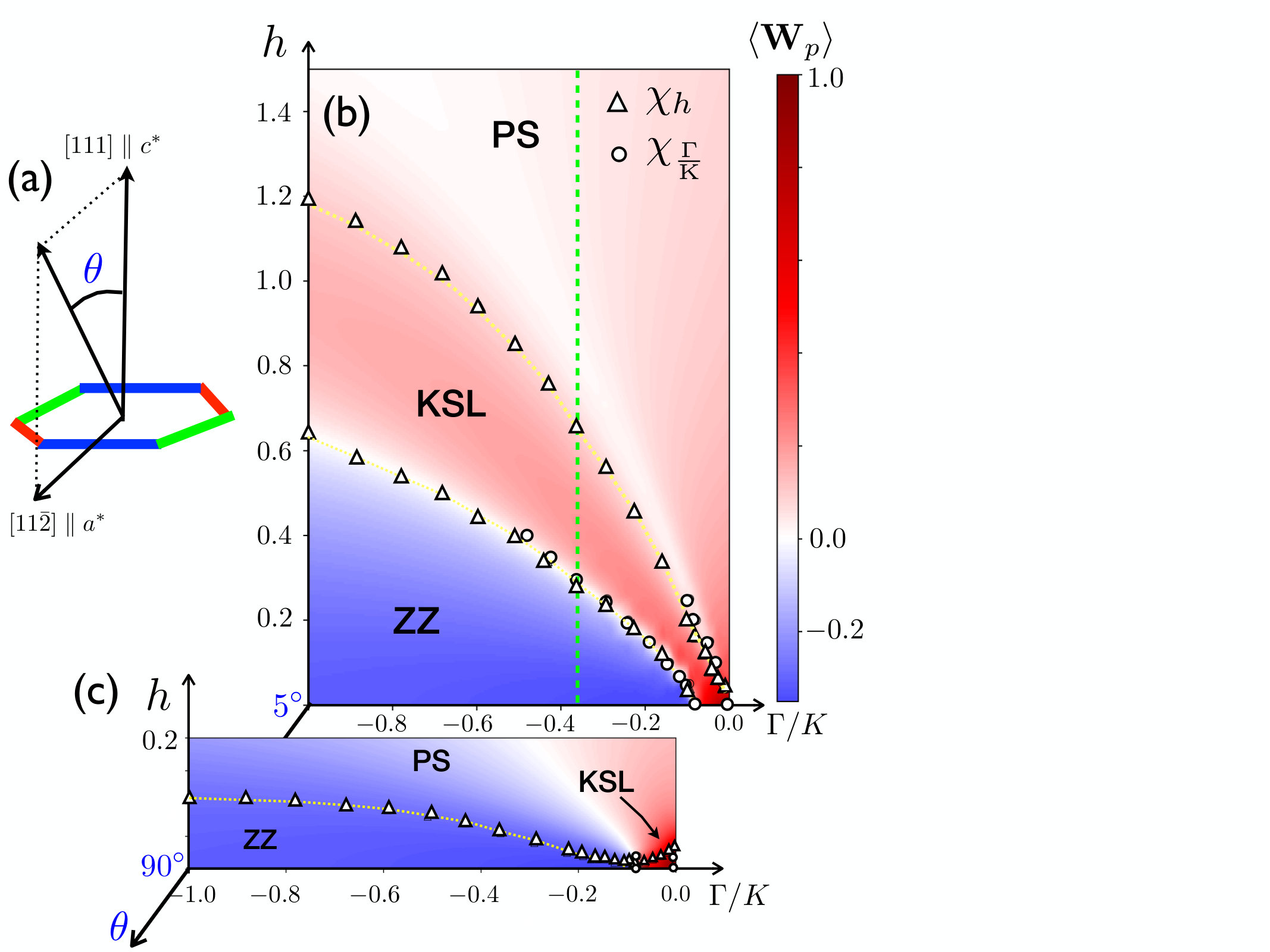 Figure 1
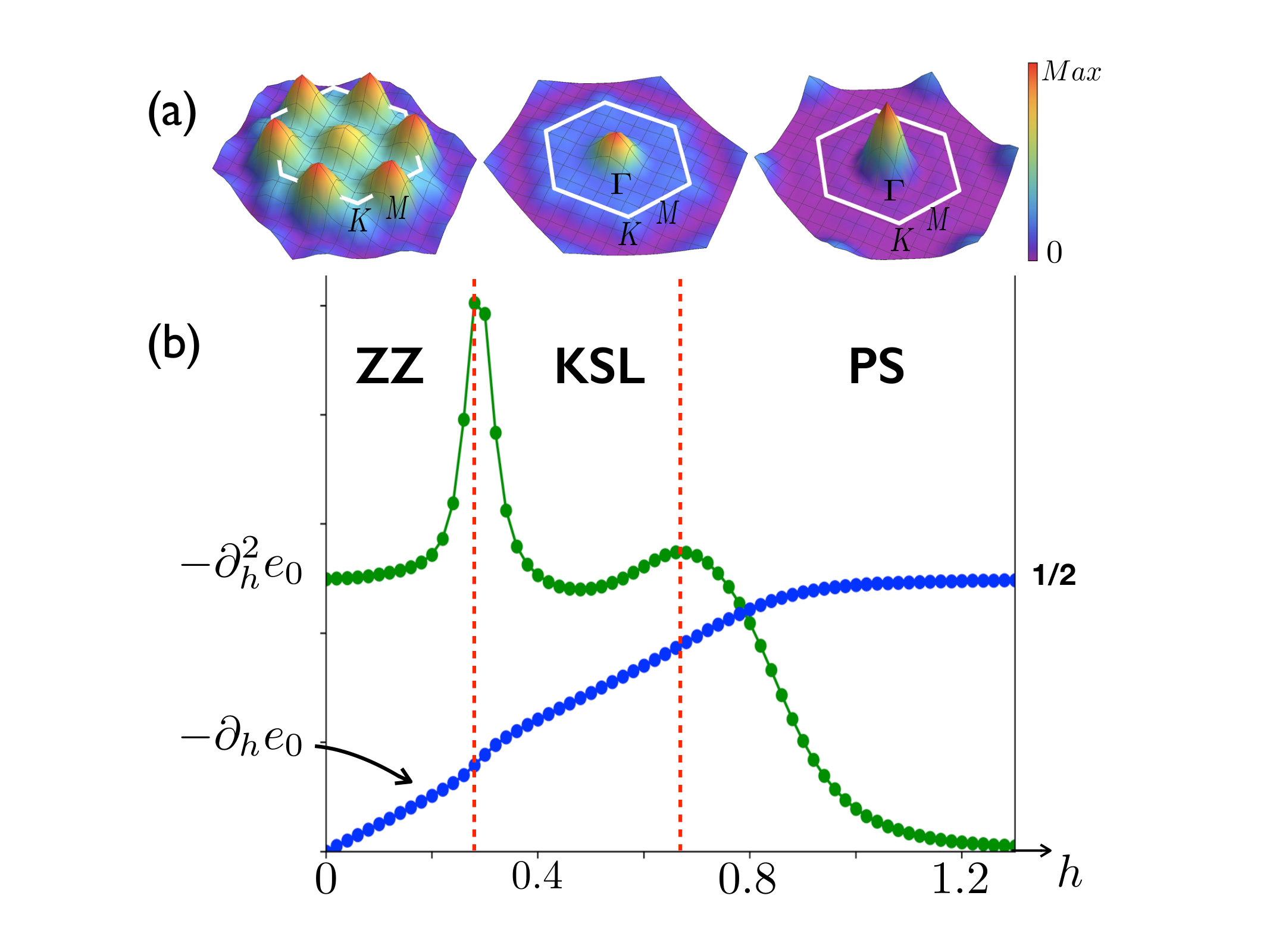 Figure 2
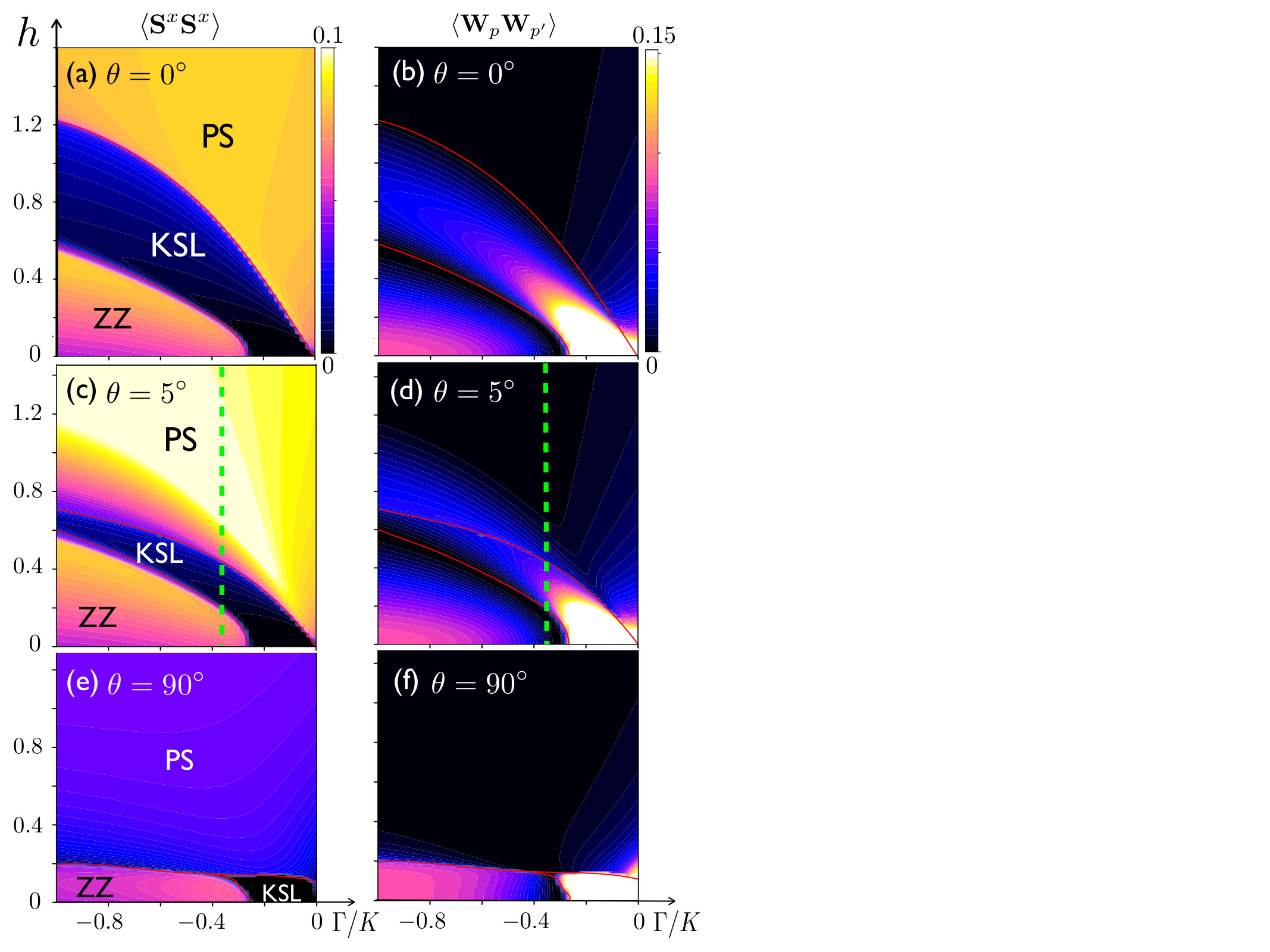 Figure 3
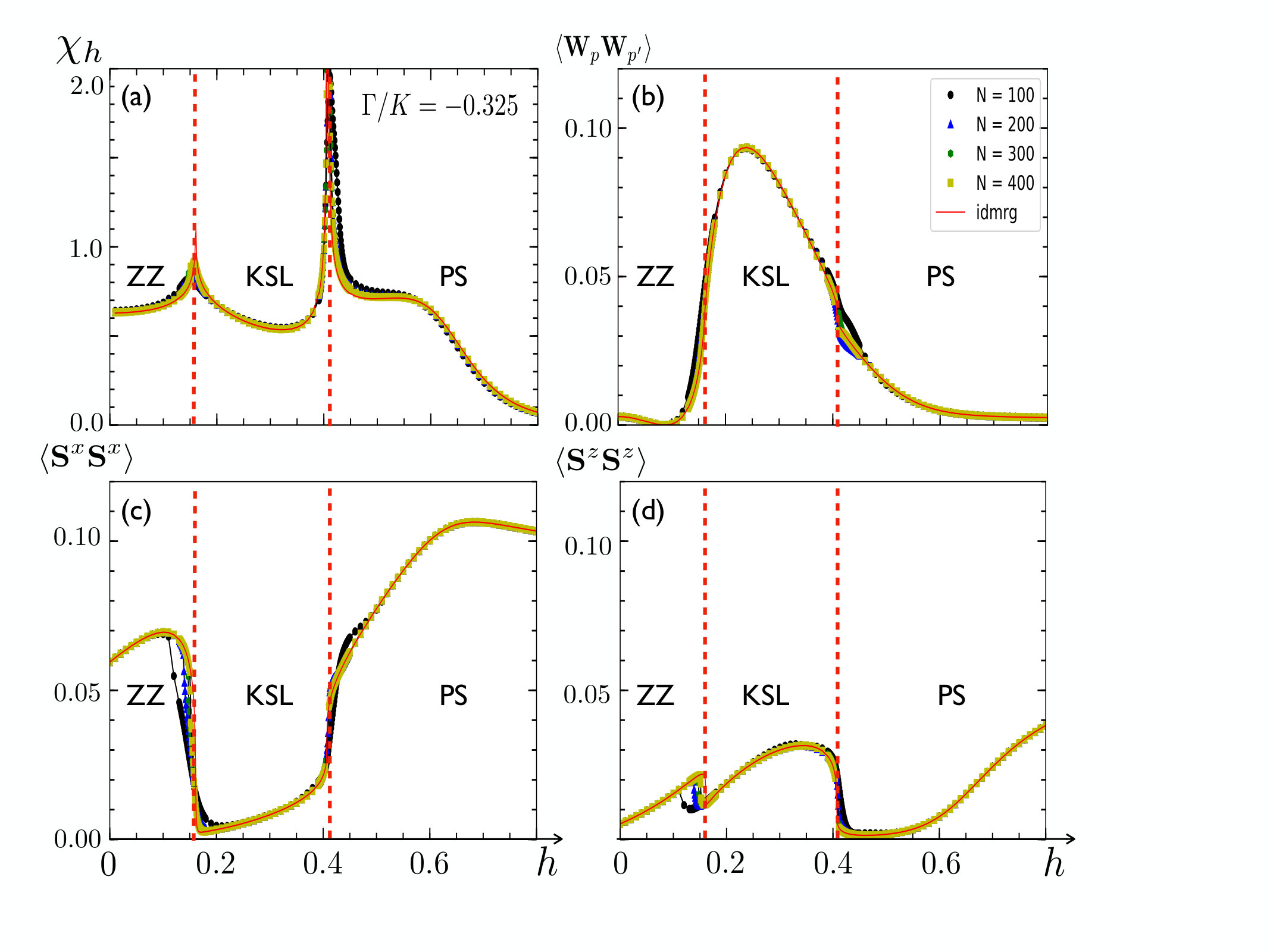 Figure 4
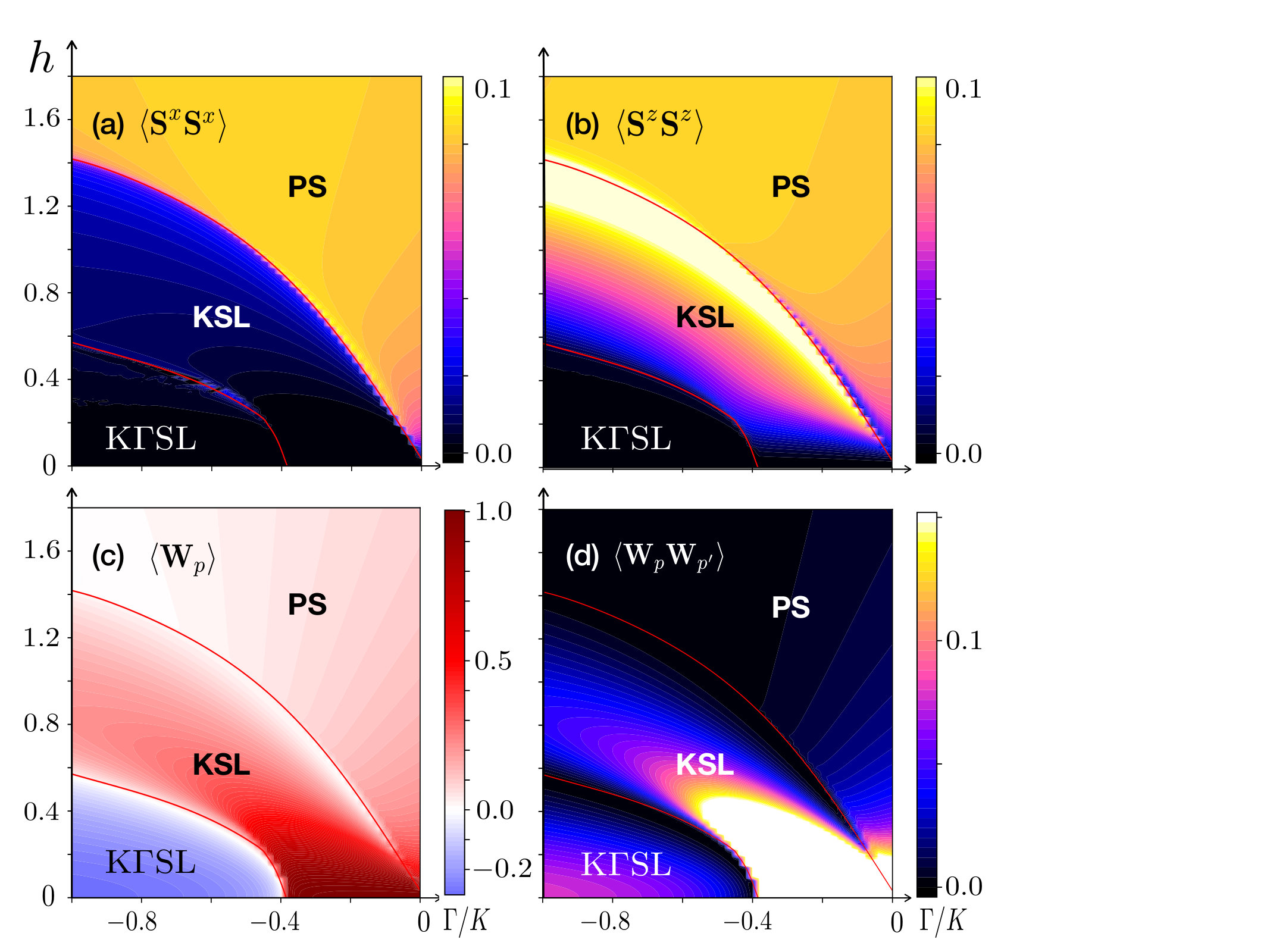 Figure 5
Peer Reviews
No public reviews on file for this paper yet. If you reviewed it on a platform where reviews are public (OpenReview, ICLR, NeurIPS, ICML), you can paste yours below so the community can read it here.
Videos
No videos yet. Explain this paper in a talk, walkthrough, or lecture? Add one.
Theory of the field-revealed Kitaev spin liquid
Jacob S. Gordon
Andrei Catuneanu
Department of Physics, University of Toronto, Ontario M5S 1A7, Canada
Erik S. Sørensen
Department of Physics and Astronomy, McMaster University, Hamilton, Ontario L8S 4M1, Canada
Hae-Young Kee
Department of Physics, University of Toronto, Ontario M5S 1A7, Canada
Canadian Institute for Advanced Research, CIFAR Program in Quantum Materials, Toronto, ON M5G 1M1, Canada
**Elementary excitations in highly entangled states such as quantum spin liquids may exhibit exotic statistics, different from those obeyed by fundamental bosons and fermions. Excitations called non-Abelian anyons are predicted to exist in a Kitaev spin liquid - the ground state of an exactly solvable model proposed by Kitaev almost a decade ago. A smoking-gun signature of such non-Abelian anyons, namely a half-integer quantized thermal Hall conductivity, was recently reported in -RuCl3. While fascinating, a microscopic theory for this phenomenon in -RuCl3 remains elusive because the pure Kitaev phase cannot capture these anyons appearing in an intermediate magnetic field. Here we present a microscopic theory of the Kitaev spin liquid emerging between the low- and high-field states. Essential to this result is an antiferromagnetic off-diagonal symmetric interaction that permits the Kitaev spin liquid to protrude from the pure ferromagnetic Kitaev limit under a magnetic field. This generic model captures a field-revealed Kitaev spin liquid, and displays strong anisotropy of field effects. A wide regime of non-Abelian anyon Kitaev spin liquid is predicted when the magnetic field is perpendicular to the honeycomb plane. **
Motivation – The Kitaev spin liquid (KSL) is a long-range entangled state on a honeycomb latticeKitaev (2006), which hosts non-AbelianKitaev (2006); Balents (2010); Zhou et al. (2017) anyon excitations in a magnetic field. It has been proposed that topological quantum computation can be performed via braiding of non-Abelian anyonsNayak et al. (2008), meaning the KSL is of both practical, and fundamental interest. However, it has been challenging to find a solid state realization of Kitaev physics, which has been the focus of recent research. Several honeycomb materials have been suggested as KSL candidates, which are Mott insulators with strong spin-orbit coupling featuring or transition metal elementsJackeli and Khaliullin (2009); Chaloupka et al. (2010); Witczak-Krempa et al. (2014); Rau et al. (2016); Winter et al. (2017). Proposals so far include the iridates A2IrO3Jackeli and Khaliullin (2009); Chaloupka et al. (2010); Singh et al. (2012); Modic et al. (2014); Rau et al. (2014); Rau and Kee (2014) (A = Li, Na), and -RuCl3Plumb et al. (2014); Sandilands et al. (2015); Kim et al. (2015); Banerjee et al. (2016); Sandilands et al. (2016). However, all these candidates exhibit magnetic ordering at low temperaturesChoi et al. (2012); Chaloupka et al. (2013); Fletcher et al. (1967); Sears et al. (2015); Johnson et al. (2015); Banerjee et al. (2016); Cao et al. (2016); Kim and Kee (2016); Janssen et al. (2017), which masks potential Kitaev physics. Later theoreticalYadav et al. (2016); Lampen-Kelley et al. (2018); Liu and Normand (2018) and experimentalBaek et al. (2017); Wolter et al. (2017); Zheng et al. (2017) results suggest that -RuCl3 may enter a field-induced spin liquid, but there has been no evidence that it is a chiral spin liquid until a half-integer quantized thermal Hall conductivity was reported in -RuCl3Kasahara et al. (2018); a strong indicationVinkler-Aviv and Rosch (2018); Cookmeyer and Moore (2018); Ye et al. (2018) of chiral edge currents of Majorana fermions (MFs) predicted in a KSL.
While this is a first experimental evidence of charge-neutral non-Abelian anyons in spin systems, a microscopic theory describing the appearance of such a chiral KSL under a field in -RuCl3 is missing. This is because if the dominant interaction in -RuCl3 is the ferromagnetic (FM) Kitaev term – based on spin wave analysisCookmeyer and Moore (2018) and ab-initio studiesKim and Kee (2016); Janssen et al. (2017) – the FM Kitaev phase is almost immediately destroyed, and the polarized state appears in an applied fieldJiang et al. (2011); Zhu et al. (2018); Liang et al. (2018) with no intervening phase. This can be contrasted with the antiferromagnetic (AFM) Kitaev phase which hosts a potentially gapless spin liquid under a field, supported by several numerical studiesZhu et al. (2018); Gohlke et al. (2018a); Liang et al. (2018); Nasu et al. (2018); Hickey and Trebst (2018); Ronquillo et al. (2018); Jiang et al. (2018); Zou and He (2018); Patel and Trivedi (2018). However, this intermediate gapless U(1) spin liquid cannot explain the half-integer thermal Hall effect observed in -RuCl3, even though it is an intriguing spin liquid. Thus searching for a possible spin liquid with MFs leading to the half-integer thermal Hall effect under a magnetic field remains a challenging task.
Here we present a microscopic theory of the KSL displaying a half-integer thermal Hall effect under a magnetic field. The key to our result is an AFM symmetric off-diagonal interaction, essential to stabilize the KSL for intermediate fields. The KSL emerges between the low- and high-field phases as increases, and is connected to the pure FM Kitaev phase at zero field. We introduce the microscopic theory with a brief review of the generic nearest neighbour spin model for spin-orbit coupled honeycomb materials, appropriate for -RuCl3.
Model – The nearest neighbour model has been derived in [Jackeli and Khaliullin, 2009,Rau et al., 2014,Rau and Kee, 2014] based on a strong coupling expansion of the Kanamori Hamiltonian. The combination of crystal field splitting and strong spin-orbit coupling leads to a model based on pseudospin- local moments with bond-dependent interactions. On a bond of type with sites , the nearest-neighbour spin Hamiltonian is taken to be of the --- formRau and Kee (2014)
[TABLE]
where are the remaining spin components in . The spin components are directed along the cubic axes of the underlying ligand octahedra, so the honeycomb layer lies in a plane perpendicular to the [111] spin direction as shown in Fig. 1(a). A small is present due to trigonal distortion of ligand octahedra in the real material. Here we omit the Heisenberg for simplicity, and its effects are discussed later. Earlier studiesPlumb et al. (2014); Janssen et al. (2017); Catuneanu et al. (2018a); Gohlke et al. (2018b); Liu and Normand (2018) noted that the interaction with AFM sign may play an important role near the FM Kitaev regime to stabilize the spin liquidCatuneanu et al. (2018a). Since -RuCl3 has a dominant FM Kitaev interaction with AFM , we focus on with and . The remaining parameters of the Hamiltonian are expressed in units of .
To describe the effect of a magnetic field, we consider a Zeeman term with isotropic -factor
[TABLE]
where is the magnetic field strength, and is a unit vector specifying the field direction. In order to make a connection with the thermal Hall measurementsKasahara et al. (2018), we focus on field directions in the plane spanned by and . The direction of the field in this plane is parameterized by an angle from the direction, as shown in Fig. 1(a).
ED Results – Our main results are shown in Fig. 1. Phase diagrams in the – plane are shown for tilting angles and obtained through numerical exact diagonalization (ED). Details of the 24-site honeycomb cluster used are discussed in the Supplementary Information (SI). Peaks in the susceptibilities and , where is the ground state energy density, are depicted as triangles and circles, respectively. There are three phases in the phase space, namely, ZZ magnetic order at low fields, the KSL, and a polarized state (PS) at high fields. Remarkably, we find an intermediate KSL sitting between ZZ order and the PS, which is adiabatically connected to the pure limit.
The intermediate KSL begins from the pure FM regime, which is unstable to a small magnetic field in the direction. However, it is stabilized by the AFM term, and extends above the ZZ phase in a magnetic field. For moderate appropriate for -RuCl3, we observe a sequence of phase transitions from ZZ order to the KSL, and finally to the PS as shown in Fig. 2(b) for . Interestingly, with a constant both the ZZ and KSL phase spaces widen with increasing , as suggested by the curvature of the transition line in Fig. 1(b). This behaviour survives for further tilting of the magnetic field away from , with increased in-plane component. However, the window of the KSL rapidly diminishes with tilting angle until a direct transition between ZZ order and the PS appears at much smaller field, as shown in Fig. 1(c) for a field. The critical field required to destroy the ZZ ordering drops drastically with increasing . With an estimate of the energy unit as , corresponds to a field of T. This is within the range of fields required to kill the ZZ order in -RuCl3Kasahara et al. (2018).
Since the pure Kitaev limit involves the fractionalization of spins into itinerant MFs and fluxes, another quantity that characterizes the KSL is the plaquette operator Kitaev (2006):
[TABLE]
defined on sites belonging to a hexagonal plaquette . The pure KSL with (bottom right corner of the phase diagram) is a flux-free state with on all plaquettes. A finite , or spoils the exact solubility of the Kitaev model, as they generate interactions among the MFs and fluxes. Although the plaquette operators are no longer conserved quantities, remains positive and can distinguish the KSL from the neighbouring ZZ ordered phase. The ZZ and PS phases have finite plaquette expectation and plaquette-plaquette correlations due to the magnetic order. In particular, a FM product state in the polarized phase at high fields has positive for small , which eventually vanishes unless the moment involves all three spin components. Conversely, ZZ magnetic order has negative plaquette expectation value. Further details of this calculation can be found in the SI. The plaquette expectation is negative in the ZZ phase, and positive in the KSL, so should vanish at the ZZ-KSL phase transition. This behaviour of is seen with ED on the 24-site honeycomb cluster in Fig. 1. It is interesting to note that there is no sharp change in between the ZZ and PS when the field is along , while a remnant of the vanishing is found at higher fields.
To confirm the ZZ magnetically ordered phase at low field, we compute the spin structure factor , which displays sharp features at the -point of the Brillouin zone (BZ) as shown in Fig. 2(a). Within the KSL, is diffuse, with a soft peak at the -point. As expected, the PS exhibits a sharp feature at the -point. At large fields, the magnetization saturates within the PS as shown in Fig. 2(b). ZZ ordering at low field can be traced back to the presence of other small interactions, in this case due to Jackeli and Khaliullin (2009); Rau et al. (2014); Rau and Kee (2014); Yadav et al. (2016). At zero field with only, the ZZ order disappears at in the 24-site cluster leaving a small window of the KSL intact. A larger enlarges the ZZ ordered phase, and decreases the window of KSL at as shown in Fig. 2 of the SI.
DMRG Results – Due to fundamental limitations on system sizes accessible with ED, we have also studied a two-leg honeycomb strip using density-matrix renormalization group (DMRG), which can access system sizes an order of magnitude larger. We denote the total number of sites in the strip by . This geometry has recently been used to study the Kitaev-Heisenberg modelCatuneanu et al. (2018b), where it was found that its phase diagram displays a striking similarity with that of the 2D honeycomb lattice. Further rationale for this choice of geometry is discussed in the SI.
Phase diagrams in the – plane with and open boundary conditions (OBC) for tilting angles , and are shown in Fig. 3. The phase boundaries in Fig. 3, determined by peaks in or , are represented by red lines. We find a notable similarity with the ED phase diagram of Fig. 1, showing a large region of KSL which extends above the ZZ ordered phase and below the PS under a magnetic field. As the in-plane component of the field becomes larger, the intermediate KSL phase space rapidly shrinks. As we found with ED on the 24-site honeycomb cluster, the intermediate KSL at large disappears, leaving a single direct transition from ZZ to the PS as the field tilts towards . Crucially, a small region of KSL remains intact at smaller . Thus, with the in-plane field, the KSL is confined to a narrow range of field near the pure FM Kitaev limit. This constrasts with another in-plane field direction , shown in the SI, where the KSL is immediately destroyed by any non-zero field for , where refers to the transition point between the ZZ and KSL at . On the other hand, for any , there is a direct transition between the ZZ and the PS at finite field. This is consistent with the observation that there is no topological order when a certain pseudo-mirror symmetry is preservedZou and He (2018), as our Hamiltonian with a field direction has this symmetry.
Figures 3(a), (c), and (e) show at separation along one leg of the strip as a function of field and for different tilting angles of the field in the plane. As expected, correlations are appreciable within the magnetically ordered and polarized states. The KSL phase is very clearly distinguished from the surrounding ordered states by nearly vanishing () spin correlations. However, spin-spin correlations need not be identically zero except at due to a component of the spin aligning with the field, which is more pronounced when is large.
In Fig. 3(b), (d) and (f) we show plaquette-plaquette correlations at separation . Close to the Kitaev limit these correlations are nearly unity, consistent with in the limit, and decrease with increasing field and within the KSL. This is expected because the magnetic field, as well as , introduces interactions among the MF and flux degrees of freedom. Interestingly, the plaquette-plaquette correlations, which approach in the KSL at large separations, show large fluctuations above the KSL phase. This effect can also can be seen with ED on the 24-site honeycomb cluster shown in Fig. 1(b), as noted by remaining variations above the transition line.
A representative cut of the phase diagram is presented in Fig. 4(c-d) as a function of a tilted field with , which corresponds to the green line in Fig. 3(c) and (d). With increasing field, a sequence of transitions from ZZ order to the KSL and finally the PS are evidenced by strong singular behaviour of in Fig. 4(a). The transition between ZZ order and the KSL is accompanied by a sharp increase in plaquette-plaquette correlations shown in Fig. 4(b), and a larger value of accordingly. Components and of the spin-spin correlators are plotted in Fig. 4(c) and (d). While the correlations are small in the KSL, the correlations are slightly larger. This is similar to the honeycomb cluster with ED, where a finite magnetization is present in the KSL phase, as shown in Fig. 2(b). Asymmetry between the and components of the spin is due to the two-leg honeycomb strip connectivity, and tilting of the magnetic field. The preceding properties are shown for and iDMRG in Fig. 4 with different colours, and are seen to be relatively insensitive to the system size.
Underlying Phase Diagram – To understand the microscopic mechanism of the emerging KSL, we study the – model without at . At zero field, there is a finite region of the KSL when the AFM off-diagonal symmetric interaction is introduced. In the absence of , there is a transition in zero field at from the KSL to another spin liquid dubbed spin liquid (KSL)Lampen-Kelley et al. (2018). Components of the spin-spin correlators, and shown in Fig. 5(a-b), demonstrate a lack of magnetic order in the KSL and KSL at , and finite correlations building with increasing field.
The KSL is characterized by a finite like the KSL, but with negative as shown in Fig. 5(c-d). While is positive in the KSL, a negative in the KSL indicates a novel phase with a finite flux density. Strikingly, when the field is applied along the direction, the KSL sits above the KSL for a fixed leading to two phase transitions with increasing field: KSL KSL PS. The KSL is extremely fragile to additional interactions that stabilize ZZ order. For example, when a small interaction is introduced, the KSL is replaced by the ZZ ordered phase as shown in Fig. 1. Importantly, the ZZ order does not extend all the way to the Kitaev limit, and leaves a finite region of the KSL at zero field.
Discussion – In -RuCl3 it was suggested that the FM nearest and AFM third neighbour () Heisenberg interactions are important to stabilize the ZZ magnetic orderWinter et al. (2016). Indeed the combination of and has a similar effect to in that they both induce ZZ order. Thus, their inclusion would not alter our main results. However, if the combined strength of , and is too large, it would completely wipe out the intermediate KSL. Indeed we show that a larger causes ZZ order to overtake the KSL in Fig. 2 of the SI. Experimental reports of a half-quantized thermal Hall conductivity in -RuCl3 imply that the combined strength of these parameters is small enough to leave the intermediate KSL intact, yet finite to induce the ZZ order. It is possible that the KSL survives with smaller while developing ZZ order, resulting in two spin liquids between ZZ and PS under a field. Quantifying these strengths is left for a detailed future study.
As the magnetic field is tilted away from the out-of-plane direction towards the in-plane direction the intermediate KSL region shrinks rapidly, independent of the strength of , and for both cluster shapes studied here. What remains is a small intermediate phase at fields an order of magnitude smaller for moderate , showing a dramatic magnetic anisotropy. While smaller tilting angles are less effective at destroying the ZZ magnetic order, they offer a much larger region of the KSL. To enlarge the intermediate KSL phase, we therefore propose that a field should be applied at smaller tilting angles. Furthermore, for another in-plane field direction , the phase diagram exhibits no intermediate-field KSL at any finite or as discussed earlier. Further thermal Hall transport measurements for different in-plane directions would be desirable in order to test our microscopic theory.
There are fascinating aspects of this work that require further study. The first is the presence of large fluctuations of and just above the KSL phase into the PS, which is also seen by and an unsaturated magnetization in the 24-site honeycomb cluster. This is suggestive of a non-trivial crossover region into the polarized phase. We also note the presence of a novel phase dubbed KSL in the underlying phase diagram of the - model next to the KSL phase. The KSL phase is differentiated from the KSL by a sharp drop from in the KSL to in the KSL, accompanied by a singular . Nature of the KSL, and the transition to the KSL are excellent subjects for future study. For instance, possible vortex patterns due to strong interactions among MFs and vortices would be highly interesting to pursue.
The reference list from the paper itself. Each links out to its DOI / PubMed record.
- 1Kitaev (2006) Alexei Yu Kitaev, “Anyons in an exactly solved model and beyond,” Annals of Physics 321 , 2–111 (2006) . · doi ↗
- 2Balents (2010) Leon Balents, “Spin liquids in frustrated magnets,” Nature 464 , 199 (2010) . · doi ↗
- 3Zhou et al. (2017) Yi Zhou, Kazushi Kanoda, and Tai-Kai Ng, “Quantum spin liquid states,” Rev. Mod. Phys. 89 , 025003 (2017) . · doi ↗
- 4Nayak et al. (2008) Chetan Nayak, Steven H. Simon, Ady Stern, Michael Freedman, and Sankar Das Sarma, “Non-Abelian anyons and topological quantum computation,” Rev. Mod. Phys. 80 , 1083–1159 (2008) . · doi ↗
- 5Jackeli and Khaliullin (2009) George Jackeli and Giniyat Khaliullin, “Mott insulators in the strong spin-orbit coupling limit: From Heisenberg to a quantum compass and Kitaev models,” Phys. Rev. Lett. 102 , 017205 (2009) . · doi ↗
- 6Chaloupka et al. (2010) Ji ří Chaloupka, George Jackeli, and Giniyat Khaliullin, “Kitaev-Heisenberg model on a honeycomb lattice: Possible exotic phases in iridium oxides A 2 Ir O 3 ,” Phys. Rev. Lett. 105 , 027204 (2010) . · doi ↗
- 7Witczak-Krempa et al. (2014) William Witczak-Krempa, Gang Chen, Yong Baek Kim, and Leon Balents, “Correlated quantum phenomena in the strong spin-orbit regime,” Annual Review of Condensed Matter Physics 5 , 57–82 (2014) . · doi ↗
- 8Rau et al. (2016) Jeffrey G. Rau, Eric Kin-Ho Lee, and Hae-Young Kee, “Spin-orbit physics giving rise to novel phases in correlated systems: Iridates and related materials,” Annual Review of Condensed Matter Physics 7 , 195–221 (2016) . · doi ↗