Phenomenological NLO analysis of eta(c) production at the LHC in the collider and fixed-target modes
Yu Feng, Jibo He, Jean-Philippe Lansberg, Hua-Sheng Shao, Andrii, Usachov, Hong-Fei Zhang

TL;DR
This paper provides NLO predictions for eta(c) production at the LHC in collider and fixed-target modes, comparing with existing data and analyzing uncertainties to aid future experimental studies.
Contribution
It offers new NLO theoretical predictions for eta(c) production at 13 TeV and fixed-target energies, including comprehensive uncertainty analysis and branching ratio discussions.
Findings
Good agreement between LHCb data and NLO predictions at 7 and 8 TeV.
Predictions made for 13 TeV LHCb and 115 GeV fixed-target mode.
Uncertainty analysis enhances the reliability of theoretical estimates.
Abstract
In view of the good agreement between the LHCb prompt-eta(c) data at sqrt(s)=7 and 8 TeV and the NLO colour-singlet model predictions --i.e. the leading v^2 NRQCD contribution--, we provide predictions in the LHCb acceptance for the forthcoming 13 TeV analysis bearing on data taken during the LHC Run2. We also provide predictions for sqrt(s)=115 GeV for proton-hydrogen collisions in the fixed-target mode which could be studied during the LHC Run3. Our predictions are complemented by a full theoretical uncertainty analysis. In addition to cross section predictions, we elaborate on the uncertainties on the p bar-p branching ratio --necessary for data-theory comparison-- and discuss other usable branching fractions for future studies.
Click any figure to enlarge with its caption.
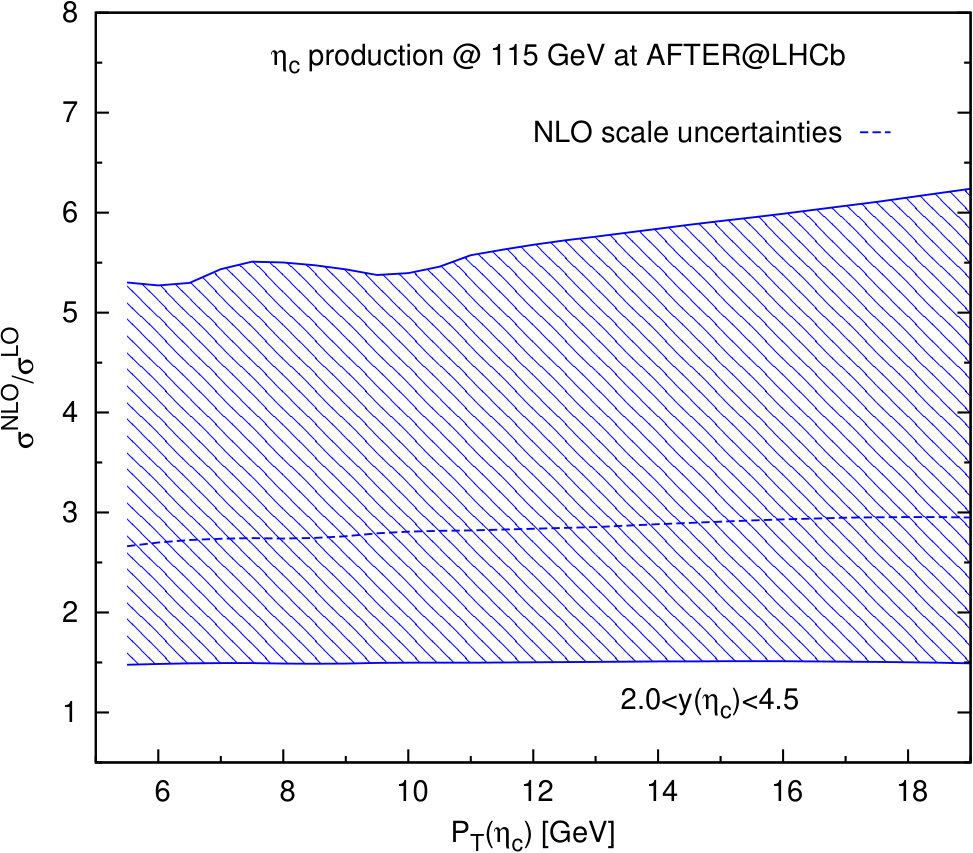 Figure 1
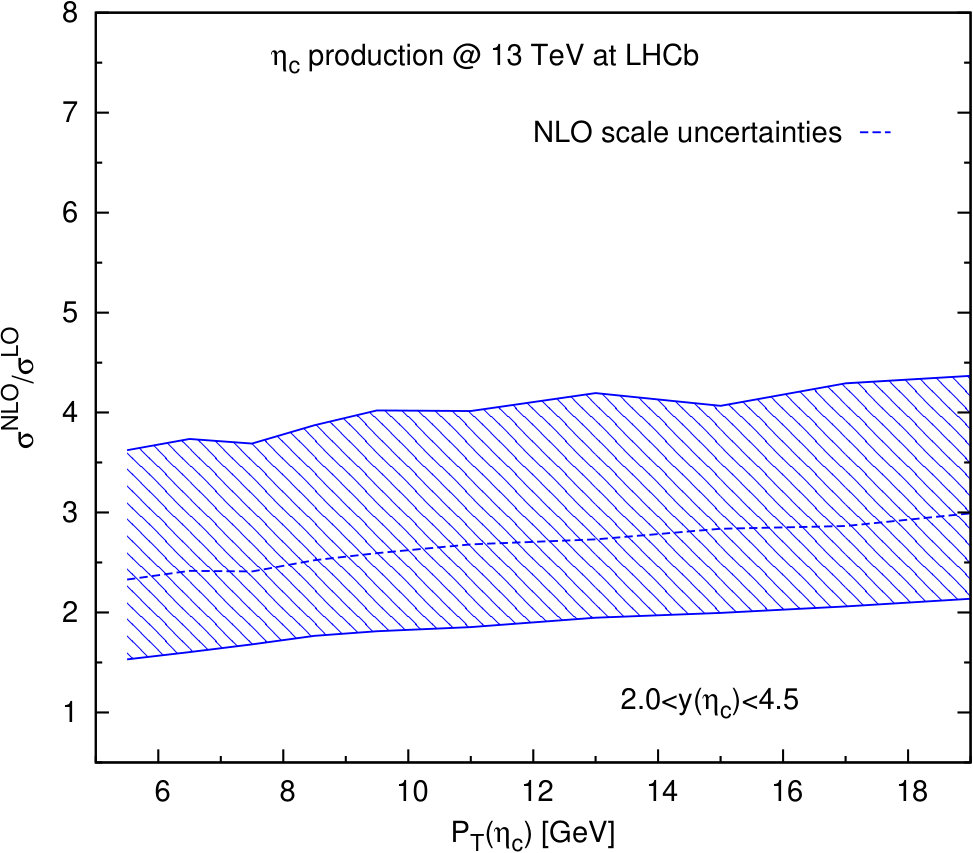 Figure 2
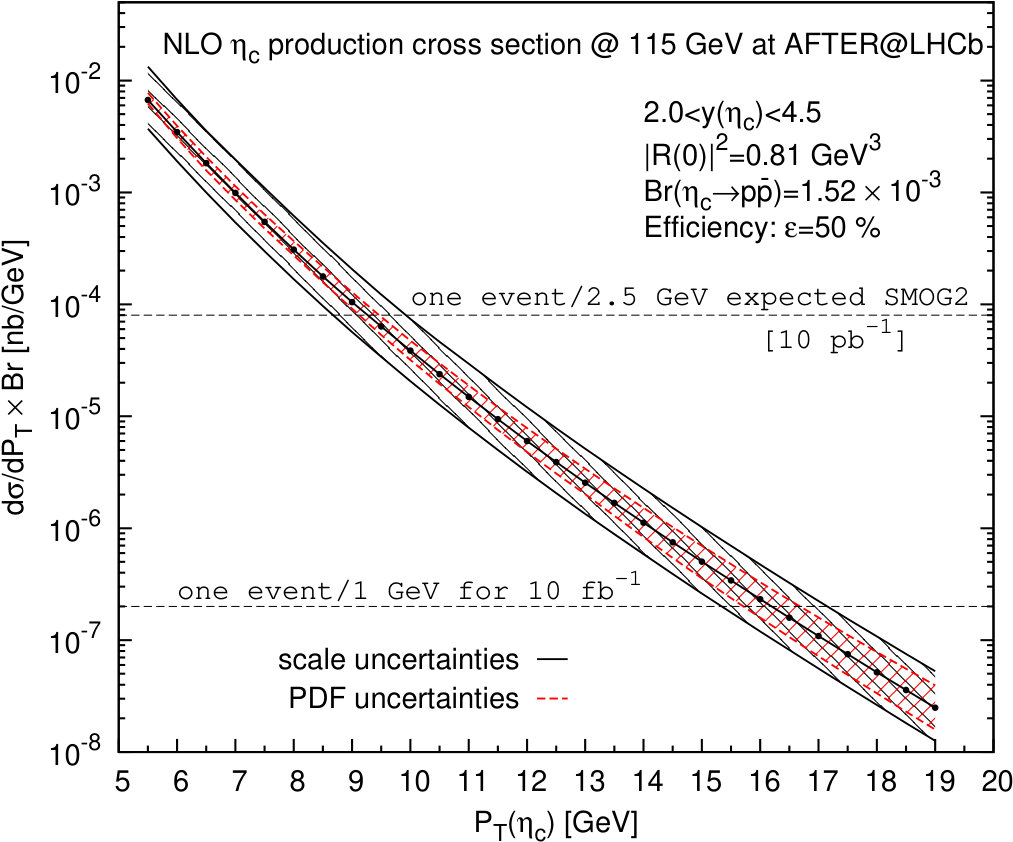 Figure 3
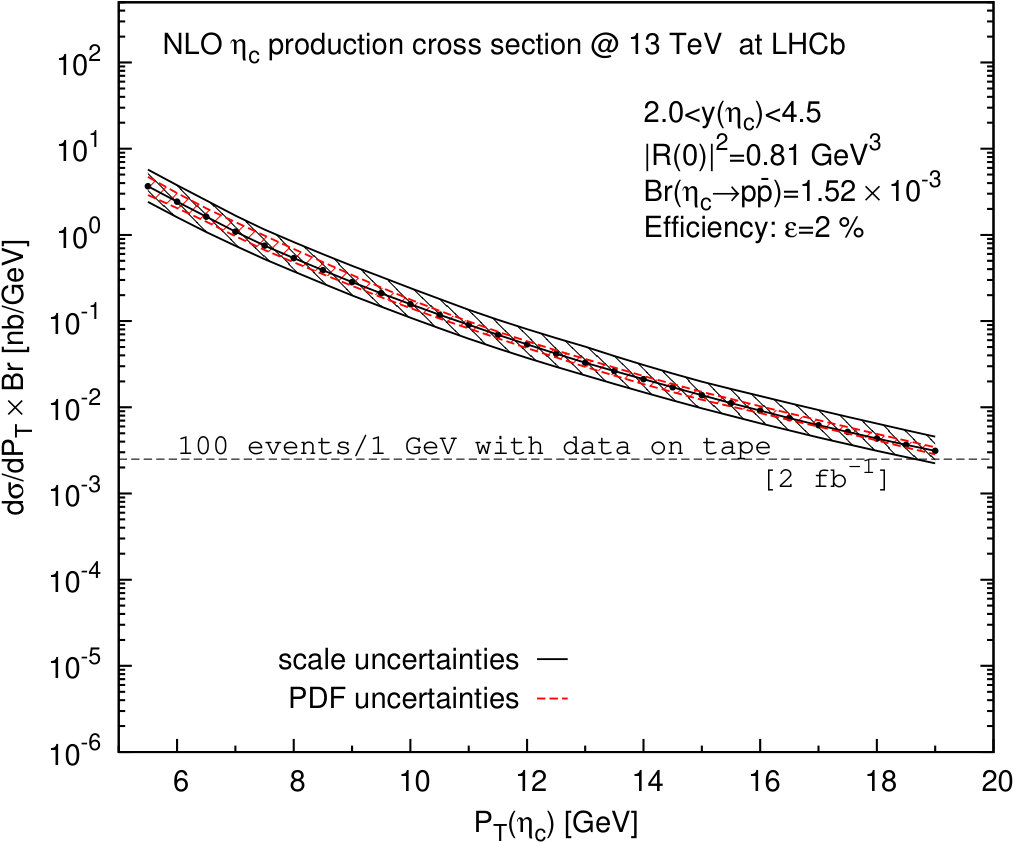 Figure 4
Peer Reviews
No public reviews on file for this paper yet. If you reviewed it on a platform where reviews are public (OpenReview, ICLR, NeurIPS, ICML), you can paste yours below so the community can read it here.
Videos
No videos yet. Explain this paper in a talk, walkthrough, or lecture? Add one.
Phenomenological NLO analysis of production at the LHC in the collider and fixed-target modes
Yu Feng
Jibo He
Jean-Philippe Lansberg
Hua-Sheng Shao
Andrii Usachov
Hong-Fei Zhang
Department of Physics, College of Basic Medical Sciences, Army Medical University, Chongqing 400038, China
LAL, Université Paris-Saclay, Univ. Paris-Sud, CNRS/IN2P3, F-91898, Orsay Cedex, France
School of Physical Sciences, University of Chinese Academy of Sciences, 19A Yuquan Road, Shijingshan district, Beijing 100049, P.R. China
IPNO, Université Paris-Saclay, Univ. Paris-Sud, CNRS/IN2P3, F-91406, Orsay Cedex, France
LPTHE, UMR 7589, Sorbonne Universités & CNRS, F-75252, Paris Cedex 05, France
College of Big Data Statistics, Guizhou University of Finance and Economics, Guiyang 550025, China
Abstract
In view of the good agreement between the LHCb prompt- data at 7 and 8 TeV and the NLO colour-singlet model predictions –i.e. the leading NRQCD contribution–, we provide predictions in the LHCb acceptance for the forthcoming 13 TeV analysis bearing on data taken during the LHC Run2. We also provide predictions for GeV for proton-hydrogen collisions in the fixed-target mode which could be studied during the LHC Run3. Our predictions are complemented by a full theoretical uncertainty analysis. In addition to cross section predictions, we elaborate on the uncertainties on the branching ratio –necessary for data-theory comparison– and discuss other usable branching fractions for future studies.
††journal: Nuclears Physics B
1 Introduction
In 2014, LHCb released the first experimental study of prompt- hadroproduction at the LHC [1] at 7 and 8 TeV. It was found that the cross section measured by LHCb was compatible with a negligible contribution of Colour-Octet (CO) transitions. More quantitatively, this observation combined with Heavy-Quark-Spin Symmetry (HQSS) yielded severe constraints on the corresponding CO transitions at work on production [2, 3, 4, 5]. These are so stringent that only one fit [2] currently survives these constraints at the expense of a slight tension with the CDF polarisation data [6]111The recent IHEP analysis where and were computed for the first time at NLO [7] also does not comply with the data.. For reviews on quarkonium production, the reader is referred to Refs. [8, 9, 10, 11, 12, 13]
In this paper, we provide predictions for prompt- hadroproduction at 13 TeV to further test the compatibility between the Colour-Singlet (CS) contributions and the data and then in turn to refine the constraints on the Long-Distance Matrix Elements (LDMEs) associated with the dominant CO contributions. See [14] for a recent similar study for the case for which forthcoming data will also be invaluable. Since such constraints need to be extracted taking a proper account of both theoretical and experimental uncertainties, we also elaborate on our knowledge of the branching fractions of the decay channels which can be used by LHCb as well as on the scale and Parton-Distribution Functions (PDFs) uncertainties of the CS cross-section predictions.
The structure of the article is as follows. Section 2 is devoted to the discussion on the decay channels. Section 3 explains the theory framework we have used to provide CS NLO predictions and gathers our predictions both for the collider kinematics and for the fixed-target kinematics. Section 4 gathers our conclusion.
2 Discussion on the decay channels
The decays of non- charmonium states to the experimentally clean di-muon channel are strongly suppressed and hence these states can only be reconstructed using decays to hadrons or their radiative transitions to underlying charmonium states. In this section we discuss possible decay channels to study , and , which cannot be accessed using their decays to or . The known branching fractions [15] of the decays discussed below are summarised in Tab. 1. Many of these branching fractions can be measured more precisely at Belle, Belle II, BES III, or the super tau-charm experiments.
The decays of charmonia have been investigated as a possible channel to measure charmonium production at the LHC [16]. The measurement of the production at the LHCb experiment has been performed using the decay [1], which demonstrated that the final state is powerful to reconstruct the state and measure the production rate relative to that of the , even though the hadroproduction rate is measured only for with transverse momenta () larger than 6.5 GeV due to the available trigger bandwidth. Also, this decay is used to study exotic candidates decaying to [17]. The branching fraction of the is known to about 10% precision [15]. The studies of the would benefit from a more precise measurement of or . Branching fractions of decays and have been measured to about 3-5% precision. Recently, LHCb has observed the decay using a data sample of exclusive decays [18]. Together with the measurement of by Belle [19], the branching fraction of is indirectly determined to be about . Therefore, the decay is promising for the hadroproduction measurement.
The other promising final state to study prompt production of charmonium is . The charmonium states are forbidden to decay to . LHCb measured the and production in inclusive -hadron decays using the final state with the first evidence of the decay [20]. In the latter analysis, a possible problem was highlighted, namely the PDG fit value of differs from the PDG average value [15] by a factor close to 2. In addition, the ratio of the branching fractions was measured. More measurements are needed to establish a robust value of the . Also, due to the evidence of the , this channel is promising to measure the hadroproduction of the . Similarly, the and the final states could be used.
The branching fractions of charmonium decays to long-lived baryons such as and are measured for most charmonium states. The reconstruction of these decay channels is challenging for LHCb due to the large lifetimes of these baryons such that they escape the Vertex Locator (VELO), which cause a small reconstruction and trigger efficiency. Decays involving short-lived baryons are reconstructed by LHCb with better efficiency.
The decays have been observed by the BES III collaboration [21] while the decay is not observed so far. This channel becomes another candidate to measure hadroproduction of charmonium states [22].
The least studied charmonium state is the meson, and not many of decays have been observed so far. The meson is expected to decay to , however, the upper limit on the reported by the BES III collaboration [23] is more than one order of magnitude smaller than the theoretical prediction [16]. Also, the can be measured using its radiative transition with branching fraction about 50%, which requires reconstruction of the state. Recently, LHCb observed the very clean decays , and precisely measured the mass and its natural width [24]. The decay can be searched similarly. Also, the BES III has observed the decay and measured its branching fraction [25] to be , which is promising for searches by LHCb.
3 Framework and results
3.1 Framework
The present NLO analysis was performed thanks to the FDC framework [26, 27]333The FDC (standing for Feynman Diagram Calculation) package have been developed to automated HEP computations. It is based on the LISP symbolic programming language in order to produce FORTRAN codes. The Lagrangian are formed by the code, following the user requirement, from which are derived the corresponding Feynman rules. The package generates all possible Feynman diagrams contributing to a given process up to one loop in a given model. It can in particular deal quarkonium production within NRQCD. The amplitude of the process are analytically manipulated to generate FORTRAN codes of the squared amplitudes up to one loop. Numerical results for the (differential) cross sections are then computed by performing the phase-space integrals using the phase-space slicing method. We refer to [27] for explanations relevant to quarkonium-production applications. which generates the Born, real-emission and virtual contributions, ensures the finiteness of their sum, performs the partonic-phase-space integration and that over the PDFs. As announced, we performed a full study of the scale uncertainty by varying both and about the default value as .
As for the CS LDME, we have taken {\langle\mathcal{O}^{\eta_{c}}(\bigl{.}^{1}\!S_{0}^{[1]})\rangle}=0.39 GeV3 which corresponds to GeV3 for the radial wave function at the origin. In order to study the impact of the PDF uncertainties at NLO, we have used the CT14 set [28] which is included in LHAPDF5 [29]. The corresponding uncertainties follow from the 57 eigensets of CT14.
3.2 Results for the collider mode at TeV
Our predictions at TeV follow from the expected kinematical range of the forthcoming LHCb study performed on data taken during the Run2 in 2015-2016. They correspond to 2 fb*-1* of data at TeV. We have therefore considered the same rapidity acceptance as that used for the first LHCb analysis [1], namely without any additional fiducial cuts on the decay product of the .
Fig. 1a displays our predictions for the -differential prompt- cross section at NLO accuracy along with their associated scale and PDF uncertainties. It is clear that the latter are negligible in this energy range as compared to those from the scales. Fig. 1b shows the ratio of the NLO/LO cross sections with the scale uncertainties only and points at a factor slightly increasing with . This is the expected behaviour with leading channels opening up at . It also shows that the scale uncertainty is as large as 50%.
Assuming a recorded luminosity of 2 fb*-1*, and an efficiency on the order of 2 %, the 100-count limit per GeV correspond to 2 pb and located around GeV. Without any surprise, the increase in the energy should allow LHCb to push their measurements at 13 TeV to slightly larger compared to 7 and 8 TeV. Limitation may come from the range where the yield is measured as well as from systematical uncertainties. In view of the other branching fractions on Table (1), let us add that other decays are also within the reach of LHCb measurements.
3.3 Results for the fixed-target mode at GeV
The use of the proton LHC beam in the fixed-target mode has lately be the object of intense investigation both in terms of feasibility and in terms of physics reach, see e.g. [30, 31, 32, 33, 34, 35, 36, 37, 38, 39, 40, 41, 42, 43, 44, 45, 46, 47, 48, 49, 50, 51, 52]. In particular, a wide variety of measurements in different possible implementations were discussed in [30]. We will limit ourselves here to a few statements on the kinematics. First, 7 TeV protons impinging fixed targets release a center-of-mass system (cms) energy close to 115 GeV (). Second, the boost between the cms and the laboratory is yielding a rapidity shift as large as . As such, the nominal acceptance of the LHCb detector in the cms approximates to . Physics wise, the LHCb detector probes backward physics in the fixed-target mode.
Nowadays, the first analysed fixed-target data based on the SMOG LHCb system –initially designed to improve the luminosity determination in LHCb, now used as a low-density-unpolarised-gas target– are coming in [53, 54] and confirm that the particle multiplicity in the LHCb detector is such that its performance in the fixed-target mode remains intact. One can thus consider that similar decay channels of the as those discussed for the collider mode could be studied if sufficient luminosities can be achieved.
Until now, the LHCb-SMOG statistical samples for taken with different noble gases (He, Ar, Ne) remain too small –on the order of hundreds– to expect any counts. The situation could significantly get better in the future with proposed SMOG2 system [55, 56] with achievable yearly luminosities on the order of 10 pb*-1* during the LHC Run3. It is however crucial to further constrain NRQCD LDMEs –as we propose here– to have a H target available as opposed as to nuclear –noble gas– targets. For the LHC Run4, yearly luminosities as high as few fb*-1* will be within experimental reach as discussed in [30].
Fig. 1a displays the -differential cross section at GeV in the expected acceptance of LHCb in the fixed-target mode. As above, we separated out the uncertainties from the scale variations ( and ) and from the PDFs which are a little larger here since one probes slightly larger values. As a matter of fact, dedicated rapidity-differential measurements at very negative could provide specific constraints on the gluon PDFs [30, 51, 52]. Fig. 2b shows the ratio of the NLO/LO cross sections with the scale uncertainties only and points at a factor slightly increasing with . This is the expected behaviour with leading channels opening up at . It also shows that the scale uncertainty is as large as 5 at low energies.
Assuming an integrated luminosity of 10 pb*-1*, and an efficiency on 50 %, the one-count limit per 2.5 GeV for is on the order 0.08 pb, which corresponds according to our results to a upper limit of GeV. It precisely happens to be the range accessed at 7 and 8 TeV. With 10 fb*-1*, the reach would simply be equivalent to that of the collider mode. We further note that, thanks to the reduced multiplicities in fixed-target mode, lower ’s should be accessible. This would allow one to measure the gluon Transverse-Momentum-Dependent functions (TMDs) along the lines of [57, 58, 59].
4 Conclusions and outlook
We have computed the prompt -production cross section at one loop accuracy in QCD and in the CSM (LO in of NRQCD) for the LHCb kinematics in the collider mode at TeV and in the fixed-target mode at GeV. In addition, we have provided an up-to-date discussion of the possible decay channels to be used for such studies and performed an original analysis of the theoretical analysis including that from the factorisation and renormalisation scales and from the PDFs.
In addition, let us stress that the understanding and the measurements of production go well beyond the determination of NRQCD LDMEs. Its production in proton-nucleus collisions (see [60] for predictions of the corresponding nuclear modification factors at LHC energies) can provide complementary means to probe the distribution of gluons inside nuclei along the lines of [61, 62]. In proton-deuteron collisions at extreme , it can also give us some handle on the gluon distribution in the deuteron at very large [63].
Acknowledgements
We thank S. Barsuk for useful discussions. The work of YF, JH, JPL, HSS, HFZ is supported in part by CNRS via the LIA FCPPL. JPL is supported in part by the TMD@NLO IN2P3 project. HSS is supported in part by the LABEX ILP (ANR-11-IDEX-0004-02, ANR-10-LABX-63).
The reference list from the paper itself. Each links out to its DOI / PubMed record.
- 1[1] LH Cb Collaboration, R. Aaij et al. , “Measurement of the η c ( 1 S ) subscript 𝜂 𝑐 1 𝑆 \eta_{c}(1S) production cross-section in proton-proton collisions via the decay η c ( 1 S ) → p p ¯ → subscript 𝜂 𝑐 1 𝑆 𝑝 ¯ 𝑝 \eta_{c}(1S)\rightarrow p\bar{p} ,” Eur. Phys. J. C 75 no. 7, (2015) 311 , ar Xiv:1409.3612 [hep-ex] . · doi ↗
- 2[2] H. Han, Y.-Q. Ma, C. Meng, H.-S. Shao, and K.-T. Chao, “ η c subscript 𝜂 𝑐 \eta_{c} production at LHC and indications on the understanding of J / ψ 𝐽 𝜓 J/\psi production,” Phys. Rev. Lett. 114 no. 9, (2015) 092005 , ar Xiv:1411.7350 [hep-ph] . · doi ↗
- 3[3] H.-F. Zhang, Z. Sun, W.-L. Sang, and R. Li, “Impact of η c subscript 𝜂 𝑐 \eta_{c} hadroproduction data on charmonium production and polarization within NRQCD framework,” Phys. Rev. Lett. 114 no. 9, (2015) 092006 , ar Xiv:1412.0508 [hep-ph] . · doi ↗
- 4[4] M. Butenschoen, Z.-G. He, and B. A. Kniehl, “ η c subscript 𝜂 𝑐 \eta_{c} production at the LHC challenges nonrelativistic-QCD factorization,” Phys. Rev. Lett. 114 no. 9, (2015) 092004 , ar Xiv:1411.5287 [hep-ph] . · doi ↗
- 5[5] A. K. Likhoded, A. V. Luchinsky, and S. V. Poslavsky, “Production of η Q subscript 𝜂 𝑄 \eta_{Q} meson at LHC,” Mod. Phys. Lett. A 30 no. 07, (2015) 1550032 , ar Xiv:1411.1247 [hep-ph] . · doi ↗
- 6[6] CDF Collaboration, A. Abulencia et al. , “Polarization of J / ψ 𝐽 𝜓 J/\psi and ψ 2 S subscript 𝜓 2 𝑆 \psi_{2S} mesons produced in p p ¯ 𝑝 ¯ 𝑝 p\bar{p} collisions at s 𝑠 \sqrt{s} = 1.96-Te V,” Phys. Rev. Lett. 99 (2007) 132001 , ar Xiv:0704.0638 [hep-ex] . · doi ↗
- 7[7] Y. Feng, B. Gong, C.-H. Chang, and J.-X. Wang, “The remaining parts for the long-standing J / ψ 𝐽 𝜓 J/\psi polarization puzzle,” ar Xiv:1810.08989 [hep-ph] .
- 8[8] N. Brambilla et al. , “Heavy quarkonium: progress, puzzles, and opportunities,” Eur. Phys. J. C 71 (2011) 1534 , ar Xiv:1010.5827 [hep-ph] . · doi ↗