Triangle-degrees in graphs and tetrahedron coverings in 3-graphs
Victor Falgas--Ravry, Klas Markstr\"om, Yi Zhao

TL;DR
This paper studies minimum degree conditions in 3-uniform hypergraphs that guarantee every vertex is contained in a specific small hypergraph, providing asymptotic results for triangles and tetrahedra, and relates the problem to graph triangle coverage.
Contribution
It determines asymptotic bounds for covering vertices with triangles and tetrahedra in 3-graphs, and connects these hypergraph problems to a graph triangle coverage conjecture.
Findings
Asymptotic determination of $c_1(n,F)$ for the generalized triangle $K_4^{(3)-}$.
Near-optimal bounds for the tetrahedron $K_4^{(3)}$ case.
Conjectured tight bounds for the maximum number of triangles containing a vertex in dense graphs.
Abstract
We investigate a covering problem in -uniform hypergraphs (-graphs): given a -graph , what is , the least integer such that if is an -vertex -graph with minimum vertex degree then every vertex of is contained in a copy of in ? We asymptotically determine when is the generalised triangle , and we give close to optimal bounds in the case where is the tetrahedron (the complete -graph on vertices). This latter problem turns out to be a special instance of the following problem for graphs: given an -vertex graph with edges, what is the largest such that some vertex in must be contained in triangles? We give upper bound constructions for this problem that we conjecture are asymptotically tight. We prove our conjecture for tripartite graphs, and…
Click any figure to enlarge with its caption.
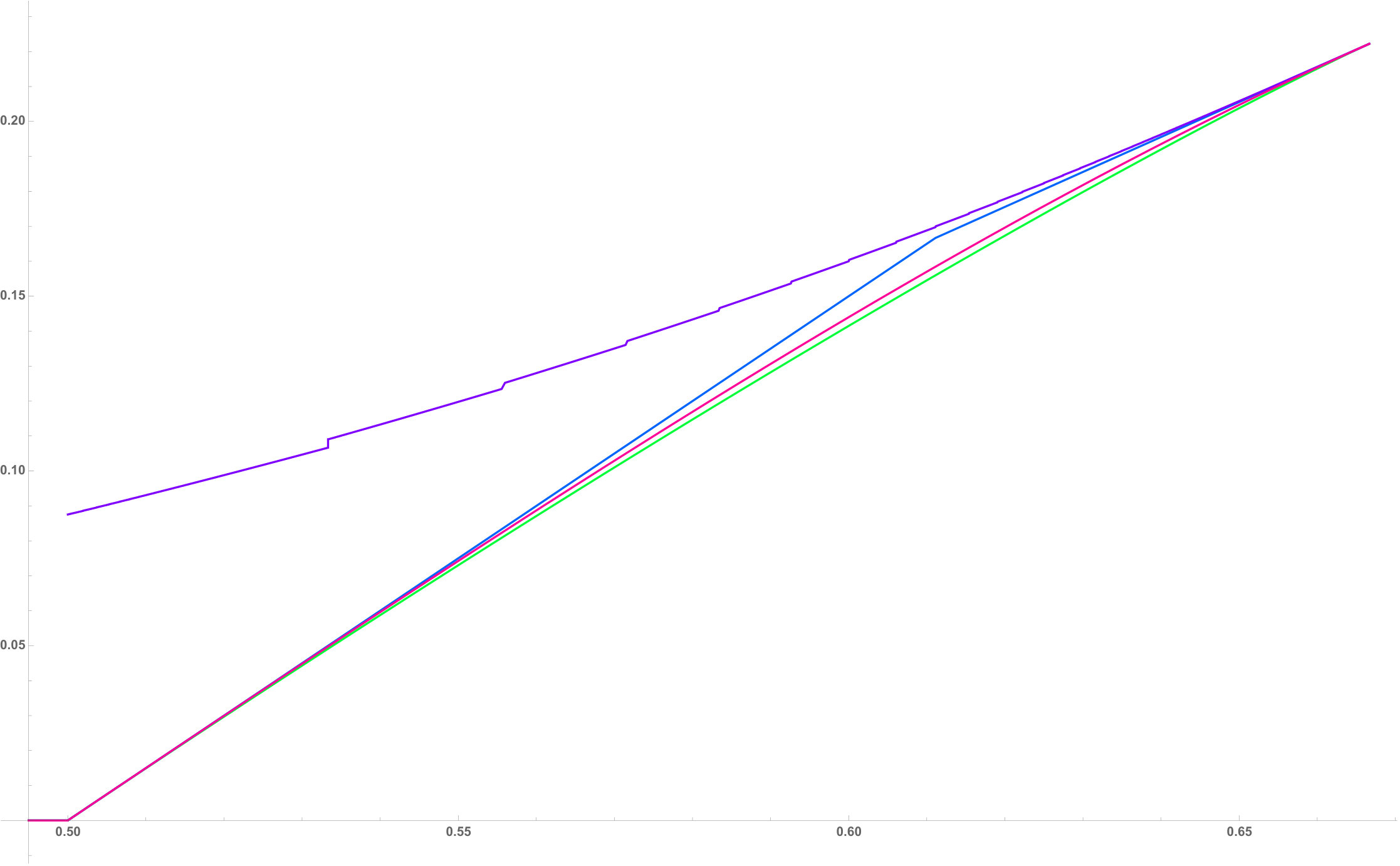 Figure 1
Peer Reviews
No public reviews on file for this paper yet. If you reviewed it on a platform where reviews are public (OpenReview, ICLR, NeurIPS, ICML), you can paste yours below so the community can read it here.
Videos
No videos yet. Explain this paper in a talk, walkthrough, or lecture? Add one.
Taxonomy
TopicsLimits and Structures in Graph Theory · Advanced Graph Theory Research · Finite Group Theory Research
Triangle-degrees in graphs and tetrahedron coverings in 3-graphs
Victor Falgas–Ravry Umeå Universitet, Umeå, Sweden. Email: [email protected]
Klas Markström Umeå Universitet, Umeå, Sweden. Email: [email protected]
Yi Zhao Georgia State University, Atlanta GA, USA. Email: [email protected]
Abstract
We investigate a covering problem in -uniform hypergraphs (-graphs): given a -graph , what is , the least integer such that if is an -vertex -graph with minimum vertex degree then every vertex of is contained in a copy of in ?
We asymptotically determine when is the generalised triangle , and we give close to optimal bounds in the case where is the tetrahedron (the complete -graph on vertices).
This latter problem turns out to be a special instance of the following problem for graphs: given an -vertex graph with edges, what is the largest such that some vertex in must be contained in triangles? We give upper bound constructions for this problem that we conjecture are asymptotically tight. We prove our conjecture for tripartite graphs, and use flag algebra computations to give some evidence of its truth in the general case.
1 Introduction
Let be a graph with at least one edge. What is the maximum number of edges an -vertex graph can have if it does not contain a copy of as a subgraph? This is a classical question in extremal graph theory. If is a complete graph, then the exact answer is given by Turán’s theorem [63], one of the cornerstones of extremal graph theory. For other graphs , the value of is determined up to a error term by the celebrated Erdős–Stone theorem [17].
Ever since Turán’s foundational result, there has been significant interest in obtaining similar “Turán–type” results for -uniform hypergraphs (-graphs), with . The extremal theory of hypergraphs has however turned out to be much harder, and even the fundamental question of determining the maximum number of edges in a -graph with no copy of the tetrahedron (the complete -graph on vertices) remains open — it is the subject of a 70-years old conjecture of Turán, and of an Erdős \lim_{n\rightarrow\infty}\mathrm{ex}(n,K_{t}^{(r)})/\binom{n}{r}t>r\geq 33$-graphs, where a small number of exact and asymptotic results are now known — see [3, 4, 12, 20, 24], as well as the surveys by Füredi [23], Sidorenko [61], and Keevash [34].
It is well-known that the Turán problem for an -graph is essentially equivalent to identifying the minimum vertex-degree required to guarantee the existence of a copy of . More recently [11, 44, 51], there has been interest in variants where one considers what minimum -degree condition is required to guarantee the existence of a copy of . Given an -set with , its neighbourhood in is the collection
[TABLE]
of -sets whose union with makes an edge of . The neighbourhood of defines an -graph
[TABLE]
which is called the link graph of . The degree of in is the size of its neighbourhood. The minimum -degree of is the minimum of over all -subsets . In particular, the case has received particular attention; is known as the minimum codegree of , and a minimum codegree condition is the strongest single degree condition one can impose on an -graph. Determining what minimum codegree forces the existence of a copy of a fixed -graph is known as the codegree density problem [51]. A few results on the codegree density for various small -graphs are known, see [18, 19, 36, 49].
In a different direction, there has been significant recent research activity devoted to generalising another foundational result in extremal graph theory. Let be a graph whose order divides . What minimum degree condition is required to guarantee that a graph on vertices contains an -tiling — a collection of vertex-disjoint copies of ? In the case of complete graphs, this was answered by the celebrated Hajnal–Szemerédi theorem [27], which (under the guise of equitable colourings) has applications to scheduling problems. For a general graph , the Kühn–Osthus theorem [40] determines the minimum degree-threshold for -tilings up to a constant additive error.
There has been a growing interest in determining analogous tiling thresholds in -graphs for , see the surveys by Rödl and Ruciński [59], and Zhao [64] devoted to the subject. In an effort to generalise Dirac’s theorem on Hamilton cycles to hypergraphs, Rödl, Ruciński and Szemerédi [60] determined the minimum codegree threshold for the existence of a perfect matching in -graphs for . The paper also introduced the hugely influential absorption method, which has been used as a key ingredient in many of the results in the area obtained since. Beyond perfect matchings, codegree tiling thresholds have by now been determined for a number of small -graphs, including [35, 45], [30, 43], and ( with two edges removed) [10, 39]. In addition, the codegree tiling thresholds for -partite -graphs have been studied recently [9, 25, 26, 29, 52]
Turning to minimum vertex-degree tiling thresholds, fewer results are known. The vertex-degree thresholds for perfect matchings were determined for -graphs by Han, Person, and Schacht [28] (asymptotically) and by Kühn, Osthus and Treglown [41] and Khan [38] (exactly). Han and Zhao [32] determined the vertex-degree tiling threshold for , while Han, Zang, andZhao [31] asymptotically determined the vertex-degree tiling threshold for all complete -partite -graphs.
As a key part of their argument, Han, Zang, and Zhao considered a certain -graph covering problem and showed it was distinct from the corresponding Turán-type existence problem. This stands in contrast with the situation for ordinary graphs, where existence and covering thresholds essentially coincide. Given an -graph , Falgas–Ravry and Zhao [21] introduced the notion of an -covering, which is intermediate between that of the existence of a single copy of and the existence of an -tiling.
We say that an -graph has an -covering if every vertex in is contained in a copy of in . Equivalently an -covering of is a collection of copies whose union covers all of . For every positive integer , the -degree -covering threshold is the function
[TABLE]
We further let the -degree -covering density to be the limit†††This limit can be shown to exist — see [21, Footnote 1].
[TABLE]
Let denote the complete -graph on vertices and denote the -graph obtained by removing one edge from . A tight -uniform -cycle is an -graph with a cyclic ordering of its vertices such that every consecutive vertices under this ordering form an edge. Falgas–Ravry and Zhao [21] determined , where is , , , and . Han, Lo, and Sanhueza-Matamala [29] determined for all and .
In this paper we investigate and for various 3-graphs . We first consider . Let be the function
[TABLE]
Observe that for fixed , is a decreasing function of over the interval . On the other hand is an increasing function of , so there exists a unique such that , namely
[TABLE]
Theorem 1.1**.**
For all odd integer , . In particular, .
The upper and lower bounds on in Theorem 1.1 are apart by less than . However it seems much more work will be needed to determine exactly. As a first step in this direction, we prove the following stability theorem characterising near-extremal configurations. Let .
Theorem 1.2**.**
For every , there exists and such that the following holds: for every , if is a -graph on vertices with minimum vertex degree at least and is not covered by a copy of in , then the link graph can be made bipartite by removing at most edges.
Next we consider .
Theorem 1.3**.**
[TABLE]
The upper bound was derived from the flag algebra method. We believe that the lower bound is tight. As we show in Section 2.3, the problem of determining is equivalent to (a special case of) a problem about triangle-degrees in graphs.
Given a graph , the triangle-degree of a vertex is the number of triangles that contains . The well-studied Rademacher–Turán problem concerns the smallest average triangle-degree among all graphs with a given edge density (the edge density is defined as ). This problem attracted significant attention (see [5, 14, 22, 46, 47]) until it was resolved asymptotically by Razborov [56] using the framework of his newly-developed theory of flag algebras. Different proofs expressed in the language of weighted graphs were later found by Nikiforov [53] and by Reiher [58] (who generalised Razborov’s result to cliques of order and of arbitrary order , respectively).
Let denote the maximum triangle-degree in . (This is related to but different from the well-studied book number, which is the maximum number of triangles containing a fixed edge of , see the discussion in Section 4 for details.) For , we define
[TABLE]
which is the asymptotically smallest maximum scaled triangle-degree in a graph with edge density . We derive the following upper bounds for and conjecture that they are tight. If Conjecture 1.5 holds, then (see Proposition 3.1).
Theorem 1.4**.**
Suppose , for some . Then
[TABLE]
As we will see, the constructions underpinning Theorem 1.4 are very different from the extremal ones for the Rademacher–Turán problem.
Conjecture 1.5**.**
The upper bounds on given in Theorem 1.4 are tight for every .
We use flag algebra computations to show the upper bounds from Conjecture 1.5 are not far from optimal when (see Theorem 3.8).
Following on a beautiful result of Bondy, Shen, Thomassé and Thomassen [7] on a tripartite version of Mantel’s theorem, Baber, Johnson and Talbot [2]
gave a tripartite analogue of Razborov’s triangle-density result. In a similar spirit, we prove Conjecture 1.5 holds for tripartite graphs. Note that a tripartite graph on vertices can have between [math] and edges.
Theorem 1.6**.**
Let be a tripartite graph on vertices. Then
[TABLE]
Structure of the paper
In Section 2 we prove Theorems 1.1–1.3 along with bounds for and for . In Section 3 we prove Theorems 1.4 and 1.6, and give flag algebra bounds on . We end the paper in Section 4 with a discussion of book numbers in graphs and a comparison of known results and conjectures on minimal triangle density, triangle-degree and book-number as functions of edge density.
Notation
We use standard graph and hypergraph theory notation throughout the paper. In addition, we use to denote the set and to denote the collection of all -subsets of a set . Where there is no risk of confusion, we identify hypergraphs with their edge-sets.
2 Covering in -graphs
2.1 Proof of Theorem 1.1
Recall that is the (unique up to isomorphism) -graph on -vertices spanning edges, also known as the generalised triangle. In this subsection, we prove Theorem 1.1.
Proof of Theorem 1.1.
Lower bound: let be odd, and let . We construct a -graph on vertices as follows. Set aside a vertex , and let be a bipartition of into two sets of equal size. Let be an arbitrary -regular bipartite graph with partition . Now let be the -graph whose -edges are the union of the triples together with all the triples of vertices from inducing at most one edge in .
Clearly, for every triple of vertices , induces at most two edges of and is not contained in any copy of . Thus . This latter quantity is easily calculated: the degree of in is . For any , there are exactly pairs such that both and lie in , and exactly pairs such that both and lie in ; such pairs are the only pairs from that do not form an edge of with . In addition, there are exactly edges of containing the pair . Thus the degree of in is
[TABLE]
By symmetry, the degree of any vertex in is also . Thus because . Since has no -covering, it follows that .
Upper bound: suppose is a -graph on vertices with and no copy of covering a vertex (here is not necessarily odd). We shall show that . Note that the link graph of is triangle-free. Furthermore, for any triple spanning two edges in . Let denote the collection of pairs such that induces two edges in . We know that for every . Observe that consists of all pairs , where either or and exactly one of , is in .
Counting non-edges of over all , we thus have
[TABLE]
where in the last line we used Jensen’s inequality and our minimum degree assumption . By averaging, there exists a vertex with
[TABLE]
Applying our minimum degree assumption yields and hence . Thus as claimed.
∎
2.2 Proof of Theorem 1.2
Our proof shall make use of a consequence of Karamata’s inequality. Let and be real numbers. We say that majorises if for all , with equality attained in the case . Karamata’s inequality states that if majorises and is a convex function then .
Lemma 2.1**.**
Suppose is a convex function. Let be real numbers such that , and let . Set . Then
[TABLE]
Proof.
Since , our assumption on tells us that . If , then the claimed inequality is just Jensen’s inequality. So assume is nonempty and set for some .
Let be given by
[TABLE]
Observe that . Setting
[TABLE]
we have
[TABLE]
It follows readily from this that the -tuple majorises . Applying Karamata’s inequality to the convex function we obtain
[TABLE]
Another ingredient in the proof of Theorem 1.2 is a classical result of Andrásfai, Erdős and Sós.
Theorem 2.2** (Andrásfai, Erdős, Sós [1]).**
Let be a triangle-free graph on vertices with minimum degree . Then is bipartite.
With these two preparatory results in hand, the proof of Theorem 1.2 is straightforward: we first use Lemma 2.1 to show that the overwhelming majority of vertices in the link graph have degree much larger than , whereupon we deduce from the Andrásfai–Erdős–Sós theorem that is almost bipartite.
Proof of Theorem 1.2.
Recall . Fix . Without loss of generality, assume that . Pick and such that
[TABLE]
both hold.
Let be a -graph with , . Suppose is a vertex in not covered by any copy of . Without loss of generality, assume . By the vertex-degree assumption, , for some . Let be the collection of vertices in whose codegree with is smaller than average by a multiplicative factor of . Set .
Since is not covered by a copy of in , the following hold:
- (i)
is triangle-free; 2. (ii)
for every triple of vertices inducing two edges in , the -edge is missing from .
Property (i) implies that for every , the neighbourhood is an independent set in , while property (ii) implies that for every and every , the -edges and are both missing from . In particular for every , we have
[TABLE]
Summing this inequality over all and using the fact , we get
[TABLE]
Since the function is convex and , we can apply Lemma 2.1 to bound below the right-hand side of (2.3) by
[TABLE]
Inserting this inequality back into (2.3), dividing through by and using yields
[TABLE]
where the last inequality holds because our choice of in (2.2) ensures . Note that satisfies . Rearranging terms in inequality (2.5) gives
[TABLE]
By the second part of (2.2) and the assumption that is sufficiently large, we have
[TABLE]
and . Remove from all vertices from . By the definitions of , the resulting triangle-free graph has at most vertices and minimum degree at least
[TABLE]
By Theorem 2.2, is bipartite. Since we removed only at most vertices from to obtain , it follows that can be made bipartite by removing at most edges, as claimed. This concludes the proof of Theorem 1.2.
∎
2.3 Proof of Theorem 1.3
Given an -graph , write for the number of copies of in that cover .
Proposition 2.3**.**
There exists an -graph on vertices with minimum vertex-degree and no -covering if and only if there exists an -graph on vertices with at least edges such that for every vertex , .
Proof.
In one direction, let be an -graph on vertices with minimum degree . Suppose is not covered by any in . By the minimum degree condition on , the -uniform link graph contains at least edges. Also, every copy of in the -graph must be a non-edge in the -graph , else together with it would make a copy of in covering . The minimum degree condition in then implies that for every vertex in the -vertex -graph ,
[TABLE]
implying as desired.
In the other direction, let be an -graph on vertices with at least edges such that for all . We add a new vertex to and define an -graph on by setting the link graph of be equal to , and adding in as edges all -sets from which do not induce a copy of in . This yields an -graph on vertices in which is not covered by a copy of , , and for every ,
[TABLE]
so as desired. ∎
Corollary 2.4**.**
For any , the -degree covering density is the least such that if is an -graph on vertices with at least edges, then there is a vertex contained in copies of in .
Proof of Theorem 1.3.
Lower bound: suppose and partition into three sets of size . Further partition each into two sets and of size . Now let be the -graph on obtained by putting in all edges of the form , with and adding for each an arbitrary -regular bipartite graph with partition . An easy calculation shows is both regular and triangle-degree regular, with every vertex satisfying and . We have thus . It follows from Proposition 2.3 that there exists a -graph on vertices with minimum degree and no -covering, establishing the desired lower bound on .
Upper bound: set . By Proposition 2.3, it is enough to show that if is an -vertex graph with , then . This is done in Proposition 3.10 in the next section via a simple flag algebra calculation. ∎
2.4
Theorem 2.5**.**
**
Proof.
**Lower bound: ** we construct a -graph on as follows. Set aside , and partition the remaining vertices into an -set and a -set . Let be the -graph on obtained by setting the link graph of to be the union of a clique on and a clique on , and adding all triples of the form or . Every path of length in the link graph of gives rise to an independent set in , hence there is no copy of the strong -cycle covering in . The degree of in is , and the degree in the rest of the graph are all at least
[TABLE]
Thus , as desired.
**Upper bound: ** Mubayi and Rödl [50, Theorem 1.9] proved that . An easy modification of their proof shows that is in fact an upper bound for the covering threshold. Indeed, let be a graph on vertices with , for some . Let be an arbitrary vertex in . By averaging, there exists such that . Form the multigraph as in [50, Proof of Theorem 1.9, p 151]. Then [50, Claim, p 151] shows that if there is no copy of covering the pair , then satisfies the conditions of [50, Lemma 6.2, p 149], and one can conclude as Mubayi and Rödl do that one of and has degree at most in , contradicting our minimum degree assumption.
∎
2.5 ,
Proposition 2.6**.**
For all , .
Proof.
Let and be sufficiently large. Suppose that is a -graph on vertices with for some satisfying . Let be an arbitrary vertex. By averaging, there exists a vertex and an -set such that . Observe that
[TABLE]
and an analogous bound holds for . Thus
[TABLE]
On the other hand, for any , we have
[TABLE]
Note that
[TABLE]
Let be the -graph obtained by taking and adding a new vertex whose link graph consists precisely of those pairs . By (2.6), (2.7) and (2.8), . Thus provided is sufficiently large, there must be a set such that induces a copy of in covering . But then by construction of , this implies that induces a copy of covering in . It follows that , and hence (since was arbitrary) that . ∎
Proposition 2.7**.**
Suppose there exists a -graph on such that
- (i)
every vertex of has degree at most ; 2. (ii)
every -set of vertices from spans at least one edge.
Then we have
[TABLE]
Proof.
We construct a -graph on as follows. Set aside , and partition the remaining vertices into -sets . Now let the link graph of in be the complete -partite graph on with partition . To make up the remainder of the edges of , add in all triples from with for and .
Clearly , and every other vertex with has degree
[TABLE]
Thus . Furthermore, every complete graph on vertices in the link graph of in meets different parts from our partition of . By assumption, spans at least one edge of , whence we have that at least one of the triples from is missing from . In particular does not span a copy of in , and fails to have a -cover. The proposition follows. ∎
A natural family of -graphs for applications of Proposition 2.7 are Steiner triple systems (STS), where each pair of vertices is contained in a unique edge. Let denote the minimum of the independence number over all STS of order . The unique (up to isomorphism) STS of orders and are the -edge and the Fano plane respectively, which give , . The affine plane of order , , is the unique up to isomorphism STS of order and has . It is further known that , [48], and [8] (see also the monograph of Kaski and Östergård [33]).
Proposition 2.8**.**
[TABLE]
Proof.
Lower bound: apply Proposition 2.7 to STS of orders , and with minimum independence numbers, and observe that an STS of order is a -regular -graph, so that .
Upper bound: repeatedly apply Proposition 2.6 with our upper bound from Theorem 1.3. ∎
Remark 2.9**.**
The lower bounds on the covering densities in Proposition 2.8 above are strictly stronger than the bounds one gets from the conjectured values of the corresponding Turán densities.
In each case, they are about below our upper bounds. Note that if one applies Proposition 2.7 to the unique STS on -vertices, one gets a lower bound of for . We obtained an improvement of this bound in Theorem 1.3 by almost by adding a few edges in the link graph of and deleting a few triples meetings the corresponding pairs. It seems natural to believe a similar (albeit significantly more intricate) process would similarly improve the lower bounds in Proposition 2.8. If we had to guess, we would thus say that the true value of for probably lies closer to the upper bounds we give.
For completeness, we give (very weak) bounds on , which show .
Proposition 2.10**.**
**
Proof.
Lower bound: consider a partition of into -sets, . Let be the -graph on whose edge-set consists of all triples meeting both and . It is easily checked that is -free and has minimum degree , giving us the required lower bound.
Upper bound: apply Proposition 2.6 with our upper bound from Theorem 1.3. ∎
3 Triangle-degree in graphs
In this section, we investigate the problem of minimising the maximum triangle-degree in a -graph with a given edge density . We give upper bound constructions for , which we conjecture are best possible. We show our conjecture holds for tripartite graphs and use flag algebra computations to bound below for general graphs with .
3.1 Proof of Theorem 1.4
Proposition 3.1**.**
Conjecture 1.5 implies .
Proof.
Suppose . By Proposition 2.3, there exist a sequence of -graphs with , and . In particular, this implies that . If Conjecture 1.5 is true, then since , we have and for sufficiently small . Hence . Together with the lower bound from Theorem 1.3, we conclude that . ∎
We now give constructions for two families of graphs used in the proof of Theorem 1.4.
Construction 3.2** (Lower interval construction).**
Let for some . Suppose is divisible by . Consider a balanced complete -partite graph on with parts . Add inside each an arbitrary -regular triangle-free graph , where . Such triangle-free graphs exist since (by our upper bound on ), which is less than (so one could take to b a balanced bipartite graph, for example). The resulting graph is -regular. We denote by the family of all graphs that can be constructed in this way.
Construction 3.3** (Upper interval construction).**
Let for some . Suppose is divisible by . Consider a balanced complete -partite graph on with parts . Equally divide each into and . Let be any bijection with the property that for all (any permutation of with no fixed point will do). Now for every , replace the complete bipartite graph between and by an arbitrary -regular bipartite subgraph , where . The resulting graph is -regular. We denote by the family of all graphs that can be constructed in this way.
Remark 3.4**.**
The choices of the graphs in both Construction 3.2 and 3.3 give rise to very different graphs (lying at edit distance from each other). In particular if Conjecture 1.5 is correct, then the problem of minimising the maximum triangle-degree is not stable. This stands in some contrast with the Rademacher–Turán problem for triangles, for which Pikhurko and Razborov [54] obtained a stability result, establishing that there is an asymptotically unique way of minimising the number of triangles for a given edge-density. This instability is observed even at the level of subgraph frequencies, as e.g. in the first construction we could take as a subgraph of a blow-up of the five-cycle instead of a bipartite graph, provided .
In particular, this suggests Conjecture 1.5 may be harder to resolve than the Rademacher–Turán problem for triangles, and might not amenable to standard flag algebraic approaches due to the instability of the extremal examples.
Proof of Theorem 1.4.
Assume that for some . When , a -regular bipartite graph on vertices (we may use and as well) shows that . So we may assume that .
First assume that . Consider an arbitrary graph of , for some divisible by . Pick a vertex . Let us compute the triangle-degree of . There are at most pairs with , and forming a triangle in . Further, there are at most pairs with and forming a triangle in . Finally, there are at most pairs with , , all distinct and forming a triangle in . Since each part is triangle-free by construction, there are no other triangles in containing , and the triangle-degree of is thus at most
[TABLE]
This gives the claimed upper bound on for .
Next, assume that . Consider an arbitrary graph of , for some divisible by . Pick a vertex (the case when is analogous) . When computing the triangle-degree of , it is more convenient to count the number of triangles containing in the balanced complete -partite graph from which an edge was deleted when constructing . Observe that every triangle has lost at most one edge.
First of all, we have lost triangles of the form with . Secondly, for every , there are vertices such that the edge was lost. This results in lost triangles . In total there are
[TABLE]
lost triangles for . Subtracting this quantity from the triangle-degree of in the original complete balanced -partite graph, we get
[TABLE]
This gives the claimed upper bound on for . ∎
3.2 Proof of Theorem 1.6
For this range of , Conjecture 1.5 states that for any -vertex graph ,
[TABLE]
Remark 3.5**.**
Since and since for we have
[TABLE]
Theorem 1.6 implies that Conjecture 1.5 holds true for all tripartite graphs.
Proof of Theorem 1.6.
Let be an -vertex tripartite graph with partition . Since is nonnegative, we only need to consider the case when . Assume without loss of generality that
[TABLE]
Suppose and (and so ). Then , and in particular . Since , we have
[TABLE]
The function of on the right-hand side has derivative for , and attains the value at . Since , we must have .
Write for the edge density of between parts and , for the edge density between parts and , and for the edge density between parts and . So we have
[TABLE]
Since , if then is maximised by letting , , and , i.e. by making bipartite. But a bipartite graph contains at most edges, contradicting our lower bound on . Thus we assume for some with . Further, if are fixed with , then is maximised by letting , , and . In other words, we have
[TABLE]
Since
[TABLE]
when is fixed, attains a maximum at (as ). Consequently,
[TABLE]
On the other hand, we can give a lower bound on as follows. Select vertices , and uniformly at random. By the union bound,
[TABLE]
In particular, must contain at least triangles. By averaging over all vertices we have
[TABLE]
Since , for fixed and , is minimised by setting . Thus
[TABLE]
Having done these preparatory work, we can now prove the theorem by using the following claim.
Claim 3.6**.**
[TABLE]
To see why Claim 3.6 implies Theorem 1.6, first assume . By (3.2), we have . Then Claim 3.6 gives that . Now assume . If we still have , then by Claim 3.6,
[TABLE]
because . Otherwise and Claim 3.6 implies that , as desired. ∎
Proof of Claim 3.6.
Case 1: . By inequalities (3.1) and (3.3), we have
[TABLE]
It is an easy exercise in calculus to show that as a function of , the right-hand side is maximized at (as ), and is decreasing in . Under our assumption , we thus have
[TABLE]
This implies that .
Case 2: . By inequalities (3.1) and (3.3) we have
[TABLE]
If , then both terms on the right-hand side are non-positive. Assume now that . Then for such values of , the right-hand side is an increasing function of . Applying our assumption on , its value is at most
[TABLE]
The discriminant of this quadratic is , so the expression above is (strictly) non-positive. We deduce that the right-hand side of (3.4) is non-positive for every value of . This yields . ∎
3.3 Flag algebra bounds
In this section we will employ Razborov’s [55] flag algebra framework, and more specifically his semidefinite method, to obtain bounds for some of the problems we study. The semi-definite method has become a fairly standard tool in extremal combinatorics — see e.g. [57] for a survey of some of the early applications. As the method is well established and we have only obtained non-sharp bounds using it, we give only minimal details here, without expounding on the underlying theoretical machinery.
We have used Flagmatic to perform our flag algebra computations; this is an open source program written by Emil Vaughan, and later developed further by Jakub Sliacan [62], who currently maintains a Flagmatic page on GitHub [62]. We have used Vaughan’s Flagmatic 2.0 in this paper. We refer the reader to [20] and to the Flagmatic 2.0 section on the webpage [62] for a description of the inner workings of Flagmatic and download links for the program. Our calculations involve the use of flag inequalities given as ‘axioms’. The use of such ‘axioms’ first appeared in [18], where an edge-maximisation problem was solved subject to a codegree constraint. We refer a reader interested in the details to either Section 3 in that paper or to the Flagmatic 2.0 webpage [62].
Let denote the -flag consisting of a triangle with one vertex labelled . Let denote the -flag consisting of a single -edge (this flag corresponds to the edge density). Let be denote the upper bound on given in Theorem 1.4.
The function is piecewise linear, continuous and strictly increasing in the interval . In particular, it has a piecewise linear inverse. Over any subinterval on which is is linear, we can use semidefinite method to obtain an upper bound on how much can deviate from on by giving an upper bound for the following problem.
Problem 3.7**.**
Maximise over subject to the constraint .
Note the constraint we have given corresponds to requiring that all but proportion of the vertices have triangle-degree at most (which is slightly weaker than what we require for ). A standard flag algebra computation will give us an upper bound on the solution to Problem 3.7. If over the interval , then this tells us that is a lower bound for on the interval , i.e that is a most away from the true value of on . Using this technique, we obtain the following:
Theorem 3.8**.**
[TABLE]
Proof.
The theorem follows from standard algebra computations using the method outline above. Running the script theorem38.sage which is found in the auxiliary files of this ArXiv submission on Flagmatic 2.0 yields the bounds claimed above. (The resulting computation certificates are somewhat large, but the computation itself can easily be run on a modern laptop computer.) ∎
We also ‘zoom in’ on the value at which becomes greater than , and which we conjecture is equal to . This is done by giving an upper bound for the following variant of Problem 3.7:
Problem 3.9**.**
Maximise subject to the constraint .
Suppose for some fixed we perform a flag algebra calculation and get a non-positive upper bound for the solution to Problem 3.9 . This implies that any -vertex graph with at least edges must have a positive proportion of its vertices having triangle-degree greater than . In particular we must have . Using this technique, we obtain the following bounds on
Proposition 3.10**.**
[TABLE]
Proof.
The theorem follows from standard algebra computations using the method outline above. Running the script theorem310.sage which is found in the auxiliary files of this ArXiv submission on Flagmatic 2.0 yields the bounds claimed above. (This is a much smaller computation than the one required for Theorem 3.8.) ∎
4 Concluding remarks
In earlier sections we showed that
[TABLE]
We conjecture that and .
4.1 Book numbers of graphs
In Section 3, we investigated the following question: let be a graph on vertices with edges. What is the largest such that must have some vertex contained in at least triangles? A different but equally natural question is to ask: what is the largest such that must have some edge contained in at least triangles? This is in fact a well-studied problem in graph theory.
Definition 4.1**.**
Let be a -graph, and . The book size of in is , the number of triangles in containing the edge .The book number of is
[TABLE]
The study of book numbers in graphs was initiated by Erdős in 1962 [14], and has attracted considerable attention in extremal graph theory and Ramsey theory. Set
[TABLE]
and
[TABLE]
Erdős conjectured that . This was proved by Edwards [13] and independently by Khadžiivanov–Nikiforov [37]. Bollobás and Nikiforov [6] determined exactly for infinitely many value of with .
A construction giving the best known lower bound on was given by Erdős, Faudree and Györi [15], generalising an earlier construction due to Erdős, Faudree and Rousseau [16].
Construction 4.2** (Erdős, Faudree and Györi [15]).**
Suppose , where are strictly positive integers satisfying for every . Set
[TABLE]
Define a graph on by joining pairs of vectors from by an edge if and only if they differ in each of the first coordinates.
This construction gives rise to a -regular graph with book number , where and . Erdős, Faudree and Györi conjectured this gives the correct behaviour for the minimum value of the book number in graphs subject to a minimum degree condition.
Conjecture 4.3** (Erdős, Faudree and Györi [15]).**
Let with . Let
[TABLE]
with and for be the (unique) “greedy representation” of . Set
[TABLE]
Then every graph on vertices with minimum degree has book number at least .
We believe that the minimum degree condition in Conjecture 4.3 can be replaced by a size condition, and this belief seemed to be borne out by flag algebra computations we ran for this problem.
Conjecture 4.4**.**
Let and be as above. Then , i.e. any graph on vertices with at least edges has book number at least .
4.2 Maximal triangle-degree, book number and triangle density
In Sections 3 and 4.1, we discussed the maximum triangle-degree of a vertex and the book number (i.e. maximum triangle-degree of an edge) in graphs, giving conjectures on their minimum value for a given edge-density or minimum degree condition. Here we compare the conjectured behaviour of these two triangle-related extremal quantities with each other and with the minimal triangle density in graphs with edges for .
Razborov [56] showed that such a graph contain at least triangles, where
[TABLE]
In addition, Lo [42] showed that if the minimum degree of is at least , then it contains at least triangles, where
[TABLE]
Conjecture 1.5 implies that every -vertex graph with edge density contains a vertex with triangle-degree at least , where
[TABLE]
Finally, let denote the function obtained by extending the function from Conjecture 4.3 from the rationals in to a monotonically increasing left-continuous function on the whole interval. This last function unfortunately does not have a nice closed form, but we can plot an approximation of it (or rather: ) along the other three in Figure 1, allowing for a visual comparison of the four functions , , and in the interval .
Clearly by averaging we have that is the smallest of the functions in Figure 1. Assume now that Conjecture 1.5 is true. Then Constructions 3.2 and 3.3 provide -regular graphs of order with . Averaging the triangle-degree over all vertices, this would give that .
Further assuming Conjecture 4.3 is true, Construction 4.2 gives a -regular graph of order with book number that is triangle-degree regular with . This would imply that , and all together,
[TABLE]
In Figure 1 we plotted the four functions , , and in the interval . As the plot shows, the inequalities in (4.1) with and taking the place of and all hold in with equality if and only if (for the first two inequalities) or (for all three).
Acknowledgements
The authors gratefully acknowledge the support of a Wenner–Gren guest professorship awarded to the third author to visit Umeå in May–June 2017, when we conducted this research. The first author would also like to thank the earlier support of an AMS-Simons grant for a visit to Atlanta in Spring 2016, in the course of which he and the third author began discussing vertex-degree thresholds for covering. Victor Falgas–Ravry’s research is supported by VR grant 2016-03488. Klas Markström’s research is supported by VR grant 2014-4897. Yi Zhao’s research is supported by NSF grants DMS-1400073 and DMS-1700622.
The reference list from the paper itself. Each links out to its DOI / PubMed record.
- 1[1] Béla Andrásfai, Paul Erdős, and Vera. T. Sós. On the connection between chromatic number, maximal clique and minimal degree of a graph. Discrete Math. , 8:205–218, 1974.
- 2[2] Rahil Baber, J Robert Johnson, and John Talbot. The minimal density of triangles in tripartite graphs. LMS Journal of Computation and Mathematics , 13:388–413, 2010.
- 3[3] Rahil Baber and John Talbot. New Turán densities for 3-graphs. The Electronic Journal of Combinatorics , 19(2):1–21, 2012.
- 4[4] Béla Bollobás. Three-graphs without two triples whose symmetric difference is contained in a third. Discrete Mathematics , 8(1):21–24, 1974.
- 5[5] Béla Bollobás. On complete subgraphs of different orders. Math. Proc. Cambridge Philos. Soc. , 79(1):19–24, 1976.
- 6[6] Béla Bollobás and Vladimir Nikiforov. Books in graphs. European Journal of Combinatorics , 26(2):259–270, 2005.
- 7[7] Adrian Bondy, Jian Shen, Stéphan Thomassé, and Carsten Thomassen. Density conditions for triangles in multipartite graphs. Combinatorica , 26(2):121–131, 2006.
- 8[8] Charles J Colbourn, Anthony D Forbes, Mike J Grannell, Terry S Griggs, Petteri Kaski, Patric R.J. Östergård, David A Pike, and Olli Pottonen. Properties of the Steiner triple systems of order 19. Electronic Journal of Combinatorics , 17(1):1–30, 2010.