Folding model analysis of $ ^{12}C- ^{12}C $ and $ ^{16}O- ^{16}O $ elastic scattering using the density-dependent LOCV averaged effective interaction
M. Rahmat, M. Modarres

TL;DR
This paper uses a density-dependent LOCV averaged effective interaction within a folding model to successfully describe elastic scattering of carbon-12 and oxygen-16 nuclei, matching experimental data without additional parameterization.
Contribution
It introduces a novel application of LOCV-derived effective interactions in folding models for heavy-ion scattering, eliminating the need for parameterized density dependence.
Findings
Accurate reproduction of elastic scattering data at low and medium energies.
LOCV AEI provides a parameter-free alternative to traditional density-dependent potentials.
Results agree well with experimental measurements across different incident energies.
Abstract
The averaged effective two-body interaction (\textit{AEI}) which can be generated through the lowest order constrained variational (\textit{LOCV}) method for symmetric nuclear matter (\textit{SNM}) with the input \textit{Reid}68 nucleon-nucleon potential, is used as the effective nucleon-nucleon potential in the folding model to describe the heavy-ion (\textit{HI}) elastic scattering cross sections. The elastic scattering cross sections of and systems are calculated in the above frameworks. The results are compared with the corresponding calculations coming from the fitting procedures with the input finite range \textit{DDM3Y1-Reid} potential and the available experimental data at different incident energies. It is shown that a reasonable description of the elastic and scattering data at the low and the medium energies can…
Click any figure to enlarge with its caption.
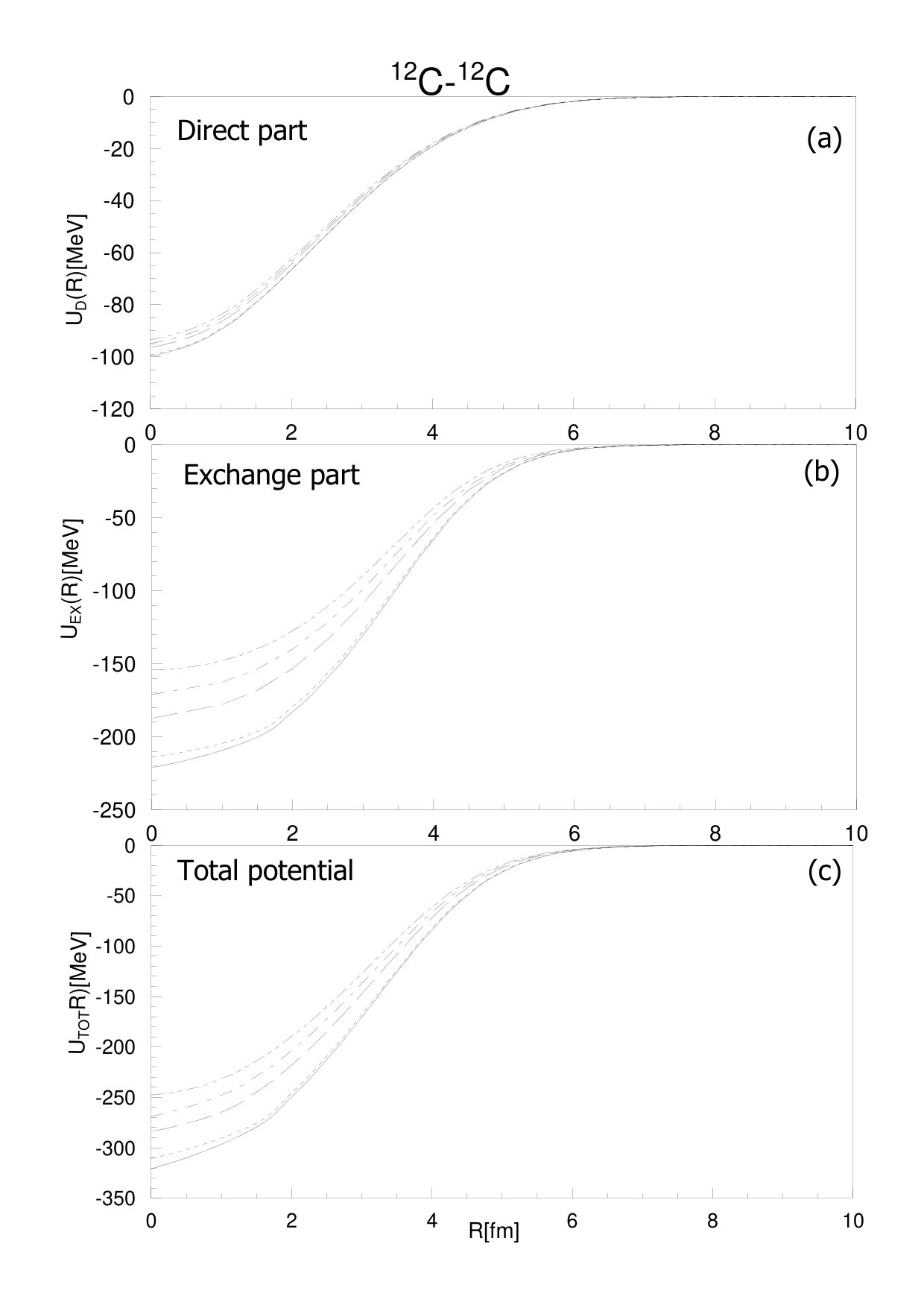 Figure 1
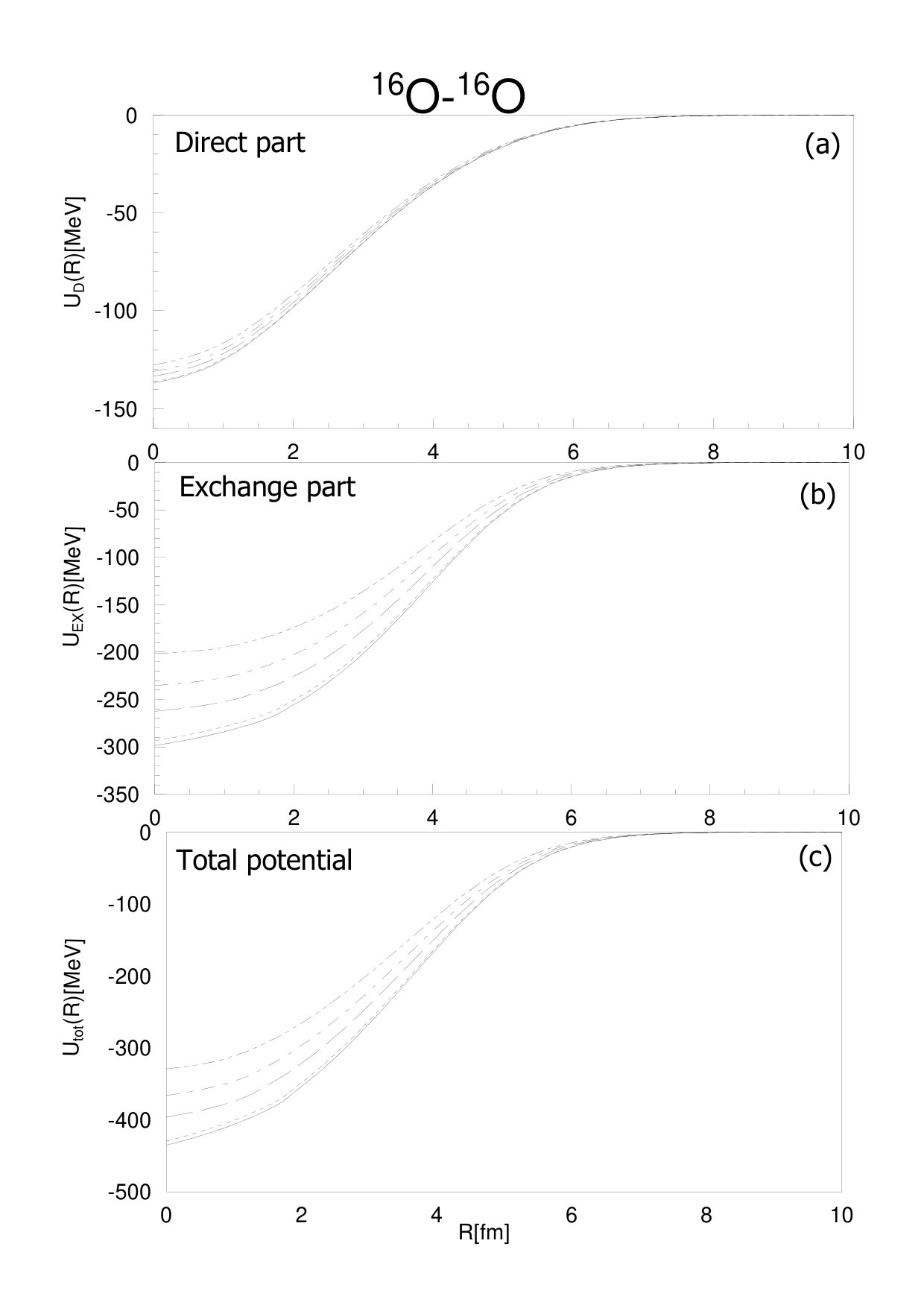 Figure 2
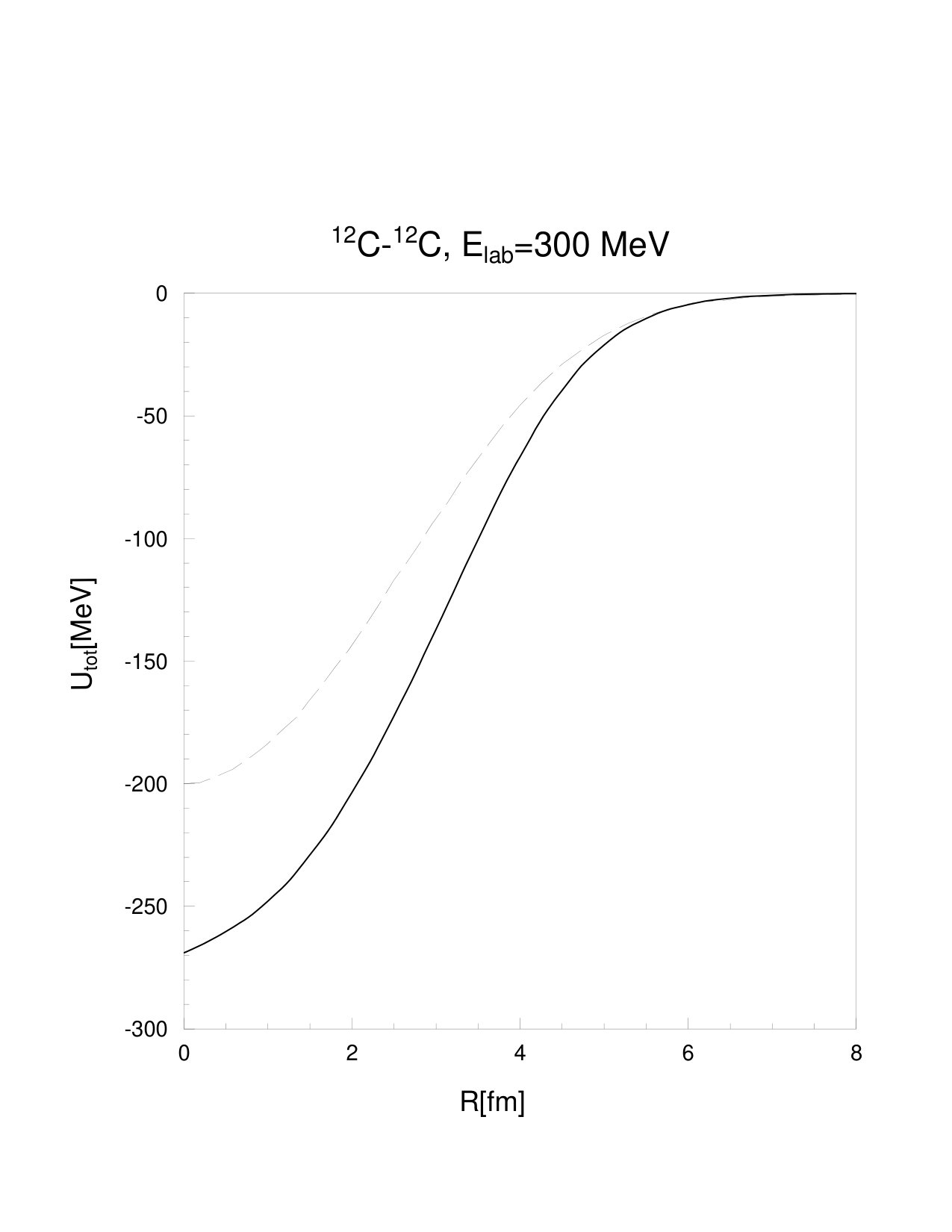 Figure 3
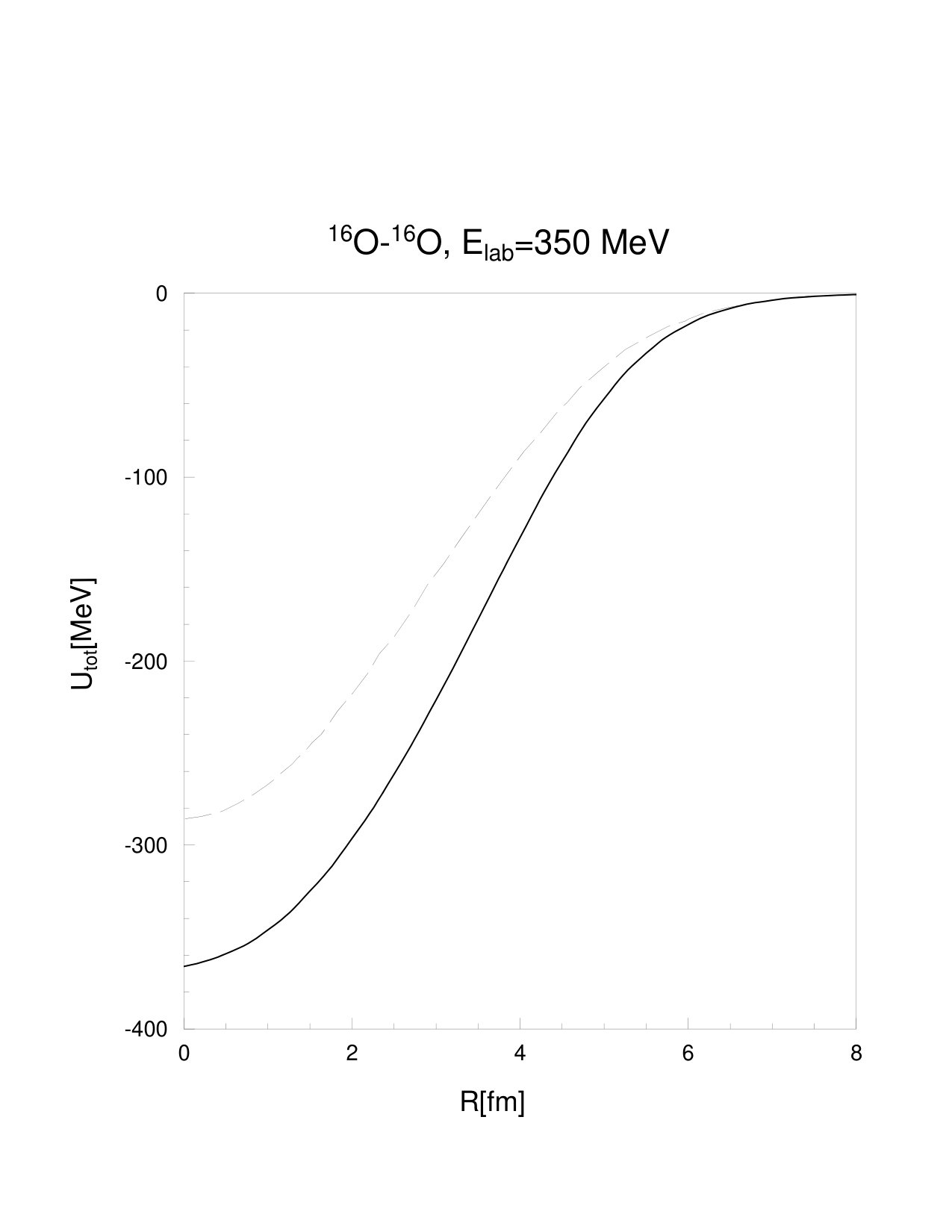 Figure 4
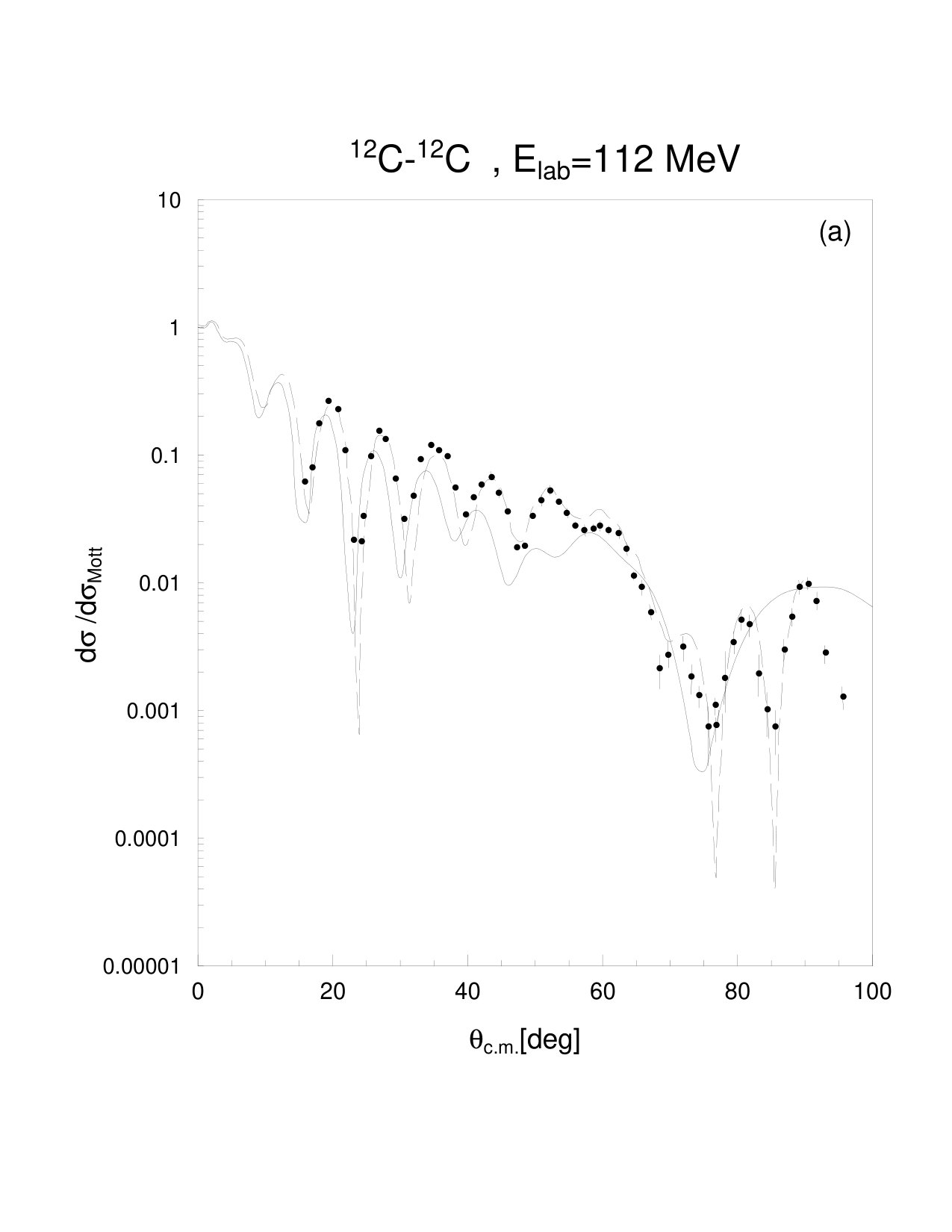 Figure 5
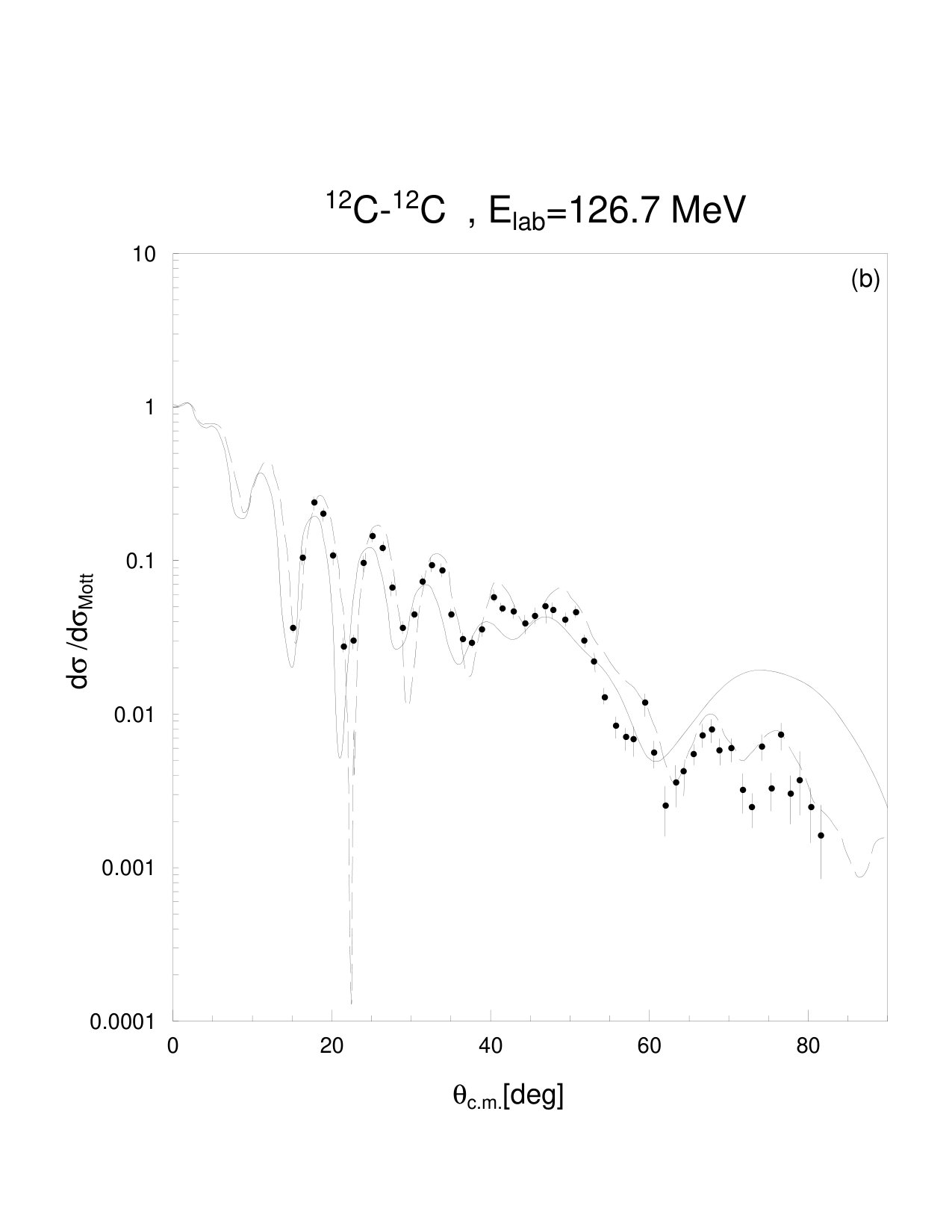 Figure 5
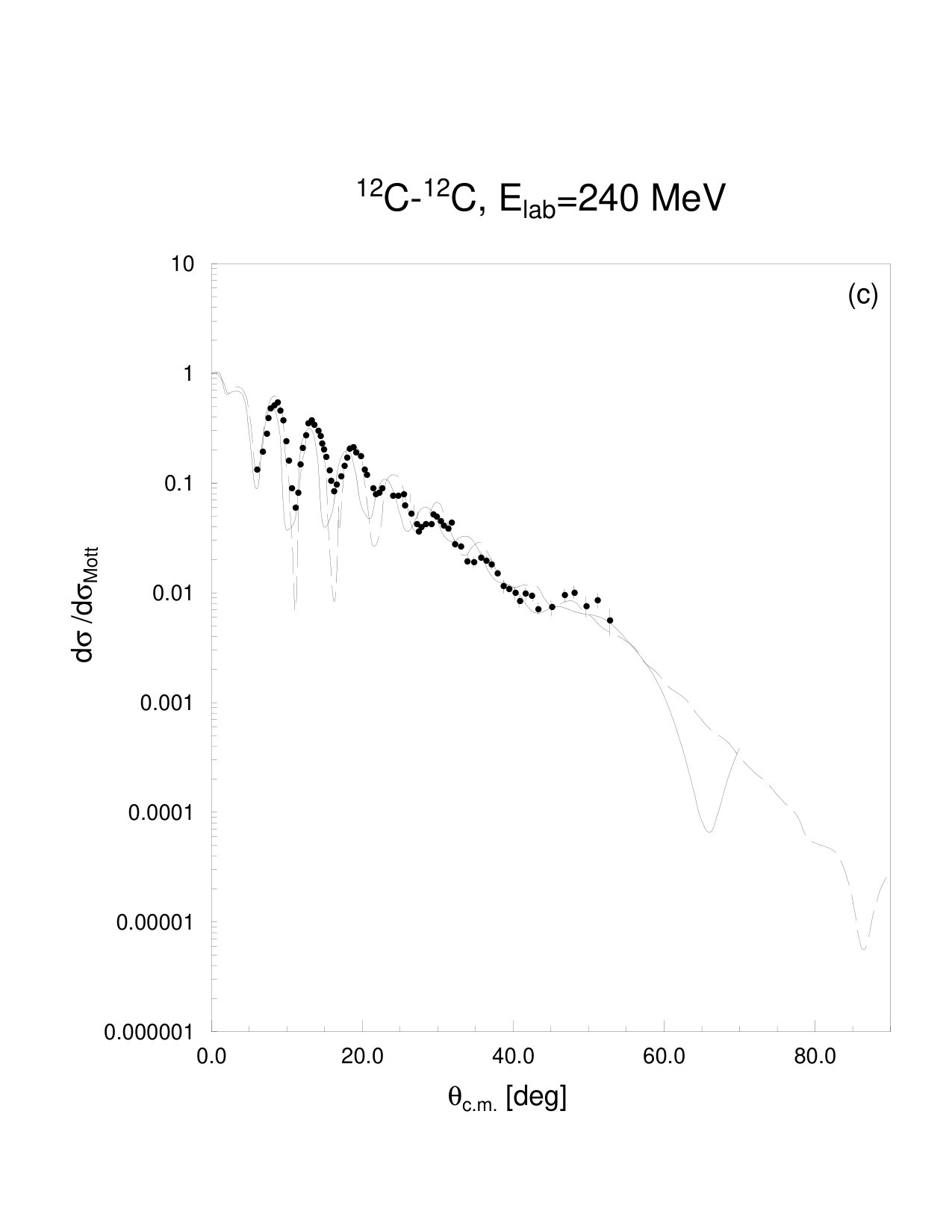 Figure 5
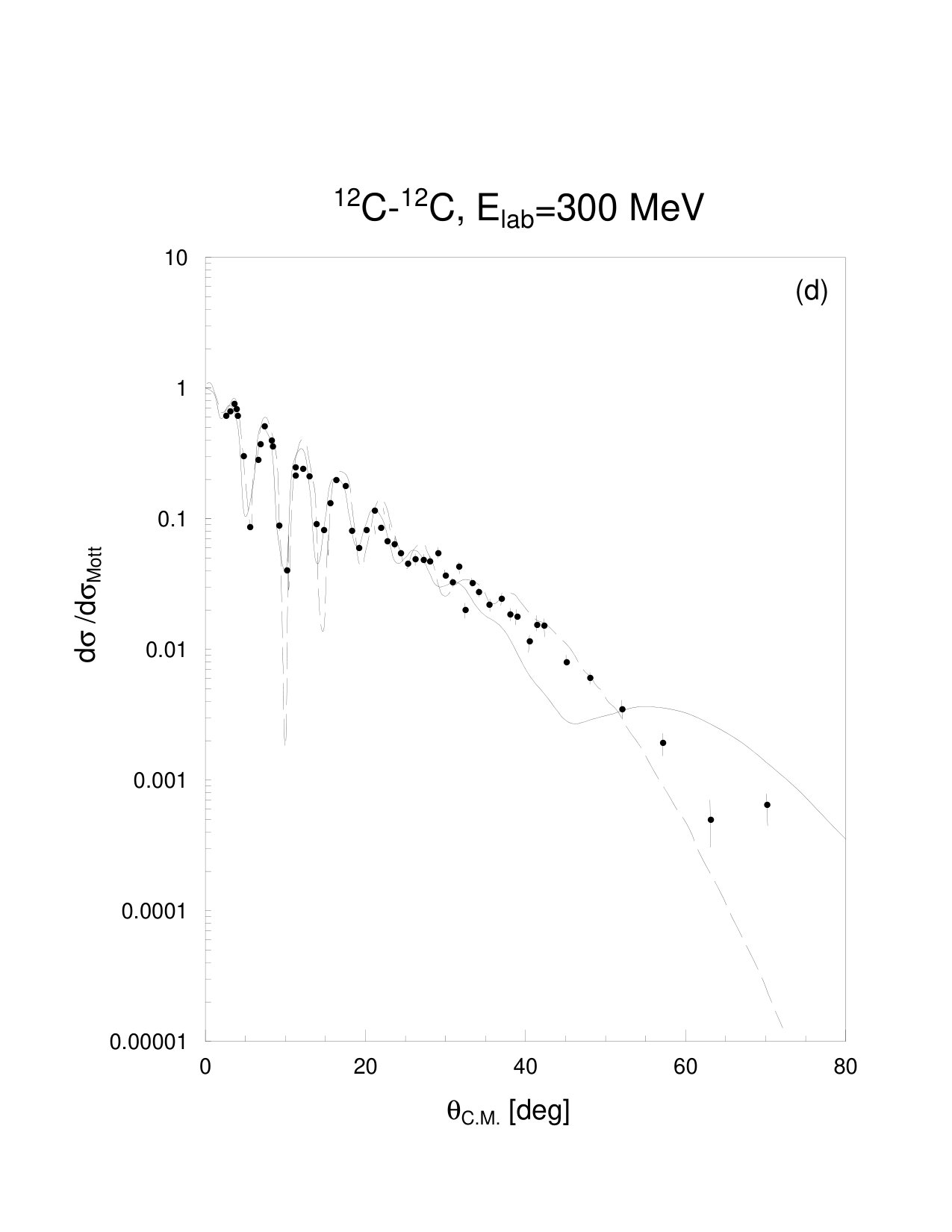 Figure 5
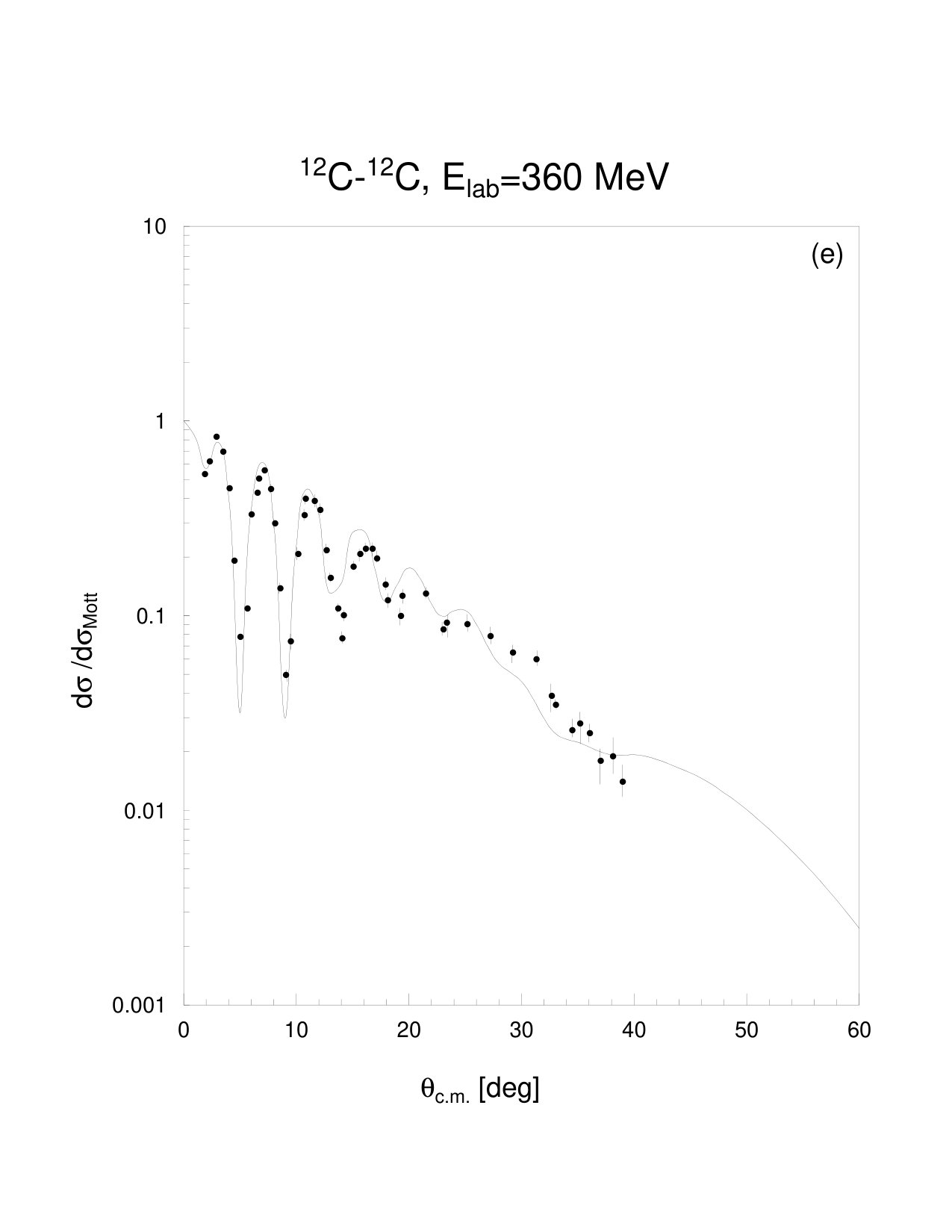 Figure 5
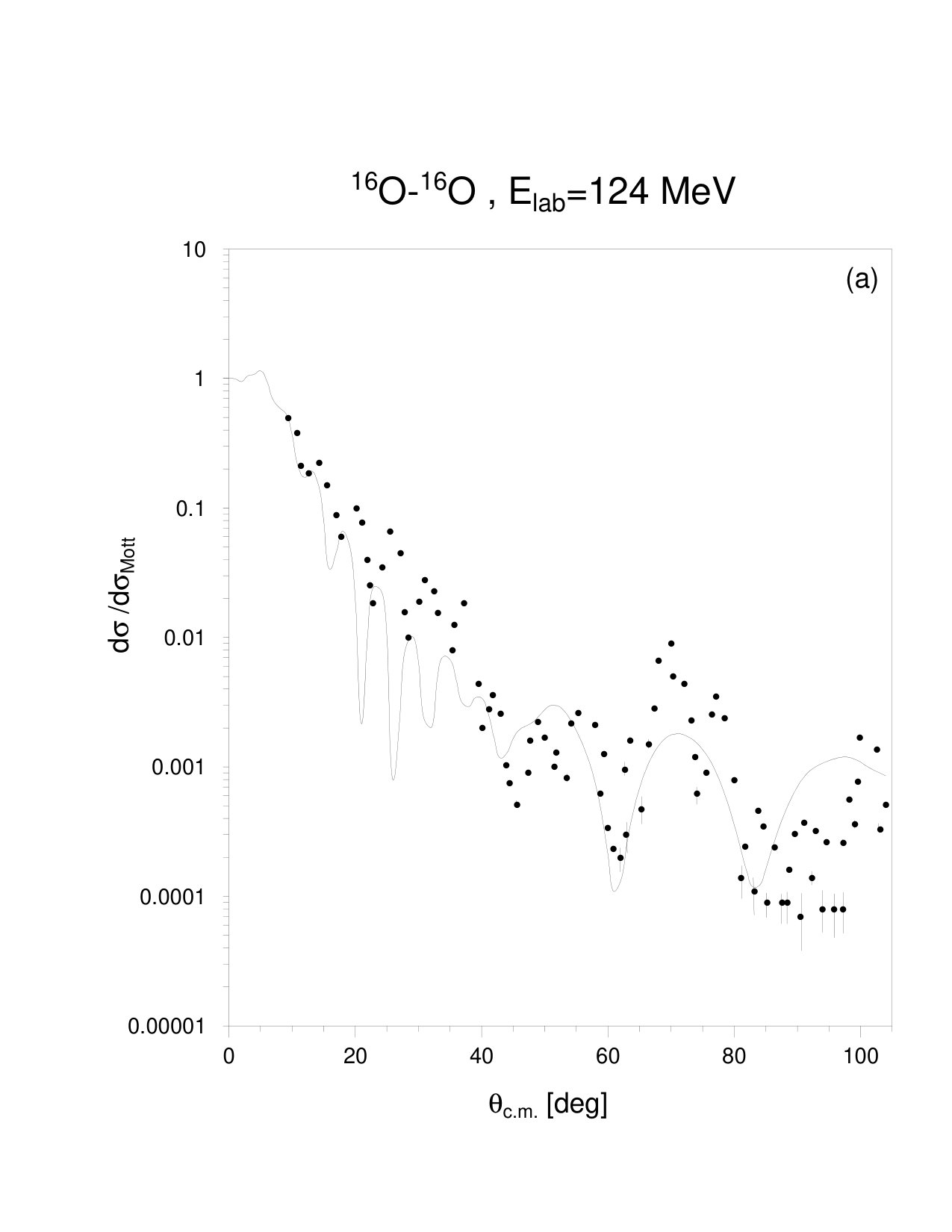 Figure 6
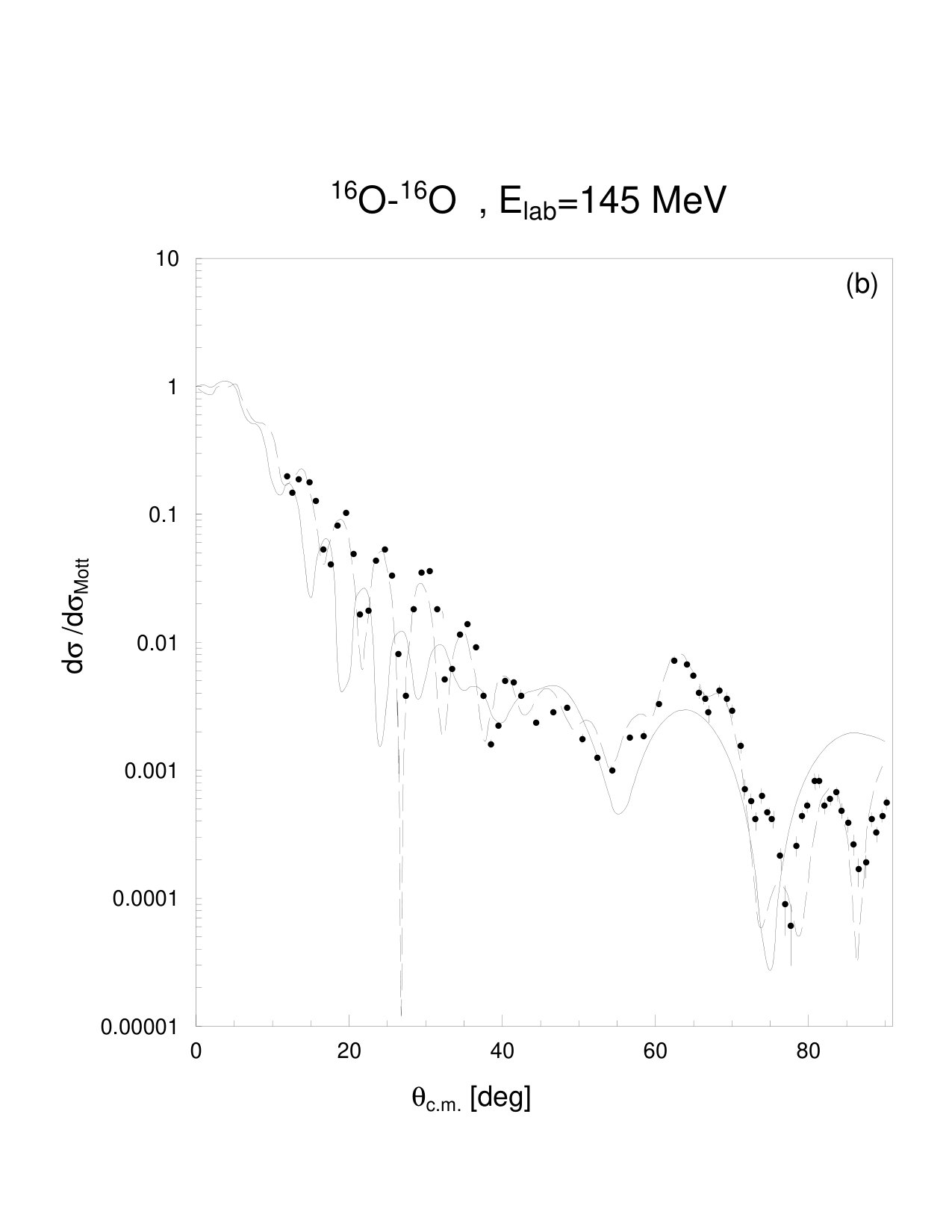 Figure 6
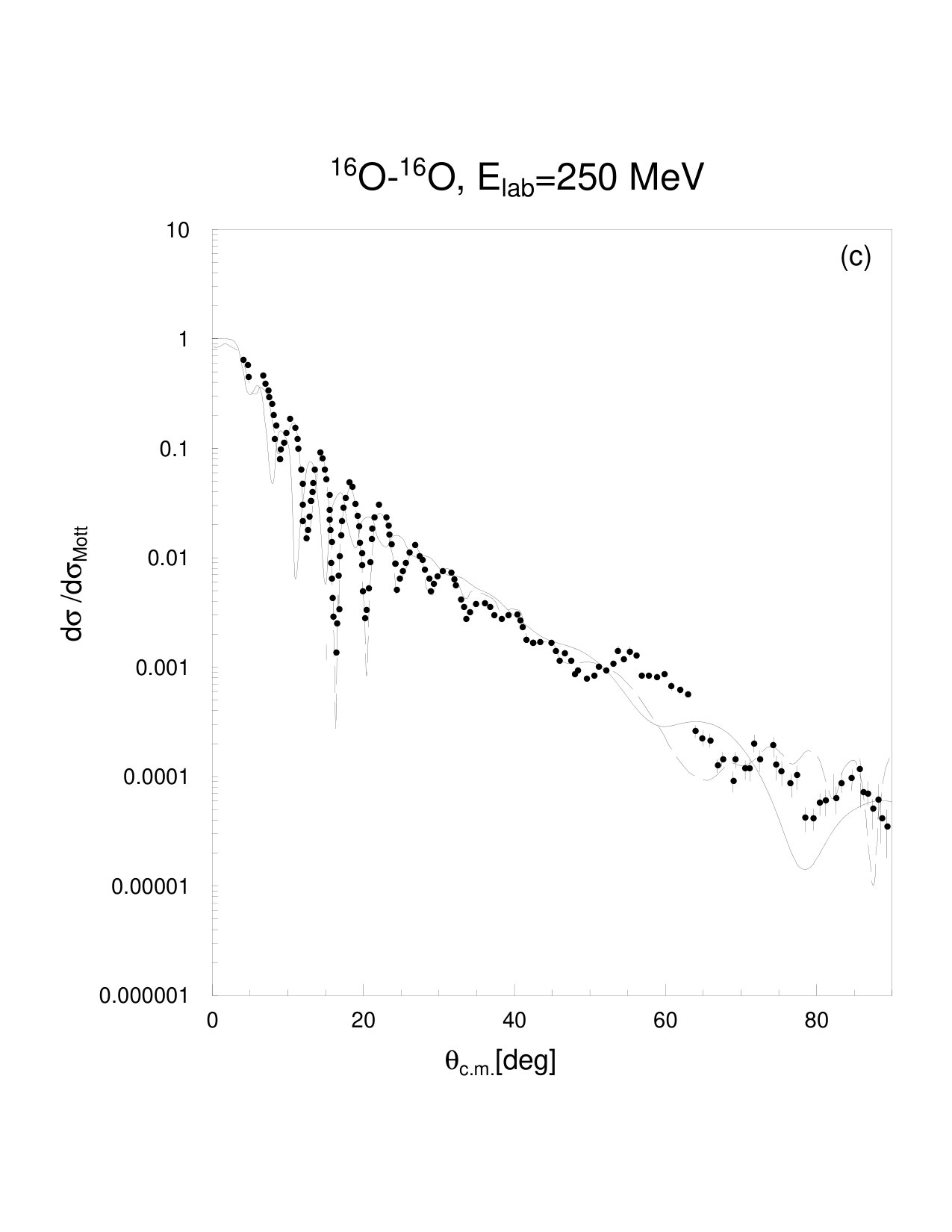 Figure 6
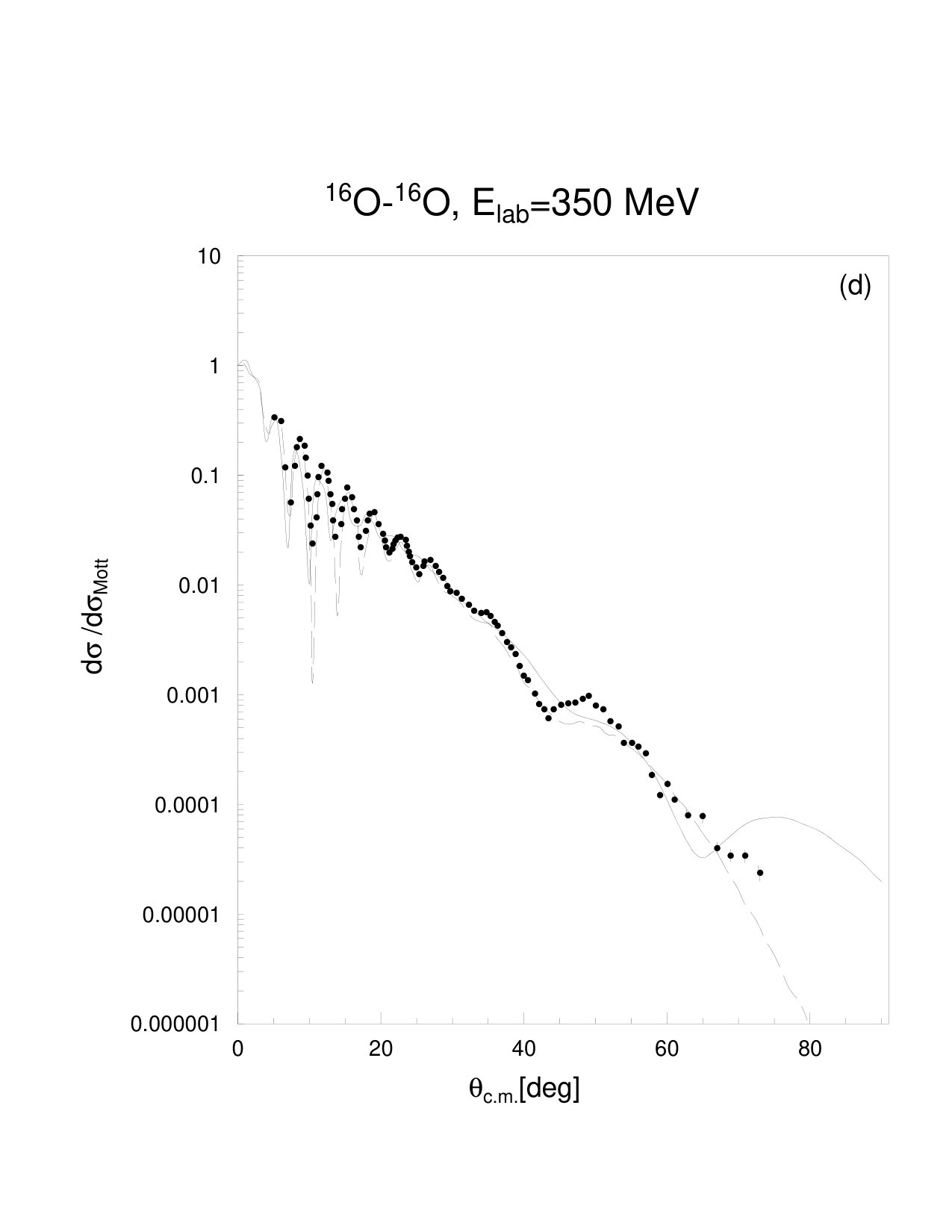 Figure 6
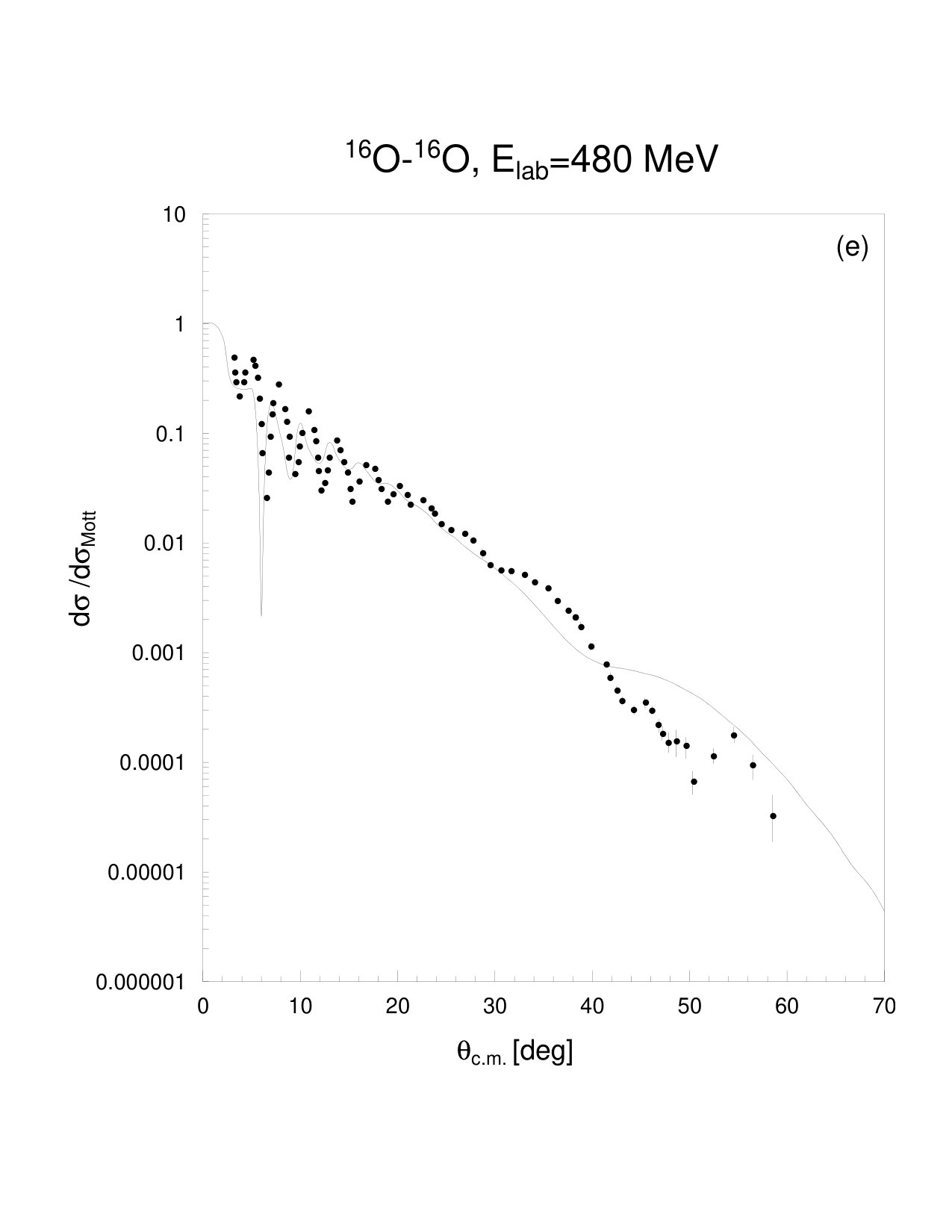 Figure 6
| With Reid | With -Reid | |||||
| Empirical | ||||||
| Saturation Fermi | 1.61 | 1.46 | 1.55 | 1.44 | 1.38 | |
| momentum | ||||||
| Saturation binding | 22.54 | 21.85 | 16.28 | 15.52 | 15.86 | |
| energy | ||||||
| Compressibility | 340 | 298 | 300 | 277 | (200-300) | |
| Convergence parameter | 0.127 | 0.085 | 0.093 | 0.062 | ||
| Direct component | 0.38 | 5.03 | 3.22 |
|---|---|---|---|
| Exchange component | 13.57 | -0.9 | 0.12 |
| 112 | 0.9383 | 17.4 | 5.403 | 0.70 | 1526.79 | 36.52 |
|---|---|---|---|---|---|---|
| 126.7 | 0.9230 | 19.10 | 5.128 | 0.79 | 1563.51 | 41.86 |
| 240 | 1.0207 | 28.90 | 5.266 | 0.69 | 1551.95 | 39.34 |
| 300 | 0.9731 | 33.82 | 4.991 | 0.72 | 1497.85 | 18.33 |
| 360 | 0.9684 | 34.5 | 4.808 | 0.70 | 1374.73 | 9.81 |
| 124 | 0.9455 | 15.3 | 6.30 | 0.93 | 2201.99 | 34.34 |
|---|---|---|---|---|---|---|
| 145 | 1.007 | 16.4 | 6.199 | 0.95 | 2226.17 | 37.07 |
| 250 | 1.011 | 31.6 | 5.695 | 0.86 | 2091.89 | 39.71 |
| 350 | 0.9890 | 36.76 | 5.544 | 0.77 | 1876.58 | 21.19 |
| 480 | 0.9703 | 42.65 | 5.241 | 0.79 | 1778.03 | 42.37 |
Peer Reviews
No public reviews on file for this paper yet. If you reviewed it on a platform where reviews are public (OpenReview, ICLR, NeurIPS, ICML), you can paste yours below so the community can read it here.
Videos
No videos yet. Explain this paper in a talk, walkthrough, or lecture? Add one.
Folding model analysis of and elastic
scattering using the density-dependent LOCV averaged effective interaction
Corresponding author, Email: [email protected], Tel:+98-21-61118645, Fax:+98-21-88004781.
Department of Physics, University of , 1439955961, , Iran.
Abstract
The averaged effective two-body interaction (AEI) which can be generated through the lowest order constrained variational (LOCV) method for symmetric nuclear matter (SNM) with the input Reid68 nucleon-nucleon potential, is used as the effective nucleon-nucleon potential in the folding model to describe the heavy-ion (HI) elastic scattering cross sections. The elastic scattering cross sections of and systems are calculated in the above frameworks. The results are compared with the corresponding calculations coming from the fitting procedures with the input finite range DDM3Y1-Reid potential and the available experimental data at different incident energies. It is shown that a reasonable description of the elastic and scattering data at the low and the medium energies can be obtained by using the above * LOCV AEI*, without any need to define a parameterize density dependent function in the effective nucleon-nucleon potential, which is formally considered in the typical DDM3Y1-Reid interactions.
pacs:
12.38.Bx, 13.85.Qk, 13.60.-r
Keywords: LOCV, effective potential, folding model, nucleon-nucleon potential, nuclear matter, finite nuclei, nucleus-nucleus scattering, heavy ions.
I Introduction
In recent years, there has been a growing interest in the heavy-ion (HI) scattering. These collision processes were investigated widely both experimentally and theoretically. One of the goals of studying the HI reactions is to determine the form of the most suitable effective nucleon-nucleon potential, to explain the experimental elastic scattering cross section data 4 ; 4p . For many years, the use of empirical parametrization of nuclear potential was very common in the HI studies, but it is desirable to relate the nucleus-nucleus () interactions to the nucleon-nucleon (NN) nuclear potential 2 . Many attempts in this direction have been made, and recently, the double-folding (DF) model was extensively used by many groups in describing the HI scattering, since it gives a simple possibility of numerical handling in two nucleus scattering calculations 3 .
In the folding model, the potential is usually generated by folding an effective NN interaction over the ground-state density distribution of the two nuclei 4 ; 4p . In general, we need a well-defined effective NN interaction which reproduces the basic nuclear matter properties (like the saturation energy and density), and, on the other hand, it can be used as a basic input in the description of HI scattering qualitatively with respect to the experimental data 5 . The M3Y interaction 6 and its density dependent versions 7 ; 8 ; 9 ; 10 ; 11 ; 12 ; 13 , are usually used into the folding model. Recently the G-matrix and extended approaches 131 ; 132 ; 133 ; 134 ; 135 ; 136 with and without the inclusion of the three body force (TBF) and the rearrangement term (RT), were applied for calculating the nucleon-nucleus and the nucleus-nucleus scattering cross-section calculations (but mainly at 70 ), as well as obtaining the nuclear matter saturation properties () 131 . The RT comes out in case of calculating the single particle energy and the corresponding potential. But in the present work, we intend to apply the lowest order constrained variational averaged effective interaction LOCV AEI, which was generated by using the input Reid68 potential in our previous work 14 , as the effective NN interaction, into the folding model to test the validity of our interaction in describing the HI elastic scattering. In this paper, we limit ourselves to the elastic scattering of spherical projectile and spherical target nuclei, so we consider the and elastic scattering.
A brief discussion about the method is given in the appendix A. Contrary to G-matrix approach, in the formalism (which is based on the cluster expansion clark ), the wave functions, e.g. the correlation functions, are calculated through the Euler-Lagrange differential equations, whereas the application of G operator on the plane wave generate the interacting wave functions. Another advantage of the cluster expansion is its expansion in the powers of correlation functions (in the G-matrix language the wound parameter) and the first power of the NN potential. So it converges faster than the G-matrix approaches which is an expansion in the powers of the potential. On the other hand since we directly calculate the LOCV AEI, there is no need to calculate the RT in our approach. In the table 1, the results of the saturation properties of symmetrical nuclear matter () calculation for the and potentials, (in comparison to the empirical one), are presented. The method is self-consistently predict the of (for the detail see the appendix and the table A.1). The one-body, ( (is simply the Fermi energy)), the two-body cluster, (), and the three-body cluster ,(), terms as well as the convergence parameters are discussed in the appendix.
In some of our calculations, we have taken into account the effects of such as the box diagram (see the appendix A). But in the present work since we intend to compare our results with those coming from the M3Y interaction 6 which is based on the Reid68 potential, so our results will be limited to this interaction. However we hope in our future works, the other interactions as well as the effects of the on the nucleus-nucleus differential cross sections are evaluated. In the table A.1 it is clearly demonstrated that the method predicts the saturation properties close to other methods, even with or without 464 . We should point out here that there is no extra parameters and conditions on the method to predict the saturation properties of .
In our recent paper 14 , we derived the averaged effective two-body interactions (AEI) through the lowest order constrained variational (LOCV) calculations for the with the Reid68 15 , the -Reid68 16 (which takes into the account the effect of three-body force ()) and the A 17 interactions as the input phenomenological nucleon-nucleon potentials, and reformulated them in the radial and density-dependent parts as well as its direct and exchange components . Note that the radial parts are fixed and density dependent functions only depend on density which becomes a constant at fix density, i.e. similar to the calculations. Here as we stated above, we only use the LOCV AEI with the input Reid68 potential into the folding model and compare our results with those coming from the DDM3Y1-Reid which uses a finite range potential as the direct and exchange components i.e. interactions 3 . The LOCV effective two-body interactions were tested by calculating the properties of the light and the heavy closed shell nuclei 18 ; 19 ; 20 , and recently it was used to calculate the in-medium nn cross section, the transport properties of neutron matter 21 ; 22 and the normal liquid Helium-3 23 . In these works, it was shown that the LOCV AEI gave the reasonable results in comparison to the corresponding available data.
So, this article is organized as follows: In the section 2, we briefly review the theoretical formalism of the double folding model. The density distributions and the different kinds of the effective interactions used into the folding model as well as the computational procedure are also discussed in this section. Finally, while the results of the calculations and discussions are given in the section 3, the section 4 is devoted to the summary and conclusions.
II THE THEORETICAL FORMALISM
II.1 The double folding model
Satchler and Love 24 presented the basic idea of the folding model in detail and in the reference 3 , an improved version of folding model was introduced to calculate the exchange part of the HI potential. We give here only a brief description of this model and refer the reader to the references 4 ; 4p ; 24 ; 25 ; 26 ; 27 for details. In the first order of Feshbach’s theory for the optical potential, the microscopic nucleus-nucleus potential can be evaluated as an antisymmetrized type potential for the system 4 ; 4p ; 3 :
[TABLE]
where and refer to the single-particle wave functions of nucleons in the two colliding nuclei and , respectively; and are the direct and the exchange parts of the effective NN interaction. After doing some algebra, one can explicitly write the energy-dependent direct and exchange potentials as,
[TABLE]
[TABLE]
Note that, in general the one-body density is written as . In the case of direct term, it becomes or , i.e. the diagonal terms, where and are the positions of the two nucleons in the nuclei p (projectile) and t (target), respectively, corresponds to the distance between the two specified interacting points of the projectile and the target, and R is a vector from the center of the t nucleus to that of p nucleus. But in case of the exchange terms, we have for each nucleus, i.e. nondiagonal terms, with () or (). So for the exchange term the densities are the functions of two different coordinates 3 . In the above equations, the wave number associated with the relative motion of colliding nuclei, which is given by:
[TABLE]
where , , and are the reduced mass number, the bare nucleon mass, the center-of-mass (c.m.) energy and the incident laboratory energy per nucleon, respectively. Here and are the total nuclear and the Coulomb potentials, respectively. It can be seen from the equation (3) that the energy-dependent HI potential is nonlocal through its exchange term. For simplicity of the numeric calculations, a realistic local expression for the density matrix is usually used 28 :
[TABLE]
where . The explicit form of is given in the reference 3 . In order to specify the overlap density during the HI collision, we have applied the procedure used in the reference 3 that is called frozen density approximation (). In this approach, the overlap density, , is taken to be the sum of the densities of the target and the projectile densities at the midpoint of the inter-nucleon separation, i.e.,
[TABLE]
This procedure simply corresponds to the local density approximation assumed in the different nuclear matter studies 3 ; 18 ; 19 ; 20 .
After performing some transformations one can obtain the exchange potential in the following local form:
[TABLE]
where ( will be defined later on, i.e. see the equations (19) to (25) in the subsection II-B),
[TABLE]
Applying the folding formulas in the momentum space 28 , one can write the exchange potential as:
[TABLE]
The explicit form of function can be found in the reference 3 .
As it can be seen from the equation (4), the wave number of relative motion, , depends on the total HI potential, so, we encounter with a self-consistency problem in obtaining the exchange part of HI potential at each radial point. In general, this problem can be overcome by applying an iterative procedure, as it was performed for the first time by Chaudhuri et al. 29 . However, in the references 26 ; 27 a closed expression was used to obtain the exchange potential by using the multiplication theorem of the Bessel function . In this paper, we use the iterative method to ensure the self-consistency at all the radial point, in which, we chose as the starting potential to enter in the term in the exchange integral, the equation (9).
Since the effective NN interactions applied into the folding model are real, the calculated HI potentials are also real, so, the imaginary part of HI potential, is usually treated phenomenologically and its parameters are adjusted to optimize the fit to the observed scattering. In the most cases, the Woods-Saxon (WS) shape (with volume or the surface type) is used for the imaginary potential. Finally the HI potential can be written in the general form as:
[TABLE]
where the renormalization coefficient together with the parameters of the imaginary potential are adjusted to give the best fit to the scattering data. The renormalization coefficient is needed to account roughly for the many-nucleon exchange effects and the dynamical polarization potential () 24 . The volume or the surface (the second and the third terms at above formula) are usually used as the imaginary potential in the elastic scattering analysis. However, we only use the volume term in our present calculations.
In the calculation of the exchange potential, we need also the Coulomb potential, . According to the reference 30 , the different models for the Coulomb potential do not have serious effect on the theoretical predictions. So, in our optical model (OM) calculations, we chose the Coulomb potential to be a simple interaction between a point charge and a uniform one with the radius 2 ,
[TABLE]
with and , , with .
II.2 The choice of the effective interaction and the density distribution
As it can be seen from the equations (2) and (3), the basic inputs into the folding model are the nuclear densities of the colliding nuclei in their ground state and the effective NN interaction. The density distributions should be normalized as:
[TABLE]
where is the mass number of the projectile or the target nucleus. In this paper, the nuclear densities of two colliding nuclei are approximated by the two-parameter Fermi distribution: with parameters taken from the table 1 of the reference 32 .
Given correct nuclear densities as inputs for the folding calculations, it is still necessary to have an appropriate NN interaction for a reasonable prediction of the nucleus-nucleus potential. The bare nucleon-nucleon interaction, obtained from analysis of NN scattering measurements, is too strong to be used directly in the folding model, so, it is common to use an effective in-medium interaction 4 ; 4p . To evaluate an in-medium NN interaction starting from a realistic free NN interaction, still remains a challenge for the nuclear many-body theory. Therefore, most of the microscopic nuclear reaction calculations so far, still use different kinds of effective in-medium NN interaction 3 . One of the most popular choice for the NN interactions, were based on the M3Y interactions and its density dependent versions 7 ; 8 ; 9 ; 10 ; 11 ; 12 ; 13 . These interactions are designed to reproduce the G-matrix elements of the Reid 33 and the Paris 34 NN interactions in an oscillator basis 4 ; 18 ; 19 ; 20 . We refer to these as the M3Y-Reid and the M3Y-Paris interactions, respectively. The explicit forms for the direct part of interactions are 4 ; 4p :
[TABLE]
[TABLE]
whereas the exchange parts of interactions in the finite-range-exchange () form (M3Y/FRE) are written as 4 ; 4p ; 2 ; 3 :
[TABLE]
[TABLE]
However, in many other calculations, the zero-range pseudo-potential (M3Y/PP) is used to represent the knock-on exchange 4 ; 4p . But in this work we focus on the finite range interactions i.e. equations (13) and (15).
The older potentials based upon the density-independent M3Y interactions could reasonably reproduce the data of HI scattering at the forward angle, or low energies 4 ; 4p . Also, the ground-state energy of nuclear matter (in a standard calculation) using the M3Y interactions is calculated in the reference 7 . One can realize that, the density-independent M3Y interactions do not fulfill the saturation condition for cold nuclear matter, i.e. leading to collapse. To ensure the predication of the nuclear matter saturation, an appropriate density-dependent factor is introduced into the original M3Y interaction. It is usually taken as an independent factor that multiplied to the original radial M3Y interaction, i.e. . As it is stated in the references 4 ; 4p , there is no theoretical justification for this factorization, but it leads to improve the description of nuclear matter properties and the HI scattering data. Various forms for were proposed. In the and , the following form is assumed for the density dependent of the potential:
[TABLE]
In interactions, a power-law dependent on is supposed:
[TABLE]
The parameters , , and are adjusted to reproduce the saturation of cold symmetric nuclear matter at and a binding energy per nucleon of about . The values of these parameters for and and interactions are given in the references 4 ; 4p ; 7 ; 30 ; 35 . As we pointed out before for comparison we focus on the finite range interaction 3 .
In the course of these application to the scattering data, it is necessary to introduce an additional energy dependent factor over which provided by localization of the exchange potential:
[TABLE]
where with or for the interaction or the interaction 2 , respectively. However none of the above potentials come from a Hamiltonian based many-body microscopic calculations.
In the present work, the density dependent averaged effective two-body interaction (AEI) is generated though the LOCV method with the bare nucleon-nucleon phenomenological Reid68 potential, and inserted as an input to the folding model calculations. In our previous work 14 , we obtained the direct and the exchange parts of the density dependent nucleon-nucleon AEI as follows (see the appendix for the definition of and ):
[TABLE]
[TABLE]
where , is the total orbital angular momentum of two nucleons i.e. plus , and , is the total iso-spin of two nucleons. Then we have reformulated these interactions as the product of a pure radial and a pure density-dependent parts:
[TABLE]
Here, we chose and to give the best fit to the and the corresponding equation of state (-) of nuclear matter. The reader should note that, by this statement, we mean that the fitted potentials should again reproduce the saturation properties given in the table 1.
There are many different functions which can fit well enough. A detailed role of description of density-dependent factor () can be found in our previous work, the reference 14 , where we stated that the includes a radial part and a density-dependent part and we show that, the radial part form of the is fixed in any density (exactly like the M3Y type interactions) and the of without taking into account the density-dependent factor did not fulfill the saturation condition and the system was collapsed (see the figure 7 of the reference 14 ). But one should notice that our density-dependent factor is not an external factor and it comes from the calculations. So, we just parameterized it in a suitable form (i.e. see below, the equation (23)) (the exponential dependent form for density). In the reference [21], we compared the direct and exchange parts of the with the corresponding results of the M3Y interactions.(see the figures (1) and (4) of the reference 14 )
So as we stated above, similar to our previous work 14 , in order to reproduce the - of nuclear matter properly, we use the power-law-dependent on : . In this paper, we use the exponential dependent form for (similar to the interaction):
[TABLE]
This choice allows us to easily calculate the integration of the double-folding equations in the momentum space 4 ; 4p . The parameters of equation (23) are given in the table 2.
Similar to the M3Y interactions, in order to apply the LOCV AEI to the scattering data, we need to add an explicit energy-dependent factor to our LOCV AEI to obtain the best description of HI scattering by taking into account the variation in the incident energy. We found that this factor can be assumed as the linear dependent to the incident energy per nucleon, which is similar to the M3Y interactions i.e. . So, we can rewrite the LOCV AEI as:
[TABLE]
Here, as in other works, the is chosen to give the best fit to the scattering data. It is shown that in the case of our LOCV AEI by choosing , the optimized fit will be acquired. However, the calculation is not very sensitive to this parameter if it is chosen in its order.
II.3 The Computational procedure
At first, we calculate the real part of the folded potential for and elastic scattering by the double folding formula, i.e. the equations (2) and (3). Then we use the LOCV AEI as the effective NN interactions and the two-parameter Fermi distribution for the nuclear densities of the projectile and the target nuclei. Now, in order to compute the scattering differential cross section, we also use the code developed by Ian Thompson 36p which is developed for the calculation of different types of nucleon-nucleus and nucleus-nucleus scattering cross-sections. This code is capable to use our folded potential directly, to calculate the elastic scattering cross section.
We will discuss our resulting potentials and the elastic scattering cross section for and systems in the next section. Generally, the goodness of our resulting cross section is quantified via the expression 4 ; 4p ,
[TABLE]
where and are the theoretical and the experimental cross sections and are defined as the uncertainties in the experimental cross sections, respectively. is the total number of angles at which measurements are made.
III RESULTS AND DISCUSSIONS
As it was pointed out in the previous section, in order to calculate the direct and the exchange components of the real part of the HI optical potential, we use the direct and the exchange parts of the LOCV AEI as the effective NN potential in the double folding formula (the equations (2) and (3)). Since the wave number of relative motion , the equation (4), depends on the total HI potential, we are faced with a self-consistency problem in obtaining the exchange part of the HI potential at each radial point. So, we apply the iterative method at each point and use as the starting potential to enter in the exchange integral, the equation (9), i.e. as it is performed when one considers the M3Y interactions in the folding formula 3 .
Unfortunately at small internuclear distances (), the iterative method for calculating the exchange potential based on the LOCV AEI, does not converge reasonably. Of course, with increasing the incident energy, this problem will be solved. Due to this low convergence speed of iterative method in case of the insertion of the LOCV AEI in the folding formula, we need much more number of iterations with respect to the M3Y interactions, in obtaining the exact self-consistent results for , especially at small internuclear distances. According to the reference 3 , in the case of the M3Y interactions, the number of iterations required is around 20 at smallest radii and ranges from 3 to 5 at the surface region, while, in case of the LOCV AEI, it is around 150 to 200 at smallest radii and around 2 or 3 at the surface region. For this reason, too much CPU computer time is needed to calculate the exchange part of the HI potential in case of the LOCV AEI. For example for the elastic scattering at the , it took about 50 hours computer CPU time by using the high performance computing (HPC) machine of the university of Tehran. Because of the different radial shapes of the LOCV AEI with respect to the M3Y interactions at the small distances, this problem is expected. Conversely to the M3Y potentials, due to short range correlations coming from the channel-dependent correlation functions, at very small distances, the direct and the exchange components of the LOCV AEI go to zero (see the figures 1 to 4 of the reference 14 ) and this behavior makes the iterative method not to converge at these distances as quicker as for the M3Y interactions. While, since the M3Y interactions are constructed from the selected channels of, for example the Reid68 potential, i.e. the singlet and the triplet even and odd components, one does not faced with this problem.
So in the figures 1 and 2, we plot the calculated direct, exchange and also the total components of the folded potential by using the for and systems at several incident energies i.e. 112, 126.7, 240, 300 and 360 for and 124, 145, 250, 350 and 480 in the case of (note that we extrapolate the folded potential at the small distances () for some points that the iterative method is not converge rapidly for calculation of the exchange potential based on ). Comparing the exchange parts with the direct parts at each incident energy, one can observe that the most of energy dependence of the HI potential is arising from the exchange part, as one should expects. We also notice that at small internuclear distances, which corresponds to large overlap densities (), the exchange potential is more deep than the direct potential, especially at lower energies, and this shows that the density-dependent contribution of HI potential predominately comes from the exchange term. On the other hand, in the surface region, which corresponds to the small overlap densities, all the calculated direct and exchange potentials are close in the strength and the slope. The figures 1 and 2 also show that with increasing the incident energy of projectile, the depth of the HI potential at the origin is decreased systematically. Similar results already reported in calculating folded potential using the M3Y interactions, for example see the references 3 ; 5 .
We compare our calculated folded potential, using the with the corresponding results of DDM3Y1 3 for the cases of the at and the at in the figures 3 and 4, respectively. It can be observed that the folded potentials by using the are more deep than the DDM3Y1 ones. For the other energies, the similar results are obtained.
The results of our folding analysis for the elastic scattering, at incident energies ranging from 112 to 360 with FRESCO code are presented in the figure 5 while the table 3 shows the parameters of the imaginary part of HI potential for the same system and at the same energies as well as and (with respect to the experimental data, see the next paragraph). In this paper we take the imaginary part of HI potential as the conventional form and adjust its parameters to obtain the best description of the experimental scattering data in the whole angular range at each incident energy. The parameters in the table 3 are close to those found in earlier analysis for (see the table 2 of the reference 3 ). The table 3 also shows that the best fit to the scattering data, can be found by using the values of which are slightly deviated from the unity. This result indicates that the high-order effects are negligible in our calculations.
The different panels of figure 5 (a to e) show the calculated cross section of elastic scattering at several incident energies, i.e. 112, 126.7, 240, 300 and 360 , by using the LOCV AEI folded potential in the FRESCO code. The scattering experimental data 37 ; 38 ; 39 ; 40 ; 41 ; 42 ; 43 ; 44 ; 45 and the resulting cross sections of the DDM3Y1 3 are also presented. It is observed that a quite good description of data scattering can be obtained by using the LOCV AEI and adjusting the imaginary potential parameters and renormalization coefficient. However, in comparison to the DDM3Y1 () results 3 , our results may not be too satisfactory, especially at forward angles, but one should notice that DDM3Y1 potential was constructed from the selected channels of the Reid68 potential and its density dependent factor was added to it later, to provide a reasonable description of HI scattering data and the equation of state () of nuclear matter, while the LOCV AEI are constructed based on the many-body calculations without any free parameters in the calculations and its density dependent part comes directly from the LOCV formalism (obviously formalism has its owns , i.e. -). It is worth to say that, by increasing the incident energy a better fit to the scattering data is achieved using the LOCV AEI at forward angles.
The calculated cross sections using the LOCV AEI for elastic scattering at incident energies ranging from 124 to 480 MeV are plotted in the different panels (a to e) of the figure 6. The scattering experimental data 37 ; 38 ; 39 ; 40 ; 41 ; 42 ; 43 ; 44 ; 45 show a clear refractive pattern at large angles and a diffractive pattern produced by an interference between nearside and farsight components of the scattering amplitude at the small angles. The refractive pattern can be clearly distinguished from the diffractive structure, i.e. it is shifting substantially towards the small angles with increasing the incident energy 5 .
One can realize that our calculated cross sections can predict reasonably the behavior of scattering data on large ranges of scattering angles 37 ; 38 ; 39 ; 40 ; 41 ; 42 ; 43 ; 44 ; 45 . Similar to the results obtained above for system, there exist considerable differences between our results with respect to the experimental data and those coming from DDM3Y1. Again, the similar discussion can be made for these results as the one we made above for . In this case, it can also be observed that the agreement of our calculations to the scattering data are getting better as the energies of projectile are increased. To improve the agreement of the calculated cross sections using the DDM3Y1-Reid and DDM3Y1-Paris with data in the large-angle region, in the references 3 ; 5 a surface () term was included into the imaginary part of potential. We hope, in our future works, we could investigate the inclusion of the term for improving our results.
The table 4 shows the parameters of our imaginary potential and renormalization coefficient for system at different incident energies as above. Again, we can see the values of are close to the unity and our parameters are in agreement to the parameters of DDM3Y1 analysis 3 .
IV SUMMARY
In conclusion, we analyzed the experimental data of and elastic scattering at different incident energies, within the standard optical model (), using the density-dependent LOCV AEI. The direct and the exchange parts of LOCV AEI were generated based on the LOCV method for the symmetric nuclear matter, using the Reid68 interaction as the input phenomenological potential. In order to use our interaction into the folding model, we separated the radial and the density-dependent parts of the LOCV AEI. Our calculated cross sections for and systems, indicate that a quite reasonable description of data scattering can be obtained by using the LOCV AEI and adjusting the imaginary potential parameters and the renormalization coefficient. Our calculations favor a rather weak imaginary potential and a small deviation of the renormalization factor from the unity. Comparing our calculations with corresponding results of the DDM3Y1, show some considerable differences. But one should notice that the M3Y interactions are semi-phenomenological potentials and they are constructed from the selected channels of the *Reid
- potential, i.e. the singlet and the triplet even and odd components and the parameters of its density dependent part are adjusted to gain a reasonable description of HI scattering data and the EOS of nuclear matter. So, it is natural to fit the scattering data better than ours. While the LOCV AEI are based on the many-body calculation with the phenomenological NN potential without any free parameters, i.e. there are no free parameters in the formalism besides the NN potential and its density dependent part comes directly from the self consistent LOCV calculations. So it is meaningful to apply the interaction to the heavy-ion scattering as the first attempt, but we hope the improvement of the present model could be committed in the near future.
The spite of the slow convergence speed of iterative procedure in using the LOCV AEI in calculating of the exchange potential, especially at small internuclear distances which increases the computing time, since the LOCV AEI are based on the many-body calculations, they are more trustable for the collision calculations. So, with respect to the above arguments, because the LOCV AEI provides a reasonable description of the normal nuclear matter 14 as well as the HI elastic scattering data simultaneously, we can claim the LOCV AEI is a good candidate to approximate the NN interaction for the nuclear matter and finite nuclei .
Finally we should make this comment that the insertion of other phenomenological nucleon-nucleon potential such as the potential, should not have any dramatic change on our present results, but it is worth to be investigated.
Acknowledgements.
The authors would like to acknowledge the Research Council of University of Tehran and the Iran National Science Foundation () for the grants provided for them. They also would like to sincerely thank Professor Ian Thompson for his valuable help regarding the FRESCO code.
Appendix A A brief introduction to the formalism with the Reid68 interaction
In the LOCV method, we use an ideal Fermi gas type wave function for the single particle states and the variational techniques, to find the wave function of interacting system 46 ; 461 ; 462 ; 463 ; 464 ; 465 , i.e.,
[TABLE]
where ( is a symmetrizing operator)
[TABLE]
The correlation functions are operators and they are written as :
[TABLE]
In above equation , and
[TABLE]
In the case of the Reid68 potential, the spin-singlet channels with the orbital angular momentum and the spin-triplet channels with is superfluous and set only to unity, while for it takes the values of 2 and 3. All of the channel correlation functions and heal to the modified Pauli function ,
[TABLE]
with
[TABLE]
where are the familiar spherical Bessel functions and the Fermi momenta is fixed by the nuclear matter density i.e., .
The nuclear matter energy per nucleon is 461 ; 462 ; 463 ; 464 ; 465 ,
[TABLE]
is simply the Fermi gas kinetic energy and it is written as
[TABLE]
The many-body energy term is calculated by constructing a cluster expansion for the expectation value of our Hamiltonian,
[TABLE]
where is the bare N-N interaction. Then, we keep only the first two terms in a cluster expansion of the energy functional:
[TABLE]
The two-body energy term is defined as,
[TABLE]
where
[TABLE]
and the two-body antisymmetrized matrix element are taken with respect to the single-particle functions composing i.e. the plane-waves. In the formalism is approximated by and one hopes that the normalization constraint makes the cluster expansion to converge very rapidly and bring the many-body effect into term.
By inserting a complete set of two-particle state twice in the equation (39) and performing some algebra, we can rewrite the two-body term as following :
[TABLE]
where (c and stand for the central and tensor parts, respectively)
[TABLE]
and ( and )
[TABLE]
[TABLE]
[TABLE]
[TABLE]
[TABLE]
[TABLE]
[TABLE]
[TABLE]
The potential functions ,…..etc., are given in the references 18 ; 19 . The calculation of is discussed in the reference 11p and the references therein.
The normalization constraint as well as the coupled and uncoupled differential equations for the NN-channels, coming from the Euler-Lagrange equations, are similar to those were described in the references 461 ; 462 ; 463 ; 464 ; 465 .
The following important points consider in the formalism: (i) Beside the inter-particle potentials, no free parameter is used in the method, i.e. it is fully self-consistent. (ii) To keep the higher cluster terms as small as possible, it considers the constraint in the form of a normalization condition 461 ; 462 ; 463 ; 464 ; 465 . This was tested by calculating the three-body cluster terms with both the state-averaged and the state-dependent correlation functions 11p . (iii) In order to perform an exact functional minimization of the two-body cluster energy with respect to the short-range behavior of correlation functions, it assumes a particular form for the long-range part of correlation functions. (iv) Rather than simply parameterizing the short-range behavior of the correlation functions, it performs an exact functional minimization 16p . So, in this respect it also saves an enormous amount of the computational time. For example, a nuclear matter calculation with the group potentials at the given density takes a few minutes CPU time on a 1.8 personal computer.
Recently 15p , it was shown that the neutron (nuclear) matter calculations with the various two-body interactions, e.g. the homework potential and the interaction 16p , reasonably agree with those of and Auxiliary Field Diffusion Monte Carlo () 17p ; 18p ; 19p ; 20p ; 21p ; 22p methods. Moreover, it was realized that the different many-body methods such as the and the fermions hypernetted chain approaches give results close to each other when the normalization constraint is imposed in its correct form. Therefore, the normalization constraint plays an important role in the minimizing of the many-body terms.
So in the framework by using e.g. the Reid68 interaction, we solve the set of Euler-Lagrange differential equations to find the correlation functions. Then we can find the - by calculating the expectation value of the Hamiltonian. The minimization of the gives some values for the binding and saturation density of the , which are demonstrated in the tables 1 and A.1. Obviously, as it is well known one should not expect to get the exact empirical values. But in the M3Y type interactions, the situation is different, in order to ensure the empirical saturation density and the binding energy as well as incompressibility of the symmetric nuclear matter, an external density dependent factor is multiplied to the original radial M3Y interactions and the constants of this density dependent function are obtained such that one could reproduce these empirical saturation properties for the . So the case of the method is different from the M3Y type interactions. The separation of radial and density dependent parts of the is done only to make it possible to use the in the double folding procedure.
In the table A.1 we compare the results on the saturation properties of by using different interactions with other many body techniques (The , , and stand for the , , , , , correlated-basis-function and using extended-soft-core interactions, see the references 464 and 131 , and the references therein, for detail, respectively). So the of SNM is directly calculated by the formalism and there is no other constraint for obtaining the saturation properties of .
Finally we should mention that the effect of have been fully discussed especially in the references 461 ; 463 ; 464 .
TABLE A.1: The saturation energy and the density of nuclear matter as well as its incompressibility for different potentials and many-body methods. See reference 464 for detail.
[TABLE]
The reference list from the paper itself. Each links out to its DOI / PubMed record.
- 1(1) M.E. Brandan, G.R. Satchler, Phys. Rep. 285 (1997) 143.
- 2(2) K. Amos, P. J. Dortmans, H. V. von Geramb, S. Karataglidis, Edited by J. W. Negele and Erich Vogt, Adv.Nucl.Phys. 25 (2000) 275.
- 3(3) G.L. Zhang, H. Liu, X.Y. Le, Chin. Phys. B 18 (2009) 136.
- 4(4) D.T. Khoa, W. von Oertzen, H.G. Bohlen, Phys. Rev. C 49 (1994) 1652.
- 5(5) D.T. Khoa, W. von Oertzen, H.G. Bohlen, G. Bartnitzky, H. Clement, Y. Sugiyama, B.Gebauer, A.N. Ostrowski, Th. Wilpwert and C. Langner, Phys. Rev. Lett. 74 (1995) 34.
- 6(6) G. Bertsch, J. Borysowicz, H. Mc Manus, W.G. Love, Nucl. Phys. A 284 (1977) 399.
- 7(7) D.T. Khoa, W. von Oertzen, Phys. Lett. B 304 (1993) 8.
- 8(8) D.T. Khoa, W. von Oertzen, Phys. Lett. B 324 (1995) 6.