Pairs of a tree and a nontree graph with the same status sequence
Pu Qiao, Xingzhi Zhan

TL;DR
This paper disproves two conjectures by constructing specific pairs of trees and unicyclic graphs with identical status sequences, showing that trees and nontree graphs can share status sequences and that status injective trees are not necessarily unique.
Contribution
It provides counterexamples to longstanding conjectures by explicitly constructing pairs of graphs with the same status sequence, including status injective trees that are not unique.
Findings
Constructed pairs of trees and unicyclic graphs with identical status sequences for all n ≥ 10.
Disproved that trees and nontree graphs cannot share status sequences.
Showed that status injective trees are not always unique in their status sequences.
Abstract
The status of a vertex in a graph is the sum of the distances between and all other vertices. Let be a connected graph. The status sequence of is the list of the statuses of all vertices arranged in nondecreasing order. is called status injective if all the statuses of its vertices are distinct. Let be a member of a family of graphs and let the status sequence of be is said to be status unique in if is the unique graph in whose status sequence is In 2011, J.L. Shang and C. Lin posed the following two conjectures. Conjecture 1: A tree and a nontree graph cannot have the same status sequence. Conjecture 2: Any status injective tree is status unique in all connected graphs. We settle these two conjectures negatively. For every integer we construct a tree and a unicyclic graph …
Click any figure to enlarge with its caption.
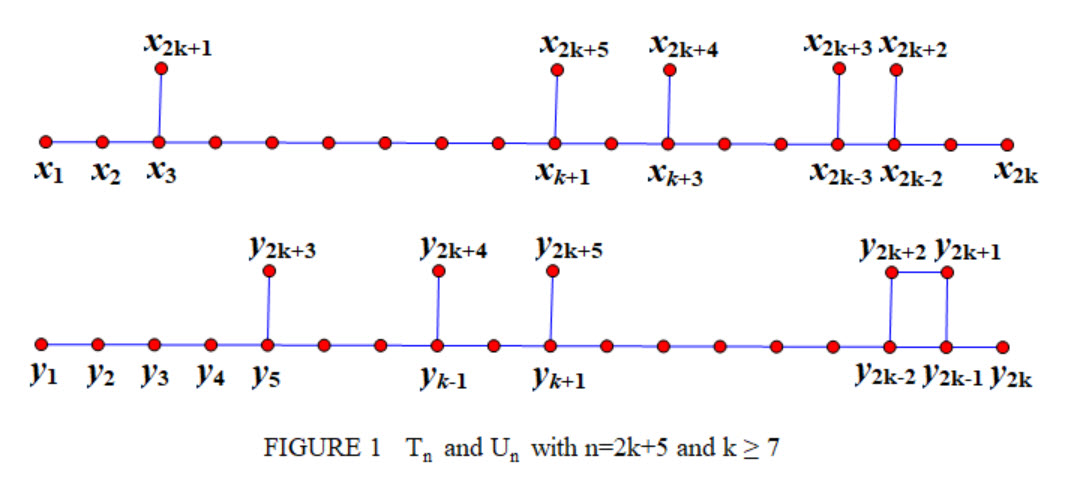 Figure 1
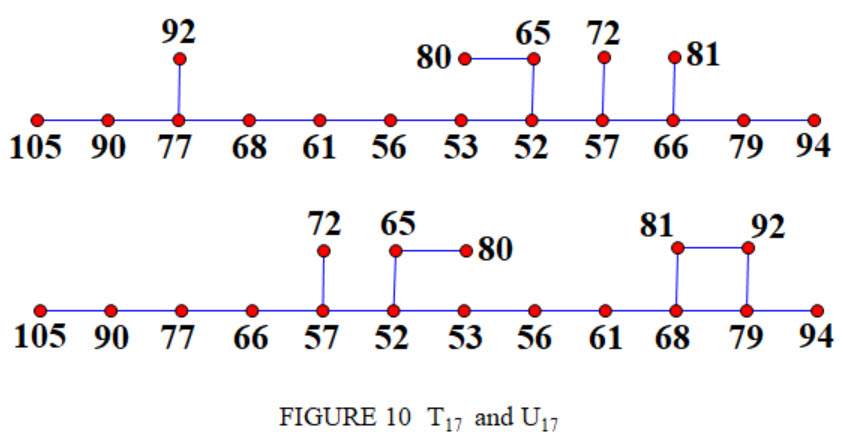 Figure 10
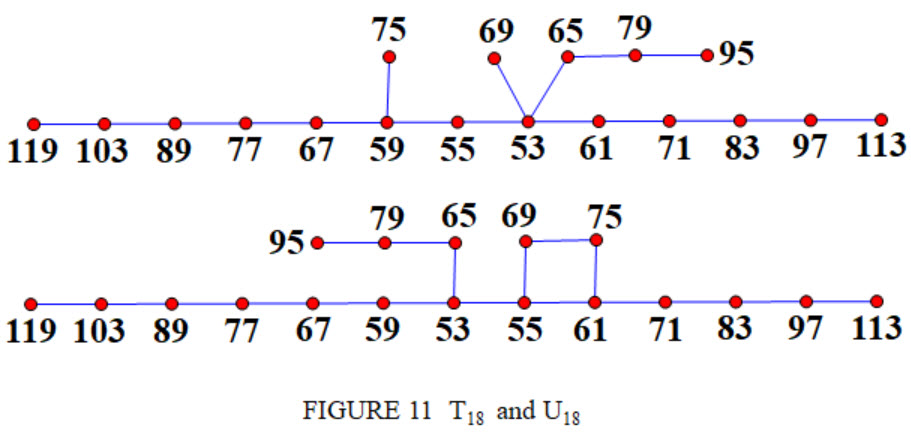 Figure 11
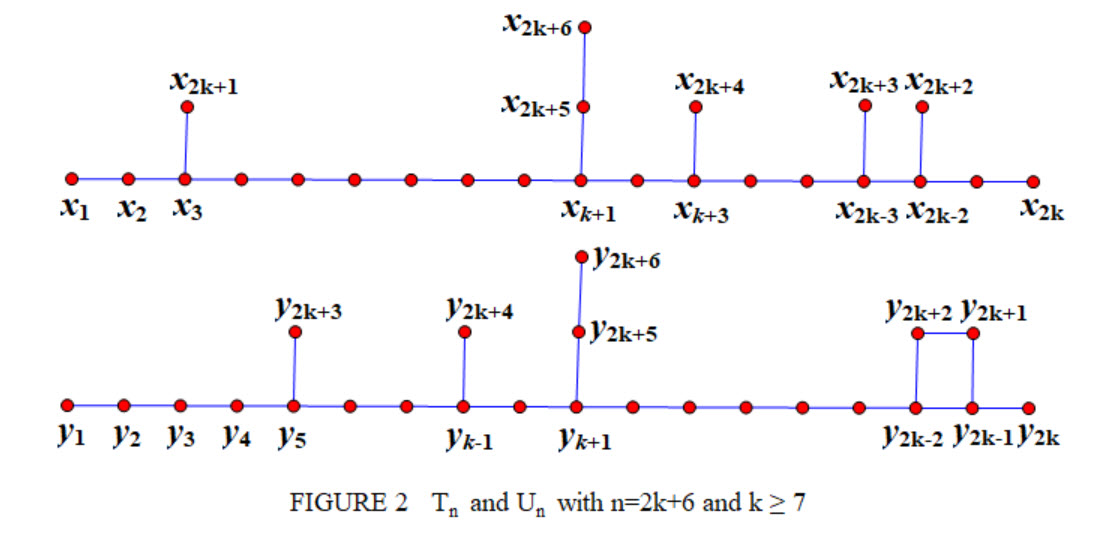 Figure 2
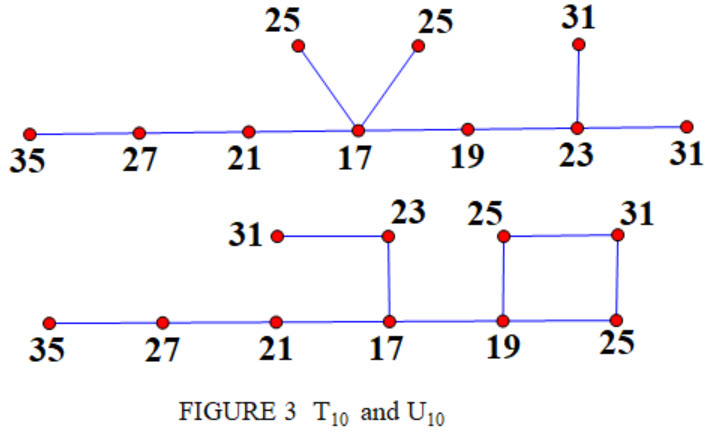 Figure 3
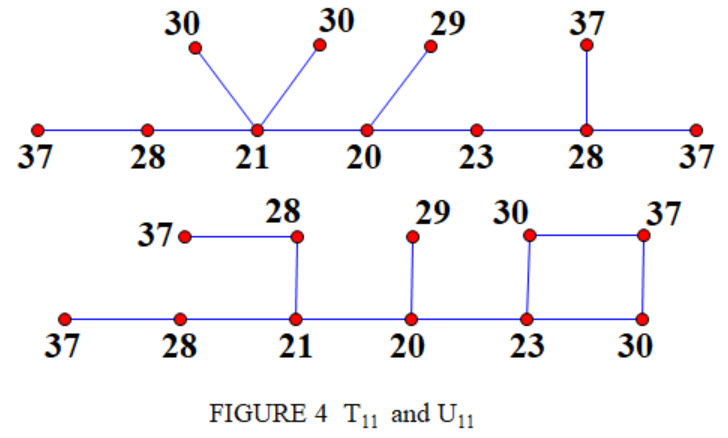 Figure 4
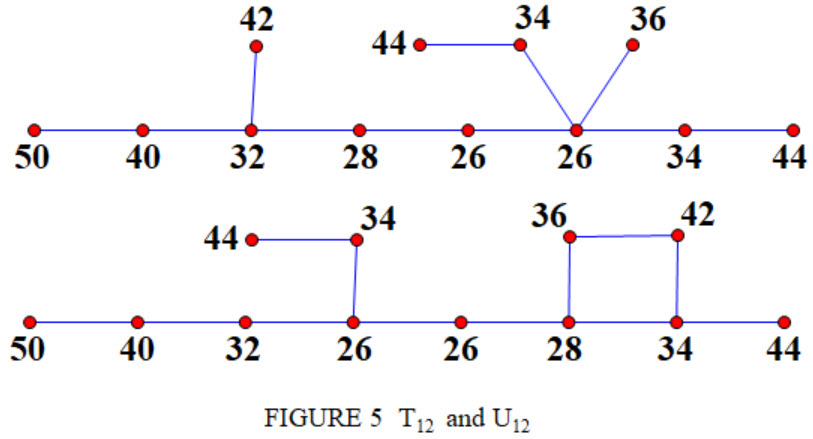 Figure 5
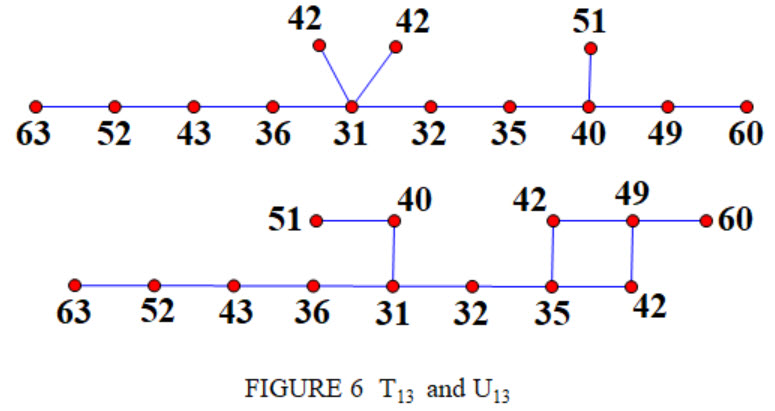 Figure 6
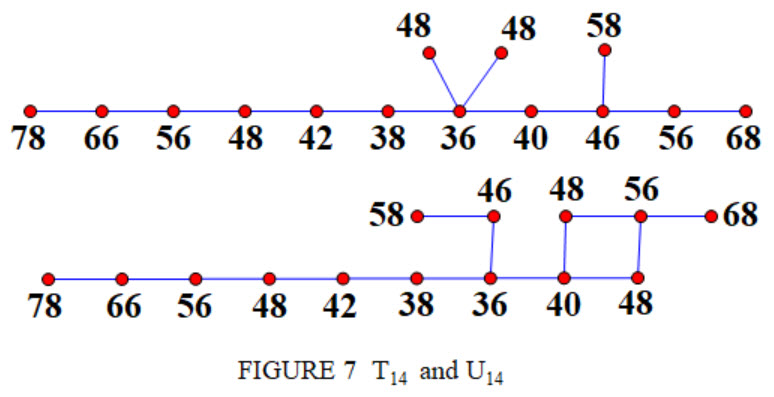 Figure 7
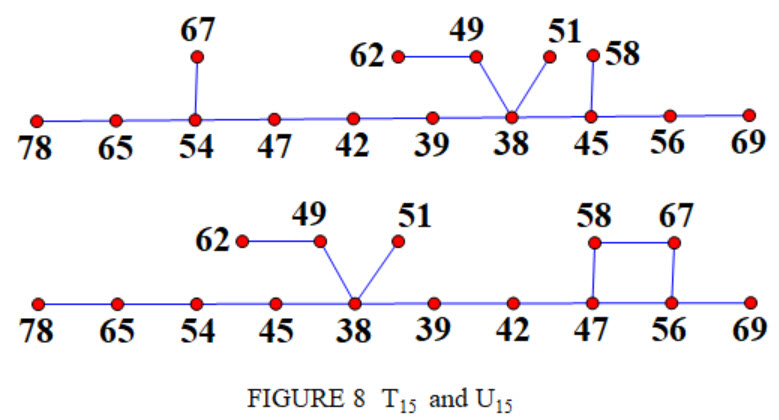 Figure 8
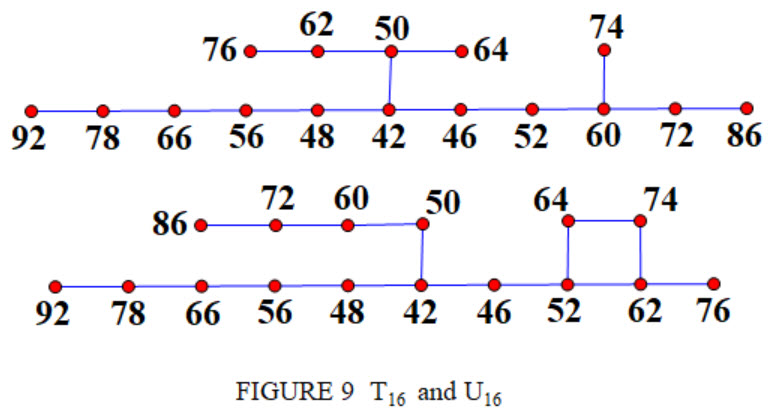 Figure 9
Peer Reviews
No public reviews on file for this paper yet. If you reviewed it on a platform where reviews are public (OpenReview, ICLR, NeurIPS, ICML), you can paste yours below so the community can read it here.
Videos
No videos yet. Explain this paper in a talk, walkthrough, or lecture? Add one.
Taxonomy
TopicsAdvanced Graph Theory Research · Graph theory and applications · Graph Labeling and Dimension Problems
Pairs of a tree and a nontree graph with the same status sequence111E-mail addresses:
[email protected](P.Qiao), [email protected](X.Zhan).
Pu Qiao, Xingzhi Zhan
Department of Mathematics, East China Normal University, Shanghai 200241, China Corresponding author.
Abstract
The status of a vertex in a graph is the sum of the distances between and all other vertices. Let be a connected graph. The status sequence of is the list of the statuses of all vertices arranged in nondecreasing order. is called status injective if all the statuses of its vertices are distinct. Let be a member of a family of graphs and let the status sequence of be is said to be status unique in if is the unique graph in whose status sequence is In 2011, J.L. Shang and C. Lin posed the following two conjectures. Conjecture 1: A tree and a nontree graph cannot have the same status sequence. Conjecture 2: Any status injective tree is status unique in all connected graphs. We settle these two conjectures negatively. For every integer we construct a tree and a unicyclic graph both of order with the following two properties: (1) and have the same status sequence; (2) for if is congruent to modulo then is status injective and among any four consecutive even orders, there is at least one order such that is status injective.
Key words. Status; status unique; distance; tree; unicyclic graph
1 Introduction
We consider finite simple graphs. The order of a graph is the number of its vertices. A connected graph is said to be unicyclic if it has exactly one cycle. We denote by and the vertex set and edge set of a graph respectively. The distance between two vertices and in a graph is denoted by The status of a vertex in a graph , denoted by is the sum of the distances between and all other vertices; i.e.,
[TABLE]
The status sequence of is the list of the statuses of all vertices of arranged in nondecreasing order. is called status injective if all the statuses of its vertices are distinct [2, p.185]. Harary [4] investigated the digraph version of the concept of status in a sociometric framework, while Entringer, Jackson and Snyder [3] studied basic properties of this concept for graphs.
A natural question is: Which graphs are determined by their status sequences? Slater [7] constructed infinitely many pairs of non-isomorphic trees with the same status sequence. Shang [5] gave a method for constructing general non-isomorphic graphs with the same status sequence. Let be a member of a family of graphs and let the status sequence of be is said to be status unique in if is the unique graph in whose status sequence is Here we view two isomorphic graphs as the same graph. It is known that [6] spiders are status unique in trees and that [1] status injective trees are status unique in trees.
Shang and Lin [6, p.791] posed the following two conjectures in 2011.
Conjecture 1. A tree and a nontree graph cannot have the same status sequence.
Conjecture 2. Any status injective tree is status unique in all connected graphs.
In this paper we settle these two conjectures negatively. For every integer we construct a tree and a unicyclic graph both of order with the same status sequence. There are infinitely many odd orders and infinitely many even orders such that is status injective.
2 Main Results
We will need the following lemmas. For a set the notation denotes the cardinality of
Lemma 1. [3, p.284] Let be an edge of a tree and let and be the two components of with and Then
Lemma 2. Let be a path in a tree and denote Then for each Consequently if then for each and in particular,
Proof. It suffices to prove the first assertion. We first show the following
Claim. If is a path in a tree and denote then
Let be the tree of order Let and be the two components of with and , and let and be the two components of with and By Lemma 1, We also have since every edge in a tree is a cut-edge. Hence Since and but we have By Lemma 1 and the relation we deduce
[TABLE]
This proves the claim.
Applying the claim successively to the path for we obtain the first assertion in Lemma 2.
Lemma 2 is a generalization and strengthening of a result in [3, p.291], which states that if is a path in a tree and has the minimum status of all vertices, then
Lemma 3. The quadratic polynomial equation
[TABLE]
in and has no nonnegative integer solution.
Proof. Suppose that and are nonnegative integers. If then If then Hence the equation cannot have any nonnegative integer solution.
Remark. It is not hard to prove that the only integer solutions of the equation in Lemma 3 are
Denote by the set of positive integers.
Lemma 4. Let the two functions and be defined on the set If and then and
Proof. If then
[TABLE]
If then
[TABLE]
If then
[TABLE]
Hence we must have and in this case, f(p)-h(q)=4.$$\Box
Now we are ready to state and prove the main result.
Theorem 5. *For every integer there exists a tree and a unicyclic graph both of order with the following two properties:
(1) and have the same status sequence;
(2) for if then is status injective and among any four consecutive even orders, there is at least one order such that is status injective.*
Proof. For the orders we have a uniform construction of and , and we treat this case first. For the orders the graphs will be constructed individually and they appear at the end of this proof.
Now suppose We distinguish the odd orders and the even orders. Let with We define and as follows. and
[TABLE]
and Note that is a caterpillar of maximum degree and is a unicyclic graph. and are illustrated in Figure 1.
It can be checked directly that for and for Hence, and have the same status sequence. For the even orders with is obtained from defined above by adding the edge and is obtained from defined above by adding the edge and are illustrated in Figure 2.
We check easily that for and for Thus and also have the same status sequence.
Next we prove that the trees satisfy condition (2) in Theorem 5. In fact, we will determine precisely for which orders is status injective.
First consider the case when is odd and let with Denote We have
[TABLE]
[TABLE]
[TABLE]
In calculating the values for we have used the fact that if is a path, then
[TABLE]
in while in calculating the values for we have used Lemma 1. From the above expressions it follows that is the unique vertex with the minimum status, are the vertices with the eight largest statuses, since
[TABLE]
for any and
[TABLE]
Partition the vertex set of into three sets:
[TABLE]
The inequalities in (2) show that any two distinct vertices in have different statuses. Applying Lemma 2 to the two paths and we see that any two distinct vertices in or in have different statuses. Next we show that for any and By the inequalities in (1) it suffices to prove that for and which is equivalent to for and We have the expressions for and for First, The equality for is equivalent to which is impossible, since and is an integer. Also, is equivalent to which is impossible, since and is an integer. Hence for and
By the above analysis, it is clear that the only possibilities for two distinct vertices to have the same status are and for or By the expressions for their status values, it is easy to verify that for some with if and only if for some integer and for some with if and only if for some integer for some with if and only if for some integer and for some with if and only if for some integer
Thus, with is not status injective if and only if or for some integer Since all these values of are even, it follows that for every odd is status injective; i.e., if then is status injective.
Next we treat the case when the order is even. Let with With we have
[TABLE]
[TABLE]
[TABLE]
From the above expressions we deduce that is the unique vertex with the minimum status The case corresponds to and we check directly that is status injective. Next suppose Then are the vertices with the eight largest statuses, since
[TABLE]
for any Also
[TABLE]
In considering two vertices with equal status, we can exclude the eight vertices with the eight largest statuses by (3) and the unique vertex with the minimum status. Denote
[TABLE]
Let and be two distinct vertices with By the inequalities in (4), it is impossible that By Lemma 2 we cannot have or Suppose and We have and for Thus, We have for some with and for some with Hence with and with Then yields which is impossible by Lemma 3.
Now, by (3) and the above analysis it is clear that can occur only if and or the roles of and are interchanged. The case corresponds to and we check directly that is not status injective. Next we suppose Then and hence can be excluded from Similarly, since can be excluded from and can be excluded from Note that the statuses of the vertices in have the uniform expression with and the statuses of the vertices in have the uniform expression with
Denote the empty set by and denote where and It follows that when has two distinct vertices with the same status if and only if Denote where and Since we obtain the following criterion for
is status injective if and only if
The graphs with constructed below are all status injective. Using the above criterion we can check that is status injective for
[TABLE]
Thus the assertion in Theorem 5 on for even with is true.
Next we suppose We will prove that among the four numbers there is at least one for which is status injective. To do so, consider
[TABLE]
The numbers in these four sets can be partitioned into two classes:
[TABLE]
We claim that
[TABLE]
Define two polynomials and Then and In the sequel the symbol means “implies”. We first prove To the contrary, suppose there exist with and such that and and We have But on the other hand, a contradiction. The inequality is similarly proved by using the fact that The inequalities and can also be similarly proved by using the facts that and
Note that the assumption implies that and Hence if we have and Lemma 4 can be applied.
Suppose for We will show that Since at least one of the two cases and must occur. Recall that
Case 1. We first consider the case when Denote By (5), By Lemma 4, It follows that Since and we deduce that By (5), and can not be both in or both in Since by Lemma 4 it is also impossible that one of and is in and the other in But Hence and we obtain The case when is similar. Again we use (5), Lemma 4 and to deduce
Case 2. Using (5) and Lemma 4 we deduce that Then the condition implies Applying (5) and Lemma 4 once more we have Hence
This completes the proof of the case of Theorem 5. The graph pairs and with are depicted in Figures 3-11 below. They satisfy the condition and for is status injective. In these graphs, the number beside a vertex is the status of that vertex.
This completes the proof of Theorem 5.
Remark. A computer search shows that is the smallest order for the existence of a tree and a nontree graph with the same status sequence.
Acknowledgement. This research was supported by the NSFC grants 11671148 and 11771148 and Science and Technology Commission of Shanghai Municipality (STCSM) grant 18dz2271000.
The reference list from the paper itself. Each links out to its DOI / PubMed record.
- 1[1] A. Abiad, B. Brimkov, A. Chan and A. Grigoriev, On the status sequences of trees, ar Xiv:1812.03765 v 1.
- 2[2] F. Buckley and F. Harary, Distance in Graphs, Addison-Wesley Publishing Company, 1990.
- 3[3] R.C. Entringer, D.E. Jackson and D.A. Snyder, Distance in graphs, Czechoslovak Math. J. 26(1976), no.2, 283-296.
- 4[4] F. Harary, Status and contrastatus, Sociometry 22(1959), 23-43.
- 5[5] J.L. Shang, On constructing graphs with the same status sequence, Ars Combin. 113(2014), 429-433.
- 6[6] J.L. Shang and C. Lin, Spiders are status unique in trees, Discrete Math. 311(2011), 785-791.
- 7[7] P.J. Slater, Counterexamples to Randi c ´ ´ c {\rm\acute{c}} ’s conjecture on distance degree sequences for trees, J. Graph Theory 6(1982), 89-92.