FCC-to-BCC phase transitions in convex and concave hard particle systems
Duanduan Wan, Chrisy Xiyu Du, Greg van Anders, Sharon C., Glotzer

TL;DR
This study uses computer simulations to analyze FCC-to-BCC phase transitions in convex and concave polyhedral and dimpled spherical particles, revealing the first-order nature of these transitions and the influence of particle shape on phase behavior.
Contribution
It provides new insights into how convexity and concavity of particle shapes affect FCC-to-BCC phase transition pathways in hard particle systems.
Findings
FCC-to-BCC transitions are first order in both convex and concave particle families.
Shape symmetry influences phase transition pathways.
Convexity or concavity impacts the free energy landscape of phase transitions.
Abstract
Particle shape plays an important role in the phase behavior of colloidal self-assembly. Recent progress in particle synthesis has made particles of polyhedral shapes and dimpled spherical shapes available. Here using computer simulations of hard particle models, we study face-centered cubic to body-centered cubic (FCC-to-BCC) phase transitions in a convex 432 polyhedral shape family and a concave dimpled sphere family. Particles in both families have four-, three-, and two-fold rotational symmetries. Via free energy calculations we find the FCC-to-BCC transitions in both families are first order. As a previous work reports the FCC-to-BCC phase transition is first order in a convex 332 family of hard polyhedra, our work provides additional insight into the FCC-to-BCC transition and how the convexity or concavity of particle shape affects phase transition pathways.
Click any figure to enlarge with its caption.
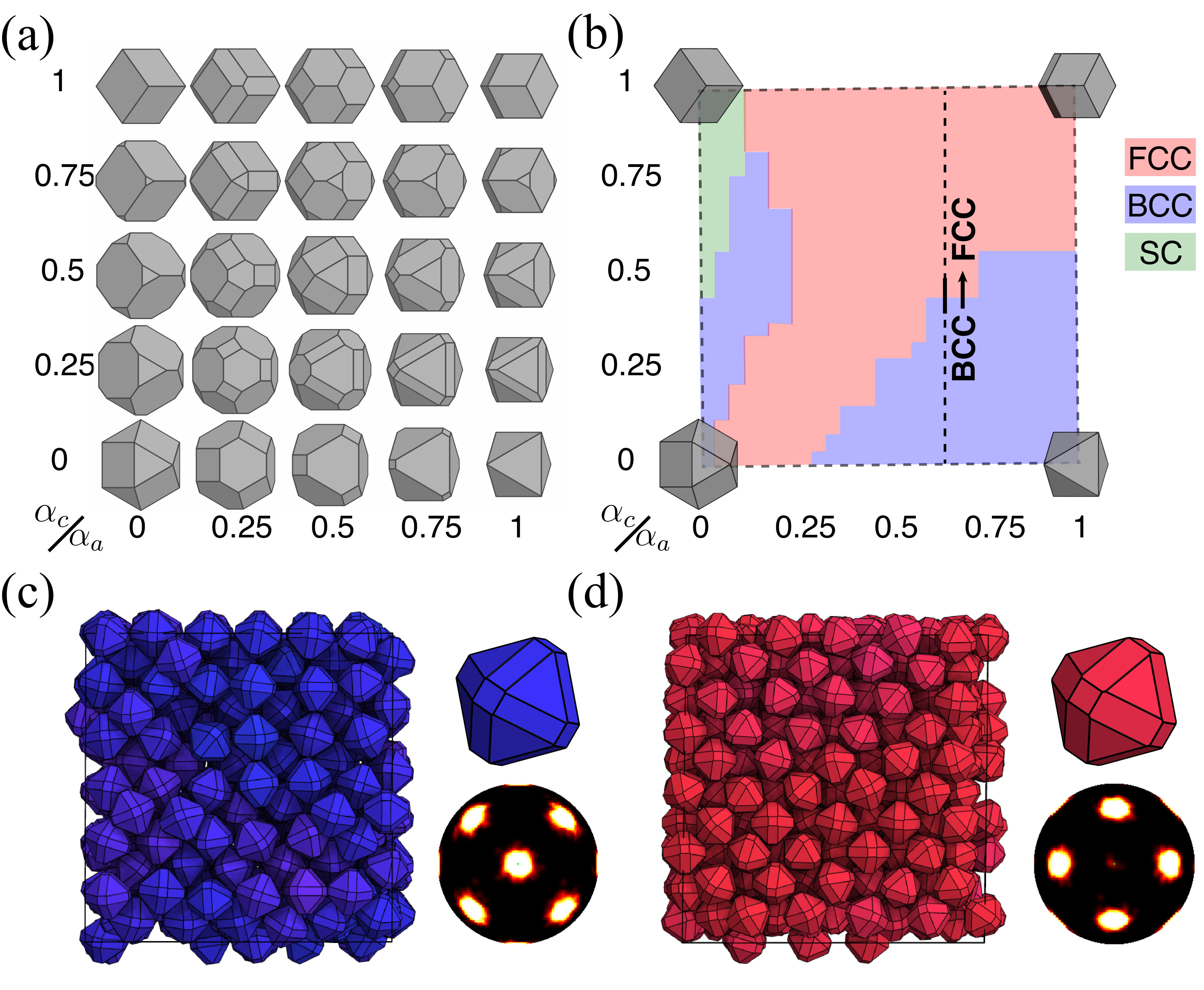 Figure 1
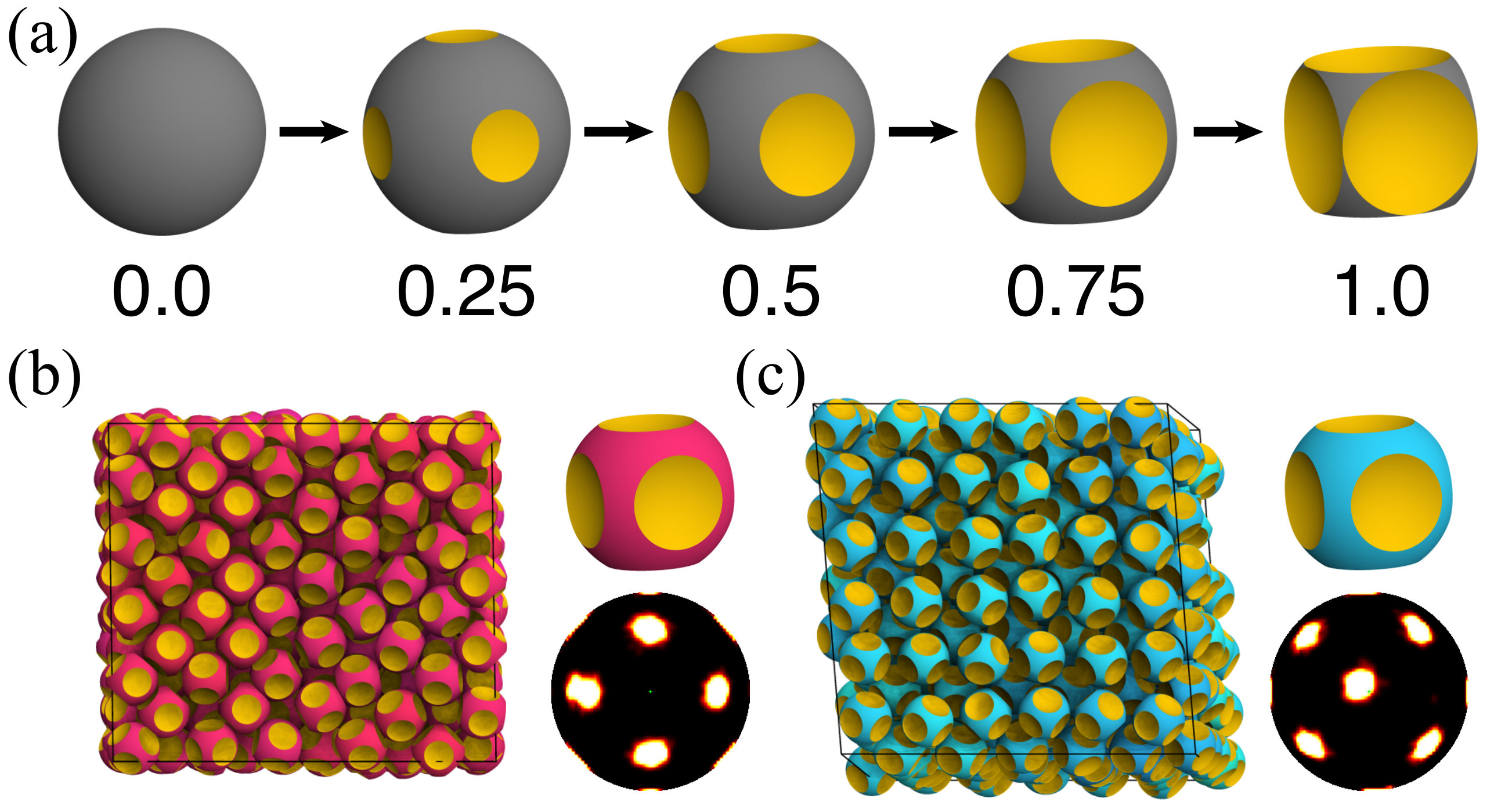 Figure 2
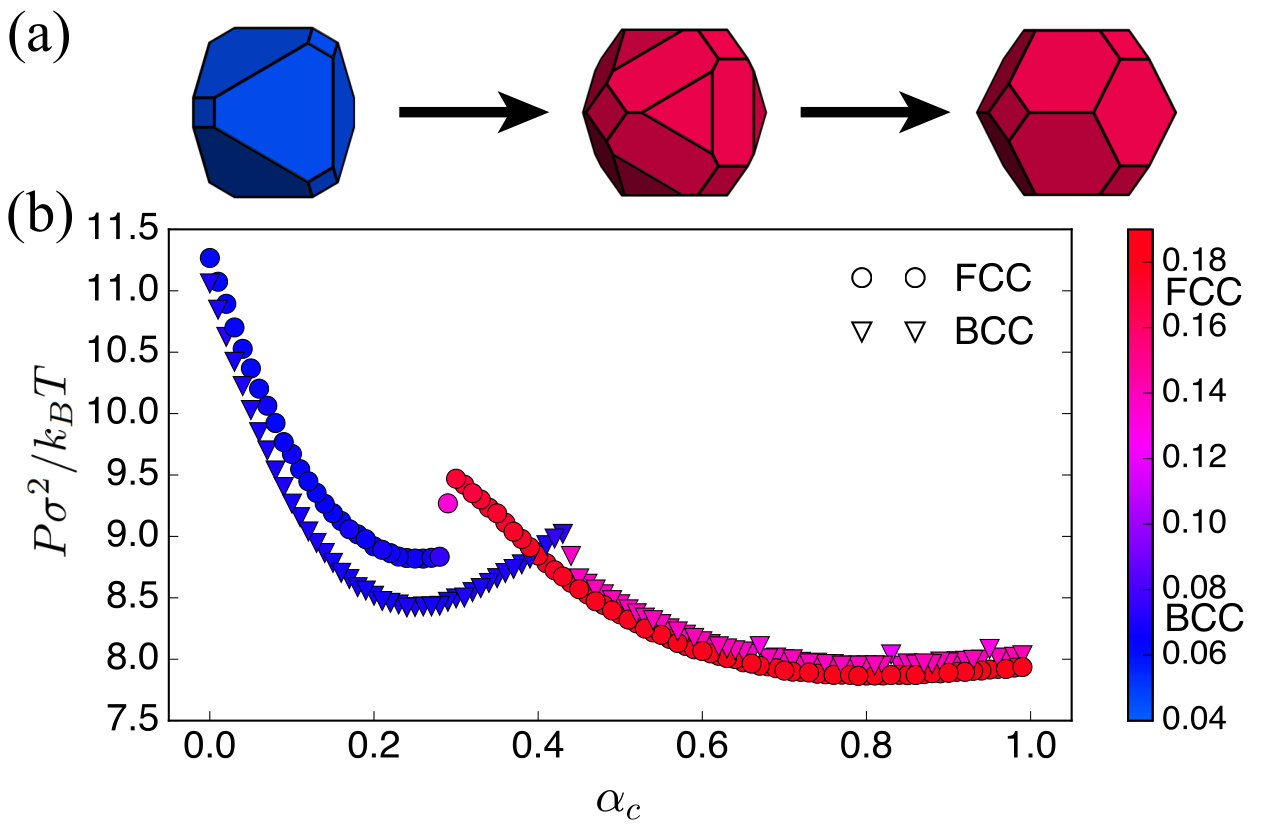 Figure 3
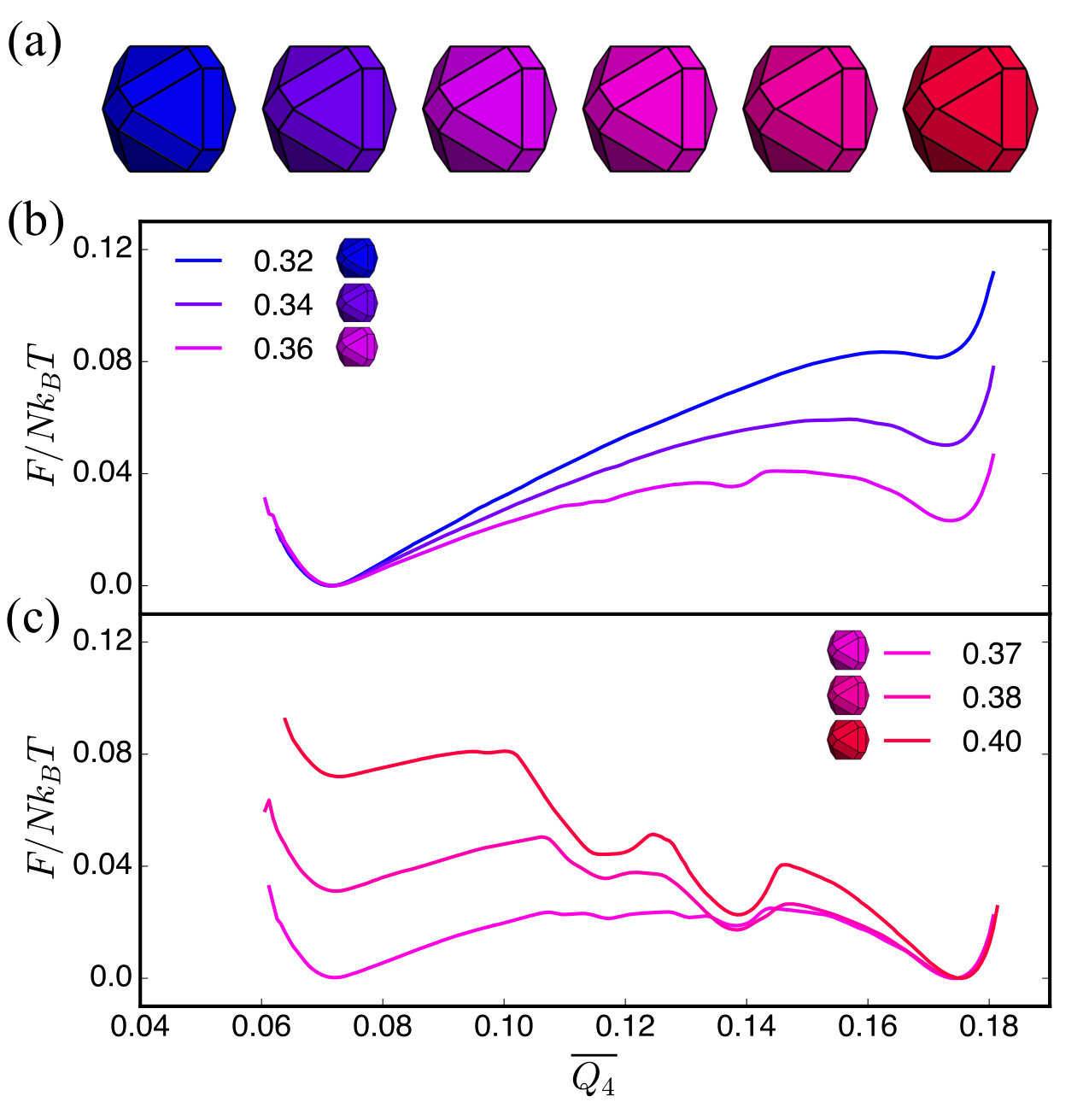 Figure 4
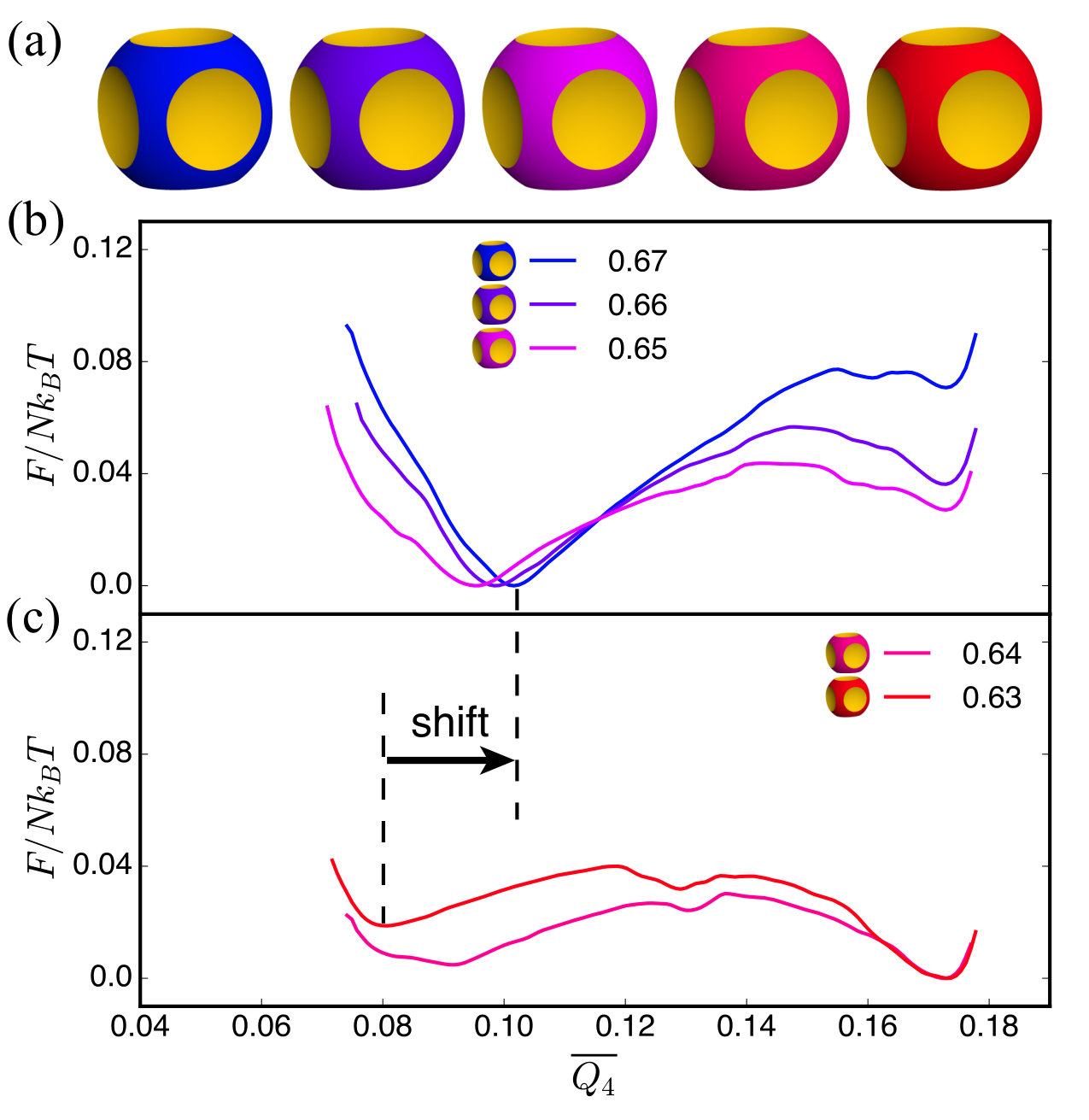 Figure 5
Peer Reviews
No public reviews on file for this paper yet. If you reviewed it on a platform where reviews are public (OpenReview, ICLR, NeurIPS, ICML), you can paste yours below so the community can read it here.
Videos
No videos yet. Explain this paper in a talk, walkthrough, or lecture? Add one.
FCCBCC phase transitions in convex and concave hard particle systems
Duanduan Wan
Department of Chemical Engineering, University of Michigan, Ann Arbor, Michigan 48109, USA
Chrisy Xiyu Du
Department of Physics, University of Michigan, Ann Arbor, Michigan 48109, USA
Greg van Anders
Department of Physics, University of Michigan, Ann Arbor, Michigan 48109, USA
Department of Physics, Engineering Physics, and Astronomy, Queen’s University, Kingston, Ontario, K7L 3N6, Canada
Sharon C. Glotzer
Department of Chemical Engineering, University of Michigan, Ann Arbor, Michigan 48109, USA
Department of Physics, University of Michigan, Ann Arbor, Michigan 48109, USA
Department of Materials Science and Engineering and Biointerfaces Institute, University of Michigan, Ann Arbor, Michigan 48109, USA
Abstract
Particle shape plays an important role in the phase behavior of colloidal self-assembly. Recent progress in particle synthesis has made particles of polyhedral shapes and dimpled spherical shapes available. Here using computer simulations of hard particle models, we study face-centered cubic to body-centered cubic (FCCBCC) phase transitions in a convex 432 polyhedral shape family and a concave dimpled sphere family. Particles in both families have four-, three-, and two-fold rotational symmetries. Via free energy calculations we find the FCCBCC transitions in both families are first order. As a previous work reports the FCCBCC phase transition is first order in a convex 332 family of hard polyhedra, our work provides additional insight into the FCCBCC transition and how the convexity or concavity of particle shape affects phase transition pathways.
I Introduction
Despite their physical significance, direct observations of solid–solid phase transitions of atomic crystals are difficult as transitions are rapid, and typically occur under extreme conditions and on small length scales. Instead systems at larger length scales, such as colloidal suspensions (e.g., Refs. Ise and Sogami (2005); Shevchenko et al. (2005); Talapin et al. (2009); Travesset (2017a, b)), and micron-sized aqueous droplets (e.g., Refs. Villar et al. (2013); Wan and Bowick (2016); Zhang et al. (2016)), whose dynamics are significantly slower, provide testbeds for investigating complex, collective phenomena analogous to that in atomic and molecular systems Gasser (2009); Manoharan (2015). Colloidal systems manifesting solid–solid transitions driven by a variety of factors have been explored in experiment (e.g., Refs. Yethiraj et al. (2004); Zhou et al. (2011); Zhang et al. (2011); Qi et al. (2015); Peng et al. (2015); Rossi et al. (2015); Mohanty et al. (2015)). Among them, one interesting kind of phase transition is that driven by a change in particle shape. Both experimental (e.g., Refs. Henzie et al. (2012); Young et al. (2013); Meijer et al. (2017); Gong et al. (2017)) and numerical (e.g., Refs. Gang and Zhang (2011); Haji-Akbari et al. (2009); Kraft et al. (2012); Agarwal and Escobedo (2011); Damasceno et al. (2012); Ni et al. (2012); Marechal et al. (2010); Marechal and Dijkstra (2010); Gantapara et al. (2013); Geng et al. (2017); van Anders et al. (2014a, b)) studies have shown that particle shape plays an important role in the self-assembled phases of colloidal systems.
Recent progress in particle synthesis has made many kinds of particle shapes possible. One class of shape is the polyhedron, such as the rhombic dodecahedron Chen et al. (2009); Vutukuri et al. (2014); Young et al. (2013) and cuboctahedron Henzie et al. (2012); Wang et al. (2013). Intermediate shapes between two polyhedra, with vertex or edge truncation from the bounding shapes, are also available Chen et al. (2009); Chiu et al. (2011); Henzie et al. (2012); Wang et al. (2013); Young et al. (2013); Zheng et al. (2014). Another class of shape is the dimpled sphere, where “lock-and-key” colloids with a prescibed number of dimples can be synthesized Sacanna et al. (2013); Ivell et al. (2013); Odriozola et al. (2008); Odriozola and Lozada-Cassou (2013); Désert et al. (2013); Sacanna et al. (2010); Wang et al. (2013); Ahmed et al. (2015). These two classes of shapes differ in that polyhedral shapes are convex while dimpled spheres are concave (e.g., Sacanna et al. (2013); Ivell et al. (2013); Odriozola et al. (2008); Odriozola and Lozada-Cassou (2013); Désert et al. (2013); Sacanna et al. (2010); Wang et al. (2013); Ahmed et al. (2015)). Despite this difference, shape-driven FCCBCC phase transitions occur in both systems when particle shape is suitably chosen Du et al. (2017).
Using the free energy calculation method developed in Ref. Du et al. (2017), here we investigate the FCCBCC phase transitions in a convex 432 polyhedral shape family Chen et al. (2014); Klotsa et al. (2018) and a concave dimpled sphere family Ahmed et al. (2015), treating particle shape as a thermodynamic variable van Anders et al. (2015), to determine the order of each transition. Particles in both families have four-, three-, and two-fold rotational symmetries. Together with the previous report of the 332 polyhedral shape family Du et al. (2017), in all three cases we find the shape induced FCCBCC transition is first order.
II Models and Methods
The two families of hard particles we study here can be described using a few shape parameters. The convex polyhedron shape family with 432-symmetry Chen et al. (2014) () can be described by two shape parameters (), as shown in Fig. 1(a). All the shapes in are bound by four shapes: cuboctahedron (), octahedron (), cube () and rhombic dodecahedron (). From to , the octahedron has an increasing amount of vertex truncation until , while from to , the octahedron has an increasing amount of edge truncation until . The same rule applies to other rows and columns in Fig. 1(a). In simulations, the volume of particles is rescaled to 1.
For the concave dimpled sphere family Ahmed et al. (2015), a dimpled sphere is a spherical cap bounded by the intersection of a central sphere with valence spheres. Here we choose the central and valence spheres of the same radius , with six valence spheres in the ,, directions. By choosing these six directions for the valence spheres, we obtain a dimpled sphere with 432-symmetry. The dimpled amount is characterized by the distance between the central sphere and the valence sphere. When , the central and valence spheres are just touching each other and no dimple is shown; when , the dimpled sphere has the maximal dimple amount, wherein the two neighboring dimples are touching each other. We thus can use a single shape parameter to describe it, where corresponds to no dimple amount and the maximal dimple possible (see examples in Fig. 2(a)). As above, the volume of particles is rescaled to 1.
To calculate the thermodynamic properties of FCCBCC transitions in these two systems, we adapt the method in Ref. Du et al. (2017). All the simulations are done using the hard particle Monte Carlo (HPMC) module in HOOMD-blue Anderson et al. (2008); Glaser et al. (2015) and data management is done using the signac toolkit Adorf et al. (2018); Adorf and Dodd . We first calculate the equation of state of the particles in . To do so, we initialize systems of particles in a cubic box with FCC () and BCC () structures and gradually compress the system to reach packing density 0.55. We then relax the system in the ensemble for up to MC sweeps. For each MC sweep, we allow both particle translation and rotation, as well as box shape change (with box volume conserved). The box shape change operation allows the simulation cell to align with the emergent orientation of the crystal Filion et al. (2009); de Graaf et al. (2012). The system is equilibrated for steps and then we begin to measure the pressure. From the pressure measurements we extract an equation of state in terms of pressure versus shape parameter , which we use to estimate the location of the solid–solid transitions (see Fig. 3(b)). With this information, we choose sample shapes around the transition area to compute their Landau free energies. We use the second neighbor-averaged of the spherical harmonic bond order parameter Lechner and Dellago (2008); Steinhardt et al. (1983) as the order parameter of this system because BCC and FCC structures have two distinct values, i.e., BCC has a characteristic value of and FCC has Du et al. (2017). If the transition happens through continuous intermediate structures, e.g., through a BCT phase, the value is expected to change continuously as well. We then compute the Landau free energy for the order parameter using umbrella sampling Kästner (2011). The spring constant of the biased potential is set to be and the window width of is 0.004 with samples used for each window. We use the weighted histogram analysis method Kumar et al. (1992) to reconstruct the free energy curves and the final plot is an average of five independent replica.
III Results and Discussion
Ref. Klotsa et al. (2018) studied the self-assembly behavior of particles in and Fig. 1(b) shows a rough sketch of the three major phases at density 0.55. Here we are interested in the BCCFCC transition at fixed and varying values (the dashed line in Fig. 1(b)). We plot the pressure of the equilibrated systems as a function of in Fig. 3(b), with the particles first initialized in BCC and FCC structures, respectively. is the length unit. The color in Fig. 3(b) represents of the final structures in the equilibrated systems, with blue for BCC and red for FCC. The color of shows that the equilibrated systems are either BCC-like or FCC-like, without any sign of intermediate structures. Pressure curves for both BCC and FCC initialized systems have cusps (in the range about 0.25 to 0.5), which also indicates the transition is first order. Fig. 1(c), (d) show snapshots of the equilibrated systems of a BCC and FCC structure, respectively. The structures can be identified from the bond order diagram, which connects a particle with neighboring particles within the first peak of the radial distribution function. We then calculated the free energy around the value of the shape parameter , where the transition takes place. From Fig. 4(b), it can be seen that at , the system has the lowest free energy in the BCC basin (). As increases, the minimal free energy of the BCC basin increases while the FCC basin () decreases, which indicates the system begins to prefer an FCC structure. A comparison of the two basins shows that it is a first order transition. The undulations of the and curves in the range are due to the existence of hexagonally close-packed (HCP) stacking faults in the FCC structure.
We next explore the FCCBCC transition of the concave dimpled spheres. Because the pressure calculation in HPMC currently does not support concave particles, we identify the phase transition boundary using bond order diagram and . When , particles tend to self-assemble into an FCC structure; when , particles tend to self-assemble into a BCC structure. Fig. 2(b-e) show snapshots of self-assembled structures. The free energy plots in Fig. 5(b), (c), similar to that in Fig. 4(b), (c), have two basins corresponding to the BCC and FCC structures, and show a first order transition as observed in the truncated octahedron system. The BCC basin shifts to the right of and shifts further with increasing (see the arrow in Fig. 5(c)) as the BCC structure becomes slightly sheared (Fig. 2(c)).
IV Conclusions and Outlook
We studied examples of FCCBCC phase transitions in a convex 432 polyhedral shape family and a concave dimpled sphere family, where shapes in both families have four-, three-, and two-fold rotational symmetries. Together with the previous report on convex 332 polyhedral shape family Du et al. (2017), in all three cases the FCCBCC phase transitions are first order. On the other hand, the existence of intermediate BCT structures between FCC and BCC indicates that in Landau theory the BCCFCC transition could occur via a pair of continuous transitions, e.g., through the Bain pathway Bain and Dunkirk (1924). The Bain pathway has been observed in kinetics of colloidal crystal transformation in experiments (e.g., Ref. Casey et al. (2012); Weidman et al. (2016)). Thus our finding raises the question what factors affect the transition pathway in shape-driven transitions. More studies in this direction are encouraged. Furthermore, despite the apparent insensitivity of the overall thermodynamics of the transition to the particle modifications tested here, some discernible differences in the thermodynamics of the transitions were found. Whereas for the convex shapes reported here and in Ref. Du et al. (2017) there is strong evidence of metastable mixed FCC/HCP stacking developing after the BCCFCC transition, this was not evident in our study of concave 432-symmetric shapes. This finding indicates that choice of particle shape does afford some control over transition thermodynamics. Understanding the extent to which this is possible will be an important question for future work, given the growing number of examples of shape-shifting colloids that can now be synthesized Gang and Zhang (2011); Lee et al. (2012); Meester et al. (2016); Youssef et al. (2016); Meijer et al. (2017); Gong et al. (2017), the potential for the use of these colloids in developing materials, and the importance of the thermodynamics of solid–solid transitions in determining the viability of these shape-shifting colloids for driving structural reconfiguration Solomon (2018).
Acknowledgements.
D.W. and C.X.D. contributed equally to this work. We thank Brendon Waters for some early work. GvA thanks D. Lubensky for helpful conversations. This work was partially supported by a Simons Investigator award from the Simons Foundation to S.C.G. C.X.D. acknowledges support from the University of Michigan Rackham Predoctoral Fellowship Program. Computational resources and services were supported in part by Advanced Research Computing at the University of Michigan, Ann Arbor.
The reference list from the paper itself. Each links out to its DOI / PubMed record.
- 1Ise and Sogami (2005) Norio Ise and Ikuo Sogami, Structure Formation in Solution (Springer Berlin Heidelberg, Germany, 2005).
- 2Shevchenko et al. (2005) Elena V. Shevchenko, Dmitri V. Talapin, Stephen O’Brien, and Christopher B. Murray, “Polymorphism in ab 13 nanoparticle superlattices: An example of semiconductor-metal metamaterials,” J. Am. Chem. Soc 127 , 8741 (2005).
- 3Talapin et al. (2009) Dmitri V. Talapin, Elena V. Shevchenko, Maryna I. Bodnarchuk, Xingchen Ye, Jun Chen, and Christopher B. Murray, “Quasicrystalline order in self-assembled binary nanoparticle superlattices,” Nature 461 , 964 (2009).
- 4Travesset (2017 a) A. Travesset, “Topological structure prediction in binary nanoparticle superlattices,” Soft Matter 13 , 134 (2017 a).
- 5Travesset (2017 b) Alex Travesset, “Soft skyrmions, spontaneous valence and selection rules in nanoparticle superlattices,” ACS Nano 11 , 5375 (2017 b).
- 6Villar et al. (2013) Gabriel Villar, Alexander D. Graham, and Hagan Bayley, “A tissue-like printed material,” Science 340 , 48 (2013).
- 7Wan and Bowick (2016) Duanduan Wan and Mark J. Bowick, “Planar and curved droplet networks,” Europhys. Lett. 113 , 16003 (2016).
- 8Zhang et al. (2016) T. Zhang, Duanduan Wan, J. M. Schwarz, and M. J. Bowick, “Shape-shifting droplet networks,” Phys. Rev. Lett. 116 , 108301 (2016).