Bounds on Dimension Reduction in the Nuclear Norm
Oded Regev, Thomas Vidick

TL;DR
This paper establishes lower bounds on the dimension required for approximate embeddings of certain matrix metric spaces, using Clifford algebra representations and quantum information theory techniques.
Contribution
It provides explicit constructions demonstrating that low-dimensional approximations of these matrix spaces are impossible under certain conditions, highlighting fundamental limits in dimension reduction.
Findings
Any approximate embedding must have dimension at least exponential in n.
Explicit matrix constructions show tight bounds on dimension reduction.
Uses Clifford algebra and quantum information tools for proof.
Abstract
For all , we give an explicit construction of matrices with such that for any and matrices that satisfy \[ \|A'_i-A'_j\|_{\schs} \,\leq\, \|A_i-A_j\|_{\schs}\,\leq\, (1+\delta) \|A'_i-A'_j\|_{\schs} \] for all and small enough , where is a universal constant, it must be the case that . This stands in contrast to the metric theory of commutative spaces, as it is known that for any , any points in embed exactly in for . Our proof is based on matrices derived from a representation of the Clifford algebra generated by anti-commuting Hermitian matrices that square to identity, and borrows ideas from…
Click any figure to enlarge with its caption.
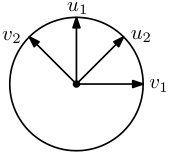 Figure 1
Peer Reviews
No public reviews on file for this paper yet. If you reviewed it on a platform where reviews are public (OpenReview, ICLR, NeurIPS, ICML), you can paste yours below so the community can read it here.
Videos
No videos yet. Explain this paper in a talk, walkthrough, or lecture? Add one.
Taxonomy
TopicsAlgebraic structures and combinatorial models · Noncommutative and Quantum Gravity Theories · Advanced Algebra and Geometry
Bounds on Dimension Reduction in the Nuclear Norm
Oded Regev Courant Institute of Mathematical Sciences, New York University. Supported by the Simons Collaboration on Algorithms and Geometry and by the National Science Foundation (NSF) under Grant No. CCF-1814524. Any opinions, findings, and conclusions or recommendations expressed in this material are those of the authors and do not necessarily reflect the views of the NSF.
Thomas Vidick Department of Computing and Mathematical Sciences, California Institute of Technology, Pasadena, USA. Supported by NSF CAREER Grant CCF-1553477, a CIFAR Azrieli Global Scholar award, and the Institute for Quantum Information and Matter, an NSF Physics Frontiers Center (NSF Grant PHY-1733907). Email: [email protected].
Abstract
For all , we give an explicit construction of matrices with such that for any and matrices that satisfy
[TABLE]
for all and small enough , where is a universal constant, it must be the case that . This stands in contrast to the metric theory of commutative spaces, as it is known that for any , any points in embed exactly in for .
Our proof is based on matrices derived from a representation of the Clifford algebra generated by anti-commuting Hermitian matrices that square to identity, and borrows ideas from the analysis of nonlocal games in quantum information theory.
1 Introduction
For let denote the space of real-valued sequences with finite -th norm . For any and any there exist such that for all . This is immediate from the fact that any -dimensional subspace of Hilbert space is isometric to . In fact, there even exist such in by considering the vectors . We can equivalently describe this as saying that any points in can be isometrically embedded into . The dimension is easily seen to be the best possible for isometric embeddings.
The Johnson-Lindenstrauss lemma [JL84] establishes the striking fact that if we allow a small amount of error , a much better “dimension reduction” is possible. Namely, for any , any points , and any , there exist points with and such that for all ,
[TABLE]
This can be described as saying that any points in can be embedded into with (bi-Lipschitz) distortion at most . We remark that this bound on was recently shown to be tight [LN17] for essentially all values of for which the bound is nontrivial.
The situation for other norms is not as well understood. Ball [Bal90] showed that for any and any integer , any points in embed isometrically into for . He also showed that for this is essentially the best possible result. However, if we allow some distortion as in (1), the situation again changes considerably. Specifically, for , Talagrand [Tal90] (improving slightly on the earlier result by Schechtman [Sch87]) showed that for any , one can embed any points in into with where here and in what follows is a universal constant that might vary at each occurrence.111In fact, he showed that one can even embed any -dimensional subspace of into with distortion . See also [Sch87, BLM89, Tal95] for extensions to other and more details. The bound was improved by Newman and Rabinovich [NR10] to (see [Nao12]), and if we allow large enough distortion , the bound can be further reduced to [ANN18]. In terms of lower bounds, Brinkman and Charikar [BC05] showed that there exist points in (in fact, in ) such that any embedding with distortion into requires . For embeddings with distortion , Andoni et al. [ACNN11] showed a bound of . See also [LN04, Reg13] for alternative proofs.
Let be the space of bounded linear operators on a separable Hilbert space with finite Schatten-1 (or nuclear) norm , where are the singular values of . We also write for the space of linear operators acting on an -dimensional Hilbert space, equipped with the Schatten-1 norm. Our main theorem shows that dimension reduction in this noncommutative analogue of is strikingly different from that in spaces. Namely, there are points that require exponential dimension in any embedding with sufficiently low distortion. In contrast, Ball’s result mentioned above [Bal90] shows that in , any points embed isometrically into dimension .
Theorem 1**.**
For any , there exist points in , where , such that any embedding into with distortion for requires , where are universal constants.
The space is a major object of study in many areas of mathematics and physics; see [NPS18] for further details and references. One area where it plays an especially important role is quantum mechanics, and specifically quantum information. This area, and specifically the theory of Bell inequalities and nonlocal games, served as an inspiration for our proof and the source of our techniques.
The best previously known bound on dimension reduction in is due to Naor, Pisier, and Schechtman [NPS18], who proved a result analogous to that of Brinkman and Charikar [BC05]. Namely, they showed that there exist points in for which any embedding into with distortion requires .222Their result is actually much stronger, and incomparable to Theorem 1: they show that there is no embedding into any -dimensional subspace of (and in fact, they even allow quotients of ). The set of points they use is the one used by Brinkman and Charikar [BC05] through the natural identification of with the subspace of diagonal matrices in . The effort then goes into showing that the bound in [BC05], which only applies to embeddings into diagonal matrices, also applies to arbitrary matrices.
In Lemma 19 we show that for any the metric space induced by the points from Theorem 1 can be embedded with distortion in for . Therefore, in order to obtain exponential lower bounds with constant one would have to use a different set of points.
Proof overview.
Due to Ball’s upper bound [Bal90], our set of points cannot be in , and in particular, cannot be the set used in previous work [BC05, NPS18]. Instead, we introduce a new set of points in , for , and show that any embedding with distortion for small enough requires almost as large a dimension. To achieve this we use metric conditions on the set of points to derive algebraic relations on any operators that (approximately) satisfy the conditions. We then conclude by applying results on the dimension of (approximate) representations of a suitable algebra.
We now describe our construction. Let be an even integer. For a matrix and an integer , let denote the tensor product of copies of . Let
[TABLE]
For let and . Then the matrices are Hermitian operators in , where .333For a construction over the reals, consider and . For even values of congruent to or mod the doubling of the dimension is necessary [Oku91]. Moreover, for each and for . For let (resp., ) be the projection on the (resp., ) eigenspace of . Using that and are orthogonal trace [math] projectors that sum to identity, it is immediate that
[TABLE]
and
[TABLE]
Finally, using the anti-commutation property, it follows by an easy calculation that
[TABLE]
Our main result is that (2), (3) and (4) characterize the algebraic structure of any operators that satisfy those metric relations, even up to distortion for small enough . Using labels and to represent [math] and , and and to represent and respectively, we show the following.
Theorem 2**.**
Let be integers, , and and operators on satisfying that for all ,
[TABLE]
and for all ,
[TABLE]
Then there is a universal constant and for orthogonal projections and on such that such that if then
[TABLE]
Note that the theorem does not assume that the and are positive semidefinite, nor even that they are Hermitian; our proof shows that the metric constraints are sufficient to impose these conditions, up to a small approximation error. Similarly, while we think of as the zero matrix and of as the scaled identity matrix, these conditions are not imposed a priori and have to be derived (which is very easy in the case of but less so in the case of ). The proof of the theorem explicitly shows how to construct the projections , from , and .
Theorem 1 follows from Theorem 2 by applying known lower bounds on the dimension of (approximate) representations of the Clifford algebra that is generated by Hermitian anti-commuting operators;444Note that the norm in (6) is the Schatten- norm. we give an essentially self-contained treatment in Section 6.
The proof of Theorem 2 is inspired by the theory of self-testing in quantum information theory. We interpret conditions such as (5) as requirements on the trace distance (which, up to a factor scaling, is the name used for the nuclear norm in quantum information) between post-measurement states that result from the measurement of one half of a bipartite quantum entangled state. This allows us to draw an analogy between metric conditions such as those in Theorem 2 and constraints expressed by nonlocal games such as the CHSH game. Although this interpretation can serve as useful intuition for the proof, we give a self-contained proof that makes no reference to quantum information. We note that the relevance of dimension reduction for Schatten- spaces for quantum information has been recognized before; e.g., Harrow et al. [HMS15] show limitations on dimension reduction maps that are restricted to be quantum channels (a result mostly superseded by [NPS18]).
Open questions.
We are currently not aware of any upper bound on the dimension required to embed any points in into with, say, constant distortion. Proving such a bound would be interesting.
Regarding possible improvements to our main theorem, our result requires the distortion of the embedding to be sufficiently small; specifically, needs to be at most inverse polynomial in . It is open whether our result can be extended to larger distortions.
The connection with quantum information and nonlocal games suggests that additional strong lower bounds may be achievable. For example, is it possible to adapt the results from [JLV18, Slo18] to construct a constant number of points in such that any embedding with distortion in requires for some constant ?
Looking at other Schatten spaces, we are only aware of trivial observations. Any set of points in trivially embeds into by first embedding the points isometrically into , as discussed earlier. For , it is well known that any point metric isometrically embeds in and hence also in ; it is possible that this could be improved. We are not aware of bounds for other , .
Acknowledgements:
We are grateful to IPAM and the organizers of the workshop “Approximation Properties in Operator Algebras and Ergodic Theory” where this work started. We also thank Assaf Naor for useful comments and encouragement.
2 Preliminaries
For a matrix we write for the Schatten- norm (the sum of the singular values). For the Schatten -norm (also known as the Frobenius norm) we use instead of , and introduce the dimension-normalized norm . We write for the operator norm (the largest singular value). We often consider terms of the form for a Hermitian matrix and a positive semidefinite matrix ; notice that the square of this norm equals . For square matrices we write and for the commutator and anti-commutator respectively. We write for the set of unitary matrices in . We use the term “observable” to refer to any Hermitian operator that squares to identity.
We will often use that for any and ,
[TABLE]
and similarly with Schatten- replaced by the Frobenius norm (see, e.g., [Bha97, (IV.40)]).
Lemma 3** (Cauchy-Schwarz).**
For all matrices ,
[TABLE]
Proof.
By definition,
[TABLE]
where the supremum is over all unitary matrices, and the inequality follows from the Cauchy-Schwarz inequality. ∎
3 Certifying projections
In this section we prove Proposition 4, showing that metric constraints on a triple of operators , where is assumed to be positive semidefinite of trace , can be used to enforce that the pair is close to a “resolution of the identity”, in the sense that there exists a pair of orthogonal projections such that and , . The proposition also shows that approximately commute with .
Proposition 4**.**
Let be positive semidefinite with trace . Suppose that , satisfy the following constraints, for some :
[TABLE]
Then there exist orthogonal projections such that and
[TABLE]
For intuition regarding Proposition 4, consider the case where , and where are -dimensional, i.e., scalar complex numbers, , , and . Then the first two conditions (7) and (8) imply that are real and . The third condition (9) then implies that and . The proof of Proposition 4 follows the same outline, adapted to higher-dimensional operators. The main idea is to argue that the projections on the positive and negative eigenspace of respectively approximately block-diagonalize , , and .
The proof is broken down into a sequence of lemmas. The first lemma shows that is close to its Hermitian part.
Lemma 5** (Hermitianity).**
Let be positive semidefinite such that , and such that (7) holds, for some . Then , where is the Hermitian part of .
Proof.
By (7),
[TABLE]
Let be the decomposition of into Hermitian and anti-Hermitian parts. Then , so . Let be a unitary such that . Note that replacing we may assume that is anti-Hermitian (of norm at most ), so is Hermitian. Let be a parameter to be determined. Then all eigenvalues of are in the complex interval and therefore has norm at most . Then
[TABLE]
which shows that . Choosing and using gives . ∎
Lemma 6**.**
Let and be Hermitian matrices satisfying
[TABLE]
for some where denotes the negative part of in the decomposition and similarly for . Then, if denotes the projection on the positive eigenspace of and , we have
[TABLE]
Proof.
We have
[TABLE]
where in the second inequality we used that and similarly for . As a result, we get that
[TABLE]
and similarly for . ∎
Lemma 7**.**
Let be a Hermitian matrix and a projector satisfying
[TABLE]
for some . Then,
[TABLE]
Proof.
The assumption (13) is equivalent to , which implies that . Therefore, by the triangle inequality, it suffices to prove that
[TABLE]
Using the Cauchy-Schwarz inequality,
[TABLE]
where the second line uses that is a projector and the fourth uses for the first term and (14) for the second. To conclude, use the triangle inequality to write
[TABLE]
∎
Lemma 8**.**
Let , , and satisfy the assumptions of Proposition 4 for some . Then there exist orthogonal projections such that and
[TABLE]
Moreover, there exists a positive semidefinite that commutes with and and that satisfies .
Proof.
Using Lemma 5, we can replace and with their Hermitian parts, and have Eqs. (7)-(9) still hold with in place of . By summing Eqs. (7) and (8), and noting by the triangle inequality that , we get that . Moreover,
[TABLE]
and similarly for . We can therefore apply Lemma 6 and obtain that if is the projection on the positive eigenspace of and ,
[TABLE]
Applying Lemma 7 to (scaled by a factor at most so that the condition is satisfied) and , we get that
[TABLE]
Notice that the set of constraints in Eqs. (7)-(9) is invariant under replacing the pair with . Moreover, our assumption that and are Hermitian implies that and are also Hermitian. Therefore, the exact same argument as above applies also to and and we conclude that
[TABLE]
Notice that we used here the fact that and therefore the projections and obtained when we apply Lemma 6 to and are identical to those obtained when we apply it to and .
From (18), and since , we obtain that
[TABLE]
Together with (17) and the triangle inequality, this proves (16).
To prove the last part of the lemma, let and notice that commutes with and . By Eqs. (17) and (18) and the triangle inequality, . Finally, we define to be the positive part of , which due to the block diagonal form of still commutes with and . We have since
[TABLE]
where the last equality uses that is positive semidefinite. ∎
We conclude by giving the proof of Proposition 4.
Proof of Proposition 4.
Let , , and be as guaranteed by Lemma 8. Using the Powers-Stormer inequality for positive semidefinite , (see, e.g., [Bha97, (X.7)]), it follows that
[TABLE]
As a result, using the triangle inequality and Cauchy-Schwarz,
[TABLE]
where we used that and . But commutes with and therefore , and we complete the proof of (10) by noting that
[TABLE]
To prove (11), notice that by (19) and the triangle inequality,
[TABLE]
but the latter norm is zero since commutes with . ∎
4 Certifying anticommutation
In this section we prove Proposition 11. The proposition shows that assuming two pairs of operators and satisfying the assumptions of Proposition 4 satisfy additional metric constraints, the corresponding projections and are such that the operators and have small anti-commutator, in the appropriate norm. For intuition, consider the case of operators in two dimensions, and . Then, Proposition 4 shows that we can think of and as two pairs of orthogonal projections. Assuming that these projections are of rank (as would follow from the constraint (22) below), we can think of them as two pairs of orthonormal bases and of . Suppose we were to impose that these vectors satisfy the four Euclidean conditions
[TABLE]
By expanding the squares, it is not hard to see that these conditions imply that the bases must form an angle of as shown in Figure 1.555These conditions underlie the rigid properties of the famous CHSH inequality from quantum information [Tsi87, SW87]. In particular, the reflection operators , , anti-commute. Proposition 11 adapts this observation to the trace norm between matrices in any dimension, and small error. We start with two technical claims.
Claim 9**.**
Let be such that for some . Let . Then .
Proof.
Expand
[TABLE]
∎
Claim 10**.**
Let be Hermitian and positive semidefinite such that . Suppose further that , where . Then
[TABLE]
Proof.
Let be a unitary such that . Let and , and notice that and . Then
[TABLE]
by assumption. Applying Claim 9 it follows that
[TABLE]
By the triangle inequality,
[TABLE]
where the second line uses the Cauchy-Schwarz inequality and (21). Thus
[TABLE]
∎
Proposition 11**.**
Let be positive semidefinite such that . Let and be operators satisfying the assumptions of Proposition 4 for some , and and be as in the conclusion of the proposition. Suppose further that666The reason that the “” sign in the last term in (20) is replaced by a “” in (22) is that one should think of as the projectors on .
[TABLE]
For let . Then , are observables777Recall that an observable is a Hermitian operator that squares to identity. such that
[TABLE]
Proof.
Using first (10) and then the Cauchy-Schwarz inequality and ,
[TABLE]
and similarly for the three other pairs (, , and ). Summing those four inequalities, we get
[TABLE]
where the first equality uses and , and the second uses . Therefore all inequalities in (24) must be equalities, up to . Applying Claim 10 to the tightness of (24), it follows that
[TABLE]
and similar bounds for the three other pairs. To conclude the proof, use the triangle inequality, Eq. (25), and the observation that by writing and ,
[TABLE]
∎
5 Replacing \texorpdfstringsigma with identity
The anti-commutation relations obtained in Proposition 11 involve the arbitrary positive semidefinite operator . In this section we show that up to a small loss of parameters we may without loss of generality assume that . Intuitively, this follows from the approximate commutation relation
[TABLE]
which follows immediately from the definition of the observable and (11). If has two eigenvalues with a big gap between them, then it is not hard to see that satisfying (26) must have a corresponding approximate block structure, in which case we can restrict to one of the blocks and obtain as desired. The difficulty is in carefully handling the general case, where some eigenvalues of might be closely spaced. The following lemma does this, using an elegant argument borrowed from [SV18].
Lemma 12**.**
Let be a positive semidefinite matrix with trace , and and Hermitian operators such that for all . Let
[TABLE]
Then there exists a nonzero orthogonal projection such that
[TABLE]
Proof.
The proof relies on two simple claims. For a Hermitian matrix and , let denote the projection on the direct sum of eigenspaces of with eigenvalues at least . The first claim appears as [SV18, Lemma 5.6].
Claim 13**.**
Let be positive semidefinite. Then
[TABLE]
The second is due to Connes [Con76, Lemma 1.2.6]. We state the claim as it appears in [SV18, Lemma 5.5].
Claim 14** ([Con76], Lemma 1.2.6).**
Let be positive semidefinite. Then
[TABLE]
Both claims can be proven by direct calculation, writing out the spectral decomposition of and using Fubini’s theorem (exchanging summation indices). The proof is given in [SV18].
Applying Claim 13 with ,
[TABLE]
where the first equality uses and the second inequality follows from Claim 13 and . Applying Claim 14 with and , and using that is Hermitian and unitary,
[TABLE]
where the second inequality follows from the Cauchy-Schwarz inequality and uses and . Adding ) times (27) and times (28), there exists an such that both inequalities are satisfied simultaneously (up to a multiplicative constant factor loss) with a nonzero right-hand side, for that . Then is a projection that satisfies the conclusions of the lemma. ∎
Combining Proposition 11 and Lemma 12, we obtain the following.
Proposition 15**.**
Let be integers, , operators on , and positive semidefinite of trace , such that for each , satisfy (7), (8), (9), and such that for each , satisfy (22). Then there exist a and observables on such that
[TABLE]
Proof.
Applying Proposition 11 and (26) we deduce the existence of observables on such that
[TABLE]
(Note that this uses that for each , the projections used to define depend on and only.) Next apply Lemma 12 with and . The lemma gives an orthogonal projection on such that
[TABLE]
For let . Then using and ,
[TABLE]
Defining the observable and using the inequality valid for all , we see that . Then using (32),
[TABLE]
For any , using the triangle inequality
[TABLE]
where the second inequality uses the definition of and . Squaring this inequality and using Cauchy-Schwarz gives
[TABLE]
Averaging over all pairs and using (31) and (33) proves the proposition. ∎
Proof of Theorem 2.
By subtracting from all the operators, we can assume without loss of generality that is zero. Let be a unitary such that , as given by the polar decomposition. Multiplying all operators on the left by , we may further assume that is positive semidefinite. Dividing by , we may assume that , and is replaced by . Eq. (6) now follows from Proposition 15. ∎
6 Dimension bounds
The following lemma shows that pairwise approximately anti-commuting observables only exist in large dimension. The observation is not new; see, e.g., [OV18, Slo18]. We give a proof that closely follows [Slo18]. Theorem 1 follows immediately by combining the lemma with Theorem 2, provided for some sufficiently small constant .
Lemma 16**.**
Let and be integers, , and observables on such that
[TABLE]
Then there are universal constants such that if then .
Proof.
The idea for the proof is that if , then the would induce a representation of the (finite) finitely presented group
[TABLE]
such that moreover, the representation maps to . Depending on the parity of , the group has either one or two irreducible representations such that , each of dimension , implying a corresponding lower bound on the dimension of the . The goal for the proof is to extend this lower bound to . This is done in [Slo18] (see Lemma 3.1 and Lemma 3.4). There are two steps: first, we use satisfying (34) to define an approximate homomorphism on such that . Second, we use a stability theorem due to Gowers and Hatami [GH15] to argue that any such approximate homomorphism is close to an exact one, and hence must have large dimension.
The first step is given by the following claim, a slightly simplified version of [Slo18, Lemma 3.4].
Claim 17** (Lemma 3.4 in [Slo18]).**
Let satisfy the conditions of Lemma 16. For any , where , define . Then is an -homomorphism from to , i.e., for every it holds that .
Proof.
Any element of has a unique representation of the form described in the claim. Let such that and . To write in canonical form involves at most application of the anti-commutation relations to sort the (together with a number of commutations of with the , that we need not count since in our representation commutes with all ), and finally at most application of the relations . When considering and , the only operation that is not exact is the anti-commutation between different . Using the triangle inequality, , as desired. ∎
The second step of the proof is given by the following lemma from [Slo18], which builds on [GH15].
Lemma 18** (Lemma 3.1 in [Slo18]).**
Let be a map from to the set of unitaries in dimensions such that is an -homomorphism for some . Suppose furthermore that . Then .
The proof of the lemma first applies the results from [GH15] to argue that must be close to an exact representation of , and then concludes using that all irreducible representations of that send to have dimension .
Combining Claim 17 and Lemma 18 proves Lemma 16. ∎
We conclude this section by a construction showing that the metric space implied by the points from Theorem 1 can be embedded with constant distortion in a Schatten- space of polynomial dimension. The construction is inspired by a result of Tsirelson [Tsi87] in quantum information.
Lemma 19**.**
Let be an integer and . There exists a distortion embedding of the metric space induced by the points from Theorem 1 into with .
Proof.
For simplicity, assume that is even. To show the lemma we construct real operators , , and and in that approximately satisfy the metric relations implied by the points from Theorem 2, i.e., the operators [math], , and , defined in the introduction.
By the Johnson-Lindenstrauss lemma [JL84] there are unit vectors for such that the inner products for all . Let be a real representation of the Clifford algebra, i.e., real symmetric matrices such that for all , where is the Kronecker coefficient. As already mentioned in the introduction, there always exists such a representation of dimension for . For let . It is easily verified that is symmetric such that , and moreover
[TABLE]
Let be the spectral decomposition, and , . Let and . Then . Using that has trace [math], we also have
[TABLE]
and , for all . It only remains to consider the distance between different and . Using that , the condition for , and (35), it follows that
[TABLE]
Similar bounds hold for pairs of the form and . Scaling all operators by gives an embedding in with distortion at most . ∎
The reference list from the paper itself. Each links out to its DOI / PubMed record.
- 1[ACNN 11] Alexandr Andoni, Moses S. Charikar, Ofer Neiman, and Huy L. Nguyen. Near linear lower bound for dimension reduction in ℓ 1 subscript ℓ 1 \ell_{1} . In 2011 IEEE 52nd Annual Symposium on Foundations of Computer Science—FOCS 2011 , pages 315–323. IEEE Computer Soc., Los Alamitos, CA, 2011.
- 2[ANN 18] Alexandr Andoni, Assaf Naor, and Ofer Neiman. On isomorphic dimension reduction in ℓ 1 subscript ℓ 1 \ell_{1} . Technical report, 2018.
- 3[Bal 90] Keith Ball. Isometric embedding in l p subscript 𝑙 𝑝 l_{p} -spaces. European J. Combin. , 11(4):305–311, 1990.
- 4[BC 05] Bo Brinkman and Moses Charikar. On the impossibility of dimension reduction in ℓ 1 subscript ℓ 1 \ell_{1} . J. of the ACM , 52(5):766–788, 2005.
- 5[Bha 97] R. Bhatia. Matrix Analysis . Number 169 in Graduate Texts in Mathematics. Springer-Verlag, New York, 1997.
- 6[BLM 89] Jean Bourgain, Joram Lindenstrauss, and Vitali Milman. Approximation of zonoids by zonotopes. Acta Math. , 162(1-2):73–141, 1989.
- 7[Con 76] Alain Connes. Classification of injective factors. Cases I I 1 , 𝐼 subscript 𝐼 1 II_{1}, I I ∞ , 𝐼 subscript 𝐼 II_{\infty}, I I I λ , 𝐼 𝐼 subscript 𝐼 𝜆 III_{\lambda}, λ ≠ 1 𝜆 1 \lambda\not=1 . Ann. of Math. (2) , 104(1):73–115, 1976.
- 8[GH 15] Timothy Gowers and Omid Hatami. Inverse and stability theorems for approximate representations of finite groups. ar Xiv preprint ar Xiv:1510.04085 , 2015.