Correlation effects on ground-state properties of ternary Heusler alloys: first-principles study
V.D. Buchelnikov, V.V. Sokolovskiy, O.N. Miroshkina, M.A. Zagrebin,, J.Nokelainen, A. Pulkkinen, B. Barbiellini, E. L\"ahderanta

TL;DR
This study uses first-principles calculations with the SCAN functional to analyze how correlation effects influence the ground-state properties of ternary Heusler alloys, revealing differences from GGA predictions in magnetic states and structural parameters.
Contribution
It provides a comparative analysis of SCAN and GGA functionals on Heusler alloys, highlighting the impact of correlation effects on magnetic and structural properties.
Findings
SCAN predicts smaller lattice parameters and higher magnetic moments than GGA.
GGA and SCAN show similar energy trends for some phases, but differ in magnetic ground states for Mn-rich alloys.
Differences in magnetic states are observed between GGA and SCAN for ferrimagnetic compounds.
Abstract
The strongly constrained and appropriately normed (SCAN) semi-local functional for exchange-correlation is deployed to study the ground-state properties of ternary Heusler alloys transforming martensitically. The calculations are performed for ferromagnetic, ferrimagnetic, and antiferromagnetic phases. Comparisons between SCAN and generalized gradient approximation (GGA) are discussed. We find that SCAN yields smaller lattice parameters and higher magnetic moments compared to the GGA corresponding values for both austenite and martensite phases. Furthermore, in the case of ferromagnetic and non-magnetic Heusler compounds, GGA and SCAN display similar trends in the total energy as a function of lattice constant and tetragonal ratio. However, for some ferrimagnetic Mn-rich Heusler compounds, different magnetic ground states are found within GGA and SCAN.
Click any figure to enlarge with its caption.
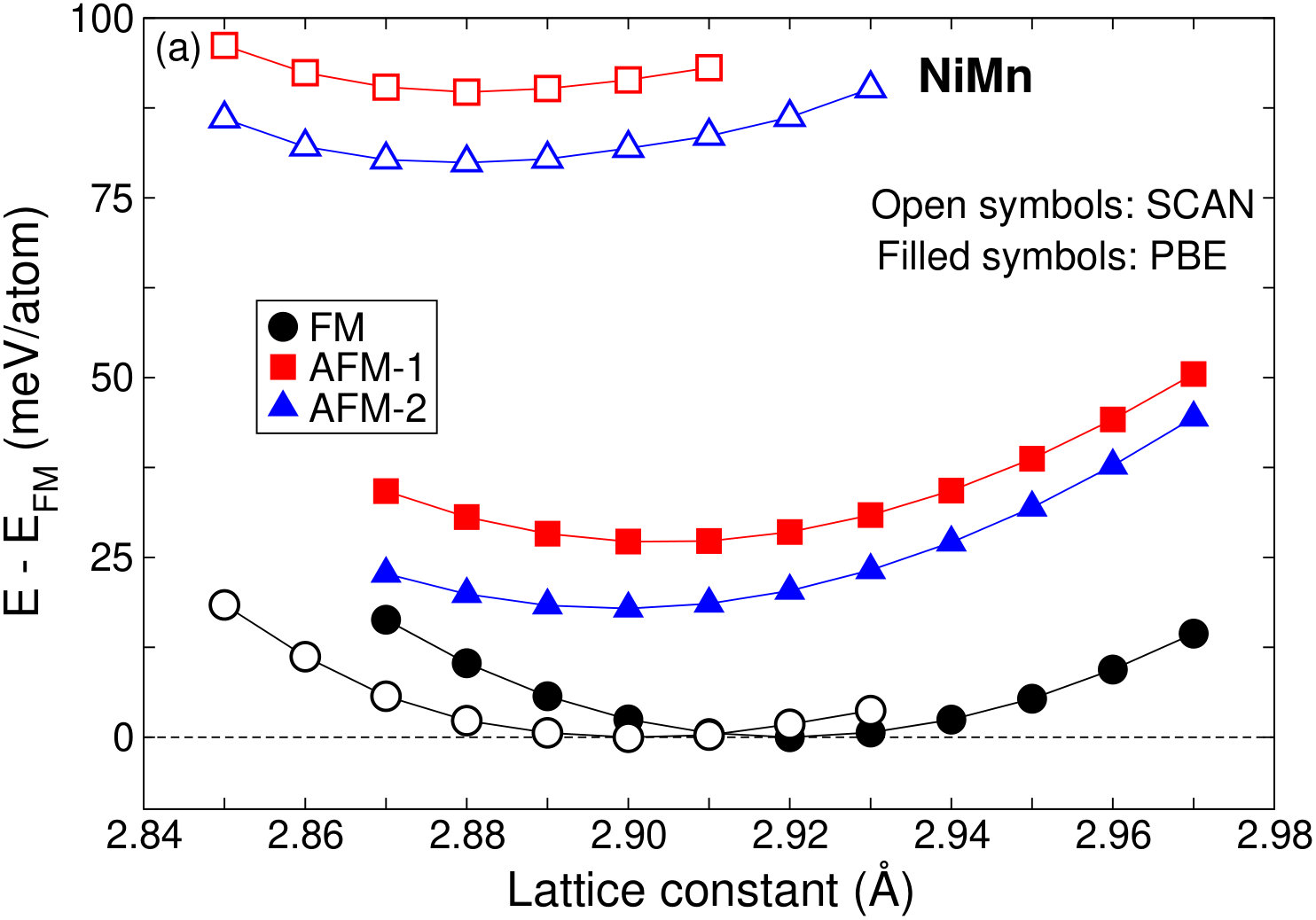 Figure 2
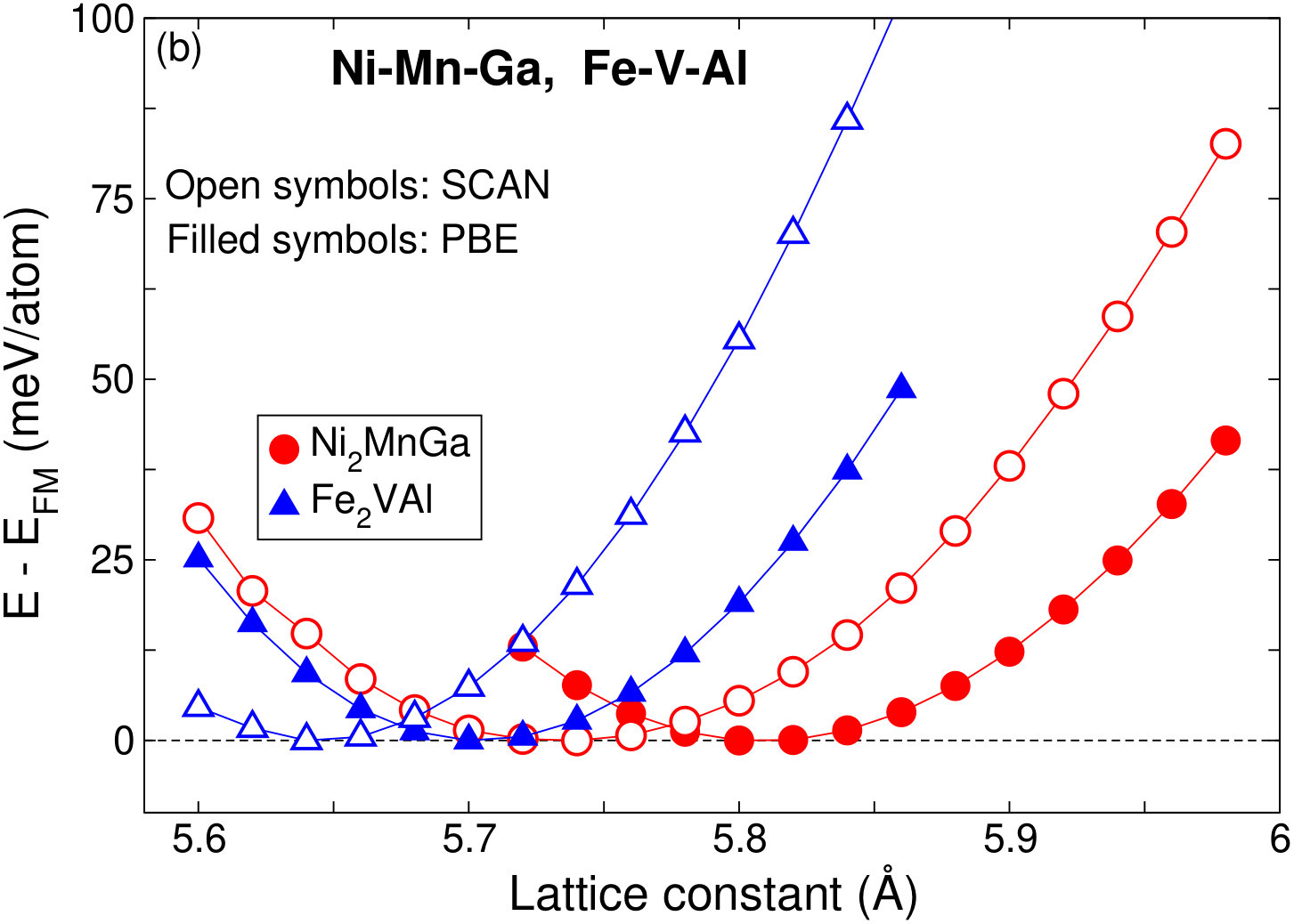 Figure 2
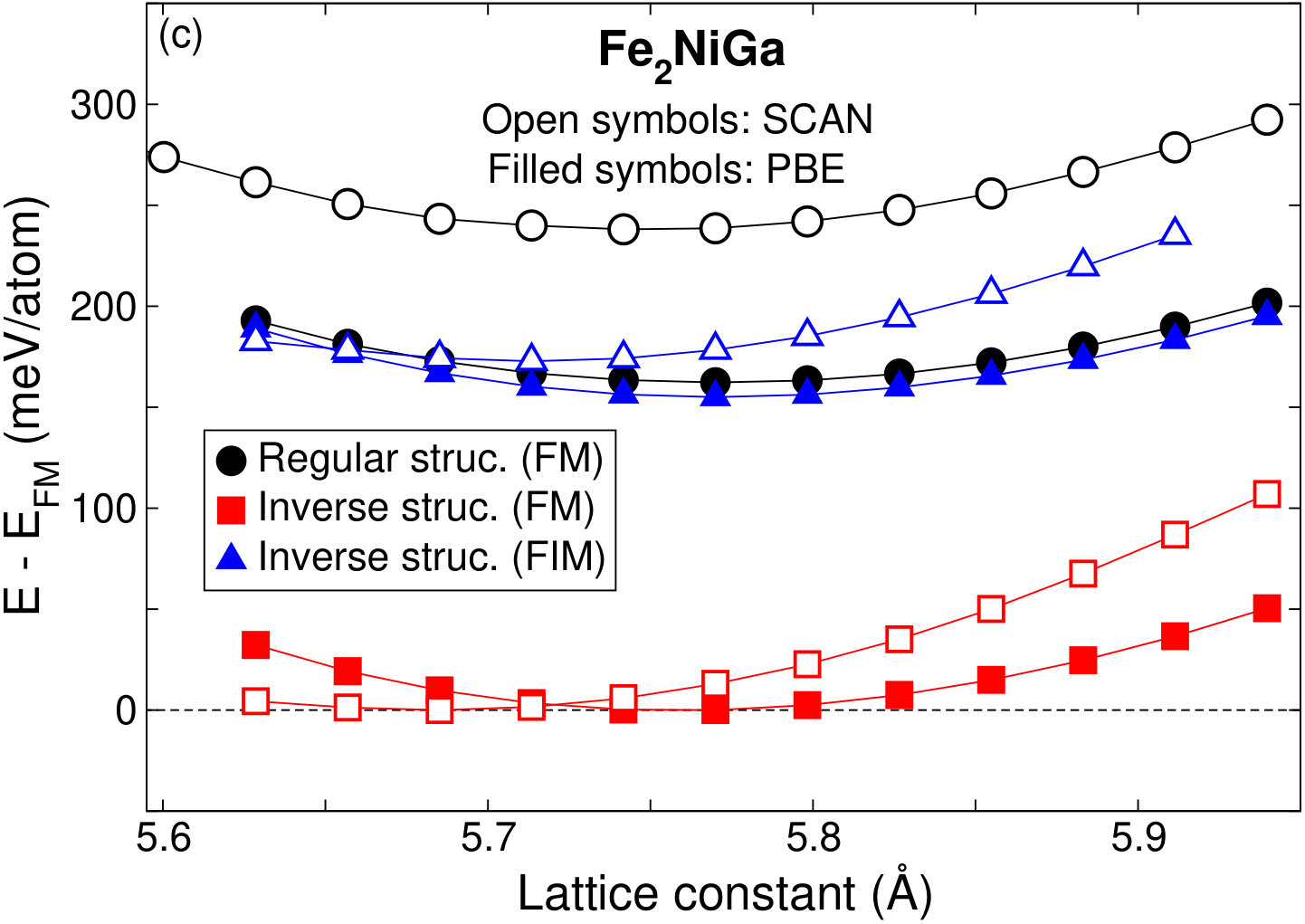 Figure 2
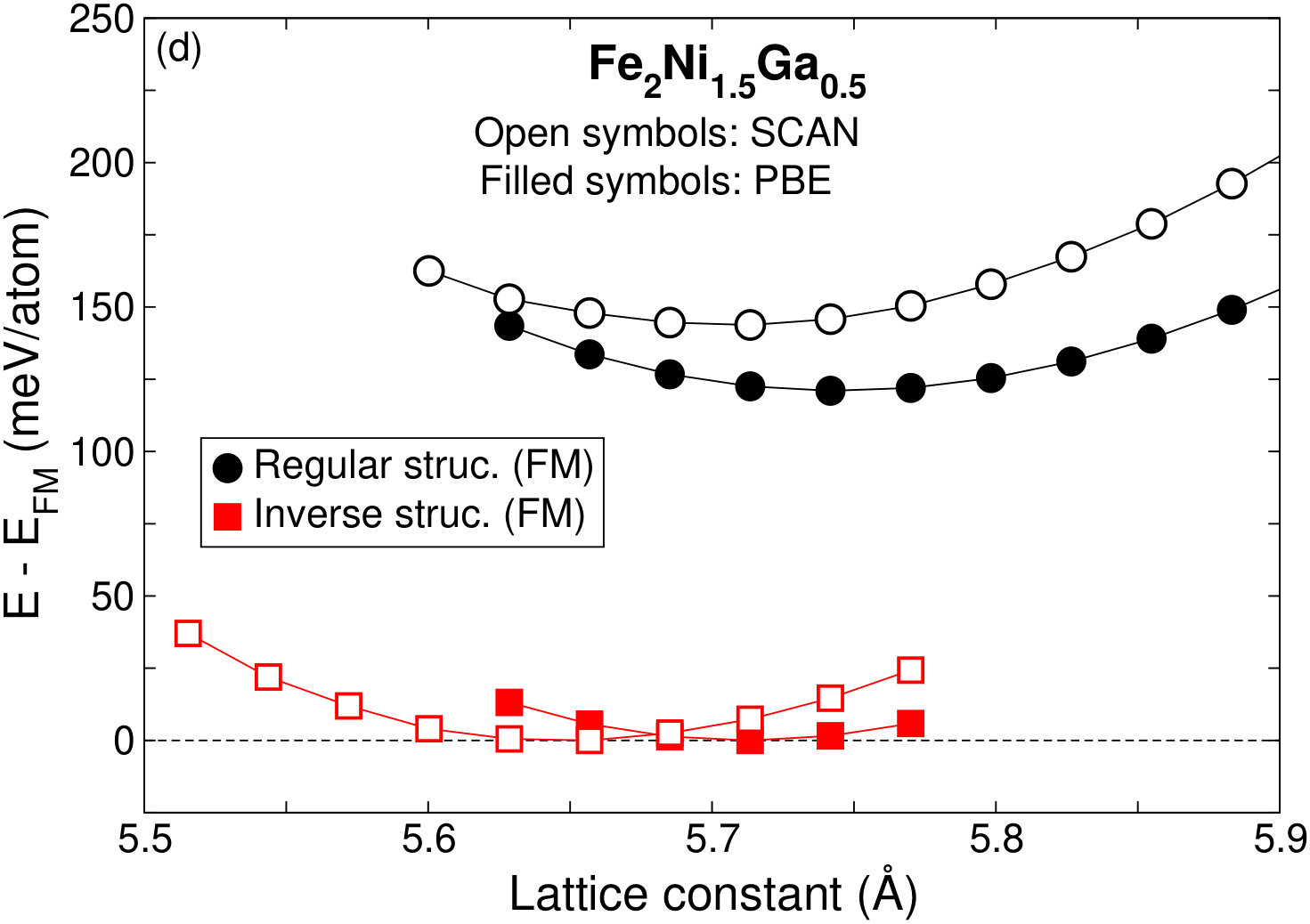 Figure 2
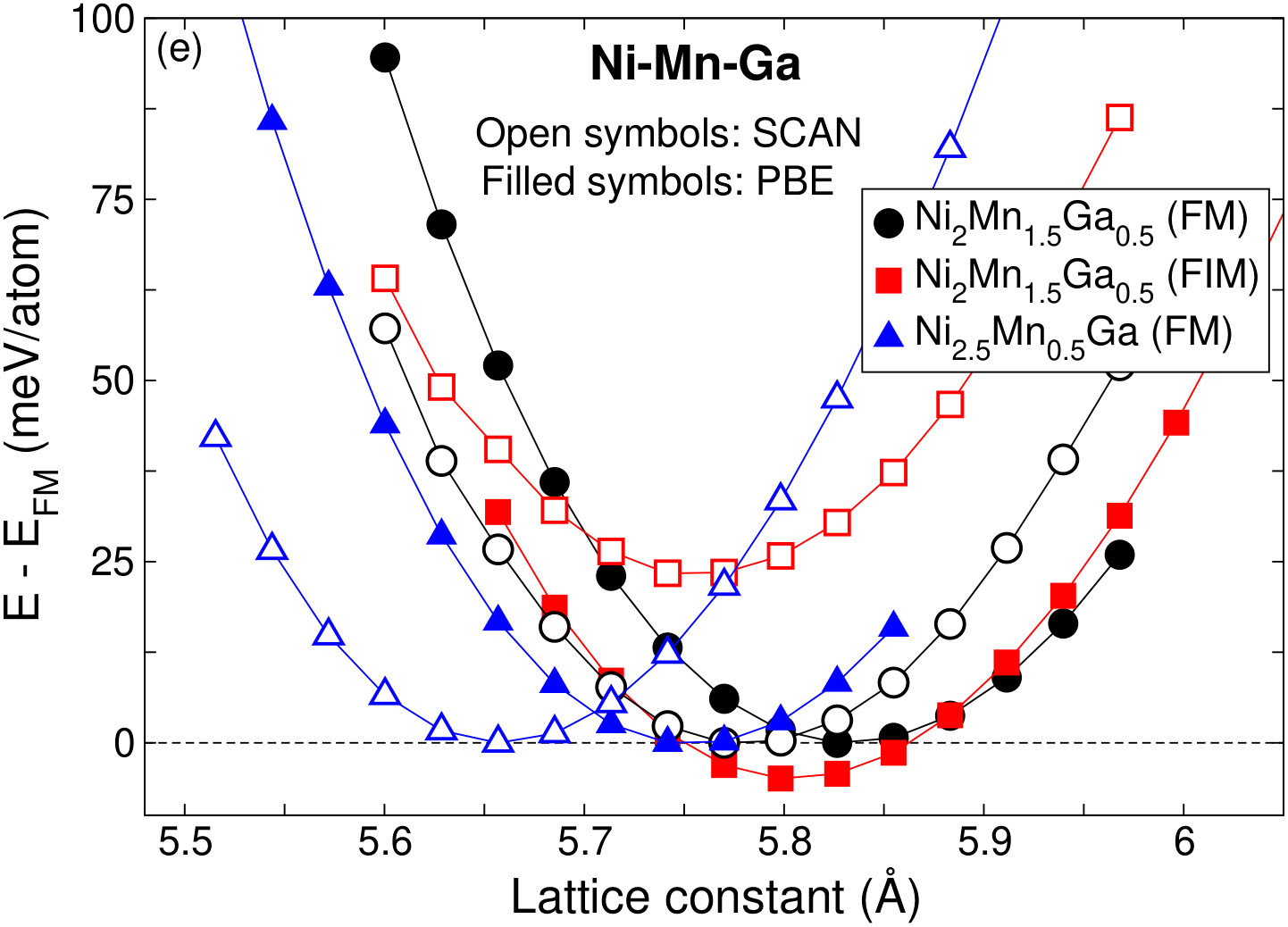 Figure 2
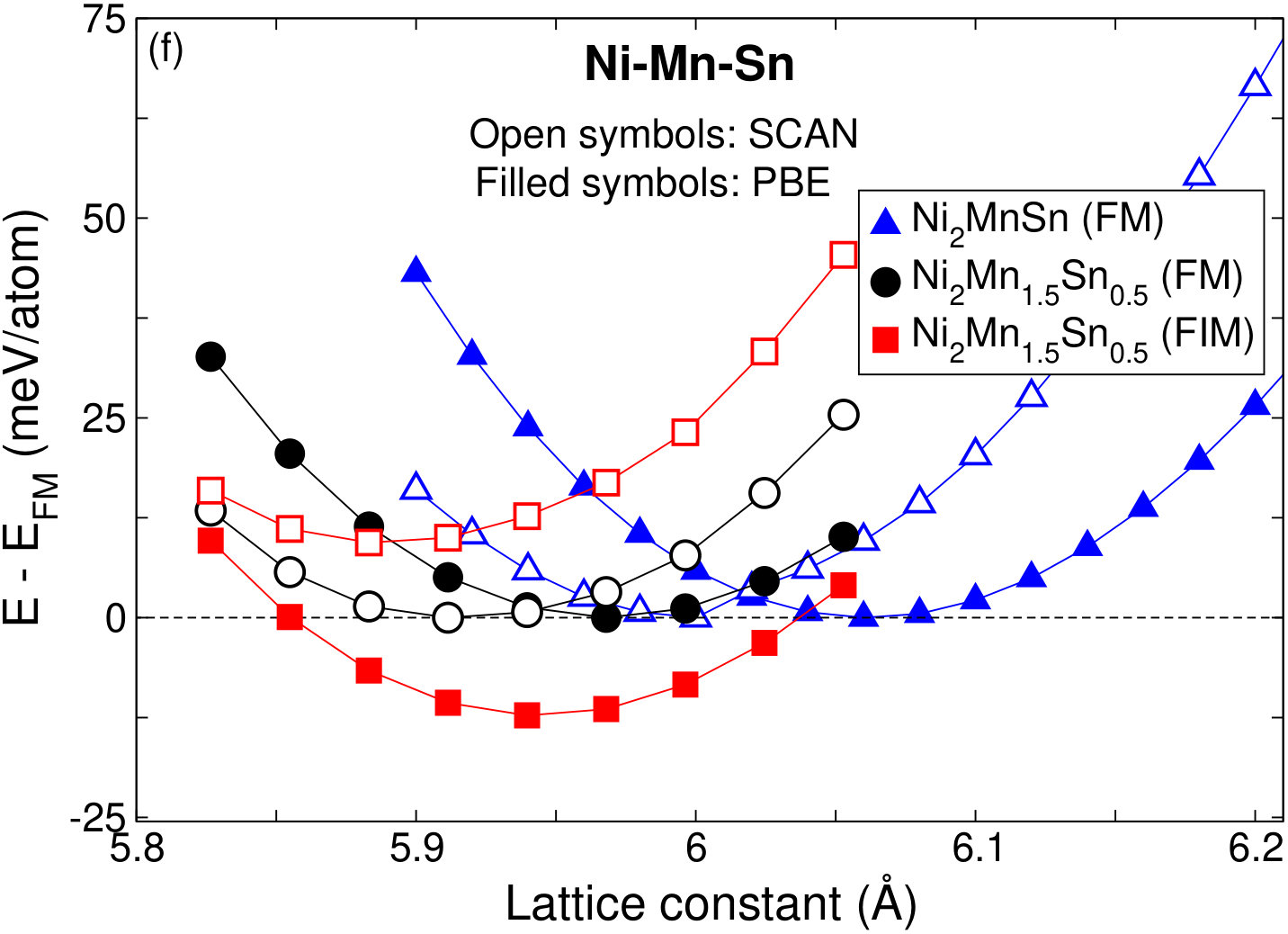 Figure 2
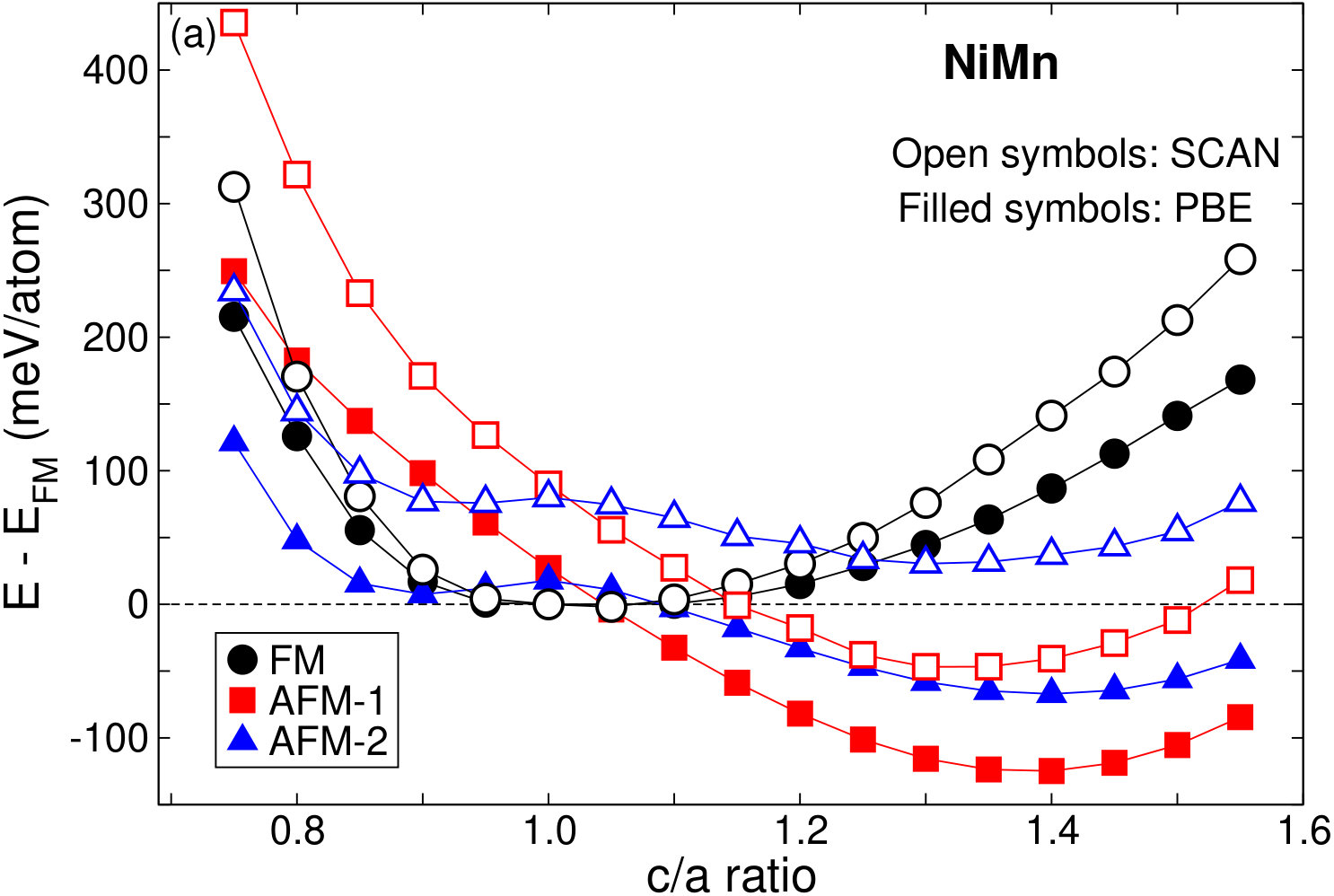 Figure 3
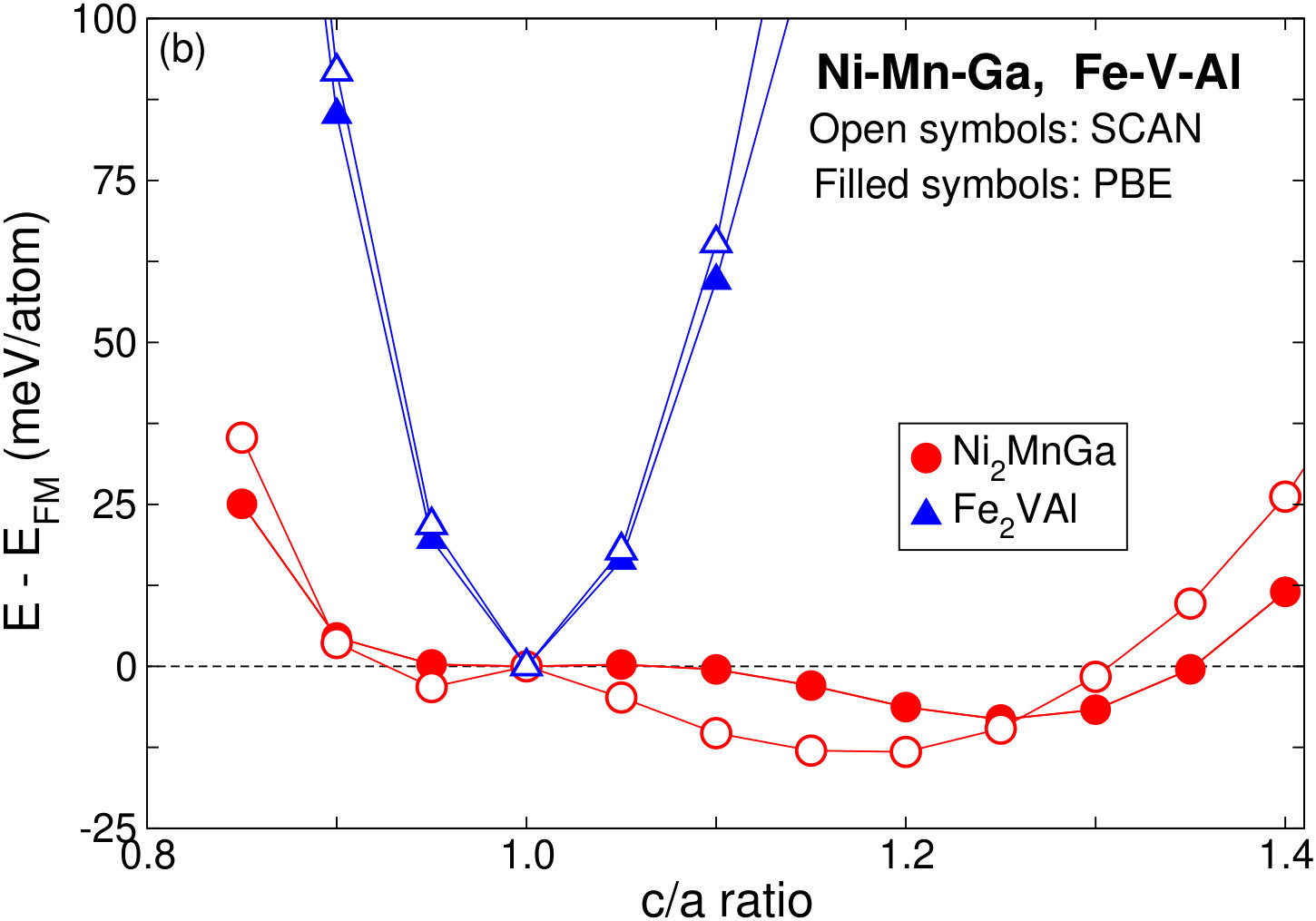 Figure 3
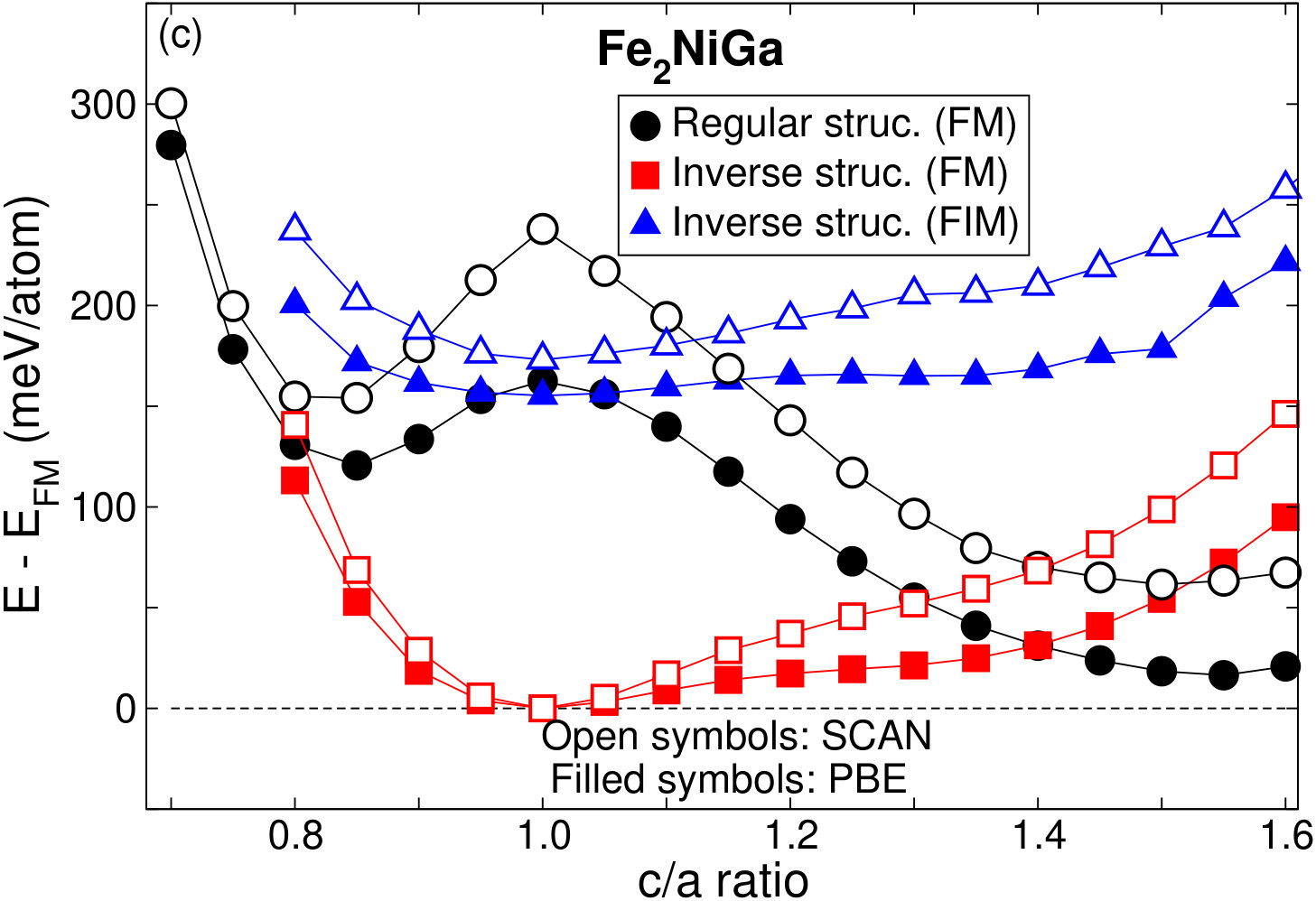 Figure 3
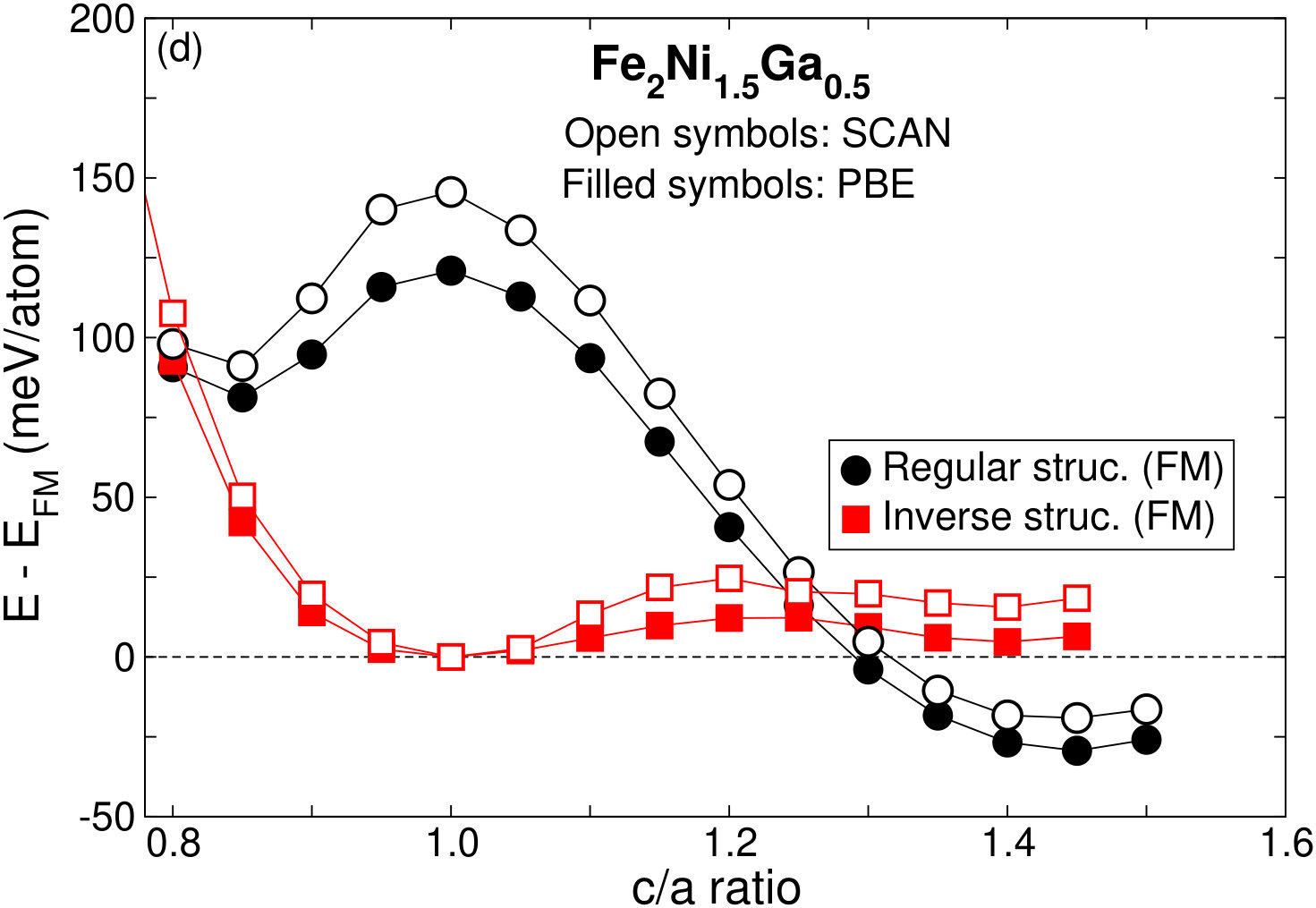 Figure 3
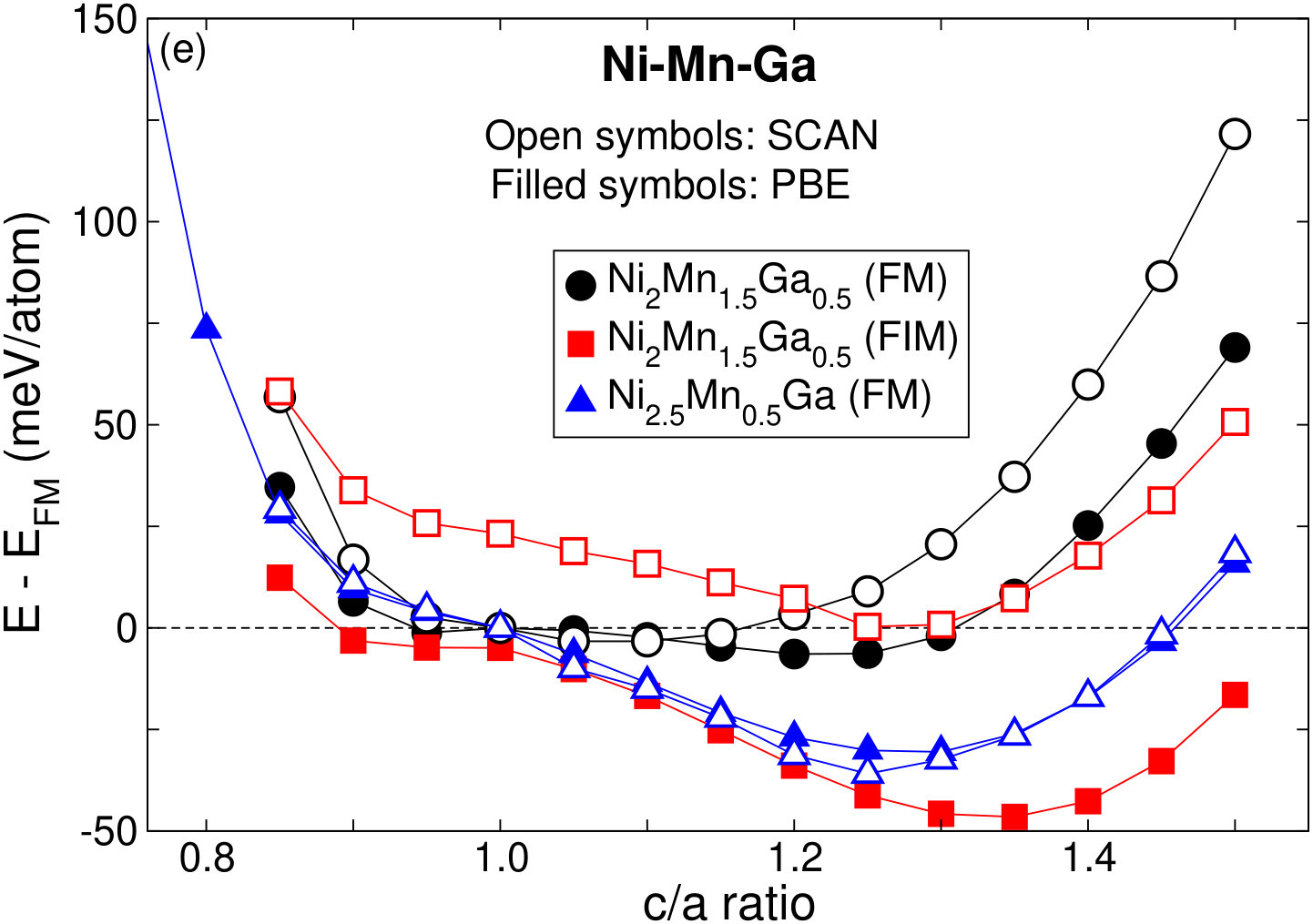 Figure 3
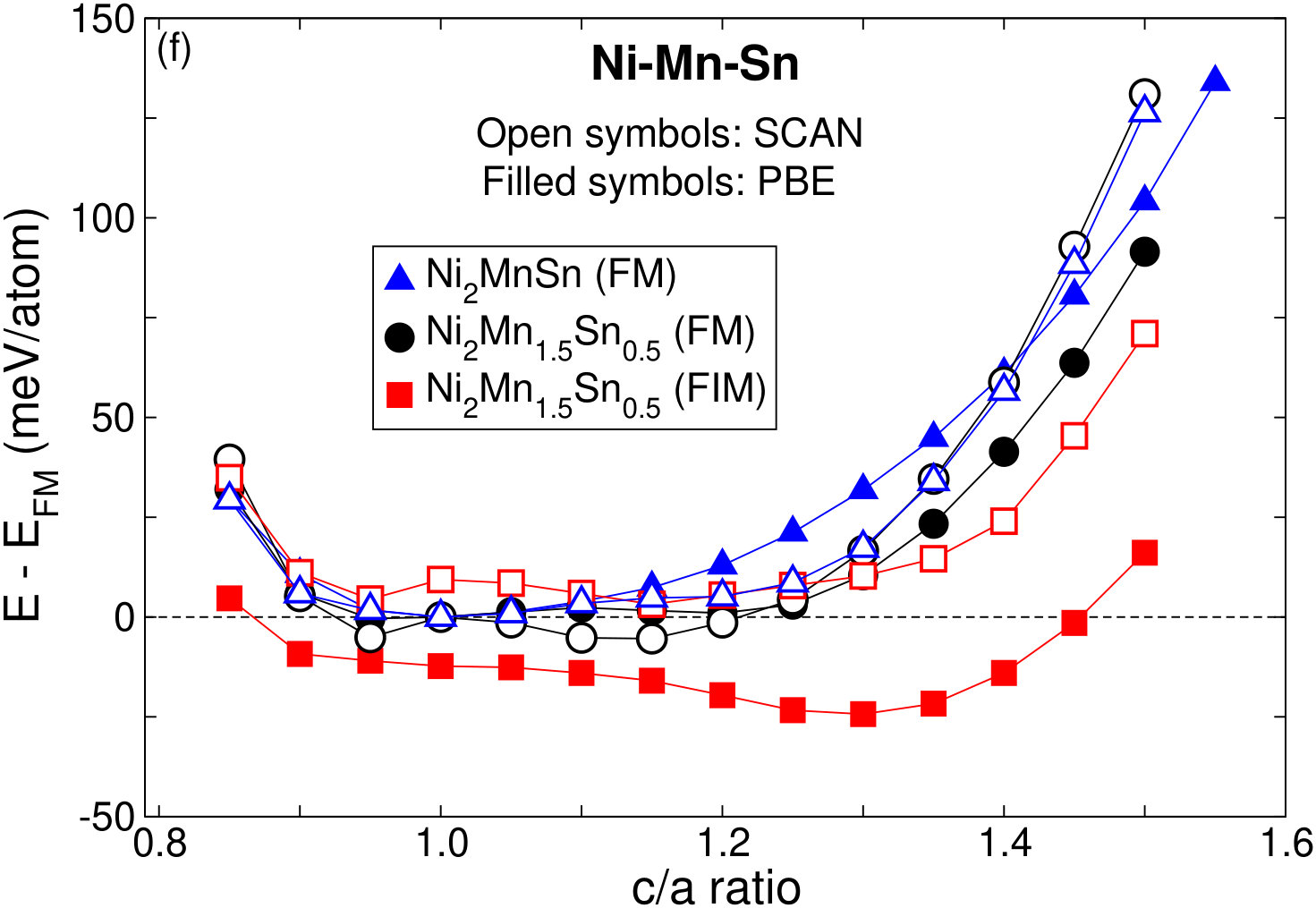 Figure 3
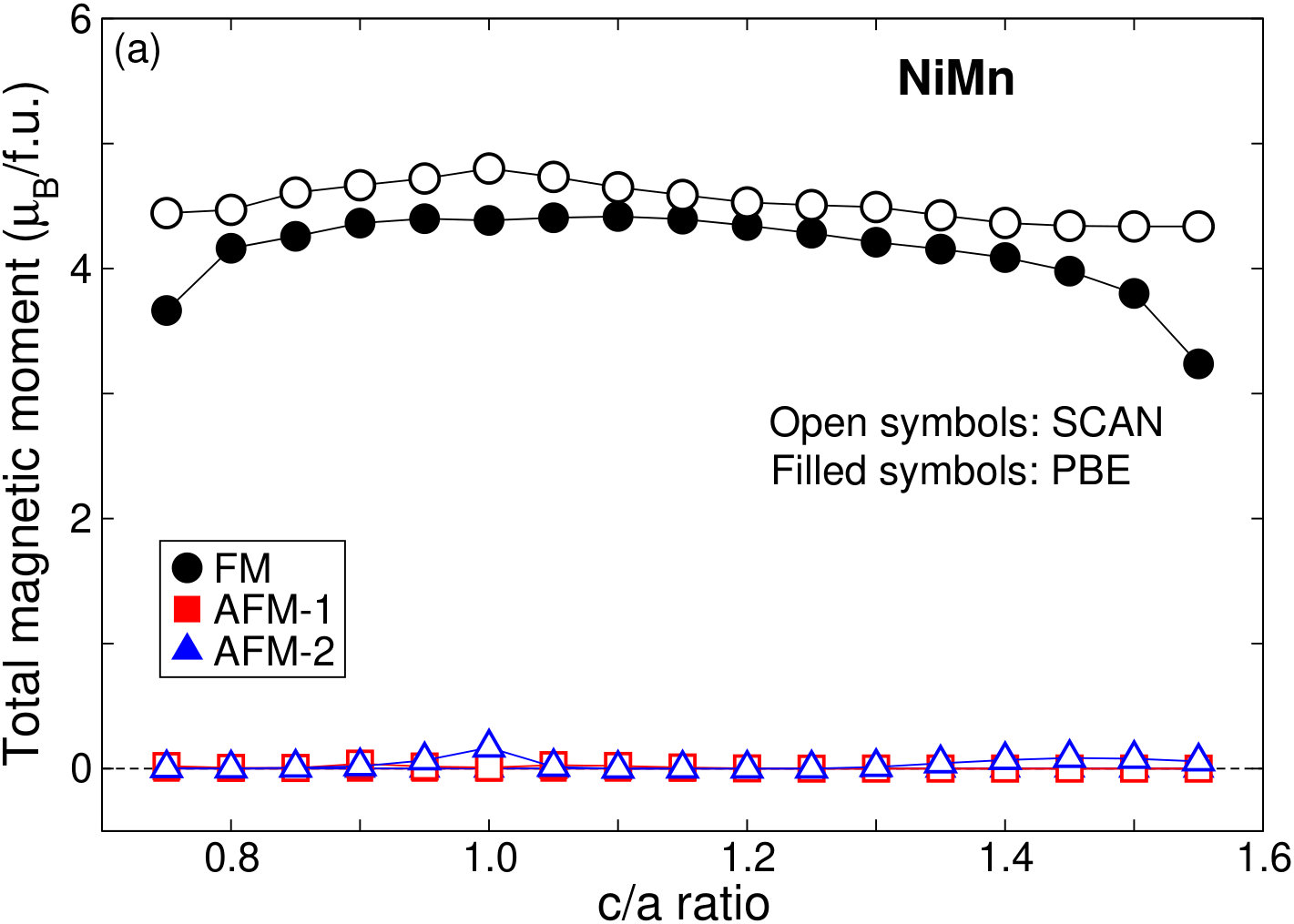 Figure 4
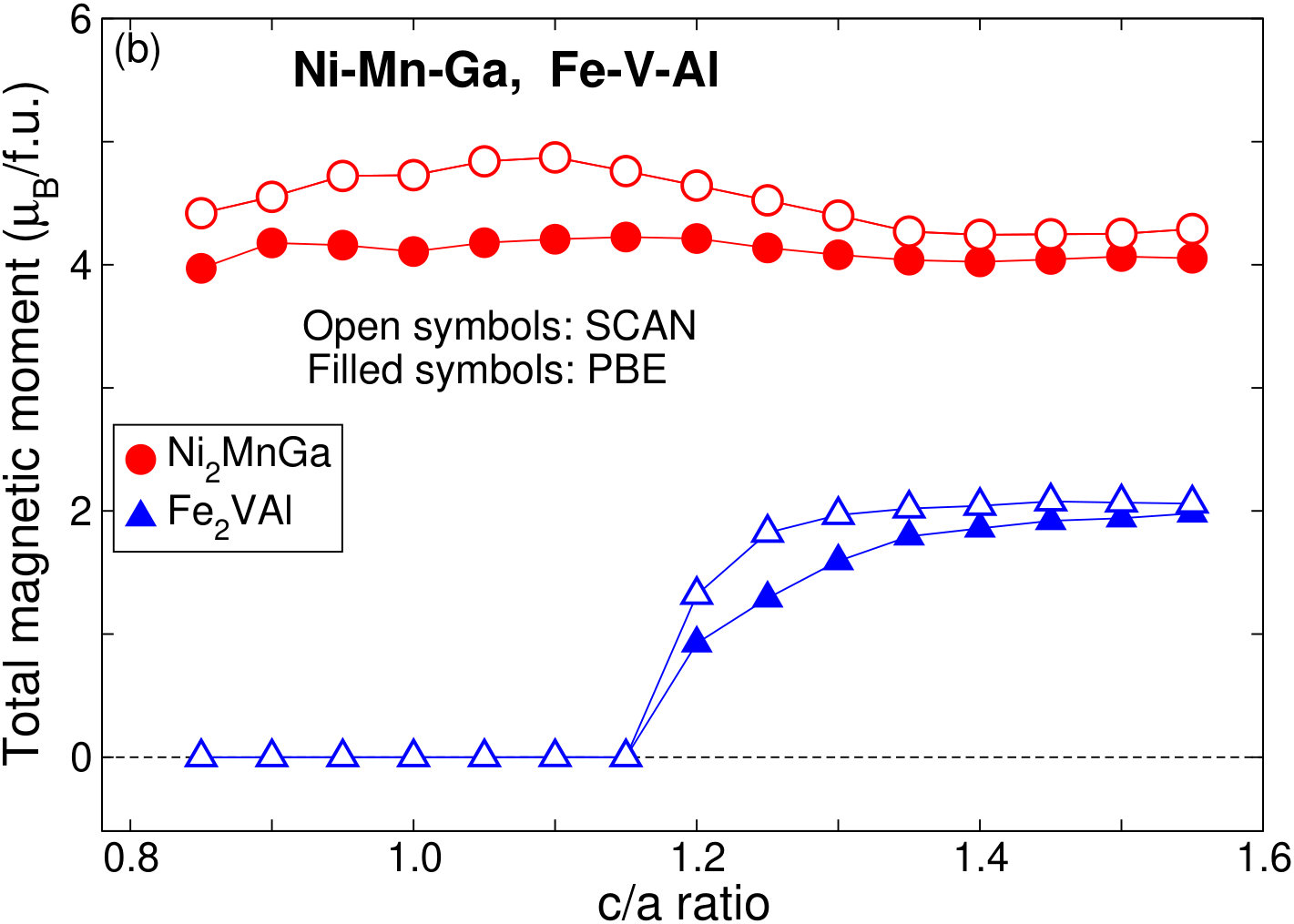 Figure 4
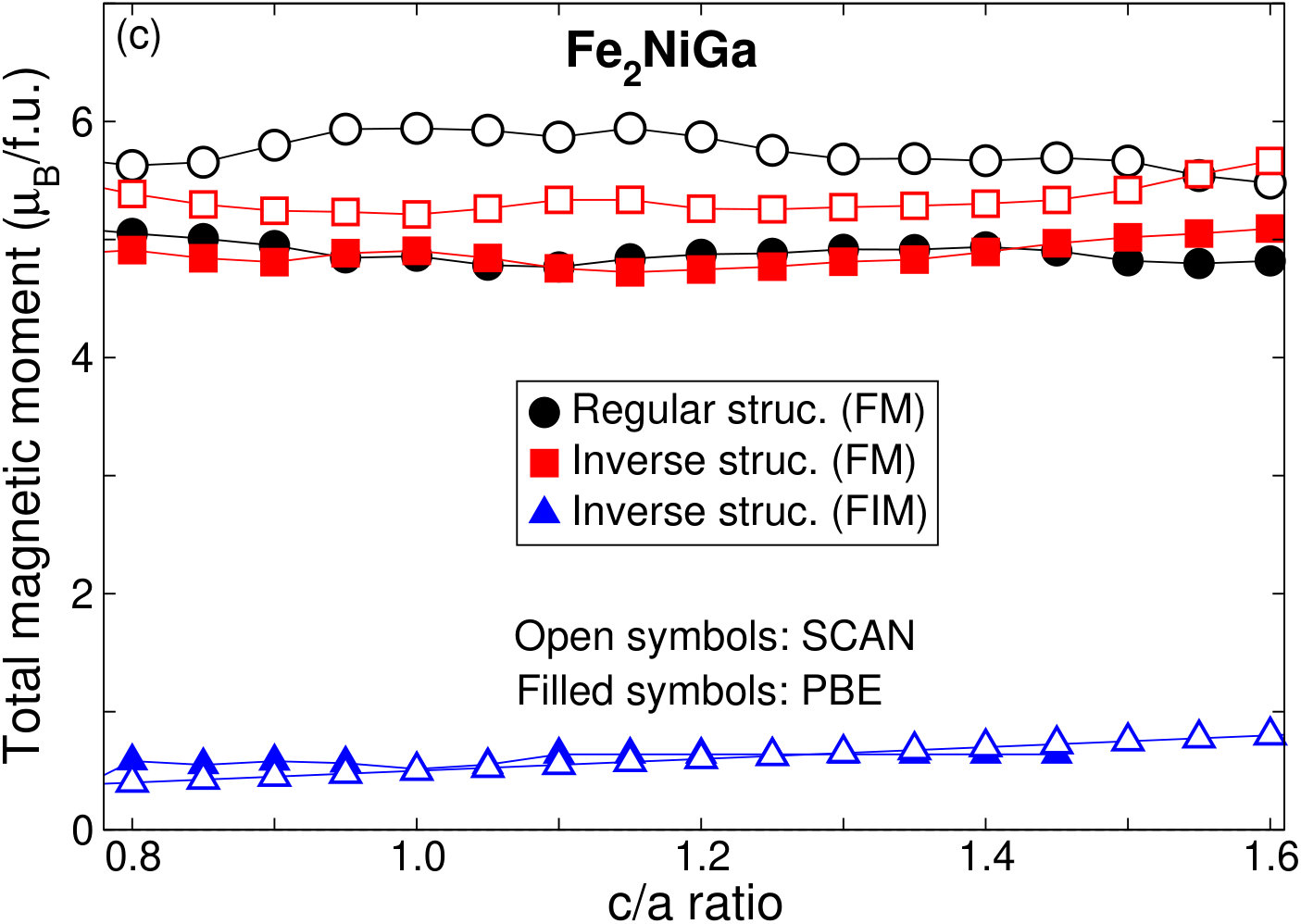 Figure 4
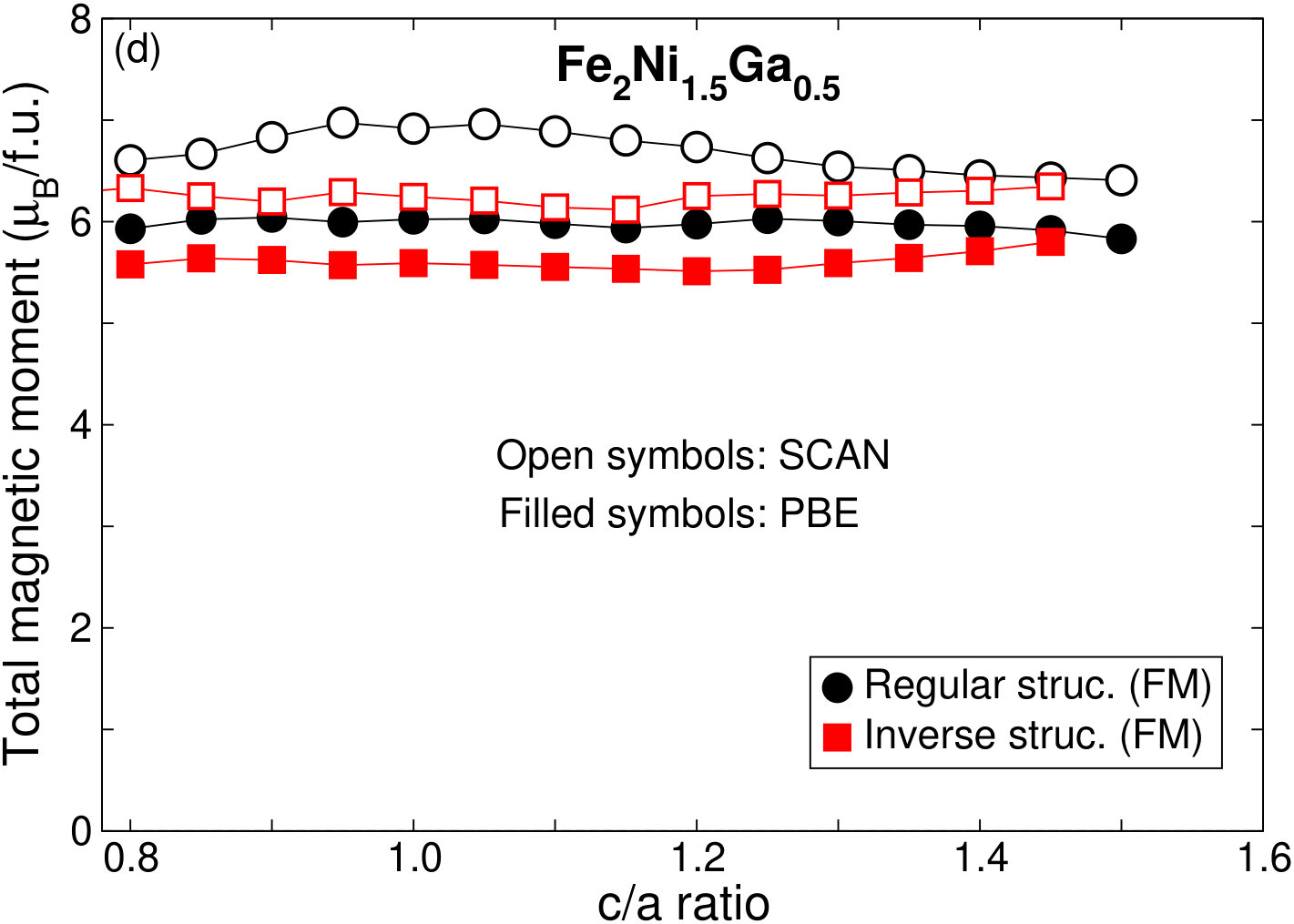 Figure 4
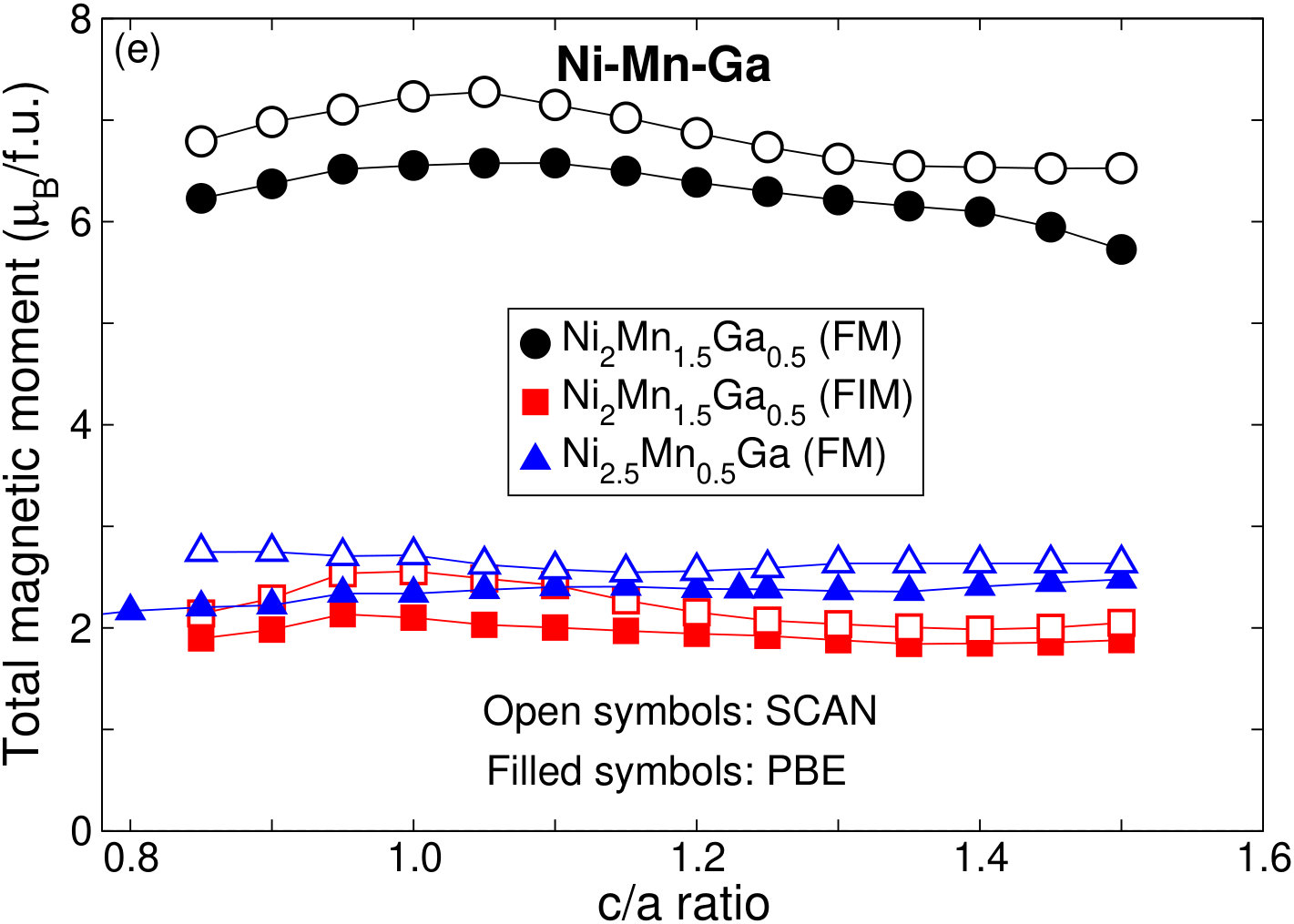 Figure 4
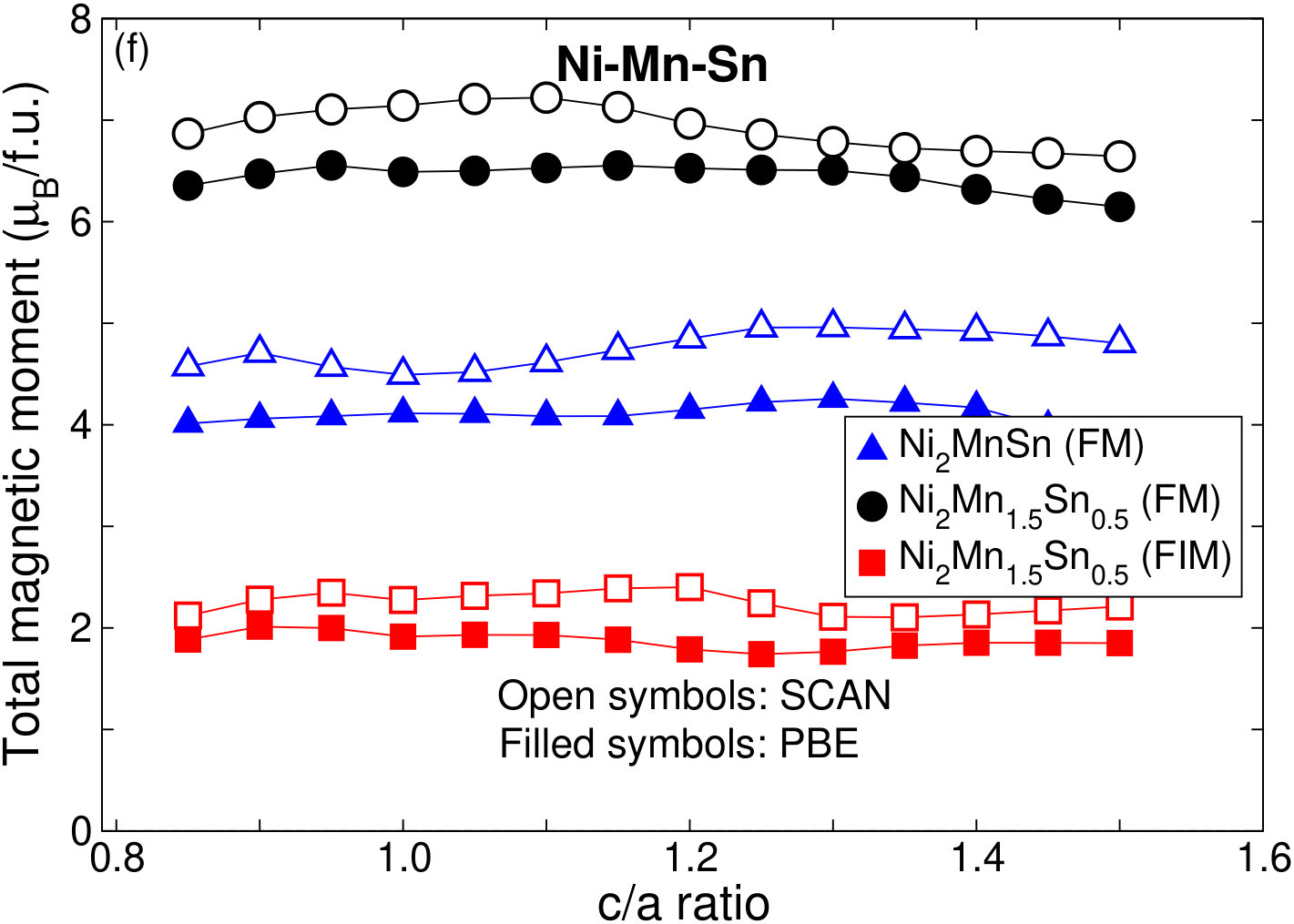 Figure 4
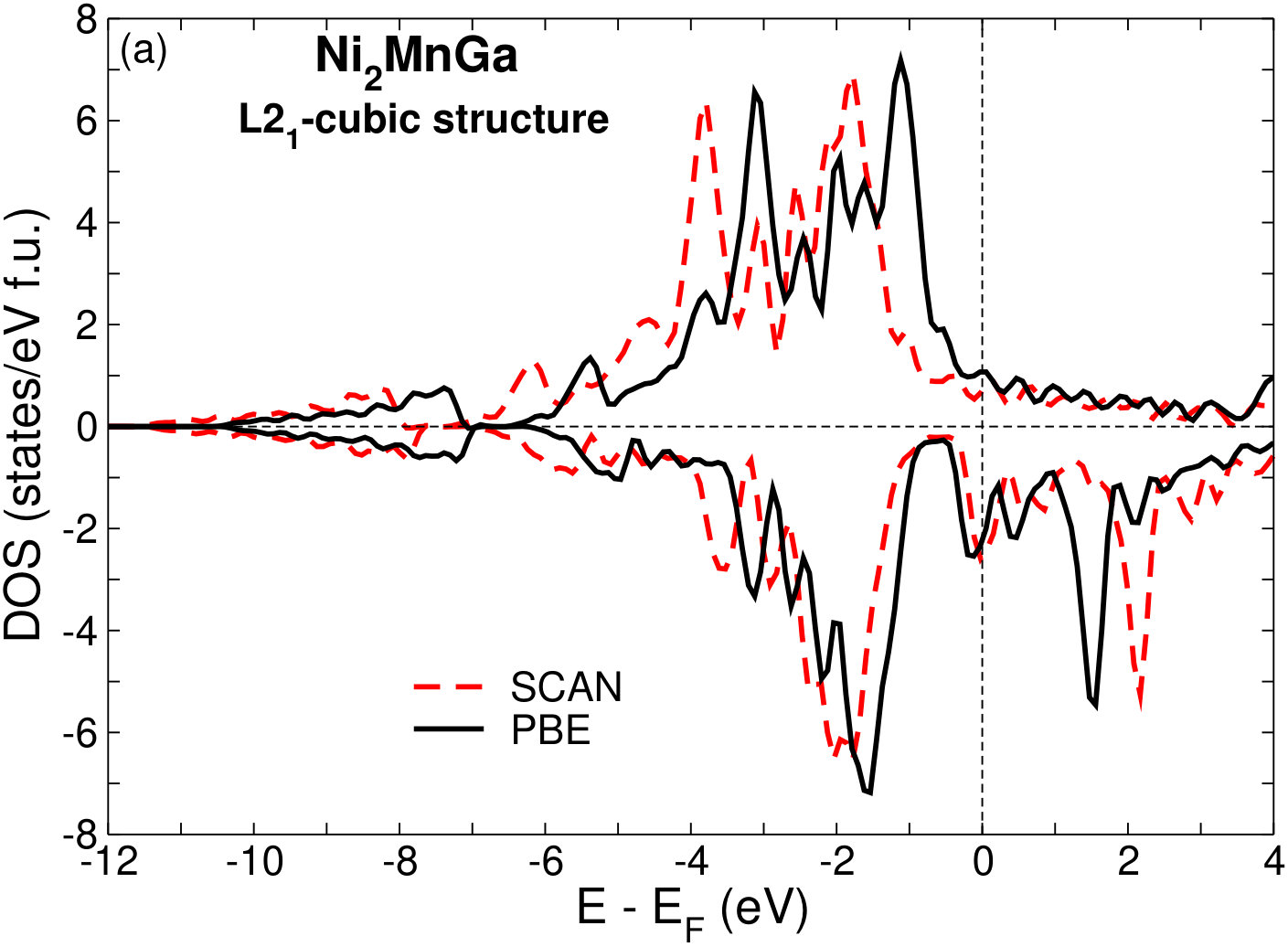 Figure 5
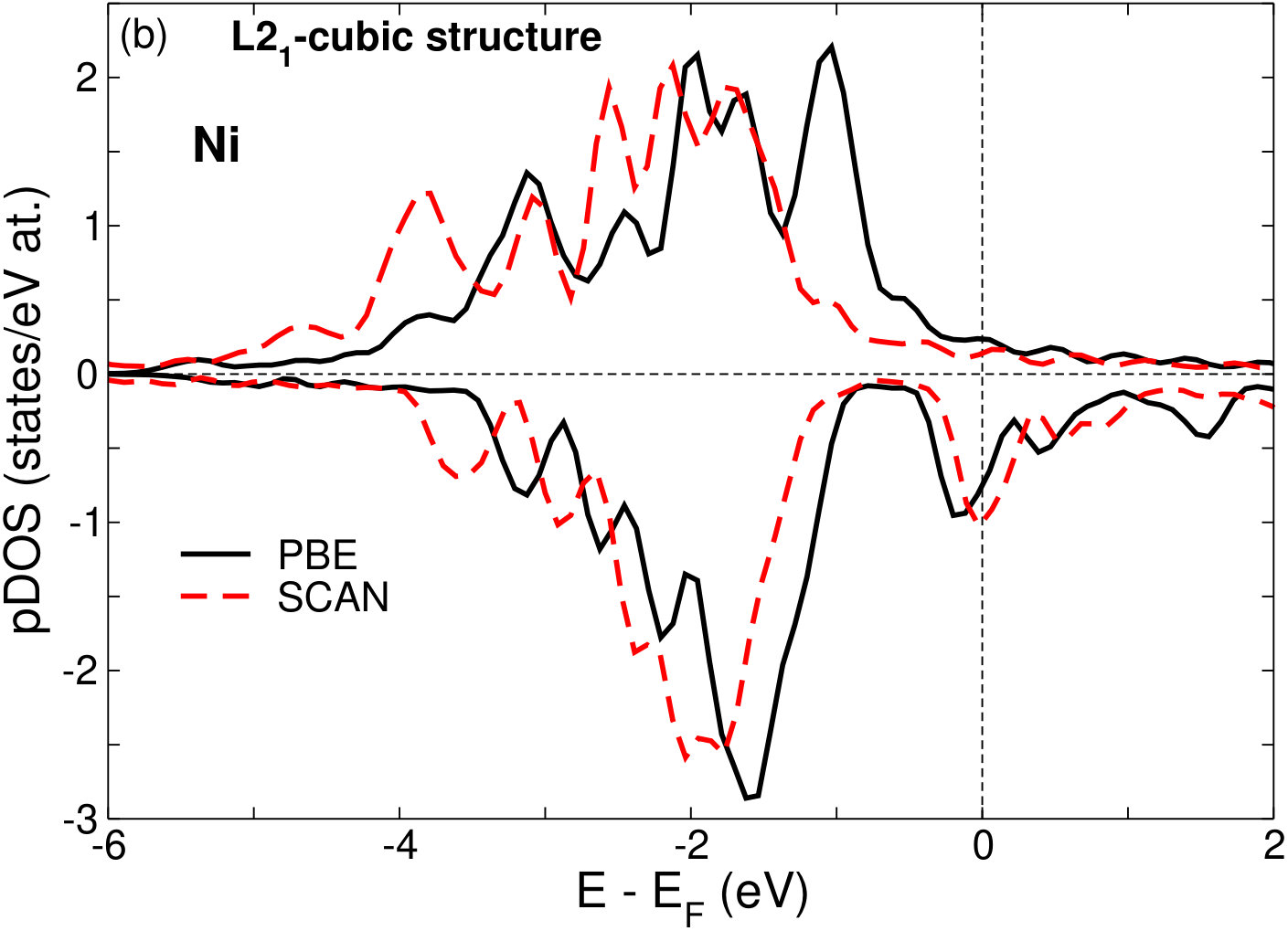 Figure 5
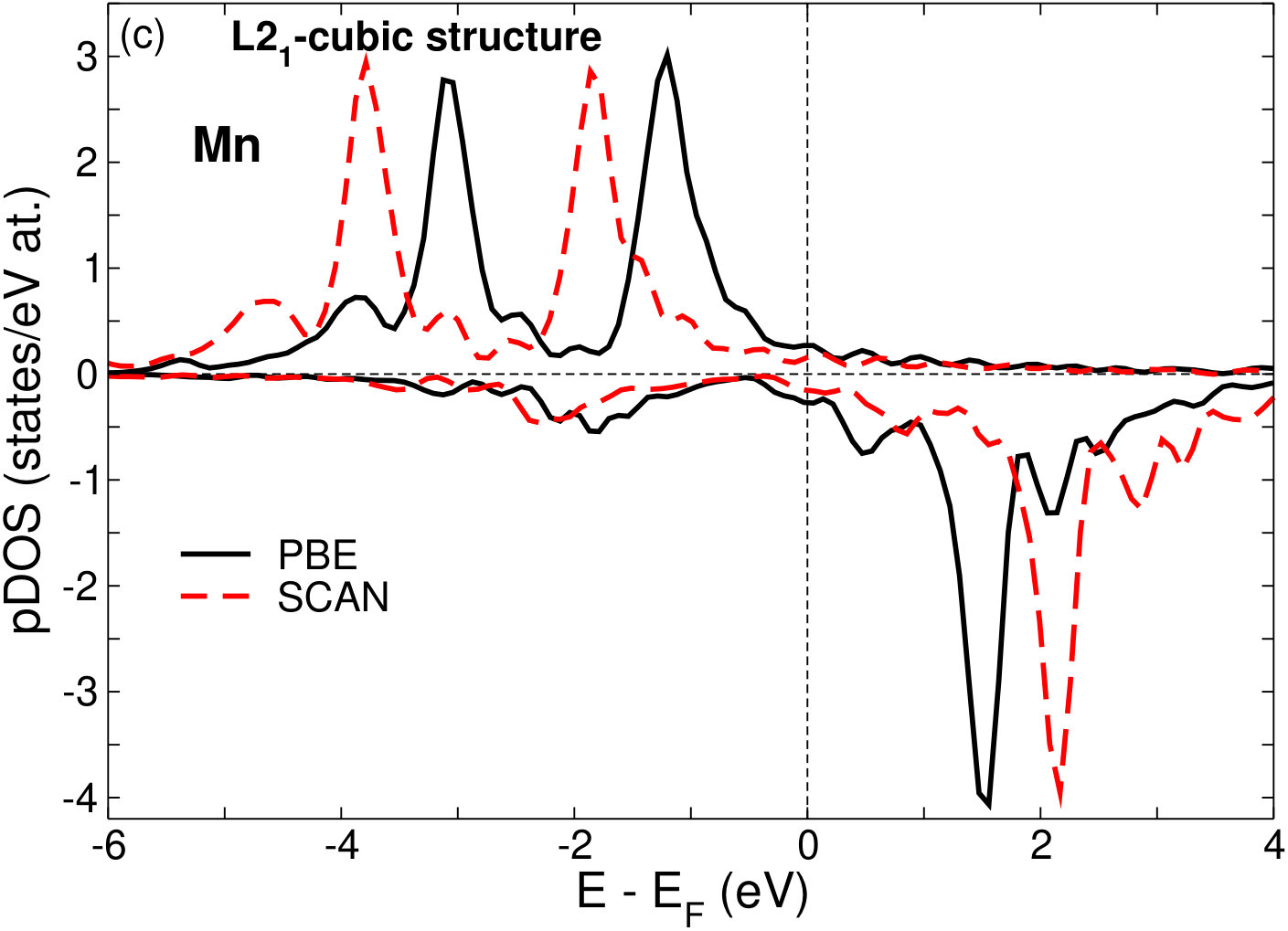 Figure 5
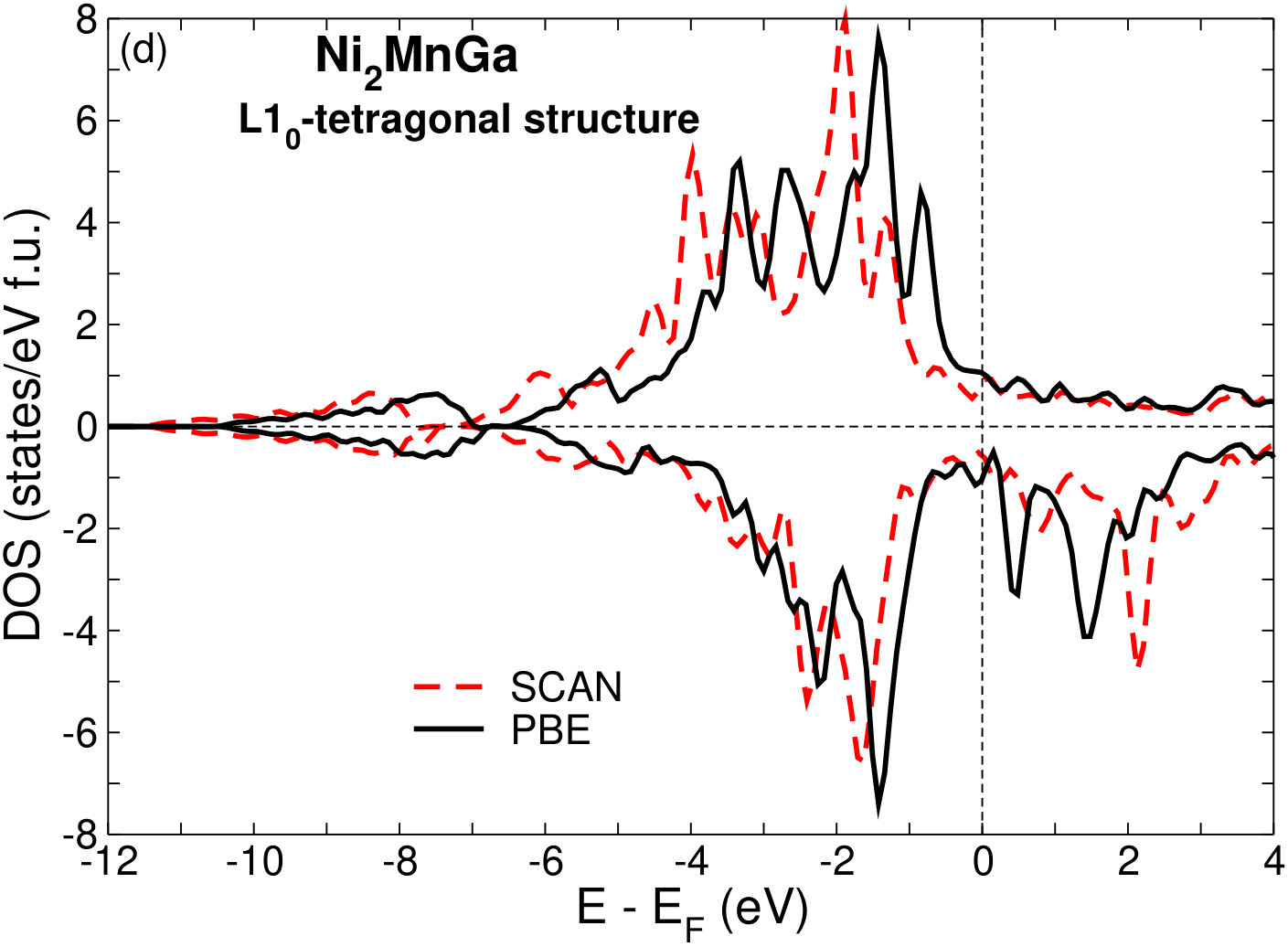 Figure 5
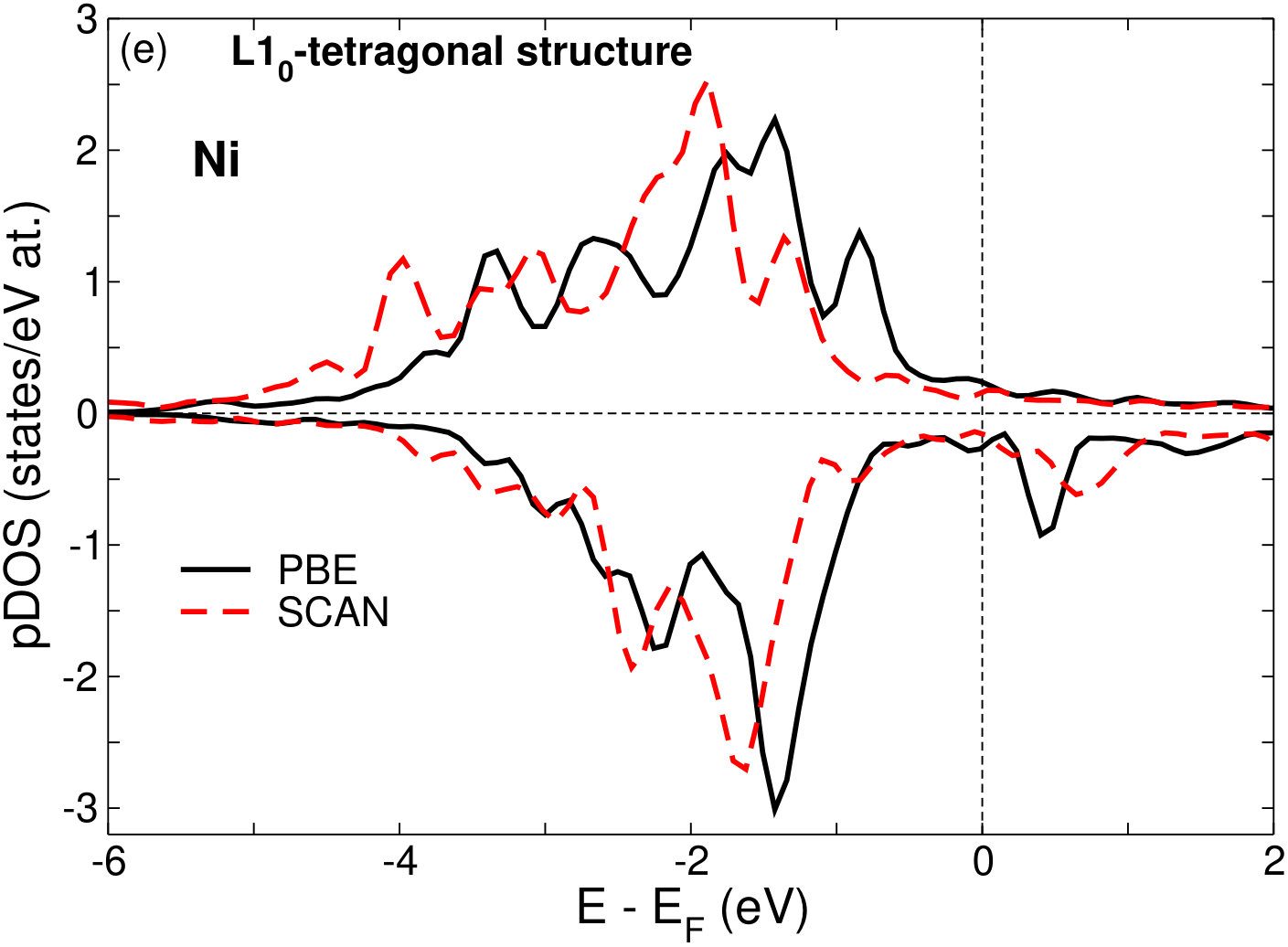 Figure 5
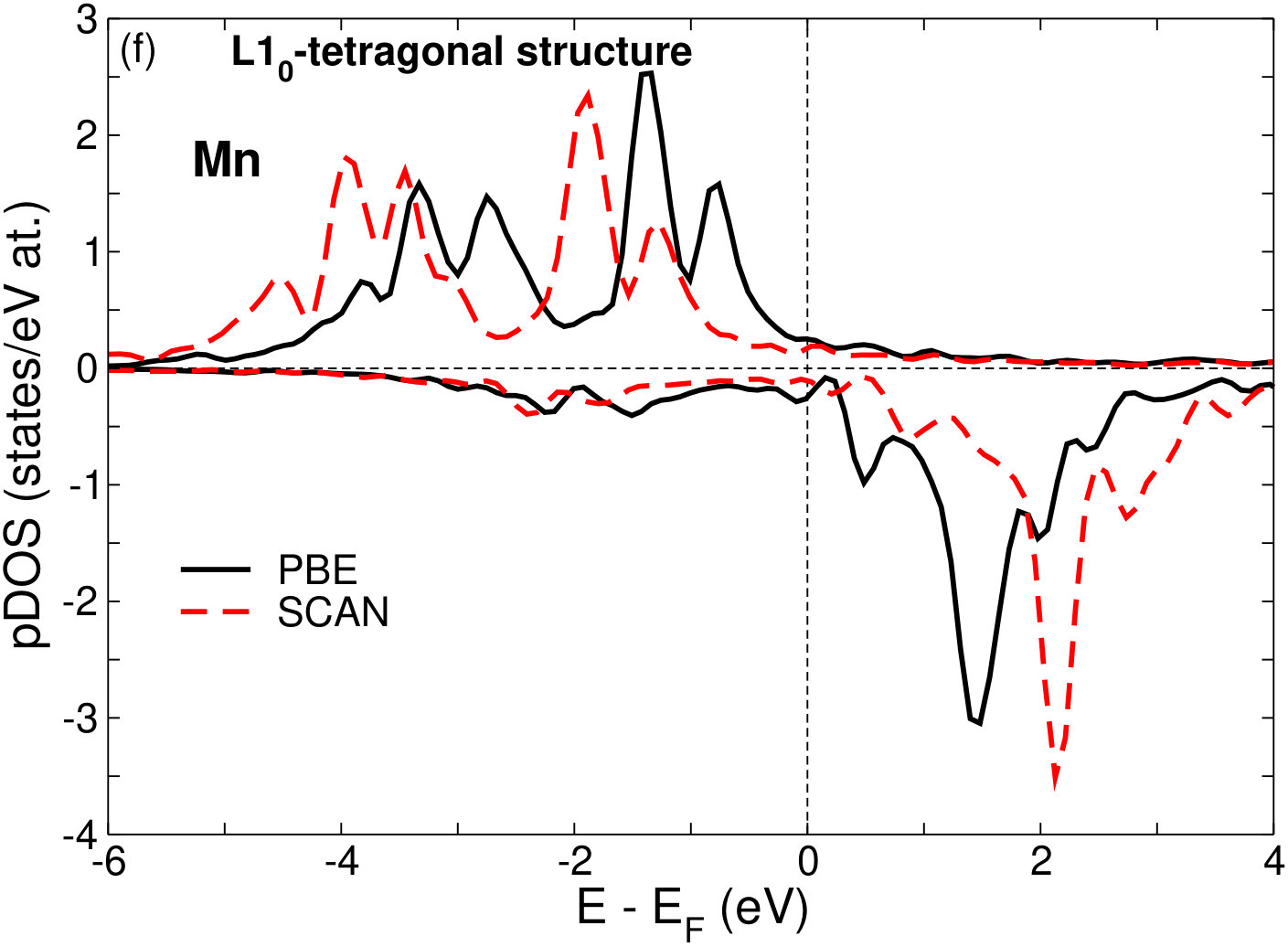 Figure 5
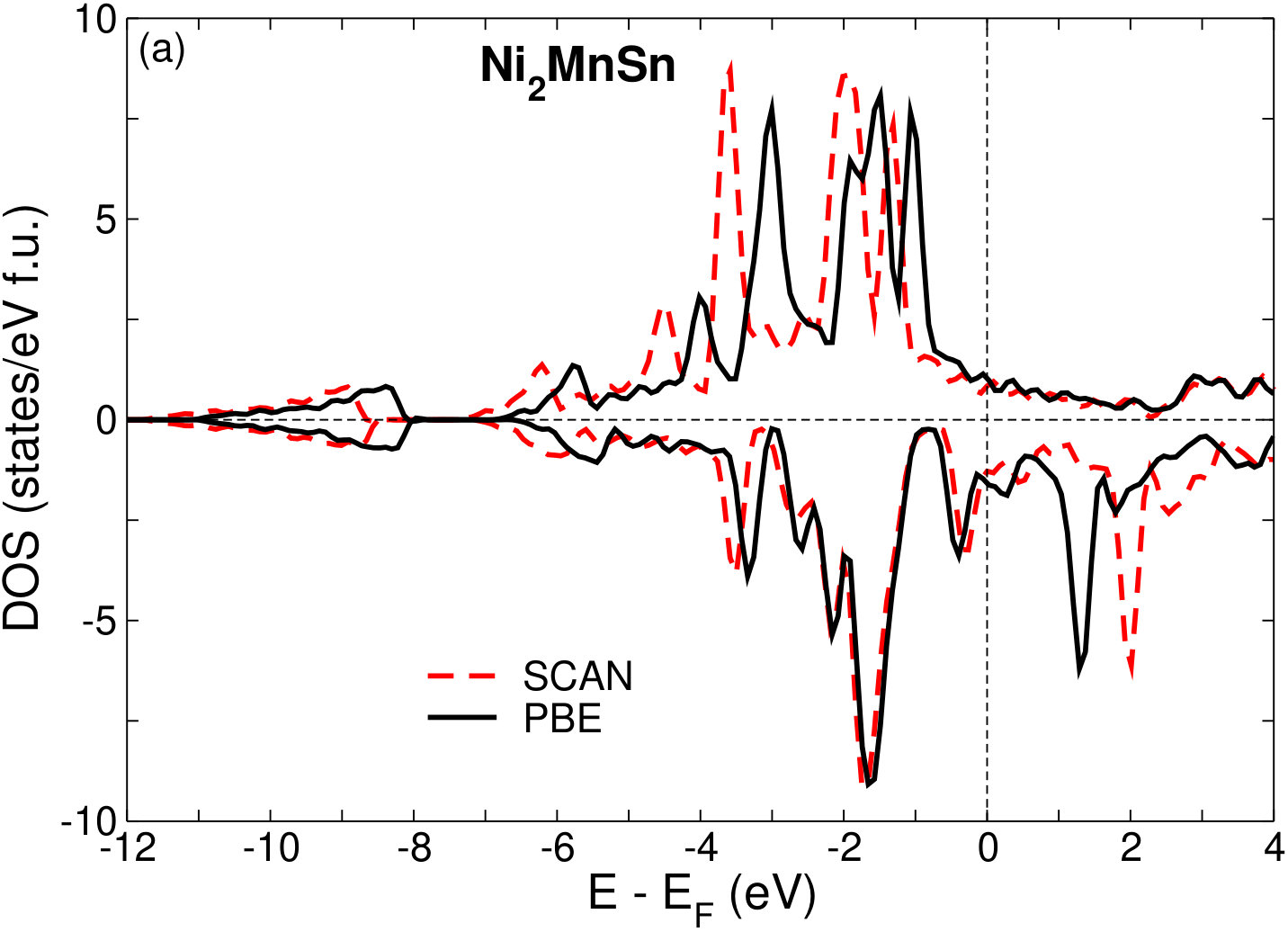 Figure 6
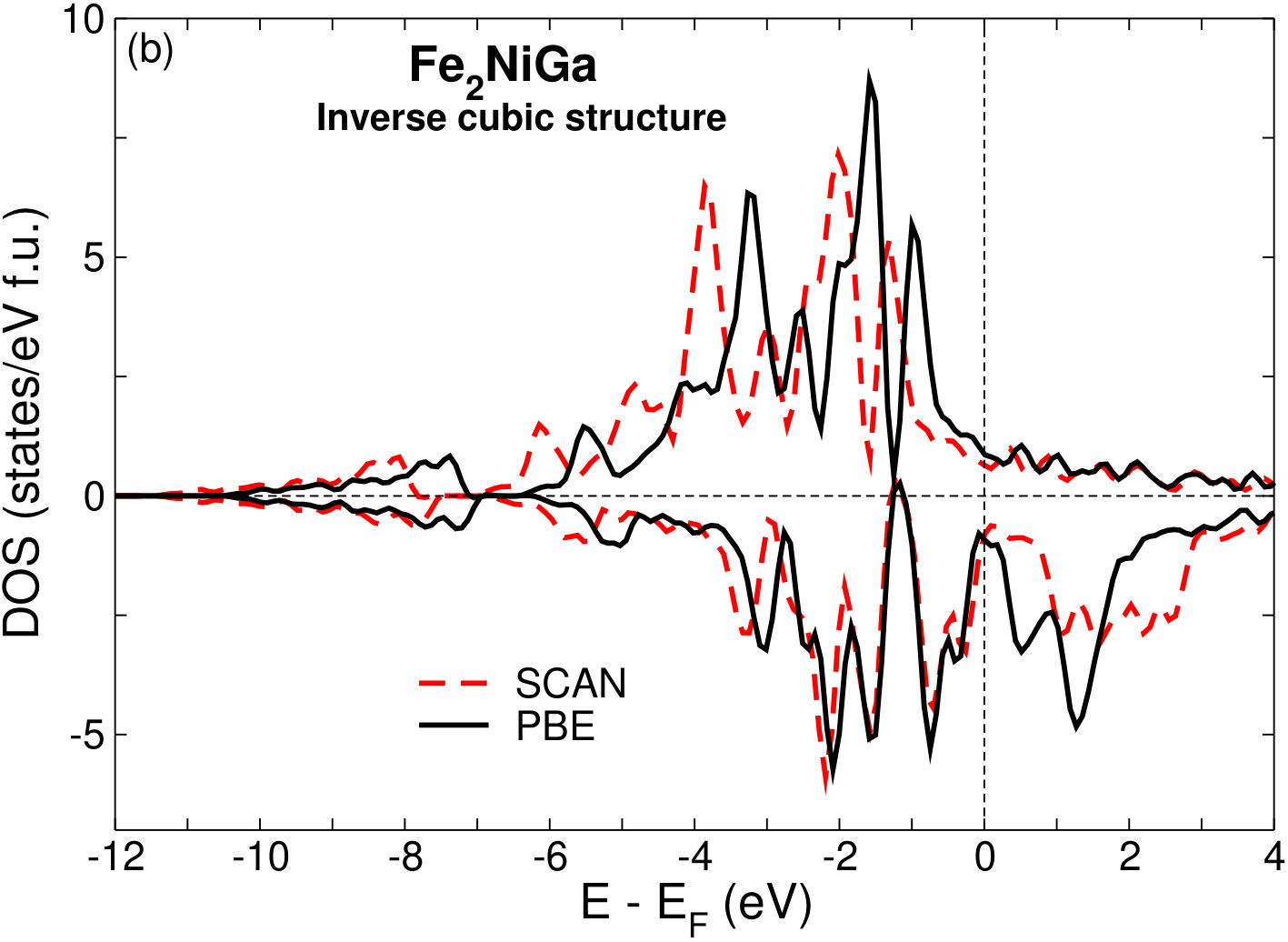 Figure 6
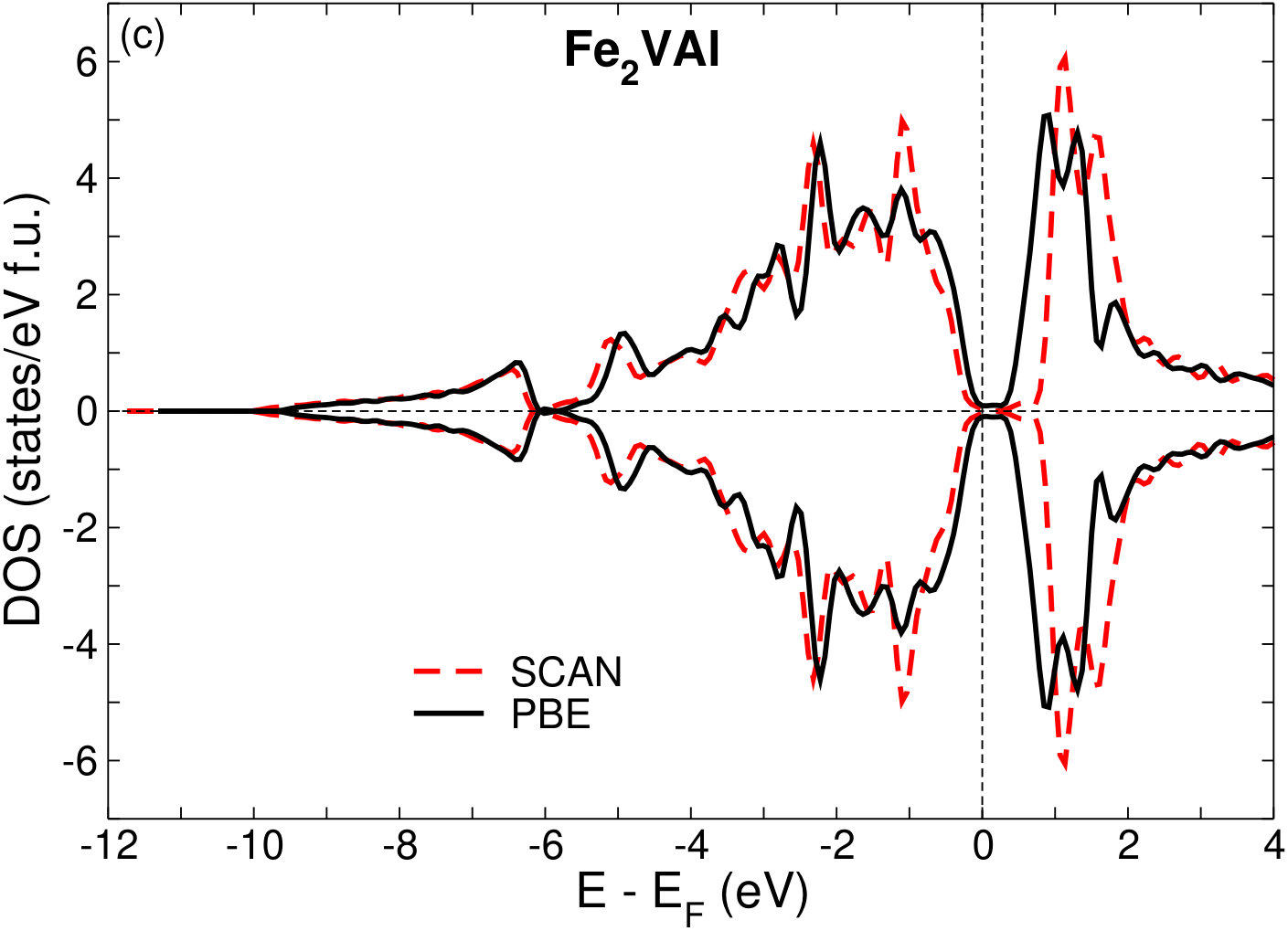 Figure 6
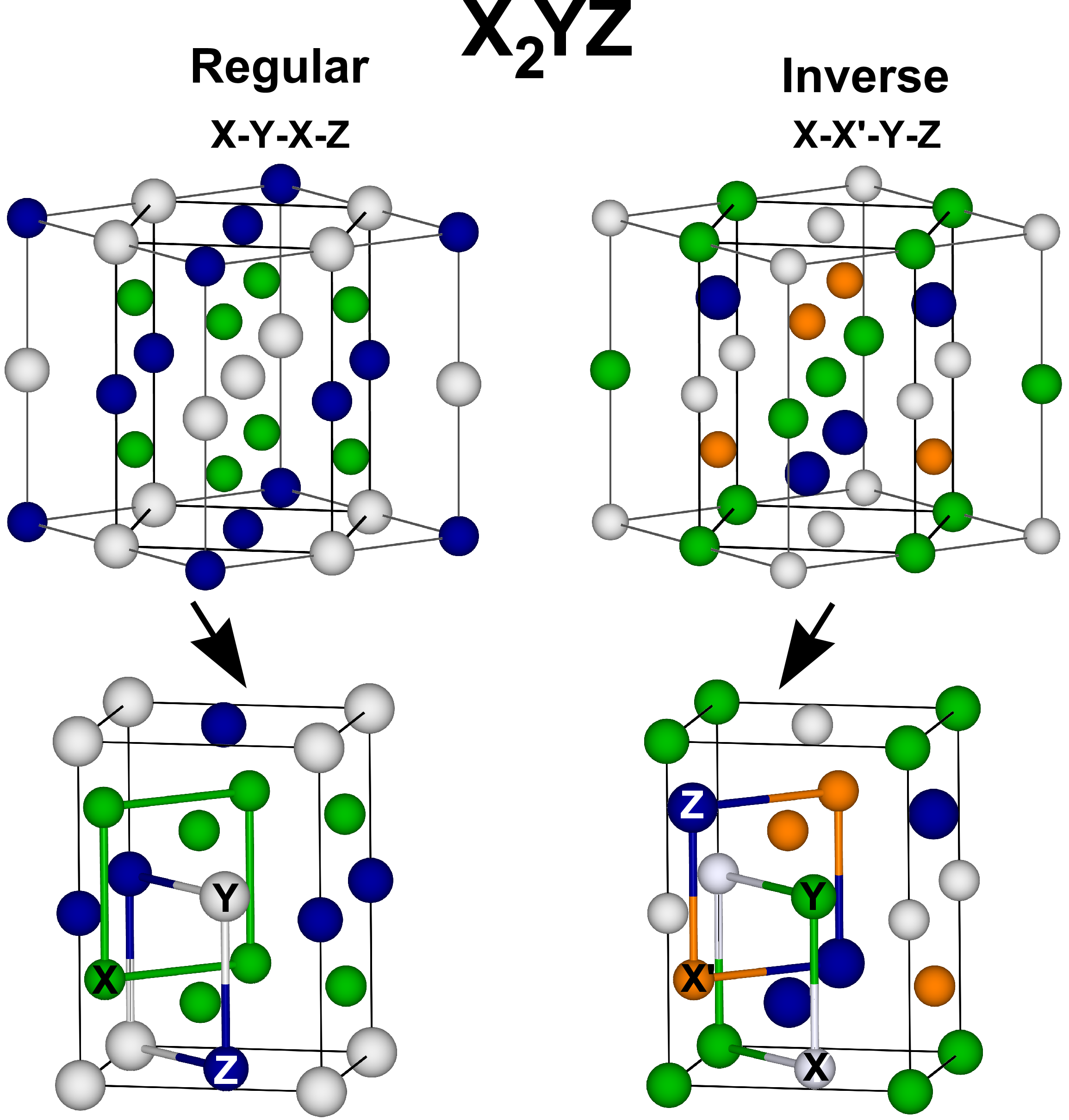 Figure 1
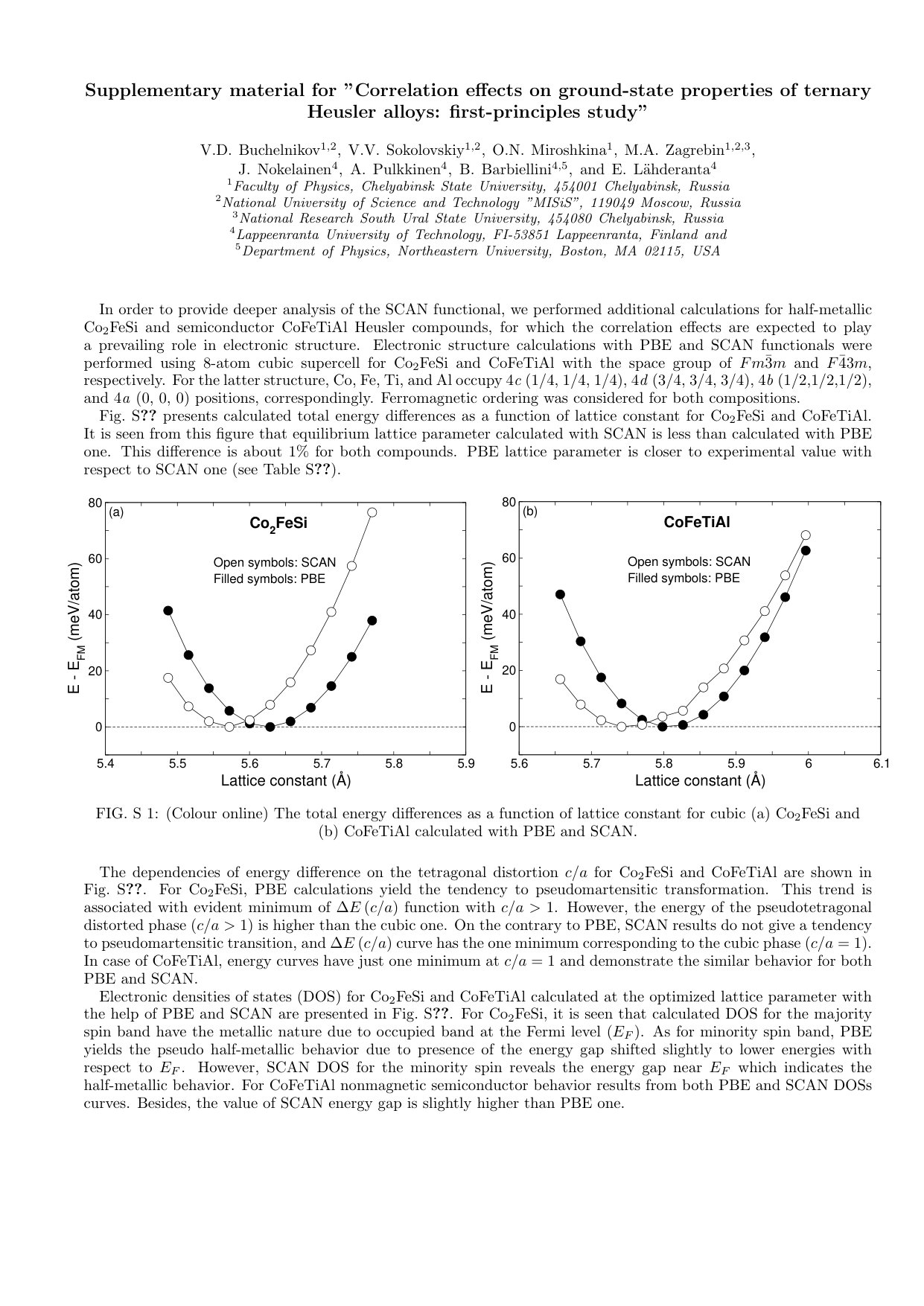 Figure 29
| System | [Å] | [GPa] | [eV/f.u.] | [Å] | [GPa] | |||||
|---|---|---|---|---|---|---|---|---|---|---|
| PBE | SCAN | PBE | SCAN | PBE | SCAN | (Ref.) | (Ref.) | |||
| NiMn (bcc) | 2.92 | 2.901 | 149.4 | 134.7 | 0.141 | -0.425 | 2.94 (calc)Godlevsky-2001 , 2.97 (calc.)Egorushkin-1983 | 155 (calc.)Godlevsky-2001 | ||
| 2.93 (calc.)Entel-2011 , 2.917 (calc.)Busgen-2004 | ||||||||||
| Ni2MnGa | 5.809 | 5.737 | 154.4 | 153.1 | -0.645 | -1.583 | 5.81 (calc.)Ayuela-1999 , 5.806(calc.)Entel-2006 | 156 (calc.)Ayuela-1999 | ||
| 5.812 (calc.)Kart-2008 , 5.822 (calc.)Entel-2011 | 155 (calc.)Kart-2008 | |||||||||
| 5.825 (exp.)Webster-1984 , 5.822 (exp.)Cakir-2013 | 146 (exp.)Worgull-1996 | |||||||||
| Ni2.5Mn0.5Ga | 5.754 | 5.668 | 167.9 | 206.5 | -0.5 | -1.100 | 5.811 (calc.)Entel-2011 | |||
| Ni2Mn1.5Ga0.5 | 5.805 | 5.781 | 148.6 | 159.5 | -0.142 | -1.158 | 5.81 (calc.)Ziewert-Dis | |||
| Ni2MnSn | 6.06 | 5.99 | 140.7 | 159.5 | -0.149 | -0.832 | 6.059 (calc.)Ayuela-1999 , 6.06 (calc.) Entel-2011 | 140 (calc.)Ayuela-1999 | ||
| 6.057 (calc.)Entel-2006 , 6.046 (exp.)Krenke-2005 | 146 (calc.)Li-2013 | |||||||||
| Ni2Mn1.5Sn0.5 | 5.944 | 5.92 | 140.9 | 145.4 | 0.113 | -0.686 | 5.95 (calc.)Entel-2011 , 6.0 (calc.)Xiao-2012 | |||
| Fe2VAl | 5.704 | 5.644 | 218.5 | 252.6 | -1.691 | -1.699 | 5.712 (calc.) Hsu-2002 , 5.76 (exp.)Hsu-2002 | 212 (calc.) Hsu-2002 | ||
| Fe2NiGa | 5.759 | 5.682 | 172.7 | 179.6 | -0.426 | -1.136 | 5.78 (calc.) Kulkova-2004 , 5.76 (calc.)Gupta-2014 | 146 (calc.) Kulkova-2004 | ||
| 5.77 (calc.) Matsushita-2017 , 5.81 (exp.) Gasi-2013 | 174 (calc.) Gupta-2014 | |||||||||
| Fe2Ni1.5Ga0.5 | 5.712 | 5.648 | 179.1 | 186.2 | 0.124 | -0.600 | ||||
| XC Potential | NiMn | Ni2MnGa | Ni2.5Mn0.5Ga | Ni2Mn1.5Ga0.5 | Ni2Mn1.5Sn0.5 | Fe2Ni1.5Ga0.5 | ||||||
|---|---|---|---|---|---|---|---|---|---|---|---|---|
| c/a | c/a | c/a | c/a | c/a | c/a | |||||||
| PBE | 1.4 | -0.058 | 1.25 | -0.632 | 1.23 | -0.491 | 1.35 | -0.234 | 1.3 | -0.710 | 1.45 | 0.000 |
| SCAN | 1.3 | -0.519 | 1.2 | -1.636 | 1.25 | -1.394 | - | - | 1.15 | -0.708 | 1.45 | -0.742 |
| System | Ref. state | ratio | |||||||||||||
|---|---|---|---|---|---|---|---|---|---|---|---|---|---|---|---|
| PBE | SCAN | PBE | SCAN | PBE | SCAN | PBE | SCAN | PBE | SCAN | PBE | SCAN | PBE | SCAN | ||
| NiMn | aust. | FM | FM | 1.0 | 1.0 | 0.816 | 0.978 | 3.523 | 3.781 | 4.339 | 4.758 | ||||
| mart. | AFM-1 | AFM-1 | 1.4 | 1.3 | 0.0 | 0.0 | 3.292 | 3.737 | -3.292 | -3.737 | 0.0 | 0.0 | |||
| Ni2MnGa | aust. | FM | FM | 1.0 | 1.0 | 0.366 | 0.539 | 3.401 | 3.689 | 4.082 | 4.72 | ||||
| mart. | FM | FM | 1.25 | 1.2 | 0.437 | 0.548 | 3.321 | 3.634 | 4.134 | 4.667 | |||||
| Ni2.5Mn0.5Ga | aust. | FM | FM | 1.0 | 1.0 | 0.26 | 0.376 | 3.393 | 3.647 | 2.324 | 2.737 | ||||
| mart. | FM | FM | 1.23 | 1.25 | 0.29 | 0.353 | 3.376 | 3.59 | 2.383 | 2.636 | |||||
| Ni2Mn1.5Ga0.5 | aust. | FIM | FM | 1.0 | 1.0 | 0.24 | 0.779 | 3.395 | 3.706 | -3.497 | 3.798 | 2.105 | 7.181 | ||
| mart. | FIM | - | 1.35 | - | 0.171 | - | 3.243 | - | -3.36 | - | 1.875 | - | |||
| Ni2MnSn | aust. | FM | FM | 1.0 | 1.0 | 0.248 | 1.028 | 3.59 | 4.16 | 4.036 | 4.450 | ||||
| mart. | - | - | - | - | - | - | - | - | - | - | |||||
| Ni2Mn1.5Sn0.5 | aust. | FIM | FIM | 1.0 | 1.0 | 0.152 | 0.644 | 3.481 | 3.84 | -3.672 | 3.927 | 1.922 | 7.065 | ||
| mart. | FIM | FM | 1.3 | 1.15 | 0.124 | 0.682 | 3.366 | 3.801 | -3.593 | 3.901 | 1.784 | 7.082 | |||
| Fe2NiGa | aust. | FM | FM | 1.0 | 1.0 | 0.495 | 0.533 | 2.275 | 2.444 | 4.984 | 5.331 | ||||
| mart. | - | - | - | - | - | - | - | - | - | - | |||||
| Fe2Ni1.5Ga0.5 | aust. | FM | FM | 1.0 | 1.0 | 0.603 | 0.716 | 2.434 | 2.703 | 5.731 | 6.427 | ||||
| mart. | FM | FM | 1.45 | 1.45 | 0.616 | 0.673 | 2.599 | 2.86 | 6.059 | 6.656 | |||||
Peer Reviews
No public reviews on file for this paper yet. If you reviewed it on a platform where reviews are public (OpenReview, ICLR, NeurIPS, ICML), you can paste yours below so the community can read it here.
Videos
No videos yet. Explain this paper in a talk, walkthrough, or lecture? Add one.
\normalfont
Correlation effects on ground-state properties of ternary Heusler alloys: first-principles study
V.D. Buchelnikov1,2
V.V. Sokolovskiy1,2
O.N. Miroshkina1
M.A. Zagrebin1,2,3
J. Nokelainen4
A. Pulkkinen4
B. Barbiellini4,5
E. Lähderanta4
1Faculty of Physics, Chelyabinsk State University, 454001 Chelyabinsk, Russia
2National University of Science and Technology ”MISiS”, 119049 Moscow, Russia
3National Research South Ural State University, 454080 Chelyabinsk, Russia
4Lappeenranta University of Technology, FI-53851 Lappeenranta, Finland
5Department of Physics, Northeastern University, Boston, MA 02115, USA
Abstract
The strongly constrained and appropriately normed (SCAN) semi-local functional for exchange-correlation is deployed to study the ground-state properties of ternary Heusler alloys transforming martensitically. The calculations are performed for ferromagnetic, ferrimagnetic, and antiferromagnetic phases. Comparisons between SCAN and generalized gradient approximation (GGA) are discussed. We find that SCAN yields smaller lattice parameters and higher magnetic moments compared to the GGA corresponding values for both austenite and martensite phases. Furthermore, in the case of ferromagnetic and non-magnetic Heusler compounds, GGA and SCAN display similar trends in the total energy as a function of lattice constant and tetragonal ratio. However, for some ferrimagnetic Mn-rich Heusler compounds, different magnetic ground states are found within GGA and SCAN.
pacs:
71.15.Mb, 71.15.−m, 71.20.−b, 75.50.−y, 81.30.Kf
I Introduction
Nowadays, the density functional theory (DFT) has become an accurate and efficient first-principles approach to investigate broad areas of physics, chemistry, and materials sciences with the aim of understanding and predicting complex and novel systems at the nanoscaleKohn-1999 ; Becke-2014 ; Martin-2004 . The main merits of DFT consist of a reduction in the number of degrees of freedom by replacing 3 coordinates with only three coordinates of the electron density () and of the possibility to include the electron correlation beyond Hartree-Fock theory Hohenberg-1964 ; Kohn-1965 ; Kohn-1999 . The accuracy and efficiency of DFT is provided by the choice of the exchange-correlation (XC) functional, which includes many-body and quantum effects. In the ”Jacob’s ladder” scheme Perdew-2001 , there are several rungs associated with consecutive improvement of correlation to achieve an arbitrary level of accuracy. However, higher rungs can become computationally challenging. The first rung is the local density approximation (LDA)Vosko-1980 ; Perdew-1981 ; Perdew-1986 , where the XC functional depends only on the local density (). The second one is the generalized gradient approximation (GGA) with no free parameters Perdew-1991 ; Burke-1997 , which depends on the local density gradient (). The most successful and widely used GGA parametrization has been proposed by Perdew, Burke, and Ernzerhof (PBE)Perdew-1996 . The third rung, the meta-GGA functional Perdew-1999 ; Tao-2003 , includes also a dependence on the kinetic energy density (). The recently developed meta-GGA functional, called SCAN (strongly constrained and appropriately normed) Sun-2015 , has been found to perform better than GGA for calculations of several systems with various types of bonding: intermediate-range van-der-Waals interactions Sun-2016a (right ordering of 7 polymorphs of H2O ice), ionic bonding Kitchaev-2016 (energetic ordering of 6 polymorphs of MnO2), covalent and metallic bonds Sun-2016b (Si under different phases), lattice constants of 2D materials Buda-2017 , and highly correlated materials Lane-2018 ; Furness-2018 ; Zhang-2018 (La2CuO4, Sr-doped La2CuO4, and YBa2Cu3O6+x). An extensive benchmark of SCAN has been performed recently by Isaacs and Wolverton Isaacs-2018 for a group of nearly 1000 crystalline compounds and compared to available experimental data. They found that SCAN provides more accurate crystal volumes and improved band gaps as compared to PBE. However, Ekholm et al. Ekholm-2018 shown that SCAN seems to improve the structural properties of bcc-Fe but does not give the overall improvement for itinerant ferromagnets. Similar conclusions were reached by Fu and Singh Fu-2018 in the study of Fe and steel. Studies focusing on SCAN benchmarks in Heusler alloys have not been reported earlier except the work of Isaacs and Wolverton Isaacs-2018 reporting about Ni2XAl (X = Ti, Hf, and Nb) and Fe2NiAl.
The full-Heusler alloys are of high experimental and theoretical interest due to the unique properties such as shape memory effect, superelasticity and superplasticity, giant magnetocaloric effect, giant magnetoresistance and magnetostrain Vasil'ev-2003 ; Buchelnikov-2006 ; Entel-2006 ; Entel-2008 ; Bozhko-1998 ; Buchelnikov-2008 ; Planes-2009 ; Aksoy-2009 ; Ye-2010 ; Graf-2010 ; Entel-2011 ; Entel-2012a ; Entel-2014 ; Felser-2015 ; Prudnikov-2010 ; Granovskii-2012 ; Khovaylo-2013 , which makes them good candidates to be used in various technological applications. It is worth noting that the strong competition between FM and AFM interactions is a peculiarity of Mn-rich Heusler alloys, where the Mn-Mn exchange interactions reveal the long-range oscillatory behavior of the Rudermann-Kittel-Kasuya-Yosida (RKKY) interaction Kasuya-1974 ; Goncalves-1972 ; Shi-1994 ; Sasioglu-2004 ; Sasioglu-2008 ; Entel-2011 . Nowadays, there is a good amount of knowledge on ternary and quaternary Heusler alloys accumulated by various ab initio studies Entel-2006 ; Entel-2011 ; Entel-2012a ; Sasioglu-2004 ; Sasioglu-2008 ; Li-2011 ; Chakrabarti-2013 ; Entel-2014 ; Zeleny-2014 ; Xiao-2012 ; Xiao-2014 ; Comtesse-2014 ; Sokolovskiy-2015 ; Li-2015 ; Roy-2016 ; Dutta-2016 ; Matsushita-2017 ; Neibecker-2017 ; Opeil-2008 ; Kundu-2017 ; Godlevsky-2001 ; Ayuela-2002 ; Ayuela-1999 ; Kart-2008 ; Ziewert-Dis ; Hsu-2002 ; Kulkova-2004 ; Gupta-2014 ; Himmetoglu-2012 ; Hasnip-2013 ; Sokolovskiy-2014jpd ; Buchelnikov-2018 ; Sokolovskiy-2019 ; Buchelnikov-2019 , where considerable efforts were devoted to investigate the effect of the XC potential within LDA or GGA on the ground state properties. In general, GGA compared to LDA leads to more accurate phase diagrams for magnetic materials Bernardo-1990 but it is also worthwhile to study corrections beyond the GGA scheme Himmetoglu-2012 ; Hasnip-2013 .
In this work, we report the impact of SCAN corrections on the ground state properties of ternary intermetallics such as FM Ni2+xMn1-xGa and Fe2Ni1+xGa1-x, ferrimagnetic (FIM) Ni2Mn1+x(Ga, Sn)1-x, and non-magnetic Fe2VAl. This collection of ternary Heusler alloys provides an overview of various FM, AFM, and FIM interactions among transition metal atoms such as V, Mn, Fe, and Ni. We also consider the binary compound NiMn since it is an end point for the phase diagram of the Mn-rich Ni2Mn1+xZ1-x family Entel-2011 . To investigate the effect of corrections beyond GGA, PBE and SCAN calculations are compared. The outline of the paper is as follows. Section II is devoted to the description of the computational methods used in the simulations. Section III presents results of the main ground state properties, total energy curves and density of states. Important discussions and conclusions are presented in Section IV.
II Details of calculations
DFT calculations were performed using the plane-wave basis set and the projector augmented wave (PAW) method as implemented in Vienna ab initio simulation package (VASP) Kresse-1996 ; Kresse-1999 . GGA and meta-GGA XC functionals using PBE and SCAN parameterizations were employed. The PAW pseudopotentials were used with the following atomic configurations: Mn (334), Ni (334), Fe (334), V (334), Al (33), Sn (455), and Ga (344). For all calculations, the plane wave basis kinetic energy cut-off of 550 eV was applied, whereas the kinetic energy cut-off for the augmented charge was chosen as 800 eV. The uniform Monkhorst-Pack mesh of -points together with a Gaussian broadening of 0.2 eV were used to integrate the Brillouin zone with the second order Methfessel-Paxton method. The calculations were converged with the energy accuracy of eV/atom.
In order to reduce computational costs, all compositions were modeled using the 8-atom supercell of Heusler alloys with regular X2YZ structure (space group No. 225, prototype Cu2MnAl) and inverse (XX’)YZ structure (space group No. 216, prototype Hg2TiCu) as shown in Fig. 1. In the case of regular Heusler structure, the unit cell contains four atoms as basis wherein two X atoms occupy 8 (1/4, 1/4, 1/4) and (3/4, 3/4, 3/4), whereas Z and Y atoms are placed at 4 (0, 0, 0) and 4 (1/2, 1/2, 1/2) Wyckoff positions, respectively. In the inverse Heusler structure, two X atoms are situated at two distinct crystallographic sites 4 (0, 0, 0) and 4 (1/4, 1/4, 1/4) as well as Y and Z atoms are located at 4 (1/2, 1/2, 1/2) and 4 (3/4, 3/4, 3/4) sites. According to Graf et al. Graf-2010 , X2YZ compound crystallizes in the inverse Heusler structure with space group on condition if the valence electrons of Y are more than those of X, otherwise it crystallizes in the regular Heusler structure (). Thus, calculations were performed for Ni2+xMn1-xGa, Ni2Mn1+x(Ga, Sn)1-x, and Fe2VAl using the regular structure while for Fe2Ni1+xGa1-x, regular and inverse structures were employed. For Ni2Mn1+x(Ga, Sn)1-x and Fe2NiGa, FM and FIM orders were considered: FM corresponds to the parallel alignment of Ni, Mn, and Fe magnetic moments, while for Mn-excess compounds, FIM corresponds to the antiparallel orientation of the magnetic moment on the Mn excess atoms (occupying Ga and Sn sites). For Fe2Ni1+xGa1-x, the magnetic moments of Fe atoms placed at the 4 sites are opposed to those of Fe atoms situated at the 4 sites.
III Results and discussion
III.1 Ground-state crystal structure
We perform geometry optimization calculations to investigate the ground-state properties for the cubic austenite structure using both PBE and SCAN. Figure 2 shows the total energy as function of the lattice constant for binary NiMn and ternary Ni2+xMn1-xGa ( and 0.5), Ni2Mn1+x(Ga, Sn)1-x ( and 0.5), Fe2Ni1+xGa1-x ( and 0.5), and Fe2VAl. For the binary NiMn system shown in Fig. 2(a), the calculations were performed for FM and AFM (AFM-1 and AFM-2) configurations Entel-2011 . AFM-1 and AFM-2 correspond to the layered and staggered magnetic structure, respectively. Both PBE and SCAN give FM as the ground state for bcc-NiMn. Moreover, results for AFM-1 and AFM-2 follow similar trends for PBE and SCAN but the SCAN equilibrium lattice constants are smaller than PBE one.
We next consider the results for stoichiometric and off-stoichiometric Ni- and Fe-based Heusler alloys (Figs. 2(b)-(f)). The SCAN equilibrium lattice parameters are smaller than the PBE ones in all these cases. PBE and SCAN predict correctly the inverse Heusler structureGasi-2013 for Fe2NiGa (Fig. 2(c)) with FM order. Similar results are obtained for Fe2Ni1.5Ga0.5 as shown in Fig. 2(d). For Ni2Mn1.5(Ga, Sn)0.5 (see Figs. 2(e, f)), PBE yields the FIM ground state of L21-cubic structure, which agrees with earlier results Entel-2014 ; Xiao-2012 ; Xiao-2014 , whereas SCAN finds the FM order more favorable than the FIM one. This disagreement might be explained as follows. Since SCAN gives smaller lattice constant, the neighbor Mn-Mn distance is also reduced leading to a modification of the RKKY interactions. However, one should note that RKKY interaction is only important in an asymptotic limit, for the magnetic ground state the closer neighbor couplings are more relevant. Thus, in this case, the Bethe-Slater (BS) curve Cardias-2017 should provide a more pertinent tool to rationalize the magnetism of compound Mn compounds (see also Ni2MnAl Galanakis-2011 ; Simon-2015 ). Since Mn is situated at a point of the BS curve where the AFM and FM orders are near in energy, a critical parameter controlling the type of magnetic order is provided by the next neighbor distance between Mn atoms. Consequently, larger separations result in ferromagnetism and smaller distances are connected to AFM order.
Table 1 reports the equilibrium lattice constants, bulk moduli, and formation energies calculated for PBE and SCAN. Comparisons with available experimental data and earlier calculations are also listed. Birch-Murnaghan equation of state Murnaghan-1944 ; Birch-1947 was fitted to the energy curves to calculate the equilibrium lattice constants. The difference between total energy of the compound and the total energies of corresponding pure elements yields the formation energy . SCAN lattice constants are about 1.2 % smaller while SCAN bulk moduli are about 9 % larger compared to the corresponding PBE values. Regarding the stability of the austenitic phase, SCAN gives negative values of for all compounds. PBE yields positive values of for three compounds, namely, bcc-NiMn, Ni2Mn1.5Sn0.5, and Fe2Ni1.5Ga0.5. An overall enhanced stability toward cubic crystal structure is observed in Table 1 when SCAN is compared to PBE.
III.2 Tetragonal distortion
Possibilities for martensitic transformation (by considering tetragonal distortions of the optimized L21-cubic structure) are discussed in this subsection. As a matter of fact, a martensitic transformation can occur if a tetragonal structure has a lower total energy compared to the cubic structure. Figure 3 shows the total energy curves as a function of the tetragonal ratio for all compounds in the present study. The volume of the supercell was kept constant while the tetragonal distortion was performed in the total energy calculations. The calculated equilibrium ratios and formation energies for tetragonal structures are reported in Table 2.
We start by considering the binary compound NiMn, which is an antiferromagnet Kasper-1959 ; Entel-2011 with CsCl structure and has a Néel temperature higher than 1000 K. This compound undergoes a structural phase transformation from the bcc-like austenite (-NiMn) to the L10-tetragonal martensite (-NiMn with fcc-like structure) at a high temperature of about 1000 K during cooling. As shown in Fig. 3(a), a crossover from the FM bcc-structure () to the AFM L10 (fcc-like) structure is obtained both with PBE () and SCAN (). Curiously, for the FM state, SCAN produces a slight cubic symmetry breaking since the minimum is shifted from 1 to 1.05. PBE gives the observed phase with fcc structure and provides a good estimate for martensitic transformation temperature Entel-2011 ; temperature while SCAN degrades the agreement with experiment concerning the ratio and the martensitic transformation temperature. Moreover, both PBE and SCAN yield the AFM-1 layered structure of the martensite phase as energetically more stable. Similar trends of the total energy curves plotted in Fig. 3(a) have been reported by Godlevsky and Rabe Godlevsky-2001 (LDA) and Entel et al.Entel-2011 (GGA) indicating that corrections beyond LDA are not too strong.
Figures 3(b)-(f) illustrate the comparison of PBE and SCAN for a series of FM Ni2+xMn1-xGa and Fe2Ni1+xGa1-x, FIM Ni2Mn1+x(Ga, Sn)1-x, and non-magnetic Fe2VAl. PBE and SCAN cubic structures are found to be stable only for stoichiometric Fe2VAl (Fig. 3(b)), Fe2NiGa (Fig. 3(c)), and Ni2MnSn (Fig. 3(f)) preventing martensitic transitions.
Concerning Ni2MnGa, Fig. 3(b) shows that PBE gives a local minima at and a global minima in agreement with earlier calculations Entel-2006 ; Entel-2011 ; Kart-2008 while SCAN yields the local minima at and the global minima at . Interestingly, SCAN is in excellent agreement with experimental Martynov-1992 ; Sozinov-2002 . Moreover, SCAN leads to a larger energy difference between the metastable austenite and martensite phase with respect to PBE. This implies that the predicted temperature of martensitic transformation from SCAN ( 153 K) is closer to the experimental value Webster-1984 ( 202 K) with respect to PBE ( 107 K) temperature .
For Fe2Ni1.5Ga0.5, according to Fig. 3(d) and in Tables 1 and 2, a structural transition from FM austenite with inverse Heusler structure to FM martensite with regular structure is predicted only within SCAN. PBE yields unstable martensitic phase with regular structure due to zero formation energy. The overall behavior of the total energy curves is similar for PBE and SCAN.
In the case of Ni2.5Mn0.5Ga (Fig. 3(e)), PBE and SCAN total energy curves almost conincide and predict a martensitic phase with about 1.25 while the austenitic phase is not favorable. However, the stability of this compound has been questioned by experiments Khovailo-2005 .
Surprisingly, for Mn-excess Ni2Mn1.5(Ga, Sn)0.5 (Figs. 3(e, f)), SCAN disagrees with PBE by stabilizing FM instead of FIM ground state in contrast with PBE and SCAN agreement for the richest Mn-excess Ni2Mn1+xZ1-x with AFM-1 ground state as shown in Fig. 3(a). Moreover, although PBE and SCAN total energy curves as a function of have a similar behavior for Ni2Mn(Ga, Sn), they significantly disagree for Ni2Mn1.5(Ga, Sn)0.5. In particular, PBE predicts for both systems the austenite-martensite transformation in the FIM state in agreement with earlier calculationsYe-2010 ; Entel-2014 ; Xiao-2012 ; Xiao-2014 . PBE global minima for Ni2Mn1.5Ga0.5 and Ni2Mn1.5Sn0.5 are 1.35 and 1.3, respectively. Experimental ratios Cakir-2013 ; Cakir-2015 of about 1.28 and 1.24 for non-modulated L10-tetragonal structure of Ni2Mn1.52Ga0.48 and Ni2Mn1.52Sn0.48, respectively, have been reported. Regarding SCAN, global minima are observed at for Ni2Mn1.5Ga0.5 and at for Ni2Mn1.5Sn0.5 in FM state. Nevertheless, experiments Aksoy-2009 ; Cakir-2013 ; Cakir-2015 suggest that L10-tetragonal phases for Mn-excess Ni-Mn-(Ga, Sn) yield almost degenerate AFM and FM ground states. Therefore, it is difficult to conclude if either PBE or SCAN give a better agreement with experiment.
III.3 Magnetic moments
Table 3 displays the value of total and partial magnetic moments for both austenite and martensite phases calculated with PBE and SCAN. As a general trend, SCAN gives higher magnetic moments as compared to PBE values.
Figure 4 shows the total magnetic moments for FM, FIM, AFM-1, and AFM-2 configurations as a function of tetragonal deformation . Mn and Fe atoms provide the largest contribution to the total magnetic moment. Most of the curves in Fig. 4 display a gentle behavior as a function of with the exception of meta-stable FM martensitic phase () of Fe2VAl. Fe2VAl is non-magnetic in the range of , but it becomes FM when for PBE and SCAN. However, the martensitic phase is not stable for Fe2VAl (see Fig. 3(b)). Generally, in the considered range, the difference between SCAN and PBE for the magnetic moments is about 10 %. As illustrated in Fig. 4(b), according to PBE, Ni2MnGa has a higher magnetic moment for martensite ( /f.u.) than that for austenite ( /f.u.), while SCAN gives a slightly lower magnetic moment for martensite ( /f.u.) in comparison with austenite ( /f.u.). Experiments Webster-1984 find a drop in the magnetization across the martensitic transformation from FM martensite to FM austenite (for magnetic fields higher than 0.8 T upon heating) suggesting that the low-temperature tetragonal phase has a higher magnetic moment compared to austenite as predicted by PBE.
III.4 Electronic structure
In this subsection we discuss correlation effects on the electronic structure of Ni2Mn(Ga, Sn), Fe2NiGa, and Fe2VAl. Figure 5 shows the spin-resolved total density of states (DOS) and partial DOS (pDOS) for -orbitals for Ni2MnGa in the L21-cubic and L10-tetragonal phase. The DOS and pDOSs calculated with PBE reproduce features already investigated earlier Ayuela-2002 ; Entel-2006 ; Kart-2008 . For instance, Ga 4 electrons are responsible for the contribution to the total DOS in the valence band below -7 eV. The upper bands below and above the Fermi energy () are due to 3 electrons of Mn and Ni. The majority states of Mn hybridizes with the spin up states of Ni while the minority Mn states are located above . The tetragonal distortion () changes slightly the electronic structure and leads to the splitting of the peak in the minority 3 states of the Ni band near into two parts. While one part is shifted above the Fermi level (and therefore is not occupied any more), the other part is shifted to a lower energy. Thereby the band energy of the tetragonal structure is lower than the band energy of the austenite structure. In general, the structural instability and formation of martensite can be associated with a Jahn-Teller band scenario involving mostly contribution of Ni 3 states Ayuela-2002 ; Brown-1999 ; Entel-2006 ; Opeil-2008 as illustrated in Fig. 5. SCAN preserves the basic features of the DOS. It produces the exchange splitting by about 0.5 eV both in the austenite and martensite.
Figure 6 shows the total DOS calculated with PBE and SCAN for Ni2MnSn, Fe2VAl, and Fe2NiGa at their equilibrium volume in the austenitic phase. As in the case of Ni2MnGa, we find that the total DOS curves produced by SCAN are modified by exchange splitting enhancement with respect to PBE. For Fe2VAl, the vanishing magnetic moment (for PBE and SCAN) agrees with the Slater-Pauling ruleSlater and the DOS has no exchange splitting implying that the material is a nonmagnetic semi-metal with a very small DOS at . Moreover, SCAN enlarges the corresponding pseudogap. Since, PBE and SCAN DOSs are very similar for the occupied states, the corrections beyond GGA are smaller for non-magnetic compared to magnetic Heusler compounds. To better understand the SCAN effects of correlation on the DOS, one can also considered more correlated Heusler compounds, for which GGA fails. The Co2FeSi is one of such a material since GGA fails to produce a half metallic gap, while the GW method Meinert-2012 reproduces experimental magnetic moment and half metallic energy gap. Interestingly, smaller GW band-gap corrections are found for quaternary Heusler like (CoFe)TiAl Tas-2016 . We show in Fig. S3 of the supplementary materials (SM) SM that SCAN reproduce very well the GW corrections for the DOS of these materials (we also show total energy results in Figs. S1 and S2 of the SM).
IV Conclusions
In the present work, the structural, magnetic and electronic properties of a series of Heusler alloys were investigated in the framework of DFT calculations. SCAN can be viewed as a correction of PBE containing extra semilocal information. Therefore, SCAN corrections for correlation effects play an important role in determining exchange interactions as in the case of DFT + methods studied by different authors Himmetoglu-2012 ; Hasnip-2013 and half metallic energy gaps in the DOS as in the case of the GW approach Meinert-2012 ; Tas-2016 .
The present investigation suggests that corrections beyond GGA are rather minor for FM Ni2+xMn1-xGa, Fe2Ni1+xGa1-x and non-magnetic Fe2VAl compounds. However, significant differences between PBE and SCAN are observed for Mn-excess compounds such as Ni2Mn1+x(Ga, Sn)1-x, where localized magnetic moments on Mn atoms couple via oscillating RKKY interactions. Thus, the magnetic behavior of these compounds is very sensitive to the distance between Mn atoms Ye-2010 . According to experiments Aksoy-2009 in compounds with Mn excess atoms the total magnetic moment decreases at the austenite-martensite transformation on cooling due to the smaller neighbor Mn-Mn distance, which becomes antiferromagnetically coupled. Regarding simulations, SCAN tends to favor FM solutions in austenite and martensite while PBE yields FIM ground state. Therefore, we conclude that the present corrections beyond GGA could be exaggerated for Mn-Mn FM interactions at short distances.
Pseudogap, spin density and charge density waves (commensurate or nor commensurate) might change the solutions landscape in Heusler alloys as observed by various authors Opeil-2008 ; Dutta-2016 ; Ye-2010 ; Kundu-2017 , some of these spin wave or charge density instabilities could be driven by Fermi surface nestings Dugdale-2006 . Interestingly, SCAN simulations for YBa2Cu3O7, give many solutions almost degenerate with the ground state in the so-called pseudogap regime Zhang-2018 . Nevertheless, some issues related to exaggerated FM coupling in SCAN remain Isaacs-2018 ; Ekholm-2018 ; Fu-2018 regardless the supercell size in the calculations and should be addressed in improved versions of this functional.
V Acknowledgments
This work was supported by RSF-Russian Science Foundation No. 17-72-20022. Calculations for Fe2NiGa were supported by RSF No. 18-12-00283. B.B. acknowledges support from the COST Action CA16218.
The reference list from the paper itself. Each links out to its DOI / PubMed record.
- 1(1) W. Kohn, Rev. Mod. Phys. 71 , 1253 (1999).
- 2(2) A.D. Becke, J. Chem. Phys. 140 , 18A 301 (2014).
- 3(3) R. Martin, Electronic structure: basic theory and practical methods (Cambridge University Press, Cambridge, 2004).
- 4(4) P. Hohenberg, W. Kohn, Phys. Rev. 136 , B 864 (1964).
- 5(5) W. Kohn, L. J. Sham, Phys. Rev. 140 , A 1133 (1965).
- 6(6) J. P. Perdew, K. Schmidt, Density Functional Theory and Its Application to Materials , ed. by V. Van Doren et al. (American Institute of Physics, Melville, NY, 2001).
- 7(7) S. H. Vosko, L. Wilk, M. Nusair, Can. J. Phys. 58 , 1200 (1980).
- 8(8) J. P. Perdew, A. Zunger, Phys. Rev. B 23 , 5048 (1981).