Finding Conformal and Isometric Immersions of Surfaces
Albert Chern, Felix Kn\"oppel, Franz Pedit, Ulrich Pinkall, Peter, Schr\"oder

TL;DR
This paper introduces variational functionals for spinor fields to find conformal and isometric immersions of surfaces into three-dimensional space, with numerical methods supporting the approach.
Contribution
It proposes a novel family of variational functionals for spinor fields to compute conformal and isometric immersions of surfaces.
Findings
Functional minimization yields close-to-conformal immersions
Numerical experiments produce piecewise smooth isometric immersions
Method can handle prescribed Riemannian metrics
Abstract
We introduce a family of variational functionals for spinor fields on a compact Riemann surface that can be used to find close-to-conformal immersions of into in a prescribed regular homotopy class. Numerical experiments indicate that, by taking suitable limits, minimization of these functionals can also yield piecewise smooth isometric immersions of a prescribed Riemannian metric on .
Click any figure to enlarge with its caption.
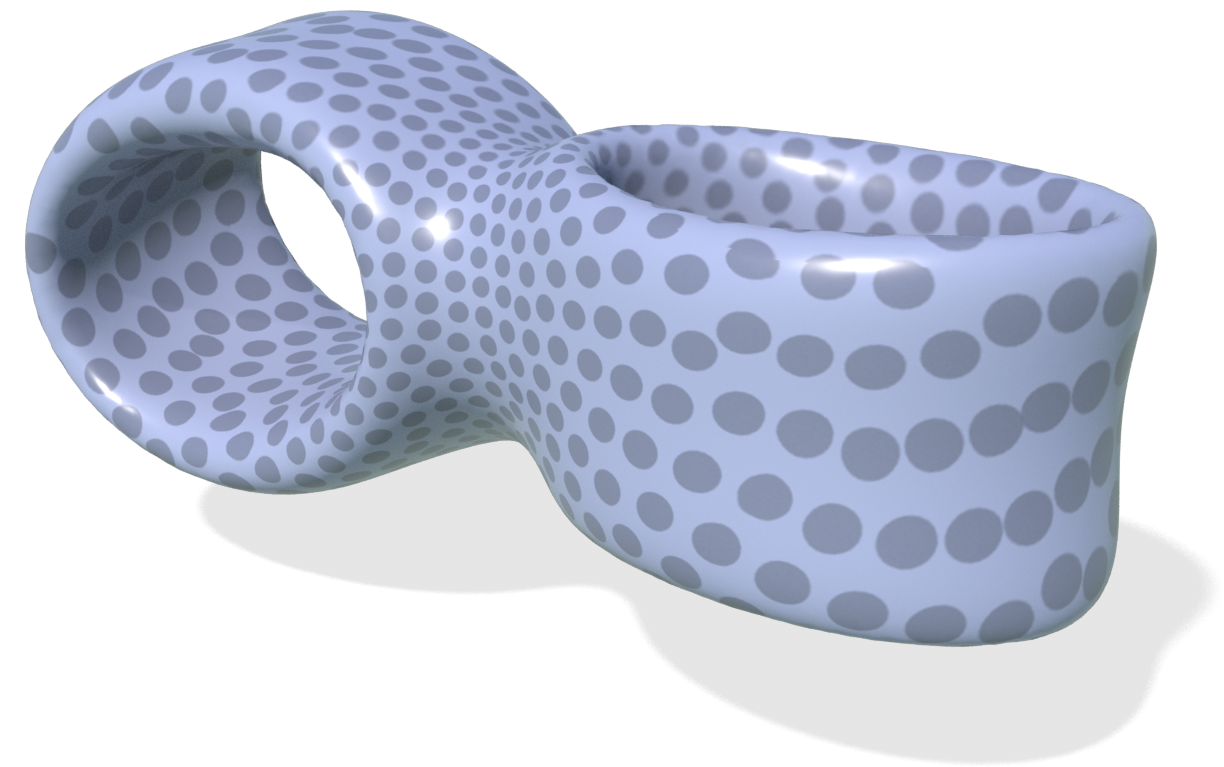 Figure 1
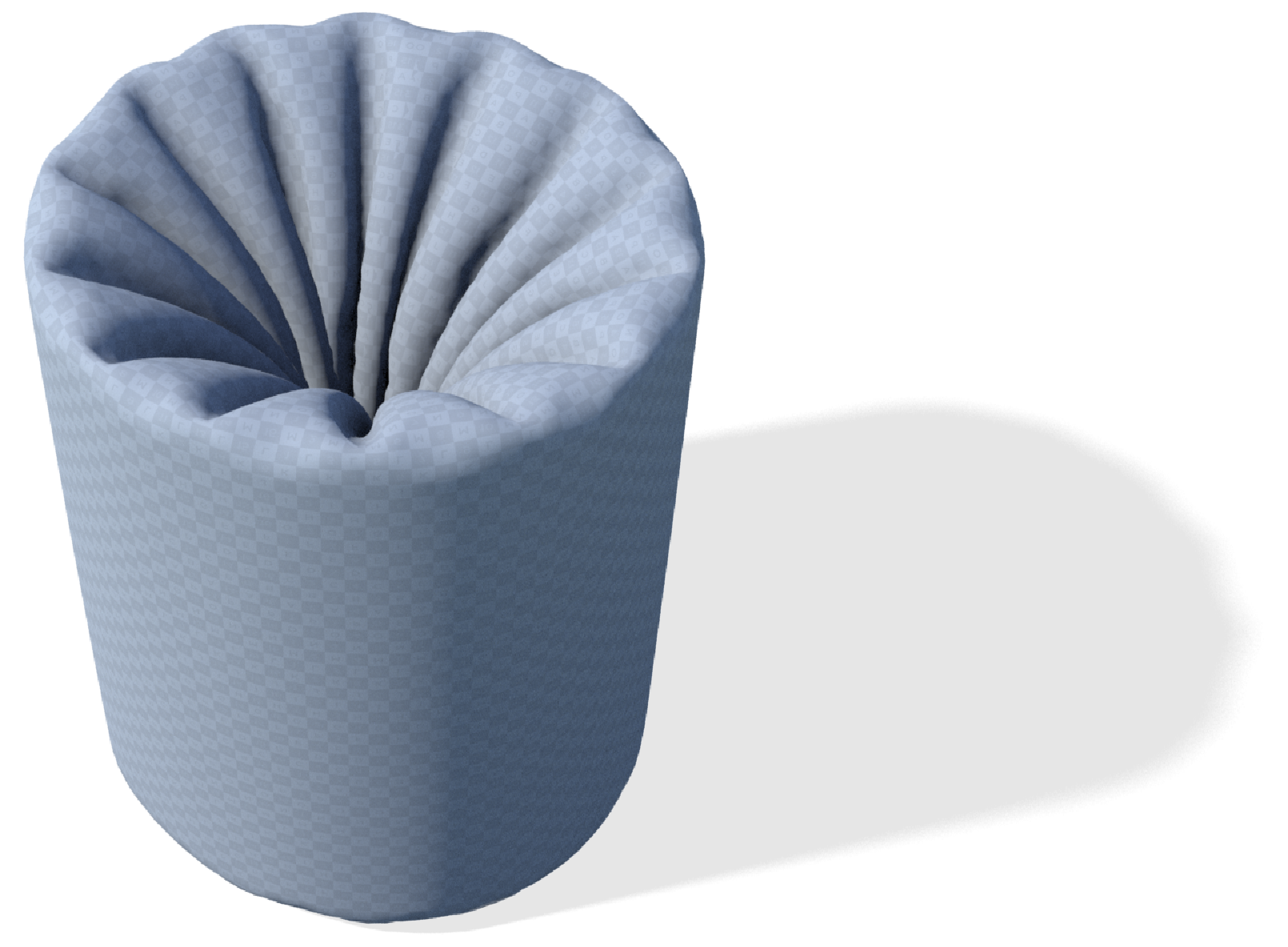 Figure 2
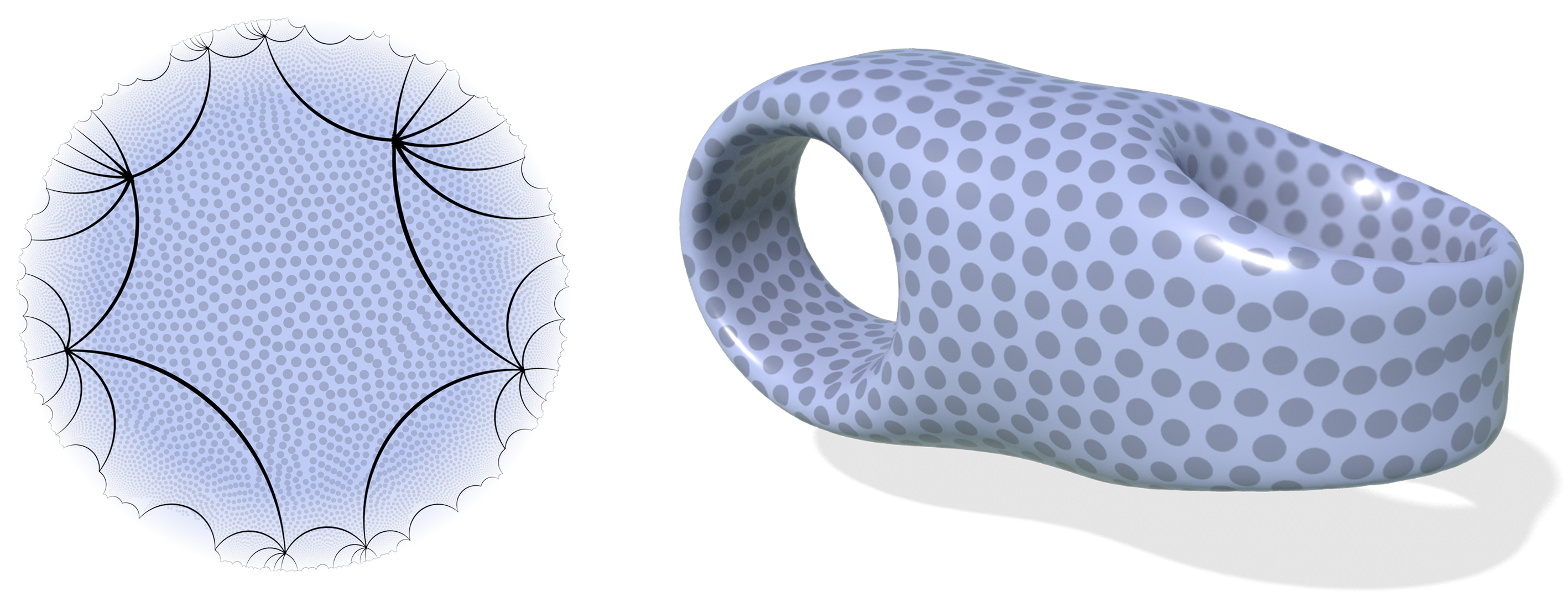 Figure 3
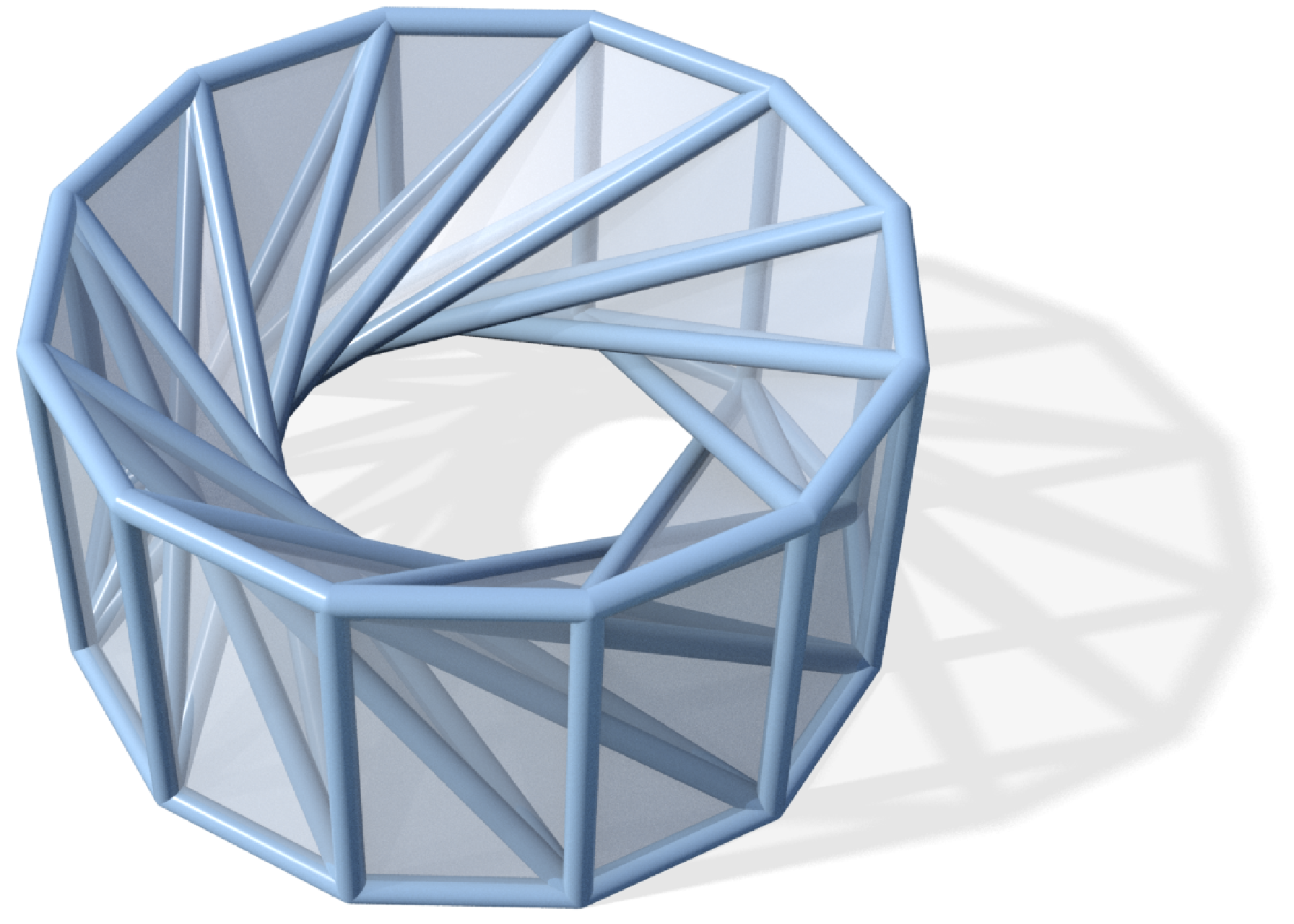 Figure 4
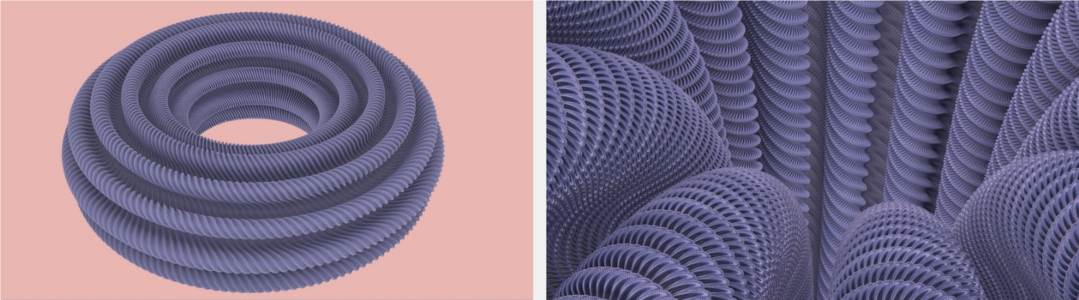 Figure 5
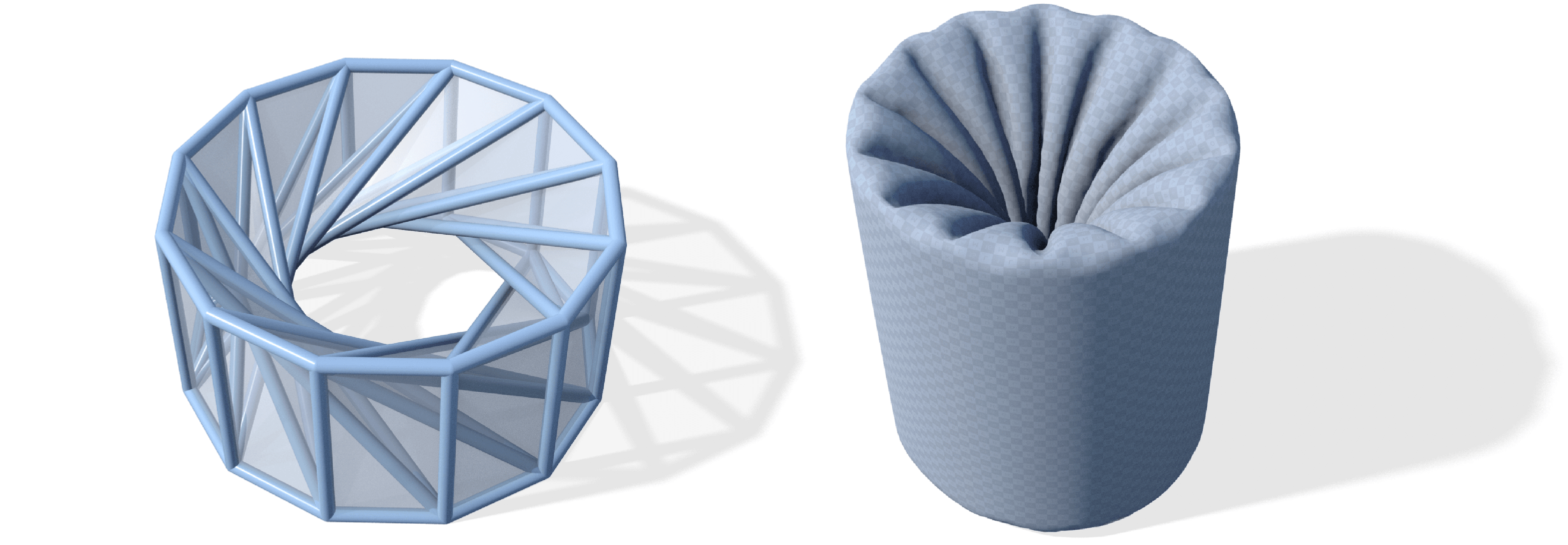 Figure 6
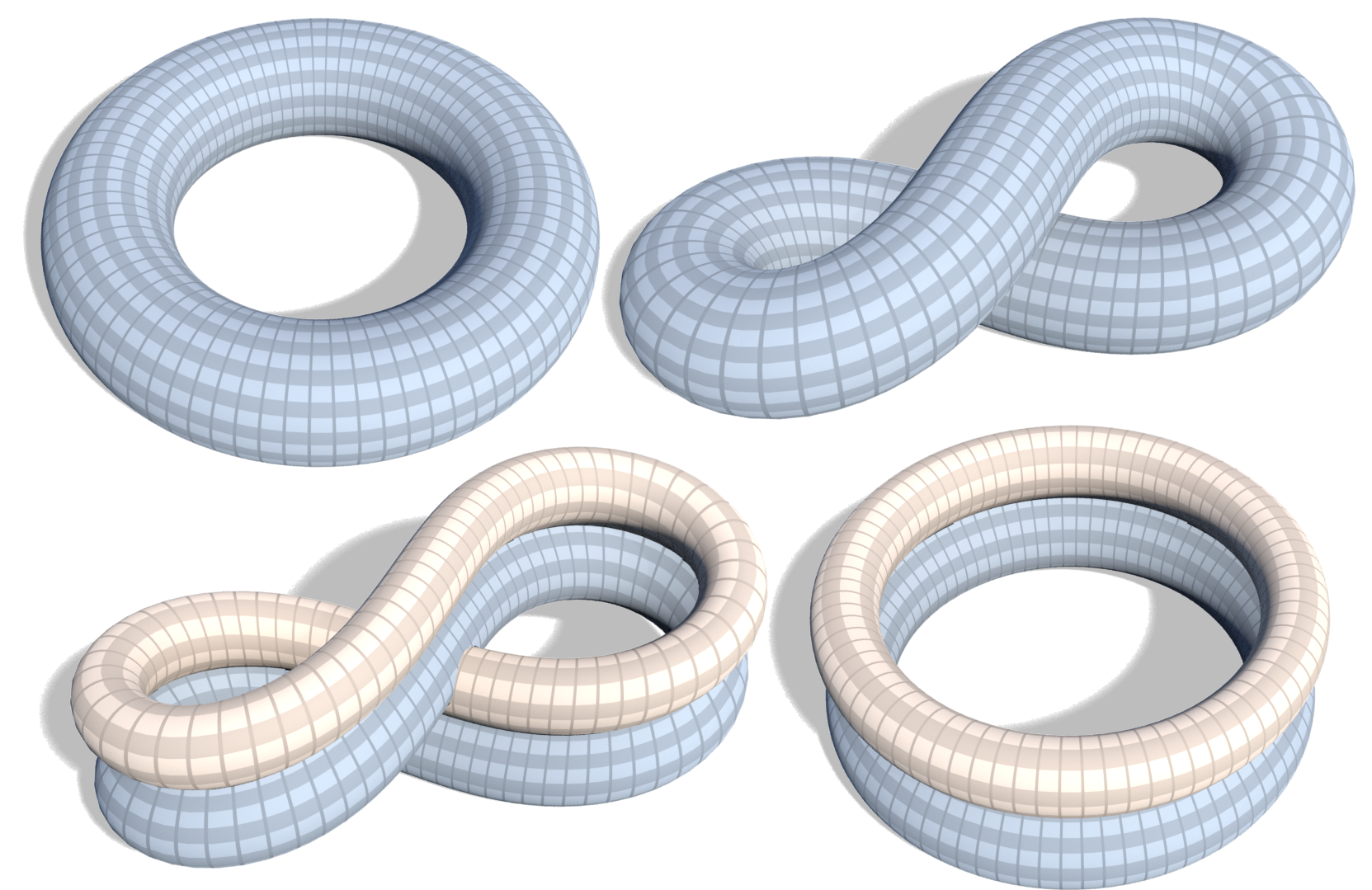 Figure 7
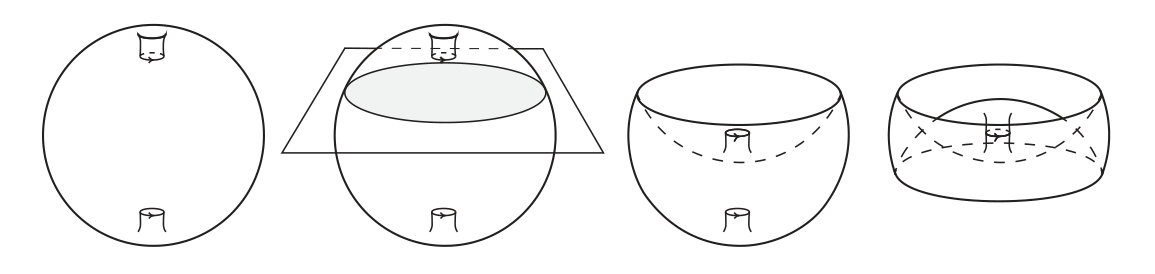 Figure 8
Peer Reviews
No public reviews on file for this paper yet. If you reviewed it on a platform where reviews are public (OpenReview, ICLR, NeurIPS, ICML), you can paste yours below so the community can read it here.
Videos
No videos yet. Explain this paper in a talk, walkthrough, or lecture? Add one.
Taxonomy
TopicsAdvanced Mathematical Modeling in Engineering · Geometric Analysis and Curvature Flows · Algebraic and Geometric Analysis
Finding conformal and isometric immersions of surfaces
Albert Chern
,
Felix Knöppel
,
Franz Pedit
,
Ulrich Pinkall
and
Peter Schröder
Authors supported by SFB Transregio 109 “Discretization in Geometry and Dynamics” at Technical University Berlin. Third author partially supported by an RTF grant from the University of Massachusetts Amherst. Fifth author partially supported by the Einstein Foundation. Software support for images provided by SideFX. We thank Stefan Sechelmann for the abstract hyperbolic triangulated surface used in Figure 1.
1. Introduction
The notion of an abstract Riemannian manifold raises the question of whether every such manifold can be isometrically realized as a submanifold of Euclidean space. This problem has been given an affirmative answer in the smooth category by Nash [20], provided that the codimension of the submanifold is sufficiently large. If one asks the more specific question of whether a given 2-dimensional Riemannian manifold can be isometrically immersed into Euclidean -space, not too much is known. There are general local existence results for real analytic metrics [27] and for smooth metrics under certain curvature assumptions [19]. Non-existence results are easier to come by: for instance, Hilbert’s classical result that the hyperbolic plane does not admit an isometric immersion into , or the fact that a compact non-positively curved -dimensional Riemannian manifold cannot be isometrically immersed into .
Surprisingly though, if one relaxes the smoothness of the immersion, every -dimensional Riemannian manifold admits a -isometric immersion into Euclidean space [20, 16, 9]. Unfortunately, neither the original existence proofs nor the recent explicit constructions of such isometric immersions [1, 2] reflect much of the underlying geometry of , as shown in Figure 3.
On the other hand, there are piecewise linear embeddings of a flat torus which make visible its intrinsic geometry (see Figure 2). In a more general vein, one could attempt to find isometric immersions in the class of piecewise smooth immersions , that is, local topological embeddings whose restrictions to the closed faces of a triangulation of are smooth. Experiments carried out with a recently developed numerical algorithm [4] provide support of the following.
Conjecture**.**
Given a Riemannian surface , there exists a piecewise smooth isometric immersion in each regular homotopy class.
The added detail—to realize a given intrinsic geometry within a prescribed regular homotopy class—is advantageous in applications to computer graphics [4] and also for the theoretical approach to the isometric immersion problem. It is the latter which will be discussed in this paper. Our objective is to rephrase the isometric immersion problem of an oriented Riemannian surface into Euclidean space as a variational problem with parameters whose minima, if they were to exist, converge (for limiting parameter values) to isometric immersions in a given regular homotopy class. As was pointed out already, for a generic metric there will be no smooth isometric immersion into , let alone one within a prescribed regular homotopy class. But experiments with the aforementioned algorithm [4] give some credence to our conjecture that there should be minima in the larger class of piecewise smooth immersions. Adjusting the parameters in our functional, the Willmore energy , the averaged squared mean curvature of the immersion, is one of its contributors and hence immersions close to a minimizer will avoid excessive creasing. This has the effect that potential minimizers of our functional reflect the intrinsic geometry of well, in contrast to the -isometric immersions by Nash and Kuiper [20, 16, 9].
In order to explain our approach in more detail, we first relax the original problem to that of finding a conformal immersion of a compact Riemann surface in a given regular homotopy class. It is known that such a conformal immersion always exists in the smooth category [8, 25], and hence our variational problem will have a minimizer if we turn off the contribution from the Willmore energy. But keeping the Willmore energy in the functional has the effect that potential minimizers will minimize the Willmore energy in a given conformal and regular homotopy class, that is, will be constrained Willmore minimizers. There are partial characterizations of constrained Willmore minimizers when has genus one [18, 21, 10], but hardly anything—besides existence [18] if the Willmore energy is below —is known in higher genus, even though there are some conjectures [11]. One of our future goals is to develop a discrete algorithm based on the approach outlined in this paper to find conformal immersions of a compact Riemann surface in a fixed regular homotopy class minimizing the Willmore energy.
Given a (not necessarily conformal) immersion , we can decompose its derivative uniquely into where is a conformal, nowhere vanishing -valued -form and is a positive, self-adjoint (with respect to any conformal metric) endomorphism with . Obviously if and only if is conformal. The space of conformal -forms is a principal bundle with stretch rotations as a structure group acting from the left. In particular, any two are related via for a unique . Two immersions are regularly homotopic if and only if their derivatives and are homotopic [26, 13]. The space of positive, self-adjoint bundle maps with is contractible, and we obtain the equivalent reformulation that are regularly homotopic if and only if their corresponding and are homotopic in .
As will be detailed in Section 2, any nowhere vanishing induces a spin bundle and for a unique (up to sign) nowhere vanishing section where denotes the spin pairing. Since homotopic give rise to isomorphic spin bundles, we obtain a description of regular homotopy classes of immersions via isomorphism classes of their induced spin bundles . If the genus of is , there are many non-isomorphic spin bundles and hence many regular homotopy classes of immersions (see Figure 5).
Fixing a regular homotopy class, that is, a spin bundle , our aim is to find a nowhere vanishing section in such a way that the -valued conformal -form is exact. In this case, the primitive of is a conformal immersion in the given regular homotopy class. We show (see also [23, 7]) that the closedness of is equivalent to the non-linear Dirac equation
[TABLE]
where is the Dirac structure (see Lemma 1) on the spin bundle . The function is the mean curvature, calculated with respect to the induced metric , of the resulting conformal immersion on the universal cover with translation periods.
As we shall discuss in Section 3, the Dirac equation (1) can be given a variational characterization: for non-negative coupling constants , we consider the family of variational problems on nowhere vanishing sections of given by
[TABLE]
Here denotes the half-density valued quadratic form on and is the half-density valued inner product obtained via polarization. The complex structure on is the negative of the Hodge-star on -forms. It is worth noting that the functional is conformally invariant, that is, well-defined on the Riemann surface , and independent on constant scalings of . In particular, we could normalize by restricting to the -sphere of sections satisfying .
The last integral in (2) turns out to be the Willmore functional and the first two integrals measure, in , the failure of the non-linear Dirac equation (1) to hold. Thus, for and , the functional attains its minimum value at nowhere vanishing sections which correspond to—in general rather singular—conformal immersions. It is therefore conceivable that minimizers of for , which has the effect of keeping the Willmore energy as a regularizer, will converge as tends to zero to smooth conformal immersions of minimizing the Willmore energy, that is, constrained Willmore surfaces. Since the Dirac equation only guarantees the closedness of , the resulting conformal immersion given by generally will have translation periods which are controlled by adding the squared lengths of the period integrals to the functional (2).
As it turns out, this strategy works surprisingly well [4] when searching for isometric immersions of a compact, oriented Riemannian surface . Since the conformal class of gives the structure of a Riemann surface, we can consider the family of functionals (2) with the additional isometric constraint
[TABLE]
Then the resulting minimizers under the above described procedure will be isometric immersions whose Willmore energy is “small”. The resulting surfaces provide examples of how piecewise smooth, and sometimes even smooth, isometric immersions of compact Riemannian surfaces might look, as can be seen in Figures 1, 2, and 6.
We should point out that spinorial descriptions of surfaces have been applied to a variety of problems, both in the discrete [5, 6, 29, 14] and smooth settings [22, 23, 7, 17, 28, 15, 12]. The present paper is novel as it focuses on the spinorial construction of conformal and isometric immersions of surfaces in from a purely intrinsic point of view.
2. Spin bundles and regular homotopy classes
Given a (not necessarily oriented or compact) -dimensional manifold , we will discuss how to relate a regular homotopy class of immersions and an isomorphism class of spin bundles over . The material is somewhat folklore [26, 13, 24, 23, 7], even though there seems to be no single source one could reference. Recall that two smooth immersions are regularly homotopic if and only if there is a smooth homotopy via immersions with and . It is well known [26, 13] that two immersions and are regularly homotopic if and only if their derivatives and are smoothly homotopic as sections in .
Definition 1**.**
A spin bundle over is a right quaternionic line bundle together with a non-degenerate quaternionic skew-Hermitian pairing
[TABLE]
which we refer to as a spin pairing.
Two spin bundles are isomorphic if there is a bundle isomorphism intertwining their respective spin pairings.
Later in the paper we use the extension of the spin pairing to the -form valued pairing
[TABLE]
obtained by inserting an -valued -form on the left, where . Requiring the skew-Hermitian property
[TABLE]
to pertain in this scenario, necessitates the analogous definition
[TABLE]
when inserting the -valued -form on the right.
Note that by transversality a quaternionic line bundle always has a nowhere vanishing smooth section . We denote the (right) principal bundle obtained by removing the zero-section of by , then is the space of nowhere vanishing sections. The following are immediate consequences from the definition of a spin bundle:
- (i)
, so that is an -valued -form where we identify . 2. (ii)
Any two sections scale by a nowhere vanishing function and hence
[TABLE]
are pointwise related by a stretch rotation in . Therefore, the Riemannian metrics are conformally equivalent and inherits a conformal structure, rendering conformal.
Whence we observe that an oriented becomes a Riemann surface in which case we denote its complex structure by , the negative of the Hodge-star operator on -forms. Since now are conformal -forms there is, at each point of , a unique (quaternionic linear) complex structure such that
[TABLE]
for all . In particular, becomes a rank complex vector bundle.
Note that if we had started from a Riemann surface in our Definition 1 of a spin bundle, the existence of the complex structure and this last compatibility relation (4) would become part of the axioms.
Example 1**.**
[The induced spin bundle] Let be a (not necessarily conformal) immersion of a conformal surface. We can uniquely decompose the derivative
[TABLE]
into a nowhere vanishing conformal -form and a positive, self-adjoint (with respect to any conformal metric) bundle isomorphism with . Note that if and only if is conformal. We define the induced spin bundle to be the trivial quaternionic line bundle
[TABLE]
together with the spin pairing
[TABLE]
Note that, by construction, with the constant section.
In case is oriented, and thus a Riemann surface, the immersion has an oriented normal , which, viewed as an imaginary quaternion, satisfies . Then the conformal -form satisfies and , for , is the unique complex structure on which satisfies the compatibility properties (4).
Theorem 1**.**
The assignment is a bijection between regular homotopy classes of immersions and isomorphism classes of spin bundles .
Proof.
Let be a regular homotopy between two (not necessarily conformal) immersions and . Then their derivatives are homotopic by [26, 13], and therefore, by uniqueness of (5), we have a homotopy in connecting and . Since is an principal bundle, there exists a path , starting at the identity , with . Whence we conclude that there is a lift of with , and in particular we have
[TABLE]
This last implies that the map is a isomorphism between the induced spin bundles and .
In order to show the converse, let be a spin bundle and choose a nowhere vanishing section . Then is a maximal rank conformal bundle map. By Smale’s theorem [26], there exists an immersion with homotopic to in . From what was said before, we can conclude that . Since all sections of are homotopic, the regular homotopy class of the resulting immersion is independent of the nowhere vanishing section chosen. In particular, immersions constructed from isomorphic spin bundles are regularly homotopic. ∎
So far, we were mainly concerned with the differential topological properties of spin bundles. Understanding how to construct conformal and isometric immersions from spin bundles, we additionally need to investigate their holomorphic aspects. Let be a spin bundle over a Riemann surface , in which case the spin pairing (3) is compatible by (4) with the complex structures on and . To fix notations and for future use, we list a number of properties of spin bundles over a Riemann surface that follow immediately from their definition.
- (i)
The complex line subbundles
[TABLE]
are isomorphic via quaternionic multiplication by on the right, and thus as a complex rank bundle is isomorphic to the double of the complex line bundle . This isomorphism is also quaternionic linear provided has the right quaternionic structure given by the Pauli matrices. 2. (ii)
The spin pairing (3) restricts to a non-degenerate complex pairing with values in the canonical bundle of , exhibiting as a complex spin bundle, that is . The holomorphic structure of the canonical bundle is given by the exterior derivative on . The isomorphism induces a unique holomorphic structure on such that or, equivalently,
[TABLE]
for . In particular, if is compact, is half of the degree of the canonical bundle, where . Furthermore, with is a holomorphic spin bundle and since there are many holomorphic square roots of the canonical bundle —the half lattice points in the Picard torus of isomorphism classes of degree holomorphic line bundles—there are many isomorphism classes of holomorphic spin bundles over a compact Riemann surface.
Lemma 1**.**
Let be a spin bundle. Then there exists a unique operator
[TABLE]
called the Dirac structure, with the following properties.
- (i)
* is complex linear, that is .* 2. (ii)
* satisfies the product rule*
[TABLE]
over quaternion valued functions , where denotes the usual type decomposition of complex vector bundle valued -forms. In particular, is a (right) quaternionic and (left) complex linear first order elliptic operator. 3. (iii)
* is compatible with the spin pairing*
[TABLE]
Proof.
Since is the double of a complex holomorphic spin bundle , the operator can be shown to fulfill the requirements of the lemma. Any other operator satisfying the properties of the lemma has to be of the form with a -form of type . But then (6) implies that . ∎
Corollary 1**.**
Let be a compact oriented surface of genus . Then there are many isomorphism classes of spin bundles and therefore, by Theorem 1, also many regular homotopy classes of immersions .
Proof.
We know that a spin bundle induces a unique complex structure on and . Since for a holomorphic spin bundle , we conclude that there are many isomorphism classes of spin bundles . ∎
At this point it is helpful to briefly review the notion of a quaternionic holomorphic structure [23] on a quaternionic line bundle over a Riemann surface. Such a structure is given by an operator
[TABLE]
satisfying the product rule
[TABLE]
over quaternion valued functions . Note that choosing constant, the product rule implies that is quaternionic linear.
If is a spin bundle, then we can demand the quaternionic holomorphic structure to be compatible with the spin pairing.
Definition 2**.**
Let be a spin bundle over a Riemann surface. A quaternionic holomorphic structure is called a quaternionic holomorphic spin structure, if is compatible with the spin pairing
[TABLE]
where .
Note that by Lemma 1, the Dirac structure on a spin bundle is a quaternionic holomorphic spin structure, in fact the unique one commuting with the complex structure on .
The general quaternionic holomorphic spin structure will not commute with , and therefore will have a decomposition
[TABLE]
into commuting and anti-commuting parts. The component , a complex holomorphic structure on , differs from the Dirac structure by a -form , where we identify . The component is a -form with values in the complex antilinear endomorphisms .
In order to characterize quaternionic holomorphic spin structures, it is helpful to identify with half-densities. Recall that the bundle of half-densities is the real, oriented line bundle , whose fiber over is given by , where is a Riemannian metric in the conformal class of . The half-density valued quadratic form
[TABLE]
on the spin bundle can be polarized to the non-degenerate, symmetric inner product
[TABLE]
We frequently will identify by assigning a metric its volume -form . Since for , a spin bundle carries the conformally invariant -metric on .
Lemma 2**.**
Let be a spin bundle over a Riemann surface. Then the complex line bundle is isomorphic to the complexified half-density bundle
[TABLE]
where is the nowhere vanishing section
[TABLE]
Notice that is well-defined independent of the choice of the nowhere vanishing section .
Proof.
If is another nowhere vanishing section of , then
[TABLE]
which shows that is well-defined. It remains to verify that , that is, . Let be a nowhere vanishing section so that with . Then, using the compatibility relation (4), we obtain
[TABLE]
which finishes the proof of the lemma. ∎
With these preparations, we can now give a characterization of quaternionic holomorphic spin structures, which also can be found in [23], albeit from a slightly different perspective.
Lemma 3**.**
Every quaternionic holomorphic spin structure on a spin bundle over a Riemann surface is of the form
[TABLE]
with the Dirac structure and a real half-density, the Dirac potential.
Proof.
From (8) and Lemma 2, we know that
[TABLE]
with the Dirac structure, , and half-densities. By Lemma 1 the Dirac structure already fulfills . Thus, is a quaternionic holomorphic spin structure if and only if the relation
[TABLE]
holds. To evaluate this last, we will use the following easy to verify identities.
- (i)
Every is of the form for a unique real -from , and then
[TABLE] 2. (ii)
If is nowhere vanishing, then
[TABLE]
and
[TABLE]
Since the spin pairing is quaternionic Hermitian and is quaternionic linear, we may put in (11). Together with the above identities, (11) unravels to
[TABLE]
Letting with , we deduce from the properties of the spin pairing (4) that anti-commutes with . Hence, the -valued -forms and in the last relation take values in complementary subspaces of . Therefore, is a quaternionic holomorphic spin structure if and only if and , which implies and thus . ∎
In Example 1 we showed how an immersion of a surface induces a spin bundle . In case is a conformal immersion of a Riemann surface, the induced spin bundle additionally carries an induced quaternionic holomorphic spin structure.
Example 2**.**
[Induced quaternionic holomorphic structure] Let be a Riemann surface and a conformal immersion. Since in the decomposition (5), the spin pairing of the induced spin bundle is given by
[TABLE]
for . In particular, for the constant section . If with denotes the Gauss normal map of , the conformality condition reads
[TABLE]
The complex structure on is given by the quaternionic linear endomorphism
[TABLE]
for and the compatibility relations (4) hold. There is a natural quaternionic holomorphic structure on given by the -part of the trivial connection
[TABLE]
In order to verify that is in fact a quaternionic holomorphic spin structure, we need to assert the compatibility (7) with the spin pairing
[TABLE]
Here we have used by type considerations. Therefore, is a quaternionic holomorphic spin structure on , and as such decomposes by Lemma 3 into
[TABLE]
with the Dirac structure and the Dirac potential. One can easily compute [23, 7, 3] that the Dirac potential is given by the mean curvature half-density , where is the mean curvature of calculated with respect to its induced metric .
The constant section lies in the kernel of , which is expressed by the non-linear Dirac equation
[TABLE]
Here we used and the definition of in Lemma 2 with . The non-linear Dirac equation will be the starting point for our construction of conformal and isometric immersions in a given regular homotopy class.
3. Conformal and isometric immersions
Given a Riemann surface , we want to construct a conformal immersion with small Willmore energy in a given regular homotopy class. By Theorem 1, a regular homotopy class is given by a choice of spin bundle that comes equipped with the Dirac structure from Lemma 1. Any nowhere vanishing section gives rise to a putative derivative of a conformal immersion in the regular homotopy class defined by . The problem is that, in general, will not be closed, which is necessary for the existence of a conformal immersion satisfying .
Lemma 4**.**
Let be a spin bundle over the Riemann surface and a nowhere vanishing section of . Then the conformal 1-form is closed if and only if solves the non-linear Dirac equation
[TABLE]
for some real valued function .
The resulting conformal immersion on the universal cover with translation periods satisfying has Gauss normal map given by . The induced spin bundle and the induced quaternionic holomorphic spin structure on corresponds, under this isomorphism, to the quaternionic holomorphic spin structure . In particular, is the mean curvature of calculated with respect to the induced conformal metric .
Remark 1**.**
Strictly speaking, Examples 1 and 2 are stated for a (conformal) immersion without periods, but all constructions only use information about the derivative . Whence a (conformal) immersion on the universal cover with translation periods induces a spin bundle together with the induced quaternionic holomorphic structure over .
Proof.
From Lemma 3 we know that
[TABLE]
where , is a quaternionic holomorphic spin structure. In particular, is compatible (7) with the spin pairing
[TABLE]
Therefore, if solves the non-linear Dirac equation, which, expressed in terms of , reads , the conformal -form is closed. The converse follows from computations similar to the proof of Lemma 3. Trivializing via the nowhere vanishing section provides the isomorphism . The remaining statements follow from Example 2. ∎
Given a spin bundle , our goal is to set up a variational problem with parameters
[TABLE]
on the space of nowhere vanishing sections of , whose minima will give rise to conformal immersions . From the previous Lemma 4 we know that a nowhere vanishing section gives rise to a conformal immersion (with translation periods) whose derivative satisfies , provided that solves the non-linear Dirac equation (12). In other words, has to satisfy
[TABLE]
for some real half-density . In general, since is nowhere vanishing, for a -form with values in the endomorphims of . Decomposing into the sum of the commuting part and the anti-commuting part with real half-densities, we obtain
[TABLE]
Thus, solves the non-linear Dirac equation, if and only if and . Before continuing, it is worthwhile to discuss the geometric implications of these conditions.
Remark 2**.**
The nowhere vanishing section gives rise to the conformal -form which is the putative derivative of a conformal immersion . From Lemma 4 the candidate for the Gauss normal map of is given by . We can decompose the rank 2 complex bundle into the sum of complex line bundles, the eigenspaces
[TABLE]
of the complex structure . Then is a trivial line bundle via the nowhere vanishing section . Since
[TABLE]
due to (4), we have the well-defined complex line bundle isomorphism
[TABLE]
The Dirac structure induces complex holomorphic structures on the summands . Since , the decomposition (13)
[TABLE]
is adapted to the splitting . Therefore, if and only if the isomorphism (14) is holomorphic, that is, is the trivial holomorphic structure. In other words, measures the failure of (14) to be holomorphic.
Since is the putative mean curvature half-density, it remains to uncover the geometric meaning of the half density in (13). The derivative of the candidate Gauss map can be decomposed into conformal and anti-conformal -valued -forms
[TABLE]
If were closed, than the latter would be the decomposition of the shape operator into the trace part and the trace-free part , the Hopf differential. Therefore, is exactly the condition that the shape operator is self-adjoint for one (and hence any) conformal metric on .
Incidentally, the above discussion of the geometric content of the decomposition (13) also gives an algorithmic answer to the question “when is a map from a compact Riemann surface the Gauss normal map of a conformal immersion?” We first choose a spin bundle which comes with a complex structure compatible (4) with the Riemann surface structure of . According to Theorem 1, the spin bundle encodes one of the regular homotopy classes of the resulting conformal immersion, where denotes the genus of . The eigenspace decomposition
[TABLE]
defines the two complex line subbundles and we need to admit a global nowhere vanishing section . In other words, has to be trivializable which is equivalent to . Due to (14) this last is guaranteed if and only if , that is, has the correct degree required by the Gauss-Bonnet Theorem. Moreover, we have seen that needs to be holomorphically trivial, which puts real conditions on . Having chosen an satisfying those conditions, it remains to check whether the half-density in the decomposition (13) vanishes. Note that globally the only remaining freedom is to rescale by a non-vanishing complex number , which has the effect of a real scaling and a rotation of the complex half density . Provided that such a constant rotation renders this complex half density real, there will be a conformal immersion (with translation periods) whose Gauss normal map is given by .
After this brief interlude describing the geometric ramifications of the requirements and in the decomposition (13), which guarantee that the conformal -valued -form is closed, we shift towards the variational aspects of those conditions. On a compact Riemann surface the requirements and are equivalent to the vanishing of the sum of their -norms Put differently, our variational problem should be designed to measure, in , the failure of to solve the non-linear Dirac equation (12). In the following lemma we calculate the possible contributions to our functional.
Lemma 5**.**
Let be a spin bundle, the Dirac structure on , and a nowhere vanishing section. Then we have the following expressions for the components of in the decomposition (13):
- (i)
, 2. (ii)
, 3. (iii)
.
Proof.
The real half-density valued inner product (10) on the quaternionic line bundle can always be seen as the real part of a quaternionic Hermitian symmetric inner product. Thus, we have
[TABLE]
for and . Moreover, the compatibility (4) of the complex structure with the spin pairing implies
[TABLE]
We therefore also have
[TABLE]
for . Recall that with so that . The -form can be written as for a real -form . Applying the above identities, after some calculations we obtain the following results.
[TABLE]
In the third and fourth relation we used the fact that the 2-form takes values in the orthogonal complement in of the image of the conformal -form . In the last relation, we also used the identification of -forms with conformal metrics on . Applying those formulas, we deduce
[TABLE]
which is the first identity of the lemma. The second identity follows from
[TABLE]
and likewise does the third. ∎
As we have discussed, a nowhere vanishing section gives rise to the closed, valued -form —and thus to a conformal immersion with translation periods—if and only if . Here the -form and the real half-density are the components in the decomposition (13) of which, due to the previous lemma, we can express in terms of the section .
Theorem 2**.**
Let be a spin bundle over a compact Riemann surface and denote by the Dirac structure. For non-negative the family of functionals
[TABLE]
on nowhere vanishing sections of , given by
[TABLE]
is well-defined on the Riemann surface and invariant under constant, non-zero scalings of . In particular, one could constrain the functional to the -sphere of sections satisfying . For and arbitrary the functional assumes its minimum value zero at a section , which gives rise to a conformal immersion (with translation periods) satisfying in the prescribed regular homotopy class given by the spin bundle .
The proof of the theorem follows immediately from Lemma 5, in which the various terms of the functional are calculated. It should be noted that, in order to guarantee exactness of the closed -form , the functional needs to be augmented by the sum of the squares of the periods , where ranges over a basis of the homology group . This being said, in the sequel we will always assume that our resulting immersions are defined on .
Remark 3**.**
For the functional contains as a contribution the Willmore energy of the resulting immersion. It is therefore tempting to minimize for while taking . The resulting conformal immersion would then be a constrained Willmore surface, that is, a minimizer for the Willmore energy in a fixed conformal and regular homotopy class. At the moment there is no evidence that this strategy, which involves -convergency of our functionals, might be successful. The development of an algorithm based on Theorem 2 to carry out experiments is a work in progress.
We finish this section with a discussion of how to adapt our variational approach to find isometric immersions of an oriented Riemannian surface in a given regular homotopy class described by a spin bundle . Every oriented Riemannian surface has a unique Riemann surface structure in which is a conformal metric. The induced metric of the immersion , constructed from a nowhere vanishing section satisfying the non-linear Dirac equation, is given by
[TABLE]
Hence, we need to minimize our functional under the constraint in order to find an isometric immersion.
Theorem 3**.**
Let be a spin bundle over a compact, oriented Riemannian surface and denote by the Dirac structure on (where we think of as a Riemann surface). For non-negative the family of functionals
[TABLE]
on nowhere vanishing sections of , given by
[TABLE]
subject to the constraint , is well-defined on the Riemannian surface . For and arbitrary the functional assumes its minimum value, zero, at a section which gives rise to an isometric immersion satisfying in the prescribed regular homotopy class given by the spin bundle .
For a generic Riemannian surface there will not exist a smooth isometric immersion into , even though there always is a isometric immersion [20, 16]. The methods to construct isometric immersions result in surfaces in that do not reflect the intrinsic geometry of well (see Figure 3). On the other hand, minimizing for non-zero , that is, with the Willmore energy turned on as a contribution to the functional, we expect the limiting isometric immersion as to have small Willmore energy and thus avoid excessive creasing. This has indeed been carried out experimentally with an algorithm based on Theorem 3, which is detailed in [4]. These experiments give some credence to our conjecture, that there should be a piecewise smooth isometric immersion of any Riemannian surface in a given regular homotopy class. Again, a theoretical analysis of this conjecture would involve an understanding of the -convergency properties of our family of functionals .
The reference list from the paper itself. Each links out to its DOI / PubMed record.
- 1[1] Borrelli, V., Jabrane, S., Lazarus, F., and Thibert, B. Flat Tori in Three-Dimensional Space and Convex Integration . Proc. Nat. Acad. Sci. 109 , 19 (2012), 7218–7223. · doi ↗
- 2[2] Borrelli, V., Jabrane, S., Lazarus, F., and Thibert, B. Isometric Embeddings of the Square Flat Torus in Ambient Space . Ensaios Matemáticos 24 (2013), 1–91.
- 3[3] Burstall, F., Ferus, D., Leschke, K., Pedit, F., and Pinkall, U. Conformal Geometry of Surfaces in S 4 and Quaternions . Lecture Notes in Mathematics. Springer Berlin Heidelberg, 2004. · doi ↗
- 4[4] Chern, A., Knöppel, F., Pinkall, U., and Schröder, P. Shape from Metric . ACM Trans. Graph. 37 , 4 (2018), 63. · doi ↗
- 5[5] Crane, K., Pinkall, U., and Schröder, P. Spin Transformations of Discrete Surfaces . ACM Trans. Graph. 30 , 4 (2011), 104:1–104:10. · doi ↗
- 6[6] Crane, K., Pinkall, U., and Schröder, P. Robust Fairing via Conformal Curvature Flow . ACM Trans. Graph. 32 , 4 (2013), 61:1–61:10. · doi ↗
- 7[7] Ferus, D., Leschke, K., Pedit, F., and Pinkall, U. Quaternionic Holomorphic Geometry: Plücker Formula, Dirac Eigenvalue Estimates and Energy Estimates of Harmonic 2-Tori . Inventiones mathematicae 146 , 3 (Dec 2001), 507–593. · doi ↗
- 8[8] Garsia, A. On the Conformal Types of Algebraic Surfaces of Euclidean Space . Commentarii mathematici Helvetici 37 , 1 (Dec 1962), 49–60.