Heavy quark spin multiplet structure of $P_c$-like pentaquark as P-wave hadronic molecular state
Yuki Shimizu, Yasuhiro Yamaguchi, Masayasu Harada

TL;DR
This paper investigates the spin multiplet structure of P-wave pentaquarks as hadronic molecules, classifies HQS multiplets using a light-cloud spin basis, and predicts bound states with specific degeneracy patterns for future experimental verification.
Contribution
It introduces a light-cloud spin basis to classify heavy quark spin multiplets and constructs a potential model to identify bound states in P-wave pentaquark systems.
Findings
HQS multiplets classified into singlets, doublets, triplets
Bound states exhibit degeneracy patterns in the heavy quark limit
Finite mass effects lift degeneracy among multiplets
Abstract
We study the heavy quark spin (HQS) multiplet structure of P-wave -type pentaquarks treated as molecules of a heavy meson and a heavy baryon. We define the light-cloud spin (LCS) basis decomposing the meson-baryon spin wavefunction into the LCS and HQS parts. Introducing the LCS basis, we find HQS multiplets classified by the LCS; five HQS singlets, two HQS doublets, and three HQS triplets. We construct the one-pion exchange potential respecting the heavy quark spin and chiral symmetries to demonstrate which HQS multiplets are realized as a bound state. By solving the coupled channel Schr\"odinger equations, we study the heavy meson-baryon systems with and . The bound states which have same LCS structure are degenerate at the heavy quark limit, and the degeneracy is resolved for finite mass. This HQS multiplet structure will be…
Click any figure to enlarge with its caption.
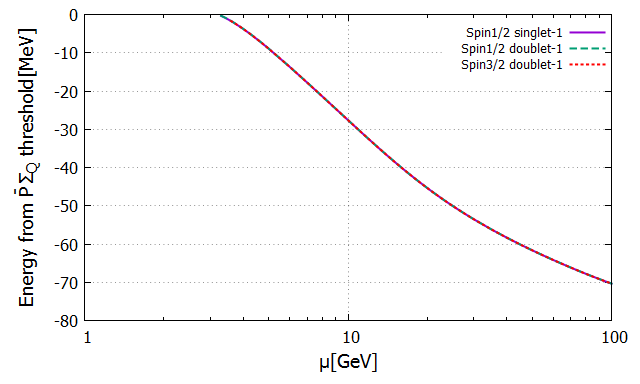 Figure 1
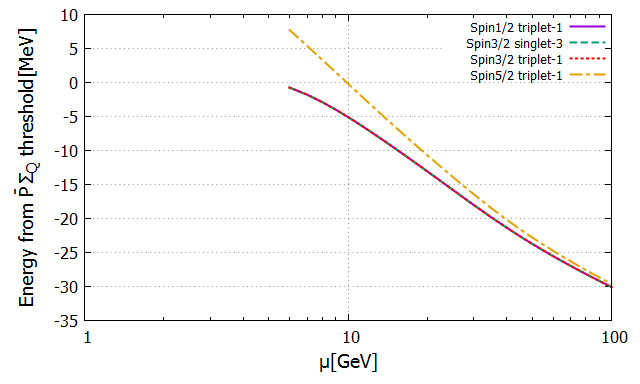 Figure 2
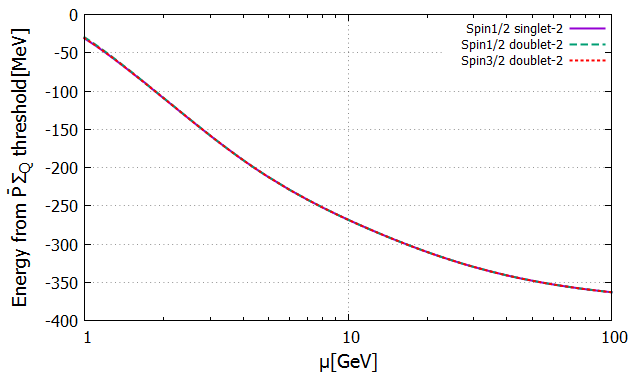 Figure 3
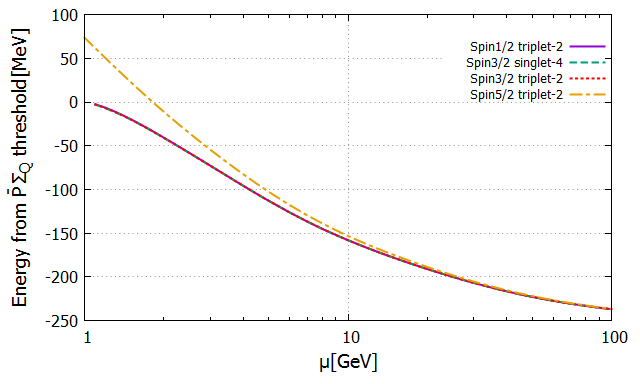 Figure 4
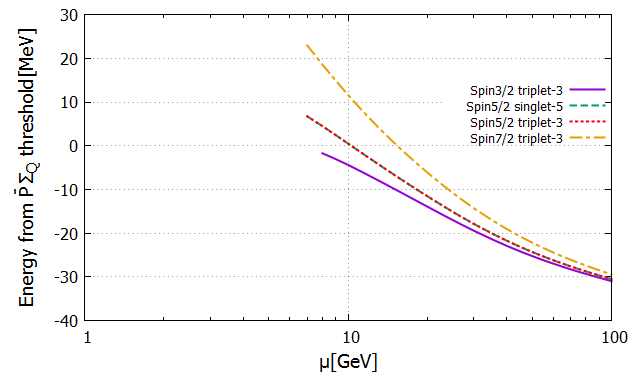 Figure 5
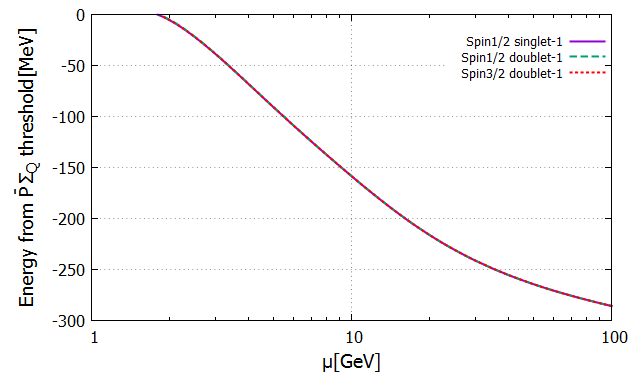 Figure 6
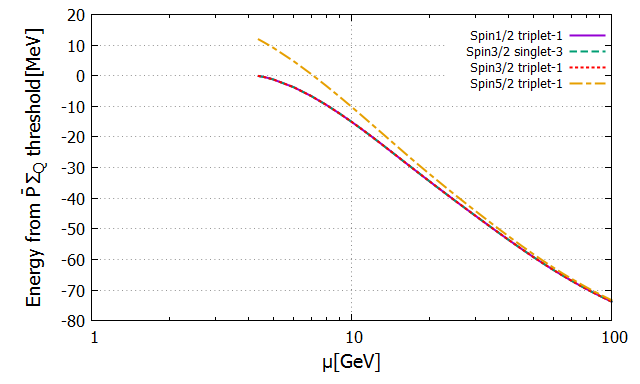 Figure 7
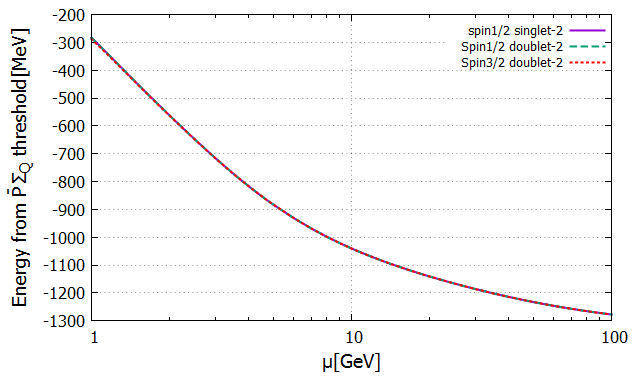 Figure 8
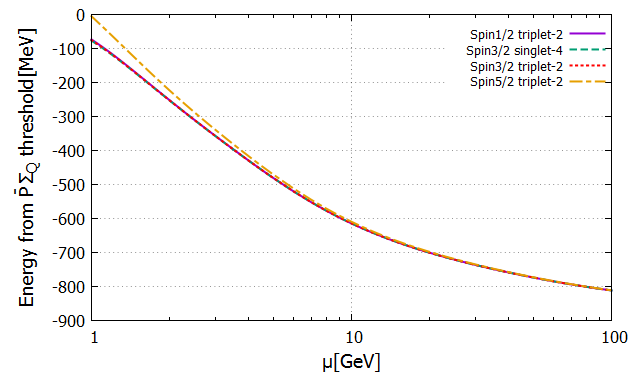 Figure 9
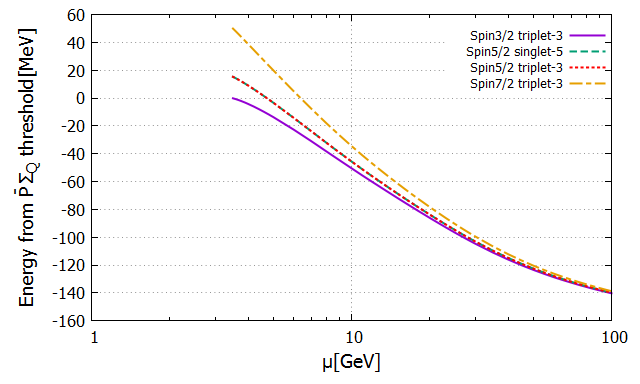 Figure 10
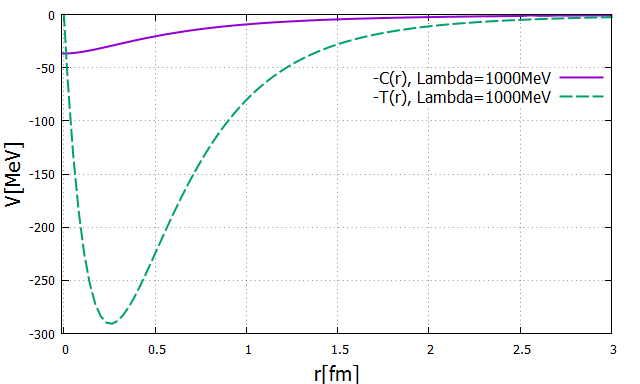 Figure 11
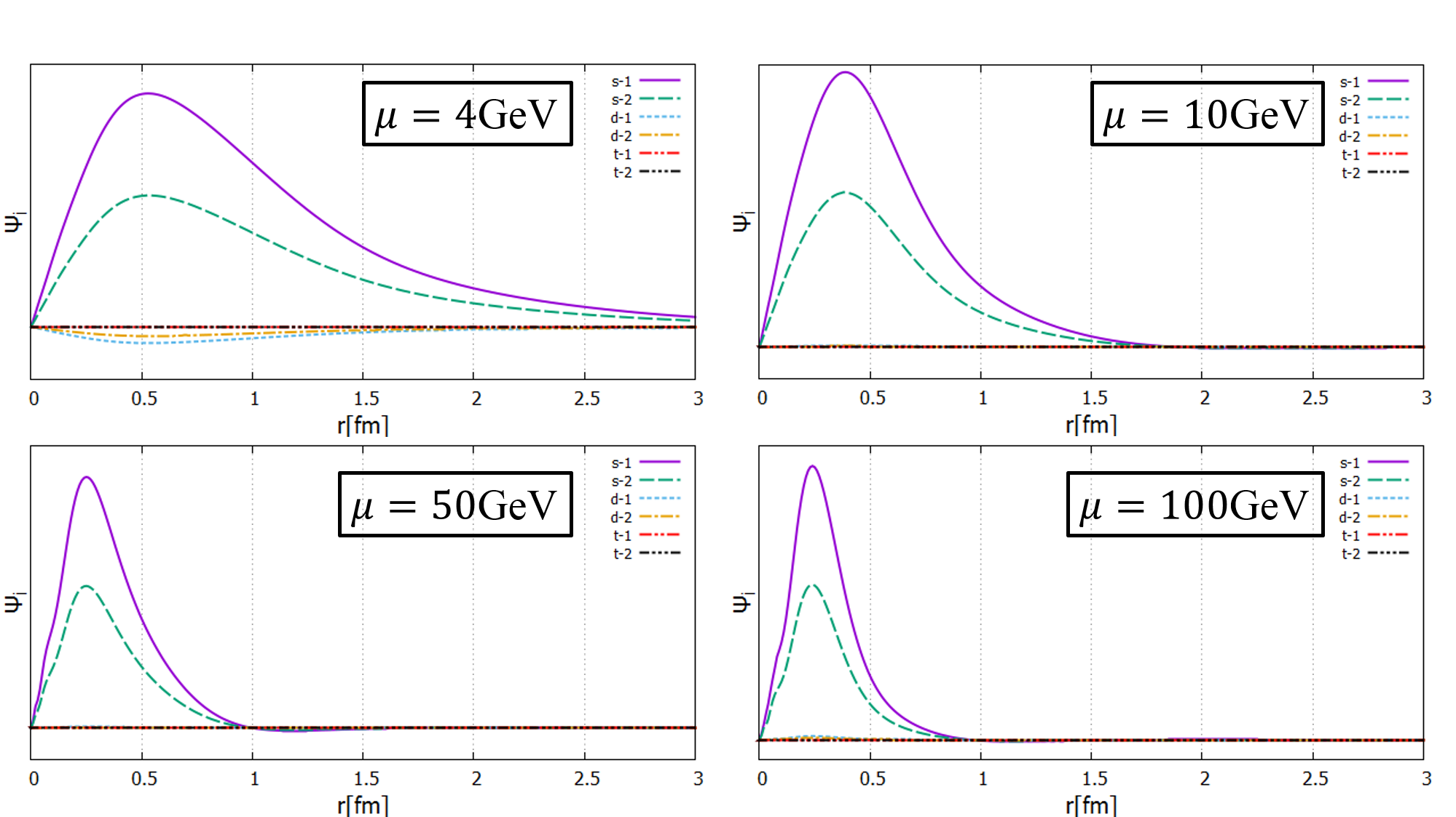 Figure 12
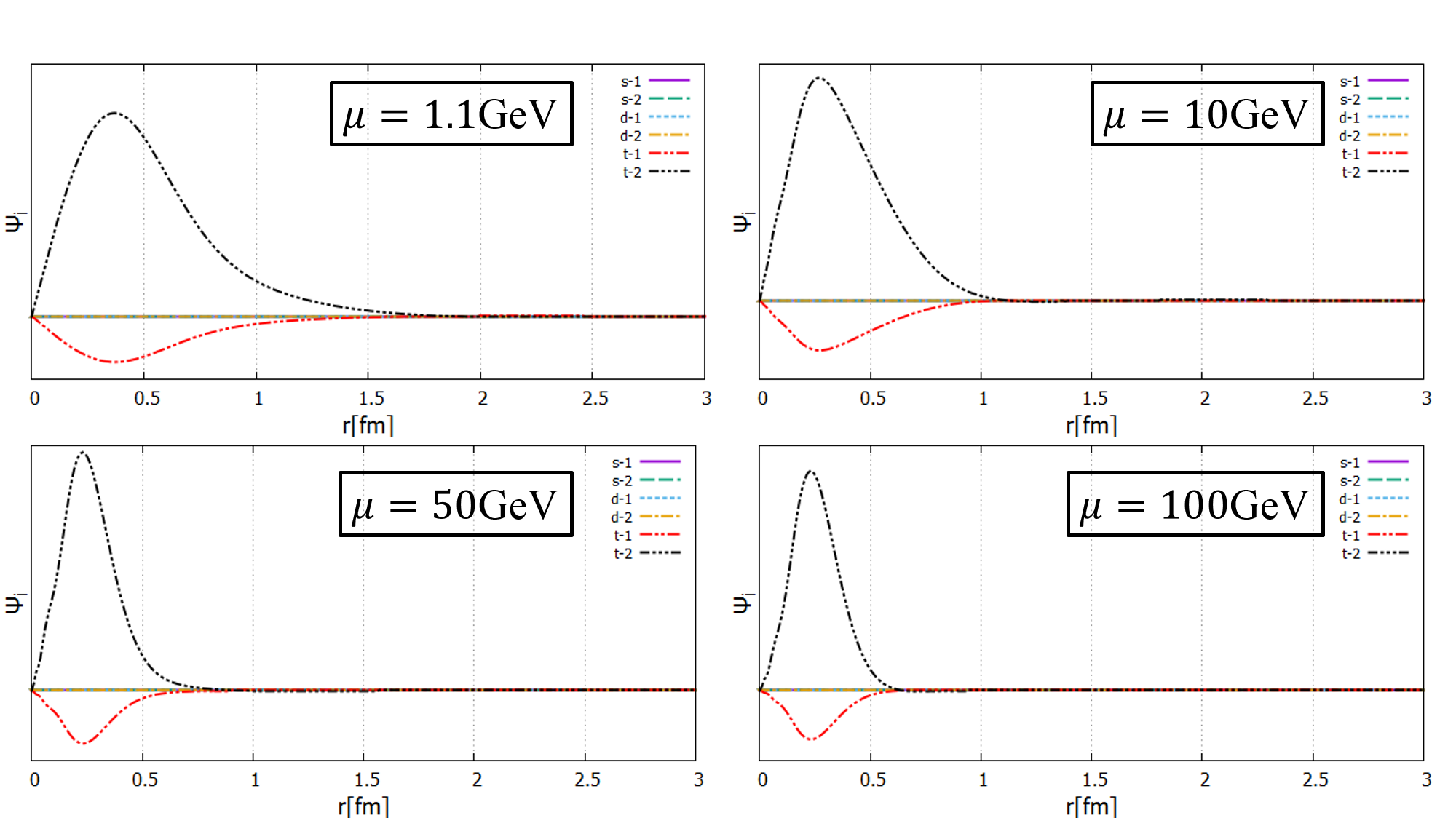 Figure 13
| Mass[MeV] | ||||
|---|---|---|---|---|
| Mass[MeV] |
| -2.0798 | -1.8685 | 1.9889 | 2.0814 | 2.9468 | 3.1677 | -3.1729 | -3.0629 |
| [GeV] | Spin | Spin | Spin | ||||
| singlet-1 | doublet-1 | triplet-2 | singlet-4 | doublet-1 | triplet-2 | triplet-2 | |
| no bound | no bound | 4317.7 | 4317.1 | no bound | 4317.4 | 4381.6 | |
| no bound | no bound | 11025 | 11025 | no bound | 11025 | 11049 |
| [GeV] | Spin | Spin | Spin | ||||
| singlet-1 | doublet-1 | triplet-2 | singlet-4 | doublet-1 | triplet-2 | triplet-2 | |
| no bound | no bound | 4225.4 | 4222.3 | no bound | 4223.7 | 4285.3 | |
| 11060 | 11060 | 10752 | 10752 | 11060 | 10752 | 11060 |
| [GeV] | Spin | Spin | |||||
|---|---|---|---|---|---|---|---|
| singlet-2 | doublet-2 | triplet-1 | singlet-3 | doublet-2 | triplet-1 | triplet-3 | |
| 4279.7 | 4281.0 | no bound | no bound | 4280.0 | no bound | no bound | |
| 10947 | 10947 | no bound | no bound | 10942 | no bound | no bound | |
| Spin | Spin7/2 | ||||||
| [GeV] | singlet-5 | triplet-1 | triplet-3 | triplet-3 | |||
| no bound | no bound | no bound | no bound | ||||
| no bound | no bound | no bound | no bound |
| [GeV] | Spin | Spin | |||||
|---|---|---|---|---|---|---|---|
| singlet-2 | doublet-2 | triplet-1 | singlet-3 | doublet-2 | triplet-1 | triplet-3 | |
| 3993.9 | 3998.7 | no bound | no bound | 3994.9 | no bound | no bound | |
| 10401 | 10401 | no bound | no bound | 10401 | no bound | no bound | |
| Spin | Spin7/2 | ||||||
| [GeV] | singlet-5 | triplet-1 | triplet-3 | triplet-3 | |||
| no bound | no bound | no bound | no bound | ||||
| no bound | no bound | no bound | no bound |
Peer Reviews
No public reviews on file for this paper yet. If you reviewed it on a platform where reviews are public (OpenReview, ICLR, NeurIPS, ICML), you can paste yours below so the community can read it here.
Videos
No videos yet. Explain this paper in a talk, walkthrough, or lecture? Add one.
Heavy quark spin multiplet structure of -like pentaquark as P-wave hadronic molecular state
Yuki Shimizu
Department of Physics, Nagoya University, Nagoya 464-8602, Japan
Yasuhiro Yamaguchi
Theoretical Research Division, Nishina Center, RIKEN, Hirosawa, Wako, Saitama 351-0198, Japan
Masayasu Harada
Department of Physics, Nagoya University, Nagoya 464-8602, Japan
Abstract
We study the heavy quark spin (HQS) multiplet structure of P-wave -type pentaquarks treated as molecules of a heavy meson and a heavy baryon. We define the light-cloud spin (LCS) basis decomposing the meson-baryon spin wavefunction into the LCS and HQS parts. Introducing the LCS basis, we find HQS multiplets classified by the LCS; five HQS singlets, two HQS doublets, and three HQS triplets. We construct the one-pion exchange potential respecting the heavy quark spin and chiral symmetries to demonstrate which HQS multiplets are realized as a bound state. By solving the coupled channel Schrödinger equations, we study the heavy meson-baryon systems with and . The bound states which have same LCS structure are degenerate at the heavy quark limit, and the degeneracy is resolved for finite mass. This HQS multiplet structure will be measured in the future experiments.
I Introduction
In 2015, the Large Hadron Collider beauty experiment (LHCb) collaboration observed two hidden charm pentaquarks, and Aaij:2015tga ; Aaij:2016phn ; Aaij:2016ymb . Their masses are MeV and MeV, and decay widths are MeV and MeV. Their spin and parity are not determined. The one state has and the other has and their parity is opposite.
The pentaquarks have a charm quark and an anti-charm quark. They are called the hidden-charm pentaquarks. There were some theoretical works of hidden-charm pentaquarks before the LHCb announcement Wu:2010jy ; Yang:2011wz ; Wang:2011rga ; Wu:2012md . After the LHCb observation, many theoretical studies in various ways have been conducted: hadronic molecular picture Chen:2015loa ; He:2015cea ; Chen:2015moa ; Huang:2015uda ; Roca:2015dva ; Meissner:2015mza ; Xiao:2015fia ; Burns:2015dwa ; Kahana:2015tkb ; Chen:2016otp ; Shimizu:2016rrd ; Yamaguchi:2016ote ; He:2016pfa ; Ortega:2016syt ; Azizi:2016dhy ; Geng:2017hxc , quark model estimation Santopinto:2016pkp ; Wu:2017weo ; Hiyama:2018ukv , diquark picture Maiani:2015vwa ; Lebed:2015tna ; Li:2015gta ; Wang:2015epa ; Zhu:2015bba , quark-cluster modelTakeuchi:2016ejt , baryocharmonium modelKubarovsky:2015aaa , hadroquarkonia modelEides:2017xnt , soliton modelScoccola:2015nia , holographic QCD Liu:2017frj , and hadronic molecule coupled with five-quark state Yamaguchi:2017zmn . Some review papers are also published Chen:2016qju ; Ali:2017jda ; Guo:2017jvc .
The hadronic molecular picture is one of the highly possible model around the hadron threshold. The threshold of is MeV and is MeV. These values are slightly above the mass of and , respectively. Therefore, the pentaquarks can be considered as the loosely bound states of a charmed meson and a charmed baryon.
In the heavy quark effective theory, the spin dependent interaction of heavy quark is suppressed by the inverse of the heavy quark mass, . At the heavy quark limit, therefore, the dynamics is independent of the transformation of the heavy quark spin. This is called the heavy quark spin symmetry (HQSS). The suppression of the spin dependent force causes the decomposition of the heavy quark spin and the light-cloud spin at the heavy quark limit Isgur:1989vq ; Isgur:1989ed ; Isgur:1991wq ; Neubert:1993mb ; Manohar:2000dt :
[TABLE]
The total angular momentum is a conserved quantity, and the heavy quark spin is conserved at heavy quark limit. Then, the light-cloud spin is also conserved.
The HQSS leads to the mass degeneracy between the heavy hadrons with different spin. Considering a heavy meson with a heavy quark and an anti-light quark , the total spin of is
[TABLE]
and () for the vector meson (the pseudoscalar meson ), because of the quark spin . Their difference comes from the spin configuration of the light cloud and heavy quark spins. However, the system is independent of the heavy quark spin and as a result, the spin [math] state and the spin state degenerate at heavy quark limit. This structure is called the HQS doublet.
In the real world, however, the quark masses are finite, so that there exists a mass difference between the pseudoscalar and vector mesons. For example, the mass difference between pseudoscalar meson and vector meson is about MeV. By contrast, the mass splitting between and is about MeV and between and is MeV. The mass difference is much smaller in the charm and bottom quark sectors than in the light quark sector. There is a same tendnecy in the single heavy baryon. The mass difference between spin baryon and spin baryon is about MeV, and and is about MeV. The HQSS approximately exists in the heavy quark sector.
The purpose of this work is to study the HQS multiplet structure of -type pentaquarks as hadronic molecular states of a meson and a baryon. Here and denote mesons with and with an anti-heavy quark like and mesons, and and the baryons with and with a heavy quark like and baryons. We note that the HQS doublet structure of single heavy hadrons such as and is well known. Furthermore, the HQS multiplet structure of multi-hadron system with single heavy quark like molecular states has been studied in Refs. Yasui:2013vca ; Yamaguchi:2014era ; Hosaka:2016ypm . On the other hand, the HQS multiplet structure of doubly heavy hadrons like pentaquarks is nontrivial. Hence, it is interesting to investigate the HQS multiplet structure of heavy meson-baryon molecular states.
In Ref. Shimizu:2018ran , the HQS multiplet structure of with S-wave has been studied. The analysis of the S-wave state covers the negative parity Pentaquarks. However, one of the pentaquarks has the positive parity. Accordingly, we study possible positive parity states by considering P-wave molecular states of and in the present paper. We define the light-cloud spin (LCS) basis introduced in Ref. Shimizu:2018ran which is useful to investigate the HQS multiplet structure. Although the hadronic molecular (HM) basis is simple to consider the possible total spin state and to construct the potentials, it is not useful to investigate the HQS multiplet structure because the heavy quark spin and the light-cloud spin are not separated in this basis. In the light-cloud spin (LCS) basis, however, these spins are separated explicitly as shown in Eq. (1). Below we shall transform the HM basis to the LCS basis and study the HQS multiplet structure. Moreover, we demonstrate which multiplets can be bound under the one-pion exchange potential (OPEP) from the heavy hadron effective theory.
This paper is organized as follows. In Sec. II we construct the HM basis of the states and transfer it to LCS basis to discuss the HQS multiplet structure. The OPEP is shown in Sec. III. In Sec. IV, we summarize the numerical results. Finally, Sec. V is a summary and discussion.
II HQS multiplet structure of with P-wave
In this section, we consider the HQS multiplet of P-wave states. First, we construct the hadronic molecular (HM) basis of the states. The possible spin states and meson-baryon components with given are shown in Tab. 1.
Giving the component with total spin , we obtain the spin structure in the HM basis and the possible total angular momentum as follows:
[TABLE]
where implies that the meson with spin and the baryon ( is a light diquark) with spin are combined into a composite state with the total spin and the orbital angular momentum . implies that the spin of the diquark is . HM basis is simple to construct the possible spin states because it is just the coupling of the spins of the meson and baryon and the orbital angular momentum. However, HM basis is not suitable to discuss the HQS multiplet structure. The heavy quark spin and the light-cloud spin are independently conserved in the heavy quark limit. Thereby, the heavy quark spin and the other spin must be treated separately. We define the light-cloud spin (LCS) basis as a suitable basis to study the structure of HQS multiplets.
In the LCS basis, the spin structures are rewritten as follows :
[TABLE]
where implies the followings: A heavy quark and an anti-heavy quark are combined into a state with spin in S-wave. Spins of a light quark and a diquark are coupled to spin and the total spin of the combined state in P-wave is given by . The right hand side of the equation shows the possible spins of the combined pentaquark states. There exist five HQS singlets (s-1 to s-5), two HQS doublets (d-1 and d-2), and three HQS triplets (t-1 to t-3). The HQS triplet does not exist in single heavy hadrons. It is a feature of the multi-heavy quark system. The basis transformation is done by
[TABLE]
where the is a transformation matrix determined by the Clebsch-Gordan coefficient to reconstruct the spin structure. The detail of the basis transformation is summarized in Appendix A. It is to be noted that the two heavy quarks are labeled by the same velocity to classify the pentaquark states based on the heavy quark spin symmetry.
III Potentials
In the previous section, we showed that there are ten multiplets in the P-wave molecular states. In this section, we demonstrate that which of the multiplets can be bound by using one-pion exchange potential (OPEP). We construct the OPEP for molecular states based on the heavy hadron effective theory.
The meson and pion interaction Lagrangian is given in Refs.Falk:1991nq ; Wise:1992hn ; Cho:1992gg ; Yan:1992gz ; Falk:1992cx , and the baryon and pion interaction Lagrangian is given in Refs.Yan:1992gz ; Liu:2011xc . See also our previous paper Shimizu:2018ran .
When we construct the OPEP from effective Lagrangians, we introduce a cutoff parameter via the monopole type form factor
[TABLE]
at each vertex, where is the mass of the exchanging pion, and is its momentum. We use the same cutoff for and vertices for simplicity, and fix the value of cutoff MeV and MeV. The obtained potential matrices in the HM basis are summarized in Appendix A. We note that contact terms are subtracted from the potentials, because in a conventional way, the OPEP has been considered at large distance Bohr-Mottelson . Furthermore, we study the cases where the final pentaquarks carry isospin , because pentaquarks carry .
The potential matrices can be also transformed to LCS basis by using the unitary matrix as follows:
[TABLE]
[TABLE]
[TABLE]
[TABLE]
where the functions and are the spin-spin potential and tensor potential, respectively. We omitted the arguments of potentials in the above equations. Their explicit forms are given by
[TABLE]
The typical shapes of and are shown in Fig.1. This shows that the signs and are negative so as to be attractive potentials.
The heavy meson - pion coupling constant is determined by the decay of Olive:2016xmw , the heavy baryon - pion coupling constant is estimated by the quark model in Ref.Liu:2011xc , and the pion decay constant is MeV.
The block matrices of the above OPEPs in LCS basis are classified by the HQS multiplet structure. For example, the first block in Eq.(28) is for HQS singlet sector with the total spin . It corresponds to the first and second component in Eq.(79), or (s-1) component in Eq.(10) and (s-2) in Eq.(11). Similarly, the second block in Eq.(28) corresponds to the third and forth component in Eq.(79) which is for spin doublet, and the third block in Eq.(28) corresponds to the fifth and sixth component in Eq.(79) which is for spin triplet.
The component of block matrix is determined by the structure of the light-cloud spin. For instance, the first and second block in Eq.(28) are identical because two singlets and two doublets have the same light-cloud spin structure, and , as shown in Eq.(79).
IV Numerical result
In this section we show the binding energy obtained by solving the coupled channel Schrödinger equation under the OPEPs obtained in the previous section. We use the Gaussian expansion method Hiyama:2003cu to solve the Schrödinger equations. As discussed in Ref.Shimizu:2018ran , the coupling constant has a sign ambiguity. This ambiguity is the relative sign between the heavy meson - pion coupling and the heavy baryon - pion coupling . We assign the same sign as the quark model estimation in Ref.Liu:2011xc as the sign of . Therefore, we treat the sign uncertainty as the sign of . In this study, we investigate both cases.
We include the effect of the heavy quark spin symmetry breaking by introducing the mass difference between two heavy mesons (baryons) in one HQS doublet, namely and ( and ). We parameterize the heavy hadron masses as done in Ref.Shimizu:2018ran :
[TABLE]
The mass parameter controls the typical mass scale. It corresponds to the averaged reduced mass of , and . We determine the eight parameters , and to reproduce the eight hadron masses shown in Table 2.
The value of eight parameters are summarized in Table 3.
When and GeV, the charmed and the bottomed hadron masses are reproduced, respectively. The heavy quark spin symmetry restores as the mass parameter increases.
Firstly, we show the numerical results obtained by solving the coupled channel Schrödinger equations for each structure of light-cloud spin in the case of . In this case, the multiplets which have the light-clouds and are attractive. In Fig.2, we show the energy of , which corresponds to the spin singlet (s-1) in Eq. (10) and spin doublet (d-1) in Eq. (15).
The labels in Fig. 2 to Fig. 6 are named by a main component of the wave function at the heavy quark limit. Here, all the energies for three states are measured from the lowest threshold of . Their energies are almost degenerate at whole range of . Next, in Fig. 3, we show the energy of , which corresponds to the spin singlet (s-4) in Eq. (13) and spin triplet (t-2) in Eq. (18).
We note that the lowest threthold of the spin and states is , while that of the spin state is . Then, the energies of spin- state shown in Fig. 3 (and Figs. 4 and 6) are positive even if they are bound states. For example, in the result of MeV, the mass of spin state is MeV at GeV. This value is very close to the mass of .
Next, we show the result of . The multiplets with , , and are attractive. We show the energy of in Fig. 4, which corresponds to the spin singlet (s-3) in Eq.(12) and spin triplet (t-1) in Eq.(17).
The lowest threthold of the spin and states is , while the spin state is . Next, the energy of is shown in Fig. 5, which corresponds to the spin singlet (s-2) in Eq.(11) and spin doublet (d-2) in Eq.(16).
Finally, we show the energy of in Fig. 6, which corresponds to the spin singlet (s-5) in Eq.(14) and spin triplet (t-3) in Eq.(19). We note that the threshold of the spin state is measured from . The difference of threshold values between and is MeV, and between and is MeV at GeV.
The states which have same structure of light-cloud spin are degenerate at heavy quark limit. However, the heavy quark spin symmetry is broken for finite quark mass, and the mass degeneracy is resolved. We summarize the values of the masses of obtained bound states at the charm region ( GeV) and bottom region ( GeV) in Table 4-7. For instance, in Table. 4, the mass difference between and in HQS triplet-3 is MeV at GeV, and MeV at GeV. This shows that the mass difference becomes smaller in the bottom sector. Although the present study includes only OPEP, the mass degeneracy should occur even using the more realistic potential model if the heavy quark spin symmetry exists in the doubly heavy hadronic molecule. The search for the HQS partner states of -like pentaquark is very important to understand the structure of heavy hadrons.
V Summary and Discussions
In Sec.II, we showed the HQS multiplet structure of molecular states made from a heavy meson and a heavy baryon in P-wave. There are five HQS singlets, two doublets, and three triplets. The potential matrix is block diagonalized in the LCS basis for each HQS multiplet as shown in Sec. III. We obtained the binding energy by solving the Schrödinger equation under OPEP in Sec. IV. When is positive, the spin singlet (s-1), singlet (s-4), the blocks of the potential for doublet (d-1), and triplet (t-2) are attractive. The blocks for other six multiplets, singlet (s-2), singlet (s-3), singlet (s-5), doublet (d-2), triplet (t-1), and triplet (t-3) are attractive when is negative. The behavior of the binding energy is classified by the structure of the light-cloud spin. As mentioned in Ref.Shimizu:2018ran , OPEP depends only on the structure of the light-cloud spin since the pion exchange interaction couples the light quark spin and the orbital angular momentum. The HQS multiplets having the same light-cloud structure are degenerate at heavy quark limit. The mass degeneracy is resolved for hidden-charm/bottom pentaquarks because of the finite quark mass.
The mass of the state in Tab. 4 is close to the one of . It’s HQS triplet partner states carrying and exist around MeV. The masses of their hidden-bottom flavor partner are MeV for and states, and MeV for states. We expect that these partner states will be found in future experiments.
When is , should be . We did not obtain such state in our previous work Shimizu:2018ran , since the mass of is above the threshold of our coupled channel. The full coupled channel analysis of using the complex scaling method was done in Ref.Yamaguchi:2016ote , which shows that it seems to be difficult to explain the mass and decay width of both and at the same time. Moreover, pentaquarks are not reproduced by the estimation of compact five-body pentaquark Hiyama:2018ukv . Some works argue that it is a threshold cusp by kinematical effect Guo:2015umn ; Liu:2015fea ; Guo:2016bkl ; Bayar:2016ftu . More theoretical efforts and experimental data are needed to reveal the nature of the pentaquarks.
We determined the names of the solutions by the dominant component of the wave function, which we obtain together with the binding energy when solving the Schrödinger equation. For instance, in Fig.7 and Fig.8, we show the obtained wave functions of singlet-1 and triplet-2 with , for which the binding energies are shown in Fig.2 and Fig.3, respectively. We note that these wave functions are not normalized, therefore only the ratio of components is meaningful. In both cases, the change in the ratio of the wave functions when changing the mass parameter is very small. In the case of the finite quark mass, although the different components of the HQS multiplet are mixed, the ratio is still small. This shows that the effect of the symmetry breaking by the kinetic terms is small. When the mass parameter becomes larger, the wave functions concentrate at a position where the tensor potential becomes deep. This means that as the mass increases, the kinetic term is suppressed and the wave function is localized at the bottom of the attractive potential.
To treat the heavy quark spin symmetry for doubly heavy system, we assume that two heavy quarks in a pentaquark are labeled by the same velocity. This assumption seems to be natural to the bound state because a hadronic molecule breaks when the relative velocity between the meson and baryon is large. However, if the heavy meson and heavy baryon are labeled by the same velocity, they can not get the orbital angular momentum exitation. To include the P-wave exitation we label one hadron by and another by , and assume that their difference is small. Namely, when is written as with the small quantity , we classify the HQS multiplet structure of P-wave states at the leading order of by neglecting . We do not include the effect of in the present study and leave the inclusion of its effects for future publications.
Acknowledgements.
The work of Y.S. is supported in part by JSPS Grant-in-Aid for JSPS Research Fellow No. JP17J06300. The work of Y.Y. is supported in part by the Special Postdoctoral Researcher (SPDR) and iTHEMS Programs of RIKEN. The work of M.H. is supported in part by JPSP KAKENHI Grant Number 16K05345.
Appendix A Basis transformation
We show the detail of the transformation from HM basis to LCS basis. The wave function transformation is done by Eq.(20). The component of wave functions in HM basis for each spin state is
[TABLE]
[TABLE]
[TABLE]
[TABLE]
The basis transformation is done by
[TABLE]
The component of wave functions in LCS basis is
[TABLE]
[TABLE]
[TABLE]
[TABLE]
The notation of spin structure is same with in Sec.II. The transformation matrix is determined by the Clebsch-Gordan coefficient to reconstruct the spin structures from HM basis to LCS basis.
[TABLE]
[TABLE]
[TABLE]
[TABLE]
In Sec.III we construct the one-pion exchange potential from the heavy hadron effective Lagrangians in HM basis. The detail of the OPEP matrix in HM basis is as follows :
[TABLE]
[TABLE]
[TABLE]
[TABLE]
The definition of the spin-spin potential and tensor potential are written in Sec.III. The tranformation of potential matrix from HM basis to LCS basis is done by
[TABLE]
The potential matrices in LCS basis are written in Sec.III.
The kinetic term is defined by
[TABLE]
where is a channel index, is an orbital angular momentum, and is a reduced mass of channel . The kinetic term matrices for each in HM basis are as follows :
[TABLE]
The transformation to LCS basis is done by
[TABLE]
The reference list from the paper itself. Each links out to its DOI / PubMed record.
- 1(1) R. Aaij et al. [LH Cb Collaboration], Observation of J / ψ p 𝐽 𝜓 𝑝 J/\psi p Resonances Consistent with Pentaquark States in Λ b 0 → J / ψ K − p → superscript subscript Λ 𝑏 0 𝐽 𝜓 superscript 𝐾 𝑝 \Lambda_{b}^{0}\to J/\psi K^{-}p Decays, Phys. Rev. Lett. 115 , 072001 (2015).
- 2(2) R. Aaij et al. [LH Cb Collaboration], Model-independent evidence for J / ψ p 𝐽 𝜓 𝑝 J/\psi p contributions to Λ b 0 → J / ψ p K − → superscript subscript Λ 𝑏 0 𝐽 𝜓 𝑝 superscript 𝐾 \Lambda_{b}^{0}\to J/\psi p K^{-} decays, Phys. Rev. Lett. 117 , no. 8, 082002 (2016).
- 3(3) R. Aaij et al. [LH Cb Collaboration], Evidence for exotic hadron contributions to Λ b 0 → J / ψ p π − → superscript subscript Λ 𝑏 0 𝐽 𝜓 𝑝 superscript 𝜋 \Lambda_{b}^{0}\to J/\psi p\pi^{-} decays, Phys. Rev. Lett. 117 , no. 8, 082003 (2016).
- 4(4) J. J. Wu, R. Molina, E. Oset and B. S. Zou, Prediction of narrow N ∗ superscript 𝑁 N^{*} and Λ ∗ superscript Λ \Lambda^{*} resonances with hidden charm above 4 Ge V, Phys. Rev. Lett. 105 , 232001 (2010).
- 5(5) Z. C. Yang, Z. F. Sun, J. He, X. Liu and S. L. Zhu, The possible hidden-charm molecular baryons composed of anti-charmed meson and charmed baryon, Chin. Phys. C 36 , 6 (2012).
- 6(6) W. L. Wang, F. Huang, Z. Y. Zhang and B. S. Zou, Σ c D ¯ subscript Σ 𝑐 ¯ 𝐷 \Sigma_{c}\bar{D} and Λ c D ¯ subscript Λ 𝑐 ¯ 𝐷 \Lambda_{c}\bar{D} states in a chiral quark model, Phys. Rev. C 84 , 015203 (2011)
- 7(7) J. J. Wu, T.-S. H. Lee and B. S. Zou, Nucleon Resonances with Hidden Charm in Coupled-Channel Models, Phys. Rev. C 85 , 044002 (2012).
- 8(8) R. Chen, X. Liu, X. Q. Li and S. L. Zhu, Identifying exotic hidden-charm pentaquarks, Phys. Rev. Lett. 115 , no. 13, 132002 (2015).