Unconventional Thermal Magnon Hall Effect in a Ferromagnetic Topological Insulator
Christian Moulsdale, Pierre A. Pantale\'on, Ramon Carrillo-Bastos,, Yang Xian

TL;DR
This paper theoretically explores the thermal Hall effect of magnons in a ferromagnetic topological insulator with Kekulé-O coupling modulation and Dzyaloshinskii-Moriya interaction, revealing unconventional conductivity behaviors and tunability.
Contribution
It introduces a strain-induced KOC modulation in a ferromagnetic lattice, identifying four topological phases and predicting unconventional thermal magnon Hall conductivity behaviors.
Findings
Identification of four topological phases based on KOC and DMI.
Prediction of unconventional thermal Hall conductivity due to Berry curvature.
Sign changes in conductivity linked to model parameters and band occupation.
Abstract
We present theoretically the thermal Hall effect of magnons in a ferromagnetic lattice with a Kekul\'e-O coupling (KOC) modulation and a Dzyaloshinskii-Moriya interaction (DMI). Through a strain-based mechanism for inducing the KOC modulation, we identify four topological phases in terms of the KOC parameter and DMI strength. We calculate the thermal magnon Hall conductivity at low temperature in each of these phases. We predict an unconventional conductivity due to a non-zero Berry curvature emerging from band proximity effects in the topologically trivial phase. We find sign changes of as a function of the model parameters, associated with the local Berry curvature and occupation probability of the bulk bands. Throughout, can be easily tuned with external parameters such as the magnetic field and temperature.
Click any figure to enlarge with its caption.
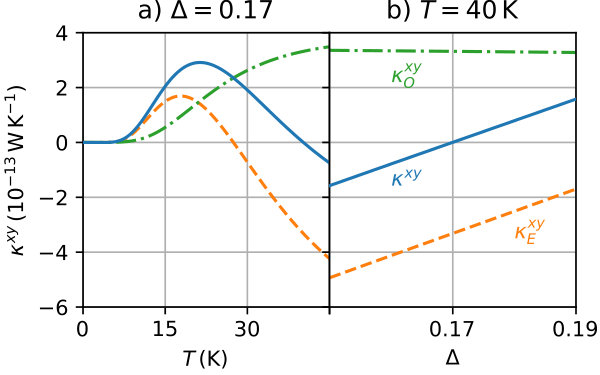 Figure 1
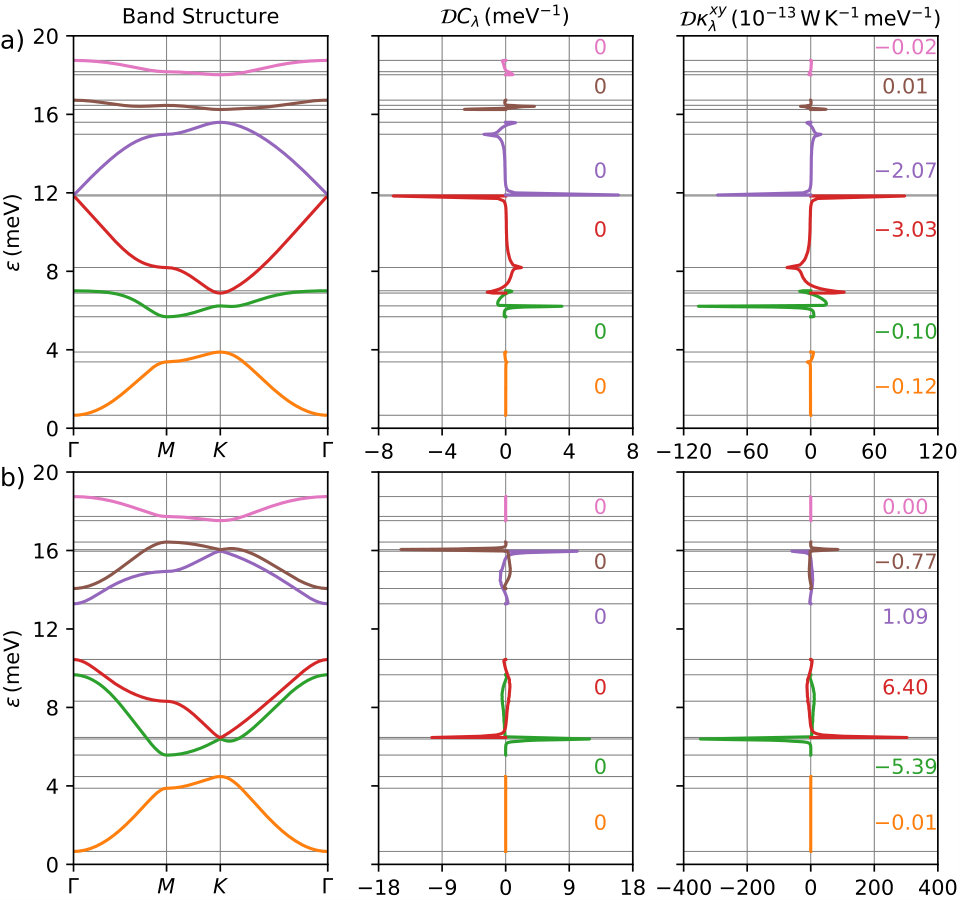 Figure 2
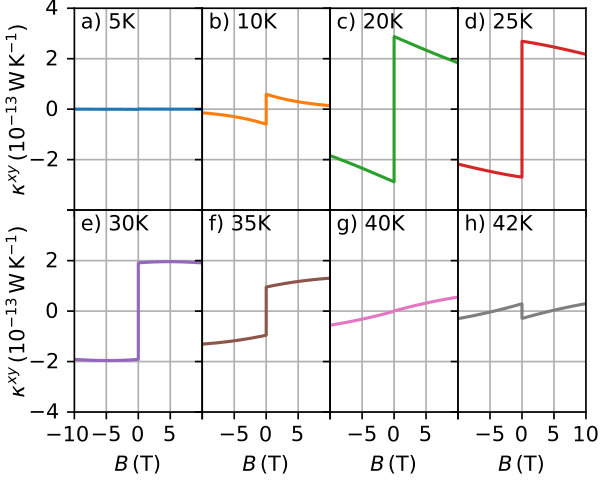 Figure 3
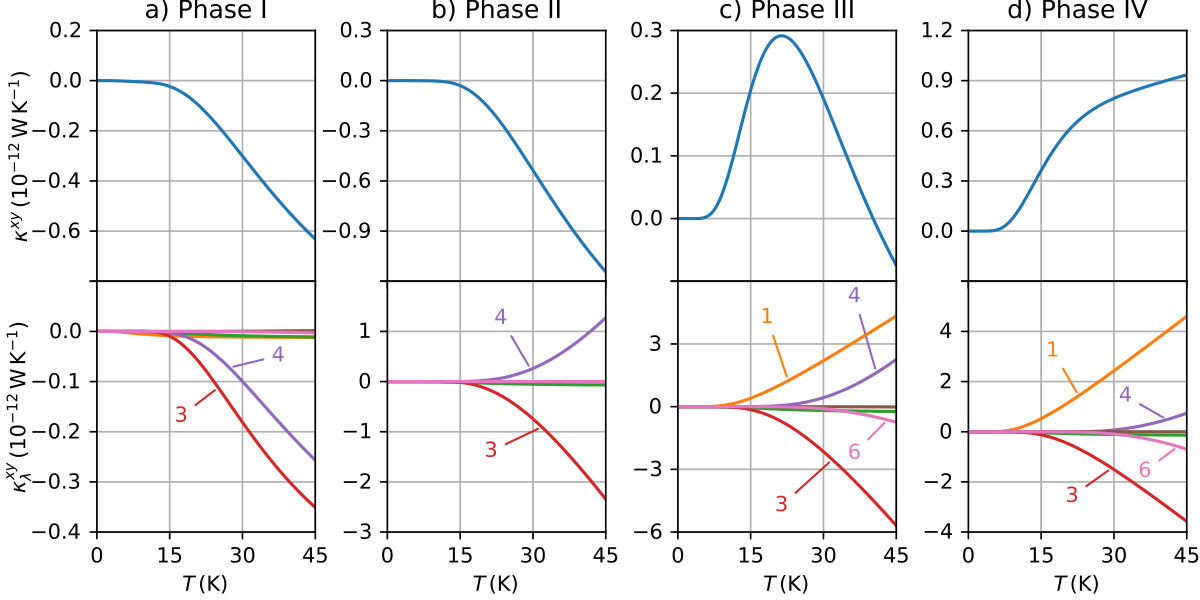 Figure 4
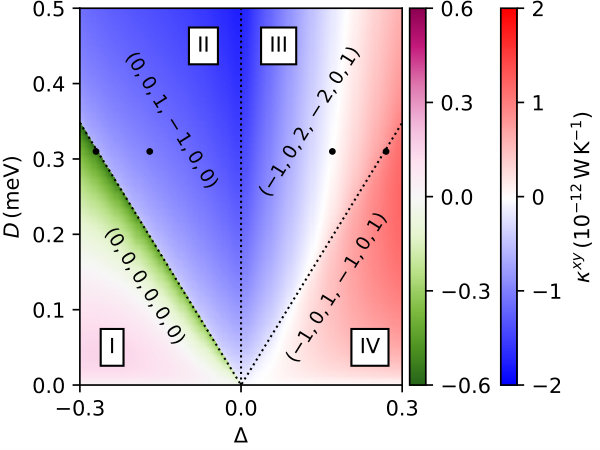 Figure 5
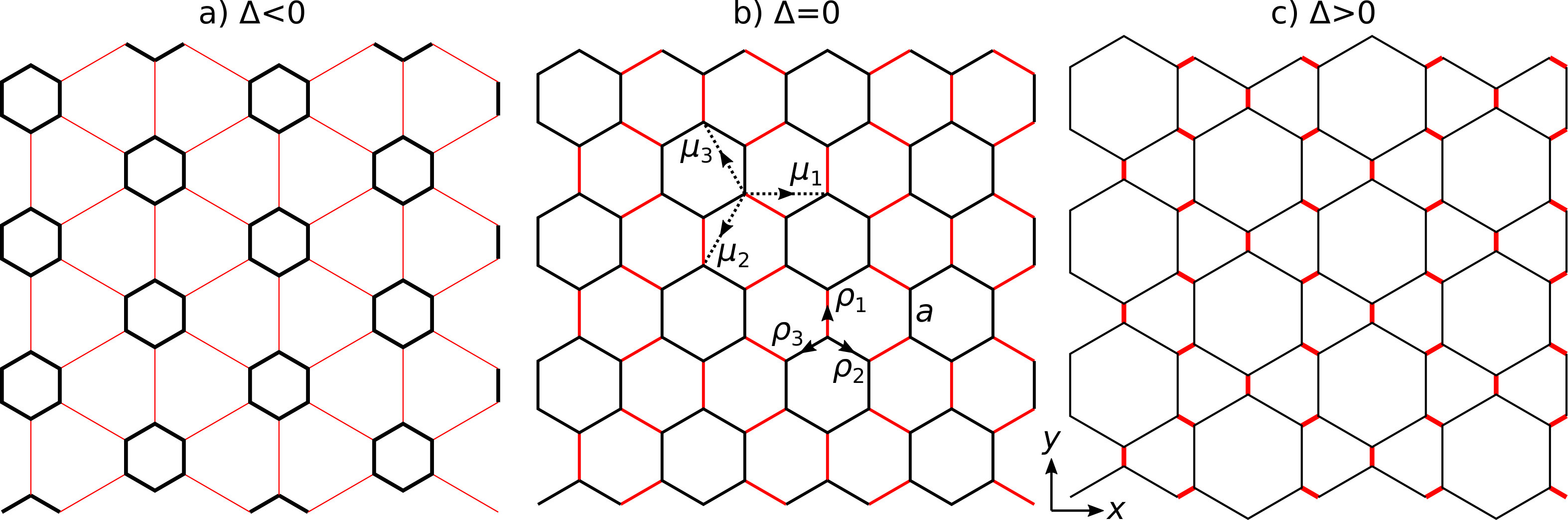 Figure 6
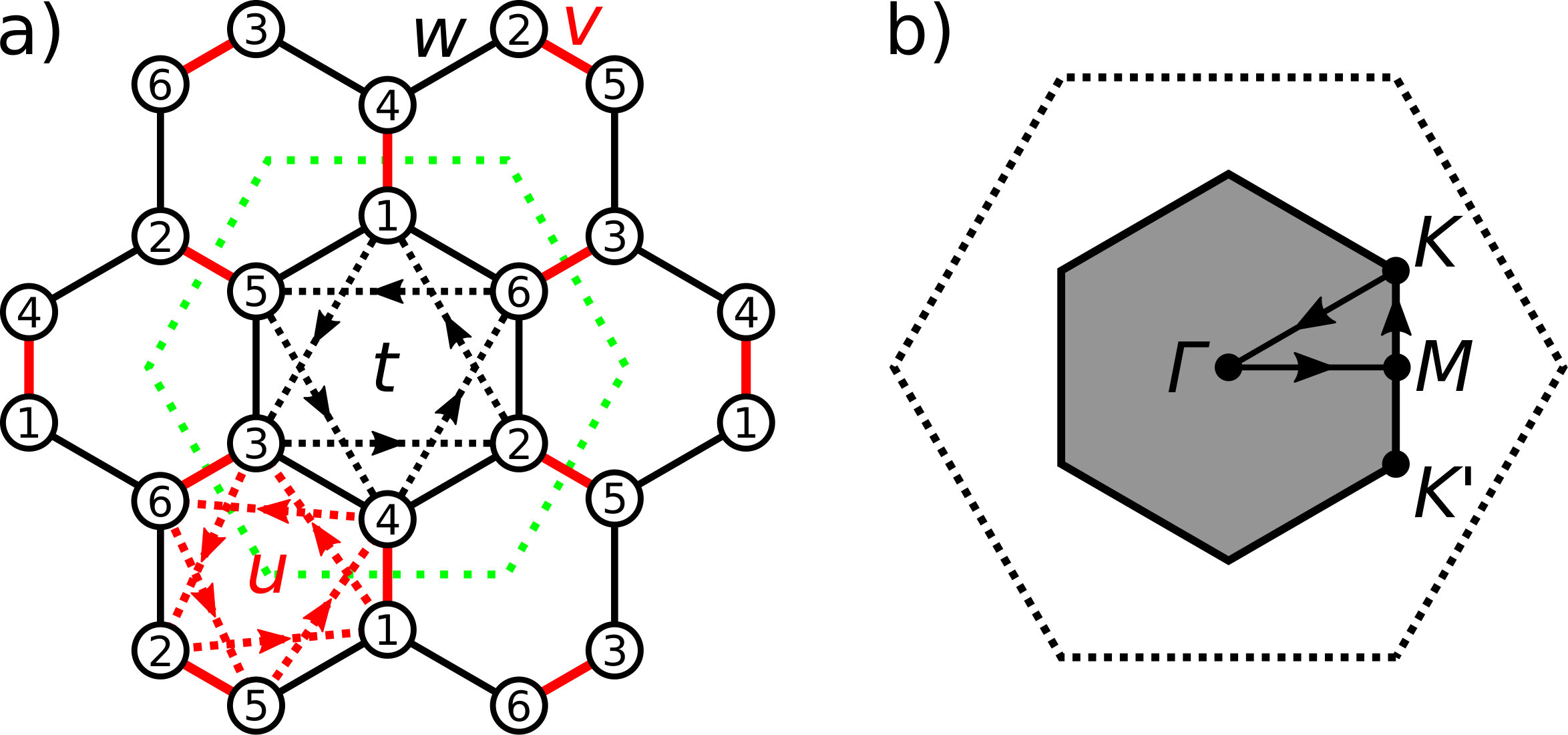 Figure 7
Peer Reviews
No public reviews on file for this paper yet. If you reviewed it on a platform where reviews are public (OpenReview, ICLR, NeurIPS, ICML), you can paste yours below so the community can read it here.
Videos
No videos yet. Explain this paper in a talk, walkthrough, or lecture? Add one.
Unconventional Thermal Magnon Hall Effect in a Ferromagnetic Topological Insulator
Christian Moulsdale
Theoretical Physics Division, School of Physics and Astronomy, University of Manchester, Manchester M13 9PL, United Kingdom
Pierre A. Pantaleón
Theoretical Physics Division, School of Physics and Astronomy, University of Manchester, Manchester M13 9PL, United Kingdom
Ramon Carrillo–Bastos
Facultad de Ciencias, Universidad Autónoma de Baja California, Apartado Postal 1880, 22800, Ensenada, Baja California, México
Yang Xian
Theoretical Physics Division, School of Physics and Astronomy, University of Manchester, Manchester M13 9PL, United Kingdom
Abstract
We present theoretically the thermal Hall effect of magnons in a ferromagnetic lattice with a Kekulé–O coupling (KOC) modulation and a Dzyaloshinskii–Moriya interaction (DMI). Through a strain-based mechanism for inducing the KOC modulation, we identify four topological phases in terms of the KOC parameter and DMI strength. We calculate the thermal magnon Hall conductivity at low temperature in each of these phases. We predict an unconventional conductivity due to a non-zero Berry curvature emerging from band proximity effects in the topologically trivial phase. We find sign changes of as a function of the model parameters, associated with the local Berry curvature and occupation probability of the bulk bands. Throughout, can be easily tuned with external parameters such as the magnetic field and temperature.
pacs:
65.90.+i, 66.70.-f, 72.20.-i, 75.10.-b, 75.30.-m, 75.70.-i, 85.75.-d
I Introduction
The thermal Hall effect is an unconventional Hall effect where a heat current is found perpendicular to a temperature gradient in a material Righi (1887); Leduc (1887). In a ferromagnetic system, these heat currents are carried by magnons Matsumoto and Murakami (2011a, b, c); Murakami and Okamoto (2017), which are weakly interacting quasiparticles obeying Bose–Einstein statistics Holstein and Primakoff (1940). Unlike the Hall effect of electrons Hall (1879), this is not a result of the Lorentz force as magnons carry no electronic charge. Then, as neutral quasiparticles, they can propagate over large distances without dissipation by Joule heating Kajiwara et al. (2010). The thermal Hall effect of magnons has been observed in pyrochlore ferromagnetic insulators Onose et al. (2010); Ideue et al. (2012), yttrium iron garnets Madon et al. (2014); Tanabe et al. (2016), a kagomé magnet Hirschberger et al. (2015a) and a frustrated pryocholore quantum magnet Hirschberger et al. (2015b).
The emergence of any Hall effect is typically a consequence of time reversal symmetry breaking which induces topologically non-trivial band gaps Murakami (2003); Sinova et al. (2004); Day (2008). This can be achieved in an electronic system in many ways including with an external magnetic field Thouless et al. (1982) or by introducing spin-orbit coupling (SOC) Sinova et al. (2004); Kane and Mele (2005). Likewise, the Dzyaloshinskii–Moriya interaction (DMI) representing SOC in magnetic systems Dzyaloshinsky (1958); Moriya (1960) induces a non-trivial band topology Katsura et al. (2010). On the other hand, a non-trivial band topology is found in the absence of DMI in frustrated antiferromagnets Owerre (2017) or by introducing the magnetic dipolar interaction Matsumoto and Murakami (2011a, b). From the bulk Hamiltonian and when a nontrivial gap is present, we can use the bulk-boundary correspondence Essin and Gurarie (2011) to predict the existence of robust magnon edge currents Delplace et al. (2011); Malki and Uhrig (2017) which are independent of the geometry of the system Matsumoto and Murakami (2011a). The edge states of an isotropic 2D honeycomb ferromagnet with DMI have been studied theoretically for a system with zigzag Pantaleón and Xian (2017, 2018a), armchair Pantaleón and Xian (2018b) and bearded boundaries Pantaleón and Xian (2018a). These may be observed experimentally in monolayers of the ferromagnetic material chromium triiodide , which has been shown to possess large intrinsic DMI and consequently a non-trivial band topology Chen et al. (2018).
In graphene, bond modulations can be induced by local changes in the position of the carbon atoms due to the absorption of adatoms on its surface Cheianov et al. (2009) or by a proximity effect Lin et al. (2017); Gutiérrez et al. (2016). One such example is the KOC modulation, depicted in Fig. 1, which is an intrinsic instability of carbon nanotubes Chamon (2000) and graphene Ryu et al. (2009); Weeks and Franz (2010); García-Martínez et al. (2013). In this case, a non-uniform strain field results in bonds of different strength within and between hexagonal unit cells similar to benzene molecules Gamayun et al. (2018). Moreover, the adsorption of lithium adatoms on the surface of has been predicted to result in an enhanced ferromagnetism and an increased Curie temperature Guo et al. (2018). Therefore, it is interesting to ask if the KOC modulation can be achieved in its ferromagnetic couplings through the selective adsorption of such adatoms.
In this paper, we report by a theoretical investigation that the thermal Hall effect of magnons is found in a KOC modulated honeycomb ferromagnet with DMI. We extend our previous model Pantaleón et al. (2019) to include a strain-based mechanism and NNN ferromagnetic exchange couplings, resulting in four topological phases. We find a small but non-vanishing thermal Hall conductivity in the trivial phase despite the lack of topologically protected edge states. Furthermore, unlike the isotropic model without the KOC modulation, we find sign changes of the thermal Hall conductivity with respect to the various model parameters. These are explained in terms of the competing contributions of the bulk bands. The model studied here may be useful for the future design of two–dimensional thermal components since the thermal Hall conductivity can be easily tuned with external parameters.
This paper is structured as follows. In Sec. II, we introduce the Heisenberg model with KOC modulation and DMI. In Sec. III, we give expressions for the Chern numbers and thermal Hall conductivity. In Sec. IV, we discuss the properties of the four topological phases found before considering the effects of the magnetic field. Finally, Sec. V is devoted to conclusions.
II Bond Modulated Heisenberg Model
Recently, it has been shown that different topological phases can be induced in a ferromagnetic honeycomb lattice by introducing the KOC modulation and DMI Pantaleón et al. (2019). In this paper, we provide evidence of the thermal Hall effect of magnetic spin excitations in a similar model, whose Hamiltonian is given by
[TABLE]
in terms of the spin operators . The first two terms in the above equation represent nearest-neighbour (NN) and next-nearest-neighbour (NNN) ferromagnetic couplings respectively. The third term represents an easy-axis anisotropy in the ferromagnetic coupling with the -axis identified as the easy-axis. The fourth term represents the NNN antisymmetric exchange (DMI), where is the DMI vector whose orientation depends on the lattice geometry and follows the rules set out by Moriya Moriya (1960). The last term represents a Zeeman coupling with an external magnetic field , where is the gyromagnetic ratio and is the Bohr magneton.
To generate the KOC modulation shown in Fig. 1, we introduce a non-uniform strain field Ferreiros and Vozmediano (2018) controlled by the KOC parameter . Following the convention of Gamayun et al. Gamayun et al. (2018), the NN coupling amplitudes within a unit cell (intracell) and between unit cells (intercell) shown in Fig. 2a) are given by
[TABLE]
respectively, where the unstrained, isotropic NN coupling amplitude is given by . The intracell bonds are strained by , so that the the spin-spin distance is and the exchange coupling becomes , like in graphene Vozmediano et al. (2010); Guinea (2012); Andrade et al. (2019). The Gruneissen–like parameter describes the response of the couplings to the local strain and, similarly to graphene Mohiuddin et al. (2009); Cheng et al. (2011), depends on the microscopic properties of the magnetic system. To linear order in the strain, we write
[TABLE]
with similar expressions found for the other couplings. Comparing this to Eq. (2), we find that the intracell strain is while the intercell strain is . This convention preserves the lattice vectors and hence the size of the unit cell as shown in Fig. 2a).
We now consider the modulation of the NNN couplings. Since the lattice sites lie in the -plane, the DMI vector takes the form , where is the DMI strength and for counterclockwise (clockwise) couplings Kane and Mele (2005). The unstrained values of and are and respectively. As shown in Fig. 2a), there are two distinct kinds of NNN couplings: intracell with a strain of and intercell with a strain of . We assume that the NNN couplings have the same Gruneissen–like parameter, as in graphene Botello-Méndez et al. (2018). Thus, Eq. (3) gives
[TABLE]
as the magnitudes of their corresponding NNN coupling amplitudes to linear order in . The ansatz in our previous work Pantaleón et al. (2019) corresponds to the NNN Gruneissen–like parameter being .
The KOC modulated Heisenberg model consisting of the first two terms in Eq. (1) features an SO(3) rotational symmetry of the magnetization vector. The Zeeman term totally breaks this symmetry, favouring the alignment of the magnetization with the external magnetic field . Thus, the mean-field ground state energy of our model with is , where and is the total number of lattice points. This is independent of both the KOC modulation and the DMI.
We perform Holstein–Primakoff (HP) transformations on the spin operators Holstein and Primakoff (1940), expressing them in terms of boson operators which destroy (create) a magnon at sublattice point . Each magnon carries a quantum of angular momentum. We make the linear spin-wave approximation and thus neglect the higher-order terms in the boson operators which result in magnon-magnon interactions. The linear HP transformations are given by
[TABLE]
where the spin ladder operators are . This corresponds to a ferromagnetic ground state aligned in the positive -direction, appropriate for , with the magnetization identified as the order parameter. The spin-flipped HP transformations appropriate for are given by Eq. (5) with and . This flips the sign of the DMI term in Eq. (1), so we multiply the DMI strengths by to make this term invariant. Hence, magnons propagating along NNN couplings gain a phase , where .
Finally, we perform a Fourier transformation on the boson operators to move into -space. Then, the Hamiltonian in Eq. (1) is written as
[TABLE]
where the summation is across all states of wavevector in the Brillouin zone (BZ), shown as a filled hexagon in Fig. 2b). Compared to the BZ of the isotropic 2-band model, shown as a dashed hexagon in Fig. 2b), this is smaller in area by a factor of 3 and rotated by around the zone center . In Eq. (6), is a 6x6 matrix in the basis shown in Fig. 2a) given by
[TABLE]
The first term represents the magnon on-site potential , where the effective magnetic field strength is and is the 6x6 identity matrix. The off-diagonal matrices in the second term represent the NN coupling and are given by
[TABLE]
The intracell and intercell gamma factors are given respectively by
[TABLE]
in terms of the unstrained NN vectors shown in Fig. 1b), where is the unstrained lattice constant. Similarly, the diagonal components representing the NNN coupling are given by
[TABLE]
The complex number is and
[TABLE]
with the indices defined modulus 3. In Eq. (11), in terms of the unstrained NNN vectors which are also shown in Fig. 1b).
We solve the time-independent Schrödinger equation (TISE) to find the corresponding energy eigenvalue and eigenvector of a band . These bands are indexed by increasing energy. We proceed numerically for general values of , although the TISE is exactly solvable at the high symmetry points , and of the BZ shown in Fig. 2b).
III Thermal Magnon Hall Effect
III.1 Berry Phase and Chern numbers
Nonzero DMI is a consequence of inversion symmetry breaking and breaks the time reversal symmetry of the component of the magnetization parallel to the DMI vector Kim et al. (2016); Owerre (2016a). Then, in a honeycomb ferromagnetic lattice, magnons accumulate an additional phase upon propagation between NNN sites and a nontrivial band topology arises characterised by a nonzero Berry curvature Berry (1984). In 2D lattice systems, the Berry curvature of a band indexed by is given by
[TABLE]
The Chern number of the band is given by the integral of its Berry curvature about the BZ:
[TABLE]
We use the algorithm of Fukui et al. Fukui et al. (2005) to calculate the Chern numbers. In our six-band system, each topological phase is characterised by the set of Chern numbers of the bulk bands , as shown in Fig. 3. Another relevant quantity is the winding number of the topologically protected edge states in band gap between bulk bands and , given by Shindou et al. (2013); Mook et al. (2014a)
[TABLE]
We find a number of topological edge states traversing this band gap, propagating (counter-)clockwise around the system if .
III.2 Thermal Hall conductivity
A direct consequence of a nonzero Berry curvature in a magnonic system is the presence of thermal currents perpendicular to an applied temperature gradient, described by the thermal Hall conductivity . In a series of seminal works Matsumoto and Murakami (2011a, b, c), Matsumoto and Murakami demonstrated that, at low temperature , can be split into two contributions, , where is the contribution from the magnons’ current density, given by
[TABLE]
and is the contribution from their reduced orbital momentum. The full expression for is given by
[TABLE]
Magnons obey Bose–Einstein statistics so that their occupation function is given by . The function is given in terms of this by {c_{2}(n)~{}=~{}(1+n)\big{[}\ln\big{(}1+\nicefrac{{1}}{{n}}\big{)}\big{]}^{2}~{}-~{}(\ln n)^{2}~{}-~{}2\mathrm{Li}_{2}(-n)}, where is a polylogarithm.
We can identify the contributions to the thermal Hall conductivity of each band in Eq. (16) with . Both the Chern number in Eq. (13) and of a band are integrals weighted by its Berry curvature and are intrinsically related. As a result, a band with a nonzero Chern number will generally have a contribution of opposite sign. Equally, a band gap with a positive winding number indicates the presence of clockwise-propagating edge states which give a negative contribution to and vice versa. At low temperatures, the lowest energy states have a greater occupation and so the dominant contribution comes from the lowest bands due to the function. As the temperature is increased, bands of increasing energy become occupied and provide significant contributions to .
IV Results and discussion
In the following calculations, we consider the parameters of a monolayer of the ferromagnetic material chromium triiodide . This is one the of chromium trihalides, which are a family of 2D ferromagnetic spin- materials with gyromagnetic ratio Dillon et al. (1966); Wang et al. (2011); Zhang et al. (2015). Using results from powder neutron diffraction Chen et al. (2018), the NN and NNN ferromagnetic coupling strengths are {J=2.01\text{,}\mathrm{m}\mathrm{e}\mathrm{V}} and {J^{\prime}=0.16\text{,}\mathrm{m}\mathrm{e}\mathrm{V}} respectively. This model also considered next-next-nearest neighbour and interlayer couplings, but these have been neglected for being too weak and irrelevant to a monolayer, respectively. has the highest Curie temperature {T_{c}=45\text{,}\mathrm{K}} of the chromium trihalides due to its large easy-axis anisotropy {A=0.22\text{,}\mathrm{m}\mathrm{e}\mathrm{V}}. It also has the largest intrinsic DMI strength {D=0.31\text{,}\mathrm{m}\mathrm{e}\mathrm{V}} due to its heavy iodine anions, making it ideal for our theoretical analysis. Its Grunessein-like parameter has not yet been calculated, so we take as in graphene Cheng et al. (2011) for demonstration purposes. This is reasonable since there is little variation of in the range . For example, if the KOC parameter has a value of , then the intracell bonds are stretched by 5% and the intercell bonds compressed by 10%.
The resulting phase diagram as a function of the KOC parameter and the DMI strength is depicted in Fig. 3, giving a total of four topological phases. The dotted black lines represent the critical regions where phase transitions occur. The v-shaped line gives the gap-closing condition at the BZ center between bulk bands 3 and 4 which changes the Chern numbers of these bands. The vertical line at gives the gap-closing transition at the points which changes the Chern numbers of all bands except 2 and 5. This gap is trivial for and non-trivial for . For small values of the NNN ferromagnetic coupling , the Chern numbers of each phase are the same as in our previous work Pantaleón et al. (2019). Outside of the region considered in Fig. 3 where the couplings are linear in , we find the emergence of new topological phases.
The thermal magnon Hall conductivity at temperature {T=40\text{,}\mathrm{K}} is shown as a function of and in Fig. 3, revealing sign changes with respect to these parameters in phases I, III and IV. These sign changes are not observed in the absence of the KOC modulation Owerre (2016b). Changing modifies the shape of the white region in Fig. 3 where these sign changes are found. In a Kagome lattice, the sign of has been shown to depend on the winding number and the occupation probability of the edge magnons Mook et al. (2014a, b). Similar results are found in our system except for in phase I, where all six Chern numbers are vanishing and so all five winding numbers from Eq. (14) are zero. Despite the resulting lack of topologically protected edge states, a nonzero is found in this phase.
In Fig. 4, is depicted as a function of temperature for four different values of , each marked with a dot in Fig. 3, which put the system into each of the topological phases. The total conductivity is shown in the top row and its corresponding band contributions in the bottom row in each case. For phases II-IV, the only significant contributions come from the bands with non-vanishing Chern numbers. For the given parameters in phase I, bands 3 and 4 are of particular significance.
In the following sections we discuss the different phases separately.
IV.1 Phase I
We first consider phase I where, as shown in Fig. 3 and 4a), there is a nonzero thermal Hall conductivity despite this phase being topologically trivial. In addition, a change of sign of with respect to the KOC parameter and the DMI strength can also be observed. To elucidate this, we write the contribution of the isonenergy surface of energy to an integral as Mook et al. (2014b)
[TABLE]
so that . The band structures, isoenergy surface contributions to the Chern numbers, , and corresponding contributions to the thermal conductivity, , are depicted in Fig. 5 for two points in phase I of Fig. 3 at {T=40\text{,}\mathrm{K}}. The first point in Fig. 5a) with and {D=0.31\text{,}\mathrm{m}\mathrm{e}\mathrm{V}} is close to the gap-closing transition at with phase II, so we find a pair of similarly-sized peaks in of opposite sign at in bands 3 and 4 due to their proximity. In each of the bands, the contributions of the different isoenergy surfaces cancel, so that all the Chern numbers are vanishing. The integrand of our expression for from Eq. (16) contains the function, which suppresses the contributions of higher isonenergy surfaces, allowing the to take nonzero values. Bands 5 and 6 are so strongly suppressed as to have negligible contributions since the average thermal energy is {k_{B}T=3.4\text{,}\mathrm{m}\mathrm{e}\mathrm{V}}, lying within band 1. A large negative contribution is found around between bands 3 and 4 with a smaller negative contribution around the points between bands 2 and 3. Thus, we find a nonzero thermal conductivity {\kappa^{xy}=-5.3\text{\times}{10}^{-13}\text{,}\mathrm{W}\text{,}{\mathrm{K}}^{-1}} at this point, albeit significantly smaller than in neighbouring phases.
As we move away from phase II in parameter space, the trivial gap between bands 3 and 4 at is opened up, while the gap between bands 2 and 3 (and 4 and 5) at the points is closed. This increases the contribution of the isoenergy surfaces at the points while suppressing those at , resulting in a transition to positive , as observed with {\kappa^{xy}=1.3\text{\times}{10}^{-13}\text{,}\mathrm{W}\text{,}{\mathrm{K}}^{-1}} at , {D=0.05\text{,}\mathrm{m}\mathrm{e}\mathrm{V}} in Fig. 5b). Thus, the competition between the contributions of the and points in the parameter space results in the observed sign change of for a fixed temperature in Fig. 3.
IV.2 Phase II
In this phase, only bands 3 and 4 have non-vanishing Chern numbers and provide significant contributions to . Band 3 has and the higher energy band 4 with can never fully counter it’s negative contribution so that this is the only phase where the thermal Hall conductivity has a fixed sign with . This is similar to the isotropic lattice, where the system is reduced to a two-band model with the upper (lower) band having a Chern number of Owerre (2016b). At the boundary with phase III where the magnitude of is greatest, we have so that the KOC modulation is absent and the system reduces to this two-band model exactly.
IV.3 Phase III
The nonzero winding numbers in this phase are , so we find four edge modes propagating counterclockwise against the fifth, in band gap 3, propagating clockwise. As shown in Fig. 4c), at low temperatures the lower bulk bands dominates with so that . Upon increasing the temperature, the edge mode in band gap 3 becomes populated, with the sign change in occurring due to the transition to its dominance over the lower edge modes.
On the other hand, the total thermal Hall conductivity in Eq. (16) and its contributions due to the current in Eq. (15) and orbital motion of magnons at the point in phase III with and the other parameters from Fig. 3 are plotted against temperature in Fig. 6a). This lies on the line of points throughout the parameter space where is vanishing at {T=40\text{,}\mathrm{K}}. At low temperatures, dominates and rapidly increases to its peak value of at {T=21\text{,}\mathrm{K}} in Fig. 6a). Beyond this, rapidly decreases and, despite the large , transitions to negative values at {T=40\text{,}\mathrm{K}}. Thus, externally varying the temperature in the region around would allow direct control over the sign of . The variation of these contributions to with respect to around its critical value of 0.17 at is depicted in Fig. 6b). Since the orbital contribution is nearly constant around criticality in both cases, this demonstrates that the sign change is driven by the current contribution at this point. Alternatively, as shown in Fig. 4c), the sign change of with temperature is a consequence of a competition between bands of different Chern numbers. For a given temperature, as shown in Fig. 3, the sign change in is due to a competition between the contributions of isoenergy surfaces near the and points, as in Sec. IV.1.
IV.4 Phase IV
Similarly to phases I and III, in this phase changes its sign in the parameter space at fixed temperature. However, as shown in Fig. 3, this sign change occurs for small values of and . For larger values, is positive. The set of Chern numbers for this phase is with winding numbers and , so we find four edge modes propagating counterclockwise. Thus, we generally have in this phase. Alternatively, for the point given in Fig. 3 at low temperatures, band 1 with dominates, resulting in . As the temperature increases, there is a competition of higher bulk bands, however their contribution to the Hall current is strongly suppressed by the function so that remains positive.
IV.5 Magnetic Field
In the Hall effect of electrons, time reversal symmetry is broken as a result of an external magnetic field deflecting the electrons carrying the heat currents via the Lorentz force. In the thermal Hall effect of magnons, which are electrically neutral, a similar effect is a consequence of the DMI and does not require an external magnetic field. Thus, in a real ferromagnetic material, the observation of the Hall effect at weak would directly demonstrate that the particles carrying the heat currents are electrically neutral, being either magnons or phonons Onose et al. (2010). As discussed in Sec. II, affects the magnon bands through the Zeeman term in Eq. (1). Flipping the sign of effectively flips the sign of the DMI strengths, so that . Increasing or the easy-axis anisotropy increases the on-site potential and the energy gap between the ground state and band 1 at , shown in Fig. 5. This suppresses the contributions to the thermal Hall conductivity of all bands as a consequence of the function in Eq. (16).
Plots of the thermal Hall conductivity against the magnetic field for various temperatures at the point in phase III from Fig. 3 are depicted in Fig. 7. We now consider for simplicity. For low temperatures, the occupation of all bands are so strongly suppressed that is negligible, as shown for {T=5\text{,}\mathrm{K}} in Fig. 7a). Increasing the temperature with {T<20\text{,}\mathrm{K}}, only band 1 has a significant contribution , so increasing decreases . This continues as band 3 with becomes successively occupied up to , at which point both bands are suppressed equally and is nearly invariant with respect to increases in . Above this temperature, as band 3 dominates and decreases , increasing increases . At {T=40\text{,}\mathrm{K}}, when at , we find no discontinuity in the plot as shown in Fig. 7f). Above this, we have so that increasing increases . This results in a transition to positive values so that it is possible to control the sign of beyond the simple transition at as shown for {T=42\text{,}\mathrm{K}} in Fig. 7g). Observation of this suppression of by increase would preclude the heat currents being carried by phonons, as their mean free path and hence is expected to be enhanced due to reduced magnon-phonon scattering Onose et al. (2010).
V Conclusion
We have investigated the thermal Hall effect of magnons in a KOC modulated honeycomb ferromagnetic lattice with DMI. As an extension of our previous model Pantaleón et al. (2019), we have considered a strain based mechanism for introducing this modulation. We have calculated the thermal Hall conductivity at low temperature in the four different topological phases as a function of the KOC parameter, DMI strength, temperature and external magnetic field. We found that in the topologically trivial phase, where all the Chern numbers are vanishing, the thermal Hall conductivity is nonzero due to a non-vanishing local Berry curvature emerging from band proximity effects. We also found that can easily be controlled using the external temperature and magnetic field as well as the internal KOC and DMI parameters. Further, we found that the sign of is not fixed, exhibiting sign changes with respect to these parameters. Thus, such a material with both KOC modulation and DMI would be highly appropriate for thermal components.
Finally, near the Curie temperature, magnon-magnon interactions beyond the scope of the linear spin-wave theory considered become important Poling (1982). Furthermore, to derive the Grunessein-like parameter of in a similar manner to graphene Cheng et al. (2011), it would be necessary to consider other interactions such as magnon-phonon. We will report on the results of such investigations in the future.
Acknowledgments
We acknowledge useful discussions with Elias Andrade and Rory Brown. Pierre A. Pantaleón is sponsored by Mexico’s National Council of Science and Technology (CONACYT) under scholarship No. 381939. P.A.P and R.C-B acknowledge Programa de Movilidad Académica 2018 UABC.
The reference list from the paper itself. Each links out to its DOI / PubMed record.
- 1Righi (1887) A. Righi, Mem. Acc. Lincei 4 , 433 (1887).
- 2Leduc (1887) M. A. Leduc, J. Phys. 2e série 6 , 378 (1887).
- 3Matsumoto and Murakami (2011 a) R. Matsumoto and S. Murakami, Phys. Rev. B 84 , 184406 (2011 a) . · doi ↗
- 4Matsumoto and Murakami (2011 b) R. Matsumoto and S. Murakami, Phys. Rev. Lett. 106 , 197202 (2011 b) . · doi ↗
- 5Matsumoto and Murakami (2011 c) R. Matsumoto and S. Murakami, in J. Phys. Conf. Ser. , Vol. 302 (IOP Publishing, 2011) p. 012025. · doi ↗
- 6Murakami and Okamoto (2017) S. Murakami and A. Okamoto, J. Phys. Soc. Japan 86 , 011010 (2017) . · doi ↗
- 7Holstein and Primakoff (1940) T. Holstein and H. Primakoff, Phys. Rev. 58 , 1098 (1940) . · doi ↗
- 8Hall (1879) E. H. Hall, Am. J. Math. 2 , 287 (1879) .