Approximate Submodularity and Its Implications in Discrete Optimization
Temitayo Ajayi, Taewoo Lee, and Andrew Schaefer

TL;DR
This paper introduces metrics for approximate submodularity, extending key properties and analytical tools from submodular optimization to broader contexts in discrete optimization, including mixed-integer sets.
Contribution
It defines new metrics for approximate submodularity and generalizes existing analytical tools to this broader setting in discrete optimization.
Findings
Metrics for approximate submodularity are introduced.
Properties of approximate submodularity preservation are derived.
Extensions of submodular optimization tools to approximate cases are demonstrated.
Abstract
Submodularity is a key property in discrete optimization. Submodularity has been widely used for analyzing the greedy algorithm to give performance bounds and providing insight into the construction of valid inequalities for mixed-integer programs. In recent years, researchers started to study approximate submodularity, with a primary focus on providing performance bounds for iterative approaches. In this paper, we study approximate submodularity from a different perspective in order to broaden its use cases in discrete optimization. We define metrics that quantify approximate submodularity, which we then use to derive new properties about both approximate submodularity preservation and the well-known Lov\'{a}sz extension for set functions. We also show that previous analyses of mixed-integer sets, such as the submodular knapsack polytope, can be extended to the approximate…
Click any figure to enlarge with its caption.
 Figure 1
 Figure 2
 Figure 3
 Figure 4
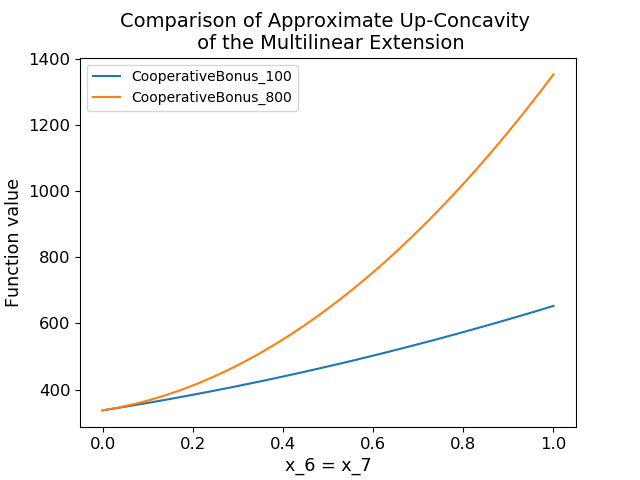 Figure 5
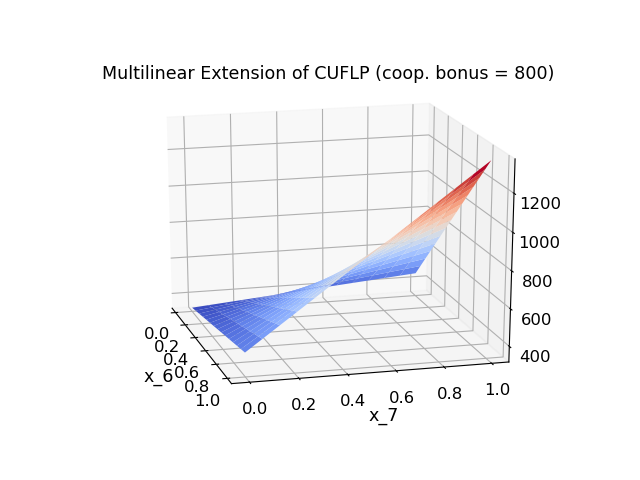 Figure 6
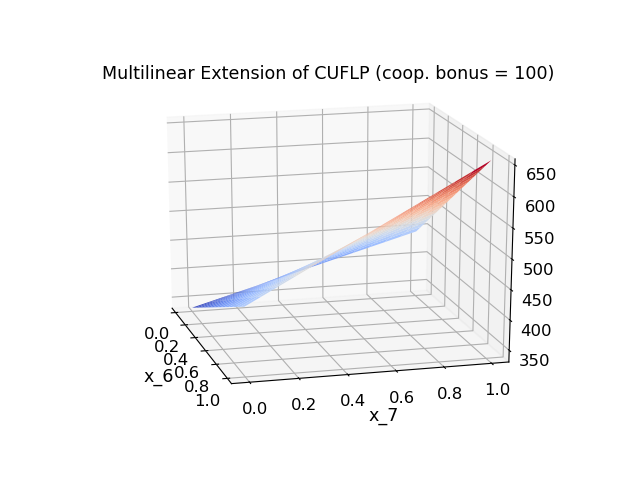 Figure 7
| Parameter | LB | UB | Set Value |
| .2 | .6 | ||
| 1 | 11 | ||
| 8.5 | 11.5 | ||
| 42 | 48 | ||
| 1.05 | 1.2 | ||
| 10 | |||
| 120 |
Peer Reviews
No public reviews on file for this paper yet. If you reviewed it on a platform where reviews are public (OpenReview, ICLR, NeurIPS, ICML), you can paste yours below so the community can read it here.
Videos
No videos yet. Explain this paper in a talk, walkthrough, or lecture? Add one.
Taxonomy
TopicsComplexity and Algorithms in Graphs · Computational Geometry and Mesh Generation · Smart Parking Systems Research
\AtAppendix\AtAppendix\AtAppendix\AtAppendix\AtAppendix\csvset
autobooktabularcenter/.style= file=#1, after head=\csv@pretable
\csv@tablehead, table head= \csvlinetotablerow
, late after line=
, table foot=
, late after last line=\csv@tablefoot \csv@posttable, command=\csvlinetotablerow,
A Note on the Implications of Approximate Submodularity in Discrete Optimization
Temitayo Ajayi
Nature Source Improved Plants
Taewoo Lee [email protected] Department of Industrial Engineering, University of Houston
Andrew J. Schaefer
Nature Source Improved Plants
Abstract
Submodularity is a key property in discrete optimization. Submodularity has been widely used for analyzing the greedy algorithm to give performance bounds and providing insight into the construction of valid inequalities for mixed-integer programs. In recent years, researchers started to study approximate submodularity, with a primary focus on providing performance bounds for iterative approaches. In this paper, we study approximate submodularity from a different perspective in order to broaden its use cases in discrete optimization. We define metrics that quantify approximate submodularity, which we then use to derive new properties about both approximate submodularity preservation and the well-known Lovász extension for set functions. We also show that previous analyses of mixed-integer sets, such as the submodular knapsack polytope, can be extended to the approximate submodularity setting. Our work demonstrates that one may generalize many of the analytical tools used in submodular optimization into the approximate submodularity context.
Keywords— Approximate submodularity, valid inequalities, set function extensions
1 Introduction
Exploiting structural properties in discrete optimization problems can lead to successful algorithms and heuristics. A classical property that is frequently used in discrete optimization is submodularity. Let be a finite set of elements, and let denote the power set of . A set function is submodular if for any and , . For some problems, submodularity provides guarantees for solution approaches such as the greedy algorithm. Recently, researchers have expanded algorithm analysis to approximately submodular functions (e.g., [11, 18, 29]). However, much of the initial focus on approximate submodularity has remained within performance guarantees for algorithms. In this paper, we propose approximate submodularity metrics to study multiple implications of approximate submodularity in discrete optimization, including the derivation of valid inequalities and properties of extensions on the unit hypercube. Our work applies to any nonnegative and monotonic set function, and our analyses often follow arguments similar to those of analogous results in the submodular context.
Continuous relaxations of problems are often used as direct approximation techniques for discrete optimization problems (e.g., solving the linear programming relaxation of a mixed-integer program) because they are easier to solve; these relaxations often have a polynomial-time algorithm. Extensions of set functions can transform discrete optimization problems into continuous optimization problems, for which efficient algorithms or approximation schemes may exist. An extension of a set function is a function such that and , for all , where denotes the characteristic vector of the set . We focus on extensions defined on the unit hypercube . Notably, the Lovász extension [23] for set functions is convex if and only if the set function is submodular; in this case, the Lovász extension is equal to the convex closure. The convex closure is difficult to compute in general; in contrast, computing the Lovász extension is comparatively simple, which makes submodularity a valuable property when considering solution methods that use the convex closure. We provide a new characterization that relates the approximate submodularity of a function with the approximate convexity of its Lovász extension.
Valid inequalities are crucial for solving mixed-integer programs as they can cut off solutions to relaxations so that the new problem’s feasible region more closely approximates the convex hull [8]. The knapsack problem is one of the foundational problems in discrete optimization where researchers have studied its facial structure and valid inequalities (e.g., [3, 6]). In particular, Atamtürk and Narayanan (2009) [3] study valid inequalities for the submodular knapsack polytope, in which the constraint function is submodular. Submodular functions feature in the constraints of other optimization problems as well. Researchers have also studied mixed-integer programs with conic-quadratic constraints and objective functions where valid inequalities are derived by leveraging the submodularity of the objective and constraint functions [2, 1, 13]. Valid inequalities and outer approximations of the epigraphs of submodular and general set functions have also been studied [4]. Our study is the first to use approximate submodularity to derive valid inequalities for mixed-integer sets defined by approximately submodular functions.
Previous studies on approximate submodularity focus on performance bounds for greedy algorithms and other iterative selection approaches. Performance bounds have been produced using different notions of approximate submodularity where metrics with different properties can produce different bounds; trade-offs between additive and multiplicative bounds for the greedy algorithm performance on non-submodular functions are studied in [18], and [11] and [29] also define metrics that they use to propose greedy algorithm performance bounds for approximately submodular functions. However, the notion of approximate submodularity can also be used for generalizing results in other areas of discrete optimization, such as analyzing properties of continuous extensions and deriving valid inequalities, which can provide new insights for efficient solution methods. New methodological applications are still emerging, even outside of the greedy algorithm, in which approximate submodularity can extend the existing results that depend on submodularity. Our contributions are as follows:
- •
In Section 2, we study fundamental properties about our approximate submodularity metrics, which we use to show which operations preserve approximate submodularity.
- •
In Section 3, we derive results on the approximate convexity of the Lovaśz extension of approximately submodular functions.
- •
We study mixed-integer sets defined by approximately submodular functions in Section 4. We use the proposed metrics to adapt analogous analyses for the submodular setting, thus deriving new valid inequalities for cases when the set function is approximately submodular.
We note that there are several cases in which our proofs are similar to those of analogous results in the submodular setting. Our primary message is that in a broad set of areas in discrete optimization, one can use approximate submodularity to generalize both classical and more recent results.
2 Approximate Submodularity Metrics
In this section, we discuss various approximate submodularity metrics; the term “metrics” is used loosely, as some are not subadditive and none are positive definite, both of which are part of the formal definition of a metric. However, the approximate submodularity metrics we discuss indicate a notion of distance to submodularity. In this work, if is an approximate submodularity metric, is the metric value for .
2.1 Proposed Notions of Approximate Submodularity
We begin with the most general (global) metric, which is inspired directly from an equivalent definition of submodularity: , for all .
Definition 1**.**
\thlabel
def:globalDistance Let . Define the global submodularity distance by
The global submodularity distance is a general purpose metric; we demonstrate its value in identifying operations that preserve approximate submodularity and proving general results about set functions (Section 2.2). The remaining metrics are inspired by a characterization of increasing, submodular functions.
Lemma 1**.**
\thlabel
def:Submod (Edmonds 1970 [12]) Let . Then is increasing and submodular if and only if for any , .
Using \threfdef:Submod, we present two metrics for approximate submodularity.
Definition 2**.**
\thlabel
def:pairwise_viol Let . Consider . The -pairwise violation* of is defined as *
Thus, the pairwise violation represents the worst-case violation of the condition in \threfdef:Submod given and with fixed cardinalities. In the context of a sensor placement problem, the -pairwise violation captures the case in which a single sensor added to a sparse sensor network (given by ) creates a smaller marginal increase in information than when the same sensor is added to a denser network (). Note that if is submodular, for all and , and the reverse implication holds with the added condition of being monotonic increasing. Also, for any , .
Definition 3**.**
\thlabel
def:marginalViolation Let . The marginal violation of is defined as D[f]\coloneqq\max\big{\{}d^{\ell,k}[f]\text{ }|\text{ }\ell\in\{0,\dots,|\Omega|-1\},k\in\{0,\dots,|\Omega|\}\big{\}}.
Note that , also used in [21], does not depend on set sizes. Although and may be difficult to compute exactly in general, Section 2.2 details some operations that preserve approximate submodularity, with respect to , which enables one to bound and . In addition, in Appendix B, we present a generalized version of the uncapacitated facility location problem in which the objective function is approximately submodular and can be bounded analytically.
2.2 Preserving Approximate Submodularity
We prove some properties of our proposed approximate submodularity metrics (\threfApproxSubmodSubadditive), as well as operations from which bounds or exact values of approximate submodularity metrics can be inferred immediately (\threfsubmodPreserve). The former compares properties of our approximate submodularity metrics to true metrics. The latter concept can be thought of as “approximate submodularity preservation.” Some of these results have analogs for submodular functions (for reference, see [5], [26], and [27]), but others are specific to approximate submodularity. We let (resp., ) be the set functions (resp., that are nonnegative and increasing) over ground set .
Theorem 1**.**
\thlabel
*ApproxSubmodSubadditive Consider a nonnegative, increasing set function and a metric of approximate submodularity where is defined by any of the following:
(I) ,
(II) , or
(III) .
Then we have:*
- (i)
*The function is sublinear. That is, is subadditive **i.e., and positively homogeneous with degree 1 *i.e., , for . 2. (ii)
If is not submodular, then for any , there does not exist a nonnegative, increasing, submodular function such that .
The contrapositive of Claim (ii) of \threfApproxSubmodSubadditive can be read as a necessary condition, which can, in some cases, remove the need for testing whether any function near is submodular (e.g., [28]). Although our notions of approximate submodularity are not “metrics” in the analytical sense, \threfApproxSubmodSubadditive proves that they are sublinear. Sublinear functions are well studied in the literature and are the “next simplest convex functions” after affine functions [17]. All metrics are sublinear. Subadditivity and positive homogeneity independently have multiple implications. They can be used to verify that a function (or , for ) satisfies conditions in hypotheses of results in Sections 3–4. We remark that subadditivity (and hence, sublinearity) is not a trivial property of approximate submodularity metrics in the literature; e.g., submodularity ratio proposed in Das and Kempe (2011) [11] is not subadditive.
We can relate our metrics to asymmetric seminorms, which share more properties with analytical metrics.
Definition 4**.**
\thlabel
def:asymSemiNorm (Cobzaş 2013 [7]) A function is an asymmetric seminorm if it is nonnegative, positively homogeneous, and subadditive.
Corollary 1**.**
\thlabel
induceASN Define by . Then is an asymmetric seminorm on .
We provide some examples in which functions induced by an approximately submodular function inherit approximate submodularity. Denote the complement of by . Given a normalized set function , define by ; thus, is a symmetric, nonnegative function. Given define by . Given a factor of , let , , for all , and be defined by . Finally, let be a modular function ( and are submodular), and define the convolution of and as . Note .
Proposition 1**.**
\thlabel
*submodPreserve Given and the corresponding functions and , we have:
(i) .
(ii) .
(iii) (iv) .
(v) .
\thref
submodPreserve can be used in a fashion similar to \threfApproxSubmodSubadditive. Also, \threfsubmodPreserve(iv) can provide guarantees on a greedy algorithm that selects among prescribed subsets of elements. Our proof for \threfsubmodPreserve(v) follows similar arguments to that of the submodular case [26]. Note that we slightly abuse notation in \threfsubmodPreserve(iii)–(iv) as the domains of and are not .
3 Extensions of Approximately Submodular Functions
Next, we study extensions of approximately submodular functions. For the remainder of this paper, we consider functions that are monotone increasing and normalized () and focus on analysis based on the marginal violation because we consider problems of this form, namely the approximately submodular knapsack and packing problems and the generalized uncapaciated facility location problem, in Section 4 and Appendix B, respectively. Other examples for monotone submodular optimization can be found in [22], which may have relevant approximately submodular analogs. Given a set function , an extension of over is a function such that , for all , where is the characteristic vector of . Our main result in this section is that the Lovász extension is approximately convex (\threfLovaszApprox) when the underlying set function is approximately submodular. A main component of multiple key results in this section is the marginal violation (\threfdef:marginalViolation). Other works on extensions of set functions include [19], [23], and [25].
The Lovász extension of a set function is defined by such that , where is a chain such that , with , and . It is well known that by defining a permutation such that , , for , the Lovász extension is equivalently defined as (see [5]). The convex closure of is the unique convex function such that for all and for any other convex understimator of . Lovász (1983) [23] shows that is submodular if and only if is convex; in fact, in this special case, the convex closure and the Lovász extension are equal (). This property is useful in that the convex closure is generally difficult to compute in comparison to the Lovász extension. Although the Lovász extension does not equal the convex closure when is not submodular, we prove a generalized result when is approximately submodular. We remark that Halabi and Jegelka (2019) [15] also study the Lovász extension of non-submodular functions, including its subgradients, in the context of convex optimization solution approaches.
Consider the following linear program parametrized by :
[TABLE]
Proposition 1**.**
(Bach 2013 [5])\thlabelconvexClosureLP For with , we have , for all .
Given a permutation , define . Define the set
Definition 5**.**
A function is -approximately convex, if , for any .
Theorem 2**.**
\thlabel
LovaszApprox For any increasing set function such that ,
[TABLE]
Hence, , and . Moreover, is -approximately convex. In addition, if for some , is -approximately convex, then .
\thref
LovaszApprox states that the approximate submodularity of implies the approximate convexity of and vice-versa. The proof of \threfLovaszApprox uses the well-known linear program (1), but a key difference is that we construct feasible primal-dual solutions with a duality gap due to the generalization to approximate submodularity.
Next, we consider the case in which there exists a submodular function close to . In this case, we show that the Lovász extension of approximates the Lovász extension of .
Proposition 2**.**
\thlabel
SubmodToConvexLovasz Given set functions , where , and their respective Lovász extensions , .
Thus, the approximating function (which may be submodular) can lead to approximation methods in the discrete domain or over the hypercube using convex optimization methods.
4 Valid Inequalities of Polyhedra Associated With Approximately Submodular Functions
We use approximate submodularity metrics from Section 2.1 to derive valid inequalities for some mixed-integer sets. Our analyses are similar to analogs in submodular analysis [2, 3, 4] with additional details to generalize to approximate submodularity.
4.1 Epigraph Inequalities
First, we study the epigraphs of set functions. These mixed-integer sets can be useful when minimizing a submodular function [1]. We consider the case when the function is approximately submodular. Let be increasing, and for any , let be defined by , where . Thus, is increasing. Consider the mixed-integer feasible region where and . Define the set function by . Notice that is increasing and if and only if . Therefore, define by , which is normalized, , and is increasing; hence, it is also nonnegative. Note that . We denote the Lovász extension of by .
For any —i.e., for some permutation of —consider the following inequality:
[TABLE]
When is the square root function, then is a submodular set function, and Atamtürk and Narayanan (2008) [2] show that inequality (2) is valid for the convex hull for . In fact, along with the variable bounds, such inequalities describe . In the more general case, where is such that is approximately submodular, we show that similar inequalities are still valid for .
Lemma 1**.**
\thlabel
generalInequality For any we have .
Proposition 1**.**
\thlabel
validEpigraphBinary For any , the following inequality is valid for :
[TABLE]
\thref
validEpigraphBinary illustrates what is lost between submodularity and approximate submodularity in deriving valid inequalities in this setting. When and are approximately submodular, may lead to looser valid inequalities. Our proof of \threfvalidEpigraphBinary follows arguments similar to those of Atamtürk and Narayanan (2008) [2], who establish the result when is the square root function.
Next, we consider the epigraph of a general, increasing, nonnegative, approximately submodular function , . Consider the associated polyhedron . We refer to the variable bounds as trivial inequalities of .
Proposition 2**.**
(Atamtürk and Narayanan 2020 [4])\thlabelatamturkOuter
Any nontrivial facet-defining inequality for satisfies and (up to scaling). 2. 2.
The inequality is valid for if and only if . 3. 3.
The inequality is facet-defining for if and only if is an extreme point of .
Atamtürk and Narayanan (2020) [4] prove that nontrivial facets of are homogeneous. We establish a similar result for approximately submodular functions.
Proposition 3**.**
\thlabel
polarIneq Let be increasing with . Suppose and
[TABLE]
defines a nontrivial facet of . Let be defined by , for all nonempty , and suppose . Then, .
The proof of \threfpolarIneq proceeds similarly to that of the submodular case in [4], with some additional steps to account for the approximate submodularity generalization. This includes bounding using the marginal violation . Given the conditions in the hypothesis of \threfpolarIneq, the constant term is bounded below by 0 and above by ; when is submodular, the condition is implied, , and the nontrivial facets are homogeneous. We also remark that Atamtürk and Narayanan (2020) [4] provide valid inequalties for general set functions, but these rely on a submodular-supermodular decomposition of .
4.2 Knapsack Inequalities
Consider the polytope , where is the subset of characterized by the binary vector and is a set function. When is submodular, nonnegative, and increasing, is known as the submodular knapsack polytope [3]; a special case is the well-known linear knapsack set, and optimizing over it is NP-hard [20]. We consider the case where is approximately submodular, nonnegative and increasing. Thus, we call the set an approximately submodular knapsack set. Our focus in this subsection is on deriving valid inequalities for this set. Some facets for 0-1 polytopes established by Atamtürk and Narayanan (2009) [3] apply in our setting; we list them in \threfthm:easyInequalities in the appendix.
Definition 6**.**
\thlabel
*def:Covers *
The subset is a cover for if and is minimal if for all . 2. 2.
Let be a permutation of . Let . The set-extension of with respect to is denoted by .
\thref
Atamturk09ExtendedV2 extends the result of Proposition 5 in Atamtürk and Narayanan (2009) [3] for submodular knapsack problems into the approximately submodular context.
Proposition 4**.**
\thlabel
Atamturk09ExtendedV2 If is a cover for , the extended cover inequality is valid for if . In addition, the inequality defines a facet of if is also a minimal cover and for each , there exist such that , and .
We observe from \threfAtamturk09ExtendedV2 that in adapting the result for approximate submodularity, we add a condition for the extended cover inequality to be valid. The proof follows similar steps as those in Atamtürk and Narayanan (2009) [3], except it accounts for violated submodularity inequalities.
4.3 Illustrative Example
In this section we provide an example in which we derive valid inequalities for the approximately submodular knapsack polytope. We apply the derived valid inequalities (\threfAtamturk09ExtendedV2) and show that they can be used as a tool in the process of finding integer solutions when optimizing a linear function over the polytope.
Let be a set of elements, , . Let and , where and if and [math] otherwise. Define and by and . Because , is convex and increasing. Also, is a linear function, so is convex and is supermodular. Moreover, is increasing and nonnegative but not submodular.
Proposition 5**.**
\thlabel
knapsackFunctionBound We have .
\thref
knapsackFunctionBound gives a bound on that can remove the need to compute directly, which helps verify whether \threfAtamturk09ExtendedV2 applies to inequalities of the form for some .
We provide an example instance in which we optimize a linear function over the integer hull of the approximately submodular knapsack polytope. In particular, we show that by adding our valid inequalities, it is possible to obtain an integral solution from the continuous relaxation. Let , , and define and as stated above. Also let . Define the following instance of an approximately submodular knapsack problem (ASK) written as a binary program:
[TABLE]
The continuous relaxation of (ASK) was solved using Gurobi 9.1.1 [14] through the Gurobipy python interface (Python version 3.6.8) using a piecewise approximation of the nonlinear function with maximum absolute error of .001, with an optimal solution of and objective value . Observe that is a (minimal) cover. Consider the permutation of . Then and , for all . Hence, and . By \threfknapsackFunctionBound, , which implies thus, \threfAtamturk09ExtendedV2 implies is a valid inequality for (ASK). Solving the relaxation of (ASK) with this valid inequality yields an optimal solution of with an objective value of . Thus, this solution is optimal for (ASK).
In general, does not hold, so not every extended cover inequality is valid.
4.4 Randomly Generated Instances
We further explore the utility of the valid inequalities presented in \threfAtamturk09ExtendedV2 by solving 40 randomly generated instances with and without a selection of these valid inequalities. The instances are larger versions of the example instance illustrated in Section 4.3; each instance contains approximately submodular knapsack constraints, and we refer to this problem as an approximately submodular packing problem. Table 4.1 shows the lower and upper bounds of the uniform distributions of the parameters of the problem instances.
Because there were decision variables, it was not practical to examine all possible valid inequalities for each instance. Instead, for each knapsack constraint, we generated 90 sets of where and searched for valid inequalities based on these sets. In particular, for five repetitions, we randomly selected a subset where and determined if an extended cover valid inequality could be generated. To aid the search for valid inequalities near the best feasible solutions, the probability that variable was added to set was given by . All generated inequalities were added to the formulation before the start of the solve. We note that optimizing the inequality generation process is outside the scope of this study; thus, we do not include the generation time in our results and leave this subject to future research. All problems were solved using Gurobi 9.1.1 [14] through the Gurobipy Python interface (Python version 3.6.8) on a Linux machine with a 20-core 2.4 GHz processor and 256 GB memory.
Overall, we observe that the extended cover valid inequalities improve the solution time for most of the instances (see Figure 1). The cumulative time to solve all of the instances with the extended cover inequalities was less than half that without the additional inequalities. Table C in the appendix provides the solution times and the number of added inequalities for each instance.
5 Conclusion
The value of submodularity in discrete optimization has long been established. Recently, notions of approximate submodularity have been applied to the greedy algorithm and similar approaches. We introduce new approximate submodularity metrics that have broad applicability in discrete optimization. We derive fundamental properties about our metrics, including which set function operations preserve approximate submodularity. We establish connections between our notions of approximate submodularity and the approximate convexity of the Lovász extension. Our approximate submodularity metrics can directly extend analyses in areas such as valid inequality derivations. Our numerical results show that valid inequalities derived based on the proposed metrics reduce solution times for approximately submodular packing problems in general. Optimizing the generation of valid inequalities for these problems and comparing their performances to prior works remains our future work.
Data availability statement
The implementable instances used in this study are available at: https://bitbucket.org/tayoajayi/approxsubmodinstances2021/src/main/.
Acknowledgements
The authors would like to thank the anonymous referees and associate editor, Seth Brown, David Mildebrath, Logan Smith, and Silviya Valeva of Rice University for their helpful comments. This research was funded by National Science Foundation grants CMMI-1826297 and CMMI-1826323.
Appendix A Omitted Proofs
\thnameref
ApproxSubmodSubadditive LABEL:ApproxSubmodSubadditive.* Consider a nonnegative, increasing set function and a metric of approximate submodularity where is defined by any of the following:
(I) ,
(II) , or
(III) .
Then we have:*
- (i)
*The function is sublinear. That is, is subadditive **i.e., and positively homogeneous with degree 1 *i.e., , for . 2. (ii)
If is not submodular, then for any , there does not exist a nonnegative, increasing, submodular function such that .
**Proof: ** For both claims, we prove case (III); proofs for other cases are similar. Let be increasing set functions for .
Consider Observe that
[TABLE]
which proves subadditivity.
Let (\mathcal{A}^{*},\mathcal{B}^{*},s^{*})\in\arg\max\limits_{\begin{subarray}{c}\mathcal{A},\mathcal{B}\subseteq\Omega,s\in\Omega\\ |\mathcal{A}|=\ell,|\mathcal{B}|=k\end{subarray}}\Big{(}f(\mathcal{A}\cup\mathcal{B}\cup\{s\})-f(\mathcal{A}\cup\mathcal{B})-f(\mathcal{A}\cup\{s\})+f(\mathcal{A})\Big{)}. Then, for any , we have (\mathcal{A}^{*},\mathcal{B}^{*},s^{*})\in\arg\max\limits_{\begin{subarray}{c}\mathcal{A},\mathcal{B}\subseteq\Omega,s\in\Omega\\ |\mathcal{A}|=\ell,|\mathcal{B}|=k\end{subarray}}\Big{(}\alpha f(\mathcal{A}\cup\mathcal{B}\cup\{s\})-\alpha f(\mathcal{A}\cup\mathcal{B})-\alpha f(\mathcal{A}\cup\{s\})+\alpha f(\mathcal{A})\Big{)}, which implies , which proves positive homogeneity.
Now suppose , for some . Let be any nonnegative, increasing set function such that . Consider (\mathcal{A}^{*},\mathcal{B}^{*},s^{*})\in\arg\max\limits_{\begin{subarray}{c}\mathcal{A},\mathcal{B}\subseteq\Omega,s\in\Omega\\ |\mathcal{A}|=\ell,|\mathcal{B}|=k\end{subarray}}\Big{(}f(\mathcal{A}\cup\mathcal{B}\cup\{s\})-f(\mathcal{A}\cup\mathcal{B})-f(\mathcal{A}\cup\{s\})+f(\mathcal{A})\Big{)}, we have
[TABLE]
which implies is not submodular.
\thnameref
induceASN LABEL:induceASN.* Define by . Then is an asymmetric seminorm on .*
**Proof: **Let . Observe that , by \threfApproxSubmodSubadditive. If , then . Otherwise, . We have , , which imply , thus proving subadditivity.
Suppose is such that . By \threfApproxSubmodSubadditive, for any . If , then By similar arguments to those of \threfApproxSubmodSubadditive, ; hence satisfies positive homogeneity. Clearly, is nonnegative, which concludes the proof.
Lemma 1**.**
(Narayanan 1997 [26])* \thlabelmodularSetProperty For any modular set function and with and , we have .*
\thnameref
submodPreserve LABEL:submodPreserve.* Given and the corresponding functions and , we have:
(i) . (ii) . (iii) (iv) . (v) . *
Proof: (i): For any , by de Morgan’s laws, and , from which the result immediately follows.
(ii): Define where . Because is a constant, by (i), . Thus, by \threfApproxSubmodSubadditive, .
(iii): Let . Then and are subsets of . Hence, .
(iv): Consider . We have
(v) This proof is similar to that of [26]. Let where and . It is not hard to show that and .
By \threfmodularSetProperty,
By the definition of and ,
[TABLE]
Hence, .
Lemma 2**.**
(Bach 2013 [5])\thlabelLovaszHomogeneous Given a set function , its Lovász extension is positively homogeneous of degree 1.
Lemma 3**.**
\thlabel
subtractOffSet Suppose , where , , and for any . If there exists a permutation of such that and , then .
**Proof: **Let be the ranking permutation in the hypothesis, and note that it is also a ranking permutation of ; i.e., . We have , and , implying that where we have used the positive homogeneity of (\threfLovaszHomogeneous).
Lemma 4**.**
\thlabel
inductionGreaterThan Let be increasing with , and let . For any , .
**Proof: **Consider a permutation such that and set . We prove by induction on that for all . The base case is confirmed as . Assume for all with , , and let . Set . Then and . Observe that by the definition of ,
[TABLE]
where the last line uses the induction hypothesis.
\thnameref
LovaszApprox LABEL:LovaszApprox.* For any increasing set function such that ,*
[TABLE]
Hence, , and . Moreover, is -approximately convex.
In addition, if for some , is -approximately convex, then .
**Proof: **The following proof uses a version of well-known linear programming duality arguments (e.g., [23]). We first suppose is not submodular (hence ).
Given there exists a permutation such that . Let . Consider the dual of (1):
[TABLE]
Define by equals , , and 0 otherwise.
We first show is feasible for (1). Observe that . In addition, for any for some hence, . Moreover, it is easy to observe that is nonnegative. Hence, is feasible for (1), and .
Consider such that . Then . By \threfinductionGreaterThan, is feasible for (5).
Therefore, This also implies that and .
To show that is approximately convex, consider , then we have
[TABLE]
For the last statement, suppose is -approximately convex. For any , denote the symmetric difference as \mathcal{A}\mathbin{\mathchoice{\ooalign{\vbox{\hbox{}}\displaystyle-\cr}}{\ooalign{\vbox{\hbox{}}\textstyle-\cr}}{\ooalign{\vbox{\hbox{}}\scriptstyle-\cr}}{\ooalign{\vbox{\hbox{}}\scriptscriptstyle-\cr}}}\mathcal{B}=(\mathcal{A}\backslash\mathcal{B})\cup(\mathcal{B}\backslash\mathcal{A}). Consider any , then we have
[TABLE]
where the last line uses the fact that the Lovász extension is positively homogeneous \threfLovaszHomogeneous and \threfsubtractOffSet.
Suppose is submodular. Then, and (e.g., see [23, 5]). A similar linear programming duality argument (with replaced with 0) proves that
\thnameref
SubmodToConvexLovasz LABEL:SubmodToConvexLovasz.* Given set functions , where , and their respective Lovász extensions , .*
**Proof: **Let and a permutation of such that and set . Then and similarly for . Hence,
[TABLE]
Hence, . Moreover, for some , which implies
\thnameref
generalInequality LABEL:generalInequality.* For any we have .*
**Proof: **Recall that and . By \threfLovaszApprox,
\thnameref
validEpigraphBinary LABEL:validEpigraphBinary.* For any , the following inequality is valid for :*
[TABLE]
**Proof: **This proof follows arguments similar to that of [2]. Consider , which implies , for some . From \threfgeneralInequality, . Because , which implies
\thnameref
polarIneq LABEL:polarIneq.* Let be increasing with . Suppose and*
[TABLE]
defines a nontrivial facet of . Let be defined by , for all nonempty , and suppose . Then, .
**Proof: **This proof follows steps similar to that of [4], with additional arguments to account for approximate submodularity. Suppose . Because (7) is a valid inequality for , for any non-empty and . Thus, , and by \threfatamturkOuter, (8) is valid for :
[TABLE]
We show that (8) is facet-defining for . Observe that the solutions are affinely independent solutions, so the dimension of is . By the hypothesis, is facet-defining for . Thus, there exist affinely independent solutions such that and . By Carathéodory’s theorem, each of the affinely independent solutions can be represented by a convex combination of (integral) extreme points of : , where , and is an integral extreme point of , for all . Consider for some and . Suppose that ; because , . Thus, . If instead then for some nonempty . Notice that by , , so . Hence, ; moreover, .
Suppose that the points are not affinely independent. Then there exists such that and . Let be such that ; without loss of generality, let . Thus, Because , ; thus,
[TABLE]
which contradicts the affine independence of , so are affinely independent. Also, , for each , which implies (8) is facet-defining for .
By \threfatamturkOuter, is an extreme point of , and by the hypothesis, there exists a permutation such that , for all . Define by , otherwise. Thus, and . Because , is increasing, so that by \threfinductionGreaterThan, . Hence, if , then . By \threfatamturkOuter, we have is valid for , which implies is also valid for . Because , we also have the valid inequality .
Combining these last two inequalities implies thus the facet-defining inequality (7) is dominated, a contradiction.
Proposition 1**.**
\thlabel
XFullDimensional If for all , then is full-dimensional.
**Proof: **By the hypothesis, the zero vector and are feasible for each . Hence there are affinely independent points in , implying the dimension of is .
Proposition 2**.**
\thlabel
thm:easyInequalities(Hammer et al. 1975 [16], Atamtürk and Narayanan 2009 [3])**
The inequality is facet-defining for , for all . 2. 2.
The inequality is facet-defining for if and only if for all .
\thnameref
Atamturk09ExtendedV2 LABEL:Atamturk09ExtendedV2.* If is a cover for , the extended cover inequality is valid for if . In addition, the inequality defines a facet of if is also a minimal cover and for each , there exist such that , and .*
**Proof: **This proof uses steps similar to those in [3], who establish the submodular case. We show that if with , then . Because is the convex hull of characteristic vectors, it suffices to consider such characteristic vectors. That is , where and there exists such that with . In this case, . Let , and , with indexing consistent with .
Observe that and . Hence,
Given , let . Then ; it follows from the definition of that
[TABLE]
Therefore,
[TABLE]
By the definition of for all , Because and , ; thus, . This implies that
[TABLE]
By the definition of , By the monotonicity of , , for all . Also, and . Thus, which follows from the hypothesis. It follows that .
To prove the facet claim, observe that each of the points for all and , for all , are affinely independent points in , and the valid inequality holds with equality for these points. Thus, the valid inequality defines a facet of .
\thnameref
knapsackFunctionBound LABEL:knapsackFunctionBound.* We have .*
**Proof: **Let Let , . Suppose that . Then .
Next, suppose . Observe that is Lipschitz continuous on , the codomain of : for any , we have Hence, Also, . Hence, , so .
Appendix B Example of Bounds on the Marginal Violation: The Cooperative Uncapacitated Facility Location Problem
We present a generalization of the well-known uncapacitated facility location problem (see [24] for a detailed overview). We choose uncapacitated facility location as a demonstrative example because of its historical importance (e.g., [9]). In this generalized facility location problem that we consider, the objective function is not submodular in general. We show that the marginal violation metric (\threfdef:marginalViolation) can be bounded analytically by exploiting the problem structure and that the objective function’s proximity to submodularity is influenced by certain problem parameters.
The objective function of the uncapacitated facility location problem (UFLP) provides an example of a submodular function. An instance of UFLP is defined by facility locations (, clients, demands , fixed costs , and facility-client revenues . We consider instances in which is nonnegative. Additionally, we assume that so that the firm only assigns facilities to clients based on the variable revenue. We note that [9] consider similar conditions. Let be the objective function of the UFLP with cardinality parameter
[TABLE]
Here, is a subset of facility locations. Under these conditions, is nonnegative, increasing, and submodular. We consider a generalization of UFLP where the objective function is approximately submodular function. Let for any . We introduce a nonnegative reward associated with the simultaneous selection of facilities and , where . We assume that for all . Define as the objective function of the cooperative uncapacitated facility location problem (CUFLP) with maximum cardinality parameter .
[TABLE]
Remark 1**.**
\thlabel
CUFLP_NPhard It is well known that UFLP is NP-hard [10]; thus, CUFLP (which includes UFLP as a special case) is also NP-hard. In addition, the objective function of CUFLP, is not submodular in general.
Example 1**.**
\thlabel
example:CUFLPNotSubmod To illustrate the second statement of \threfCUFLP_NPhard, consider an instance of the cooperative uncapacitated facility location problem in which , and , for , , and otherwise. The fixed costs are zero so is increasing. Consider and . Then, By \threfdef:Submod, is not submodular.
Let .
Proposition 1**.**
\thlabel
nearSubmodFLP Given an instance of CUFLP, we have for all Hence, .
Proof.
Because is nonnegative, for all . Further, Let , where and .
[TABLE]
It follows that The bound for follows immediately. ∎
\thref
nearSubmodFLP is an example of how one can use the structure of the approximately submodular function in order to derive bounds for the metrics. This allows one to use these bounds immediately as a substitute for the exact value of the metric and avoid exact computation.
Appendix C Solution Times for Randomly Generated Approximately Submodular Packing Problem Instances
Table C shows solution times for the approximately submodular packing problem instances with and without the addition of the proposed valid inequalities.
**Time w/o Ineqs (s) Time w/ Ineqs (s) Time Ratio # of Inequalities Added
Table C.1: Solution times for randomly generated approximately submodular packing problems.**
The reference list from the paper itself. Each links out to its DOI / PubMed record.
- 1[1] A. Atamtürk and A. Gómez. Submodularity in conic quadratic mixed 0-1 optimization. Operations Research , 68(2):609–630, 2020.
- 2[2] A. Atamtürk and V. Narayanan. Polymatroids and mean-risk minimization in discrete optimization. Operations Research Letters , 36(5):618–622, 2008.
- 3[3] A. Atamtürk and V. Narayanan. The submodular knapsack polytope. Discrete Optimization , 6(4):333–344, 2009.
- 4[4] A. Atamtürk and V. Narayanan. Submodular function minimization and polarity. Mathematical Programming Series B , 2021.
- 5[5] F. Bach. Learning with Submodular Functions: A Convex Optimization Perspective . Now Publishers Inc., Hanover, MA, USA, 2013.
- 6[6] E. Balas. Facets of the knapsack polytope. Mathematical Programming , 8:146–164, 1975.
- 7[7] Ş. Cobzaş. Functional Analysis in Asymmetric Normed Spaces . Birkhäuser, Basel, Basel, 2013.
- 8[8] G. Cornuéjols. Valid inequalities for mixed integer linear programs. Mathematical Programming , 112:3–44, 2008.