Generalized Alignment Chain: Improved Converse Results for Index Coding
Yucheng Liu, Parastoo Sadeghi

TL;DR
This paper introduces a generalized alignment chain for index coding, leading to tighter converse bounds that outperform existing bounds like MAIS, especially for large problems, and extends these results to multi-server scenarios.
Contribution
It generalizes the alignment chain concept to derive improved converse bounds for index coding, applicable to single and multi-server cases, and identifies instances requiring non-Shannon inequalities.
Findings
New bounds are always as tight as MAIS and can outperform it.
The bounds are computationally practical for large problems.
Identifies smaller instances where non-Shannon inequalities are necessary.
Abstract
In this paper, we study the information-theoretic converse for the index coding problem. We generalize the definition for the alignment chain, introduced by Maleki et al., to capture more flexible relations among interfering messages at each receiver. Based on this, we derive improved converse results for the single-server index coding problem. Compared to the maximum acyclic induced subgraph (MAIS) bound, the new bounds are always as tight and can strictly outperform the MAIS bound. They can also be useful for large problems, where the generally tighter polymatroidal bound is computationally impractical. We then extend these new bounds to the multi-server index coding problem. We also present a separate, but related result where we identify a smaller single-server index coding instance, compared to those identified in the literature, for which non-Shannon-type inequalities are…
Click any figure to enlarge with its caption.
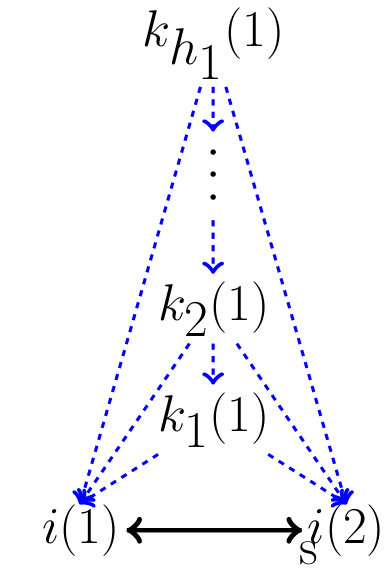 Figure 1
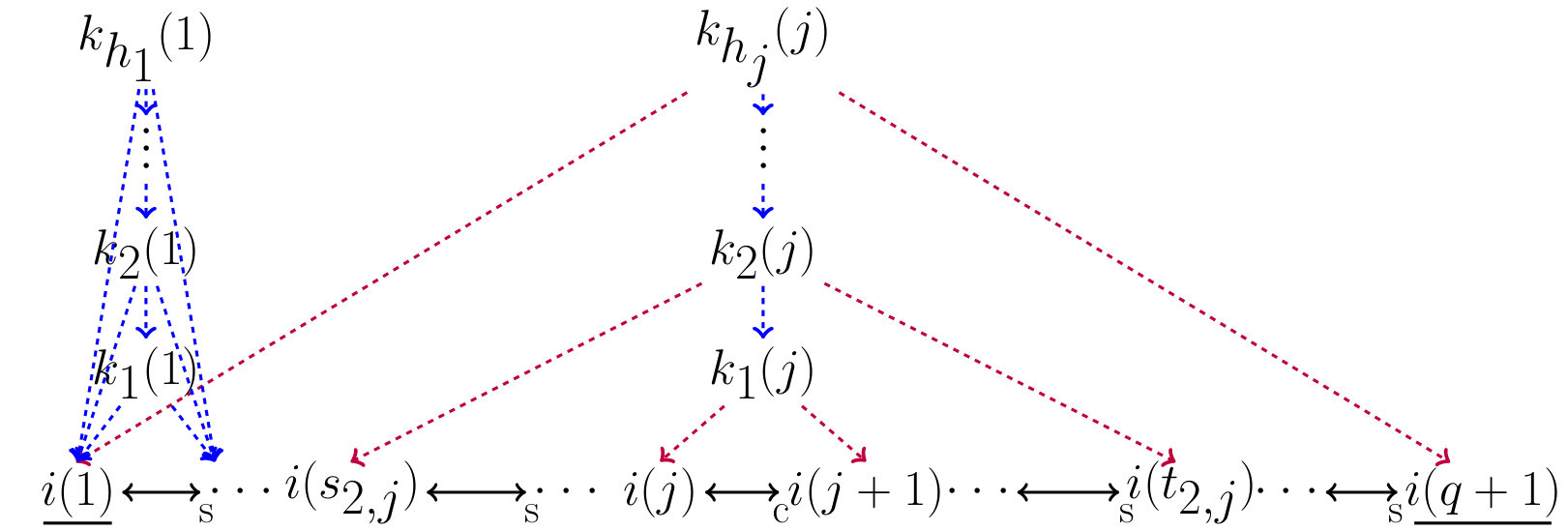 Figure 2
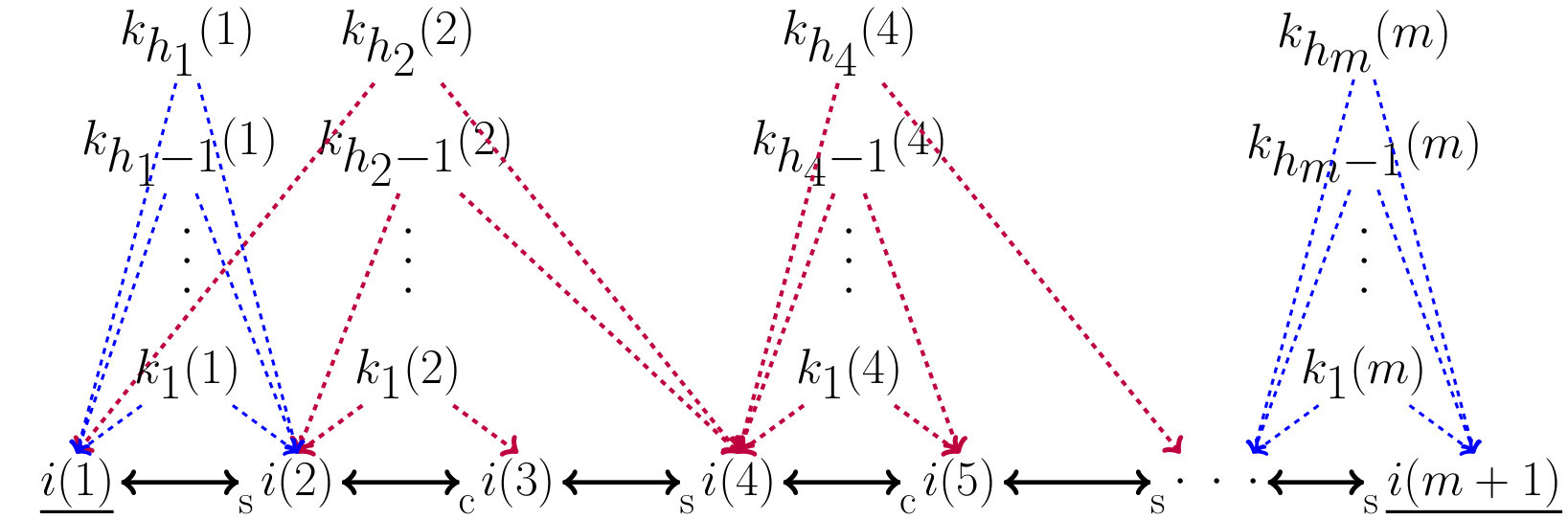 Figure 3
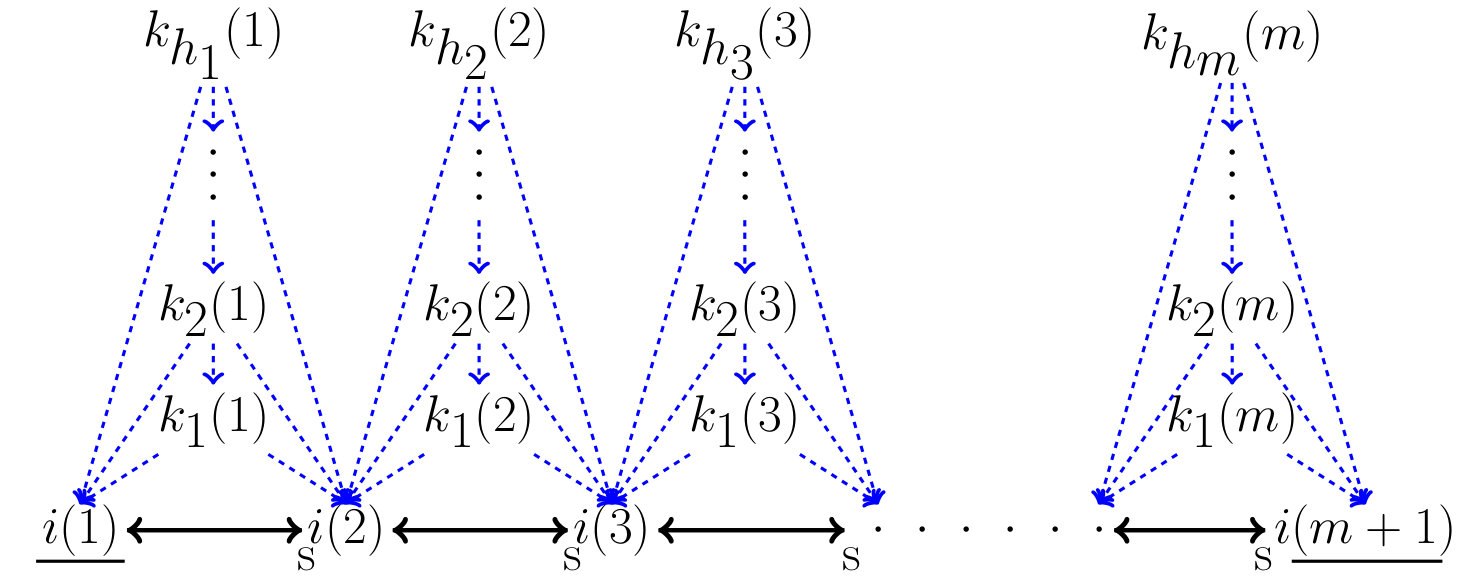 Figure 4
Peer Reviews
No public reviews on file for this paper yet. If you reviewed it on a platform where reviews are public (OpenReview, ICLR, NeurIPS, ICML), you can paste yours below so the community can read it here.
Videos
No videos yet. Explain this paper in a talk, walkthrough, or lecture? Add one.
Taxonomy
TopicsCooperative Communication and Network Coding · Wireless Communication Security Techniques · Advanced MIMO Systems Optimization
Generalized Alignment Chain: Improved Converse Results for Index Coding
Yucheng Liu and Parastoo Sadeghi
Research School of Electrical
Energy and Materials Engineering
Australian National University
Canberra
ACT
2601
Australia
Emails: {yucheng.liu
parastoo.sadeghi}@anu.edu.au
Abstract
In this paper, we study the information-theoretic converse for the index coding problem. We generalize the definition for the alignment chain, introduced by Maleki et al., to capture more flexible relations among interfering messages at each receiver. Based on this, we derive improved converse results for the single-server index coding problem. Compared to the maximum acyclic induced subgraph (MAIS) bound, the new bounds are always as tight and can strictly outperform the MAIS bound. They can also be useful for large problems, where the generally tighter polymatroidal bound is computationally impractical. We then extend these new bounds to the multi-server index coding problem. We also present a separate, but related result where we identify a smaller single-server index coding instance, compared to those identified in the literature, for which non-Shannon-type inequalities are necessary to give a tighter converse.
I Introduction
Index coding, introduced by Birk and Kol in [1], investigates the broadcast rate of messages from a server to multiple receivers with side information. Despite the substantial progress achieved during the past two decades, the index coding problem remains open in general. See [2] and the references therein.
In contrast to the single-server centralized index coding (CIC) problem, in the more general distributed index coding (DIC) problem, different subsets of the messages are stored at multiple servers. Such communication model has clear applications for practical circumstances where the information is geographically distributed over multiple locations. See [3, 4, 5] and the references therein.
In this paper, we study the information-theoretic converse for both CIC and DIC problems. For the CIC problem, the maximum acyclic induced subgraph (MAIS) bound was proposed in [6], and the polymatroidal (PM) bound was presented in [7, 8]. Both bounds have been extended to the DIC problem [4, 5]. The PM bound is generally tighter than the MAIS bound. However, it has a much higher computational complexity, which can be forbidding for large problems.
Therefore, it is of interest to find bounds that are strictly tighter than the MAIS bound, and at the same time, not as computationally intensive as the PM bound. The internal conflict bound for the CIC problem, introduced in [9, 10] based on the alignment chain model, can sometimes be useful. However, it does not subsume the MAIS bound in general.
In this paper, we first generalize the internal conflict bound for the CIC problem by extending the alignment chain model. We prove that the new converse results are no looser than the internal conflict bound and the MAIS bound. We show by examples that they can sometimes be strictly tighter. We then generalize these results to the DIC problem. We also present a separate result. That is, we identify a smaller CIC problem in terms of the number of messages, compared to those previously identified in [11],[2, Section 5.3], where Shannon-type inequalities are insufficient to give a tight converse.
Notation: For non-negative integers and , denotes the set , and denotes the set . If , . For a set , denotes its cardinality.
II System Model
Assume that there are messages, , where is the length of binary message . For brevity, when we say message , we mean message . Let be the random variable corresponding to . We assume that are independent and uniformly distributed. For any , set , , and . By convention, .
There are receivers, where receiver wishes to obtain and knows as side information for some . The set of indices of interfering messages at receiver is denoted by the set .
To avoid redundancy, we describe the remaining system model for the DIC problem only, in which there are servers, each containing a unique nonempty subset of the messages. The server indexed by contains messages , where . Every server is connected to all receivers via its own noiseless broadcast channel with finite link capacity . Clearly, the CIC problem is a special case of the DIC problem with (normalized) and otherwise. Let be the output of server to be broadcast, which is a function of , and be the corresponding random variable. For any set , set , and . By convention, .
For any DIC problem, we define a distributed index code by
encoders, one for each server , such that maps the messages in server to an -bit sequence , and
decoders, one for each receiver , such that maps the received sequences and the side information to .
We say that a rate–capacity tuple is achievable if for every , there exist a code and a positive integer such that , , , and that .
For a given link capacity tuple , the capacity region is the closure of the set of all rate tuples such that is achievable. The symmetric capacity is defined as The centralized index code, the achievable rate tuple , the capacity region , and the symmetric capacity can be defined accordingly.
Any CIC or DIC problem can be represented by a sequence , . For example, for , , and , we write . It can also be represented by a side information graph with vertices, in which vertex represents message , and a directed edge means that . For any nonempty message subset , denotes the subgraph of induced by . If is acyclic, we simply say that the message group forms an acyclic structure or that is acyclic.
III Preliminaries
We briefly review the MAIS bound [6] and the internal conflict bound [9, 10].
Proposition 1** (MAIS bound, [6])**
For the CIC problem , , if is achievable, then
[TABLE]
For the internal conflict bound, we first re-state the definition of the alignment chain [9] in our notation as follows.
Definition 1** (Alignment Chain,[9])**
*For the CIC problem , , messages and constitute an alignment chain of length denoted as
if the conditions listed below are satisfied:*
* or ;* 2. 2.
for any , we have .
For any alignment chain or any weighted alignment chain to be proposed later, we call the edge between and edge . In Definition 1, the two terminals and are underlined to indicate that is acyclic. Note that Definition 1 does not depend on the server setup, and thus also works for the DIC problem.
For a CIC or DIC problem, if there exits at least one alignment chain, then we say that there is an internal conflict between the two terminal messages and of the alignment chain and that the problem is internally conflicted. The symmetric capacity for the CIC problems that are not internally conflicted is known [2, 9, 12]. For the internally conflicted CIC problems the following bound holds.
Proposition 2** (Internal conflict bound,[9, 10])**
For the internally conflicted CIC problem , , if is achievable, then , where denotes the minimum length of alignment chains for the problem.
In the rest of this paper, whenever we say a CIC or a DIC problem, we assume that the problem is internally conflicted.
IV Main Results
IV-A Improved Necessary Conditions for CIC
We start by introducing a simple structure which will play a crucial role as the basic building block in the generalized alignment chains to be developed henceforth.
Definition 2** (Basic Tower)**
For the CIC problem , , messages and constitute the following basic tower ,
[TABLE]
if for any .
A visualization of the above definition is given in Figure 1. In the basic tower , messages and are placed horizontally at the ground level of the tower, and message is placed on the -th floor for any , where is called the height or the weight of the tower. The receiver who wants message on the -th floor cannot know any of the -labeled messages on the lower floors nor the two -labeled messages at the ground level as its side information. As a result, the message groups and are acyclic.
Now we propose the first generalization of the alignment chain, namely, the singleton weighted alignment chain.
Definition 3** (Singleton Weighted Alignment Chain)**
For the CIC problem , , we have the following singleton weighted alignment chain,
[TABLE]
denoted compactly as , where , and , if the conditions listed below are satisfied:
* or ;* 2. 2.
for any , , , i.e., messages consitute a basic tower .
For simpler notation, in the rest of the paper, we use to denote the message sequence , for some , , e.g. the Condition 2 of Definition 3 can be equivalently stated as that for any , , .
The singleton weighted alignment chain can be seen as a horizontal concatenation of basic towers, , such that the terminal message set of the chain, , is acyclic. See Figure 1 for visualization.
We have the following theorem.
Theorem 1
For the CIC problem , , if is achievable, then for any of its singleton weighted alignment chains we have
[TABLE]
The proof is presented in Appendix A.
The original alignment chain can be viewed as a special case of the singleton weighted alignment chain where all the towers are of weight . Also, any acyclic message group constitutes a singleton weighted alignment chain with only one edge. Therefore, the internal conflict bound and the MAIS bound are strictly subsumed by Theorem 1.
Intuitively speaking, for every basic tower message sets and each form an acyclic structure, leading to a constraint on the symmetric rate, which can be captured by the MAIS bound. Yet, the singleton weighted alignment chain can further capture the concatenated relationship among these acyclic structures, which is not possible in the original MAIS bound.
Towards further generalization of the alignment chain, we introduce the following structure, which is defined based on the basic tower.
Definition 4** (Crossing Tower)**
For the CIC problem , , we have the following crossing tower,
[TABLE]
denoted as , if the conditions listed below are satisfied:
for any , the message group consitutes a basic tower ; 2. 2.
for any , ; 3. 3.
for any there exist two integers , such that
- (a)
; 2. (b)
for any , we have , and .
For the crossing tower defined above, it has edges. We call edge the central edge, and the message group the core. Every other edge corresponds to a basic tower . Note that we use different subscripts for the edges in the horizontal chain in the definition above to distinguish the two different types of edges.
Condition 3 in Definition 4 is described as follows. In the core, message on the -th floor has messages and to start and terminate its coverage, respectively. In particular, for message on the first floor, we have , and . The coverage of a message on a lower floor is within the range of the coverage of any message on a higher floor. We call the coverage of the message on the top floor the total coverage of the crossing tower, and define denoting the set of edges located within the total coverage. Note that any basic tower can be seen as a special crossing tower with and for any , and hence , and . Unless otherwise stated, when we say a crossing tower we assume that it is not a basic tower.
For visualization of Definition 4, see Figure 2. To avoid clutter, we only draw the leftmost basic tower of edge and the core of central edge . Dashed arrows outgoing from the messages in the core to their corresponding and messages in the horizontal chain are color-coded as purple, while all other dashed arrows are blue.
Now we are ready to present our most general alignment chain model, namely, disjoint weighted alignment chain.
Definition 5** (Disjoint Weighted Alignment Chain)**
For the CIC problem , , we have the following disjoint weighted alignment chain,
[TABLE]
denoted as , if the conditions listed below are satisfied,
* or ;* 2. 2.
For every , message group constitutes either a basic tower or the core of a crossing tower ; 3. 3.
*Set denote the set of central edges of crossing towers, then for any , , (i.e., the total coverage of different crossing towers must be disjoint). *
We remove any subscripts for the edges in the horizontal chain in Definition 5 since the positions of the basic and crossing towers are flexible in general. For a specific example of Definition 5, see Figure 3. To help understanding, dashed arrows from of some edges to the corresponding and are drawn. The dashed arrow is purple if the edge is in set , and blue otherwise. Definitions 4 and 5 jointly ensure that two purple dashed arrows can never criss-cross.
Define as the set of edges located outside the total coverage of any crossing tower. Then the disjoint weighted alignment chain can be seen as a horizontal concatenation of the crossing towers , and the basic towers , , such that is acyclic. Clearly, any singleton weighted alignment chain can be seen as a special disjoint weighted alignment chain, for which , and .
We have the following theorem.
Theorem 2
For the CIC problem , , if is achievable, then for any of its disjoint weighted alignment chains we have
[TABLE]
The proof is presented in Appendix B.
For the CIC problem , , let , , , and denote the upper bounds given by Theorem 2, Theorem 1, Proposition 2, and Proposition 1, respectively. In the following proposition, we formalize the relationships between these upper bounds, which were alluded to earlier in this subsection.
Proposition 3
, and .
Proof:
Any alignment chain can be seen as a singleton weighted alignment chain and any singleton weighted alignment chain can be seen as a disjoint weighted alignment chain. Therefore, it is clear that .
Set , then there exists an acyclic message set of size , say . In other words,
[TABLE]
Therefore, we have the following one-edge singleton weighted alignment chain,
[TABLE]
and thus by Theorem 1, we have . ∎
The relationships in Proposition 3 can sometimes be strict.
Example 1
Consider the -message CIC problem
[TABLE]
For this problem, . However, we have the following singleton weighted alignment chain,
[TABLE]
and thus by Theorem 1 we have , which matches the composite coding lower bound [8] on the symmetric capacity. Therefore, for this problem, we have Note that in the above chain, message appears twice in two different towers, which is allowed.
Example 2
Consider the -message CIC problem
[TABLE]
For this problem, . However, we have the following disjoint weighted alignment chain,
[TABLE]
and thus by Theorem 2 we have , which matches the composite coding lower bound [8] on the symmetric capacity. Therefore, for this problem, we have
[TABLE]
*Note that the above disjoint weighted alignment chain is not a singleton weighted alignment chain due to the existence of the crossing tower whose central edge is edge , i.e., the edge between messages and . For , message on the first floor of the core has messages and to start and terminate its coverage, respectively, and message on the second floor has messages and to start and terminate its coverage, respectively, and thus . *
The new bounds can be also be useful for solving some large problems, for which the more general PM bound is computationally infeasible in practice.
Example 3
Consider the -message CIC problem as follows, denoted by , rather than , for brevity,
[TABLE]
For this problem, . However, we have the following disjoint weighted alignment chain,
[TABLE]
*and thus by Theorem 2 we have , which matches the composite coding lower bound [8] on . Note that the above chain is not a singleton weighted alignment chain due to the existences of the two crossing towers and , whose central edges are edge that is between messages and , and edge that is between messages and , respectively. For , its total coverage starts at message and terminates at message , and thus . For , its total coverage starts at message and terminates at message , and thus . *
IV-B Improved Necessary Conditions for DIC
Definitions 1-5 also apply to the DIC problem. In the following we extend Theorems 1 and 2 to Theorems 3 and 4, respectively. Recall that , , and .
Theorem 3
For the DIC problem , with link capacity tuple , if is achievable, then for any of its singleton weighted alignment chains we have
[TABLE]
Theorem 4
For the DIC problem , with link capacity tuple , if is achievable, then for any of its disjoint weighted alignment chains we have
[TABLE]
where
[TABLE]
The proofs for Theorems 3 and 4 are presented in Appendices C and D, respectively. Note that these proofs are similar in principle, but more involved compared to their centralized counterparts.
Example 4
Consider the following DIC problem with messages and equal link capacities ,
[TABLE]
For this problem, there exists a singleton weighted alignment chain as , and thus by Theorem 3,
[TABLE]
which matches the distributed composite coding lower bound [4] on the symmetric capacity.
IV-C A -Message CIC Problem Which Needs Non-Shannon-Type Inequalities for Capacity Characterization
We present a -message CIC problem, which is the CIC problem with the smallest number of messages identified so far, for which non-Shannon-type inequalities are necessary to derive a tighter converse on the capacity region.
Example 5
Consider the following -message CIC problem, denoted by , ,
[TABLE]
The PM bound111The PM bound, including all decoding constraints, is as tight as the bound utilizing all Shannon-type inequalities. See the full arXiv version of [13]. gives . However, applying Zhang-Yeung non-Shannon-type inequalities [14] to the problem, the upper bound can be further tightened to
[TABLE]
Note that for this problem we are focusing on the achievable sum-rate, rather than the symmetric rate for which Shannon-type inequalities are capable of giving tight upper bound. The proof of (6) is presented in Appendix E.
Appendix A Proof of Theorem 1
Before presenting the proofs for Theorems 1-4, and (6), we first introduce two set functions for the CIC and the DIC problems, which will be extensively used later.
For the CIC problem , , define set function , for any . Clearly, . It can be verified that for any , the set function has the following two properties,
[TABLE]
which we refer to as the monotonicity and submodularity of , respectively. Also, . Note that set functions equivalent to have been used in **[8, 13]** to study the PM bound for the CIC problem. In particular, detailed proofs for the properties of can be found in **[2, Section 5.2]**.
Similarly, for the DIC problem , with link capacity tuple , define set function for any . Obviously, . It can be verified that for any , the two-argument set function has the following two properties,
[TABLE]
which we refer to as the monotonicity and submodularity of , respectively. Also, for any , we have
[TABLE]
Note that a two-argument set function equivalent to defined above has been introduced in **[15, Section V]**, where the proofs for its properties are also presented.
We sometimes use to denote . Similarly, can be written in equivalent forms as , , and .
For the two set functions and , the following two lemmas hold.
Lemma 1** ([13])**
Consider the CIC problem , . For any , we have
[TABLE]
Particularly, when , , and thus .
Lemma 2
Consider the DIC problem , with link capacity tuple . For any , we have
[TABLE]
Particularly, as , we have .
Lemma 2 can be proved similarly to Lemma 1.
To show Theorem 1, we further introduce the following lemmas.
Lemma 3
For the CIC problem , with the basic tower constituted by the message group , we have
[TABLE]
Proof:
For the basic tower , we have
[TABLE]
where the inequality is due to the fact that , , and the equalities follow from Lemma 1 with , by Definition 2.∎
Lemma 4
For the CIC problem , with the weighted alignment chain , for any two integers , we have
[TABLE]
Proof:
We have
[TABLE]
where the first inequality follows from the following derivation:
[TABLE]
where the inequality is due to the submodularity of and the equality is due to Lemma 1. The remaining inequalities, except for the last one follow similarly. The last inequality above is due to the monotonicity of . ∎
Now we are ready to present the proof for Theorem 1.
Proof:
Consider the singleton weighted alignment chain for a CIC problem, which can be seen as a concatenation of basic towers . According to Condition 1 in Definition 3, and Lemma 1, we have
[TABLE]
For the basic tower , , by Lemma 3 we have
[TABLE]
Summing up (13) for all , we obtain
[TABLE]
We can further bound as
[TABLE]
where the inequality is due to Lemma 4, and the equality is due to (12).
Combining (14) and (15) yields
[TABLE]
which completes the proof. ∎
Appendix B Proof of Theorem 2
We first present the following lemma for the crossing tower.
Lemma 5
For the CIC problem , with the crossing tower of central edge , we have
[TABLE]
Proof:
According to Condition 1 in Definiton 4, for any , the message group forms a basic tower . Hence by Lemma 3 we have
[TABLE]
For the core of constituted by the message group , consider any , we write
[TABLE]
where the equality follows from Lemma 1 and Conditions 2 and 3a in Definition 4, the first inequality follows from the monotonicity of , and the second inequality follows from the submodularity of . Also by Lemma 1 and Conditions 2 and 3a in Definition 4, as well as that , we have
[TABLE]
Summing up (18) for all and adding (19), and then eliminating redundant terms on the LHS and RHS of the inequality gives
[TABLE]
Again consider any . By Lemma 4, we have
[TABLE]
and
[TABLE]
Also, we have
[TABLE]
due to the submodularity of as well as Lemma 1. Combinning the above three inequalities, we have
[TABLE]
Condition 3b in Definition 4 states that for any , , and . Hence, adding up (21) for all and rearranging yields
[TABLE]
Finally, summing up (17), (20), and (22) and simplifying the result yields (16), which completes the proof. ∎
We prove Theorem 2 in the following with the help of Lemmas 1, 3, and 5.
Proof:
Consider the disjoint weighted alignment chain for a CIC problem. By Lemma 1 and Condition 1 in Definition 5, we have
[TABLE]
Recall that any disjoint weighted alignment chain can be seen as a concatenation of the crossing towers , and the basic towers , . Hence, by Lemmas 3 and 5, we have
[TABLE]
We further bound the LHS and the RHS of (24) in the following.
For the RHS of (24), we have
[TABLE]
Similarly, for the LHS of (24), we have
[TABLE]
As any basic tower , is a special crossing tower with , , we have
[TABLE]
Note that the set denotes the collection of central edges of the crossing towers , and the basic towers , . As these towers are concatenated to form the chain, if we order the elements of the set as , then we have
[TABLE]
For any , by the submodularity and the monotonicity of , as well as Lemma 1, we have
[TABLE]
Given the fact that , is a reindexing of , , as well as (28)-(30), summing up the above inequality for all and simplifying yields
[TABLE]
where the last equality is due to (23).
Combinning (26), (27) and (31), we can bound the LHS of (24) as
[TABLE]
Given (24), (25), and (32), we can conclude that
[TABLE]
which completes the proof. ∎
Appendix C Proof of Theorem 3
Lemma 6
For the DIC problem , with the basic tower constituted by the message group , we have
[TABLE]
Similar to Lemma 3 which is shown via repeated application of Lemma 1, Lemma 6 above can be shown via repeated application of Lemma 2.
Lemma 7
For the DIC problem , with the weighted alignment chain , for any , we have
[TABLE]
Proof:
We have
[TABLE]
where the first and second inequalities are due to the submodularity and monotonicity of , respectively, and the equality is due to property (7) of . ∎
Lemma 8
For the DIC problem , with the weighted alignment chain , for any two integers , we have
[TABLE]
Proof:
Due to the fact that when , , it suffices to show that
[TABLE]
For any , by the submodularity of and Lemma 2, we have
[TABLE]
Summing up (38) for all and simplifying the result yields (37), and thus completes the proof. ∎
We show Theorem 3 as follows.
Proof:
Consider the singleton weighted alignment chain for a DIC problem. According to Condition 1 in Definition 3 and Lemma 2, we have
[TABLE]
As the singleton weighted alignment chain can be seen as a concatenation of basic towers , , by Lemma 6 we have
[TABLE]
By Lemma 8, we can bound the LHS of (40) as
[TABLE]
where the last equality follows from (39).
Combinning (40) and (41), we have
[TABLE]
where the second inequality follows from Lemma 7 with , , and for any , and the last inequality follows from property (8) of . ∎
Appendix D Proof of Theorem 4
For easier reference, we repeat (5) in Theorem 4 below,
[TABLE]
where
[TABLE]
We first show the following lemma for the crossing tower.
Lemma 9
For the DIC problem , with link capacity tuple and the crossing tower of central edge , we have
[TABLE]
Proof:
Within the crossing tower , any edge corresponds to a basic tower . Thus by Lemma 6 we have
[TABLE]
Consider any . We have
[TABLE]
where the inequality follows from the submodularity and the monotonicity of , and the equality follows from Lemma 2 with by Definition 5. Summing up (46) for all and removing redundant terms yields
[TABLE]
Thus, we have
[TABLE]
where the inequality follows from (47) and the equality follows from Lemma 2 with by Definition 5.
Again consider any and define shorthand notation , , and as follows,
[TABLE]
Note that the Condition 3b in Definition 4 indicates that for any , sets , , , and are mutually disjoint. Also, recall that , and . Hence, one can verify that
[TABLE]
According to the above equation, to show (44), it suffices to show that
[TABLE]
We bound , , and in the following. First, we have
[TABLE]
where the first inequality follows from Lemma 6, the second inequality follows from Lemma 8 with , , and the third inequality follows from Lemma 7 with , , and for any . Similarly, one can show that
[TABLE]
By the submodularlity of and Lemma 2, we have
[TABLE]
Combining (50)-(52) and rearranging, we have
[TABLE]
Summing up (53) for all yields
[TABLE]
Finally, (49) can be shown as follows,
[TABLE]
where the first inequality follows from (48) and (54), and the second inequality follows from property (8) of . ∎
We show Theorem 4, i.e., (43), in the following.
Proof:
Consider the disjoint weighted alignment chain for a DIC problem. By Condition 1 in Definition 5 and Lemma 2, (39) also holds here.
We first consider the special case when , which indicates that either or is an empty set.
If is an empty set, then . Hence, the disjoint weighted alignment chain reduces to a singleton weighted alignment chain of length , where Theorem 4 reduces to the already proved Theorem 3.
If is an empty set, then . Hence, the disjoint weighted alignment chain can be seen as a special crossing tower for which , , , and that is acyclic. In such case,
[TABLE]
and hence (43) reduces to the following,
[TABLE]
We have
[TABLE]
where the equality follows from (39), the first inequality follows from Lemma 9, and the second inequality follows from property (8) of . The above inequality directly leads to (55) and thus completes the proof.
So far we have shown that Theorem 4 holds when . From now on, we assume that .
As any disjoint weighted alignment chain can be seen as a concatenation of the crossing towers , , and the basic tower , , by Lemmas 6 and 9, we have
[TABLE]
Same as what we have done in the proof of Thoerem 2 in Appendex B, we can reindex the elements of the set as , and (28)-(30) hold, which are repeated below for easier reference.
[TABLE]
For any , by the submodularity of and Lemma 2, we have
[TABLE]
Given the fact that , is a reindexing of , , as well as (58)-(60), summing up (61) for all yields
[TABLE]
where the equality is due to (39).
The LHS of (57) can be bounded as,
[TABLE]
where the first equality follows from simply rearranging the terms of the LHS of (57), the inequality follows from (62), the second equality follows from (59), and the third equality follows from the fact that , is a reindexing of , .
For the RHS of (57), simply rearranging the terms we have
[TABLE]
*Given (57), (63), and (64), we can conclude that *
[TABLE]
where the second inequality follows from Lemma 7 with , , , and for any , and the last inequality follows from property (8) of .
Rearranging and simplifying (65) yields (43) and thus completes the proof. ∎
Appendix E Proof of (6)
Proof:
For the problem described in Example 5, we show that (6) holds by showing that
[TABLE]
and that
[TABLE]
in the following.
We first show that (66) holds as follows.
First of all, it can be verified the following inequalities hold
[TABLE]
among which we only give detailed derivations for the first one, (68), as shown in the following, while all the others can be obtained via similar steps. Consider
[TABLE]
where the first inequality follows from the fact that , the first equality follows from Lemma 1 with , the second inequality follows from the submodularity of , the third inequality follows from the monotonicity of , and the second equality follows from Lemma 1 with . Rearranging (74) leads to (68).
Next, it can be verified that according to Lemma 1, as well as the submodularity and the monotonicity of , we have the following inequalities,
[TABLE]
By (68), we have
[TABLE]
By (70) and (71), and the submodularity of , as well as Lemma 1, it can be verified that
[TABLE]
Summing up (75)-(84) and simplifying, we have
[TABLE]
Then, adding (85), (72) and (73) and simplifying, we obtain (66).
It remains to show that (67) holds, and for that purpose we will use the Zhang-Yeung non-Shannon-type information inequality **[14]**, stated as follows,
[TABLE]
where each denotes an arbitrary subset of the set of all random variables for the problem, . Set
[TABLE]
By (86) and message independence, as well as the definition of the set function , we have
[TABLE]
Swap and in (89), but keep and unchanged. By (86) and message independence, as well as the definition of the set function , we have
[TABLE]
Adding (90) and (91), we obtain
[TABLE]
where the second inequality follows from Lemma 1 with .
Therefore, we have
[TABLE]
where the first inequality follows from that , the equality follows from Lemma 1 with , the second inequality follows from (92), and the last inequality follows from (68) and (69).
We can see that rearranging (93) leads to (67).
Now that both (66) and (67) have been proved, by adding them together and dividing both sides by , we conclude that
[TABLE]
which completes the proof. ∎
Acknowledgement
The authors would like to thank Young-Han Kim from UCSD for many fruitful discussions.
The reference list from the paper itself. Each links out to its DOI / PubMed record.
- 1[1] Y. Birk and T. Kol, “Informed-source coding-on-demand (ISCOD) over broadcast channels,” in IEEE INFOCOM , Mar. 1998, pp. 1257–1264.
- 2[2] F. Arbabjolfaei and Y.-H. Kim, “Fundamentals of index coding,” Foundations and Trends® in Communications and Information Theory , vol. 14, no. 3-4, pp. 163–346, 2018.
- 3[3] L. Ong, C. K. Ho, and F. Lim, “The single-uniprior index-coding problem: The single-sender case and the multi-sender extension,” IEEE Trans. Inf. Theory , vol. 62, no. 6, pp. 3165–3182, Jun. 2016.
- 4[4] Y. Liu, P. Sadeghi, F. Arbabjolfaei, and Y.-H. Kim, “Capacity theorems for distributed index coding,” ar Xiv preprint ar Xiv:1801.09063 , 2018.
- 5[5] M. Li, L. Ong, and S. J. Johnson, “Cooperative multi-sender index coding,” IEEE Trans. Inf. Theory , vol. 65, no. 3, pp. 1725–1739, 2019.
- 6[6] Z. Bar-Yossef, Y. Birk, T. Jayram, and T. Kol, “Index coding with side information,” IEEE Trans. Inf. Theory , vol. 57, pp. 1479–1494, 2011.
- 7[7] A. Blasiak, R. Kleinberg, and E. Lubetzky, “Lexicographic products and the power of non-linear network coding,” in Proc. Symp. on Foundations of Computer Science (FOCS) , 2011, pp. 609–618.
- 8[8] F. Arbabjolfaei, B. Bandemer, Y.-H. Kim, E. Sasoglu, and L. Wang, “On the capacity region for index coding,” in Proc. IEEE Int. Symp. on Information Theory (ISIT) , 2013, pp. 962–966.