Chiral excitation of spin waves in ferromagnetic films
Tao Yu, Chuanpu Liu, Haiming Yu, Yaroslav M. Blanter, Gerrit E. W., Bauer

TL;DR
This paper theoretically explores how chiral spin wave excitations occur in ferromagnetic films with nanowire arrays, highlighting the roles of dipolar and exchange couplings and their effects on mode interactions.
Contribution
It reveals the conditions under which chiral coupling occurs in ferromagnetic nanowire and film systems, emphasizing the suppression of exchange coupling by spacers and the absence of Damon-Eshbach modes.
Findings
Interlayer dipolar coupling matches experimental anticrossings.
Chiral coupling occurs despite the absence of Damon-Eshbach modes.
Strong exchange coupling suppresses chirality.
Abstract
We theoretically investigate the interlayer dipolar and exchange couplings for an array of metallic magnetic nanowires grown on top of an extended ultrathin yttrium iron garnet film. The calculated interlayer dipolar coupling agrees with observed anticrossings [Chen \emph{et al.}, Phys. Rev. Lett. \textbf{120}, 217202 (2018)], concluding that the interlayer exchange coupling is suppressed by a spacer layer between the nanowires and film. The Kittel mode in the nanowire array couples chirally to spin waves in the film, even though Damon-Eshbach surface modes do not exist. The chirality is suppressed when the interlayer exchange coupling becomes strong.
Click any figure to enlarge with its caption.
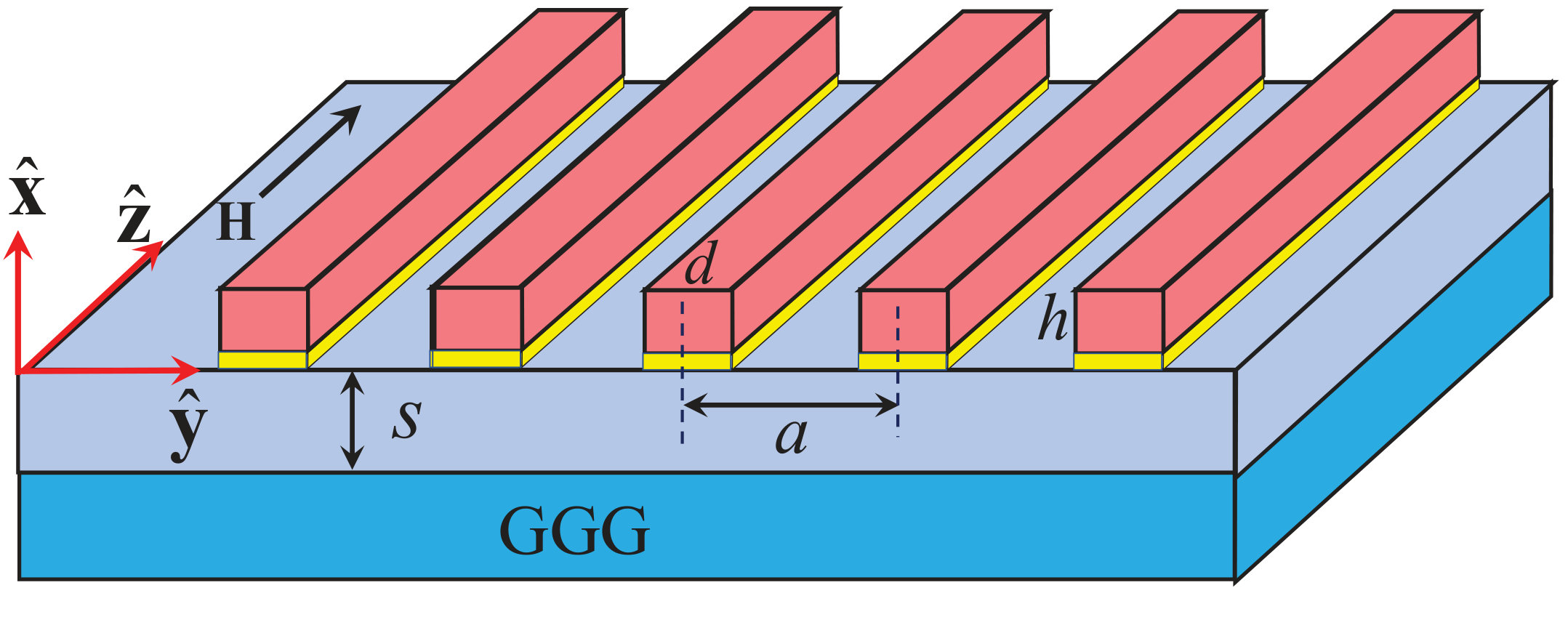 Figure 1
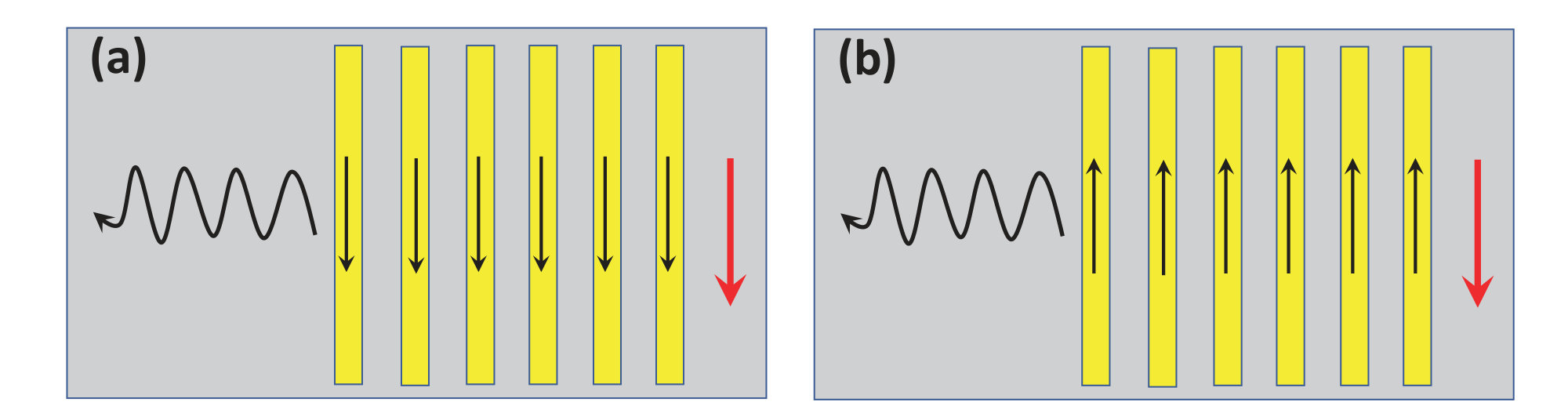 Figure 2
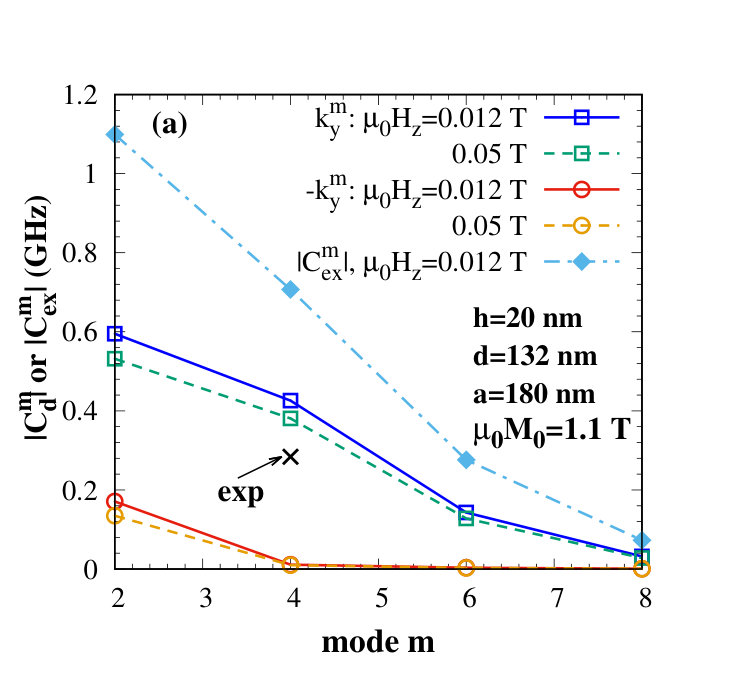 Figure 3
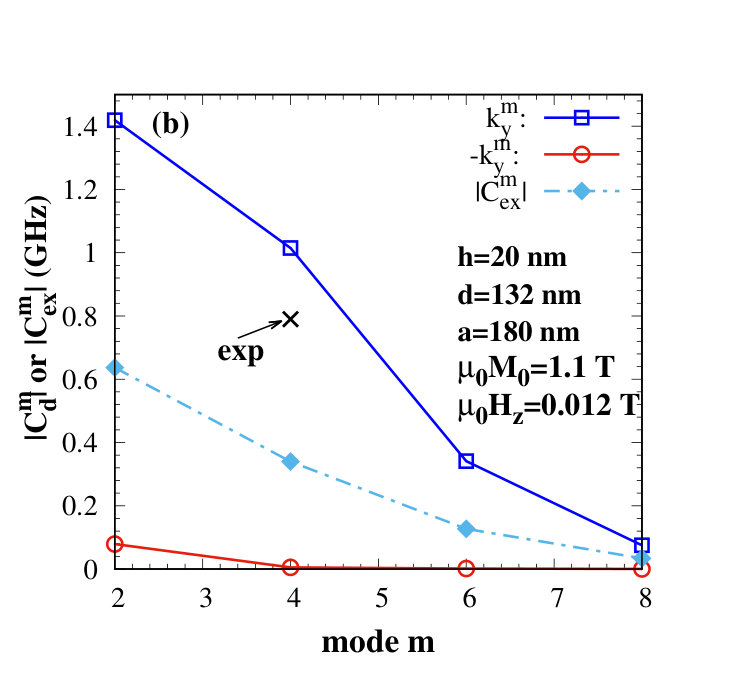 Figure 4
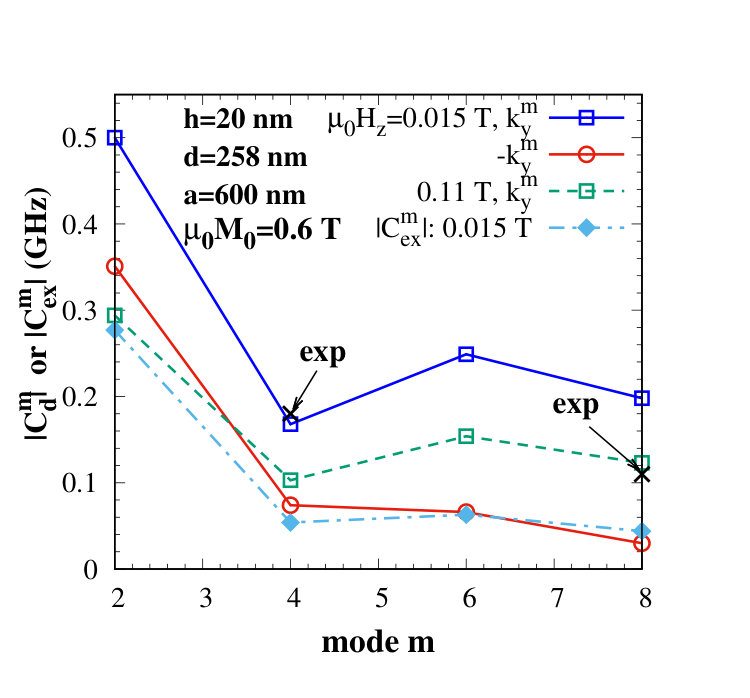 Figure 5
Peer Reviews
No public reviews on file for this paper yet. If you reviewed it on a platform where reviews are public (OpenReview, ICLR, NeurIPS, ICML), you can paste yours below so the community can read it here.
Videos
No videos yet. Explain this paper in a talk, walkthrough, or lecture? Add one.
Chiral excitation of spin waves in ferromagnetic films
Tao Yu
Kavli Institute of NanoScience, Delft University of Technology, 2628 CJ Delft, The Netherlands
Chuanpu Liu
Fert Beijing Institute, BDBC, School of Microelectronics, Beihang University, Beijing 100191, China
Haiming Yu
Fert Beijing Institute, BDBC, School of Microelectronics, Beihang University, Beijing 100191, China
Yaroslav M. Blanter
Kavli Institute of NanoScience, Delft University of Technology, 2628 CJ Delft, The Netherlands
Gerrit E. W. Bauer
Institute for Materials Research WPI-AIMR CSRN, Tohoku University, Sendai 980-8577, Japan
Kavli Institute of NanoScience, Delft University of Technology, 2628 CJ Delft, The Netherlands
Abstract
We theoretically investigate the interlayer dipolar and exchange couplings for an array of metallic magnetic nanowires grown on top of an extended ultrathin yttrium iron garnet film. The calculated interlayer dipolar coupling agrees with observed anticrossings [Chen et al., Phys. Rev. Lett. 120, 217202 (2018)], concluding that the interlayer exchange coupling is suppressed by a spacer layer between the nanowires and film. The Kittel mode in the nanowire array couples chirally to spin waves in the film, even though Damon-Eshbach surface modes do not exist. The chirality is suppressed when the interlayer exchange coupling becomes strong.
pacs:
75.75.-c,75.78.-n,75.30.Ds
I Introduction
Magnon spintronics is the research field aimed at understanding and controlling spin waves — the collective excitations of magnetic order — and its quanta, magnons, with perspectives of technological applications [1; 2; 3; 4]. Yttrium iron garnet (YIG), a ferrimagnetic insulator, is currently the best material for magnon spintronics due to its record low damping [5; 6; 7]. Long-wavelength spin waves in YIG can travel over centimeters [8]. Dipolar interactions add unique features to the magnetostatic surface or Damon-Eshbach (DE) spin waves in magnetic film with in-plane magnetization that are exponentially localized at the surface and possess directional chirality: the surface spin waves propagate only in one direction that is governed by surface normal and magnetization directions [9; 10; 11; 12; 13; 14; 15; 16; 17; 18]. This chirality can be very attractive for application in magnetic logics [19]. However, dipolar surface spin waves suffer from a low group velocity which makes them less attractive for information transfer. A different mechanism — exchange interactions — generates spin waves with much higher group velocity, but they are scattered easily. Transport is then slowed down by becoming diffusive and their reach becomes limited to the order of 10 m and the directional chirality vanishes as well.
The spin waves most suitable for information technologies therefore arise in the intermediate regime, i.e., dipolar-exchange spin waves that combine the long-lifetime and attractive features, such as the chirality of magnetostatic magnons, with the higher group velocity generated when the exchange interaction kicks in. Unfortunately, these spin waves are hard to excite since coherent microwave absorption conserves linear momentum, and the impedance matching problem exists when using conventional coplanar waveguide. Recently, excitation of relatively-short–wavelength spin waves in Co(FeB)YIG thin-film bilayers with uniform microwave fields has been demonstrated [20; 21], but these are standing waves which can not travel. Refs. [22; 23] demonstrated that microwaves can excite higher-momentum in-plane spin waves by ferromagnetic resonance (FMR) of Ni or Co nanowire arrays (NWA) on an ultrathin (20 nm) YIG film (see Fig. 1). The dimensions of the grating in Fig. 1 are the thickness and width of the nanowires, the period or center-to-center distance between the nanowires and the YIG thickness . We choose to be parallel to the nanowires, the magnetizations, and the applied magnetic field. A thin non-magnetic layer between the nanowires and film suppresses the interlayer exchange coupling. We allow NWA and YIG magnetizations to be antiparallel as well. We investigate the magnetization dynamics of such a magnetic grating on a magnetic film and find the spin waves can be chirally excited. This is at the first glance surprising since DE surface modes [10] do not exist for such thin films. However, it corresponds to and explains recent experiments (Yu c.s., unpublished). We show that the chirality arises from the unique polarization-momentum locking of the dipolar field generated by the Kittel modes of NWA.
In the experiments, a coplanar waveguide on top of the NWAYIG system of Fig. 1 is tuned to the NWA Kittel mode, in which the magnetization of all wires precesses in phase. Due to the large magnetization and form anisotropy of Co and Ni, this frequency is much higher than that of the underlying YIG film FMR. The array acts as grating that couples to short-wavelength in-plane spin waves in the YIG film by the dipole and exchange couplings [22; 23]. Only the spin waves propagating perpendicular to the nanowires (the -direction in Fig. 1) with in-plane wave vector can be excited, where is an even integer. The coherent coupling generates anti-crossings between the NWA Kittel mode and the spin waves in the YIG film that can be observed in the microwave reflection spectra [23]. The mode splitting is a direct measure of the interlayer coupling strength. Since YIG is magnetically very soft, the magnetizations of film and nanowires can be rotated with respect to each other, which enhances the interlayer coupling up to GHz when in antiparallel configuration [23]. We theoretically study the dynamics of this system, focussing on the experimentally relevant thin-YIG-film limit (e.g., 20 nm). We find a good agreement with experiments when only the dipolar coupling is taken into account, which could indicate that the spacer in the experiments suppresses the exchange interaction [23]. Interestingly, we find that the coupling is chiral, i.e. it excites only spin waves propagating with linear momentum , where is the magnetization of and the normal to the film as is known for surface DE modes in thick films [10]. However, DE modes do not exist in thin films with a magnetization dynamics that is almost constant over the film thickness. The predicted chiral coupling of exchange spin waves survives a finite interface exchange coupling and adds functionality to down-scaled magnonic devices [24].
This paper is organized as follows. We first introduce the uncoupled modes for NWA and the YIG film in Sec. II. Then, the interlayer dipolar and exchange interactions are addressed in Sec. III followed by concrete calculations and comparison with experiments in Sec. IV. Finally, section V contains a discussion of the results and conclusions.
II Uncoupled dynamics
In this section, we formulate the Kittel mode dynamics in a NWA as well as spin waves in the thin magnetic film. The collective mode in the NWA generates the high momentum Fourier components that couple to the exchange spin waves in the film as elaborated in Section III. There we also need the spin waves amplitude formulated in Section II.2.
II.1 Kittel mode in nanowire array (NWA)
The NWA with a length much larger than the periodicity is to a very good approximation a one-dimensional magnonic crystal [27; 1; 25; 26]. In this limit we may disregard interwire dipolar interactions.
The frequency and magnetization amplitude of the Kittel mode in a single magnetic wire read [29; 28]
[TABLE]
where is the vacuum permeability, the electron gyromagnetic ratio, the applied magnetic field (in the -direction), the saturation magnetization, and the demagnetization factor with for a sufficiently long wire [28; 30; 29; 31; 32; 22; 29]. When (or ) the demagnetization factor of ellipsoids [32] simplifies to and [28; 30; 29], while
[TABLE]
where is the FMR frequency of the extended film.
Under FMR, the Kittel modes of all wires excited by a homogeneous microwave field that precess in phase. The magnetization is periodic in the direction perpendicular to the nanowires,
[TABLE]
where is an integer. The Fourier series of the transverse components of reads
[TABLE]
in which , is the Heavyside step function, with a positive even integer and
[TABLE]
is the lowest acoustic mode with frequency for the nanowire array in the interval with [25; 26; 1]. The normalization condition of the amplitudes read (for general modes labelled by ) [9; 27]
[TABLE]
where . The acoustic mode in Eq. (5) is elliptically polarized as
[TABLE]
[TABLE]
which can be strongly elliptic in the thin film limit.
II.2 Spin waves in a thin magnetic film
Magnetic modes in the film are the solution of the Landau-Lifshitz (LL) equation [33]
[TABLE]
where is the same applied magnetic field as above, is the dipolar field (see Appendix A) [34], and the exchange field with stiffness . We choose free boundary conditions for simplicity [35; 36; 37], since the lowest mode in sufficiently thin films is not affected by partial pinning [38; 39; 40; 41].
By translational symmetry in the - plane, with . We focus on the spin waves with that couple to the acoustic mode of the nanowire array (see Sec. III). From Eqs. (9) and (124), and we have the Fourier series [34; 17]
[TABLE]
Eq. (9) leads to the following equations for [34; 17],
[TABLE]
where , and
[TABLE]
and when and when .
The exchange energy for the spin waves along the -direction is . For the typical film thickness nm and magnon wavelength nm, when . In Appendix B, we argue that we may confine our attention to the spin waves in the lowest branch with amplitude governed by [34; 17]
[TABLE]
which leads to the energy spectrum [34; 35; 36; 37; 42]
[TABLE]
and ellipticity
[TABLE]
where
[TABLE]
With the normalization Eq. (7) we find
[TABLE]
For wavelengths that are relatively short but still much larger than the film thickness or , the energy of the spin waves in the lowest branch approaches , and the precession becomes circular with .
III Interlayer dipolar and exchange interactions
We now analyze the coupling between the NWA and film that generate the observed anticrossings in the microwave absorption. We focus on the experimental relevant interlayer dipolar and exchange couplings of the Kittel mode of the NWA and the spin waves in the lowest subband of the thin film. We adopt the configuration in which the equilibrium magnetizations and applied field are all parallel to the -direction. The results also hold for the antiparallel configuration with and , by replacing with .
III.1 Interlayer dipolar interaction
The free energy due to the interlayer dipolar interaction reads [33]
[TABLE]
where () is the demagnetization field generated by the acoustic mode (spin waves) in the NWA (films) [33]
[TABLE]
where and the repeated index implies summation (over ). The field acting on the nanowire array is with (see Fig. 1) while that acting on the film is with . Below, rich features are revealed for the interlayer dipolar coupling by both classical and quantum descriptions, which are further understood from the unique behaviors of and .
III.1.1 Classical description
In a classical description, the Kittel mode of the NWA as derived above reads (see Eq. (5))
[TABLE]
By substituting these modes into Eq. (28) and using the Coulomb integral
[TABLE]
its dipolar field in the film below becomes
[TABLE]
with the form factor . By inspection of the dipolar fields under the wire center and between the wires
[TABLE]
it becomes clear that rotates in the - plane, but in opposite direction of . Decomposing the latter into right and left circularly-polarized components as , the dipolar field Eq. (44) can be written
[TABLE]
Since , the standing magnetization mode in the NWA generates two travelling dipolar field waves with opposite direction locked by the polarization. A right circularly polarized Kittel mode generates dipolar magnetic fields with the opposite polarization that propagate only in one direction, while ellipticity leads to a second wave with same polarization sense but in opposite direction.
can now interact with the proximate spin waves in the film below, which we denote as
[TABLE]
where . Substituting, the magnetic free energy due to the interlayer dipolar coupling becomes
[TABLE]
The dipolar thin-film form anisotropy also causes elliptical precessions that can be decomposed into the right and left circularly-polarized components as . At resonance the average over a time period is finite
[TABLE]
Eq. (65) leads to the following conclusions:
- •
The ac dipolar magnetic fields couple only to spin waves with the same polarization (conservation of angular momentum).
- •
The FMR resonance of the NWA couples only to spin waves with momentum (conservation of linear momentum).
- •
Circularly polarized excitations in both NWA and film to do not interact when equilibrium magnetizations are parallel. However, they do couple in the antiparallel configuration, which is obtained from Eq. (65) by exchanging .
- •
When the spin waves are circularly polarized, i.e. but the NWA modes are elliptic, the coupling is perfectly chiral, i.e. the Kittel mode of the NWA interacts with spin waves that propagate in one direction only.
- •
A finite chirality persists when both the spin waves and NWA mode are elliptically polarized as long as .
The dipolar (magnetostatic) spin waves in thin films are elliptically polarized due to the anisotropy of demagnetization fields, with the exception of the DE modes in thick films as discussed briefly below. The NWA Kittel mode then asymmetrically mixes with spin waves in both directions. At higher frequencies the dipolar interaction becomes less dominant and the spin waves become nearly circularly polarized, , which implies that only spin waves propagating in one direction interact as long as . When the magnetizations are antiparallel, and are exchanged, leading to perfect and large chiral coupling for circularly polarized magnetization dynamics.
The physics can be also understood in terms of the dipolar field generated by the spin waves and acting on the NWA. We can express the spin waves in the thin film as
[TABLE]
where and denote the right and left circularly-polarized components. Above the film with ,
[TABLE]
Irrespective of an ellipticity , the dipolar field is left (right) circularly polarized above (below) the film. Moreover, the dipolar field generated by the right (left) circularly polarized components of the spin waves does not vanish above the film only when (). This can be understood in terms of the surface magnetic charges with dipolar fields that point in opposite direction on both sides of the film: When the spin waves are right or left circularly polarized, only those travelling in particular direction can couple with the NWA Kittel mode with fixed circularly polarized component.
Although not treated here explicitly, we can draw some conclusions about the DE modes in thick films as well. DE modes propagating perpendicular to the magnetization can be excited efficiently by interlayer dipolar coupling because they are circularly polarized, but the excitation efficiency is very different for the parallel and anti-parallel configurations. Here, we disregard the DE modes on the opposite side completely now since the film is thick. From Eq. (58), the anisotropic NWA generates the right (left) circularly polarized magnetic fields propagating in (opposite to) the -direction determined by (). With this in mind, DE modes of thick films can be efficiently excited by dipolar interactions because they are confined to a thin skin near the surface. However, the exchange coupling can also do that, irrespective of the parallel vs. antiparallel configuration but with equal excitation efficiency. The NWA therefore can be an efficient coupler to excite short-wavelength DE modes that by the exchange interaction acquire a significant group velocity.
III.1.2 Quantum description
We now formulate the interlayer dipolar coupling in second quantization deriving the appropriate matrix elements from the classical interactions. In order to make better contact with the literature, we replace the magnetization by the spin operators via . After performing the Holstein-Primakoff transformation [28; 43], we linearize the problem in the magnon operators and diagonalize the resulting Hamiltonian by a Bogoliubov transformations [44; 28; 43; 45]. The leading term of the interaction between NWA and film then reads
[TABLE]
with spin operators (for the time being for general film thickness) [44; 28; 43],
[TABLE]
with . Here is a magnon annihilation operator with band index in the film and the Kittel mode of the nanowire array is annihilated by . Then
[TABLE]
in terms of
[TABLE]
Here, , , , and
[TABLE]
and calligraphic letters denote matrices here and below.
Only terms with survive the spatial integration in Eq. (83), which reflects momentum conservation. In the following, we focus again on the experimental relevant regime [22; 23] of spin waves in the lowest branch labeled in the following by “H” and the acoustic mode “K” in the nanowire array. With
[TABLE]
in which
[TABLE]
with the spinor
[TABLE]
and
[TABLE]
The equilibrium magnetization of the NWA and film are parallel to the -direction. When they are antiparallel with and , should be replaced by , as before.
We emphasize again that the couplings of the spin waves of opposite momentum to the acoustic Kittel mode in the NWA can be very different. When the wavelength is relatively short, or the spin waves are nearly circularly polarized, . When substituted into , the integral
[TABLE]
and in Eq. (86). This implies that the dipolar interaction cannot couple spin waves with momentum to the acoustic mode in the nanowire, while such a restriction does not hold for waves with . In other words, the microwave field couples to short-wavelength spin waves in thin films via a nanowire grating in a chiral manner.
As discussed above, the physical reason for this unexpected selection rule is the asymmetry of the dipolar field generated by (circularly polarized) spin waves propagating normal to the magnetization (). For a particular momentum , the dipolar field generated by the circular spin waves on the upper side is
[TABLE]
which vanishes for negative but is finite for positive . Therefore only spin waves with positive (negative) can couple (not couple) with the magnetization in the nanowire array.
The different excitation configurations and the chiral coupling are illustrated by Fig. 2. When the nanowire array is fabricated on the upper surface of the film, irrespective of whether the magnetizations in the film and nanowires are parallel [Fig. 2(a)] or anti-parallel [Fig. 2(b)], among the short-wavelength spin waves only those with momentum (shown by the wavy line with arrow) couple to (are excited by) the acoustic NWA mode.
III.2 NWA-magnetic film exchange interaction
Both the static [46; 47; 48] and dynamic [49; 50; 21; 20; 51] interlayer exchange interaction between the NWA and magnetic film can play a role in the coupling of short-wavelength spin waves in magnetic bilayers [50; 21; 20]. Here we focus on the dynamic exchange interaction, eventually moderated by spin diffusion in a spacer layer [49; 52; 21; 20; 51]. Indeed, recent experiments [21] show that for direct contact between Co and YIG bilayers, the static interfacial exchange interaction plays a dominant role by locking the interface magnetization on both sides together. A 5-nm Cu space layer, on the other hand, completely suppresses the static exchange interaction, while the dynamic interaction mediated by the exchange of non-equilibrium spin currents through the spacer remains [21]. A 1.5-nm AlOx layer suppresses both static and dynamic exchange interactions [21]. Here, we assess the role of a significant direct exchange interaction between the NWA and film, but do not discuss the dissipative dynamic coupling.
The free energy due to an interfacial exchange interaction density can be written as [46; 47; 48; 21]
[TABLE]
When (), the interlayer exchange interaction is anti-ferromagnetic (ferromagnetic). can be calculated by first principles [53] or fitted to experiments [46; 47; 21; 20; 23].
[TABLE]
As above, and represent the lowest spin wave subband in the film and the Kittel mode of the NWA. The expansion into normal modes, Eq. (81),
[TABLE]
then contains the coefficients
[TABLE]
For short-wavelength spin waves with nearly constant amplitude across a thin film, and . The expressions above hold when magnetizations in the NWA and films are both parallel to the -direction. When they are anti-parallel in Eqs. (101-104).
III.3 Energy spectra of coupled NWA-spin wave modes
With established interlayer dipolar and exchange coupling between the lowest-branch spin waves in the film and acoustic mode in the nanowire array, we can compute the energy spectra of the coupled system.
III.3.1 Dominant interlayer dipolar coupling: anticrossings
We first focus on the interlayer dipolar interaction, assuming that the interlayer exchange interaction is efficiently suppressed by a thin spacer [21; 20]. We then may use the approximate selection rule found in Sec. III.1: when , the interlayer dipolar coupling between the acoustic mode in the nanowire array and the short-wavelength spin waves is chiral. This simplifies the analysis since one only needs to consider the dipolar coupling between and . For a particular , the Hamiltonian of this subspace reads
[TABLE]
where and are the energies of the lowest-branch spin waves with momentum and the NWA Kittel mode, respectively. When , terms with may be disregarded from rotating wave approximation, the Hamiltonian is simplified to the quadratic form
[TABLE]
with the frequencies
[TABLE]
is the coupling strength between the short-wavelength spin waves in the film and the acoustic mode in the nanowire array which governs the anticrossing with splitting of between these modes at the resonance . In Sec. IV, we calculate this coupling strength for experimental conditions in Refs. [22; 23], which can be used to understand the experiments [22; 23] without having to invoke interface exchange.
III.3.2 Dominant interlayer exchange coupling: in-plane standing wave
When the interlayer exchange is active, we need to additionally consider the couplings between , and . At resonance , the Hamiltonian becomes
[TABLE]
where and . Its eigenvalues are
[TABLE]
with corresponding eigenfunctions
[TABLE]
When the interlayer exchange interaction is much larger than the dipolar one, . In this situation, the first eigenfunction in Eq. (118) corresponds to the in-plane standing wave in the film, which arises from the linear superposition of the two spin waves with opposite momenta.
IV Material and device parameter dependence
In this section, we illustrate the expressions we produced above and demonstrate the magnitude of the effect by specifically considering coupling between a nanowire array and a thin film for the Co or Ni NWAs fabricated on YIG films. This system has been experimentally realized in Refs. [22; 23], and we use the parameters from these papers.
IV.1 Co nanowire array
The lattice constant of the Co nanowire array was nm with wire thickness nm and width of nm [22; 23]. The saturated magnetization T for the Co and T for the YIG films. The YIG exchange interaction constant is m2 [54] and thickness nm [23]. We compute the coupling constants for these parameters when the magnetizations in the nanowire array and film are parallel and antiparallel to each other in Figs. 3(a) and (b), respectively, as a function of the mode index of allowed spin waves in YIG. The magnetic field is chose to be constant and to agree with a main anticrossing. In Fig. 3(a), for example, T corresponds to the anticrossing of the mode
IV.1.1 Parallel configuration
When the mode dependence of the dipolar coupling strengths is shown in Fig. 3(a) with applied magnetic fields and 0.05 T. When T, in Fig. 3(a), the blue (red) solid curve with squares (circles) describes the mode dependence of the interlayer dipolar coupling between the lowest spin wave subband with momentum () in the YIG film and the FMR of the Co nanowire array. The coupling strength for the spin waves with positive wave vector is much larger than that for opposite one when that corresponds to exchange spin waves, confirming that the chirality of the coupling should be very significant in real systems.
With increasing mode number, the coupling strength decreases. According to Eq. (86), , where is the Fourier component of the NWA magnetization dynamics, while the integral represents the decay of the dipolar field inside the film. The drop of the coupling with increasing is caused by the evanescent decay of the dipolar field and not by the form factor . In the presence of a non-magnetic insertion with thickness , the overlap integral
[TABLE]
So the inserted layer exponentially suppresses the interlayer dipolar coupling by . However, this effect is rather inefficient for and a wave length nm, i.e. .
The decrease of the coupling with magnetic field in Fig. 3(a) can be understood as follows. For relatively short-wavelength spin waves with , Eq. (86) gives
[TABLE]
For the amplitudes and in the film do not depend strongly on the field, in contrast to the NWA Kittel mode. Specifically,
[TABLE]
in which . When and , decreases with and so does the interlayer dipolar coupling.
We also present the interlayer exchange coupling for direct contact between the Co NWA and the YIG film by the cyan dot-dashed curve with diamonds in Fig. 3(a), with an interlayer exchange coupling constant J/m2 [21]. Without spacer layer, the interlayer exchange coupling wins over the dipolar interaction for the sample geometries considered here. The decrease can be understood from in Eq. (102): , , and do not depend strongly on mode number, but we find a decreasing with increasing . can also become oscillatory as a function of (refer to Sec. IV.2 below).
IV.1.2 Antiparallel configuration
Assuming that and , becomes negative and is replaced by when calculating the interlayer dipolar and exchange couplings. The results in Fig. 3(b) for T show a strong enhancement of the magnitude and chirality of the dipolar coupling at the cost of a reduced exchange interaction, which is caused by, see Eq. (8). However, we disregarded here a possible exchange-spring magnetization texture in the non-collinear and antiparallel configurations [23], whose treatment is beyond of the scope of this work.
IV.2 Ni nanowire array
Experiments have been also carried out on a Ni NWA with a (relatively large) lattice constant nm, and thickness and width of nm and nm, respectively, and with a thin spacer of nm between Ni wires and the YIG substrate [22; 23]. The Ni saturated magnetization is T [23]. For these parameter the factor causes a non-monotonous dependence of the interlayer dipolar coupling, see Fig. 4. For T, the asymmetry in the coupling of the Kittel mode to spin waves propagating into opposite directions is strong, for , the chirality is almost perfect. For larger T the interlayer dipolar coupling is suppressed for the same reason as for the Co NWA discussed above.
The interlayer exchange coupling is also shown in Fig. 4 for an exchange interaction strength J/m2 [23], which is smaller than the dipolar one.
IV.3 Summary of the comparison with experiments
The present study was motivated by FMR experiments which displayed clear anti-crossings, i.e. strong coupling, between YIG film and NWA spin wave modes [22; 23]. The observed splittings are shown by the crosses in Figs. 3 and 4, respectively. The experimental values are quite close to the calculated ones for dipolar interactions without fit parameters. This supports the assumption that interlayer exchange interactions are suppressed by spacer layers inserted between the YIG film and Co/Ni nanowires [20; 21; 22; 23]. A dominant interlayer dipolar interaction implies a chiral coupling. As shown in Figs. 3 and 4, only the short-wavelength spin waves propagating with momenta interact with the NWA Kittel mode, where is the unit vector normal to the interface. A similar chiral feature is intrinsic to the Damon-Eshbach surface mode that exist in sufficiently thick films [10] but not in the ultrathin films considered here.
V Conclusion and discussion
In conclusion, we demonstrated that spin waves can be coherently excited in an ultrathin magnetic film in only one direction by a magnetic grating. We focus on the limiting cases in which the applied magnetic field and magnetizations in the film are either parallel or antiparallel to the NWA magnetization and wire axis. We report an unexpected chirality in the coupling that strongly favors spin waves propagating perpendicular to the nanowires with wave vector (where is an even integer and the NWA lattice constant) [22; 23]. The dipolar regime can be realized by an inserted non-magnetic layer between the YIG film and nanowires that suppresses the exchange interaction more efficiently than the dipolar one [20; 21; 23]. The calculated coupling strength agrees well with the experimental observations [23] for both parallel and anti-parallel configurations. This suggests that the interlayer dipolar interaction plays a dominant role in the experiments [23], but more work, especially including magnetic texture and dynamic exchange is necessary to confirm this assertion. The spacer layer might also be instrumental to support an antiparallel magnetic configuration without associated exchange-spring magnetization textures in the film.
The dipolar coupling is a classical interaction between two magnetic bodies that has a relative longer range than the (static) exchange interaction. In the present configuration both interactions are exponentially suppressed with distance between the magnets, but on an atomic length scale and that of the wave length for exchange and dipolar coupling. In ultra-thin films without chiral surface waves, the exchange coupling mixes the Kittel mode almost symmetrically with the spin waves in opposite directions, thereby leading to in-plane standing waves by interference. In the presence of spacer layers, the dynamic exchange interaction competes as well, falling off on the scale of the spin-flip diffusion length, which can be rather long-range when the spacer is a clean simple metal such as copper [50].
The spin waves with the wave vector in a thin film with surface normal are coherently exited by the NWA grating with equilibrium magnetization along and propagate dominantly in the direction (but only for significantly elliptic precession of either NWA or film magnetic modes). This phenomenology agrees with the intrinsic chirality of dipolar Damon-Eshbach surface modes in thick films [10]. However, the physics which we describe in this work is quite different, since there is no intrinsic chirality in the spin waves of ultrathin magnetic films with nearly constant amplitude over the film thickness. It is rather the intrinsic chirality of the dipolar fields that generates a chiral coupling to non-chiral spin waves. This directionality can be exploited in several ways [55], for example, to generate a heat conveyer belt [56; 57; 58; 59] without the need for surface states.
Finally, we would point out an electric analogy, viz. the chiral coupling induced by rotating electric (rather than magnetic) dipoles. When excited close to a planar waveguide, the chiral evanescent electromagnetic field unidirectionally excites surface plasmon polaritons [60], also referred to as “spin-orbit interaction of light” [61]. There are large differences in the physics that we will emphasize elsewhere, but note that the dipolar field with momentum larger than with and being the frequency and light velocity is evanescent on a sub-wavelength scale. Its chirality arises from the near-field interference of the radiated fields from the vertical and horizontal components of the ac electric field [60]. The circularly-polarized magnetic dipolar dynamics generates a purely circularly-polarized magnetic field [e.g., see Eq. (79)], while the circularly-polarized electric dipole results in an elliptically-polarized field by retardation [see Eq. (1) in Ref. [60]]. Nonetheless of this and other differences, the application perspective of the chiral coupling found in plasmonics such as broadband optical nanorouting [60; 61] and polarization analyzers [62] should stimulate similar activities in magnonics.
Acknowledgements.
This work is financially supported by the Nederlandse Organisatie voor Wetenschappelijk Onderzoek (NWO) as well as JSPS KAKENHI Grant No. 26103006. One of the authors (TY) would like to thank Sanchar Sharma and Jilei Chen for useful discussions.
Appendix A Green function tensor
Here we review the calculation of the demagnetizing field [33]
[TABLE]
in a thin magnetic film [34]. For a plane wave modulation ,
[TABLE]
In matrix form
[TABLE]
where
[TABLE]
is the Green function and the unity tensor. The -function vanishes when lies outside the magnetic film. The demagnetization field naturally satisfies electromagnetic boundary condition, i.e. continuity of the electromagnetic fields and currents at the surface of the magnet [34].
Appendix B Higher magnon subbands in thin films
Here we estimate the effects of higher-order standing wave modes on the spin waves in the lowest subband. Retaining only the lowest-order modes in Eq. (20) we arrive at the secular equation
[TABLE]
With Eq. (21) we find and . The matrix in Eq. (126) can be directly diagonalized by the Bogoliubov transformation [17]. We can use perturbation theory to estimate the importance of higher-order modes for our film thicknesses. The second mode contributes to the with amplitudes . For a grating with period nm [22; 23], , while thickness of the film is nm. Then , , and hence , which can be safely disregarded.
The reference list from the paper itself. Each links out to its DOI / PubMed record.
- 1[1] B. Lenk, H. Ulrichs, F. Garbs, and M. Muenzenberg, Phys. Rep. 507 , 107 (2011).
- 2[2] A. V. Chumak, V. I. Vasyuchka, A. A. Serga, and B. Hillebrands, Nat. Phys. 11 , 453 (2015).
- 3[3] D. Grundler, Phys. Rep. 11 , 407 (2016).
- 4[4] V. E. Demidov, S. Urazhdin, G. de Loubens, O. Klein, V. Cros, A. Anane, and S. O. Demokritov, Phys. Rep. 673 , 1 (2017).
- 5[5] V. Cherepanov, I. Kolokolov, and V. L’vov, Phys. Rep. 229 , 81 (1993).
- 6[6] A. A. Serga, A. V. Chumak, and B. Hillebrands, J. Phys. D: Appl. Phys. 43 , 264002 (2010).
- 7[7] M. Wu and A. Hoffmann, Recent Advances in Magnetic Insulators: From Spintronics to Microwave Applications , Vol. 64 (Elsevier, Amsterdam, 2013).
- 8[8] A. A. Serga, A. V. Chumak, and B. Hillebrands, J. Phys. D 43 , 264002 (2010).