Scotogenic $U(1)_\chi$ Dirac Neutrinos
Ernest Ma (UC Riverside)

TL;DR
This paper explores models extending the Standard Model with a $U(1)_ ext{chi}$ gauge symmetry, generating Dirac neutrino masses radiatively via dark matter, and presents two examples with different dark matter candidates and properties.
Contribution
It introduces two novel models for Dirac neutrino mass generation involving dark matter within a $U(1)_ ext{chi}$ framework, highlighting their distinct dark matter candidates and decay mechanisms.
Findings
One model supports light Dirac fermion dark matter.
The other features self-interacting scalar dark matter with a neutrino-decaying scalar mediator.
Abstract
The standard model of quarks and leptons is extended to include the gauge symmetry which comes from . The radiative generation of Dirac neutrino masses through dark matter is discussed in two examples. One allows for light Dirac fermion dark matter. The other allows for self-interacting scalar dark matter with a light scalar mediator which decays only to two neutrinos.
Click any figure to enlarge with its caption.
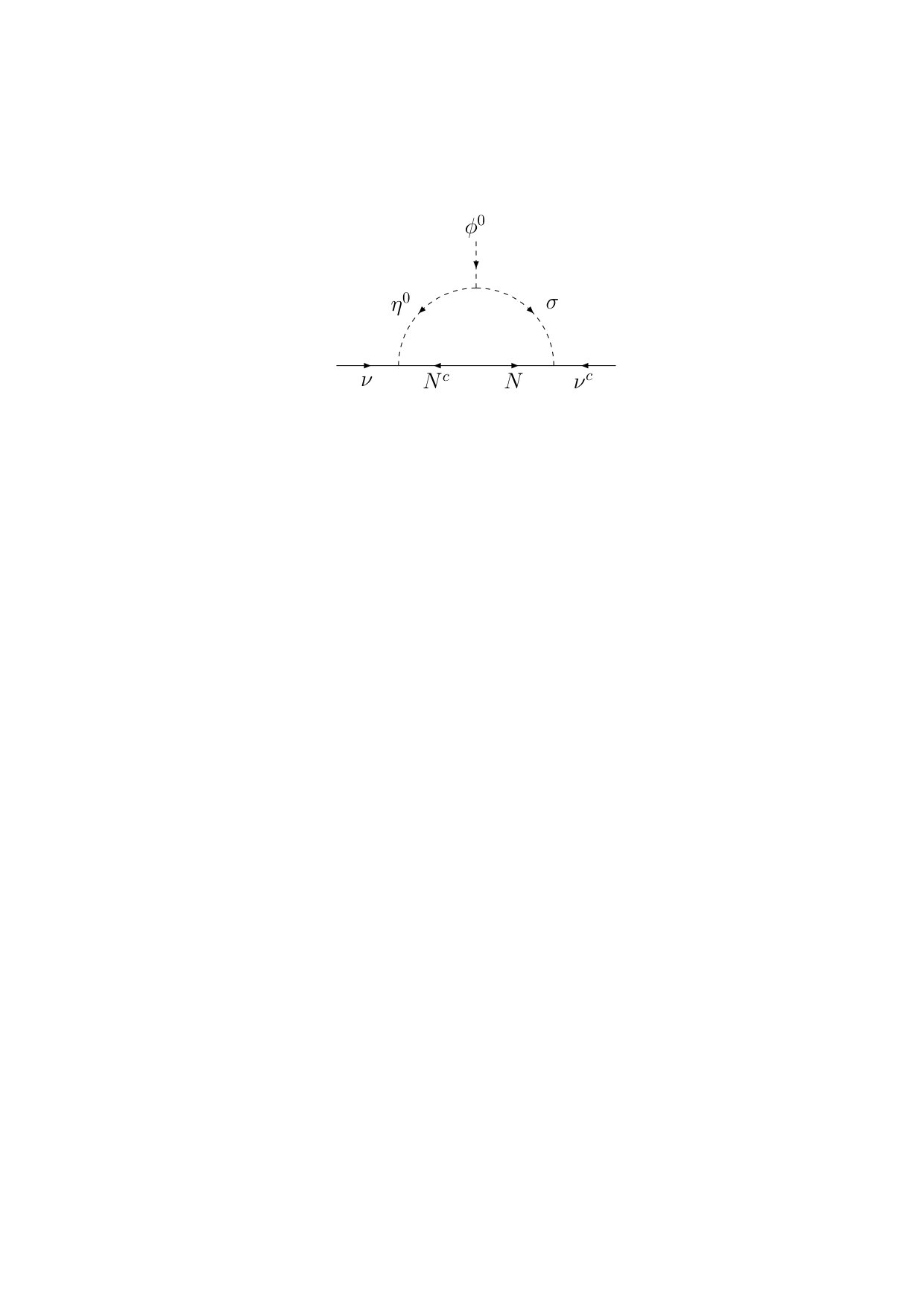 Figure 1
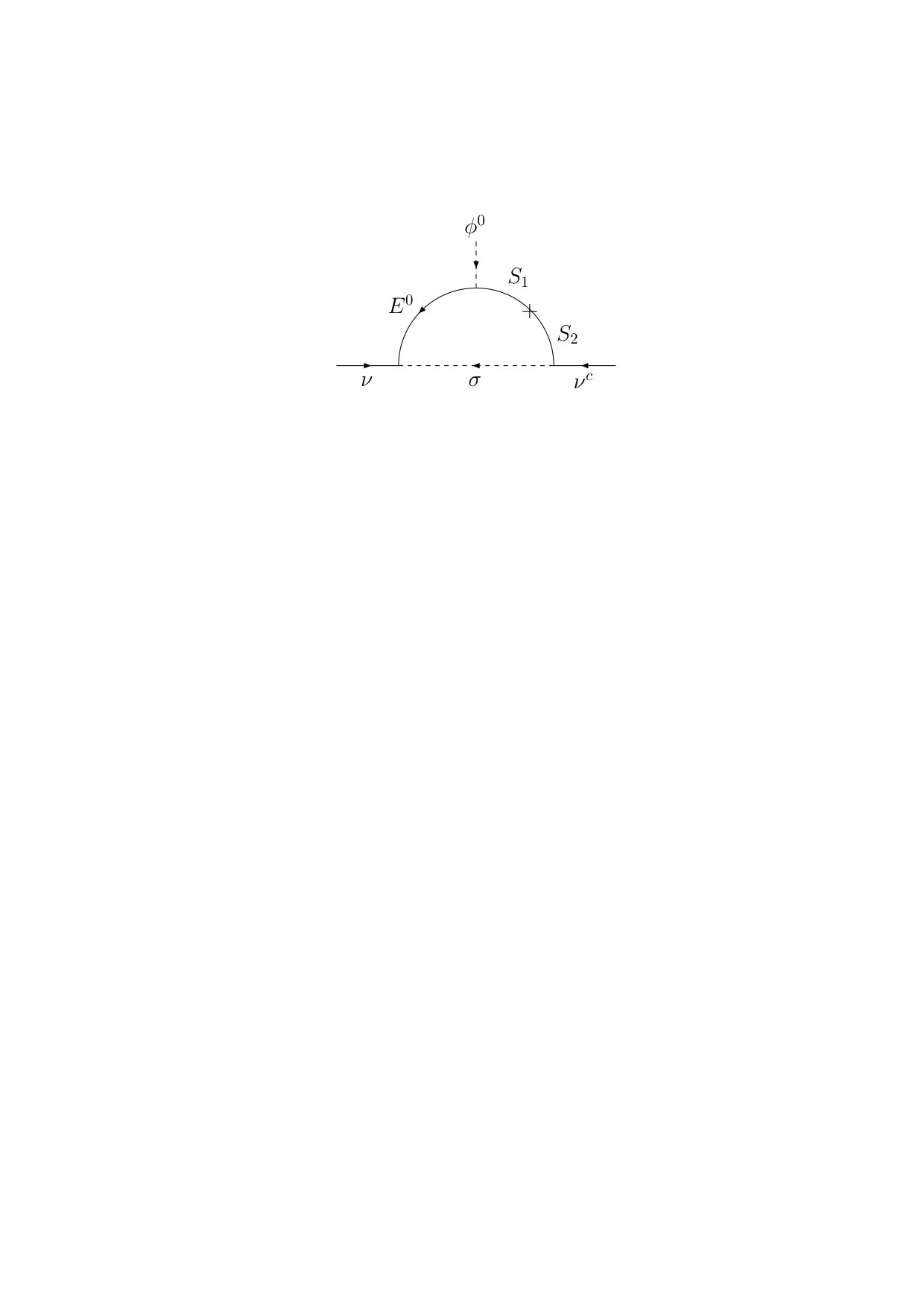 Figure 2
| fermion | ||||||||||
| 16 | 1 | 1/3 | 3 | + | + | + | + | |||
| 16 | 1 | 2 | 3 | + | + | + | + | |||
| 16 | 10 | 3 | 2 | 1/6 | + | + | + | + | ||
| 16 | 10 | 1 | + | + | + | + | ||||
| 16 | 10 | 1 | 1 | 1 | + | + | + | + | ||
| 16 | 1 | 1 | 1 | 0 | ||||||
| 1 | 1 | 1 | 0 | 10 | + | + | ||||
| 126 | 1 | 1 | 1 | 0 | + | + |
| scalar | ||||||||||
| 10 | 2 | + | + | + | + | |||||
| 10 | 1 | 2 | 2 | + | + | + | + | |||
| 144 | 5 | 1 | 2 | 1/2 | + | + | ||||
| 16 | 1 | 1 | + | + | ||||||
| 672 | 1 | 1 | 1 | 0 | 15 | + | + | + | + |
| particle | |||||||||
| 16 | 1 | 2 | 3 | + | + | ||||
| 16 | 1 | 1 | 1 | 0 | + | ||||
| 10 | 5 | 1 | 2 | 1/2 | 2 | 1 | |||
| 45 | 24 | 1 | 1 | 0 | 0 | 1 | |||
| 45 | 24 | 1 | 1 | 0 | 0 | 1 | |||
| 16 | 1 | 1 | |||||||
| 126 | 1 | 1 | 1 | 0 | + | + | |||
| 2772 | 1 | 1 | 1 | 0 | + | 1 | + |
Peer Reviews
No public reviews on file for this paper yet. If you reviewed it on a platform where reviews are public (OpenReview, ICLR, NeurIPS, ICML), you can paste yours below so the community can read it here.
Videos
No videos yet. Explain this paper in a talk, walkthrough, or lecture? Add one.
UCRHEP-T597
Mar 2019
**Scotogenic Dirac Neutrinos
**
**Ernest Ma
**
Physics and Astronomy Department,
University of California, Riverside, California 92521, USA
Abstract
The standard model of quarks and leptons is extended to include the gauge symmetry which comes from . The radiative generation of Dirac neutrino masses through dark matter is discussed in two examples. One allows for light Dirac fermion dark matter. The other allows for self-interacting scalar dark matter with a light scalar mediator which decays only to two neutrinos.
Introduction* : Whereas neutrinos are usually assumed to be Majorana, there is yet no experimental evidence, i.e. no definitive measurement of a nonzero neutrinoless double beta decay. To make a case for neutrinos to be Dirac, the first is to justify the existence of a right-handed neutrino , which is not necessary in the standard model (SM) of quarks and leptons. An obvious choice is to extend the SM gauge symmetry to the left-right symmetry . In that case, the doublet is required, and the charged gauge boson is predicted along with a neutral gauge boson.*
A more recent choice is to consider which comes from , with breaking to the SM. Assuming that survives to an intermediate scale, the current experimental bound on the mass of being about 4.1 TeV [1, 2], then must exist for the cancellation of gauge anomalies. Now is a singlet and is not predicted. In this context, new insights into dark matter [3, 4] and Dirac neutrino masses [5] have emerged. In particular, it helps with the following second issue regarding a Dirac neutrino mass. Since neutrino masses are known to be very small, the corresponding Yukawa couplings linking to through the SM Higgs boson must be very small. To avoid using such a small coupling, a Dirac seesaw mechanism [6, 7] is advocated in Ref. [5]. The alternative is to consider radiative mechanisms, especially through dark matter, called scotogenic from the Greek ’scotos’ meaning darkness. Whereas the original idea [8] was applied to Majorana neutrinos, one-loop [9, 10] and two-loop [11] examples for Dirac neutrinos already exist in the context of the SM. For a generic discussion of Dirac neutrinos, see Ref. [12], which is patterned after that for Majorana neutrinos [13]. Here two new examples are shown. One allows for light Dirac fermion dark matter. The other allows for self-interacting scalar dark matter with a light scalar mediator which decays only to two neutrinos.
First Scotogenic Model* : The particle content follows that of Ref. [5] except for the addition of from the 672 of . This is used to break without breaking global lepton number. The fermions are shown in Table 1 and scalars in Table 2.*
New fermions belonging to respectively are added per family, as well as a Higgs doublet from 144 and a singlet from 16. Note that their charges are fixed by the representations from which they come. It should also be clear that incomplete and multiplets are considered here (which is the case for all realistic grand unified models). Since transforms exactly like , the linear combination is the analog of the standard-model Higgs doublet, where . An important discrete symmetry is imposed so that is odd and all other SM fields are even, preventing thus the tree-level Yukawa coupling . This symmetry is respected by all dimension-four terms of the Lagrangian. It will be broken softly by the dimension-three trilinear term (in cases B and D) or the mass term (in cases A and C). This allows the one-loop diagram of Fig. 1 to generate a radiative Dirac neutrino mass.
Cases C and D allow the Yukawa coupling which would violate lepton number, hence only cases A and B will be considered. In case A, the quartic scalar term is allowed. Hence the would-be dark U(1) symmetry is reduced to , i.e. for and for , where . In case B, it is forbidden, so the model possesses a dark U(1) symmetry, i.e. is 1 for and for . In either case, there is still a conserved lepton symmetry, i.e. for and for . The idea of using a scalar which breaks a gauge U(1) symmetry by 3 units, so that a global U(1) symmetry remains was first discussed in Ref. [14] and then used for in Ref. [15]. There have been also studies [16, 17, 18], using dimension-five operators, i.e. where carries a new charge which forbids the dimension-four term but the singlet scalar carries a compensating charge which allows the dimension-five term.
To compute the neutrino mass of Fig. 1, note first that it is equivalent to the difference of the exchanges of two scalar mass eigenstates
[TABLE]
where is the mixing angle due to the term. Let the Yukawa coupling be and the Yukawa coupling be , then the Dirac neutrino mass matrix is given by
[TABLE]
where are the masses of and is the mass of . If , then
[TABLE]
This expression is of the radiative seesaw form. On the other hand, if , then [19]
[TABLE]
This is no longer a seesaw formula. It shows that the three Dirac neutrinos have masses which are linear functions of the three light dark Dirac fermions . This interesting possibility opens up the parameter space in the search for fermion dark matter with masses less than a few GeV.
Consider the annihilation of through exchange, assuming that is very small in Eq. (1). The cross section relative velocity is
[TABLE]
As an example, let GeV, GeV, , then this is about 1 pb, which is the correct value for to have the observed dark-matter relic abundance of the Universe, i.e. . In Eq. (4), let , , and GeV, then eV, as desired.
At the mass of 6 GeV, the constraint on the elastic scattering cross section of off nuclei is about cm2 from the latest XENON result [37]. This puts a lower limit on the mass of , i.e.
[TABLE]
where
[TABLE]
and , for xenon. In , the vector couplings are
[TABLE]
Using from Ref. [3], the bound TeV is obtained.
Second Scotogenic Model* : Using two new fermion singlets and one fermion doublet, with a different , another one-loop diagram is obtained in Fig. 2.*
The relevant particles are shown in Table 3.
Again, the symmetry forbids the would-be tree-level Yukawa coupling , but is softly broken by the mass term, whereas and are allowed Majorana mass terms. The gauge symmetry is broken by and since it couples to and couples to , the residual symmetry of this model is [20, 21, 22, 23, 24], which enforces the existence of Dirac neutrinos, and the dark symmetry is , i.e. as pointed out in Refs. [3, 25], as shown in Table 3.
In this second model, the scalar is a pure singlet, whereas in the first model, it must mix with which is part of a doublet. Because of the interaction, it is a self-interacting dark-matter candidate [26] which can explain the flatness of the core density profile of dwarf galaxies [27] and other related astrophysical phenomena. The light scalar mediator decays dominantly to so it does not disturb [28] the cosmic microwave background (CMB) [29], thus avoiding the severe constraint [30] due to the enhanced Sommerfeld production of at late times if it decays to electrons and photons, as in most proposed models. This problem is solved if the light mediator is stable [31, 32, 33] or if it decays into through a pseudo-Majoron in the singlet-triplet model of neutrino mass [34]. A much more natural solution is for it to decay into as first pointed out in the prototype model of Ref. [35] and elaborated in Refs. [3, 5]. Here it is shown how it may arise in the scotogenic Dirac neutrino context using . The connection of lepton parity to simple models of dark matter was first pointed out in Ref. [36]. To obtain three massive Dirac neutrinos, there are presumably also three ’s. Only the lightest is stable, the others would decay into the lightest plus which then decays into two neutrinos. Typical mass ranges for and are
[TABLE]
as shown in Ref. [35]. Lastly, the conjugate fermions to are also assumed, to allow them to have invariant Dirac masses and to cancel the gauge anomalies.
Concluding Remarks* : The gauge symmetry and a suitably chosen particle content with a softly broken symmetry are the ingredients for the radiative generation of Dirac neutrino masses through dark matter. Both the symmetries for maintaing the Dirac nature of neutrinos and the stability of dark matter are consequences. In the first example, because the breaking of is by 3 units of lepton number through the relationship*
[TABLE]
global U(1) lepton number remains, whereas the dark symmetry is either or U(1). The dark-matter candidate is a Dirac fermion which may be light. In the second example, the lepton symmetry is and the dark parity is . The dark-matter candidate is a complex scalar which has self-interactions through a light scalar mediator which decays only into two neutrinos. Both cases are interesting variations of basic dark matter, and will face further scrutiny in future experiments.
Acknowledgement* : This work was supported in part by the U. S. Department of Energy Grant No. DE-SC0008541. I thank Jose Valle and associates (IFIC, Valencia, Spain) and Alfredo Aranda and associates (DCPIHEP, Colima, Mexico) for their great hospitality during two recent visits which inspired and facilitated this work.*
The reference list from the paper itself. Each links out to its DOI / PubMed record.
- 1[1] ATLAS Collaboration, M. Aaboud et al., JHEP 1710 , 182 (2017).
- 2[2] CMS Collaboration, A. M. Sirunyan, A. Tumasyan et al., JHEP 1806 , 120 (2018).
- 3[3] E. Ma, Phys. Rev. D 98 , 091701(R) (2018).
- 4[4] E. Ma, ar Xiv:1810.06506 [hep-ph].
- 5[5] E. Ma, ar Xiv:1811.09645 [hep-ph].
- 6[6] P. Roy and O. U. Sanker, Phys. Rev. Lett. 52 , 713 (1984).
- 7[7] E. Ma, Phys. Rev. Lett. 89 , 041801 (2002).
- 8[8] E. Ma, Phys. Rev. D 73 , 077301 (2006).