Spacetime Instability and Quantum Gravity as Low Energy Effective Field Theory
Hiroki Matsui

TL;DR
This paper examines how higher derivative curvature terms in effective quantum gravity theories cause spacetime instabilities, challenging their viability in describing our universe without special techniques.
Contribution
It demonstrates that standard effective field theories of quantum gravity lead to instabilities unless couplings are fine-tuned to extremely large values.
Findings
Higher derivative terms induce spacetime instabilities.
Couplings must be extremely large to match cosmological data.
Standard EFTs of quantum gravity are insufficient without special techniques.
Abstract
We discuss spacetime instability for effective field theories of quantum gravity. The effective action of gravity introduces infinite higher derivative curvature terms . Although these higher derivative curvature terms are indispensable to construct the self-consistent renormalizable theory of quantum gravity, they lead to several pathologies. We clearly show that even if they are written as the Planck-suppressed operators they lead to serious consequences and and de Sitter or radiation-dominated Universe is highly unstable. We show that the couplings of these higher derivative curvatures must satisfy to be consistent with the cosmological observations. Thus, the standard effective field theories of quantum gravity fail to describe the observed…
Click any figure to enlarge with its caption.
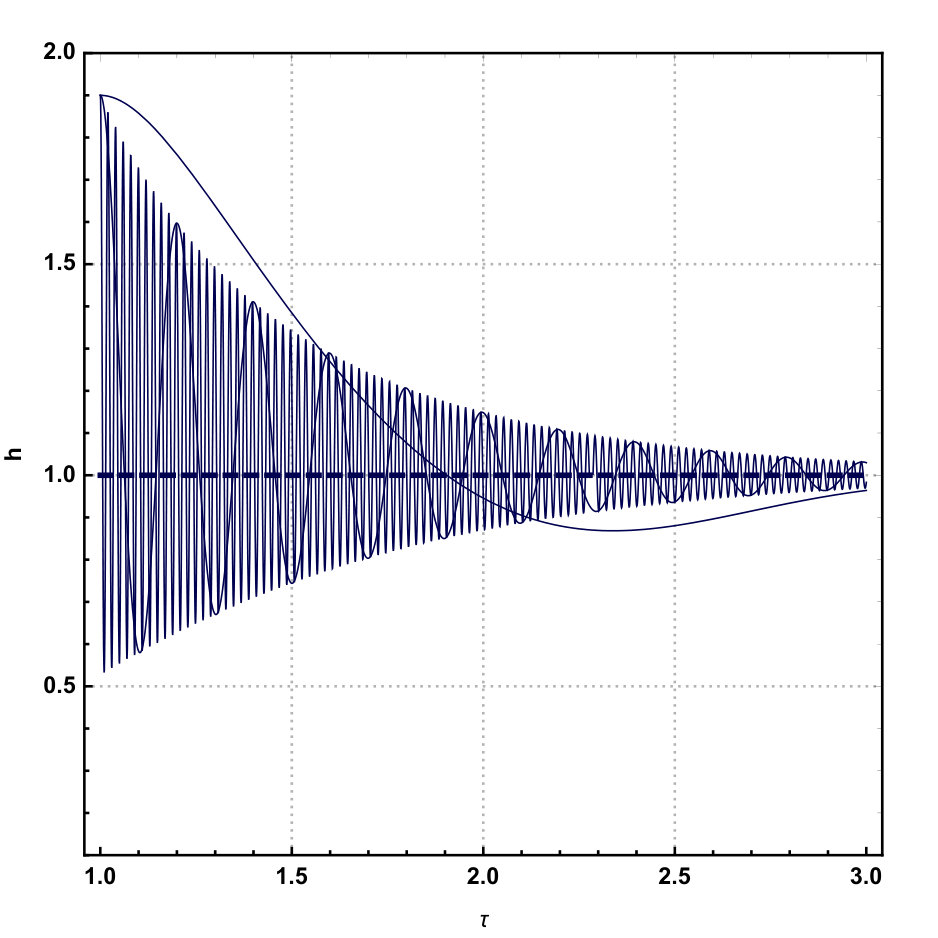 Figure 1
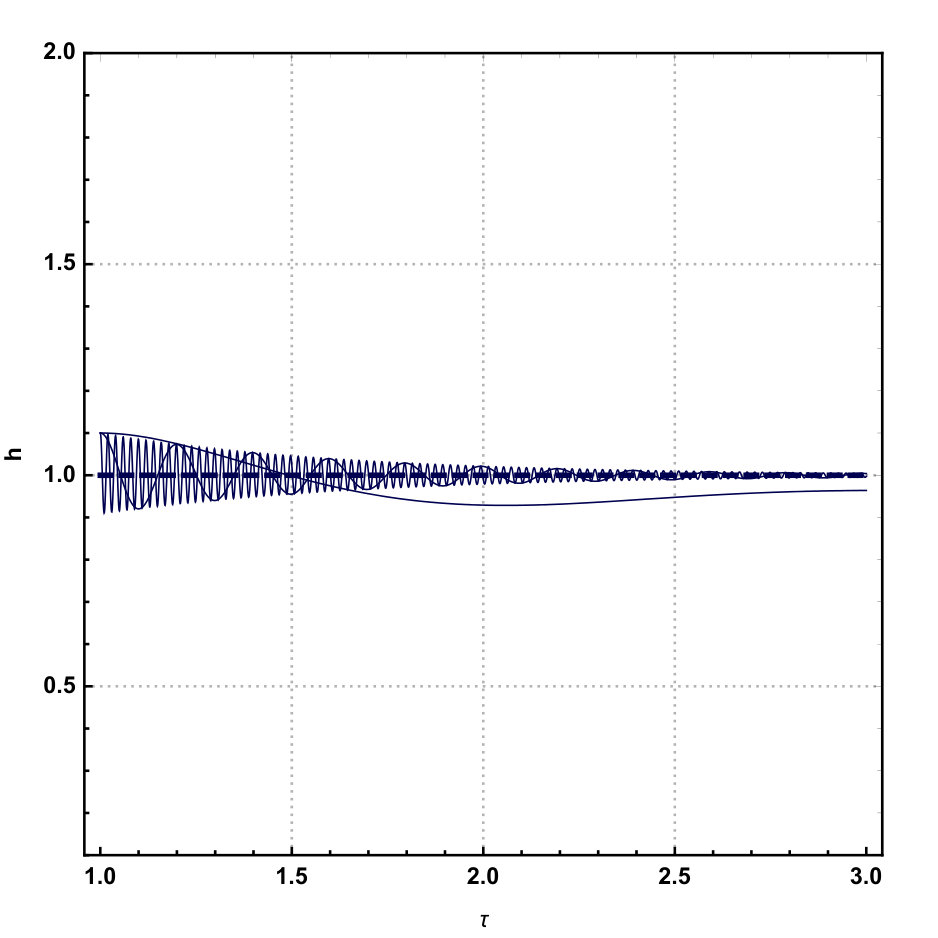 Figure 2
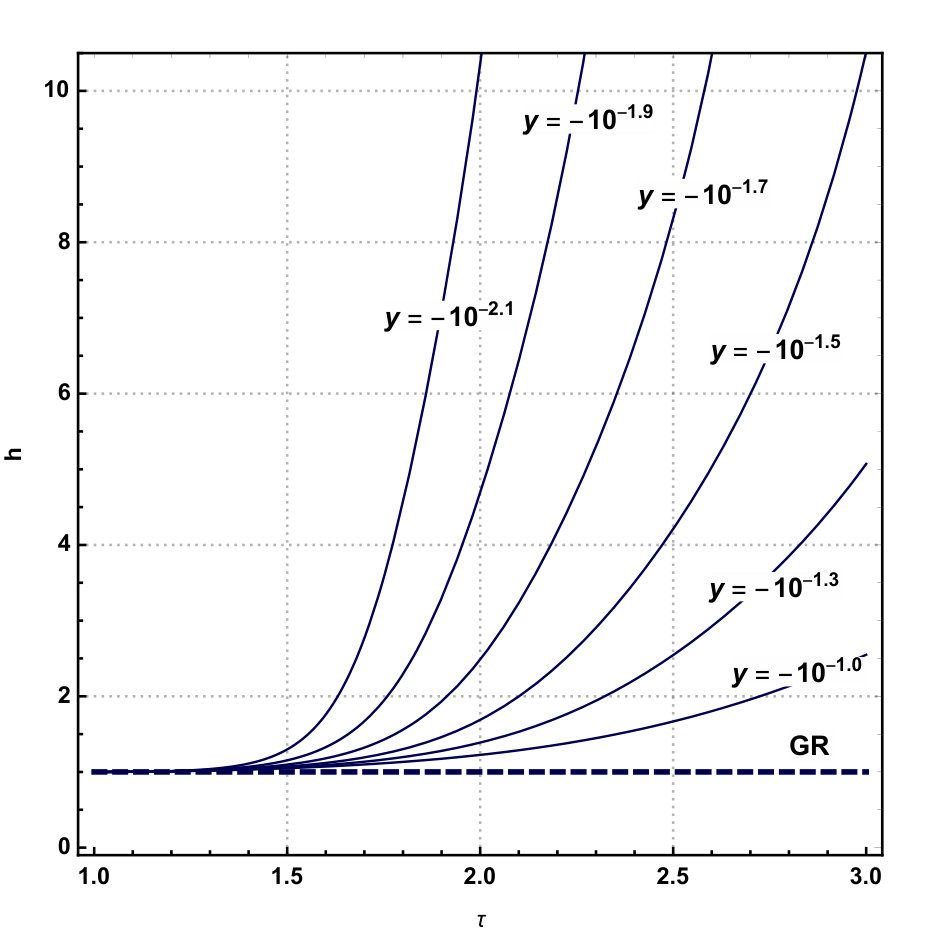 Figure 3
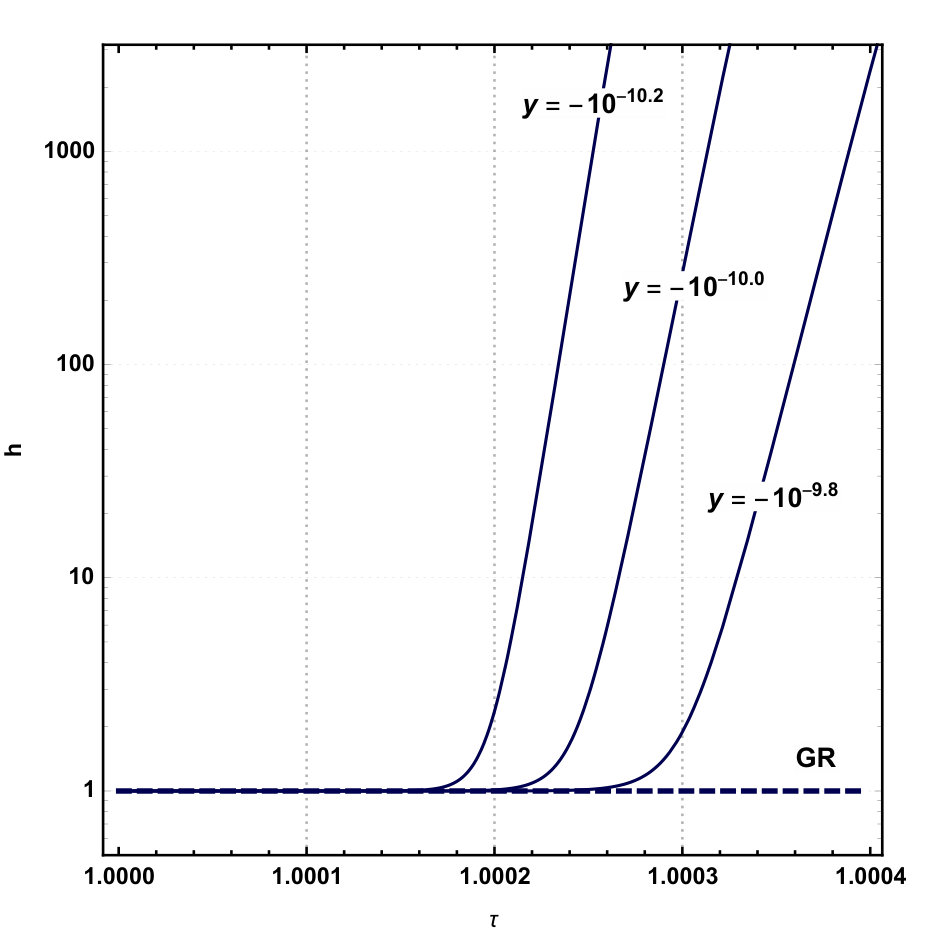 Figure 4
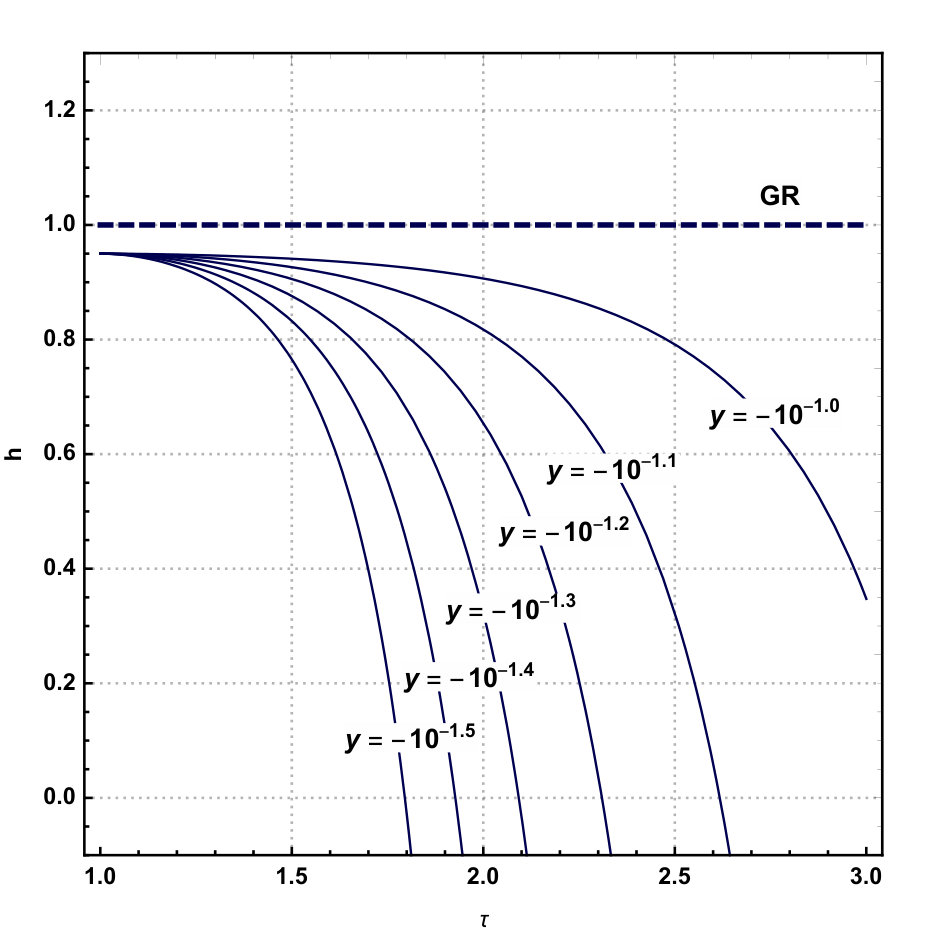 Figure 5
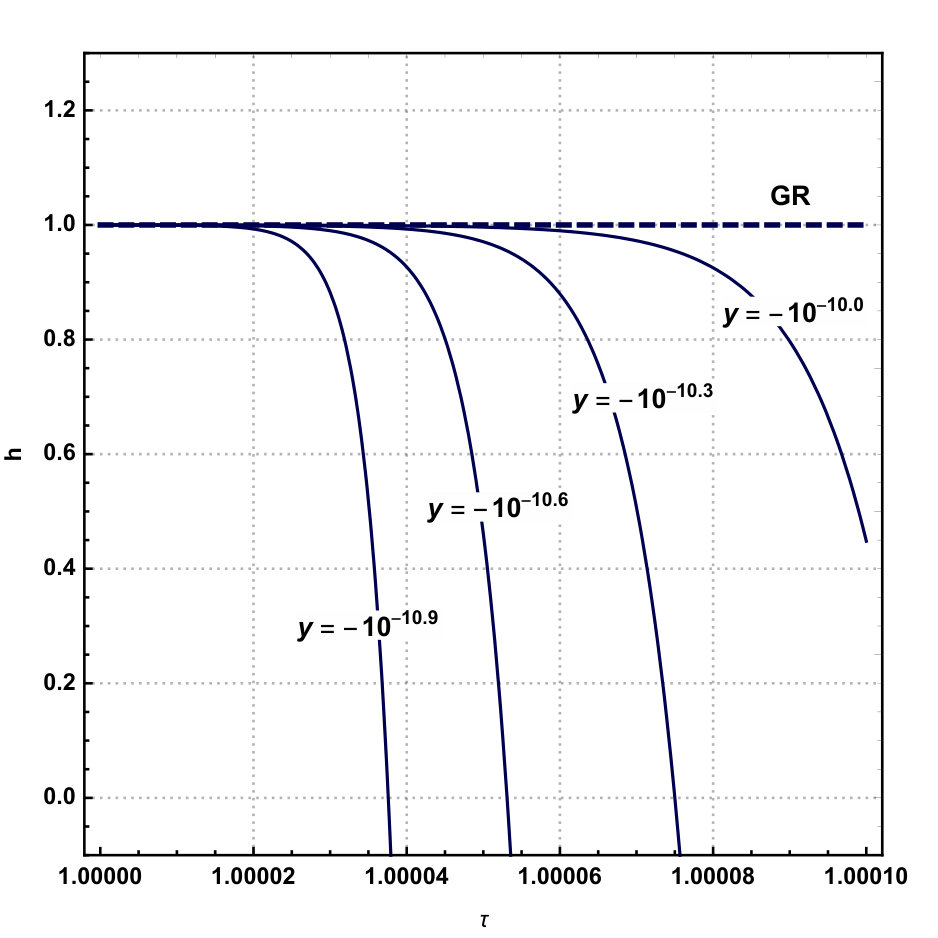 Figure 6
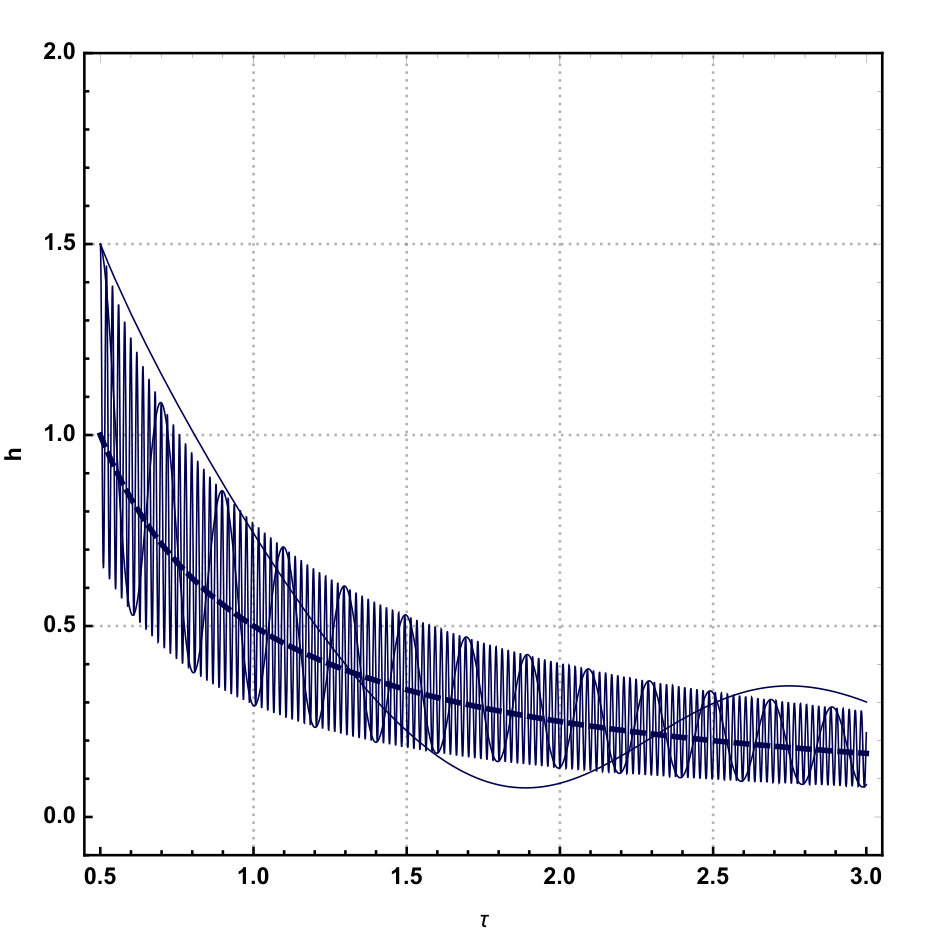 Figure 7
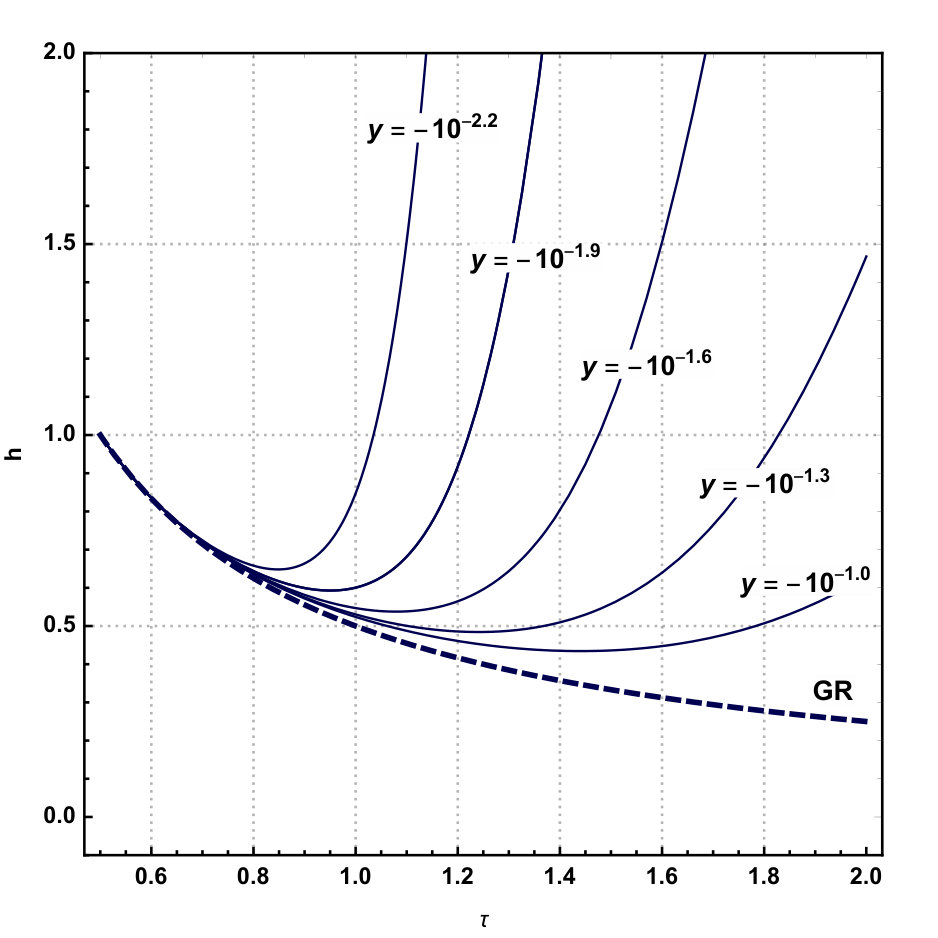 Figure 8
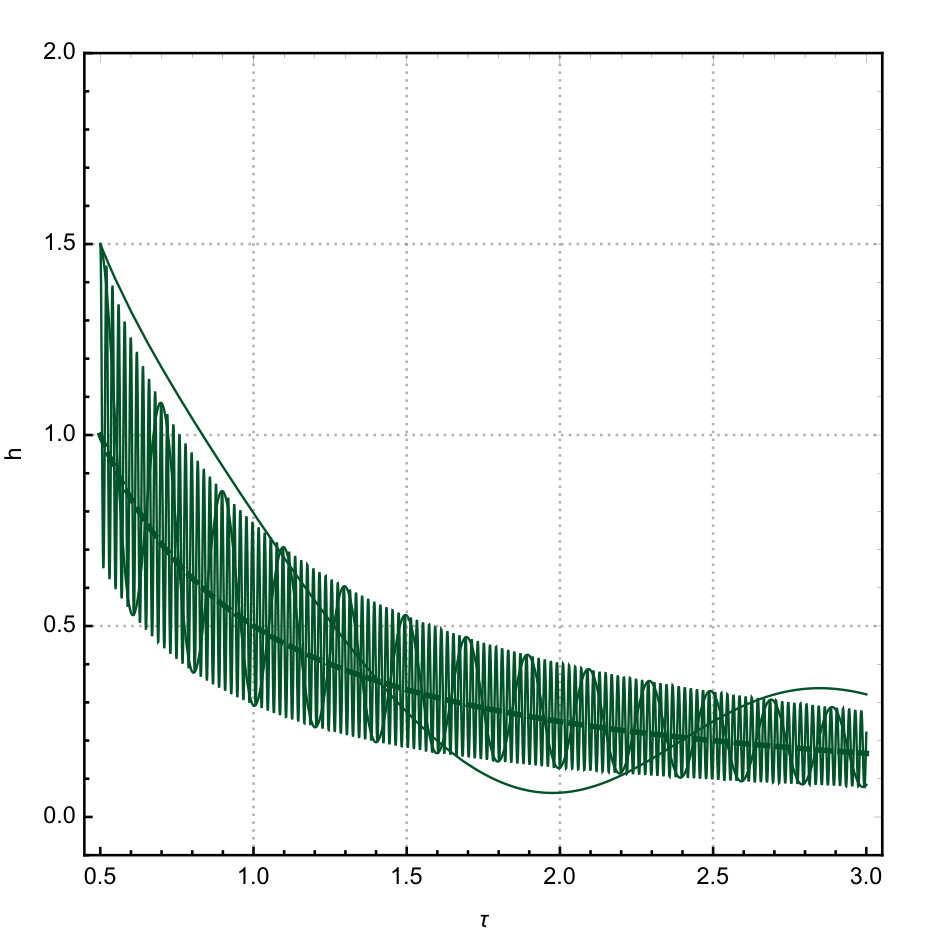 Figure 9
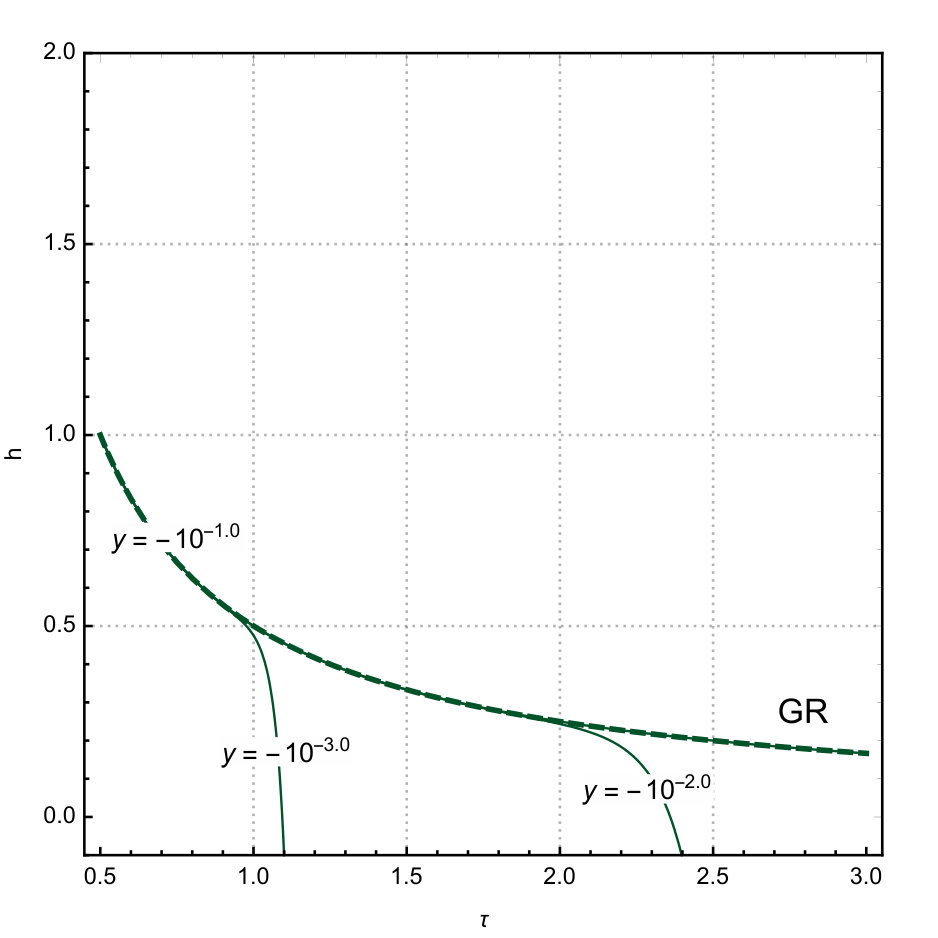 Figure 10
Peer Reviews
No public reviews on file for this paper yet. If you reviewed it on a platform where reviews are public (OpenReview, ICLR, NeurIPS, ICML), you can paste yours below so the community can read it here.
Videos
No videos yet. Explain this paper in a talk, walkthrough, or lecture? Add one.
**Spacetime Instability and Quantum Gravity
as Low Energy Effective Field Theory **
Hiroki Matsui*a,*[email protected],
a* Center for Gravitational Physics and Quantum Information, Yukawa Institute for Theoretical Physics, Kyoto University, 606-8502, Kyoto, Japan *
We discuss spacetime instability for effective field theories of quantum gravity. The effective action of gravity introduces infinite higher derivative curvature terms . Although these higher derivative curvature terms are indispensable to construct the self-consistent renormalizable theory of quantum gravity, they lead to several pathologies. We clearly show that even if they are written as the Planck-suppressed operators they lead to serious consequences and and de Sitter or radiation-dominated Universe is highly unstable. We show that the couplings of these higher derivative curvatures must satisfy to be consistent with the cosmological observations. Thus, the standard effective field theories of quantum gravity fail to describe the observed Universe unless introducing a specific technique dealing with the higher derivative curvature terms.
1 Introduction
To construct quantum field theory (QFT) of gravity has many serious problems. Famously, general relativity is not renormalizable which is a reasonable requirement on fundamental theory. Adding higher curvature terms [1] to Einstein-Hilbert action makes the theory renormalizable or even superrenormalizable [2, 3]. However, they lead to unphysical massive ghosts and spacetime instabilities. The spin- massive ghost brings a notorious unitary problem about the gravitational -matrix although further higher-curvature corrections might save such a unitary problem [4, 5, 6]. Furthermore, these higher curvatures destabilize classical spacetimes under small perturbations [7, 8, 9, 10, 11, 12] and provide unstable de Sitter spacetime solutions [13, 14]. Although they are indispensable ingredients for the renormalization [1] and constricting the perturbative effective field theories of quantum gravity (QG) or string theory [15, 16, 17], they provide undesired pathology and there has been considerable debate about these issues.
In the perturbative effective field theory of gravity, the higher curvature terms appear as quantum corrections in Einstein-Hilbert action and the effective action of the gravity can be given by [17],
[TABLE]
where the parameters of the effective action as the cosmological constant and Newton’s constant are determined by experiments and observations. The higher-derivative curvatures are leading quantum corrections and express gravitational vacuum polarization or quantum particle creation. For the effective field theory approaches, these coefficients are expected to be ( is a particle number for theory) and are strongly suppressed by Planck mass or reduced Planck mass which is defined by . Hence, one might consider that the low-energy physics and Planck-scale physics are safely sequestered. For instance, the Newtonian potential for gravitational interactions of two heavy objects can be described by the effective action [18],
[TABLE]
where we explicitly denoted the Planck constant . The first-order correction of comes from general relativity, whereas the second-order correction expresses quantum corrections which are derived by . These quantum corrections are safely negligible for the Newtonian potential and such quantum effects appear only at the very short distance. The above argument matches the heart of the perturbative effective field theories which are a standard paradigm of particle physics [19]. Hence, one expects that these quantum corrections are irrelevant in the low-energy physics and our universe would not receive such quantum effects except for very early stage like singularities [20, 21, 22].
However, these higher-derivative curvature terms modify Einstein equations to higher-derivative equations [23] and, consequently, the gravitational system has well-known Ostrogradski instability [24]. Even if such corrections are suppressed by the reduced Planck mass , the spacetime drastically changes compared with general relativity. Although these issues about the higher derivative quantum gravity or -gravity theories have been discussed in Refs. [25, 26, 27, 28, 29, 30, 31], they have not been fully clarified and considered in perturbative effective field theories of QG.
The present paper addresses the problem involving effective field theories of QG and discusses the spacetime instability induced by higher-derivative curvatures. In principle, we focus on the effective field theory approach of QG originating from Einstein gravity, but our results are directly applied to the higher-derivatives gravity theories. The present paper is organized as follows. In Section 2, we review the renormalization of the gravity why higher-derivative curvatures are indispensable for QG. In Section 3, we consider the effective action of the gravity and derive modified Einstein equations. Solving the modified Einstein equations, we investigate the instabilities of the Friedmann-Lemaitre-Robertson-Walker (FLRW) spacetime. In our analysis, we assume that the initial background solution is the solution of the Einstein gravity with , and discuss how much it varies on a timescale from that solution. We show that the de Sitter spacetime is unstable against small perturbations 222 The similar instability of de Sitter spacetime from higher-derivative quantum gravity has been discussed in [26]. and the de Sitter expansion rolls down to the Planckian stage or terminates even in one normalization time where is the initial value of the Hubble parameter, is the cosmic time, and we introduce a dimensionless timescale parameter to simplify our discussion. The instabilities are consistent with the early results of Refs. [10, 11]. The radiation dominated FLRW spacetime is also unstable and drastically changes in one normalization time . We clearly show that the homogenous and isotropic flat Universe is unstable and either grow exponentially or oscillate even in Planckian time . In Section 4 we draw the conclusion of our work.
2 Renormalization and effective action for gravity
The effective field theory of quantum gravity is a full quantum theory and should take into account the loop diagrams of the various fields [17]. Accidentally, all quantum corrections of gravity are renormalized into and the simplest renormalizable gravitational action can be contracted by using them. The only difference between higher-derivative renormalizable gravity and effective field theories of quantum gravity with respect to the leading quantum corrections is whether to introduce renormalized coupling constants or write down quantum corrections with ultraviolet (UV) cutoffs. Recalling that the Standard Model of particle theory is a renormalizable effective field theory, one can also treat the higher-derivative quantum gravity as an effective field theory and introduce an infinite higher-order curvature term. Hereafter, we will review how the higher-order curvature terms incorporate the quantum effects of gravity.
We introduce the simplest renormalizable (bare) gravitational action given as,
[TABLE]
where is the higher-derivative gravitational action,
[TABLE]
with the higher-derivative curvature couplings and is the matter action. These higher-derivative terms and couplings are indispensable for the renormalization to eliminate one-loop divergences. For instance, one-loop divergent corrections from scalar fields are calculated by using Schwinger-DeWitt method and dimensional regularization as follows [32]:
[TABLE]
where is the subtraction scale, is the regularization parameter and is the Euler’s constant, and or is the mass or non-minimal coupling of the scalar field. The higher-derivative corrections written as divergent quantum corrections express gravitational vacuum polarization or quantum particle creation. These divergences can be absorbed by (bare) coupling constants of the gravitational action of Eq. (3) and Eq. (4). Hence, we get renormalized coupling constants.
Proceeding to the renormalization, for instance, we obtain the renormalized cosmological constant,
[TABLE]
which express physical cosmological constant and express the renormalization scale. Recalling that the renormalized cosmological constant does not depend on the scale , we can get the renormalization group equations for the cosmological constant,
[TABLE]
where is one-loop -function for the cosmological constant. Similarly, we obtain the renormalization group equations for other gravitational coupling constants. If we consider real scalars with , Dirac spinors with and massless vector bosons gravitational one-loop -functions are given as follows [32, 33],
[TABLE]
where can not be fixed to be zero due the renormalization group (RG) running and they are expected to be
[TABLE]
where is the cut-off scale and a large number of particle species brings fine-tuning problems to the gravitational couplings. Clearly, the cosmological constant and the Newton’s constant must permit a hard fine-tuning against the quantum corrections. On the other hand, these higher-gravitational terms are interpreted as gravitational vacuum polarization or quantum particle production from gravity. Indeed, the particle creation ratio for the scalar field in the FLRW spacetime can be expressed by the higher-derivative terms [34],
[TABLE]
which is also consistent with the mode-mixing Bogolyubov technique. Clearly, these terms can not be regarded as low-energy decoupling effects of the cosmological constant and the Newton’s constant unlike the QED case (see e.g. the detailed discussion in [32]). We emphasize that these higher curvature terms are indispensable for the effective field theory of quantum gravity.
3 Quantum gravitational instabilities of spacetime
In this section, we will consider spacetime instability using the effective action (1) or (3) and (4) of the gravity at the one-loop level. The higher-derivative terms modify the Einstein’s equations and destabilize classical solutions of the spacetime even for the small perturbations. Here, we investigate the instabilities for the FLRW spacetime with various conditions and seek the stability condition.
The effective action of Eq. (3) and (4) derives the following modified Einstein’s equations [35], 333The Gauss-Bonnet term reduces to a topological surface term in and we can neglect it in modified Einstein’s equations.
[TABLE]
where is the vacuum expectation value of the energy-momentum tensor and,
[TABLE]
Since left-hand side of Eq. (11) is covariantly conserved, the quantum energy-momentum tensor must satisfy covariant conservation: . For a flat FLRW universe, the geometrical tensors and are related with . Thus, we obtain the following relation,
[TABLE]
in which we introduce . However, the quantum energy-momentum tensor requires more additional geometric tensors (for the detailed discussions see Ref [35]). For instance, the renormalized vacuum energy-momentum tensor for a massless conformal coupled scalar field which corresponds to the conformal anomaly [36, 37, 38, 39], is given as follows,
[TABLE]
where is introduced by the conformal anomaly
[TABLE]
Furthermore, we must introduce an additional geometric tensor which depends on the vacuum state like Eq. (45) (see Ref [35] for the details). From here we drop the brackets of and simply neglect . Hence, we obtain the following modified Einstein’s equations taking account of quantum gravitational effects, 444 The parameter for conformal invariant fields is expected to be [35],
(14)
[TABLE]
Thus, we can get a differential equation for the flat FLRW spacetime,
[TABLE]
Then, we rewrite Eq. (16) concerning the Hubble parameter 555 The derivative of Eq. (17) yields,
\displaystyle\begin{split}\dot{H}&={16\pi G_{N}}\alpha_{3}{H}^{2}\dot{H}-{48\pi G_{N}}{\alpha_{1}}\\ &\times\left(6\dot{H}^{2}+3H\ddot{H}+\dddot{H}\right)-4\pi{G}_{N}\left(1+\omega\right)\rho_{\rm matter}\,.\end{split}
which includes the covariant conservation law of Eq. (18).,
[TABLE]
where the energy density of matter satisfies the covariant conservation law,
[TABLE]
in which is an equation-of-state parameter. For non-relativistic, relativistic matter or vacuum state we get respectively. Note that Einstein’s equations have no additional terms and de Sitter spacetime is defined to be the vacuum spacetime: .
3.1 De Sitter spacetime solutions from quantum corrections
The modified Einstein’s equations are formally written as the higher-derivative equations, and therefore, they do not necessarily follow the standard description of general relativity. We note that the vacuum state of the effective Einstein’s equations leads to two classical and quantum de Sitter solutions [13]. Discarding time-derivative terms of Eq. (17), we get stationary solutions for the Hubble parameter as follows:
[TABLE]
For and relatively small cosmological constant , we can get two de Sitter spacetime solutions [13, 40, 41, 42, 43, 44],
[TABLE]
where turns out to be a classical de Sitter solution which is the same as the general relativity and is quantum driven de Sitter solution. On the other hand, the gravity theory has no quantum de Sitter solutions for . These two de Sitter solutions are generally unstable for the small perturbation [45] and then other spacetime derived from Eq. (15) show the instability. We consider this case in the next subsection.
3.2 Analytical estimation for FLRW spacetime instability
We briefly discuss why the modified Einstein’s equations (17) provide instability. Let us rewrite Eq. (17) as follows,
[TABLE]
For the smallness of we can approximately get the following equations
[TABLE]
This admits that the solutions either grow exponentially or oscillate even in Planckian time . For the perturbations oscillate in the Planck time and they emit the Planck energy photons, [7] which is unreasonable for the observed Universe. For the evolution of the Hubble parameter exponentially grow even in the Planck time and is not consistent with the observations. Hence, the large values of the gravitational curvature coupling are required to stabilize the homogenous and isotropic flat Universe.
3.3 Numerical estimation for FLRW spacetime instability
Next, we numerically show the instability of the FLRW spacetime using Eq. (17) and (18). First, let us start the de Sitter spacetime under small perturbations and consider the effects of gravity only. We rewrite Eq. (17) and (18) in terms of dimensionless quantities and obtain the following differential equation [25],
[TABLE]
where we introduce , , , , and is the initial Hubble parameter at some time . For instance, we can expect the following cosmological relations,
[TABLE]
where the former corresponds to the typical Hubble parameter during inflation from the current bound [46] and the latter is consistent with the current Hubble parameter dominated by the dark energy. These values for are expected by the one-loop -functions of high-derivative curvature couplings. The dynamics of the dimensionless Hubble parameter with the vacuum state and is determined by the following equation,
[TABLE]
where prime express the derivative with respect to dimensionless time . The natural de Sitter initial conditions are given by
[TABLE]
which makes the time-evolution of the system consistent with the general relativity at the initial time .
We investigate the system of equations starting at with various conditions and perturbations. We find out that the numerical solutions of the system of equations show the stability or instability which can be roughly understood by some analytical estimates. In Fig.1(a) and 1(b), we present the numerical results for the dimensionless Hubble parameter determined from Eq. (25) with the following initial conditions,
[TABLE]
and we compare them with the de Sitter solution from the general relativity. Fig.1(a) and 1(b) show that the de Sitter spacetime oscillates for the perturbation and the variation converges for a few normalization times . We found that the Hubble oscillation becomes faster for the small values of and the spacetime dynamics for or shows the same results. In Fig.2(a), 2(b), 3(a) and 3(b), we show the numerical results for the dynamics of the dimensionless Hubble parameter for and take the following conditions,
[TABLE]
We found that the de Sitter spacetime is destabilized by the Planck-suppressed quantum corrections in even if we set the tiny values of . Rather, the smallness of amplifies the spacetime instability and this case is inconsistent with the usual general relativity. In other words, the de Sitter spacetime is highly unstable for , whereas the instability can be alleviated for . This means a serious UV/IR mixing problem and the higher-derivative curvatures can not be ignored unless the higher-derivative curvature couplings for the gravitational action are extremely large.
Next, we investigate the radiation-dominated Universe with the relativistic state . For the radiation-dominated Universe, we get , . Taking and we can obtain the condition,
[TABLE]
where we rewrite and take . The condition is natural when we start the system at the radiation-dominated stage. In Fig.4(a) and 4(b) we investigate the system of equations starting at by using Eq. (23) with the following conditions and the higher-derivative parameters,
[TABLE]
and compare them with the radiation-dominated solution . Fig.4(a) show that the de Sitter spacetime oscillates for under the Hubble perturbations and the variations converge to the solutions of the general relativity. In this case we found that the Hubble oscillations are faster for the small values of . On the other hand, Fig.4(b) show that the higher-derivative curvature corrections lead to the instability and for the solutions do not follow general relativity. For , we demonstrate the dynamics of the normalized Hubble parameter in Fig.5(a) and Fig.5(b).
As we saw in the de Sitter spacetime the smallness of amplifies the instability [10, 11]. Therefore, the Planck-suppressed curvature corrections strongly affect the spacetime dynamics. For , the higher-derivative curvature corrections clearly destabilize the classical spacetime and the universe at least has to satisfy the following conditions,
[TABLE]
where is the renormalization scale. However, it is not easy to satisfy that condition because the higher-derivative curvature couplings usually change sign for the cosmological scale based on the renormalized group equations [33]. Hard fine-tuning is required for the couplings from the inflation to the current accelerating stage and moreover, the above condition is only effective for the one-loop perturbative corrections. Any higher-loop corrections require such conditions and that is not desired. Furthermore, for where the perturbations oscillate in the short time and they emit the high energy photons [7] which is inconsistent with the cosmological observations.
Let us discuss how large gravitational curvature couplings are required. As we saw in the de Sitter or radiation-dominated Universe the smallness of amplifies the instabilities, and therefore, the higher-curvature couplings should satisfy,
[TABLE]
where we use the current Hubble parameter . This requires large values of the gravitational curvature coupling or a large number of the particles species for the theory.
4 Conclusion
In this work, we have discussed the spacetime instability in the effective field theories of quantum gravity, where the theory requires as the leading quantum corrections. Although these higher-derivative curvatures are indispensable for the renormalization of the semiclassical or quantum gravity theories, they lead to serious problems. We have clearly shown that even if they are expressed as the Planck-suppressed operators they lead to catastrophic instability for the FLRW Universe. The cosmological solutions for the effective field theories of gravity either grow exponentially or oscillate even in Planckian time . In order to stabilize the universe the gravitational couplings must be rather large and a large number of the particles species are expected at the current observed scale. Thus, the standard effective field theories of quantum gravity naively fail to describe the observed Universe by the instability arising from higher-order derivative corrections.
The best-known and only approach to solving this problem is to consider all higher-order derivative terms to be small perturbations. In the specific perturbative approach [47, 48, 49, 50, 51], all higher-order differential terms, including local and nonlocal quantum corrections, running parameters, etc., are considered small perturbations to the Einstein-Hilbert terms of the GR, eliminating the instability problem due to ghosts. However, this is an ad hoc approach and it is not clear how valid it is. One would expect it to actually break down at larger energy scales, otherwise, it would prohibit the Starobinsky inflation model [48], which is phenomenologically very successful. Furthermore, the full contribution of higher-order derivative terms can not be ignored for sufficiently long timescales as our analysis. After all, the instability problem due to higher-order derivative terms in the effective field theories of quantum gravity is not exactly solved, and the directly derived modified Einstein equations contradict our observed universe.
Acknowledgments
The author thanks Fuminobu Takahashi, Takahiro Terada and Naoki Watamura for fruitful discussions and comments.
Data Availability
The datasets generated and/or analyzed during the current study are available from the corresponding author on reasonable request.
Appendix A Geometrical tensors for FLRW spacetime
Here, we provide geometrical tensors for FLRW spacetime. In this paper we take the FLRW line element as follows,
[TABLE]
in which express the scale factor with the cosmic time and,
[TABLE]
where is the spatial curvature parameter. For simplicity, we consider spatially flat spacetime . The conformal time parameter is given by,
[TABLE]
whose line element is given by
[TABLE]
We introduce and in which the prime ′ express the derivative of . The Ricci tensor, Ricci scalar and other geometrical tensors are given by [35],
[TABLE]
Appendix B Null energy condition and effective field theory of gravity
In this appendix, we show that the higher-derivative gravitational corrections violate the null energy condition (NEC). Although the NEC has little relation to the main result of this paper, we briefly mention it. The NEC is the weakest but most standard energy conditions to restrict the pathological spacetime for the general relativity and states that satisfy,
[TABLE]
for any null (light-like) vector . For a perfect fluid with positive energy, the NEC yields the relation: . The condition preclude undesired consequences such as wormhole, spacetime instabilities, superluminal propagation and unitary violations [52, 53, 54, 55, 56] for general relativity and it is consistent with gravitational thermodynamics [57, 58, 59, 60]. It is widely believed that any physical system or theory should respect the condition and the violation leads to pathology. Now, we will discuss whether the effective field theory of quantum gravity with the action (3) and (4) violates the NEC and the theoretical consequence.
For the cosmological framework of the flat FLRW universe, the Friedmann equations yield a simple equation,
[TABLE]
where the Hubble parameter decreases with time or stays constant if the null energy condition is satisfied. Thus, the flat FLRW spacetime always decelerates and finally terminates the expansion. On the other hand, the de Sitter spacetime is always stable and the cosmological constant satisfy the relation . The time-evolution of the Universe can be classified as,
[TABLE]
For the slow-roll inflation driven by an inflaton field , we have which is consistent with one’s intuition. On the other hand, considering the ghost field which has negative kinetic terms and provides problems in QFT, it leads to the relation . Thus, we can expect that the Hubble expansion ratio always decelerates or stays for ordinary cosmological theories.
First, let us consider semiclassical gravity which includes the backreaction effects of the quantum fluctuations onto spacetime. The de Sitter spacetime can be interoperated as one observer is surrounded by thermal radiation at the Hawking temperature [73] from the horizon. The energy density or pressure including the thermal de Sitter radiation can be written as
[TABLE]
The backreaction of the thermal Hawking radiation satisfies the NEC: and terminates the expansion as follows [74]
[TABLE]
where it is not surprising that the thermal backreaction of Eq. (43) satisfies the NEC since we regard the quantum corrections as classic matters. However, the above thermal interpretation of the de Sitter particle creations is not exact and it is necessary for a detailed consideration based on the QFT approach. In order to take into account of the gravitational vacuum polarization and quantum particle creation we usually consider the vacuum expectation values of the energy-momentum tensor . For a massless minimally coupled scalar field, the renormalized energy-momentum tensor is computed approximately for the Bunch-Davies vacuum as follows [75]:
[TABLE]
For simplicity, let us consider massless conformal coupled fields and the renormalized energy-momentum tensor for the scalar field is given by Eq. (13). The corresponding energy density or pressure is,
[TABLE]
which breaks the NEC and leads to the expansion [45]. Although semiclassical gravity does not quantize the metric it takes into account the backreaction of the quantum matter fields properly. However, the semiclassical gravity suffers from the spacetime instability and has the NEC violation. Similarly, we show the relation of the NEC for the effective field theory of gravity with the action (3) and (4), 666 We note that the averaged null energy condition (ANEC) [76] is also violated.
[TABLE]
where we can regard the higher-derivative gravitational corrections as quantum matter. It is clear that the effective field theory violates the NEC from the higher-derivative gravitational corrections and the Hubble expansion ratio can increase. We can similarly see unnatural consequences by using de Sitter entropy. The character of the gravitational thermodynamics in de Sitter spacetime is summarized by the de Sitter entropy [73] and the time-evolution is written as follows,
[TABLE]
Considering the classical matter the de Sitter entropy always increases,
[TABLE]
On the other hand, for the effective field theory of gravity, the de Sitter entropy can decrease as follows,
[TABLE]
which is inconsistent with gravitational thermodynamics [57].
The reference list from the paper itself. Each links out to its DOI / PubMed record.
- 1[1] K. S. Stelle, Renormalization of Higher Derivative Quantum Gravity , Phys. Rev. D 16 (1977) 953–969 . · doi ↗
- 2[2] I. L. Buchbinder, S. D. Odintsov and I. L. Shapiro, Effective action in quantum gravity . 1992.
- 3[3] M. Asorey, J. L. Lopez and I. L. Shapiro, Some remarks on high derivative quantum gravity , Int. J. Mod. Phys. A 12 (1997) 5711–5734 , [ hep-th/9610006 ]. · doi ↗
- 4[4] E. Tomboulis, Renormalizability and Asymptotic Freedom in Quantum Gravity , Phys. Lett. 97B (1980) 77–80 . · doi ↗
- 5[5] I. Antoniadis and E. T. Tomboulis, Gauge Invariance and Unitarity in Higher Derivative Quantum Gravity , Phys. Rev. D 33 (1986) 2756 . · doi ↗
- 6[6] L. Modesto, Super-renormalizable Quantum Gravity , Phys. Rev. D 86 (2012) 044005 , [ 1107.2403 ]. · doi ↗
- 7[7] G. T. Horowitz and R. M. Wald, Dynamics of Einstein’s Equation Modified by a Higher Order Derivative Term , Phys. Rev. D 17 (1978) 414–416 . · doi ↗
- 8[8] S. Randjbar-Daemi, Stability of the Minkowski Vacuum in the Renormalized Semiclassical Theory of Gravity , J. Phys. A 14 (1981) L 229 . · doi ↗