Deterministic 2-Dimensional Temperature-1 Tile Assembly Systems Cannot Compute
J\'er\^ome Durand-Lose, Hendrik Jan Hoogeboom, Nata\v{s}a Jonoska

TL;DR
This paper proves that deterministic 2D temperature-1 tile assembly systems are incapable of universal computation by characterizing their maximal assemblies as para-periodic and finite, thus limiting their computational power.
Contribution
It introduces the concept of para-periodic assemblies, characterizes maximal assemblies in confluent 1-TAS, and proves their computational limitations.
Findings
Maximal assemblies in confluent 1-TAS are para-periodic.
Such systems have at most one maximal assembly, which is either a grid or a union of combs.
Finite descriptions (quipu) can be algorithmically generated for these assemblies.
Abstract
We consider non cooperative binding in so called `temperature 1', in deterministic (here called {\it confluent}) tile self-assembly systems (1-TAS) and prove the standing conjecture that such systems do not have universal computational power. We call a TAS whose maximal assemblies contain at least one ultimately periodic assembly path {\it para-periodic}. We observe that a confluent 1-TAS has at most one maximal producible assembly, , that can be considered a union of path assemblies, and we show that such a system is always para-periodic. This result is obtained through a superposition and a combination of two paths that produce a new path with desired properties, a technique that we call \emph{co-grow} of two paths. Moreover we provide a characterization of an of a confluent 1-TAS as one of two possible cases, so called, a grid or a disjoint union of…
Click any figure to enlarge with its caption.
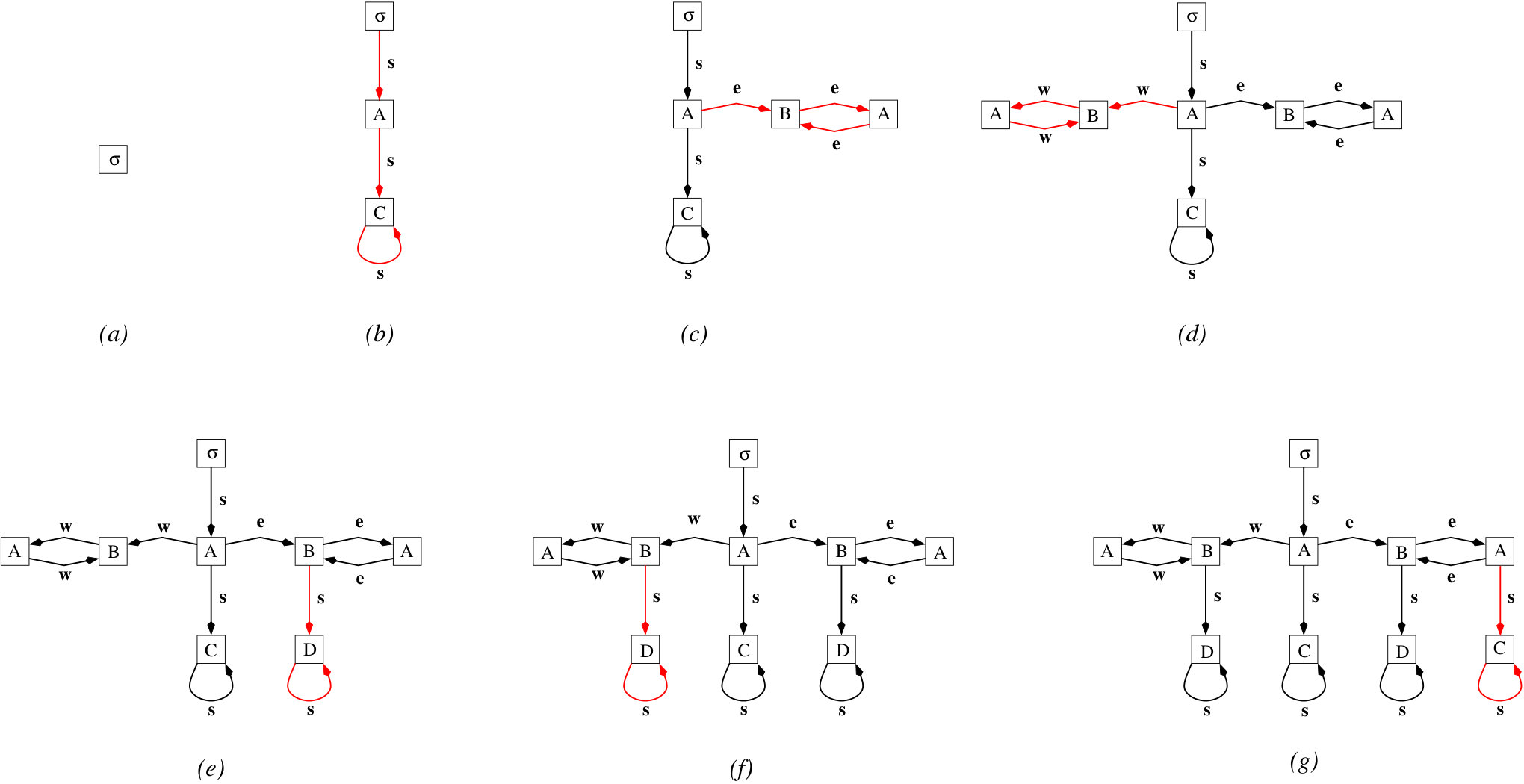 Figure 1
Peer Reviews
No public reviews on file for this paper yet. If you reviewed it on a platform where reviews are public (OpenReview, ICLR, NeurIPS, ICML), you can paste yours below so the community can read it here.
Videos
No videos yet. Explain this paper in a talk, walkthrough, or lecture? Add one.
Taxonomy
TopicsDNA and Biological Computing · Cellular Automata and Applications · Advanced biosensing and bioanalysis techniques