Topological Phases in Non-Hermitian Aubry-Andr\'e-Harper Models
Qi-Bo Zeng, Yan-Bin Yang, and Yong Xu

TL;DR
This paper explores topological phases in a non-Hermitian Aubry-Andre9-Harper model, revealing unique edge states and topological invariants, with potential experimental realization in electric circuits.
Contribution
It introduces a non-Hermitian AAH model with imaginary modulations, identifying novel edge modes and topological invariants not present in Hermitian systems.
Findings
Zero-energy edge modes localized at one edge
Existence of a quarter winding number in eigenenergy
Topological non-Hermitian quasicrystal with edge localization
Abstract
Topological phases have recently witnessed a rapid progress in non-Hermitian systems. Here we study a one-dimensional non-Hermitian Aubry-Andr\'e-Harper model with imaginary periodic or quasiperiodic modulations. We demonstrate that the non-Hermitian off-diagonal AAH models can host zero-energy modes at the edges. In contrast to the Hermitian case, the zero-energy mode can be localized only at one edge. Such a topological phase corresponds to the existence of a quarter winding number defined by eigenenergy in momentum space. We further find the coexistence of a zero-energy mode located only at one edge and topological nonzero energy edge modes characterized by a generalized Bott index. In the incommensurate case, a topological non-Hermitian quasicrystal is predicted where all bulk states and two topological edge states are localized at one edge. Such topological edge modes are protected…
Click any figure to enlarge with its caption.
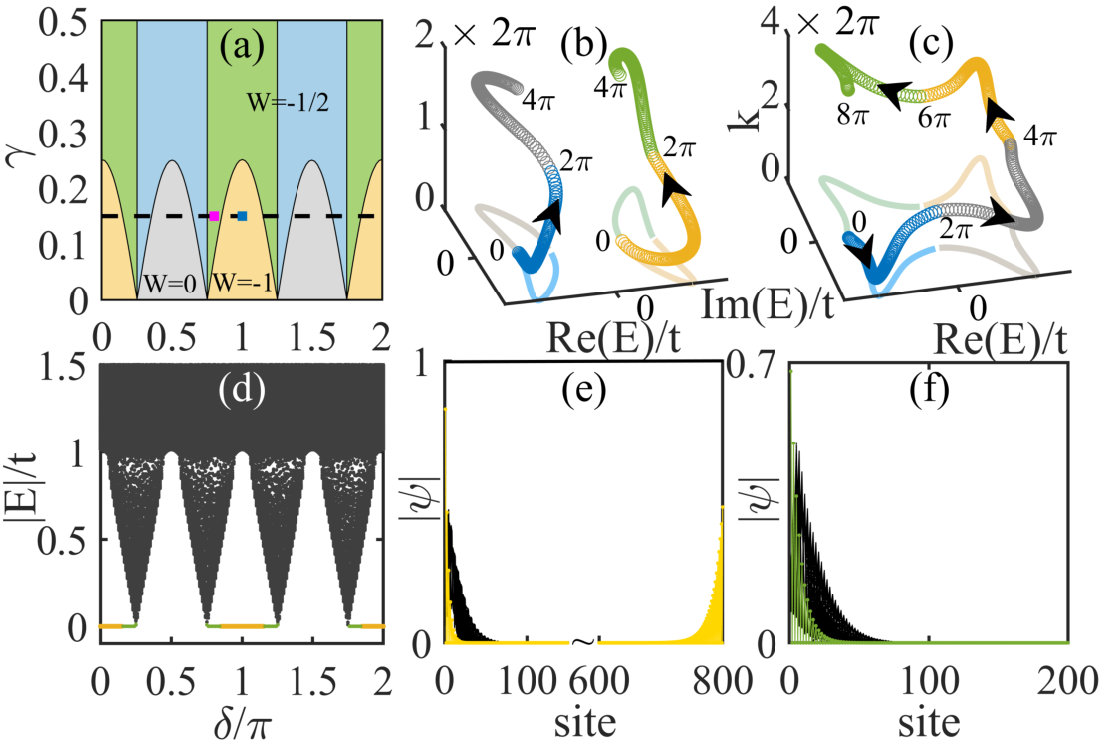 Figure 1
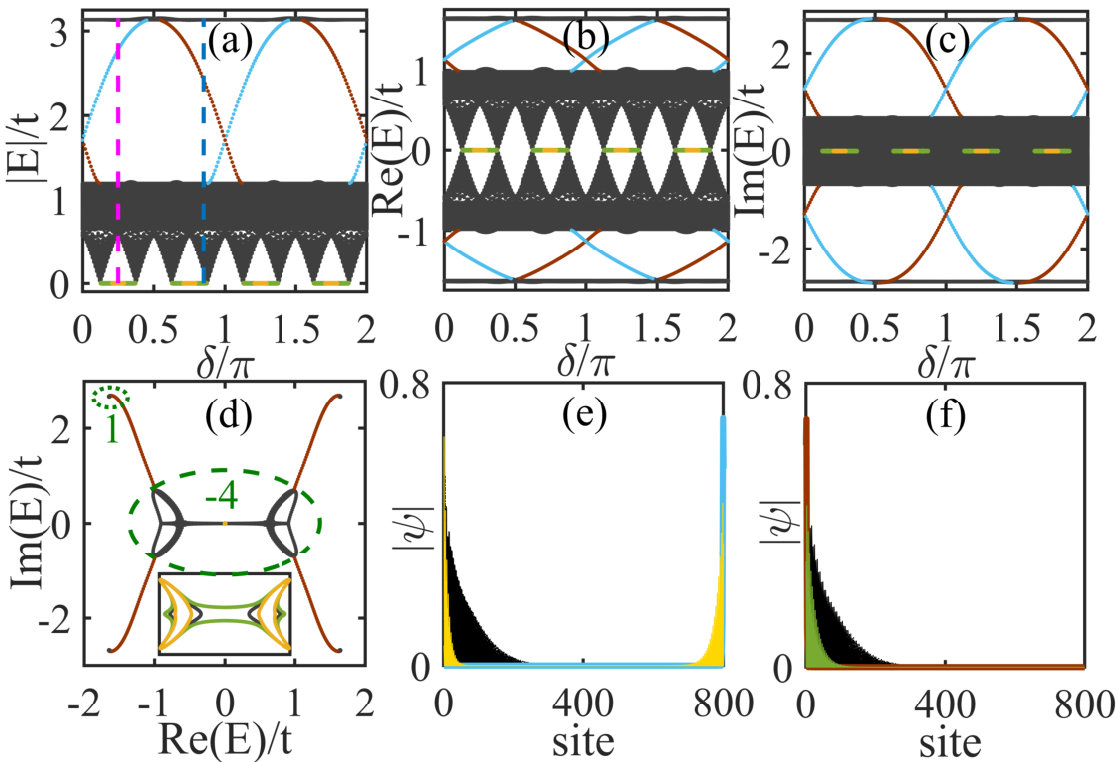 Figure 2
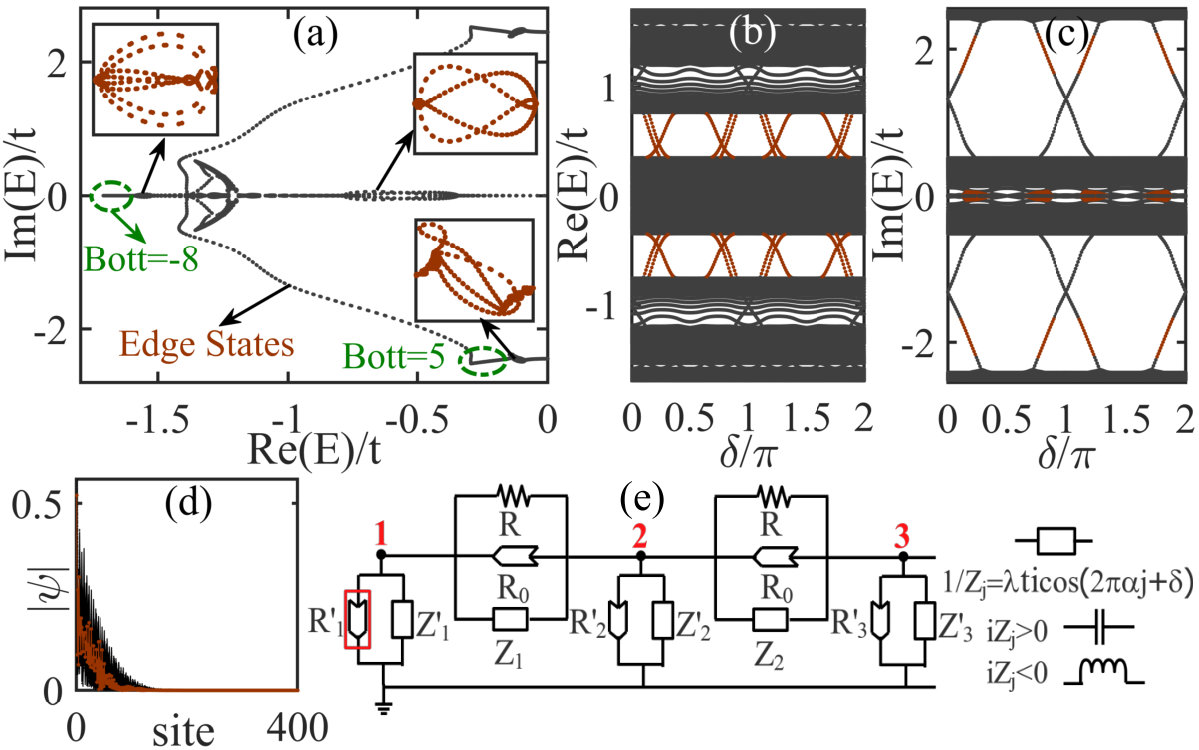 Figure 3
Peer Reviews
No public reviews on file for this paper yet. If you reviewed it on a platform where reviews are public (OpenReview, ICLR, NeurIPS, ICML), you can paste yours below so the community can read it here.
Videos
No videos yet. Explain this paper in a talk, walkthrough, or lecture? Add one.
Topological Phases in Non-Hermitian Aubry-André-Harper Models
Qi-Bo Zeng
Yan-Bin Yang
Yong Xu
Center for Quantum Information, IIIS, Tsinghua University, Beijing, 100084, P. R. China
Abstract
Topological phases have recently witnessed a rapid progress in non-Hermitian systems. Here we study a one-dimensional non-Hermitian Aubry-André-Harper model with imaginary periodic or quasiperiodic modulations. We demonstrate that the non-Hermitian off-diagonal AAH models can host zero-energy modes at the edges. In contrast to the Hermitian case, the zero-energy mode can be localized only at one edge. Such a topological phase corresponds to the existence of a quarter winding number defined by eigenenergy in momentum space. We further find the coexistence of a zero-energy mode located only at one edge and topological nonzero energy edge modes characterized by a generalized Bott index. In the incommensurate case, a topological non-Hermitian quasicrystal is predicted where all bulk states and two topological edge states are localized at one edge. Such topological edge modes are protected by the generalized Bott index. Finally, we propose an experimental scheme to realize these non-Hermitian models in electric circuits. Our findings add a new direction for exploring topological properties in Aubry-André-Harper models.
today
Topological phases have become one of the most fascinating and rapidly developing research field in condensed matter physics in the past decade, both theoretically and experimentally Hasan ; Qi ; Armitage . Despite being found in Hermitian systems, topological phases have recently sparked tremendous interests in non-Hermitian systems Rudner1 ; Esaki ; Bardyn ; Poshakinskiy ; Zeuner ; Malzard ; Rudner2 ; Aguado2016SR ; Lee3 ; Molina ; Joglekar2016PRA ; Zeng ; Weimann ; Leykam ; Xu ; Menke ; Xiao ; Lieu ; Zyuzin ; Fan2018PRB ; HZhou18 ; Yin ; Xiong ; Shen ; Kunst ; Yao1 ; Yao2 ; Gong ; Kawabata2 ; Takata ; YChen ; WYi2018 ; JHu2018 ; HZhang2018 ; Rechtsman2018 ; Song2018 ; RYu2018 ; Kunst19 ; Xu2019 ; Sato2019 ; HZhou19 ; Kawabata1 ; Herviou . Such systems exist naturally or artificially due to gain or loss arising from the finite lifetime of quasiparticles Fu2014 , the interaction with environment Bender1 ; Bender2 , the engineered complex refractive index Musslimani ; Feng2017Nat and the engineered Laplacian in electric circuits RYu2018 ; Thomale1 . A number of new topological phases have been found, such as anomalous edge modes corresponding to half a winding number in a non-Hermitian Su-Schrieffer-Heeger model Lee3 , Weyl exceptional rings with both quantized Chern number and quantized Berry phase Xu and anomalous corner modes in non-Hermitian higher order topological insulators Ueda2019PRL ; Edvardsson2018 ; Luo2019 .
While there have been extensive studies of topological non-Hermitian phenomena including classification of non-Hermitian topological phases Gong ; Sato2019 ; HZhou19 , the one-dimensional (1D) Aubry-André-Harper (AAH) model Aubry ; Harper has been largely overlooked and not well explored. The AAH model, a 1D system modulated by an on-site cosinusoidal potential, plays a very important role in investigating the Anderson localization and topological phases Siggia83 ; Kohmoto83 ; DasSarma88 ; DasSarma90 ; DasSarma09 ; DasSarma10 ; LJLang ; Zilberberg ; Zilberberg2012b ; Ganeshan ; Cai ; Chong ; Hu ; Zeng2 ; Yi . Specifically, the model can be mapped to a two-dimensional (2D) Hall effect system with topological edge modes LJLang ; Zilberberg ; Zilberberg2012b . Further generalization to an off-diagonal AAH model leads to a topological phase with zero-energy modes. Another very interesting aspect is that this model gives rise to a topological quasicrystal when the incommensurate modulation is considered Zilberberg ; Zilberberg2012b .
In this paper, we study the topological phases in a non-Hermitian off-diagonal AAH model with a purely imaginary cosinusoidal modulation and asymmetric hopping under both commensurate and incommensurate scenarios. We find that (i) non-Hermitian AAH models can host zero-energy modes at the edges. In contrast to the Hermitian counterpart, the zero-energy mode can be localized only at one edge. Such a topological phase corresponds to the existence of the structure of energy bands in momentum space enclosing a branch point of order 3 Needham , in contrast to the previously discovered structure enclosing a branch point of order 1 in the SSH model Lee3 . That implies that starting at any quasimomentum corresponding to an energy , we will return to this original energy if we continuously follow the value of the energy as the quasimomentum varies from to . This leads to a winding number being one quarter defined by the eigenenergy. (ii) We further find the coexistence of a zero-energy mode located only at one edge and nonzero energy edge modes. For the latter edge modes, we show that they can be characterized by a generalized Bott index in a system under open boundary conditions (OBCs). (iii) For incommensurate non-Hermitian quasicrystals, we demonstrate that both two edge modes and all bulk states are localized at one edge, in stark contrast to the Hermitian case where all bulk states are extended and two edge modes are localized at two edges. Such topological edge modes can also be characterized by the generalized Bott index. Finally, we propose an experimental scheme with electric circuits for realizing the non-Hermitian AAH models.
Model Hamiltonian.— We start by considering the following 1D non-Hermitian AAH model
[TABLE]
where () is the creation (annihilation) operator for a spinless particle at site , and denote the hopping strength and an asymmetric hopping strength, respectively, and depicts an imaginary modulation with , and being real parameters. When is a rational number such that with and being relatively prime positive integers, the modulation is periodic with being its period, whereas the modulation becomes quasiperiodic, when is an irrational number.
To determine the eigenenergy and eigenstates of the system under OBCs, we write the Hamiltonian as where \hat{c}=(\begin{array}[]{cccc}\hat{c}_{1}&\hat{c}_{2}&\cdots&\hat{c}_{L}\end{array}) with being the number of sites and diagonalize the Hamiltonian and allowing us to obtain both the left and right eigenstates and which satisfy and ( is the corresponding eigenenergy), respectively. In the commensurate case, the Hamiltonian is translational invariant with respect to sites under periodic boundary conditions. As a result, we can write the Hamiltonian in momentum space as where \hat{c}_{k}=(\begin{array}[]{cccc}\hat{c}_{1k}&e^{-ik/q}\hat{c}_{2k}&\cdots&e^{-i(q-1)k/q}\hat{c}_{qk}\end{array}) with and with and . Note that we have scaled the quasimomentum so that . The left and right eigenvectors in momentum space and can be obtained by diagonalizing the matrix and , respectively.
Zero-energy modes in the commensurate AAH model— Let us first consider the commensurate modulation. To show the topological features, we first consider the simplest case with . In Fig. 1(a), we map out the topological phase diagram with respect to and , showing four distinct topological phases characterized by , where and denote the winding number of the Hamiltonian in momentum space and the number of zero-energy edge eigenstates, respectively. These four phases correspond to , which will be elaborated on in the following discussion.
Since the 1D system for a fixed respects the sublattice symmetry SM ; ChiuReview , can be transformed into an off-diagonal block form SM : , and the winding number for each block is defined as Gong We can further define the winding number of the system as Gong . In the Hermitian case, leading to and thus has to equal an integer. However, the non-Hermitian term breaks this relation so that can be a half integer Gong . This occurs in our system with (see Fig. 1(a)). For a system with two energy bands, such as the SSH model, if , we have and with being an integer and thus and , where () changes continuously from to as varies from to . Since the eigenenergy is , implying that one ends up with the other energy starting from one energy as varies from to .
However, in our system, we find that when , all these four energy bands are connected (see Fig. 1(c)), implying that , where gains a as continuously vary from to , similar to . This shows that the energy encloses a branch point of order 3 so that a state needs to travel across the Brillouin zone four times to return. To discriminate with the case involving a branch point of order 1, we define a winding number for a separable energy band as
[TABLE]
with respect to a base energy , where with being the smallest integer so that this relation is satisfied. For the non-Hermitian SSH model involving a branch point of order 1, . However, in our system when , we find . Further calculation of the Berry phase as varies from [math] to shows that Xu . Interestingly, in the region with and and , we see that each separable energy bands encloses a branch point of order 1, yielding with respect to the corresponding base energies inside the rings (see Fig. 1(b)).
Under OBCs, we show that when , there appear two zero-energy edge states located at two edges as shown in Fig. 1(e). While this is similar to the Hermitian case, different properties arise that all bulk states are localized at the left edge when due to the non-Hermitian skin effects arising from the asymmetric hopping. More interestingly, when , we find a region (green) where there is only one zero-energy eigenstate located only at the left edge (see Fig. 1 (f)). In fact, the system exhibits a zero-energy exceptional point with a zero-energy eigenstate and a zero-energy generalized eigenstate, where the Hamiltonian becomes defective. This is also reflected by the change of with from to as varies from the yellow region to the green one.
In addition, we see that there exists a region (blue) where despite and , no zero-energy modes emerge, implying the breakdown of the bulk-edge correspondence (here bulk correspond to the wave functions in momentum space). This arises from the dramatic change of the bulk wave functions as boundary conditions are changed Xiong . To restore the bulk-edge correspondence, we need to use the wave functions under OBCs to calculate the winding number. Let us follow the method proposed in Ref. Yao1 and calculate the where is an identity matrix and with the Hamiltonian in momentum space SM . This equation gives us two solutions and for each satisfying . For the bulk states, . This leads to a generalized Bloch Hamiltonian so that calculation of the winding number of this Hamiltonian gives us the phase boundary for the existence of zero-energy modes. In fact, this new Hamiltonian gives the same winding number as the case without . For , we do not find any skin effects so that the bulk-edge correspondence is preserved, implying that the gap closing of the energy bands in momentum space with respect to signals whether zero-energy edge modes appear. We find that the gap closes when with and zero-energy edge modes emerge when as shown in Fig. 1.
In the general case, when ( being an integer and being prime to ) instead of a multiple of , we find that the energy spectrum of is gapless with the presence of zero-energy eigenstates for every SM , indicating the absence of the zero-energy edge modes in such cases footnote1 . When , we have proved that the spectrum of is gapless when with (suppose ) SM . When , it is proved that a gapped region can appear, showing that the topologically nontrivial zero-energy modes can exist SM . In other cases, for instance, when is an odd number, there is no sublattice symmetry and thus the zero-energy states cannot be protected.
Coexistence of distinct types of edge modes in the commensurate AAH model— The non-Hermitian AAH model also exhibits a peculiar feature that the single zero-energy mode can coexist with other topological nonzero energy edge modes (see Fig. 2). Specifically, Fig. 2 shows that there exist two regions with one and two zero-energy edge states, respectively. In the former region, for the eigenstates in momentum space. Besides the zero-energy states, we find other edge modes inside a gap, reminiscent of chiral edge modes in a Chern insulator if is viewed as a quasimomentum. In the complex energy plane for all , we observe five separable bands with four lines connecting four bands outside to one at the center; these four lines correspond to the edge states.
When , we find that all bulk states are localized at the left edge, implying that we need to use the wave functions obtained under OBCs to characterize the “chiral” edge states. Here, we generalize the Bott index Hastings by defining it as
[TABLE]
where with and and denoting the position operators along or , respectively, and labelling the size of the system along the corresponding direction. Additionally, and represent the right and left eigenvectors in a separable band, respectively. To calculate the Bott index, we map our system into a 2D Harper model footnoteHaper . Transforming this Hamiltonian along to the form in momentum space exactly gives us the Hamiltonian (1) if is replaced with . This allows us to calculate the Bott index of under periodic (open) boundary conditions along () to obtain the topological invariant of our system. We find that for the five separable bands, the Bott index is for the central band and for each of the other four bands at the corners of the complex energy plane (see Fig. 2(d)), demonstrating that the edge states are topologically protected. We note that, with OBCs, while there appear edge states connecting the separable bands, their presence does not affect our results.
Non-Hermitian quasicrystals.— When is irrational, the non-Hermitian AAH model becomes quasiperiodic, and the imaginary modulation is incommensurate with lattice spacings, leading to a quasicrystal. Similar to the commensurate scenario, in Fig. 3(a), we illustrate the energy spectrum in the complex energy plane for all from [math] to for . The figure exhibits rich band structures. Apparently, there are two separable bands with the imaginary value around . They are connected by the edge states (denoted by the brown lines) to the band with real energies. For each of these two bands, there is also a mini-gap within which four edge states reside (see the insets). For the band with real energies, there exist a gap and a mini-gap with four and eight edge states inside, respectively. These edge states can also be observed when the energy spectrum is projected to the real or imaginary part.
Remarkably, we further find that all bulk states are localized at the left edge when and all edge states are located at the left edge when is sufficiently large, in start contrast to the Hermitian case, as shown in Fig. 3(d). We note that the localization of the bulk states is caused by the non-Hermitian skin effect instead of the Anderson localization. Since the bulk states are sensitive to the boundary conditions, we cannot apply a twisted boundary condition to calculate the Chern number as the Hermitian case Zilberberg . Instead, we can still calculate the Bott index using the wave functions obtained under OBCs. We find that the Bott index for each separable band equals the number of edge states inside the gap. For instance, the Bott index of the band with the imaginary value around and the real value smaller than is 5, protecting five edge states coming from this band (see Fig. 3(a)).
Experimental realizations.— Recently, electric circuits have been demonstrated to be a powerful platform to simulate topological phenomena, such as the SSH model Thomale1 , Weyl semimetals Lu2019 and higher order topological insulators Thomale2 . Here, we propose an experimental scheme with electric circuits for realizing the non-Hermitian AAH models (see Fig. 3(e)). We can achieve the required the Laplacian so that by choosing appropriate impedances for these electric devices footnote2 . The edge states can be observed by measuring the two-point impedance between two nodes which diverges as as we vary .
In summary, we have demonstrated that for the commensurate non-Hermitian off-diagonal AAH model, there exist zero-energy states localized at the edges. In contrast to the Hermitian case, the edge states can be localized only at one edge. Such a topological phase corresponds to the emergence of a quarter winding number defined by eigenenergy in momentum space. We further find that the zero-energy edge modes can coexist with nonzero energy edge modes protected by the generalized Bott index. For the incommensurate case, topological non-Hermitian quasicrystals with edge modes are predicted. These edge modes can be characterized by the generalized Bott index. Our findings pave the way for further studies on topological properties in non-Hermitian Aubry-André-Harper models.
Acknowledgements.
Acknowledgement: We thank S.-T. Wang for helpful discussions. This work was supported by the start-up program of Tsinghua University and the National Thousand-Young-Talents Program.
I Supplementary Materials
In the supplementary material, we will derive the generalized Bloch Hamiltonian for bulk states with open boundary conditions, prove the condition under which the system is gapless around zero energy and discuss the condition for the presence of the winding number of the Hamiltonian in detail.
I.1 A. Generalized Bloch Hamiltonian
We follow the method proposed in WangZhong1 ; GeneralBloch to obtain the generalized Hamiltonian. For the commensurate case with with and being mutually prime positive integers, we can write the eigenstate of as where is the number of unit cells. For open boundary conditions, let us suppose that . The equation leads to
[TABLE]
where
[TABLE]
To have a nontrivial solution, we require that . This gives us a quadratic equation for with two solutions satisfying
[TABLE]
For bulk states, we require GeneralBloch in order to obtain a continuum band. This gives us
[TABLE]
The generalized Bloch Hamiltonian can be obtained by replacing the with in the Bloch Hamiltonian , that is,
[TABLE]
In the following, we will use the generalized Bloch Hamiltonian to determine the condition for the existence of zero-energy edge states with open boundary conditions and calculate the corresponding winding number.
I.2 B. Condition for the existence of topological zero-energy modes
In this section, we will show that for with being an integer, the spectrum is gapless around zero energy under periodic boundaries for all , while for , the spectrum is gapless for with (suppose ).
When is an even number, the system has the sublattice symmetry with being a diagonal matrix and we thus can transform into the off-diagonal form: \tilde{H}(k)=\left(\begin{array}[]{cc}0&\tilde{h}_{1}(k)\\ \tilde{h}_{2}(k)&0\end{array}\right) with
[TABLE]
which are matrices. Here . When , and . If the determinant of equals zero, i.e., , there will be eigenstates with zero eigenenergy.
In the case with , we have
[TABLE]
where and . This expression can be simplified to
[TABLE]
where
[TABLE]
We have
[TABLE]
Similarly, we obtain
[TABLE]
Thus, we have , indicating that for each , we can always find a such that . Therefore, we conclude that when , the system is gapless in the energy spectrum for all , implying the absence of the zero-energy edge states.
Before we consider the case for , we first present a lemma.
Lemma I.1**.**
Let with and being an integer larger than zero. If for all , then for each with , there exists a with such that ; conversely, for each with , there exists a with such that .
Proof.
Since the equation is satisfied for all , we have
[TABLE]
Let be an integer such that . With aids of Eq. (S14), multiplying Eq. (S13) by gives us
[TABLE]
where indicates that its subscripts cannot be equal to . We further multiply Eq. (S18) by and, with aids of Eq. (S15), we obtain
[TABLE]
We repeat this process until we get
[TABLE]
Since the left-hand expression can be written as , we have
[TABLE]
For all , this equation holds, implying that, for each , there exists a with such that . Conversely, similar derivation gives us
[TABLE]
implying that, for each , there exists a with such that . ∎
When , we have
[TABLE]
where , and
[TABLE]
where
[TABLE]
and
[TABLE]
When , we have
[TABLE]
Based on the lemma, if for all , we have
[TABLE]
where . This equation gives two types of possible solutions. For the first one,
[TABLE]
with being an integer, which does not hold as odd numbers cannot be equal to even ones. For the second one, we have
[TABLE]
Solving this equation shows that the gap of the energy spectrum closes when
[TABLE]
which is equivalent to
[TABLE]
with . This tells us that the energy gap closes for all when takes the above values. When takes other values, there exist so that the system is gapped, implying that the zero-energy edge states can exist there.
When , while we cannot prove that these in Eq. S33 are all the solutions to for all , we can verify that when take these values,
[TABLE]
yielding and thus the energy gap closes at some .
For each term in the numerator of , we can find a corresponding term in the denominator of to satisfy
[TABLE]
if the two indices and satisfy
[TABLE]
with being an integer. This is true for which is equivalent to with . It can also be seen that that holds true in these cases. Therefore, the energy spectrum is gapless at these points.
I.3 C. The Winding number of the generalized Bloch Hamiltonian
Since the system respect the sublattice symmetry, we can use the winding number as the topological invariant to characterize the zero-energy edge modes. When , the winding number of the generalized Bloch Hamiltonian for each block is defined as
[TABLE]
We obtain
[TABLE]
where denotes an integral path along a clockwise unit circle in the complex plane. Clearly, we have if and , if , corresponding to topologically nontrivial and trivial regions, respectively.
References
- (1) S. Yao and Z. Wang, Phys. Rev. Lett. 121, 086803 (2018).
- (2) K. Yokomizo and S. Murakami, arXiv:1902.10958 (2019).
The reference list from the paper itself. Each links out to its DOI / PubMed record.
- 1(1) M. Z. Hasan and C. L. Kane, Rev. Mod. Phys. 82 , 3045 (2010).
- 2(2) X.-L. Qi and S.-C. Zhang, Rev. Mod. Phys. 83 , 1057 (2011).
- 3(3) N. P. Armitage, E. J. Mele, and Ashvin Vishwanath, Rev. Mod. Phys. 90 , 015001 (2018).
- 4(4) M. S. Rudner and L. S. Levitov, Phys. Rev. Lett. 102 , 065703 (2009).
- 5(5) K. Esaki, M. Sato, K. Hasebe, and M. Kohmoto, Phys. Rev. B 84 , 205128 (2011).
- 6(6) C.-E. Bardyn, M. A. Baranov, C. V. Kraus, E. Rico, A. İmamoğlu, P. Zoller, and S. Diehl, New J. Phys. 15 , 085001 (2013).
- 7(7) A. V. Poshakinskiy, A. N. Poddubny, L. Pilozzi, and E. L. Ivchenko, Phys. Rev. Lett. 112 , 107403 (2014).
- 8(8) J. M. Zeuner, M. C. Rechtsman, Y. Plotnik, Y. Lumer, S. Nolte, M. S. Rudner, M. Segev, and A. Szameit, Phys. Rev. Lett. 115 , 040402 (2015).