The $O(\alpha^2)$ Initial State QED Corrections to $e^+e^-$ Annihilation to a Neutral Vector Boson Revisited
J. Bl\"umlein, A. De Freitas, C.G. Raab, K. Sch\"onwald

TL;DR
This paper provides a precise calculation of second-order QED initial state corrections for electron-positron annihilation into a neutral vector boson, highlighting discrepancies with previous results and confirming the factorization approach.
Contribution
It offers an exact analytic computation of $O( ext{alpha}^2)$ corrections, including non-logarithmic terms, and clarifies the validity of factorization in high-energy $e^+e^-$ processes.
Findings
Discrepancies with earlier $O( ext{alpha}^2)$ results at high energies.
Confirmation of the factorization of massive partons in Drell-Yan processes.
Addition of non-logarithmic terms previously omitted.
Abstract
We calculate the non-singlet, the pure singlet contribution, and their interference term, at due to electron-pair initial state radiation to annihilation into a neutral vector boson in a direct analytic computation without any approximation. The correction is represented in terms of iterated incomplete elliptic integrals. Performing the limit we find discrepancies with the earlier results of Ref.~\cite{Berends:1987ab} and confirm results obtained in Ref.~\cite{Blumlein:2011mi} where the effective method of massive operator matrix elements has been used, which works for all but the power corrections in . In this way, we also confirm the validity of the factorization of massive partons in the Drell-Yan process. We also add non-logarithmic terms at which have not been considered in \cite{Berends:1987ab}. The corrections are of…
Click any figure to enlarge with its caption.
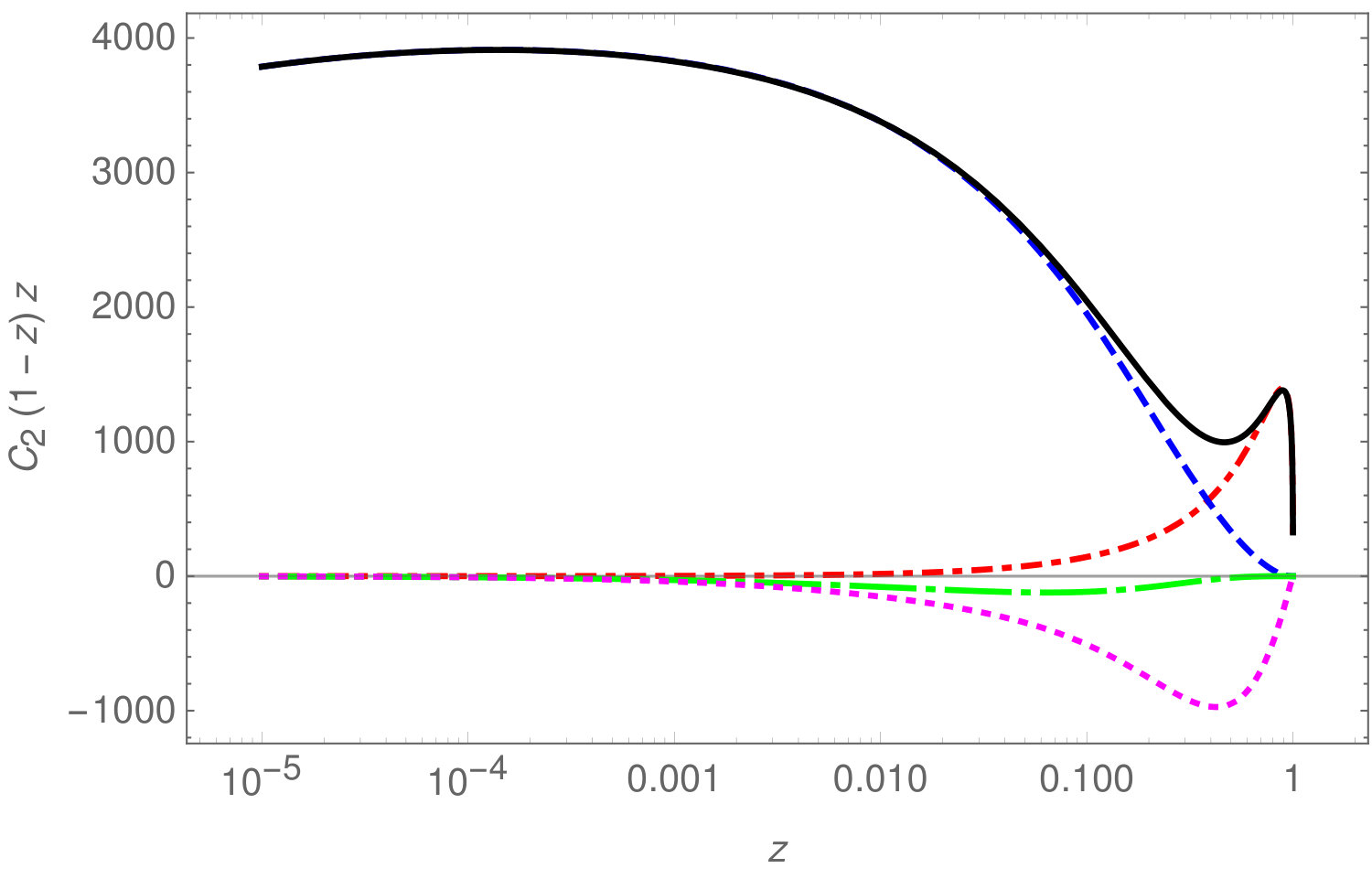 Figure 1
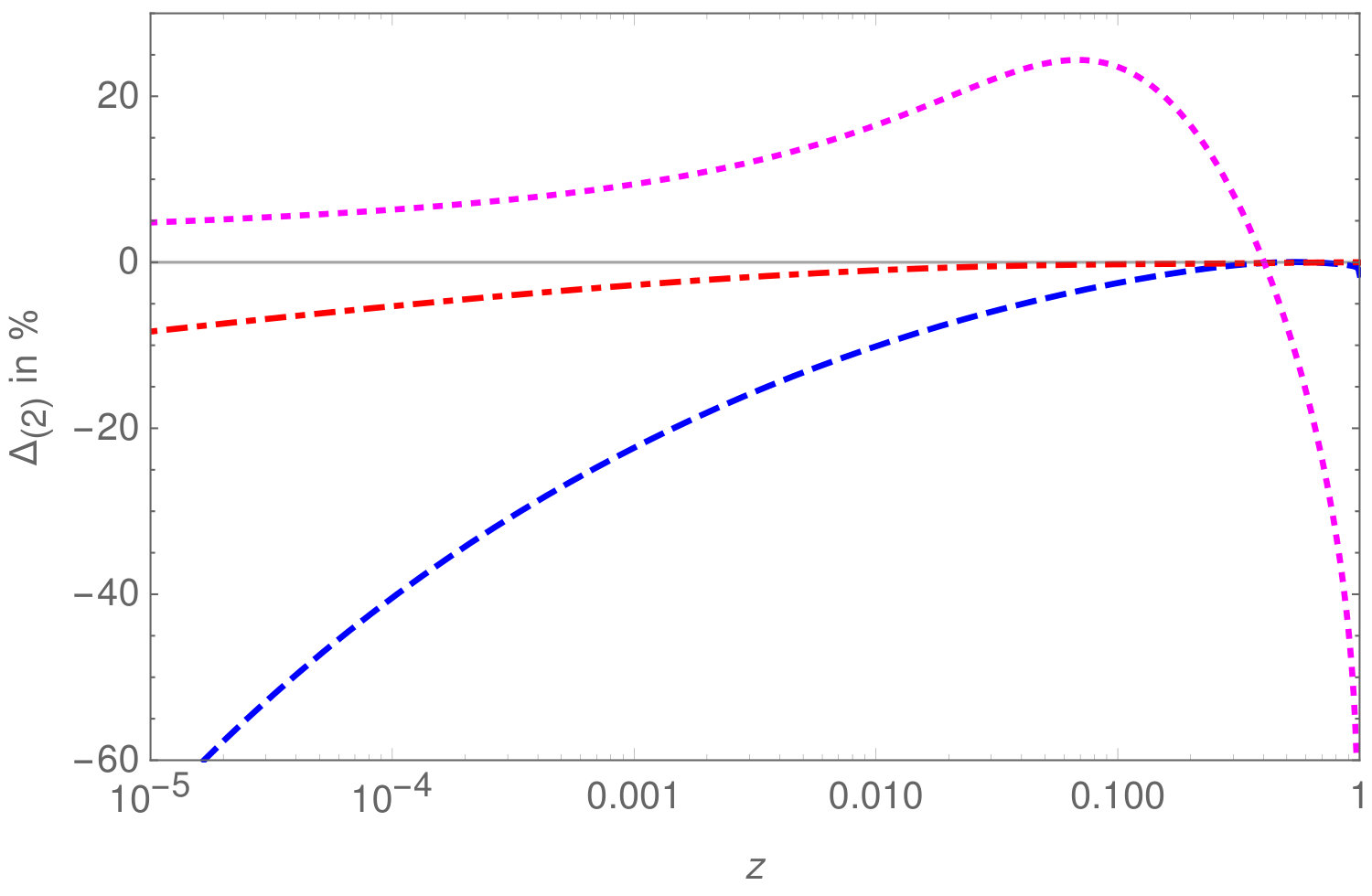 Figure 2
Peer Reviews
No public reviews on file for this paper yet. If you reviewed it on a platform where reviews are public (OpenReview, ICLR, NeurIPS, ICML), you can paste yours below so the community can read it here.
Videos
No videos yet. Explain this paper in a talk, walkthrough, or lecture? Add one.
The Initial State QED Corrections to Annihilation
to a Neutral Vector Boson Revisited
J. Blümlein
Deutsches Elektronen–Synchrotron, DESY, Platanenallee 6, D–15738 Zeuthen, Germany
A. De Freitas
Deutsches Elektronen–Synchrotron, DESY, Platanenallee 6, D–15738 Zeuthen, Germany
C.G. Raab
Institute of Algebra, Johannes Kepler University, Altenbergerstraße 69, A–4040, Linz, Austria
K. Schönwald
Deutsches Elektronen–Synchrotron, DESY, Platanenallee 6, D–15738 Zeuthen, Germany
Abstract
We calculate the non-singlet, the pure singlet contribution, and their interference term, at due to electron-pair initial state radiation to annihilation into a neutral vector boson in a direct analytic computation without any approximation. The correction is represented in terms of iterated incomplete elliptic integrals. Performing the limit we find discrepancies with the earlier results of Ref. Berends:1987ab and confirm results obtained in Ref. Blumlein:2011mi where the effective method of massive operator matrix elements has been used, which works for all but the power corrections in . In this way, we also confirm the validity of the factorization of massive partons in the Drell-Yan process. We also add non-logarithmic terms at which have not been considered in Berends:1987ab . The corrections are of central importance for precision analyzes in annihilation into at high luminosity.
pacs:
12.20.-m, 03.50.-z, 14.70.Hp, 13.40.Ks, 14.80.Bn
††preprint: DESY 18–226, DO–TH 18/30
The initial state QED corrections (ISR) to annihilation are of crucial importance for the experimental analyzes at LEP EWWG and for planned projects like the ILC and CLIC ILC , the FCC_ee FCCEE , muon colliders Delahaye:2019omf , and notably also at Higgs factories using the process , as well as . The initial state corrections have been carried out analytically to O\big{(}(\alpha L)^{5}\big{)} in the leading logarithmic series using the structure function method LO . A small -resummation has been performed in Blumlein:1996yz . In Ref. Berends:1987ab the corrections were calculated neglecting terms of O\big{(}\tfrac{m^{2}}{s}\ln(\tfrac{m^{2}}{s})\big{)}. Here is the cms energy squared and . These corrections are used in analysis codes such as TOPAZ0 Montagna:1998kp and ZFITTER ZFITTER . The initial state QED corrections can be written in terms of the following functions
[TABLE]
which yield the respective differential cross sections by
[TABLE]
with the scattering cross section without the ISR corrections, the fine structure constant and , where is the invariant mass of the produced (off-shell) boson.
In Ref. Blumlein:2011mi the method of massive operator matrix elements (OMEs) Buza:1995ie has been applied to calculate the corrections, factorizing the process into universal massive contributions and the massless Wilson coefficients of the Drell–Yan process Hamberg:1990np ; Harlander:2002wh . This method has been known to work in the case of external massless fields, including the non-logarithmic contributions in QCD, cf. Buza:1995ie ; Blumlein:2016xcy . However, the results of Refs. Berends:1987ab and Blumlein:2011mi were found to disagree.
One way to find out the correct answer is to perform the direct analytic calculation of the corresponding contributions without doing any approximation. This is done in the present paper for three of the subprocesses of the corrections related to fermion-pair production, i.e. for the processes II–IV of Ref. Berends:1987ab . Like in Refs. Berends:1987ab ; Blumlein:2011mi we will consider the case of pure vector couplings in the following. It is known already from the massless case Hamberg:1990np that in some of the processes axialvector-vector terms receive different corrections if compared to the pure vector or axialvector case. These aspects will be presented in Ref. BDRS . In the calculation we used the packages FORM, Sigma, HarmonicSums, HolonomicFunctions Vermaseren:2000nd ; Schneider:2007a ; Schneider:2013a ; Vermaseren:1998uu ; Blumlein:1998if ; Ablinger:2014rba ; Ablinger:2010kw ; Ablinger:2013hcp ; Ablinger:2011te ; Ablinger:2013cf ; Ablinger:2014bra ; Ablinger:2017Mellin ; KOUTSCHAN and private implementations RAAB1 . The complete results have an iterative integral representation. We compare the exact result numerically with the one obtained in the limit . Both results agree better than a relative deviation of at , as expected by neglecting the power corrections. The result is given in terms of the variable and powers of the logarithm . The logarithmic corrections in Berends:1987ab ; Blumlein:2011mi agree.
In the calculation, the phase space integrals can be mapped to fourfold scalar integrals. Here one depends on , with the mass squared of the emitted fermion pair. Unlike the case of and , the latter invariant is not large against everywhere. Three of the four integrals can be consecutively obtained yielding results which contain different functions whose arguments involve square-roots. It is then useful to construct a basis of the contributing root-valued letters and to perform the last integral over it, using differential field methods Ablinger:2014bra . Here also nested roots have to be transformed to single roots before. By this the complete integrals are at most triple iterated over an alphabet including also new types of square-root letters. Finally, the individual terms are regularized such that the expressions can be expanded in the ratio term by term BDRS1 . Typical letters are
[TABLE]
with
[TABLE]
Here denotes the next integration variable. After having performed suitable regularizations, one may also expand in before performing the last integral.
Processes II and III have been also considered primarily for massless quark–antiquark pair production in Refs. Kniehl:1988id ; SCHELLEKENS in 4–dimensional calculations. Here a quark mass serves as a regulator since the massless limit is aimed at from the beginning. Neglecting the mass terms not needed to regularize the corresponding integrals leads to simpler integrands, which finally integrate to polylogarithms directly and the logarithmic contributions in are obtained correctly. In the case discussed at present, however, the finite electron mass is physical and the expansion in is only possible if all terms which contribute to the final result are retained. This may require a deeper expansion in than the one performed in Ref. Berends:1987ab . Terms which can be safely neglected are of O\big{(}\rho\ln^{k}(\rho)\big{)},~{}k=0,1,2 in the result.
For process II in Berends:1987ab we find the difference term
[TABLE]
Here the original lower bound of the integral can be set to zero since its contribution is of the order of the neglected terms. From this integral it follows that terms containing higher powers in are appearing, which were not contained in Berends:1987ab ; Kniehl:1988id . They emerge from further terms in the mass expansion that cannot be neglected.
In the case of process III, Ref. Berends:1987ab , takes the results from SCHELLEKENS in which, however, mass terms being necessary here, were neglected beforehand since the result concerned a massless quark calculation REM1 . Note also that the pure singlet interference term SCHELLEKENS was taken with the wrong sign.
The difference terms, II, III, IV, for pair emission between the present results and those of Ref. Berends:1987ab , after the analytic expansion of the complete expression in including the constant term, read :
[TABLE]
with the term given in (B.22) of Hamberg:1990np setting . Here, and denote the polylogarithm and Nielsen integrals, respectively, cf. Devoto:1983tc . We remark that we agree with the result on the interference terms in the pure singlet case SCHELLEKENS which has been found there already to be regularization scheme invariant; it also agrees with the massless result Hamberg:1990np . Numerically, it turns out that the deviation due to the is small against the other differences for the pure singlet term. We agree with the result for emission for the non-singlet term (process II) of Refs. Berends:1987ab ; Kniehl:1988id , see also Ref. BDRS . This contribution has also a representation using massive OMEs. Here, however, the external fermion lines are massless since , see Ref. QCD3 . The terms of given in Berends:1987ab for process IV have not been observed in the respective contribution of the OMEs in Blumlein:2011mi . Terms of this kind are only expected for (anti)particle-(anti)particle scattering.
The relative deviations for the results for processes II–IV in the present calculation and Berends:1987ab are shown in Figure 1, where denotes the ratio of and the corresponding complete correction for II, III, IV. All illustrations are made for . The relative differences reach from +25 to –60% for . Here we have changed the term in Eq. (2.43) in Berends:1987ab which appears twice (suggesting a typo), such that this term is only logarithmic but not linear divergent for and thus integrable. Otherwise the difference would be even larger.
For the non-logarithmic terms, not all contributions have been considered in Berends:1987ab . These are the graphs B and their interference terms with the non-singlet (A) and pure singlet terms (C and D) in Hamberg:1990np . We have recalculated them in the massive case. Note that the interference term between the graphs A and B only contributes to the axialvector term. For these processes there is no massive OME. Since the massive OMEs contain all massive corrections in the limit , the only contributions are from the massless Wilson coefficients. We find in the corresponding massive calculation the massless results given in Hamberg:1990np , which is a further confirmation of the formalism presented in Ref. Buza:1995ie including the constant terms. This has also been observed e.g. in the case of the massive asymptotic two–loop corrections to the deep–inelastic structure function Buza:1995ie ; Blumlein:2006mh . Figure 2 shows the different contributions at of initial state pair production to -boson production. The dominant contributions come from the pure singlet and non–singlet terms; other contributions are smaller but not negligible at the 0.1% level in the radiator function. For large values of the non–singlet terms are dominant, whereas for z\;\hbox to0.0pt{\lower 3.5pt\hbox{\mathchar 0\relax\sim}\hss}\raise 1.0pt\hbox{<}\;0.03 the pure singlet contributions dominate.
Analogous contributions to those considered here have been calculated at three–loop order for the massive OMEs in QCD with external massless parton lines in QCD3 . When Ref. Blumlein:2011mi was published, we could not explain the differences to Ref. Berends:1987ab and we tended to assume that the OME method might have a problem in case of massive external states, which is now proven not to be the case. The factorization of massive initial states for the Drell-Yan process Collins:1998rz is also observed in the case discussed here.
Acknowledgments
This paper is dedicated to the memory of our colleague W.L. van Neerven. We would like to thank J.C. Collins, J.H. Kühn, G. Passarino, C. Schneider and G. Sterman for discussions. This project has received funding from the European Union’s Horizon 2020 research and innovation programme under the Marie Sklodowska-Curie grant agreement No. 764850, SAGEX, and COST action CA16201: Unraveling new physics at the LHC through the precision frontier and from the Austrian FWF grants P 27229 and P 31952 in part.
The reference list from the paper itself. Each links out to its DOI / PubMed record.
- 1(1) F.A. Berends, W.L. van Neerven and G.J.H. Burgers, Nucl. Phys. B 297 (1988) 429 Erratum: [Nucl. Phys. B 304 (1988) 921].
- 2(2) J. Blümlein, A. De Freitas and W.L. van Neerven, Nucl. Phys. B 855 (2012) 508 [ar Xiv:1107.4638 [hep-ph]].
- 3(3) https://lepewwg.web.cern.ch/LEPEWWG/ S. Schael et al. Phys. Rept. 427 (2006) 257 [hep-ex/0509008].
- 4(4) E. Accomando et al. Phys. Rept. 299 (1998) 1 [hep-ph/9705442]; J.A. Aguilar-Saavedra et al. hep-ph/0106315; http://www.linearcollider.org/ILC R. Franceschini et al. , ar Xiv:1812.07986 [hep-ex].
- 5(5) http://tlep.web.cern.ch/
- 6(6) J.P. Delahaye et al. , Muon Colliders , ar Xiv:1901.06150 [physics.acc-ph].
- 7(7) A.B. Arbuzov, Phys. Lett. B 470 (1999) 252 [hep-ph/9908361]; JHEP 0107 (2001) 043 [hep-ph/9907500]; J. Blümlein and H. Kawamura, Nucl. Phys. B 708 (2005) 467 [hep-ph/0409289]; Eur. Phys. J. C 51 (2007) 317 [hep-ph/0701019] and references in these papers.
- 8(8) J. Blümlein, S. Riemersma and A. Vogt, Eur. Phys. J. C 1 (1998) 255 [hep-ph/9611214].