Quantum state tomography across the exceptional point in a single dissipative qubit
M. Naghiloo, M. Abbasi, Yogesh N. Joglekar, and K. W. Murch

TL;DR
This paper experimentally investigates the effects of exceptional point degeneracies on a single dissipative qubit using quantum state tomography, revealing phenomena like PT symmetry breaking and decoherence enhancement in a quantum regime.
Contribution
It demonstrates the first quantum state tomography of a dissipative qubit near an exceptional point, highlighting non-Hermitian effects in quantum systems.
Findings
PT symmetry breaking transition observed at zero detuning
Decoherence enhancement detected at finite detuning
Quantum signature of the exceptional point in relaxation state
Abstract
Open systems with gain and loss, described by non-trace-preserving, non-Hermitian Hamiltonians, have been a subject of intense research recently. The effect of exceptional-point degeneracies on the dynamics of classical systems has been observed through remarkable phenomena such as the parity-time symmetry breaking transition, asymmetric mode switching, and optimal energy transfer. On the other hand, consequences of an exceptional point for quantum evolution and decoherence are hitherto unexplored. Here, we use post-selection on a three-level superconducting transmon circuit with tunable Rabi drive, dissipation, and detuning to carry out quantum state tomography of a single dissipative qubit in the vicinity of its exceptional point. Quantum state tomography reveals the PT symmetry breaking transition at zero detuning, decoherence enhancement at finite detuning, and a quantum signature…
Click any figure to enlarge with its caption.
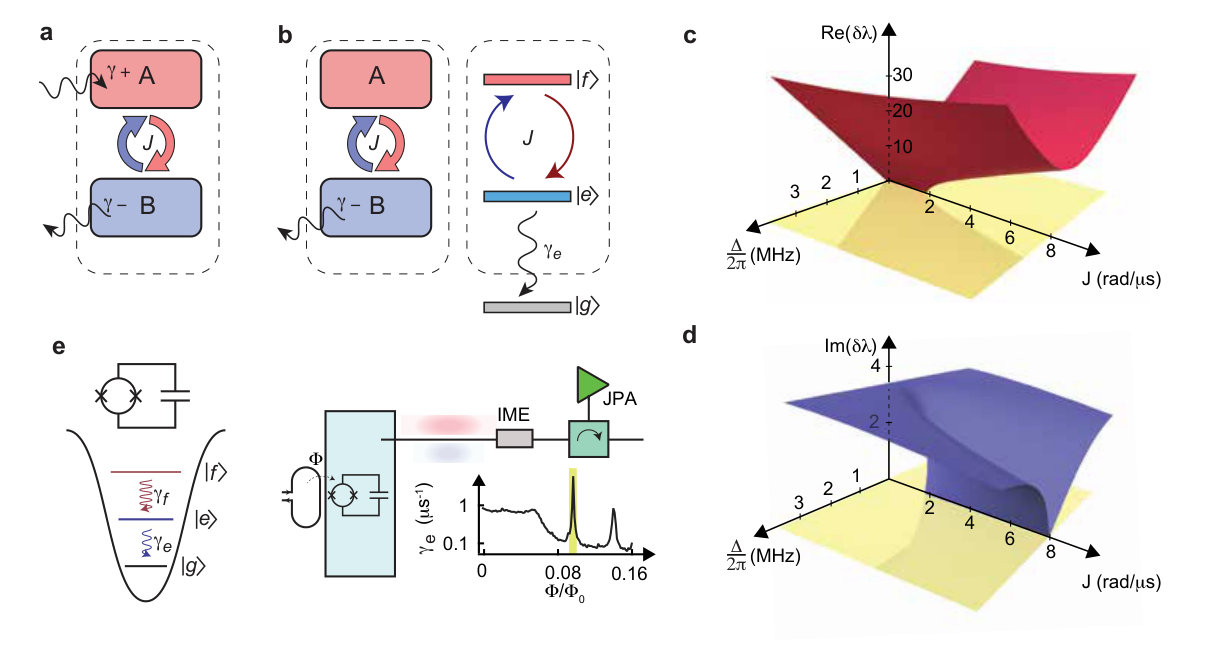 Figure 1
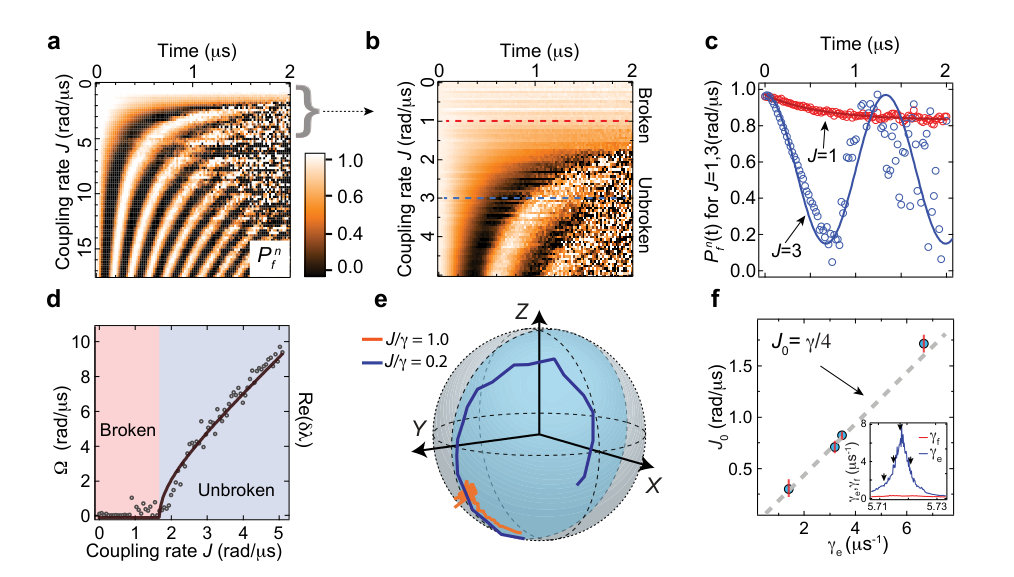 Figure 2
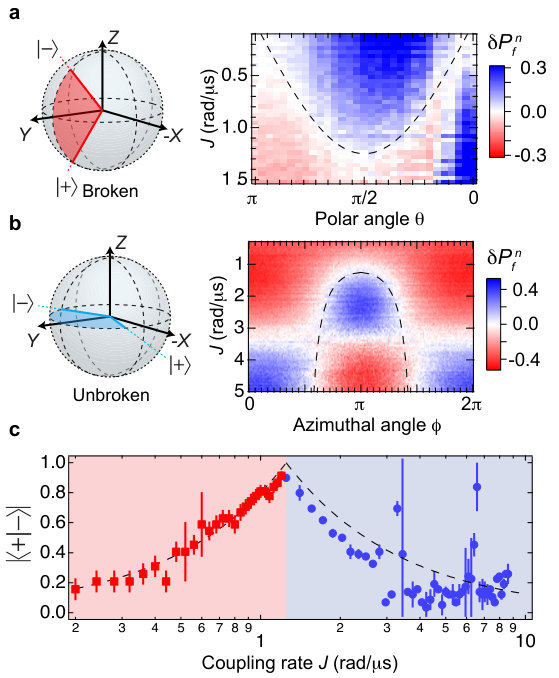 Figure 3
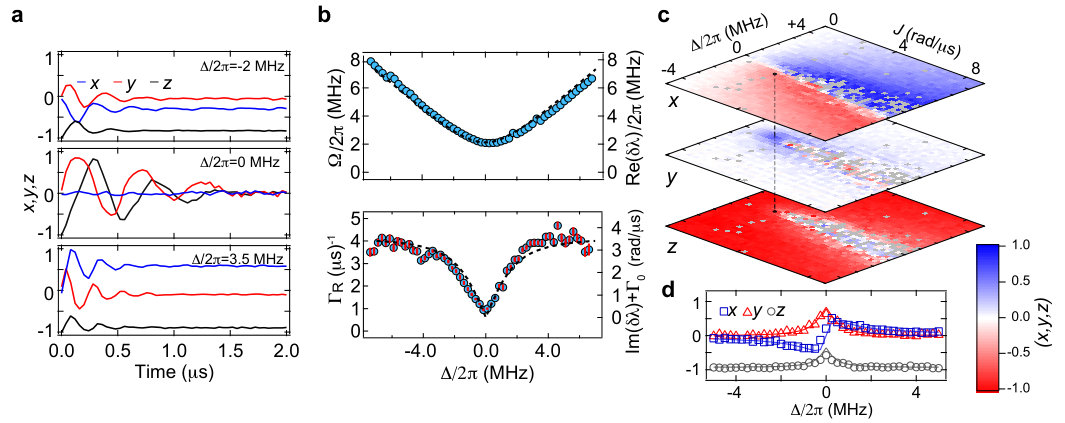 Figure 4
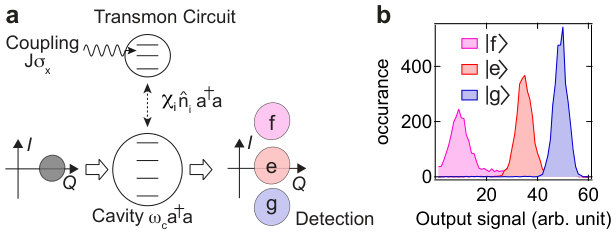 Figure 5
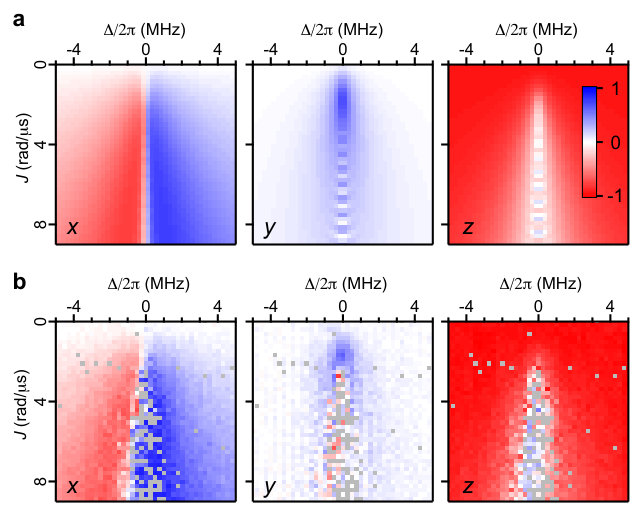 Figure 6
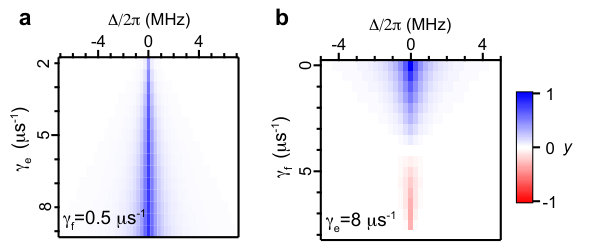 Figure 7
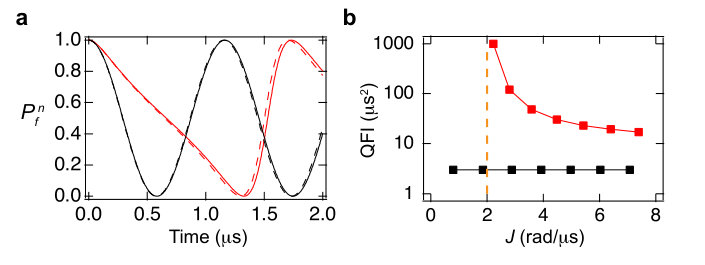 Figure 8
Peer Reviews
No public reviews on file for this paper yet. If you reviewed it on a platform where reviews are public (OpenReview, ICLR, NeurIPS, ICML), you can paste yours below so the community can read it here.
Videos
No videos yet. Explain this paper in a talk, walkthrough, or lecture? Add one.
Quantum state tomography across the exceptional point in a single dissipative qubit
M. Naghiloo
Department of Physics, Washington University, St. Louis, Missouri 63130
M. Abbasi
Department of Physics, Washington University, St. Louis, Missouri 63130
Yogesh N. Joglekar
Department of Physics, Indiana University Purdue University Indianapolis (IUPUI), Indianapolis, Indiana 46202
K. W. Murch
Department of Physics, Washington University, St. Louis, Missouri 63130
Institute for Materials Science and Engineering, St. Louis, Missouri 63130
(March 16, 2024)
Abstract
Open systems with gain and loss, described by non-trace-preserving, non-Hermitian Hamiltonians, have been a subject of intense research recently. The effect of exceptional-point degeneracies on the dynamics of classical systems has been observed through remarkable phenomena such as the parity-time symmetry breaking transition, asymmetric mode switching, and optimal energy transfer. On the other hand, consequences of an exceptional point for quantum evolution and decoherence are hitherto unexplored. Here, we use post-selection on a three-level superconducting transmon circuit with tunable Rabi drive, dissipation, and detuning to carry out quantum state tomography of a single dissipative qubit in the vicinity of its exceptional point. Quantum state tomography reveals the symmetry breaking transition at zero detuning, decoherence enhancement at finite detuning, and a quantum signature of the exceptional point in the qubit relaxation state. Our observations demonstrate rich phenomena associated with non-Hermitian physics such as non-orthogonality of eigenstates in a fully quantum regime and open routes to explore and harness exceptional point degeneracies for enhanced sensing and quantum information processing.
In introductory treatments of quantum mechanics one typically assumes that a Hamiltonian describing a physical system is Hermitian thus ensuring the reality of energy eigenvalues and a unitary time evolution. Many open physical systems are instead described by effective non-Hermitian Hamiltonians that characterize the gain or loss of energy or particle-number from the system. In recent years there has been growing interest in non-Hermitian systems, particularly those with space-time reflection () symmetry exhibiting transitions from purely real to complex-conjugate spectra bend98 ; most10 . Such non-Hermitian systems have been realized with optical rute10 ; rege12 ; hoda14 ; feng14 ; peng14_2 ; feng17 ; el2018 and mechanical systems bendpend with balanced gain and loss, or with mode-selective loss guo09 ; zeun15 ; li16 ; weim16 ; xiao17 . The degeneracies of such Hamiltonians occur at exceptional points (EPs) where the eigenvalues, and corresponding eigenmodes coalesce, and are topological in nature dopp16 ; zhen15 ; gao15 ; kato ; heis12 ; zhan17 . Open systems in the vicinity of EPs have shown functionalities including lasing peng14 ; miao16 ; wong16 , topological features wang09 ; rech13 ; chan14 ; el2018 , optimal energy transfer xu16 ; assa17 , and enhanced sensing hoda17 ; chen17 that are absent in their closed counterparts. However, most of these realizations are limited to classical (wave) systems in which the amplitude information is measured, but the phase information is ignored. Thus, the effects of the -transition and a system’s proximity to the EP on its full quantum evolution and decoherence are open questions.
Here, we employ bath engineering techniques to realize a superconducting circuit with quantum energy levels that are described by a non-Hermitian Hamiltonian and use quantum state tomography to observe the dynamics of the non-Hermitian qubit across and in the vicinity of the exceptional point. At zero detuning, we observe the symmetry breaking transition as manifested in the evolution of both diagonal and off-diagonal elements of the system’s density matrix. By measuring the overlap of the eigenstates of the effective Hamiltonian across the transition, we observe their coalescence at the EP. We go on to show that the decoherence rate of the qubit and the steady state it reaches are both affected by the system’s proximity to the EP.
A canonical example of a -symmetric system consists of a bipartite system with balanced gain (part A) and loss (part B) as shown in Figure 1a. Such systems have been experimentally studied in the classical domain. The central feature of these systems is a transition from broken to unbroken symmetry. When the coupling, given by rate , between the two parts is larger than the gain-loss rate, given by , the system exhibits a real spectrum and simultaneous eigenmodes of both the Hamiltonian and the antilinear operator; yet when the coupling is small, this symmetry is broken by the emergence of complex conjugate eigenvalues. These two phases are joined by an exceptional point. The exceptional point degeneracy also occurs for a bipartite system with imbalanced losses. Figure 1b schematically displays such a system in which part A and B are coupled and part B exhibits loss. Here we extend these studies to a fully quantum limit where these parts are realized as quantum energy levels—with no classical counterpart—where the loss corresponds to transitions outside that manifold of states. This two-level system in the presence of coupling produced by a drive with strength and detuning can be described by an effective non-Hermitian Hamiltonian (),
[TABLE]
where and denote first and second excited states of the quantum system, is the occupation-number loss rate to the ground state (Fig. 1b). At zero detuning, the complex eigenvalues of have different imaginary components at small and the system is in the -broken phase. At stronger coupling, past the exceptional point at , the imaginary components for the two dissipative eigenmodes coincide, and the system is in the -symmetric phase. When , the two complex eigenvalues of the Hamiltonian (Eq. 1) have different real and imaginary parts. Here, the qubit dynamics is governed by eigenmode-energy differences (Fig. 1c) and (Fig. 1d), where .
Experimental setup—Our experiment comprises a transmon circuit koch07 formed by a pair of Josephson junctions in a SQUID geometry shunted by a capacitor (Fig. 1e). The transmon circuit exhibits several quantum energy levels that can be individually addressed with narrow bandwidth microwave pulses. By applying a magnetic flux through the SQUID loop we can tune the spacing between energy levels. The coupling Hamiltonian is realized by a coherent resonant drive of variable amplitude and detuning.
The transmon circuit is embedded in a three-dimensional waveguide cavity paik113D . The dispersive interaction between the transmon circuit and fundamental electromagnetic mode of the cavity results in a state dependent shift in the cavity frequency wall05 . This frequency shift is detected by probing the cavity with a weak microwave tone; the resulting state dependent phase shift is detected with homodyne measurement using a Josephson parametric amplifier cast08 ; hatr11para . The lowest energy level is the stable ground state and we use it as an effective continuum—an environment that is “outside” of the sub-manifold of states and which form the qubit system under investigation. In order to implement the effective non-Hermitian Hamiltonian we require the respective energy decay rates . The presence of a finite decay rate shifts the EP to . We achieve this hierarchy of decay rates by inserting an impedance mismatching element (IME) between the cavity and parametric amplifier which causes an interference in the cavity field alternately suppressing and enhancing the density of states in the transmission line resulting a frequency dependence of the Purcell decay rate. Thus by tuning the transition frequency between the and states to regions where the density of states is enhanced, we enhance the decay rate of the state.
-transition and quantum state tomography—We first investigate the symmetry breaking transition which occurs when . We tune the transmon such that s*-1* and s*-1*. We then initialize the system in the state with and at time we switch to a finite value for a variable period of time. The experimental sequence is concluded with a projective measurement of the transmon energy. Evolution under leads to exponential decay of the norm of a given initial state. Experimentally, we focus on the evolution in the qubit manifold, which results in normalized populations, and . This is achieved through post-selection; experimental sequences conclude with a projective measurement of the transmon in the energy basis and only experiments where the transmon remains in the qubit manifold are included in the analysis. Thus, for longer experimental duration the success rate decreases exponentially.
We now characterize the -symmetry breaking transition using the observed experimental signatures in the populations and coherences in the qubit manifold. In Figure 2a we show the normalized population versus time for different coupling rates . For a large we observe oscillatory dynamics in . These Rabi oscillations occur because the initial state can be expressed as a superposition of eigenmodes of with corresponding time evolution ; the equal imaginary parts of for result in the oscillatory evolution at angular frequency for the post-selected occupation probabilities. This region is referred to as the -symmetric region. The time evolution of shows a striking transition at finite coupling rate as detailed in Figure 2b. Here, we observe that when the oscillations cease due to the vanishing real parts of . This is referred to as the -symmetry broken region. Figure 2c displays time-trace cuts from 2b in the broken and unbroken regions with decaying and oscillatory behavior respectively. Although Figure 2 only displays experimental data where the transmon did not leave the qubit manifold, the post-selection on the qubit manifold leads to measurement backaction favoring the state, leaving a clear signature of the decay in the temporal evolution within this manifold.
The symmetry breaking transition can be quantified by looking at the oscillation frequency, , as a function of coupling rate. This oscillation frequency is obtained from a simple exponentially damped sinusoidal fit to (Fig. 2c). In Figure 2d we plot the observed oscillation frequency versus coupling rate , which displays a square-root singularity that is associated with increased sensitivity near the EP chen17 ; hoda17 ; chen18 ; lau18 ; meng18 . The solid curve displays a fit to with as the sole free parameter. From the fit, we find s*-1* which is in agreement with the expected value based on the independently measured decay rates s*-1*.
Next we characterize the evolution of the qubit in the broken and unbroken regimes using quantum state tomography stef06 . Figure 2e displays and (the initial state and Hamiltonian confine the evolution to the – plane of the Bloch sphere) versus time for two different experimental conditions. While evolution in the -symmetric phase shows oscillatory behavior, in the -broken phase the state approaches a fixed point in the - plane. Both state trajectories are plotted for the same scaled time interval, rad, highlighting the difference in quantum evolution in the symmetric and broken phases.
We repeat the experiment for different values of by tuning the flux threading the transmon SQUID loop thereby and placing the transmon levels in contact with different parts of the engineered bath as depicted by arrows in Figure 2f (inset). Figure 2f shows the result from four different experiments. The transition as determined from fits of the oscillation frequency for different as in Figure 2d is in close agreement with the analytical result .
Figure 3 we study the locations of the eigenstates of on the Bloch sphere as the system traverses the transition at the second-order EP. We prepare different states of the qubit given by polar () and azimuthal () angles on the Bloch sphere. In the broken region (Fig. 3a) the eigenstates appear as places where is zero for different initial preparations in the – plane. For the unbroken region (Fig. 3b) these stationary states appear on the – plane. The expected stationary states, based on diagonalization of are given by dashed lines. The non-orthogonality of the eigenstates across the transition, including in the vicinity of the EP, is characterized in terms of the overlap of the two eigenstates, displayed in Figure 3c, where the dashed line indicates the theoretical value, where .
Decoherence in the vicinity of the EP—With access to the quantum coherent dynamics in the vicinity of the exceptional point it is natural to investigate the role of decoherence in this regime. As shown in Figure 1c,d the eigenvalue difference of exhibits rich dependence on and , which in turn determines the time evolution of the dissipative qubit. Figure 4a depicts the time evolution of the qubit state given by Bloch coordinates , , , which were measured with quantum state tomography for different values of the detuning. In the -symmetric phase, we fit the oscillations to determine both the oscillation frequency and the coherence damping rate for different detunings, yielding respectively the real and imaginary parts of (Fig. 4b). At , the eigenmode decay rates are equal and we observe only a residual, small coherence-damping in the qubit manifold, characterized by ; this damping is larger than expected from the small and is primarily due to charge and flux noise. As is increased, the difference in the eigenmode decay rates leads to faster coherence damping. The observed and are in good agreement with the analytical predictions offset by the residual zero-detuning coherence damping .
Quantum state tomography also allows us to study the steady states of the qubit system evolving under in the vicinity of the exceptional point. Figure 4c displays the steady-state results of quantum state tomography after 4 s of time evolution. Along the -symmetric phase line ( and ), the qubit reaches a maximally mixed state. When , the qubit reaches a mixed steady state in the – plane, i.e. . Remarkably, in the close proximity of the EP, when , the qubit reaches a steady state given by , i.e. the single eigenmode of at the EP. In our experiment, this appears as a peak in the -component in the tomography in Figure 4c, along with vanishing component, and a component that is suppressed in magnitude. These results indicate that the dissipation of the system stabilizes the qubit to non-trivial steady-states for different drive and detuning parameters.
Outlook—While the dynamics of the 3-level transmon are described by a Lindblad equation with two dissipators that characterize spontaneous emission from levels and , the non-Hermitian evolution and EP effects are only manifest when quantum jumps to the state are eliminated by post selection MolmerPRL92 . Using this approach we have explored the EP signatures in the quantum domain by investigating the quantum coherent dynamics in its vicinity. These results highlight how circuit quantum electrodynamics serves as a versatile platform to explore fundamental questions in the quantum mechanics of open systems. Recent work identifying enhanced sensitivities in the vicinity of the EP have spurred interest in the role of quantum noise in EP-based sensors lau18 ; meng18 ; chen18 . Our system forms an ideal platform characterizing quantum sensing applications using non-Hermitian systems including the role of noise entering from dissipation (Methods). Finally, real time control over the parameters of the effective non-Hermitian Hamiltonian will allow studies of topological features associated with adiabatic perturbations that encircle the exceptional point, and of higher-order exceptional surfaces that arise in time-periodic (Floquet) non-Hermitian dynamics.
I Methods
In this section we provide details of the experimental setup and techniques utilized in this work. We also provide an analysis of the system as described by a Lindblad evolution in the three-state manifold, which is equivalent to the non-Hermitian Hamiltonian evolution in the two-state manifold. We provide further discussion regarding the interplay of Lindbladian dissipation and non-Hermitian dissipation as well as prospects for enhanced sensing near the EP.
Experimental setup—The transmon circuit was fabricated by conventional double-angle evaporation and oxidation of aluminum on a silicon substrate. With zero flux threading the SQUID loop, the transition frequencies are GHz and GHz. The transmon circuit is placed in a 3D copper cavity with frequency GHz and decay rate MHz with an embedded coil for adjusting the dc magnetic flux through the SQUID loop. The coupling rate between the transmon circuit and the cavity fields is MHz. Experiments are performed with a small flux threading the SQUID loop resulting in transition frequencies, GHz and GHz, given by charging energy MHz and Josephson energy GHz where the dressed cavity resonance frequency is GHz and the dispersive cavity resonance shifts are given by MHz and MHz. In order to rapidly resolve the transmon states with high fidelity, we use a Josephson parametric amplifier operating in phase sensitive mode with 20 dB gain and instantaneous bandwidth of 50 MHz. As shown in Figure 5 we are able to resolve the three transmon states with high fidelity.
Data analysis and experimental error—In Figure 3 we extract the locations of the eigenstates in the broken and unbroken regions. This is achieved through a two point measurement technique. In the unbroken region, the eigenstates are simply found by comparing the change in over 500 ns of evolution. States that are stationary exhibit no change, whereas non-eigenstates exhibit oscillatory behavior. In the broken regime, although the eigenvalues are strictly imaginary, the stationary states are still visible as regions where is stationary. The data displayed in Figure 3a have been scaled to account for the small decay over 500 ns. The preparation angles for the eigenstates were found from the zero crossing of the plots, determined from , and the error bars indicate the distance to the next-nearest minima. For this data set and .
Lindblad evolution of the three-state system—In the main text, we solely focused on the dynamics in qubit subsystem which is governed by the effective, dissipative Hamiltonian , Eq. (1). Instead, one can look at the dynamics for the entire 3-level system which can be described by a Lindblad master equation (),
[TABLE]
Where is a density matrix, is coupling Hamiltonian with detuning in the rotating frame. The Lindblad dissipation operators and account for the energy decay from level to and to respectively. Equation (2) leads to the following closed set of equations for the dynamics of the qubit levels,
[TABLE]
Since the drive only acts on the manifold of two excited states, the dynamics of the ground state is decoupled from the upper manifold. For a given initial condition, one can solve Eqs. (3) and obtain the evolution of any observable. As in the experiment, where the system is initialized in the state , and in the limit of and , the evolution for the populations of each level in the -symmetric phase is given by,
[TABLE]
where and .
In the main text, all analysis is performed in a model-independent manner; the evolution of the post-selected occupation number is fit to an exponentially decaying sine function to determine the coherence-decay rate and the Rabi oscillation frequency. With access to the exact evolution in the three state system we can determine the actual form for the oscillation in the sub-manifold (e.g. Fig 2c). From Eq. (4),(5) we can obtain the normalized population,
[TABLE]
In the limit of , Eq. (6) reduces to , which means that deep in the -symmetric region, far away from the EP, the population oscillates with frequency of . The observed oscillation frequency at was used to calibrate the values of for weaker drives. These results are consistent with the direct theoretical approach for the evolution of the qubit wave function under non-Hermitian Hamiltonian .
Quantum state tomography in the vicinity of the EP—Figure 4c displays quantum state tomography for a fixed evolution time s as a function of and . At s the number of successful post-selections can be quite low, especially at , where the evolution takes the qubit through the lossy state.
Figure 6 displays comparisons of the tomography data to simulations using Eqs. 3, for the same evolution time s. We note oscillations for have not completely damped out for this evolution time. We attribute the faster damping in the experimental data to additional dephasing, characterized by which was not included in the simulation. Otherwise we see good qualitative agreement between simulation and experimental data.
We also measured for a different flux bias of the transmon where , and found for in fairly close agreement to what was observed in Figure 4. From this we conclude that the additional dephasing is likely due to flux or charge noise in the transmon and not an additional feature of the effective non-Hermitian evolution.
Interplay between non-Hermitian () and Lindbladian () dissipation—A remarkable feature that quantum state tomography uncovered in Figure 4c is that the combination of non-Hermitian evolution and dissipation produces a steady state of the qubit along the axis. Here we examine this feature through simulations of the Lindblad master equation for the three state system where both and are present with comparable magnitudes. In Figure 7a we display the steady state as a function of for , corresponding to the EP for . We observe that while finite is necessary for the formation of a steady state, the steady state coherence is maximum for extremal ratios of . Figure 7b displays a similar calculation, but for different values of . We observe that at the steady state changes sign, approaching that expected for a normal dissipative qubit where the balance of drive and decay can result in a steady state coherence carm87 with a negative . This transition occurs when the Lindbladian dissipation overtakes the non-Hermitian dissipation, which occurs at
Quantum sensing in the vicinity of the EP—Recent work with classical systems has indicated EP degeneracies may yield measurement advantages wier14 ; hoda17 ; chen18 . These studies have motivated further investigation into whether these advantages persist in the fully quantum regime where quantum noise dominates the measurement process. Theoretical work on semi-classical optical systems lau18 ; meng18 has found that enhanced sensitivities near the EP are counteracted by enhanced fluctuations, curtailing measurement advantages. How these studies extend to the fully quantum regime explored here remains an open question. In this section, we briefly discuss how the Lindblad evolution of the 3-state system can be used to characterize enhanced measurement sensitivities in terms of the quantum Fisher information (QFI), as well as how the post-selection process may hamper these advantages.
In quantum metrology, the Cramér-Rao bound cram46 gives a universal limit for the mean squared deviation an estimate of a parameter,
[TABLE]
where is a measure of the amount of data, is an unbiased estimator of the parameter formed from measurement data, and is the quantum Fisher information, which can be expressed in terms of the Bures distance bure69 , , where .
One approach to metrology near the EP is based on Rabi interferometry. For this, we consider preparing the qubit in state , and allowing evolution under for certain durations of time. Figure 8a displays the evolution of for parameter regimes that are near the EP, calculated using the Equations 3 for the 3 state system. The evolution near the EP is not purely sinusoidal and we note that there are points where the -state population varies rapidly with time. By changing by a small amount, we observe a large change in the -state population compared to the case of a normal Hermitian qubit with no EP for the same evolution time. The fractional change in the -state population for a fractional change in is closely related to the quantum Fisher information.
To determine the QFI, we simply vary by a small amount to determine the slope . For small changes near , we have , where is a small change in polar angle near the equator of the Bloch sphere. Thus, near the equator of the Bloch sphere, the QFI about the coupling rate is simply given by .
Figure 8b displays the QFI for this measurement scheme near the EP based on the parameters used in Figure 8a. We note that the QFI diverges near the EP, as has been observed for the classical Fisher information in classical systems. This improved QFI, however, comes at a cost due to the post-selection that is used to realize the effective non-Hermitian dynamics; near the EP, the post selection efficiency is low, which ultimately decreases the amount of data available. In this way, the enhanced sensitivity near the EP bears similarities to weak value amplification, where low post-selection efficiency is at odds with amplified signals. We note that even in this case, advantages to post-selection remain when signals are dominated by technical noise jord14 .
Note—During preparation of this manuscript we became aware of other recent work using superconducting circuits part18 and and an experiment with nitrogen vacancy centers wu18 .
Acknowledgments—We acknowledge P.M. Harrington for preliminary contributions, D. Tan for sample fabrication and K. Mølmer and C. Bender for discussions. KWM acknowledges research support from the NSF (Grant PHY-1607156, and PHY-1752844 (CAREER)), and YJ acknowledges NSF grant DMR-1054020 (CAREER). This research used facilities at the Institute of Materials Science and Engineering at Washington University.
Author Information Correspondence and requests for materials should be addressed to KWM and YJ ([email protected], [email protected]).
The reference list from the paper itself. Each links out to its DOI / PubMed record.
- 1(1) Carl M Bender and Stefan Boettcher. Real spectra in non-Hermitian Hamiltonians having P T symmetry. Physical Review Letters , 80(24):5243, 1998.
- 2(2) Ali Mostafazadeh. Pseudo-Hermitian representation of quantum mechanics. International Journal of Geometric Methods in Modern Physics , 07(07):1191–1306, 2010.
- 3(3) Christian E Rüter, Konstantinos G Makris, Ramy El-Ganainy, Demetrios N Christodoulides, Mordechai Segev, and Detlef Kip. Observation of parity–time symmetry in optics. Nature physics , 6(3):192, 2010.
- 4(4) Alois Regensburger, Christoph Bersch, Mohammad-Ali Miri, Georgy Onishchukov, Demetrios N. Christodoulides, and Ulf Peschel. Parity–time synthetic photonic lattices. Nature , 488:167–171, 2012.
- 5(5) Hossein Hodaei, Mohammad-Ali Miri, Matthias Heinrich, Demetrios N. Christodoulides, and Mercedeh Khajavikhan. Parity-time-symmetric microring lasers. Science , 346(6212):975–978, 2014.
- 6(6) Liang Feng, Zi Jing Wong, Ren-Min Ma, Yuan Wang, and Xiang Zhang. Single-mode laser by parity-time symmetry breaking. Science , 346(6212):972–975, 2014.
- 7(7) Bo Peng, Şahin Özdemir, Fuchuan Lei, Faraz Monifi, Mariagiovanna Gianfreda, Gui Lu Long, Shanhui Fan, Franco Nori, Carl M. Bender, and Lan Yang. Parity-time-symmetric whispering-gallery microcavities. Nature Physics , 10:394, 2014.
- 8(8) Liang Feng, Ramy El-Ganainy, and Li Ge. Non-Hermitian photonics based on parity-time symmetry. Nature Photonics , 11(12):752–762, 2017.