Correspondence between bulk equilibrium spin-currents and edge spin accumulation in wires with spin-orbit coupling
I.V. Tokatly, B. Bujnowski, F.S. Bergeret

TL;DR
This paper reveals that in 1D wires with spin-orbit coupling, equilibrium spin currents cause edge spin accumulation perpendicular to the applied fields, with effects amplified in the superconducting state, generalizing Knight-shift theory.
Contribution
It establishes a universal link between bulk equilibrium spin currents and edge spin accumulation in wires with spin-orbit coupling, including superconducting states.
Findings
Edge spin polarization is perpendicular to both Zeeman and spin-orbit fields.
Superconductivity enhances the transverse edge spin polarization.
Transverse spin component at edges can be much larger than the parallel component.
Abstract
We demonstrate that the interplay of Zeeman and spin-orbit coupling fields in a 1D wire leads to an equilibrium spin current that manifests itself in a spin accumulation at the wire ends with a polarization perpendicular to both fields. This is a universal property that occurs in the normal and superconducting state independently of the degree of disorder. We find that the edge spin polarization transverse to the Zeeman field is strongly enhanced in the superconducting state when the Zeeman energy is of the order of the superconducting gap. By calculating the space resolved magnetization response of the wire we demonstrate that the transverse component of the spin at the wire edges can be much larger than the one parallel to the field. This result generalizes the well established theory of the Knight-shift in superconductors to the case of finite systems.
Click any figure to enlarge with its caption.
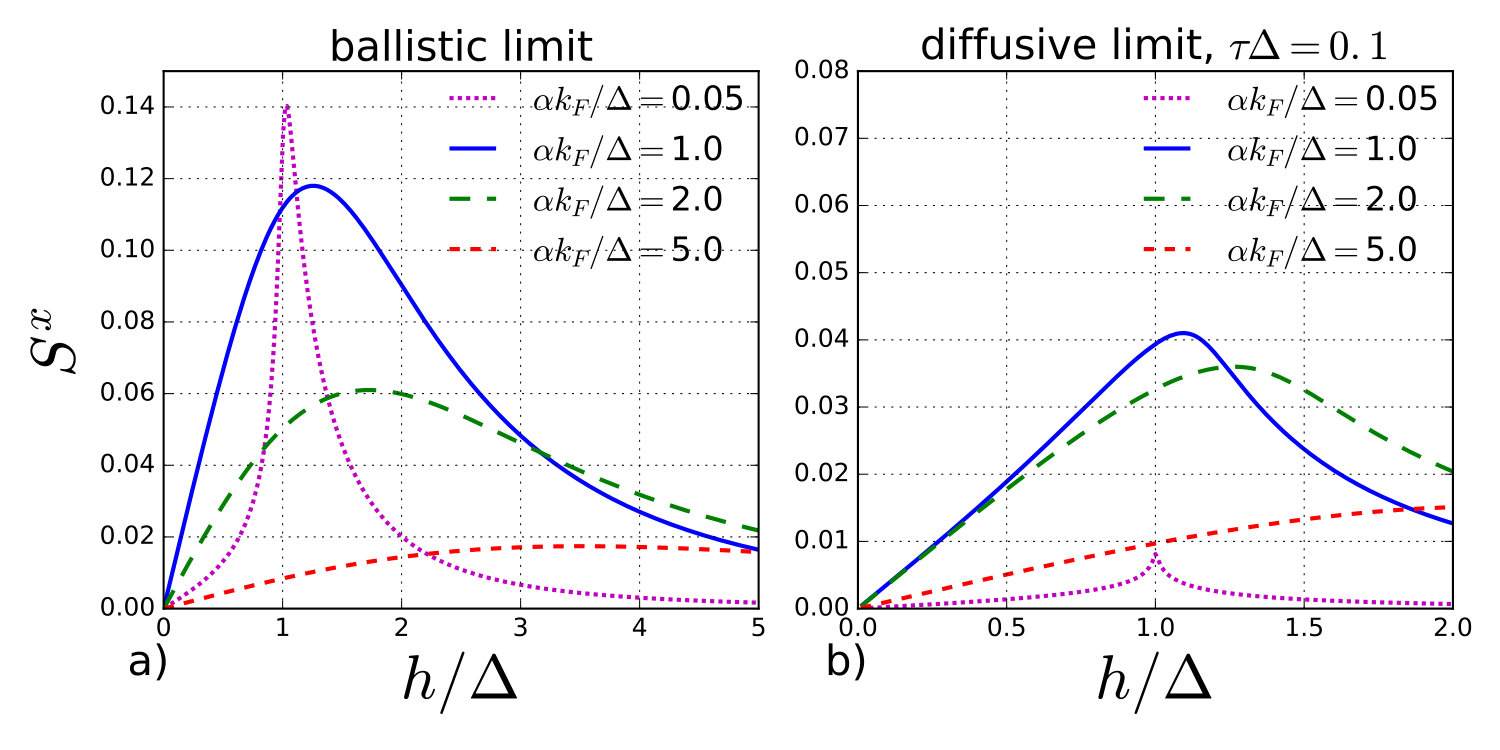 Figure 0
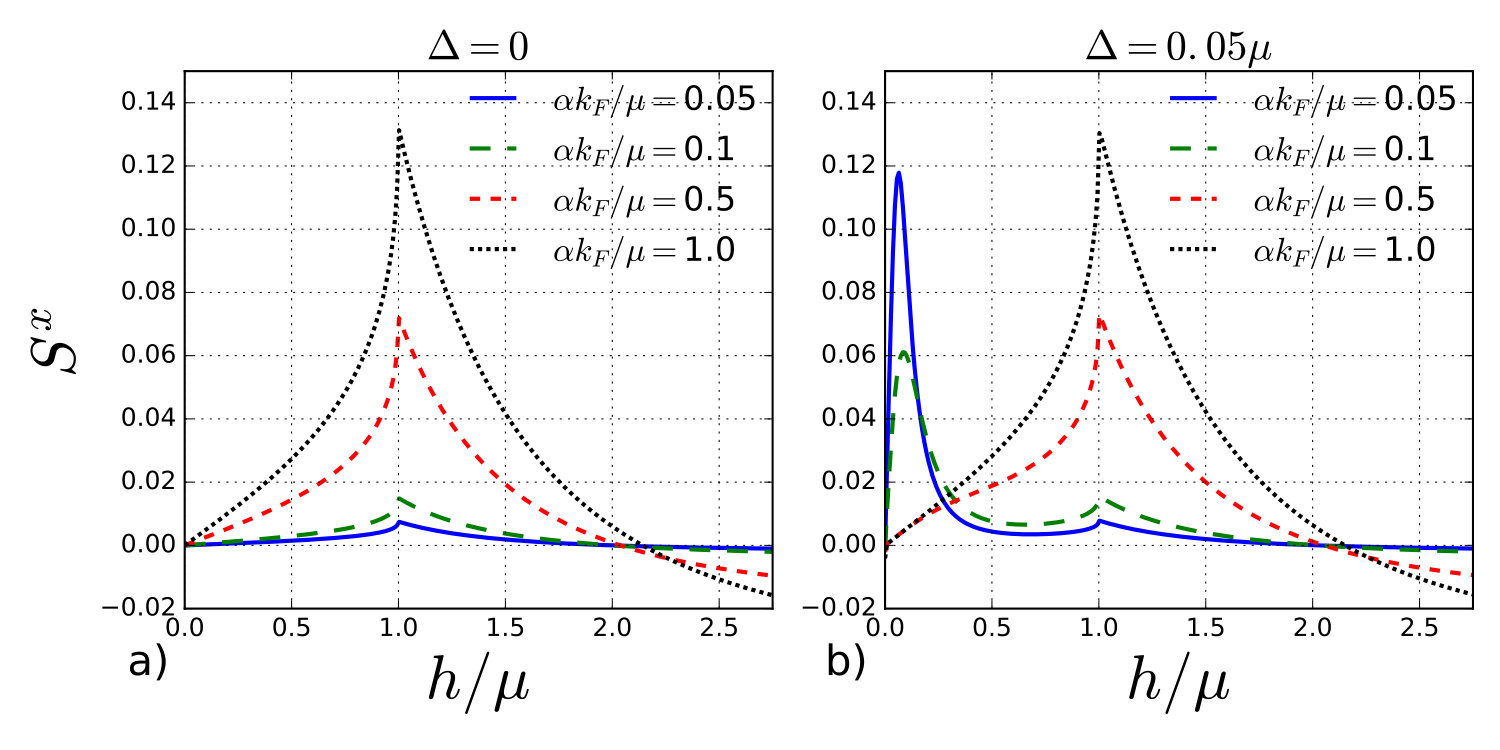 Figure 0
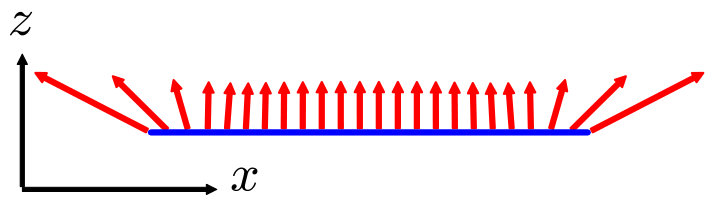 Figure 3
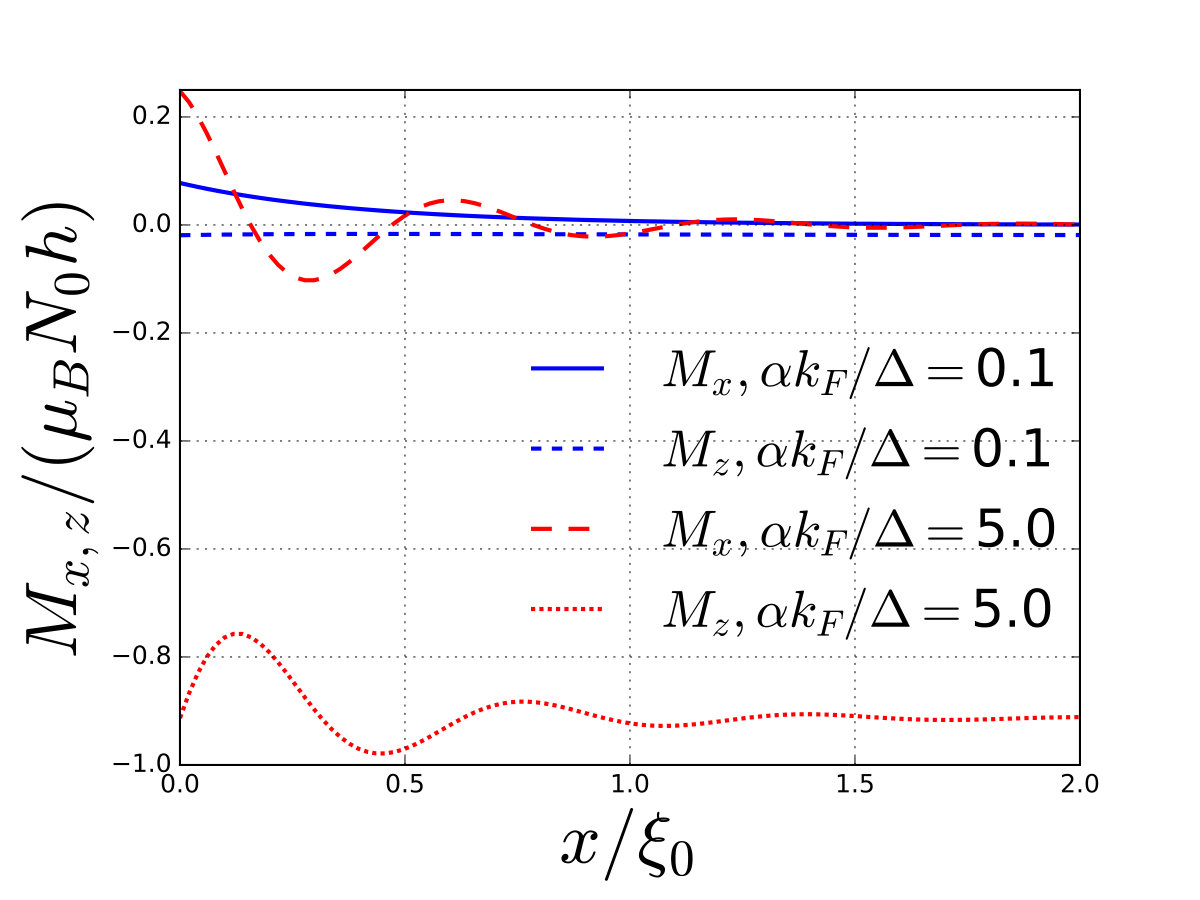 Figure 4
Peer Reviews
No public reviews on file for this paper yet. If you reviewed it on a platform where reviews are public (OpenReview, ICLR, NeurIPS, ICML), you can paste yours below so the community can read it here.
Videos
No videos yet. Explain this paper in a talk, walkthrough, or lecture? Add one.
Correspondence between bulk equilibrium spin-currents and edge spin
accumulation in wires with spin-orbit coupling
I. V. Tokatly
Nano-Bio Spectroscopy Group, Departamento Física de Materiales, Universidad del País Vasco, Av. Tolosa 72, E-20018 San Sebastián, Spain
IKERBASQUE, Basque Foundation for Science, E-48011 Bilbao, Spain
Donostia International Physics Center (DIPC) - Manuel de Lardizabal 5, E-20018 San Sebastián, Spain
B. Bujnowski
Donostia International Physics Center (DIPC) - Manuel de Lardizabal 5, E-20018 San Sebastián, Spain
F. S. Bergeret
Centro de Física de Materiales (CFM-MPC) Centro Mixto CSIC-UPV/EHU - 20018 Donostia-San Sebastian, Basque Country, Spain
Donostia International Physics Center (DIPC) - Manuel de Lardizabal 5, E-20018 San Sebastián, Spain
Abstract
We demonstrate that the interplay of Zeeman and spin-orbit coupling fields in a 1D wire leads to an equilibrium spin current that manifests itself in a spin accumulation at the wire ends with a polarization perpendicular to both fields. This is a universal property that occurs in the normal and superconducting state independently of the degree of disorder. We find that the edge spin polarization transverse to the Zeeman field is strongly enhanced in the superconducting state when the Zeeman energy is of the order of the superconducting gap. This hitherto unknown transverse magnetic susceptibility can be much larger than the longitudinal one, and generalises the well established theory of the Knight-shift in superconductors to the case of finite systems.
Spin currents have been a subject of intensive investigations in several branches of condensed matter physics Fabian2004 ; Rashba2007 ; Maekawa2012 ; Eschrig2011 . Special attention was brought to equilibrium spin currents (ESC) that may exist in materials with spin-orbit coupling (SOC). The interpretation of the ESC in such systems remained under debate for a while because in the presence of SOC the spin is not conserved in a customary sense Rashba2007 ; Shi2006 ; EngelRashbaHalperin2007 ; Rashba2003 . The theoretical controversy can be removed by treating the SOC as an external SU(2) gauge field Tokatly2008 ; Tokatly2010 , but from the experimental point of view ESC still remain elusive. There were several suggestions to detect ESC indirectly, for example in form of resulting mechanical and spin torques Sonin2007a ; Sonin2007 . However, to best of our knowledge such measurements have not been achieved and the ESC remains to be elucidated.
In this letter, we demonstrate a correspondence between ESC in wires with SOC and a transverse spin accumulation at the edges of the corresponding finite system. This correspondence is universal in the sense that it holds for any many-body one-dimensional system, provided the particle-particle interaction is spin-independent. ESC appear when a Zeeman field with a component perpendicular to the SOC is applied. The bulk ESC is always accompanied with the edge spin accumulation that is transverse to both the Zeeman field and SOC, and as a function of shows a cusp when , where is the chemical potential of the wire and the induced superconducting gap. Interestingly, this cusp shows up in both the normal () Dolcini2018 and superconducting state. More striking, when , the transverse spin accumulation shows a sharp maximum at which can be much larger than the magnitude of the spin accumulation at the cusp. We analyze in detail this maximum of the spin accumulation and show its robustness against disorder. Finally we present analytical results for the spatial distribution of the magnetic moment induced as a response to the Zeeman field. We find that the transverse susceptibility close to the edge of the wire can be much larger than the longitudinal one, provided the SOC is small. This generalizes the well known Knight-shift in bulk systems for the case of finite samples abrikosov1962spin ; Abrikosov1988 ; Gorkov2001 .
In the context of Majorana fermions Sau2010 ; Oreg2010 ; Mourik2012 ; Das2012 ; Deng2012 ; Hansen2016 ; Sticlet2012a ; Ojanen2012 the presence of a transverse polarization has been identified as a signature of the topological transition Sticlet2012a ; Szumniak2017 ; Bjornson2015 when . However, as discussed in Ref. Dolcini2018, such transverse polarization also appears in the normal state and therefore this identification has to be treated with care. Our work shows that the transverse spin polarization is a universal property of any one-dimensional system supporting ESC and it exists at all values of , including those far below the topological transition.
We consider a 1D system with a linear in momentum SOC in the presence of a Zeeman or exchange field. As we will show, an equilibrium spin current, appears when the Zeeman field vector is perpendicular to the SOC field. Without loss of generality let the wire be oriented along the x-axis, Rashba SOC along the y axis and a Zeeman field along the z-axis. The many-body Hamiltonain in that case reads
[TABLE]
where the index labels the particles, is a confinement potential, is the momentum operator, is the strength of the SOC, is the Zeeman field and describes a spin-independent interaction. This Hamiltonian is real and therefore its eigenfunctions can be chosen real. This implies that in equilibrium there is no component of the spin density parallel to the SOC, . Similarly, by defining the spin current operator in the standard way Rashba2007 ; EngelRashbaHalperin2007 ; Sonin2007a ; Tokatly2008 ,
[TABLE]
we find that the system can only support an equilibrium spin current polarized along the -axis.
In equilibrium the equation of motion for the spin density takes the standard form,
[TABLE]
where the last term is the usual spin torque due to the Zeeman field. This equation shows that ESC in the bulk of the system may exist only if the -component of the spin is accumulated at the edges. In other words, Eq. (3) establishes a correspondence between the bulk property of the system, the ESC, and the net spin accumulation transverse to the Zeeman field at the edge of a finite system. An example of this correspondence has been obtained in Ref.Dolcini2018 for a non-interacting finite 1D wire contacted to leads.
In a semi-infinite wire, where all particles are confined in the right half-space, the spin accumulation at the left edge is obtained by integrating Eq.(3)
[TABLE]
Thus the edge spin accumulation can be determined by calculating the ESC which is a bulk property independent of boundary conditions. For a finite wire, the transverse spin accumulation at opposite edges is equal in magnitude but oriented in the opposite direction, as shown schematically in Fig. 3a. In the following we will use this relation to compute the transversal spin accumulation in normal and superconducting systems.
We start with the example of a normal ballistic wire described by the Hamiltonian in Eq.(1) without interactions Dolcini2018 . The spin current can be written as
[TABLE]
with the velocity operator and the equilibrium density matrix, projector on the two eigenstates
[TABLE]
respectively, where , and the Fermi distribution is denoted by . We focus on the case and . Introducing the Fermi momenta for the two spin split bands
[TABLE]
the current can be expressed as the sum of the contributions from the two spin splitt bands
[TABLE]
where , labels the upper, lower band respectively. The contributions are
[TABLE]
Clearly the ESC is finite only if both the SOC and Zeeman field are finite. The transverse spin accumulation can be computed by substituting Eq. (9) into Eq. (4). The result is shown in Fig. 1a. For the spin current increases until to point where . For larger the upper band does not contribute, which results in a cusp-like maximum in the spin current, in accordance to the results of Ref. Dolcini2018 for a normal wire 111Notice that the expression (4) makes a connection between the bulk spin-current and the total transverse spin. The spatial distribution of the latter has to be computed by solving the full boundary value problem. In a normal wire this was done in Ref. Dolcini2018 ..
Now we assume that the wire is placed on top of a superconductor so that it is fully proximized. The system is described by the Bogoliubov de Gennes (BdG) Hamiltonian in the Nambu-Spin space
[TABLE]
where is the SC order parameter. The Hamiltonian has the spectrum ()
[TABLE]
with . The spin current can be written as
[TABLE]
where is the projection operator to the eigenstate of the BdG Hamiltonian and the spin current operator in Nambu-spin space. Evaluating the expression at leads to
[TABLE]
The numerical evaluation of the integral shows two prominent features as can be seen in Fig.1b). The cusp like local maximum also obtained in the normal conducting case is shifted to marking the critical Zeeman field above which the wire is in the topological phase. The second feature is a peak that appears within the quasiclassical regime, . For small enough values of this peak is at . By lowering the peak first gets narrow and simultaneously increases in magnitude exceeding by far the local maximum at the topological transition. Further decrease of reduces the height of the peak until the spin current, and thus the spin accumulation, vanish non-analytically when . To investigate this non-analyticity in we turn to the quasiclassical approximation where the spin current is given by Konschelle2014 ,
[TABLE]
Here is the quasiclassical Green’s function that is obtained from the Gorkov Green’s function by the -integration Eilenberger1968 , is the average over the Fermi surface, the temperature, is the 1D density of states at the Fermi level, are the Matsubara frequencies and , denote the Fermi velocity, Fermi momentum respectively. At we obtain for the spin current
[TABLE]
with . As shown in Fig.2a the peak of at within the quasiclassical approximation shows the same behaviour as in the exact case (cf. Fig. 1b). The peak is more pronounced for small values of SOC and washes out with increasing SOC strength. To describe the behavior at when the integral can be approximated by keeping only leading order terms in which gives
[TABLE]
where in the second step . In a similar fashion we can compute the spin current at the point for finite temperature and which leads to
[TABLE]
The next important question is whether this strong enhancement of the spin accumulation for Zeeman energies close to the gap is robust against disorder. To answer this question we calculate the spin current in the diffusive limit as follows Tokatly2017
[TABLE]
where is the quasiclassical Green’s function in the diffusive limit, is the diffusion constant in 1D, is the momentum relaxation time, , and is the inverse of the spin precession length. To find we solve the Usadel equation for a bulk systemTokatly2017
[TABLE]
where , and is the inverse Dyakonov-Perel spin relaxation time. The Green’s function has to fulfill the normalization condition .
The only non-vanishing components of the normal and anomalous quasiclassical Green’s functions and are the singlet and triplet- components. Thus we make the ansatz with and . For this setup in equilibrium and for the expression for the spin current, Eq.(18), reduces to
[TABLE]
with , . Substitution of the solution of Eq. (19) into Eqs. (18-4) leads to the transverse spin accumulation shown in Fig. 2b. We find the same maximum in at for small values of SOC. To investigate the behavior in this parameter regime we notice that Eq. (19) and the condition are equivalent to the following system of equations
[TABLE]
In the limit we can obtain from these equations the Green’s functions. Within the logarithmic accuracy the spin current, Eq.(20), is given by
[TABLE]
Thus, in the diffusive case the peak in the spin-current at for small values of the SOC is reduced by a factor , with , with respect to the pure ballistic case, cf. Eq. (16). This explains the large difference between the peaks heights in Figs. 2a-b, for . Notice however that this difference is not that pronounced for larger values of the SOC.
The general expression Eq. (4) relates the bulk ESC to the transverse spin-polarization, in a finite wire. accumulates at the edge and decays from the edge towards the bulk, but the exact spatial distribution of has to be determined in each particular case. From symmetry arguments it is also clear that in a wire of finite length at the two edges has opposite sign (see Fig.3a). In the normal state the dependence was computed numerically in Ref. Dolcini2018 for a wire connected to two leads and for values of of the order of . Here we focus on the superconducting state in the relevant quasiclassical regime, , for which the Eilenberger equation holds
[TABLE]
Here denotes the the GF for both propagation directions . We assume that the wire extends over the region . At the edge, no current flows and the boundary condition imposes that . In order to obtain simple analytical results we perform perturbation in and write the solution of Eq. 24 as where and . The spin density, or magnetic response, is obtained from , where . Specifically, we obtain
[TABLE]
and hence
[TABLE]
[TABLE]
where is the Pauli paramagnetic term. This is a remarkable result that generalizes the Knight shift in superconducting systems with intrinsic SOC Gorkov2001 . In a finite system besides the longitudinal response, , there is a finite transverse magnetization accumulated at the edge of the sample which decays toward the bulk over the superconducting coherent length. At low temperatures, the ratio at the edge of the sample, , is proportional to and therefore the transverse magnetization can be much larger than provided . The full spatial dependence of is shown in Fig. 3b.
In summary, we have demonstrated a universal correspondence between equilibrium spin currents and a transverse spin accumulation in wires with SOC and a perpendicular Zeeman field. Such spin accumulation appears in both normal and superconducting systems. In the normal state the total edge spin is maximized for values of of the order of the chemical potential . More interesting, in the superconducting state the effect can be maximized at values of the SOC and Zeeman energy much smaller than . We demonstrated that this effect is robust against disorder and manifest in a hitherto unknown transverse magnetic susceptibility in finite systems.
Acknowledgments.- We acknowledge funding by the Spanish Ministerio de Ciencia, Innovacion y Universidades (MICINN) (Projects No. FIS2016- 79464-P and FIS2017-82804-P). I.V.T. acknowledges support by Grupos Consolidados UPV/EHU del Gobierno Vasco (Grant No. IT578-13). F.S.B. and B. B acknowledge funding from the EU’s Horizon 2020 and innovation programme under grant agreement No. 800923 (SUPERTED).
The reference list from the paper itself. Each links out to its DOI / PubMed record.
- 1(1) I. Žutić, J. Fabian, and S. Das Sarma, Rev. Mod. Phys. 76 , 323 (2004).
- 2(2) E. I. Rashba, in Future Trends in Microelectronics: Up the Nano Creek , edited by S. Luryi, J. M. Xu, and A. Zaslavsky (Wiley, Hoboken, 2007).
- 3(3) S. Maekawa, S. O. Valenzuela, E. Saitoh, and T. Kimura, editors, Spin Current (Oxford University Press, 2012).
- 4(4) M. Eschrig, Phys. Today 64 , 43 (2011).
- 5(5) J. Shi, P. Zhang, D. Xiao, and Q. Niu, Phys. Rev. Lett. 96 , 076604 (2005).
- 6(6) H.-A. Engel, E. I. Rashba, and B. I. Halperin, in Handbook of Magnetism and Advanced Magnetic Materials , edited by H. Kronmüller and S. Parkin (Wiley, New York, 2007), Vol. 5.
- 7(7) E. I. Rashba, Phys. Rev. B 68 , 241315 (2003).
- 8(8) I. V. Tokatly, Phys. Rev. Lett. 101 , 106601 (2008).