
TL;DR
This paper investigates the maximal projection constants of finite-dimensional Banach spaces, linking them to eigenvalues of two-graphs, and provides new methods to compute and understand these constants.
Contribution
It introduces a novel approach to determine maximal projection constants using eigenvalues of two-graphs and offers an alternative proof for a specific case, expanding the theoretical understanding.
Findings
Maximal projection constants relate to eigenvalues of two-graphs.
Convergence of relative projection constants to 1+Pi_n.
Existence of polyhedral spaces achieving maximal projection constants.
Abstract
The linear projection constant of a finite-dimensional real Banach space is the smallest number such that is a -absolute retract in the category of real Banach spaces with bounded linear maps. We denote by the maximal linear projection constant amongst -dimensional Banach spaces. In this article, we prove that may be determined by computing eigenvalues of certain two-graphs. From this result we obtain that the relative projection constants of codimension converge to . Furthermore, using the classification of -free two-graphs, we give an alternative proof of . We also show by means of elementary functional analysis that for each integer there exists a polyhedral -dimensional Banach space such that .
Click any figure to enlarge with its caption.
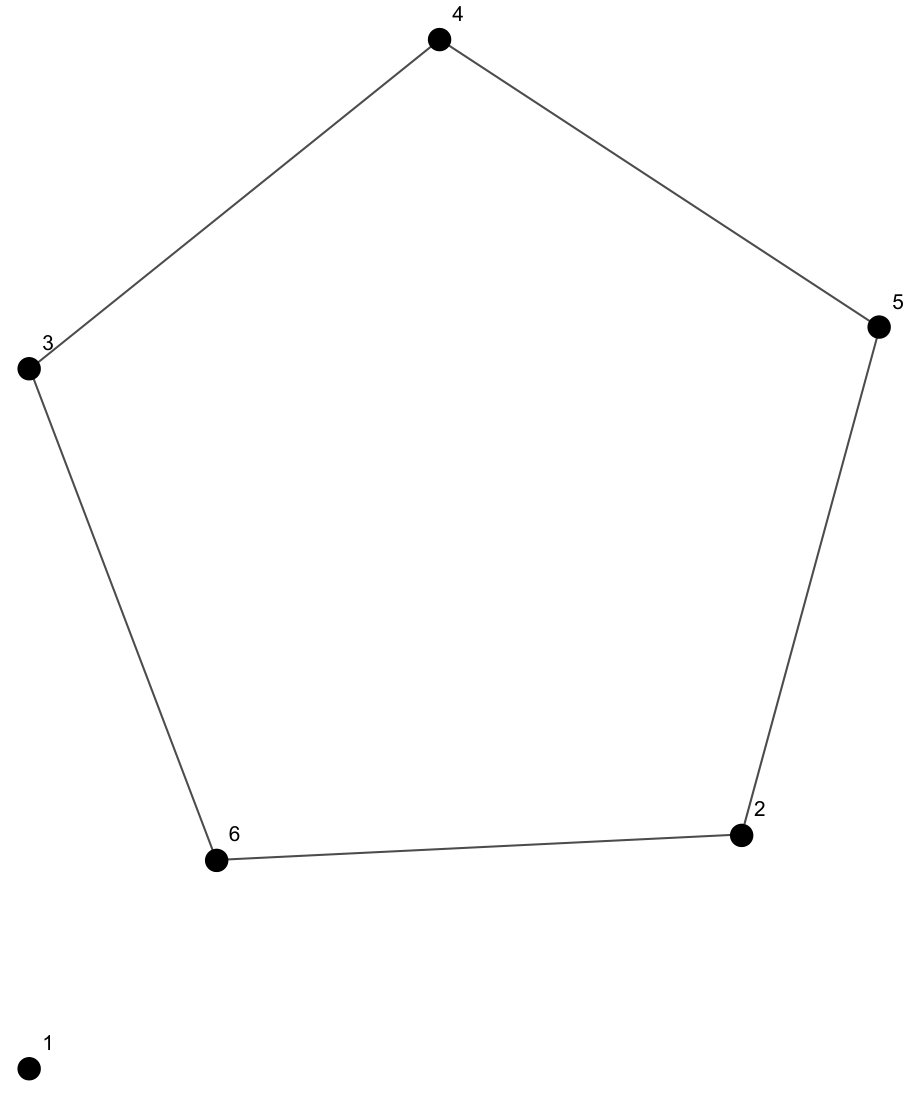 Figure 1
Peer Reviews
No public reviews on file for this paper yet. If you reviewed it on a platform where reviews are public (OpenReview, ICLR, NeurIPS, ICML), you can paste yours below so the community can read it here.
Videos
No videos yet. Explain this paper in a talk, walkthrough, or lecture? Add one.
Computation of maximal projection constants
Giuliano Basso
Abstract
The linear projection constant of a finite-dimensional real Banach space is the smallest number such that is a -absolute retract in the category of real Banach spaces with bounded linear maps. We denote by the maximal linear projection constant amongst -dimensional Banach spaces. In this article, we prove that may be determined by computing eigenvalues of certain two-graphs. From this result we obtain that the relative projection constants of codimension converge to . Furthermore, using the classification of -free two-graphs, we give an alternative proof of . We also show by means of elementary functional analysis that for each integer there exists a polyhedral -dimensional Banach space such that .
1 Introduction
Overview
As a consequence of ideas developed by Lindenstrauss, cf. [Lin64], for a finite-dimensional Banach space the smallest constant such that is an absolute -Lipschitz retract is completely determined by the linear theory of . Indeed, Rieffel, cf. [Rie06], established that it is equal to the linear projection constant of , which is the number defined as
[TABLE]
Linear projections have been the object of study of many researchers and the literature can be traced back to the classical book by Banach, cf. [Ban32, p.244-245]. The question about the maximal value of the linear projection constants of -dimensional Banach spaces has persisted and is a notoriously difficult one. In this article, we establish a formula that relates with eigenvalues of certain two-graphs. This reduces the problem (in principle) to the classification of certain two-graphs and thus allows the introduction of tools from graph theory. Following this approach, we present an alternative proof of , see 4.3, and we establish that that the relative projection constants of codimension converge to , see Corollary 1.3. In the remainder of this overview, we summarize the current state of the theory.
For , define to be the set of linear isometry classes of -dimensional Banach spaces over the real numbers. The set equipped with the Banach-Mazur distance is a compact metric space, cf. [TJ89]. Thus, the map is 1-Lipschitz and consequently for all the maximal projection constant of order ,
[TABLE]
is a well-defined real number. Apart form , the only known value is , due to Chalmers and Lewicki, cf. [CL10]. There is numerical evidence indicating that , cf. [FS17, Appendix B], but to the author’s knowledge, there is no known candidate for for all . From a result of Kadets and Snobar, cf. [KS71],
[TABLE]
Moreover, König, cf. [Kön85], has shown that this estimate is asymptotically the best possible. Indeed, there exists a sequence of finite-dimensional real Banach spaces such that , where for , and
[TABLE]
There are many non-isometric maximizers of the function , cf. [KTJ03]. A finite-dimensional Banach space is called polyhedral if its unit ball is a polytope. Equivalently, a finite-dimensional Banach space is polyhedral if there exists an integer such that admits a linear isometric embedding into . Using a result of Klee, cf. [Kle60, Proposition 4.7], and elementary functional analysis, we show that there exist maximizers of that are polyhedral, see Theorem 1.4.
In the 1960s, Grünbaum, cf. [Grü60], calculated , and , where is the 2-plane with the hexagonal norm. In particular, , which Grünbaum conjectured to be the maximal value of amongst -dimensional Banach spaces. In 2010, Chalmers and Lewicki presented an intricate proof of Grünbaum’s conjecture employing the implicit function theorem and Lagrange multipliers, cf. [CL10].
Our main result, see Theorem 1.2, provides a characterization of the number in terms of certain maximal sums of eigenvalues of two-graphs that are -free. In [FF84], Frankl and Füredi give a full description of two-graphs that are -free. Via this description and Theorem 1.2 we can derive from first principles that . This is done in Section 4.
Next, we introduce the necessary notions from the theory of two-graphs that are needed to properly state our main result.
Two-graphs
The subsequent definition of a two-graph via cohomology follows Taylor [Tay77], and Higman [Hig73]; see also [Sei91, Remark 4.10]. Let denote a finite set. For each integer we set
[TABLE]
where denotes the field with two elements. Elements of are finite simple graphs. If is strictly greater than the cardinality of , then consists only of the empty function . For each the map is given by
[TABLE]
Clearly, it holds that , where [math] denotes the neutral element of the group . Two-graphs can be defined as follows.
Definition 1.1** (two-graph).**
*A two-graph is a tuple , where and are finite sets and there exists a map such that and . The cardinality of is called the order of . *
Among other things, two-graphs naturally occur in the study of systems of equiangular lines and 2-transitive permutation groups; authoritative surveys are [Sei91, Sei92]. Given a two-graph , the following set is always non-empty:
[TABLE]
Each gives rise to a graph . The Seidel adjacency matrix of a graph is the matrix , which is the symmetric -matrix given by
[TABLE]
For each choice the matrices and have the same spectrum.
By definition, the eigenvalues of are the real numbers
[TABLE]
that are the eigenvalues of for (counted with multiplicity). This definition is independent of .
We say that a two-graph is -free if there is no injective map such that \big{\{}\varphi(v_{1}),\varphi(v_{2}),\varphi(v_{3})\big{\}}\in\Delta for all distinct points .
Main result
Our main result reads as follows:
Theorem 1.2**.**
If is an integer, then
[TABLE]
To prove Theorem 1.2, we invoke a simple trick, see Lemma 2.2, that allows us to greatly narrow down the matrices that need to be considered. This is done in Section 2.
Relative projection constants
The following question has first been systematically addressed by König, Lewis, and Lin in [KLL83]:
Question 1.1**.**
Let be integers. What is
[TABLE]
By definition, . Clearly, and it is a direct consequence of the classical Hahn-Banach theorem that for all integers . The quantity has been examined by Bohnenblust, cf. [Boh38], where it is shown that . In [CL09], Chalmers and Lewicki determined the exact value of . In [KLL83], König, Lewis, and Lin established the general upper bound
[TABLE]
with equality if and only if admits a system of distinct equiangular lines. Thereby, as admits a system of six equiangular lines, cf. [LS73, p. 496], it holds that
[TABLE]
In light of
[TABLE]
which we demonstrate in Paragraph 4.4, up to all exact values of for are now computed. It is well-known that
[TABLE]
for all , cf. [CL09]. Via Theorem 1.2, we infer the following asymptotic relation between these two increasing sequences:
Corollary 1.3**.**
For each integer we have
[TABLE]
A proof of Corollary 1.3 is given in Section 2. If , then Corollary 1.3 follows directly from the fact that Bohnenblust’s upper bound of is sharp, cf. [CL09, Lemma 2.6]. Recently, the special case has been considered by Sokołowski in [Sok17].
Recall that for all . The proof of Grünbaum’s conjecture, cf. [CL10], shows that
[TABLE]
Numerical experiments, cf. [FS17, Appendix B], suggest that if , then . Since admits a polyhedral maximizer, the sequence stabilizes eventually.
Theorem 1.4**.**
Let be an integer. There exists a polyhedral -dimensional Banach space such that
[TABLE]
As a result, there is an integer such that
[TABLE]
*for all . *
A proof of Theorem 1.4 can be found in Section 3.
2 A formula for
A result of Chalmers and Lewicki
Let be an integer and set
[TABLE]
Moreover, we use to denote the set of all diagonal -matrices that have trace equal to one and whose diagonal entries are non-negative.
For and we write for the eigenvalues of the symmetric matrix (counted with multiplicity). The subsequent result, due to Chalmers and Lewicki, characterizes the values in terms of maximal sums of eigenvalues of matrices of the form .
Theorem 2.1** (Theorem 2.3 in [CL10]).**
Let be integers. The value is attained and equals
[TABLE]
Blow-up of matrices
Let be an integer and consider the map
[TABLE]
where denotes the -th row of . By construction, the -th row of and the last row of coincide. We say that the matrix is a blow-up of (with respect to the -th row).
If is a matrix and is positive-definite, then all eigenvalues of are real, for is equivalent to the symmetric matrix . With a similar argument, one can show that even if is positive-semidefinite, then all eigenvalues of are real. We use the notation
[TABLE]
where are the eigenvalues of (counted with multiplicity). The lemma below is the key step in the proof of Theorem 1.2.
Lemma 2.2**.**
Let be a matrix, let for some integer and let be an invertible matrix. We set . Then is invertible, has a zero entry and
[TABLE]
Proof**.**
For each integer let denote the -th row of . By assumption,
[TABLE]
Let be an eigenvalue of and let be a corresponding eigenvector. We define . For all we compute
[TABLE]
Thus, for all we have
[TABLE]
Furthermore,
[TABLE]
as a result, the vector is an eigenvector of with corresponding eigenvalue .
Next, we show that and have the same rank. There exists a principal submatrix of such that is invertible and . This is well-known, cf. for example [Tho68, Theorem 5]. Clearly, cannot be obtained from by keeping the -th and -th column simultaneously; thus, is also a principal submatrix of . Therefore,
[TABLE]
and thereby . Now, via Sylvester’s law of interia
[TABLE]
as claimed. To summarize, and have the same rank and if is an eigenvalue of , then is an eigenvalue of . This completes the proof.
Proofs of the main results
Now, we have everything at hand to verify Theorem 1.2.
Proof of Theorem 1.2****.
We set
[TABLE]
First, we show for all that
[TABLE]
We abbreviate
[TABLE]
Due to Theorem 2.1, there exist matrices and such that
[TABLE]
Choose a sequence of invertible matrices with rational entries satisfying
[TABLE]
This is possible since and because the map is continuous on the set of symmetric matrices, cf. [OW92, p. 44]. Fix . By finding a common denominator, we may write
[TABLE]
where for all and . We set
[TABLE]
where we use the convention . Note that . By applying Lemma 2.2 repeatedly, we get that is obtained from by deleting exactly zero entries. As a result,
[TABLE]
Thus, by combining (2.3) with (2.2), we obtain
[TABLE]
It is well-known that
[TABLE]
Hence,
[TABLE]
The inequality is a direct consequence of Theorem 2.1. Putting everything together, we conclude
[TABLE]
We are left to show that it suffices to consider -free two-graphs. To this end, fix an integer and let be a matrix such that
[TABLE]
As the symmetric matrix is orthogonally diagonalizable, there are orthonormal vectors such that
[TABLE]
where is the matrix that has the vectors as columns. Let for be the rows of the matrix . We use to denote the standard basis. Fix and let be a real number. We set
[TABLE]
and
[TABLE]
Clearly, is symmetric. Hereafter, we show that . To this end, suppose that
We set , and we observe that . Further, we abbreviate . It holds that
[TABLE]
Via von Neumann’s trace inequality, cf. [Mir75], we obtain
[TABLE]
thus,
[TABLE]
The equality case of von Neumann’s trace inequality occurs. Therefore, the diagonalizable matrices and are simultaneously orthogonally diagonalizable and thereby commute. This implies that and \tfrac{1}{2}\big{(}A(i,j;\varepsilon_{\star})+A(j,i;\varepsilon_{\star})\big{)} commute; as a result, we get that
[TABLE]
By applying the same argument to for every , we may conclude that the vectors are orthogonal and none of them is equal to the zero vector. However, this is only possible if . Therefore, we have shown for that for all integers .
We claim that
[TABLE]
for all . Because , this is a direct consequence of the maximality of and equality (2.4). Hence, we have shown that and have the same sign pattern, which allows us to invoke [CW13, Lemma 2.1]. From this result we see that does not have a principal -submatrix which has only as off-diagonal elements. Such a matrix is the Seidel adjacency matrix of the complete graph on vertices. For that reason, we have shown that
[TABLE]
This completes the proof.
We conclude this section with the proof of Corollary 1.3.
Proof of Corollary 1.3****.
Let denote the all-ones matrix. For every , the matrix is contained in , where denotes the Kronecker product of matrices. Moreover, since the eigenvalues of are precisely all possible products of an eigenvalue of (counted with multiplicity) and an eigenvalue of (counted with multiplicity), it is readily verified that
[TABLE]
Let be a sequence of positive real numbers that converges to zero. Due to Theorem 1.2 and the above, there exists a strictly increasing sequence of integers and matrices such that
[TABLE]
We have
[TABLE]
thus,
[TABLE]
where . Consequently,
[TABLE]
Since , we obtain
[TABLE]
Proposition 2 in [FS17] tells us that
[TABLE]
for all . Thus,
[TABLE]
for that reason, the desired result follows.
3 Polyhedral maximizers of
Projections in and
Let be a Banach space and let and denote linear subspaces. We set
[TABLE]
and
[TABLE]
Suppose that is a linear subspace such that . The map
[TABLE]
is a linear projection onto . In the subsequent lemma we gather useful results from functional analysis.
Lemma 3.1**.**
Let be a Banach space.
If there exist closed linear subspaces such that is finite-dimensional and , then , ,
[TABLE] 2. 2.
If there exist closed linear subspaces such that is finite-dimensional and , then , ,
[TABLE] 3. 3.
If there exist closed linear subspaces such that is finite-dimensional and , then
[TABLE]
Proof**.**
We prove each item separately.
If , then for all , implying . As and are closed, we may deduce with the usual Hahn-Banach separation argument that
[TABLE]
Accordingly, and So, and are weak-star closed, cf. [Rud91, Theorem 4.7]. The quotient is a Hausdorff locally convex vector space and the quotient map is continuous. We claim that the subspace is closed in . As every finite-dimensional linear subspace of a Hausdorff topological vector space is closed, cf. [Rud91, Theorem 1.21], it suffices to show that is finite-dimensional. Since
[TABLE]
we see that is finite-dimensional; thus, the subspace is finite-dimensional as well. Therefore, the subspace is closed in and we get that is weak-star closed. Note that is weak-star dense in , because separates points of . This implies , as desired. 2. 2.
Suppose that . We have for all . As the elements of separate points, we get that and consequently . Since is finite-dimensional and thereby weak-star closed, [Rud91, Theorem 4.7] tells us that
[TABLE]
Using
[TABLE]
we may deduce that is finite-dimensional. Let denote the quotient map. The linear subspace is finite-dimensional and thus closed. As a result, is closed. Via the familiar Hahn-Banach separation argument, it is not hard to check that is a dense subset of . For that reason, . The first item tells us that
[TABLE]
therefore , as . This completes the proof of the second item. 3. 3.
We abbreviate and . We compute
[TABLE]
and
[TABLE]
as was to be shown.
Construction of polyhedral maximizers
Let be a Banach space and let denote a finite-dimensional linear subspace. The number
[TABLE]
is called the relative projection constant of with respect to . The following theorem translates the calculation of relative projection constants to second preduals (if such a space exists).
Theorem 3.2**.**
Let be a Banach space and let denote a finite-dimensional linear subspace. If is a Banach space such that , then there exist a linear subspace with and
[TABLE]
Proof**.**
It is not hard to check that
[TABLE]
We set . On the one hand, using the second and third item of Lemma 3.1, we obtain
[TABLE]
on the other hand, using the first and third item of Lemma 3.1, we infer
[TABLE]
This completes the proof.
We conclude this section with the proof of Theorem 1.4.
Proof of Theorem 1.4****.
Let be an -dimensional linear subspace with
[TABLE]
Via Theorem 3.2, there exists an -dimensional linear subspace such that
[TABLE]
As , we get
[TABLE]
This completes the proof, since due to a result of Klee, cf. [Kle60, Proposition 4.7], every finite-dimensional subspace of is polyhedral.
4 Applications: Computation of and
List of all -free two-graphs
Let be an integer, let be a regular -gon centred at the origin and let denote the vertices of . Further, we let denote the two-graph that has as vertex set and is an edge if and only if the origin is contained in the closed convex hull of . It is readily verified that for
[TABLE]
where is the all-ones vector, is the all-ones -matrix and is the -matrix given by
[TABLE]
Note that has only ’s below the diagonal and only [math]’s above the first sub-diagonal. We set
[TABLE]
One can check that is the Seidel adjacency matrix of the graph depicted in Figure 1. We abbreviate
[TABLE]
In [FF84], Frankl and Füredi showed that each non-empty -free two-graph belongs to the set
[TABLE]
How to maximize the first eigenvalues of ?
Given a matrix , we denote by the set
[TABLE]
We use to denote the group of orthogonal -matrices with integer entries. Every has a unique decomposition , where is a permutation matrix and is a diagonal matrix consisting only of ’s and ’s. We write if the permutation matrix is associated to the permutation , that is, . The group acts on via
[TABLE]
Two Seidel adjacency matrices and are called switching equivalent if . This gives rise to an equivalence relation, equivalence classes are called switching classes. The lemma below tells us that the orbit decomposition of the action may be obtained by determining the switching class of every principal dimensional submatrix of .
Lemma 4.1**.**
Let be a matrix, let be two integers and for let denote the submatrix of obtained by deleting the -th column and the -th row of .
*Then, the matrices and are switching equivalent if and only if the integers and lie in the same orbit under the action . *
Proof**.**
This is a straightforward consequence of the definitions.
Let be a diagonalizable -matrix over the real numbers. We set
[TABLE]
for each integer . The following lemma simplifies the calculation of the maximum value of the function if the action is transitive.
Lemma 4.2**.**
Let be a matrix and let be an integer. If is a invertible matrix such that
[TABLE]
then
[TABLE]
*for all . In particular, if is odd and the action is transitive, then . *
Proof**.**
For each we have
[TABLE]
where . Consequently,
[TABLE]
We get
[TABLE]
Via the Cauchy-Schwarz inequality, we deduce
[TABLE]
as a result, there exists a real number such that
[TABLE]
Since , we get and thus
[TABLE]
which is equivalent to
[TABLE]
Now, suppose that is odd and assume that the action is transitive. We claim that . The statement follows via elementary group theory. Indeed, let denote the subgroup of generated by the squares. By basic algebra, is normal and the action of on the orbits of is transitive. Since for some integer , the action has either one orbit or an even number of orbits. Because is odd and the orbits of all have the same cardinality, we may conclude that is transitive. This completes the proof.
Determination of
In the following we retain the notation from Paragraph 4.1. By the use of Theorem 1.2, Lemma 2.2 and the classification of all -free two-graphs, we obtain
[TABLE]
Clearly, all induced sub-graphs of that are obtained by deleting one vertex are isomorphic (as two-graphs) to each other. Thus, via Lemma 4.1 and Lemma 4.2, we get that
[TABLE]
Moreover, if is a principal submatrix of , then it is not hard to see that
[TABLE]
thereby,
[TABLE]
Thus, we are left to consider the eigenvalues of the matrices for . Due to the following lemma it suffices to calculate the eigenvalues of .
Lemma 4.3**.**
Let be integers. It holds
[TABLE]
Proof**.**
We abbreviate . Let denote the -matrix that is obtained from by deleting the second row and second column. Clearly, is a blow-up of ; thus, via Lemma 2.2, we obtain
[TABLE]
If for all integers
[TABLE]
then
[TABLE]
and thus (4.1) follows. We are left to show that (4.2) holds.
Suppose that has multiplicity one. Below, we show that this leads to a contradiction.
Let be an eigenvector of associated to the eigenvalue . As we assume that has multiplicity one, we get or for each . We know that the action is transitive; thus all entries of differ only by a sign. Without loss of generality we may suppose the entries of consist only of ’s and ’s. For each integer let denote the matrix that is obtained from by replacing the -th column with . Cramers rule tells us that
[TABLE]
for all . It is easy to see (via the definition of ) that for all : if and have the same sign, then . But this is impossible; for that reason, for all we have . Similarly,
[TABLE]
for all and , . Thus, if we suppose that , then
[TABLE]
and
[TABLE]
Therefore, if denotes the all-ones vector we obtain
[TABLE]
and consequently it holds that
[TABLE]
This is a contradiction, since and we assume that has multiplicity one. Hence, we have shown that the eigenvalue has multiplicity greater than or equal to two. As a result, (4.2) holds, which was left to show. This completes the proof.
Employing Lemma 4.3, we get
[TABLE]
as conjectured by Grünbaum.
An illustrative example:
In this paragraph, we show that We hope that some of the tools that are developed here may also simplify the computation of other relative projection constants.
From a result of Sokołowski, cf. [Sok17], we obtain . Given , we let (or ) denote the number of positive (or negative) eigenvalues of counted with multiplicity. Since and , we deduce with the help of Theorem 2.1 that
[TABLE]
In [BMS81], Bussemaker, Mathon and Seidel classified all two-graphs on six vertices. Using this classification, we get that there are exactly three non-isomorphic two-graphs on six vertices with signature , namely for
[TABLE]
[TABLE]
and
[TABLE]
Therefore,
[TABLE]
In [LS91], Lieb and Siedentop established that the function
[TABLE]
is concave if is invertible and . This result and the following lemma simplifies the computation of .
Lemma 4.4**.**
Let be an invertible matrix that has positive eigenvalues. If the supremum
[TABLE]
is attained, then there exist an invertible matrix such that and
[TABLE]
Proof**.**
We set
[TABLE]
The function is concave if we restrict the source space to the non-singular matrices in ; accordingly, it is immediate that the subset is convex. Let . For all we obtain
[TABLE]
for that reason, for all the set is invariant under conjugation with . If we equip with the euclidean distance , then every map is an isometry. Since is a bounded non-empty CAT(0) space, there is a matrix with the desired properties, cf. [BH13, II. Corollary 2.8]. This completes the proof.
To begin, we show that
[TABLE]
The value will be estimated afterwards. By drawing the underlying graph of and employing Lemma 4.1, we may deduce that the action has orbit decomposition ; consequently, Lemma 4.4 tells us that
[TABLE]
where is the 2-dimensional standard simplex and .
The characteristic polynomial of the matrix can be written as , for
[TABLE]
[TABLE]
and
[TABLE]
Clearly, the roots of are
[TABLE]
As has four positive roots, we obtain that has two positive roots. Let denote the roots of . We need to bound from above. By the virtue of Vieta’s formulas, the roots of the polynomial
[TABLE]
satisfy . Hence, in order to estimate from above, it suffices to bound the largest root of the polynomial from above. In the subsequent lemma we use Taylor’s Theorem to get an upper bound for the largest root of a cubic polynomial with three real roots.
Lemma 4.5**.**
Let , with , be a polynomial. If has three real roots , then
[TABLE]
for
[TABLE]
Proof**.**
As all roots are real, the cubic formula tells us that
[TABLE]
For we define the map via
[TABLE]
From Taylor’s Theorem for each it holds that
[TABLE]
where is a real number between [math] and . Using elementary analysis, we obtain
[TABLE]
Therefore, we may deduce that
[TABLE]
for all . All things considered, we get
[TABLE]
as was to be shown.
Employing the splitting and Lemma 4.5, we infer that \pi_{4}\big{(}A_{1}\Lambda_{1}\big{)} is less than or equal to
[TABLE]
where
[TABLE]
By elementary analysis,
[TABLE]
as a result, we obtain
[TABLE]
Clearly,
[TABLE]
Via Lagrange multipliers, the maximal value over of the right hand side of (4.6) is equal to
[TABLE]
So,
[TABLE]
as desired.
Next, we proceed with exactly the same strategy that dealt with to show that
[TABLE]
As before, one can verify that the action has orbit decomposition . The characteristic polynomial of , for
[TABLE]
is given by , with
[TABLE]
[TABLE]
and
[TABLE]
Since all the roots of and are positive, we see that has two negative roots. Thus, employing Lemma 4.5 and Lemma 4.4, we obtain that \pi_{4}\big{(}A_{2}\Lambda_{2}(s,t,w)\big{)} is less than or equal to
[TABLE]
where
[TABLE]
By elementary analysis, it is possible to verify that
[TABLE]
for that reason,
[TABLE]
Via Lagrange multipliers, the maximal value over of the right hand side of the above is equal to for
[TABLE]
Thereby, with the help of Lemma 4.4 we have established that
[TABLE]
Next, we show that . The action is transitive, that is, has orbit decomposition . Thus, by Lemma 4.4, we deduce that
[TABLE]
Let denote the -dimensional all-ones matrix and let denote the matrix introduced in Paragraph 4.1. Since ,
[TABLE]
where we use to denote the Kronecker product of matrices. Consequently, for , we get
[TABLE]
Considering , we get and finally
[TABLE]
as claimed.
Remark 4.6**.**
As admits a system of ten equiangular lines, cf. [LS73, p. 496], the general upper bound of König, Lewis, and Lin, cf. [KLL83], tells us that
[TABLE]
To summarize, we obtain the sequence
[TABLE]
which naturally leads to the open question: Are there integers such that
[TABLE]
Acknowledgements:
I am thankful to Urs Lang who read earlier draft versions of this article and who stimulated several improvements. Moreover, I am grateful to Anna Bot for proofreading this paper.
The reference list from the paper itself. Each links out to its DOI / PubMed record.
- 1[Ban 32] Stefan Banach “Théorie des opérations linéaires” In Instytut Matematyczny Polskiej Akademi Nauk , 1932
- 2[BH 13] Martin R Bridson and André Haefliger “Metric spaces of non-positive curvature” Springer Science & Business Media, 2013
- 3[BMS 81] FC Bussemaker, RA Mathon and Johan Jacob Seidel “Tables of two-graphs” In Combinatorics and graph theory Springer, 1981, pp. 70–112
- 4[Boh 38] .F Bohnenblust “Convex regions and projections in Minkowski spaces” In Annals of Mathematics JSTOR, 1938, pp. 301–308
- 5[CL 09] Bruce L. Chalmers and Grzegorz Lewicki “Three-dimensional subspace of ℓ ∞ 5 superscript subscript ℓ 5 \ell_{\infty}^{5} with maximal projection constant” In Journal of Functional Analysis 257.2 , 2009, pp. 553 –592 DOI: https://doi.org/10.1016/j.jfa.2009.01.005 · doi ↗
- 6[CL 10] Bruce L. Chalmers and Grzegorz Lewicki “A proof of the Grünbaum conjecture” In Studia Mathematica 200.2 , 2010, pp. 103–129 URL: http://eudml.org/doc/285668
- 7[CW 13] Xinzhong Cia and Xinmao Wang “A note on the positive semidefinite minimum rank of a sign pattern matrix” In Electronic Journal of Linear Algebra 26.1 , 2013, pp. 23
- 8[FF 84] Peter Frankl and Zoltán Füredi “An exact result for 3-graphs” In Discrete mathematics 50 Elsevier, 1984, pp. 323–328