On integrals over a convex set of the Wigner distribution
B\'erang\`ere Delourme, Thomas Duyckaerts, Nicolas Lerner

TL;DR
This paper constructs a specific example of a function whose Wigner distribution's integral over a square exceeds 1, answering a question from 1988 and involving Weyl quantization and numerical analysis.
Contribution
It provides the first counterexample to a longstanding question about the integrals of Wigner distributions over convex sets.
Findings
Wigner distribution integral can exceed 1 over certain convex sets.
Counterexample disproves previous assumptions about Wigner distribution bounds.
Numerical analysis supports the theoretical construction.
Abstract
We provide an example of a normalized function such that its Wigner distribution has an integral on the square for a suitable choice of . This provides a negative answer to a question raised by P. Flandrin in 1988. Our arguments are based upon the study of the Weyl quantization of the indicatrix of along with a precise numerical analysis of its discretization.
Click any figure to enlarge with its caption.
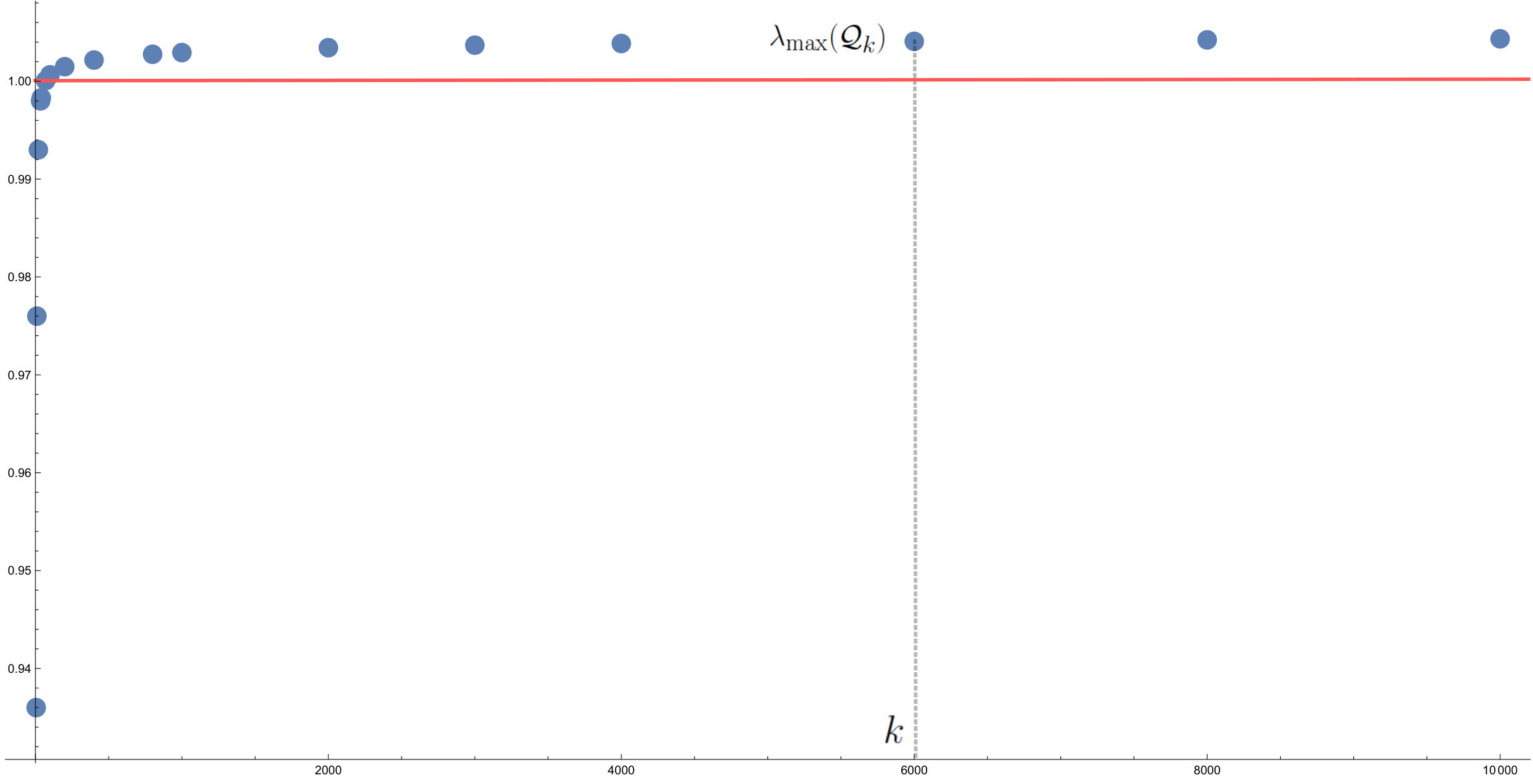 Figure 1
Peer Reviews
No public reviews on file for this paper yet. If you reviewed it on a platform where reviews are public (OpenReview, ICLR, NeurIPS, ICML), you can paste yours below so the community can read it here.
Videos
No videos yet. Explain this paper in a talk, walkthrough, or lecture? Add one.
On integrals over a convex set of the Wigner distribution
Bérangère Delourme, Thomas Duyckaerts, Nicolas Lerner
B. Delourme, LAGA, UMR 7539, Institut Galilée, Université Paris 13, 99, avenue Jean-Baptiste Clément, 93430 - Villetaneuse France
T. Duyckaerts, Institut Universitaire de France & LAGA, UMR 7539, Institut Galilée, Université Paris 13, 99, avenue Jean-Baptiste Clément, 93430 - Villetaneuse France
N. Lerner, Institut de Mathématiques de Jussieu, Sorbonne Université (former Paris VI), Campus Pierre et Marie Curie, 4 Place Jussieu, 75252 Paris cedex 05, France
Abstract.
We provide an example of a normalized function such that its Wigner distribution has an integral on the square for a suitable choice of . This provides a negative answer to a question raised by P. Flandrin in [6]. Our arguments are based upon the study of the Weyl quantization of the indicatrix of along with a precise numerical analysis of its discretization.
Contents
-
1.2 A reformulation of Flandrin’s conjecture, state of the art, main result
-
4.2 General results on the round-off error resulting from numerical sums and products
-
4.2.1 Evaluation of the round-off error when adding two numbers
-
4.2.2 Evaluation of the round-off error when adding successively numbers.
-
4.2.3 Evaluation of the round-off error when multiplying two numbers
-
4.3 Application to the numerical computation of the Rayleigh quotient
1. Introduction
1.1. Flandrin’s conjecture
Let be a convex bounded subset of and be the characteristic function of . A statement known as Flandrin’s conjecture111On page 2178 of [6], P. Flandrin writes “it is conjectured that the result (1.1.1) is true for any convex domain ”, a quite mild commitment for the validity of (1.1.1), although that statement was referred to later on as Flandrin’s conjecture in the literature. asserts that for ,
[TABLE]
where the Wigner function is given by
[TABLE]
Note that appears as the partial Fourier transform222For , we define its Fourier transform by and we obtain the inversion formula . Both formulas can be extended to tempered distributions. with respect to of the function
[TABLE]
and since for , belongs to from the identity
[TABLE]
the function is in with
[TABLE]
giving a meaning to the integral in (1.1.1) for with a finite Lebesgue measure. We may note as well that although the function is complex-valued, the function is in fact real-valued. In fact we have readily
[TABLE]
We note also that the real-valued function can take negative values, choosing for instance on the real line, we get
[TABLE]
1.2. A reformulation of Flandrin’s conjecture, state of the art, main result
It is easy to see that for in the Schwartz class , the remark above on the Fourier transform ensures that belongs as well to and we can reformulate (1.1.1) as
[TABLE]
The latter property follows from (1.1.1) and conversely, let us consider , . We have
[TABLE]
so that for a subset of with finite Lebesgue measure, we have, thanks to (1.1.3),
[TABLE]
so that if is convex bounded and (1.2.1) holds true, we have
[TABLE]
Taking now as a sequence in the Schwartz space converging in towards , we obtain (1.2.1) for any .
Lemma 1.1**.**
Property (1.2.1) is equivalent to the same statement where the requirement bounded is removed.
Proof.
When is convex with infinite Lebesgue measure, with , we have so that, thanks to the Lebesgue dominated convergence Theorem,
[TABLE]
and (1.2.1) implies ∎
That property is easy for equal to a half-space where is a linear form since we can find (if ) a unitary operator on such that, for ,
[TABLE]
where is the operator of multiplication by , which is an orthogonal projection (thus has norm 1): this is a consequence of the symplectic covariance properties of the Wigner distribution detailed in the next section, but in that particular case, it is easy to choose linear symplectic coordinates such that
Property (1.2.1) is true as well for two-dimensional Euclidean disks and follows from a precise study of P. Flandrin (see e.g. [7]): for , defining
[TABLE]
the paper [7] contains the proof of the estimate for ,
[TABLE]
for any . The results for the disk in two dimensions are readily extendable to polydisks by tensorisation. A non-trivial matter was to extend this study to -dimensional Euclidean balls, a task done in the paper [13] by E. Lieb and Y. Ostrover, who provided the case where is chosen as an Euclidean ball. As for the argument of [7], a highly non-trivial inequality on Laguerre polynomials provides a proof of the estimate for ,
[TABLE]
for any . It turns out that the above short summary contains most of our knowledge on Flandrin’s conjecture and for instance, the cases of the square or of balls of () were not explicitly explored in the literature. Our main result in this paper is the following theorem.
Theorem 1.2**.**
There exist and such that
[TABLE]
where the Wigner distribution is defined by (1.1.2).
This theorem is proven in Section 5. It turns out that most of the properties of the Wigner distribution are inherited from its links with the Weyl quantization introduced by Hermann Weyl in 1926 in the first edition of [17] and our first remarks are devised to stress that link.
1.3. Weyl quantization
Definition 1.3**.**
Let . We define the Weyl quantization of the Hamiltonian , by the formula
[TABLE]
to be understood weakly as
[TABLE]
We note that the sesquilinear mapping
[TABLE]
is continuous so that the above bracket of duality makes sense. We note as well that a temperate distribution gets quantized by a continuous operator from into . This very general framework is not really useful since we want to compose our operators . A first step in this direction is to look for sufficient conditions ensuring that the operator is bounded on . Moreover, for and a polynomial in , we have the composition formula,
[TABLE]
which involves here a finite sum. This follows from (2.1.26) in [12] where several generalizations can be found.
Proposition 1.4**.**
Let be a tempered distribution on . Then we have
[TABLE]
Proof.
In fact we have from (1.3.2), ,
[TABLE]
so that defining for the operator by
[TABLE]
we see that (phase symmetry) is unitary and self-adjoint and
[TABLE]
proving the first estimate of the proposition. As a consequence of (1.3.7), we obtain that
[TABLE]
To prove the second estimate, we introduce the so-called ambiguity function as the inverse Fourier transform of the Wigner function , so that for in the Schwartz class, we have
[TABLE]
i.e.
[TABLE]
Applying Plancherel formula on (1.3.2), we get
[TABLE]
We note that a consequence of (1.3.4) is that for a linear form , we have
[TABLE]
As a result, considering for , the linear form defined by
[TABLE]
we see that
[TABLE]
and thus we get Weyl’s original formula
[TABLE]
which implies the second estimate in the proposition. ∎
A particular case of Segal’s formula (see e.g. Theorem 2.1.2 in [12]) is with standing for the Fourier transformation,
[TABLE]
We defined the canonical symplectic form on with
[TABLE]
The symplectic group is the subgroup of such that
[TABLE]
with
[TABLE]
The symplectic group is generated by
[TABLE]
Now for , the operator
[TABLE]
where belongs to the metaplectic group, which is a group of unitary transformations of . Let us describe the generators of the metaplectic group corresponding to the symplectic transformations (i-iii) above. The metaplectic group is generated by
[TABLE]
We note also that for , the symmetry is defined by and is quantized by the phase symmetry as defined by (1.3.6) with the formula
[TABLE]
Similarly, the translation is defined on the phase space by and is quantized by the phase translation ,
[TABLE]
and we have
[TABLE]
Note also that the covariance formula (1.3.16) can be reformulated as the following property of the Wigner distribution,
[TABLE]
Since the metaplectic group is continuous from into itself, Segal’s Formula (2.1.8) is valid as well for . We note also that
Lemma 1.5**.**
Flandrin’s conjecture (1.2.1) is equivalent to
[TABLE]
Proof.
Indeed, since has finite Lebesgue measure, the first inequality in (1.3.5) ensures that is a bounded operator in and, thanks to (1.3.2), Property (1.2.1) reads
[TABLE]
which indeed means ∎
2. The quarter-plane, elementary observations
2.1. Definitions
We have chosen to focus our attention on a most simple-looking case, when is the “quarter-plane”
[TABLE]
We study in this section the operator
[TABLE]
where , that is the Weyl quantization of the characteristic function of the first quarter of the plane. The Hardy operator is defined as the operator with distribution-kernel
[TABLE]
and is bounded on with operator-norm equal to 1 (see e.g. Lemma 4.1.8 in [12]).
Proposition 2.1**.**
The operator given by (2.1.2) is bounded self-adjoint on . Flandrin’s conjecture for the quarter-plane (2.1.1) is .
Proof.
Since the Weyl symbol of is real-valued, is formally self-adjoint and it is enough to prove that is bounded on . Let us start with recalling the classical formulas
[TABLE]
useful below. For , we define whose distribution-kernel is the function
[TABLE]
We can thus consider
[TABLE]
and the operator with distribution-kernel is H\bigl{(}\mathbf{1}_{[0,\lambda]}(\xi)\bigr{)}^{w}H, that is , where stands for the operator of multiplication by the Heaviside function . On the other hand, the operator with distribution kernel is such that
[TABLE]
Since the Hardy operator with kernel (2.1.3) has norm 1, we obtain that, for , with ,
[TABLE]
so that
[TABLE]
proving the -boundedness of the operator .
Remark 2.2**.**
That cumbersome detour with the operator is useful to ensure that the operator is indeed bounded on . The kernel of is a distribution of order 1 and the product is not meaningful, even when is a Radon measure. However with the -boundedness of , the products of operators , , , make sense and for instance we may approximate in the strong-operator-topology the operator by the operator where is a smooth function supported in and equal to on . We have indeed
[TABLE]
so that for , The operator with kernel
[TABLE]
converges strongly towards the operator . **
We can provide a slightly better estimate than above. The kernel of the -bounded operator is333Note that, for distributions on the real line, there is no difficulty at multiplying by : in fact we may define
\langle T_{1}(x+y)T_{2}(x-y),\phi(x,y)\rangle_{\mathscr{D}^{\prime}(\mathbb{R}^{2}),\mathscr{D}(\mathbb{R}^{2})}=\frac{1}{2}\langle T_{1}(x_{1})\otimes T_{2}(x_{2}),\phi\bigl{(}\frac{x_{1}+x_{2}}{2},\frac{x_{1}-x_{2}}{2}\bigr{)}\rangle_{\mathscr{D}^{\prime}(\mathbb{R}^{2}),\mathscr{D}(\mathbb{R}^{2})}.
It is also a general consequence of the location of the wave-front-set of (a subset of the conormal bundle of the second diagonal ) and of (a subset of the conormal bundle of the diagonal ): we have
[TABLE]
and with , this implies readily (see Remark 2.2) that . In fact, for with , we have for small enough and as in Remark 2.2,
[TABLE]
since
[TABLE]
On the other hand, for with , we have for small enough and as in Remark 2.2,
[TABLE]
and the kernel of is
[TABLE]
so that
[TABLE]
where is the operator of multiplication by and is the Fourier multiplier
[TABLE]
We have thus, defining ,
[TABLE]
The kernel of the operator is
[TABLE]
and the kernel of is
[TABLE]
Using again the above estimate on the Hardy operator, we obtain that
[TABLE]
so that
[TABLE]
proving the proposition with the estimate , a rather crude estimate that we shall improve below (we have used here that the two-variable quadratic form has eigenvalues ). ∎
Proposition 2.3**.**
Let be given by (2.1.2). With (resp. ) standing for the operator of multiplication by (resp. ) and for the Fourier multiplier , we have
[TABLE]
where is the (self-adjoint) operator with kernel
[TABLE]
The operator-norm of is smaller than 1.
Proof.
The first statements are proven in (2.1.6), (2.1.8) and the norm-estimate follows from the fact that the Hardy operator (cf. (2.1.3)) has norm 1. ∎
2.2. Elementary calculations
Lemma 2.4**.**
Flandrin’s conjecture for the quarter-plane is equivalent to
[TABLE]
Proof.
We have from (2.1.7),
[TABLE]
If for all , we get from (2.2.2) that with a given in supported in , we may choose
[TABLE]
and we get with ,
[TABLE]
which is indeed (2.2.1). Conversely, assuming (2.2.1) on , we get from (2.2.2) that . ∎
Lemma 2.5**.**
The kernel of the operator is
[TABLE]
[TABLE]
Proof.
The kernel of the operator is
[TABLE]
where is given by (2.1.8). We have thus
[TABLE]
implying that
[TABLE]
If we get
[TABLE]
If we get
[TABLE]
Eventually we find that
[TABLE]
which is (2.2.3). We note now that the smooth function given by
[TABLE]
is decreasing444For , we have and . on , so that . As a result, the kernel is symmetric non-negative and we have
[TABLE]
Since the Hardy operator with kernel has norm 1 (cf. Lemma 4.1.8 in [12]), we obtain that the operator-norm of
[TABLE]
is bounded above by , so that concluding the proof of the lemma. ∎
2.3. An upper bound and non-positivity
Proposition 2.6**.**
We have
[TABLE]
Proof.
We have from (2.1.7) and (2.2.4),
[TABLE]
The eigenvalues of the quadratic form in two dimensions are
[TABLE]
entailing the result. ∎
Proposition 2.7**.**
The operator is bounded self-adjoint on with norm less than . Moreover, the spectrum of intersects and the operator is not non-negative.
Proof.
From (2.3.2), we have
[TABLE]
and the first result on the norm follows from the reasoning in the proof of the previous proposition. The operator cannot be non-negative: if it were the case, we would have
[TABLE]
It would imply from (2.1.7)
[TABLE]
and thus , so that and thus , so that , which is not true from Lemma 2.5. ∎
Lemma 2.8**.**
We have
Proof.
From (2.1.7) and (2.2.4), we have
[TABLE]
and thus we have
[TABLE]
3. From the quarter-plane to an infinite matrix
3.1. Discretization
With given by (2.1.2) , , and , we define
[TABLE]
and for , we set
[TABLE]
Proposition 3.1**.**
We have and using the notation , we have
[TABLE]
The operator is bounded self-adjoint on .
N.B**.**
We have for
[TABLE]
so that
[TABLE]
Proof.
Using Formula (1.3.16), with
[TABLE]
we have
[TABLE]
and with , from (2.1.7), (2.1.9), we obtain
[TABLE]
with
[TABLE]
On the other hand, we have
[TABLE]
and thus
[TABLE]
where we note that in the above integral, for (resp. ) we have
[TABLE]
so that the integrand is non-negative (resp. non-positive). We have also from (3.1.6)
[TABLE]
so that finding in the support of the integrand implies that
[TABLE]
so that is supported where .
As a result, if , we have from (3.1.5), (3.1.8),
[TABLE]
proving (3.1.3) for .
Let us tackle now the case where . We have
[TABLE]
and we find also that
[TABLE]
so that and
[TABLE]
as well as from (3.1.5), (3.1.8),
[TABLE]
proving (3.1.3) for .
Assuming now , we have
[TABLE]
As a result for , we have from (3.1.5), (3.1.8),
[TABLE]
and for , we get proving (3.1.3) for .
We are left with the case : by symmetry, we may also assume so that and thus . We have in that case from (3.1.10),
[TABLE]
We have for that and the Fubini-Tonelli Theorem gives
[TABLE]
so that (3.1.11) gives for
[TABLE]
proving (3.1.3) in the case . In the symmetric case , we use that (cf. (3.1.1), (3.1.2))
[TABLE]
completing the proof of (3.1.3).
The matrix is Hermitian since is self-adjoint: the real part is indeed symmetric (even diagonal) with
[TABLE]
and the imaginary part of is skew-symmetric from (3.1.3) since is odd, with
[TABLE]
For , we have
[TABLE]
and since , we get so that is self-adjoint bounded. The proof of Proposition 3.1 is complete. ∎
3.2. The matrix related to the quarter-plane
Lemma 3.2**.**
Let be given. We define the set
[TABLE]
The set is dense in .
Proof.
For , we set
[TABLE]
Let . Setting for ,
[TABLE]
we find that, assuming
[TABLE]
with a modulus of continuity of ,
[TABLE]
As a consequence, the norm of can be made arbitrarily small, choosing small enough. ∎
Lemma 3.3**.**
The matrix defined in Proposition 3.1 is self-adjoint and bounded and
[TABLE]
where stands for the orthogonal projection on \text{\rm span}\bigl{(}\{e_{j}\}_{j\in F}\bigr{)} where .
Notation 3.4**.**
For finite subset of , we shall use the notation for the matrix .
Proof.
We have from Lemma 3.2,
[TABLE]
where is the supremum of the spectrum of . In particular, taking with norm 1 and supported on a finite set , we get that
[TABLE]
The other result can be obtained by changing into in the above argument. ∎
3.3. A consequence of Flandrin’s conjecture
Theorem 3.5**.**
Let be the matrix defined in Proposition 3.1. A consequence of Flandrin’s conjecture is that for all finite subset of , we have with the notations of Lemma 3.3,
[TABLE]
Remark 3.6**.**
Lemma 3.3 is also proving that if (3.3.1) holds true for all finite subsets of , then .
Proof.
With defined by (2.1.2), Proposition 2.1 and Flandrin’s conjecture imply that , so that applying Lemma 3.3, we obtain (3.3.1). ∎
In the next section, we shall use Theorem 3.5 to disprove Flandrin’s conjecture by finding some finite subset of such that the largest eigenvalue of is strictly larger than 1. Our proof will rely on a careful numerical analysis of the finite matrix for a suitable choice of .
4. Numerics
4.1. Main result and methodology
Theorem 4.1**.**
There exists a finite subset of such that the self-adjoint matrix defined in Notation 3.4 has an eigenvalue strictly larger than 1.
This section is dedicated to the proof of Theorem 4.1. That proof is based on the combination of a numerical computation with a rigorous numerical error analysis. We recall that in any computer, numbers are stored with a limited precision (finite arithmetic precision, or floating-point arithmetic), see [8, 2, 4]. That is why, for any number , we shall make the distinction between and its numerical representation that we denote by . In the sequel, we use the standard double precision accuracy, meaning that, for any real number , the relative error between and its numerical representation is bounded above by namely
[TABLE]
The number is often referred to as the machine precision. In the present case, since we deal with complex numbers, we shall introduce
[TABLE]
We also notice that any numerical computation (multiplication, addition or subtraction) introduces an additional round-off error (see Section 4.2) which could be significant. This phenomenon explains why the use of finite arithmetic precision can lead to important numerical errors that we need to control.
To prove Theorem 4.1, we choose defined by
[TABLE]
and we take (somehow arbitrarily) . The proof of Theorem 4.1 is then divided into three main steps:
Step 1. We compute numerically an eigenvector associated with the largest (in modulus) eigenvalue of . We choose this eigenvector such that its numerical Euclidian norm is equal to , that is to say
[TABLE]
Then, we compute numerically the associated numerical Rayleigh quotient
[TABLE]
where stands here for the Euclidian scalar product on and denotes the numerical approximation of . We deliberately added the superscript N after each operation to remind that these operations are made numerically. We remark that
[TABLE]
Step 2. Using a standard error analysis, we evaluate the numerical error made on the evaluation of the Rayleigh quotient. More specifically, we prove that
[TABLE]
Step 3. To conclude the proof, we collect the results of (4.1.3) and (4.1.4) and we deduce the following inequality for the spectral radius of :
[TABLE]
The remainder of this section is organized as follows. In Section 4.2, we briefly remind several classical results related to numerical errors arising from the standard arithmetic operations. Based upon these results, a first estimate of is proven in Section 4.3 (Lemma 4.10). Finally, numerical computations, and, in particular Estimates (4.1.3)-(4.1.4) are given in Section 4.4.
4.2. General results on the round-off error resulting from numerical sums and products
This section makes use of the basic results from [4, Chapter 1], which will be useful in Section 4.3.
4.2.1. Evaluation of the round-off error when adding two numbers
Lemma 4.2**.**
Let be complex numbers and let us denote by some numerical approximations of , with
[TABLE]
Let be a numerical approximation of using finite precision arithmetic with a machine error : we have
[TABLE]
where is defined in (4.1.1).
Proof.
First, let us consider the case where all the numbers , , and are real. One has
[TABLE]
Here, we use the subscript to remind that acts on real number. In view of [4, Section 1.3], we get
[TABLE]
As a result, applying the triangular inequality leads to
[TABLE]
In the complex case, we still have
[TABLE]
We decompose the modulus in term of its real and imaginary part, namely
[TABLE]
and, setting and , Formula (4.2.2) gives
[TABLE]
As a result, we have
[TABLE]
Inserting the previous inequality into (4.2.4) and applying the triangle inequality we find that
[TABLE]
Noticing that ends the proof. ∎
4.2.2. Evaluation of the round-off error when adding successively numbers.
Let , and assume that we are given numerical approximations of some numbers such that
[TABLE]
We recall that numerically, the summation over terms is obtained by a recurrence procedure, which mimics that
[TABLE]
That is why, for a given integer , we define by induction the numerical sum of terms (using finite precision arithmetic with a machine error ) as follows:
[TABLE]
In view of the previous recurrence formula, the order of summation of the terms may change the result of the numerical summation. For a given , we shall evaluate the error
[TABLE]
Lemma 4.3**.**
Under Assumption (4.2.6), for any , we have
[TABLE]
and
[TABLE]
Proof.
A direct application of Lemma 4.2 gives
[TABLE]
We prove the second estimate by induction, the initialization step for being a direct consequence of Lemma 4.2. Then, assuming that (4.2.7) holds for a given , we get
[TABLE]
Using the induction hypothesis, rearranging the terms and applying the change of index gives,
[TABLE]
∎
We notice that we can obtain from (4.2.7) the less accurate estimate for given below. Anyhow, this estimate turns out to be accurate enough for the application that we have in mind.
Lemma 4.4**.**
Under Assumption (4.2.6), for any , we have
[TABLE]
where stands for the binomial coefficient.
Proof.
It suffices to note that , and consequently the first term in the right-hand-side of (4.2.7) can be bounded above by
[TABLE]
4.2.3. Evaluation of the round-off error when multiplying two numbers
Lemma 4.5**.**
Let be a numerical approximation of the product using finite precision arithmetic with a machine error . Let be a numerical approximation of a complex number such that
[TABLE]
Then, we have for a complex number ,
[TABLE]
Proof.
First, we have
[TABLE]
Here again, we separate the treatment of the real and the imaginary part:
[TABLE]
Setting and , since , we have
[TABLE]
where the subscript in and is used to highlight that these computations are made on real numbers. We note that [4, Section 1.4] gives
[TABLE]
As a result, applying formula (4.2.3) (specific to real numbers) leads to
[TABLE]
A similar analysis on the imaginary part gives
[TABLE]
Noticing that
[TABLE]
and introducing (4.2.11)-(4.2.12) into (4.2.10), we obtain
[TABLE]
Combining the previous inequality with (4.2.9) and applying again the triangular inequality gives
[TABLE]
Substituting for (see Definition (4.1.1)) completes the proof. ∎
4.3. Application to the numerical computation of the Rayleigh quotient
In this section, we shall evaluate the numerical error made when evaluating the Rayleigh quotient . The main result of this section is given by Lemma 4.10. It provides an estimate of under two appropriate assumptions (Assumption 4.6 and Assumption 4.8) listed below. Its proof requires to prove consecutively Lemma 4.7 and Lemma 4.9.
Assumption 4.6**.**
* The space is the space defined by (4.1.2). We set so that defined in Notation 3.4 is a square matrix of size that satisfies*
[TABLE]
* There exists such that, for all ,*
[TABLE]
* The vector is known explicitly and satisfies*
[TABLE]
Since we have,
[TABLE]
we can decompose the numerical computation of as follows: we have
[TABLE]
where, for all ,
[TABLE]
and, for all ,
[TABLE]
Combining successively the results of Lemma 4.5 and Lemma 4.4, we can prove the following results.
Lemma 4.7**.**
Under Assumption 4.6, for any , we have
[TABLE]
Moreover, we have
[TABLE]
and
[TABLE]
Proof.
First, a direct application of Lemma 4.5 gives that, for any , we have, using (4.3.1),
[TABLE]
Then, Lemma 4.4 (taking ) along with (4.3.1) gives
[TABLE]
As a result, applying again Lemma 4.5, we find that, for any ,
[TABLE]
Here we have used the fact that, thanks to (4.3.1), . Finally, we apply Lemma 4.4 to obtain
[TABLE]
Using that ends the proof. ∎
To continue our computation, we shall make an additional assumption linking (error made on each coefficient the matrix ) and the machine precision . The previous assumption will be validated in Section 4.4.
Assumption 4.8**.**
The positive numbers and satisfy the following inequalities
[TABLE]
Lemma 4.9**.**
We suppose that Assumption 4.6 and Assumption 4.8 hold true. Then we have,
[TABLE]
Proof.
Under Assumption 4.8, we have
[TABLE]
which implies in particular that
[TABLE]
As a result, there exists such that
[TABLE]
Since , , we deduce that
[TABLE]
Then, using again that (so that ), we have
[TABLE]
The result follows now directly from Lemma 4.7. ∎
We can finally state the main result of this section:
Lemma 4.10**.**
We suppose that Assumption 4.6 and Assumption 4.8 hold true. Then, we have
[TABLE]
Proof.
First, we use twice the triangular inequality along with Lemma 4.9 to get
[TABLE]
It is now enough to prove that, under Assumption 4.6, (in particular (4.3.3)) and Assumption 4.8, we have
[TABLE]
To get (4.3.11) we remark first that corresponds in fact to the number
[TABLE]
which means that (4.3.3) in Assumption 4.6 can be written as
[TABLE]
But Assumption 4.6 and Lemma 4.5 ensure that, for all , we have
[TABLE]
As a result, applying Lemma 4.4 gives
[TABLE]
Then, the triangular inequality combined with Assumption 4.8 (see (4.3.9)) leads to
[TABLE]
We deduce from the previous inequality that
[TABLE]
so that
[TABLE]
Since and , we obtain
[TABLE]
and
[TABLE]
which proves (4.3.11). ∎
4.4. Numerical results
To finish this part, it remains to prove Estimates (4.1.4) and (4.1.3).
First, let us briefly describe our numerical experiments. In what follows, as indicated in the beginning of this section, we use (defined in (4.1.2)) with . As a consequence the matrix is a square Hermitian matrix of size . For the numerical computation of the Rayleigh quotient , we use the software Matlab. The vector used in the evaluation of the Rayleigh quotient is obtained using the function eig, taking the eigenvector associated with the largest eigenvalue of :
[TABLE]
We emphasize that the use of the function norm of Matlab or the direct implementation of the power method [14, Chapter 6] provide the same results (up to 15 digits of accuracy), and consequently the same lower bound.
To conclude our proof, it remains to prove the estimate on the error on the Rayleigh quotient . This is based on the application of Lemma 4.10. To do so, we have to evaluate (the maximum absolute error made on the coefficients of ) and to verify that Assumption 4.6 and Assumption 4.8 are fulfilled. For the first part, we computed the matrix using double and quadruple precision (using a Fortran 90 code). We denote the corresponding matrix and . We find that
[TABLE]
As a result, it is coherent to take . We can verify that
[TABLE]
so that Assumption 4.6 and Assumption 4.8 will be fulfilled if we prove (4.3.1): to do so, we check Formula (3.1.3) and we see that
[TABLE]
Since is odd, we need only to check for . For , we have
[TABLE]
so that and thus since for from (3.1.4), we get for ,
[TABLE]
Moreover, we have for , and for , . Applying Lemma 4.10 then gives (noticing that and ),
[TABLE]
and (4.1.4) is proved.
Remark 4.11**.**
The reader may object that Formula (3.1.2) used for the evaluation may lead to cancellation rounding error for large. Indeed, for large, we have
[TABLE]
as well as
[TABLE]
so that for , we have
[TABLE]
leading to the compensation of the large and constant terms
[TABLE]
triggering possibly cancellation errors. More specifically, in the present case, for , since and , we might expect the relative error on to be bounded by
[TABLE]
It then leads to the following bound for the absolute error on
[TABLE]
which is of the same order of magnitude than (4.4.1). To overcome this difficulty, we could write the formula as
[TABLE]
The latter formula is apparently more stable numerically since
[TABLE]
the leading terms not compensating each other. In that case, we observe that
[TABLE]
and the choice of is obviously valid again. Note that we have obtained the same value for up to 14 digits of accuracy.
Remark 4.12**.**
We also conducted the full computation of using quadruple precision for (exporting obtained with the function eig of Matlab, or programming directly the power method). Here again, we obtain the same value for up to 14 digits of accuracy.
4.5. A summary of numerical results
We define as defined by (4.1.2), Notation 3.4 and Proposition 3.1. The matrix is a square Hermitian matrix with size , thus with real eigenvalues. We denote by
[TABLE]
the eigenvalues of . We know from Proposition 2.6, Lemma 2.8 and Lemma 3.3 that
[TABLE]
Also we have the following numerical results, for ranging up to ; each entry printed in red violates Flandrin’s conjecture.
[TABLE]
We have and . The paper [18] by J.G. Wood & A.J. Bracken studied integrals of the Wigner distribution on the regions , where is a non-negative parameter and provided some numerical bounds for the case (which is the quarter-plane),
[TABLE]
5. Proof of the main result, Further Comments
5.1. Proof of Theorem 1.2
Using Theorem 4.1, Theorem 3.5 and (1.2.1) we obtain that there exists such that
[TABLE]
Thanks to the results of Section 1.1, the function belongs to , and the Lebesgue Dominated Convergence Theorem implies that
[TABLE]
so that for large enough,
[TABLE]
concluding the proof of Theorem 1.2.
5.2. Integrals on convex subsets
Several interesting questions can be formulated about the integrals of the Wigner distribution on convex sets. We have seen that for the quarter-plane defined in (2.1.1), although the spectrum of intersects , we have proven the estimate (2.3.1) providing an upper bound for that spectrum. The estimates of Theorem 4.1 leave a wide gap between the lower bound and the upper bound given by (2.3.1). It would be interesting to know the least upper bound of the spectrum of \bigl{(}H(x)H(\xi)\bigr{)}^{w}.
We may also consider a general convex polygon with vertices in the plane and it is possible to prove that there exists such that
[TABLE]
For instance, it is possible to prove that for all triangles (), we have
However, we do not know if the following weakening of Flandrin’s conjecture holds true: is it possible to find such that for all convex subsets of the plane
[TABLE]
Another remark is concerned with the lack of smoothness of the boundary of the cube or of the quarter-plane; of course starting from (5.1.1), we can find an analytic family of open subsets of such as for ,
[TABLE]
and since , we get for satisfying (5.1.1)
[TABLE]
proving that the spectrum of intersects for large enough, showing that a counterexample to Flandrin’s conjecture can be an analytic open bounded set. The next result shows that we can produce many examples of convex sets failing to satisfy the estimate required by the Flandrin conjecture. We recall a few notions of convex analysis (see e.g. Chapter 1 in [15]). Let be a closed convex subset of ; for we define
[TABLE]
Then is a convex cone, i.e. is closed under linear combination with positive coefficients: indeed for , positive we have with positive and , ,
[TABLE]
We note also that
[TABLE]
since for , we have with
[TABLE]
Definition 5.1**.**
Let be a compact convex subset of with non-empty interior and let . We shall say that is a corner of if
[TABLE]
Proposition 5.2**.**
Let be a compact convex subset of such that there exists which is a corner of . Then there exists such that the compact convex set
[TABLE]
is such that the spectrum of intersects .
N.B**.**
By symplectic invariance, can be replaced by for any .
Proof.
Using a translation, a rotation in the plane and their quantizations, we may assume that ,
[TABLE]
As a result from (5.2.1), (5.2.2), we have for and ,
[TABLE]
Using the symplectic matrix
[TABLE]
we see that where is the quarter-plane. As a result, the operator is unitarily equivalent to which thus has a spectrum intersecting and there exists such that
[TABLE]
implying from (5.2.3) that for large enough,
[TABLE]
proving the proposition. ∎
5.3. Further comments
A more difficult problem related to the initial question by P. Flandrin would be to find a geometric condition on a compact subset of the plane to ensure that
[TABLE]
We have seen that convexity of is not enough for that property to hold true, but convexity is not necessary either: simple examples are for with a Lebesgue measure smaller than 1/2, thanks to the first estimate of (1.3.5), but also some non-convex sets with large Lebesgue measure may satisfy (5.3.1): in fact using Flandrin’s estimate (1.2.3), we find that for any , we have
[TABLE]
so that we may consider where is any subset of the plane with Lebesgue measure smaller than and get
[TABLE]
without convexity for .
The reference list from the paper itself. Each links out to its DOI / PubMed record.
- 1[1] Laurent Amour, Lisette Jager, and Jean Nourrigat, Lower bounds for pseudodifferential operators with a radial symbol , J. Math. Pures Appl. (9) 103 (2015), no. 5, 1157–1162. MR 3333053
- 2[2] Uri M Ascher and Chen Greif, A first course on numerical methods , vol. 7, Siam, 2011.
- 3[3] Richard Askey and George Gasper, Positive Jacobi polynomial sums. II , Amer. J. Math. 98 (1976), no. 3, 709–737. MR 0430358
- 4[4] Jean-Pierre Demailly, Analyse numérique et équations différentielles-4ème ed , EDP sciences, 2016.
- 5[5] Ervin Feldheim, Développements en série de polynômes d’Hermite et de Laguerre à l’aide des transformations de Gauss et de Hankel. III , Nederl. Akad. Wetensch., Proc. 43 (1940), 379–386. MR 0001401
- 6[6] Patrick Flandrin, Maximum signal energy concentration in a time-frequency domain , Proc. IEEE Int. Conf. Acoustics 4 (1988), no. 1, 2176–2179.
- 7[7] by same author, Time-frequency/time-scale analysis , Wavelet Analysis and its Applications, vol. 10, Academic Press, Inc., San Diego, CA, 1999, With a preface by Yves Meyer, Translated from the French by Joachim Stöckler. MR 1681043
- 8[8] David Goldberg, What every computer scientist should know about floating-point arithmetic , ACM Computing Surveys (CSUR) 23 (1991), no. 1, 5–48.