Emergence of inertial waves from coherent vortex source in Yukawa medium
Akanksha Gupta, Rajaraman Ganesh

TL;DR
This study investigates how inertial waves emerge from a vortex in a strongly correlated Yukawa medium, revealing conditions for their existence and the influence of medium properties on wave speed.
Contribution
It demonstrates the emergence of inertial waves from vortices in Yukawa media and identifies critical parameters affecting their propagation and transition to compressibility.
Findings
Inertial waves only exist when vortex speed exceeds or equals the sound speed.
Nonlinear wave speed exceeds transverse sound speed across parameters.
Compressibility and drag suppress nonlinear inertial wave speed.
Abstract
The evolution of isotropic, nondispersive, inertial wave, emerging from an unsteady initial coherent vortex is studied for strongly correlated Yukawa medium using 2D molecular dynamics simulation. In this study, the effect of azimuthal speed of vortex source, strong correlation, large screening and the compressibility of the medium over the propagation of generated inertial wave have been presented. It has been observed that these inertial waves only exist when the speed of the vortex source (U_0) is larger or equal to the longitudinal sound speed of the system. Estimated speed of the nonlinear wave (C_NLW ) is found to be always larger than the transverse sound speed (C_t ) of the system for the range of coupling and screening parameters. In this study, we find that spontaneously generated nonlinear inertial wave speed in Yukawa medium is suppressed by compressibility and dust-neutral…
Click any figure to enlarge with its caption.
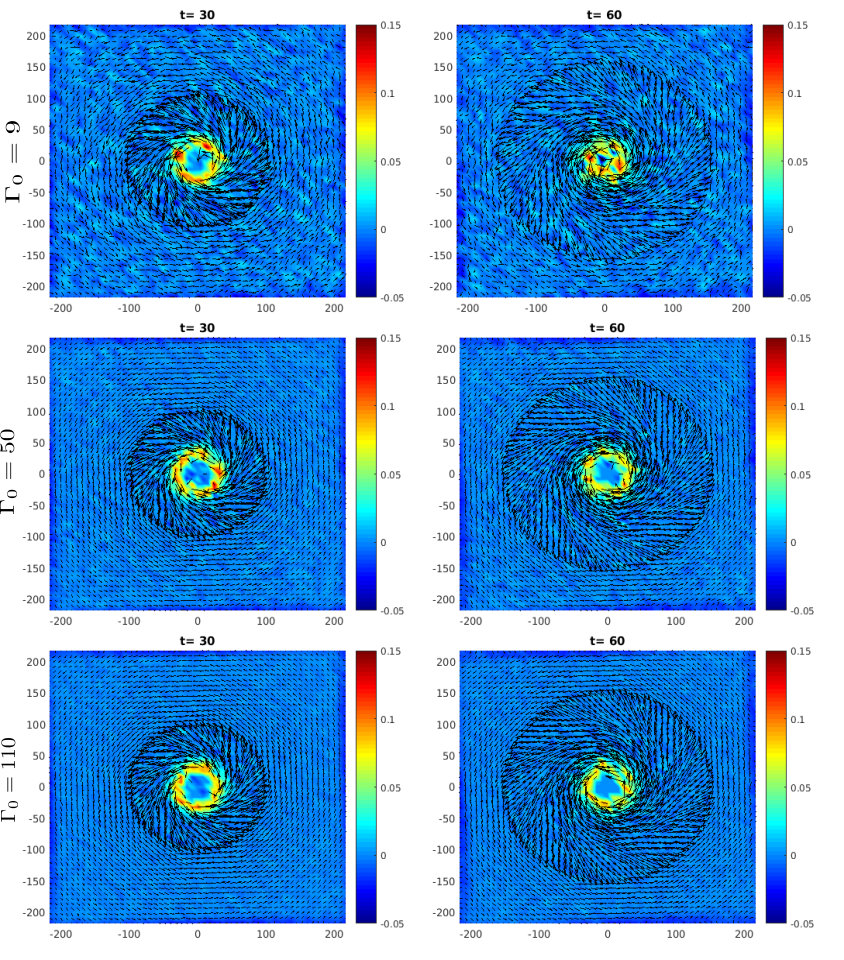 Figure 1
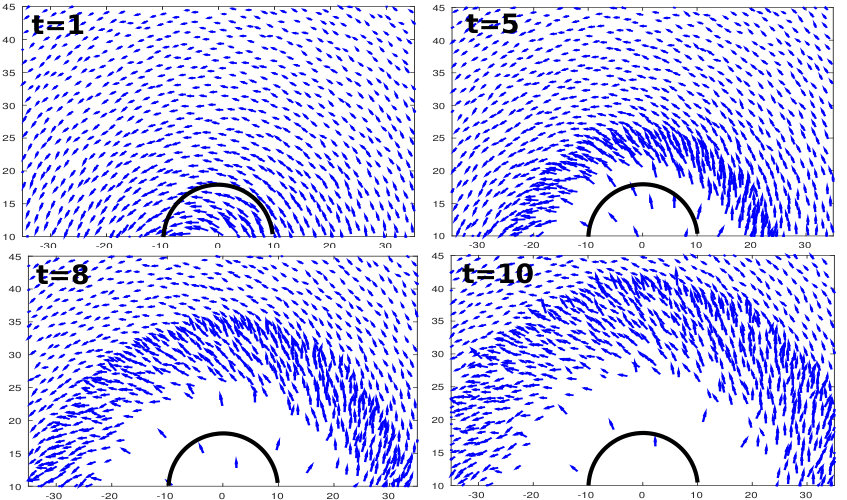 Figure 2
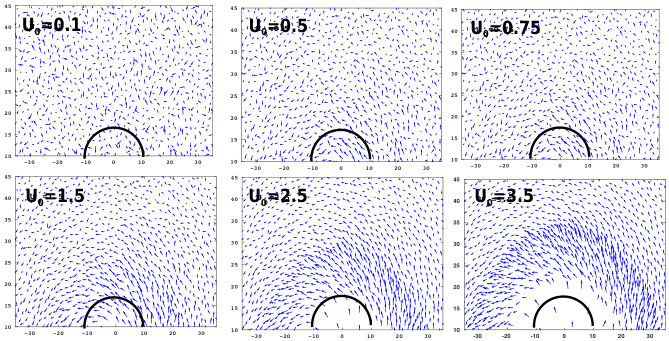 Figure 3
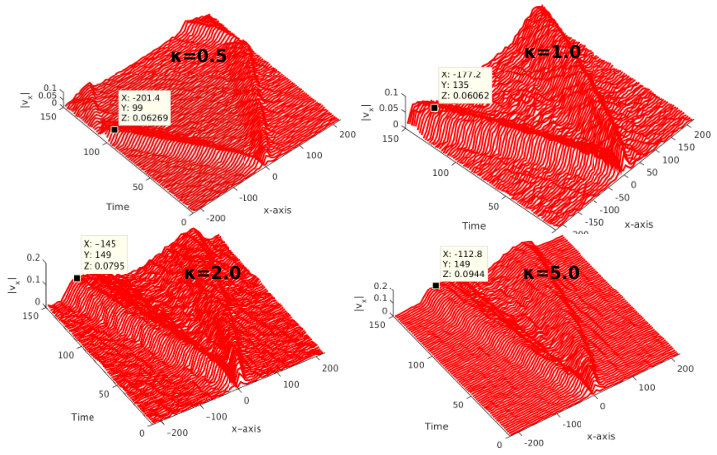 Figure 4
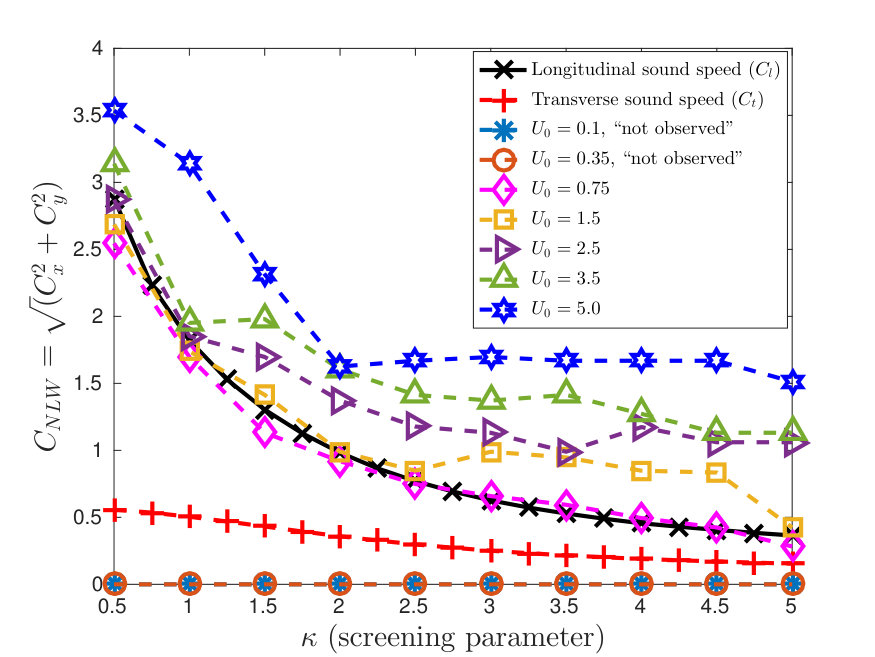 Figure 5
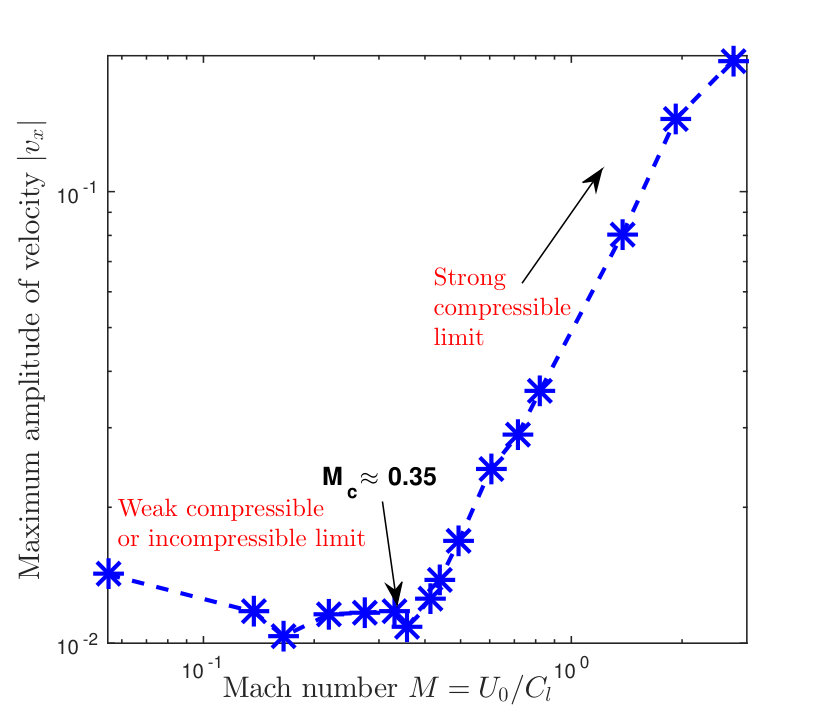 Figure 6
Peer Reviews
No public reviews on file for this paper yet. If you reviewed it on a platform where reviews are public (OpenReview, ICLR, NeurIPS, ICML), you can paste yours below so the community can read it here.
Videos
No videos yet. Explain this paper in a talk, walkthrough, or lecture? Add one.
Taxonomy
TopicsIonosphere and magnetosphere dynamics · Solar and Space Plasma Dynamics · Geophysics and Gravity Measurements
Emergence of inertial waves from coherent vortex source in Yukawa medium
Akanksha Gupta
Indian Institute of Technology Kanpur, Kanpur-208016, India
Rajaraman Ganesh
Institute for Plasma Research, HBNI, Bhat, Gandhinagar - 382428, India
Abstract
The evolution of isotropic, nondispersive, inertial wave, emerging from an unsteady initial coherent vortex is studied for strongly correlated Yukawa medium using 2D molecular dynamics simulation. In this study, the effect of azimuthal speed of vortex source, strong correlation, large screening and compressibility of the medium over the propagation of generated inertial wave have been presented. It has been observed that these inertial waves only exist when the speed of vortex source () is larger or equal to the longitudinal sound speed of the system. Estimated speed of nonlinear wave is found to be always larger than the transverse sound speed () of the system for the range of coupling and screening parameters. In this study, we find that spontaneously generated nonlinear inertial wave speed in Yukawa medium is suppressed by compressibility and dust-neutral drag of the system and is less sensitive to coupling strength. A transition from incompressible to compressible Yukawa liquid is observed. This transition depends on the screening parameter and azimuthal speed of vortex source. Existence of a critical Mach number is found above which nolinear wave is found to exists, indicating compressible nature of the medium.
pacs:
Valid PACS appear here
††preprint: APS/123-QED
I Introduction
Grain medium (plasma with micron and sub-micron sized dust grains), also known as complex or dusty plasma which behaves like viscoelastic medium, facilitate linear and nonlinear waves Kaw and Sen (1998); Piel et al. (2002). Such grain medium can behave like viscous, visco-elastic and elastic medium and can be characterized by two dimensionless parameters, screening parameter (where is inter-grain-spacing and is Debye length of background plasma, , are Debye length of electron and ion respectively) and coupling parameter wherein and are charge and temperature of grain (Morfill and Ivlev, 2009). Such plasma occur in nature and in laboratory as well for example, comets, planetary rings, white dwarf, earth’s atmosphere and in plasma processing reactors, plasma torch and fusion devices (de Angelis, 2006).
Due to strong coupling nature of the medium both longitudinal and transverse wave modes may be expect to be correlated in the grain medium. Longitudinal modes exist through all state of dusty plasma, however Transverse mode occur due to finite elasticity of the medium and hence exist in liquid and solid regime. Transverse shear waves, are also known as surface waves and studied theoretically Kaw and Sen (1998), numerically Singh Dharodi et al. (2014) and experimentally Piel et al. (2006) in the strongly correlated grain medium (or complex plasma). In the past, various wave related phenomena have been studied in strongly correlated grain medium for example, compressional and shear modes (Nunomura et al., 2000; Nosenko et al., 2002a), Mach cones (Nosenko et al., 2002b), transverse waves (Pramanik et al., 2002) and driven transverse wave Bandyopadhyay et al. (2008). In the past, using molecular dynamics simulation and experiments the radiation of elastic waves in a plasma crystal using small dipole source has been observed (Piel et al., 2002).
There are many bodies in our solar system which have solid rotating inner core and a fluid outer core Zhang et al. (2001). Inertial waves are found to emerge from a localized rotating inner core, for example, these waves exist at the outer core of Earth because of the Earth’s rotationAldridge (1987); Greenspan (1968). In such case, restoring force for inertial waves is the Coriolis force. Understanding of such wave propagation has many important applications in geophysics, geodynamo, and Earth’s core dynamics. In present study, we use a Yukawa liquid (dusty plasma) as a prototype or a visco-elastic medium to study such hydrodynamical waves, wherein restoring force is provided by the finite compressibility and elasticity of the medium. In the present study, we address several important questions, for example, for a single value of strong correlation () and screening () is there any inertial wave generated by the presence of coherent localized vortex?, how the inertial wave changes its nature with an azimuthal speed of coherent localized vortex? what are the effect of variation of and over the generated wave. In the present work, for the first time, using molecular dynamics simulation, we study the emergence of non-linear inertial waves due to azimuthal motion of ideal rotational flow and the effect of strong correlation of the medium over such waves.
Dusty or complex plasmas are often modelled by repulsive interaction potential called screened Coulomb potential or Yukawa potential where is the inter particle distance of and particle. We perform molecular dynamics simulation for unbounded (infinite) system hence periodic boundary condition and no confining external force have been used. Space is normalised to Wigner-Seitz radius and time is normalised to , where (, where and are two-dimensional dust density and average mass of dust grain respectively ) (Gupta et al., 2016). We consider ambient plasma properties to be invariant and model only grain dynamics because of slow response of grain medium as compared to electrons and ions which is due to large mass of the dust. In later part of this work, we also discuss the effect of neutral-dust collisions. The -body problem is numerically integrated using our parallelized MD code Joy and Ganesh (2009).
II Flow Description
To study the vortex flow dynamics of rotational shear flow in strongly correlated liquids, a Rankine vortex (Giaiotti and Stel, 2006; Loiseleux et al., 1998; Hoff et al., 2016) is chosen as the initial condition. Rankine vortex model is an azimuthal shear flow with two flow regions namely inner region of the flow , which has a rotational profile like that of a rigid rotator outer region ,. The mathematical expression of Rankine velocity profile is , where
[TABLE]
where , , are radial, azimuthal and axial velocities respectively. is the strength of azimuthal velocity, and are radial coordinates and radius of Rankine vortex core respectively. In Cartesian co-ordinate the and component of velocities are and , where and are particle velocities in cartesian system.
III Computational Analysis and Results
To start MD simulation in Yukawa medium, a large number of particles were thermalized for desired value of coupling strength or inverse of temperature. Particles are thermalised using a Gaussian thermostat Evans and Morriss (1984) for time . The thermostat is put off for . To study the vortex dynamics of rotational shear flow, the Rankine vortex profile is superimposed over thermalised particles velocities. The reduced number density . We do not consider Ewald sums Salin and Caillol (2002) due to the large size of the simulation box . To obtain macro-scale quantities for example, averaged velocity and averaged vorticity from microscopic information, we perform “process of fluidization” (Gupta et al., 2016).
Time evolution of vortex rotation and wave propagation have been shown in Fig.1. Increasing strong correlation by increasing coupling strength at constant screening parameter does not show any significant qualitative differences in the structure and time evolution of wave as time passes. To measure the quantitative changes, we estimate the speed of nonlinear inertial wave . Speed of emerging non-linear wave has been calculated by , where , ( and are distance traveled by wave along and directions in time ). It is important to note that the propagated wave is isotropic in space and hence the speed along and directions are found to be close to each other i.e . For each value of initial coupling parameter , with various initial azimuthal speeds = 0.75, 2.5, 3.5, 5.0, speed of inertial wave are 1.51, 1.81, 2.26 and 3.11 respectively. It has been observed that the increasing strength of rotational vortex () enhances the speed of propagation of wave (). For example, waves generated from vortex source of higher azimuthal velocity touch the boundary first rather than lower one and re-appear on the other side of the boundary because of periodic boundary condition. Fig.2 shows the particles orientation radially outward from the centre of vortex for , and . Due to strong correlation between the particles of the medium, the bunch of particles near the edge of vortex source resume its natural shape after vortex rotation and therefore, nearest particles undergo shear, by this way the wave propagate in the medium. The wave propagation from the vortex source is crucially depends upon the azimuthal speed of vortex source. In Fig.3 [details are present in the caption], it is shown that the wave propagation starts when , which is much grater than transverse sound speed and thermal speed . We shall come to this point later. Two sound speeds in the system exist one for compressional ( towards direction) and other for shear ( towards direction) waves. In the presence of macroscale vortex flows speed larger and finite compressiblity these modes get coupled with each other. We have repeated our numerical experiments for various values of screening parameter [] with constant value of azimuthal speed and coupling parameter. Fig.4 shows that the screening parameter suppresses the speed of linear wave. It is found that in Yukawa medium for given value of and , sound speeds ( and ) are mainly dependent on and insensitive to (Khrapak, 2016). We have calculated the and using equilibrium MD simulation for our system for and using pair correlation related formula (Khrapak, 2016). In present study, there are three main speed exist in Yukawa medium i.e , and . In Fig.4, 3D plot of space, time and absolute value of fluidized averaged velocity along direction has been plotted for various values of for , .
The slope and give the propagation speed of wave along () and directions respectively. Fig.4 clearly show that screening parameter () decreases the speed of wave and increases the amplitude of velocity [see axis of Fig.4]. It is observed that the inertial wave propagate when and and no wave has been observed when . Fig.5 shows the speed of linear wave with screening parameter as decreases the sound speed of the system and makes the system (or medium) to be more compressible. In this study, we find that spontaneously generated rotational wave speed in Yukawa medium is suppressed by compressibility and independent of coupling strength. Emergent wave is isotropic and non-dispersive. In fluid dynamics, it is well known and experimentally observed that the fluid medium below Mach number is incompressible or weakly compressible Kundu et al. (2015). In our work, Mach number variation (via increasing initial velocity magnitude ) study with maximum amplitude of absolute value of inertial wave velocity along direction () for and , a critical value of Mach number is observed above which the medium gets significant compressibility to sustain the wave [see Fig.6 ]. We also studied the generation of wave in presence of neutral-dust collision by incorporating the neutral drag force in the equation of motion. It is found that the neutral drag decreases values. From our simulations, for , , parameters with realistic neutral-drag coefficients , , the wave speed , 2.47, 2.26.
In present work, we observe isotropic and non-dispersive wave emerged from a localized source in strongly correlated dusty plamsa which also behave as a viscoelastic medium. We studied for the first time, the effect of azimuthal speed of vortex source, strong correlation, large screening and compressibility of the medium over the propagation of generated wave using non-equilibrium molecular dynamics simulation. We have also observed the incompressible (water-like) to compressible flow transition via increasing value of initial velocity magnitude . We find that spontaneously generated wave speed in Yukawa medium is suppressed by compressibility and dust-neutral drag of the system and is less sensitive to coupling strength.
IV Acknowledgement
All simulations have been performed at Uday and Udbhav clusters at Institute for Plasma Research and HPC2013-IITK cluster of IIT Kanpur.
The reference list from the paper itself. Each links out to its DOI / PubMed record.
- 1Kaw and Sen (1998) P. K. Kaw and A. Sen, Physics of Plasmas 5 , (10), 3552 (1998).
- 2Piel et al. (2002) A. Piel, V. Nosenko, and J. Goree, Phys. Rev. Lett. 89 , 085004 (2002).
- 3Morfill and Ivlev (2009) G. E. Morfill and A. V. Ivlev, Rev. Mod. Phys. 81 , 1353 (2009).
- 4de Angelis (2006) U. de Angelis, Physics of Plasmas 13 , 012514 (2006).
- 5Singh Dharodi et al. (2014) V. Singh Dharodi, S. Kumar Tiwari, and A. Das, Physics of Plasmas 21 , 073705 (2014).
- 6Piel et al. (2006) A. Piel, V. Nosenko, and J. Goree, Physics of plasmas 13 , 042104 (2006).
- 7Nunomura et al. (2000) S. Nunomura, D. Samsonov, and J. Goree, Physical review letters 84 , 5141 (2000).
- 8Nosenko et al. (2002 a) V. Nosenko, S. Nunomura, and J. Goree, Physical review letters 88 , 215002 (2002 a).