TL;DR
This paper models the coexistence of age and throughput optimizing networks sharing wireless spectrum as a repeated game, deriving equilibrium strategies that reveal how these networks can coexist efficiently.
Contribution
It introduces a game-theoretic framework for analyzing coexistence of age and throughput optimizing networks, deriving Nash equilibria and studying their evolution over time.
Findings
Sharing spectrum with an AON is more favorable for a TON than sharing with another TON.
AON's equilibrium strategy involves occasional refraining from transmission, enabling free access for the TON.
Equilibrium strategies evolve over time, affecting the networks' average payoffs.
Abstract
Real-time monitoring applications have Internet-of-Things (IoT) devices sense and communicate information (status updates) to a monitoring facility. Such applications desire the status updates available at the monitor to be fresh and would like to minimize the age of delivered updates. Networks of such devices may share wireless spectrum with WiFi networks. Often, they use a CSMA/CA based medium access similar to WiFi. However, unlike them, a WiFi network would like to provide high throughputs for its users. We model the coexistence of such networks as a repeated game with two players, an age optimizing network (AON) and a throughput optimizing network (TON), where an AON aims to minimize the age of updates and a TON seeks to maximize throughput. We define the stage game, parameterized by the average age of the AON at the beginning of the stage, and derive its mixed strategy Nash…
Click any figure to enlarge with its caption.
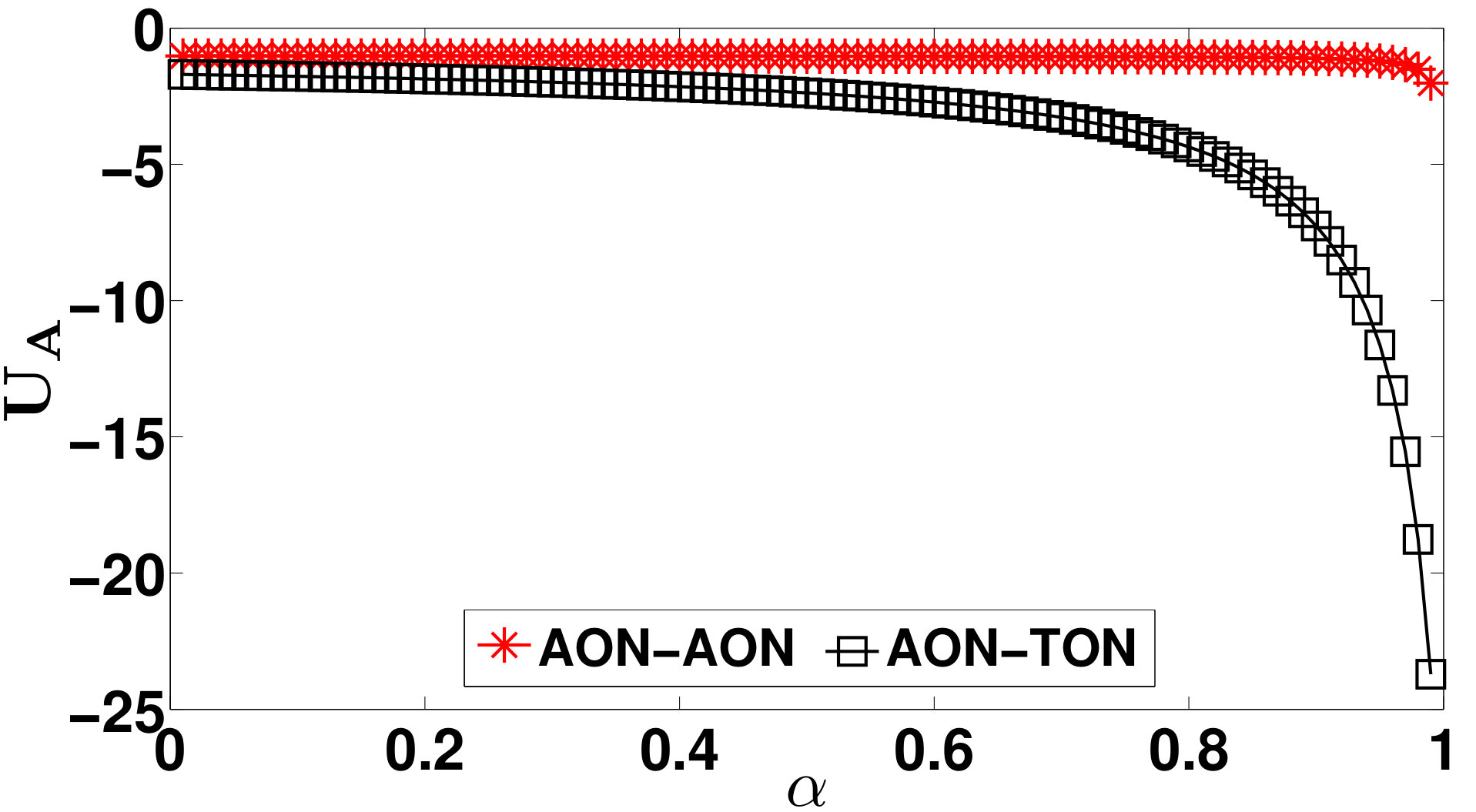 Figure 1
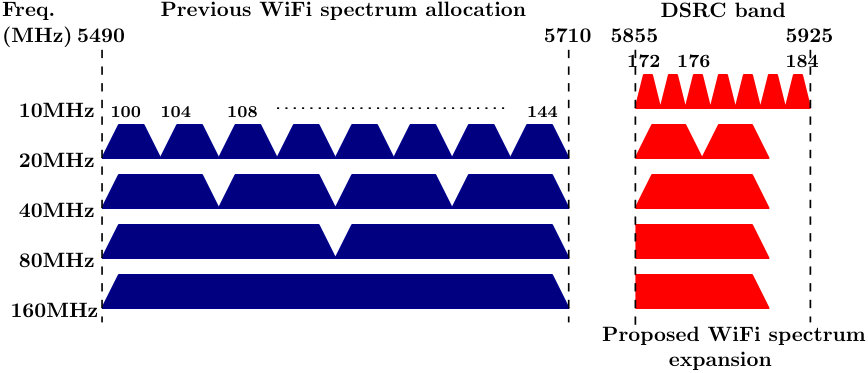 Figure 2
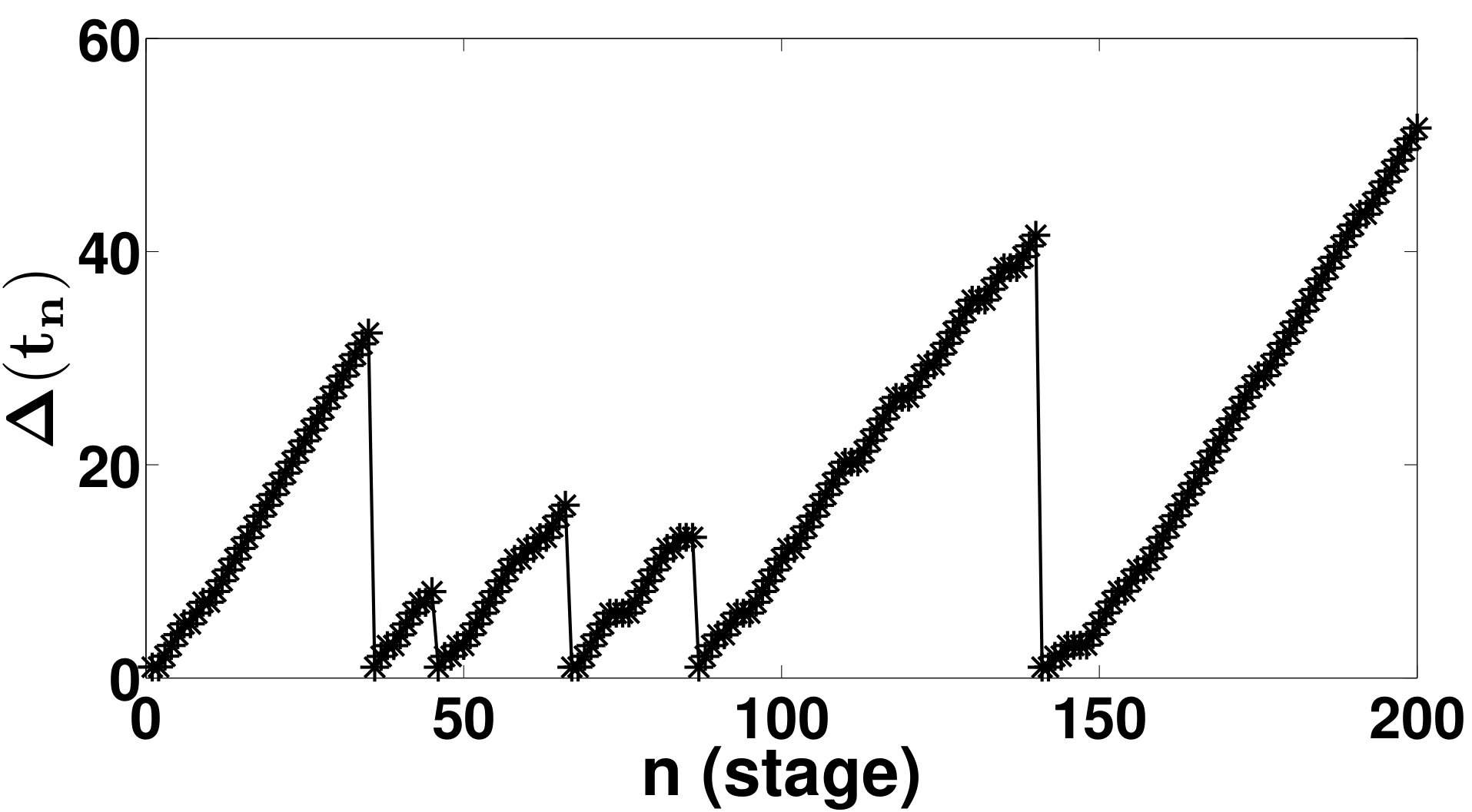 Figure 3
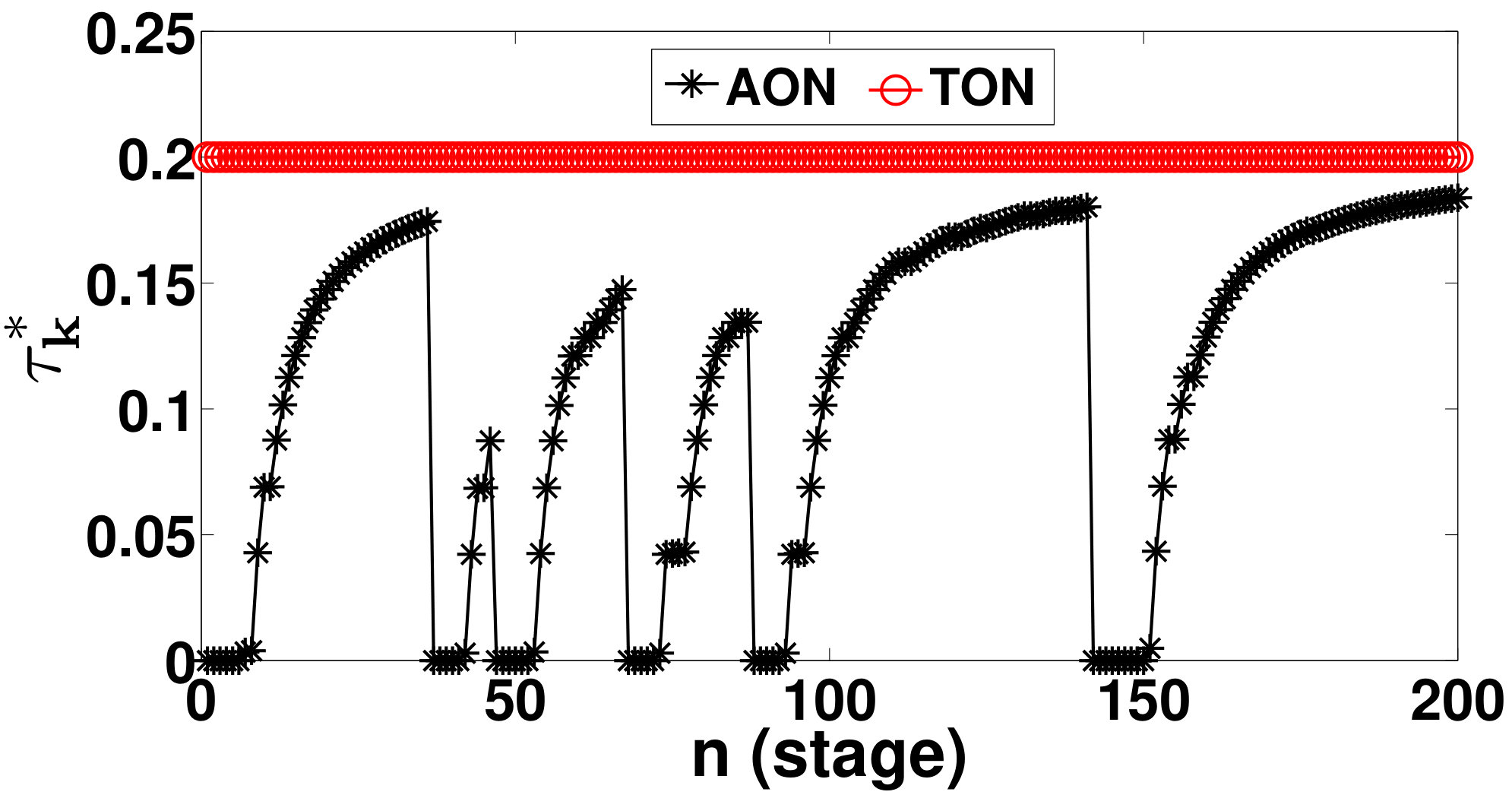 Figure 4
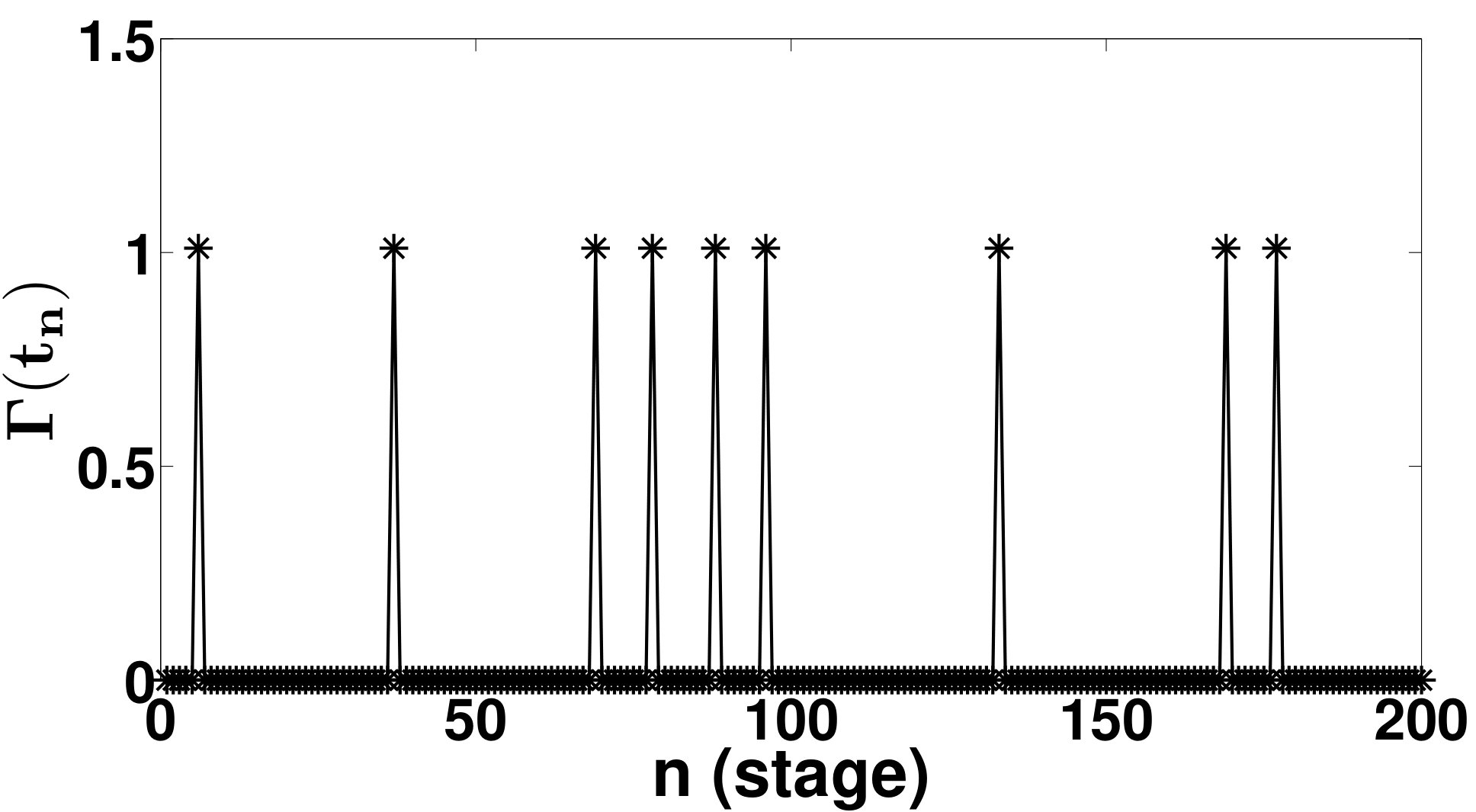 Figure 5
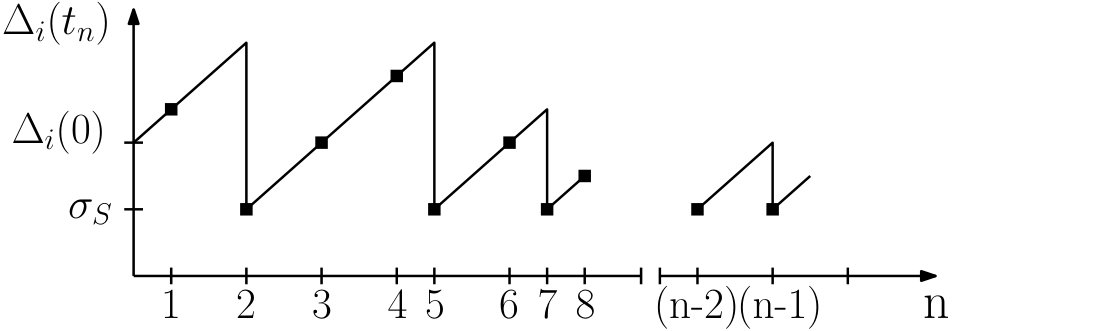 Figure 6
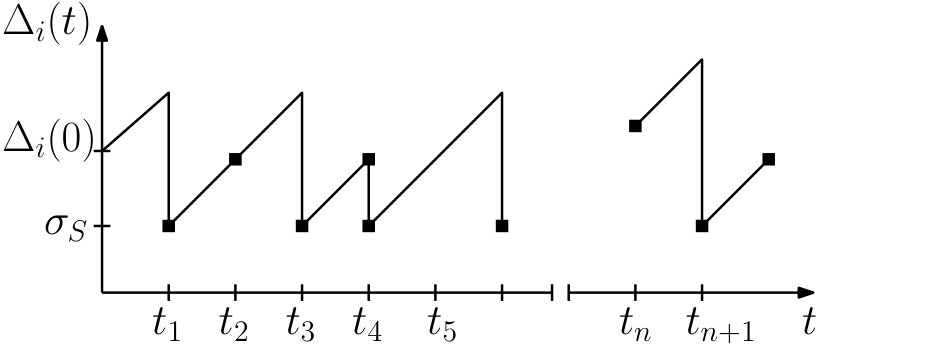 Figure 7
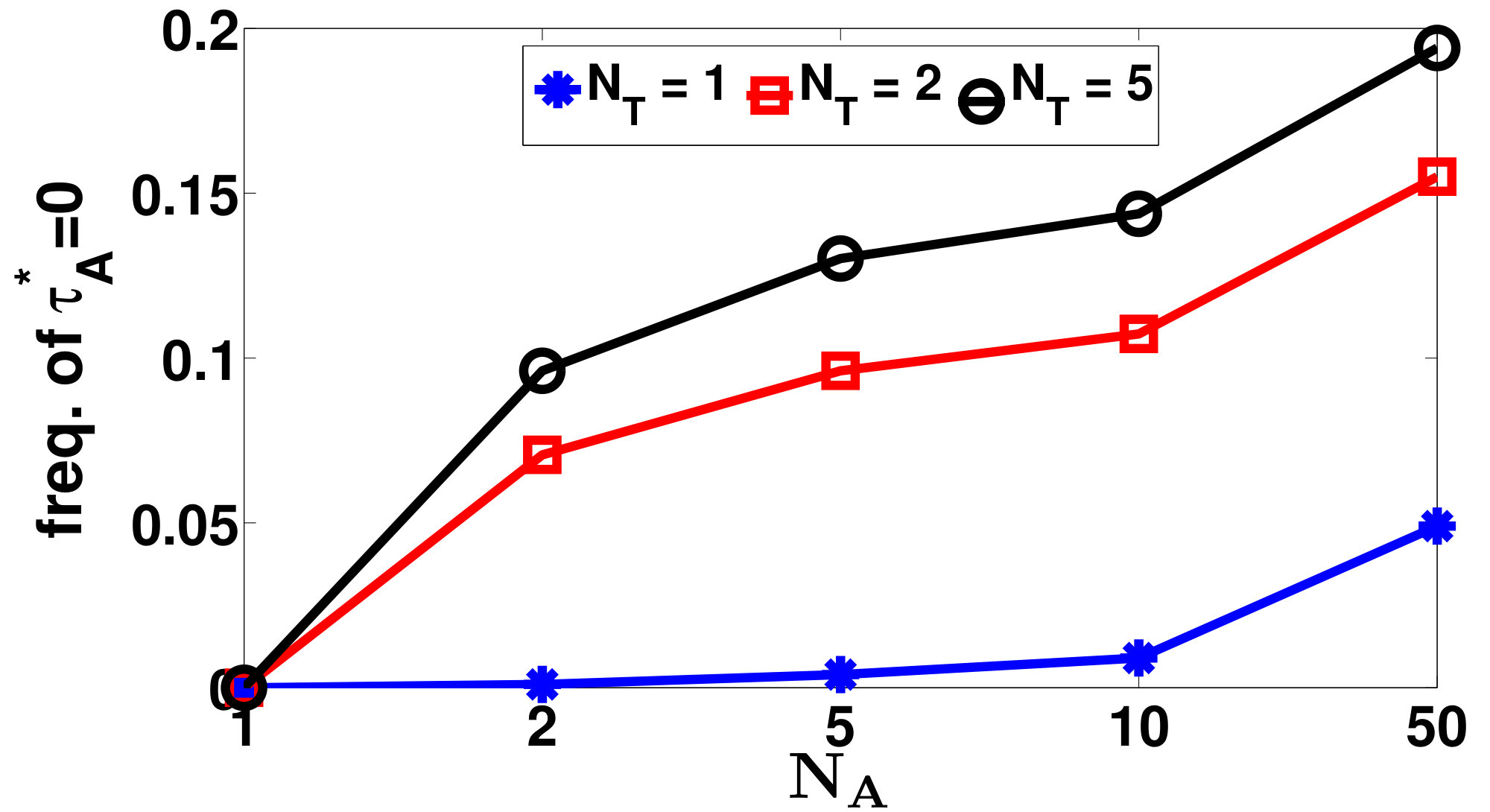 Figure 8
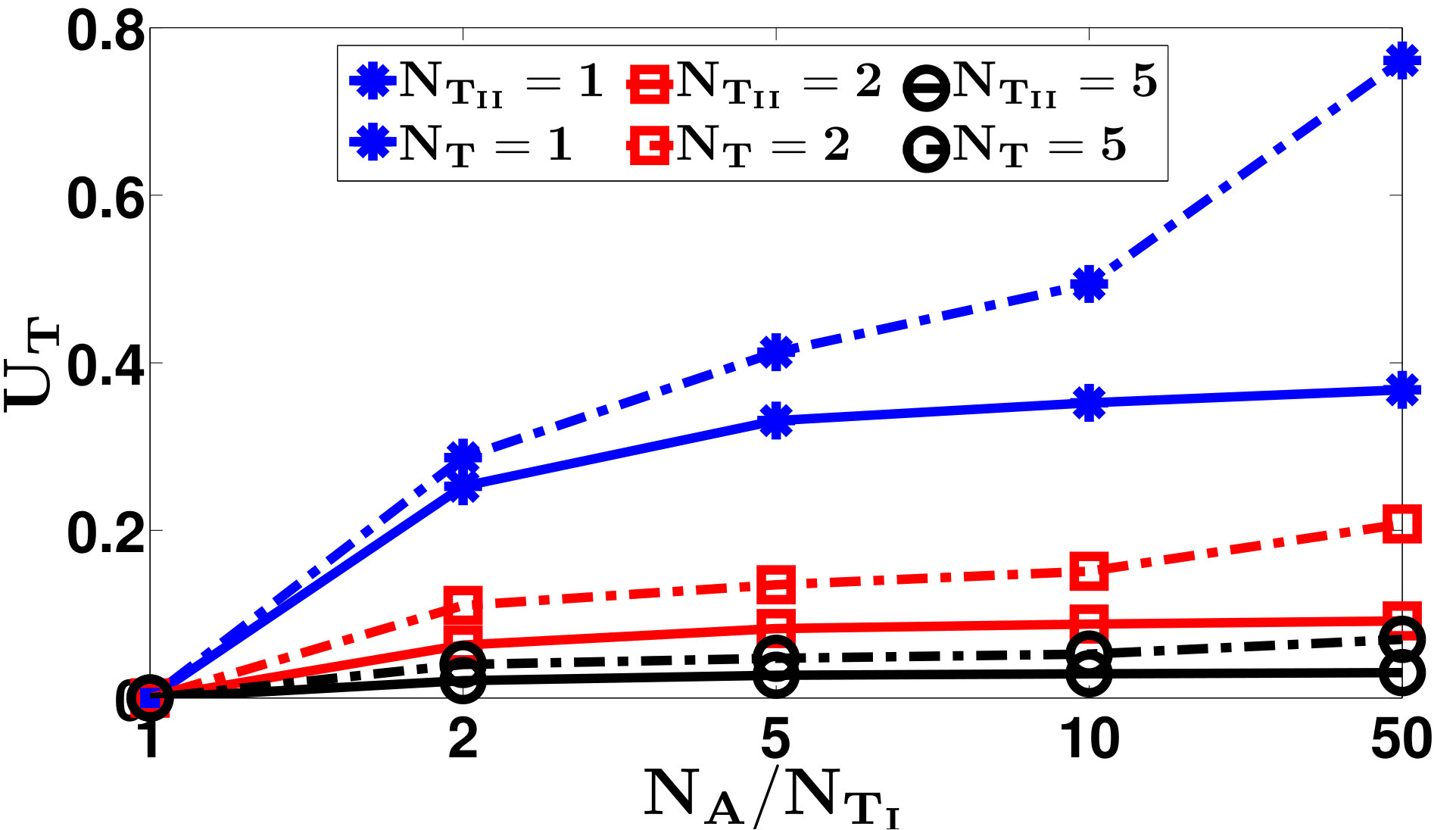 Figure 9
 Figure 10
 Figure 11
 Figure 12
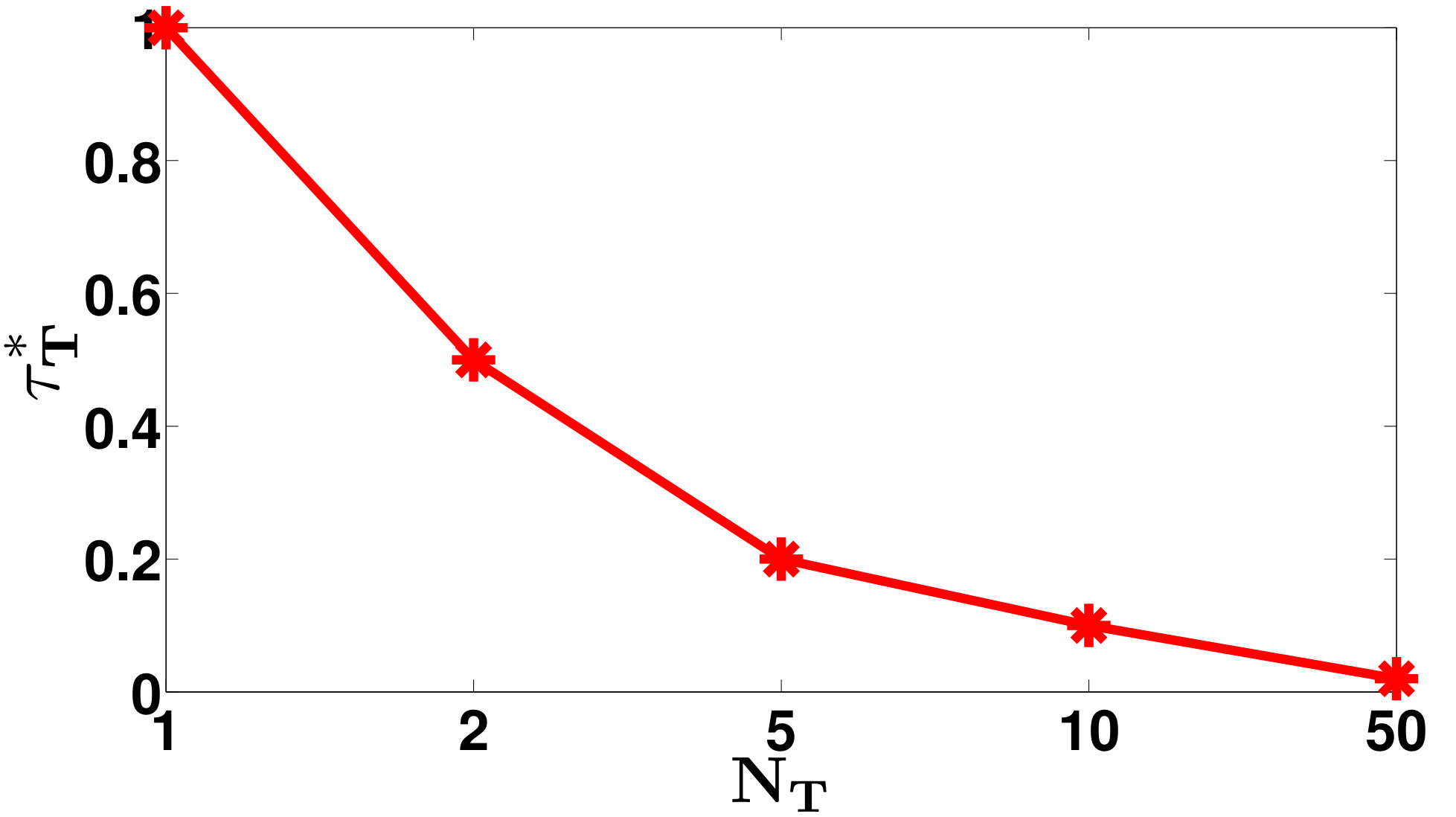 Figure 13
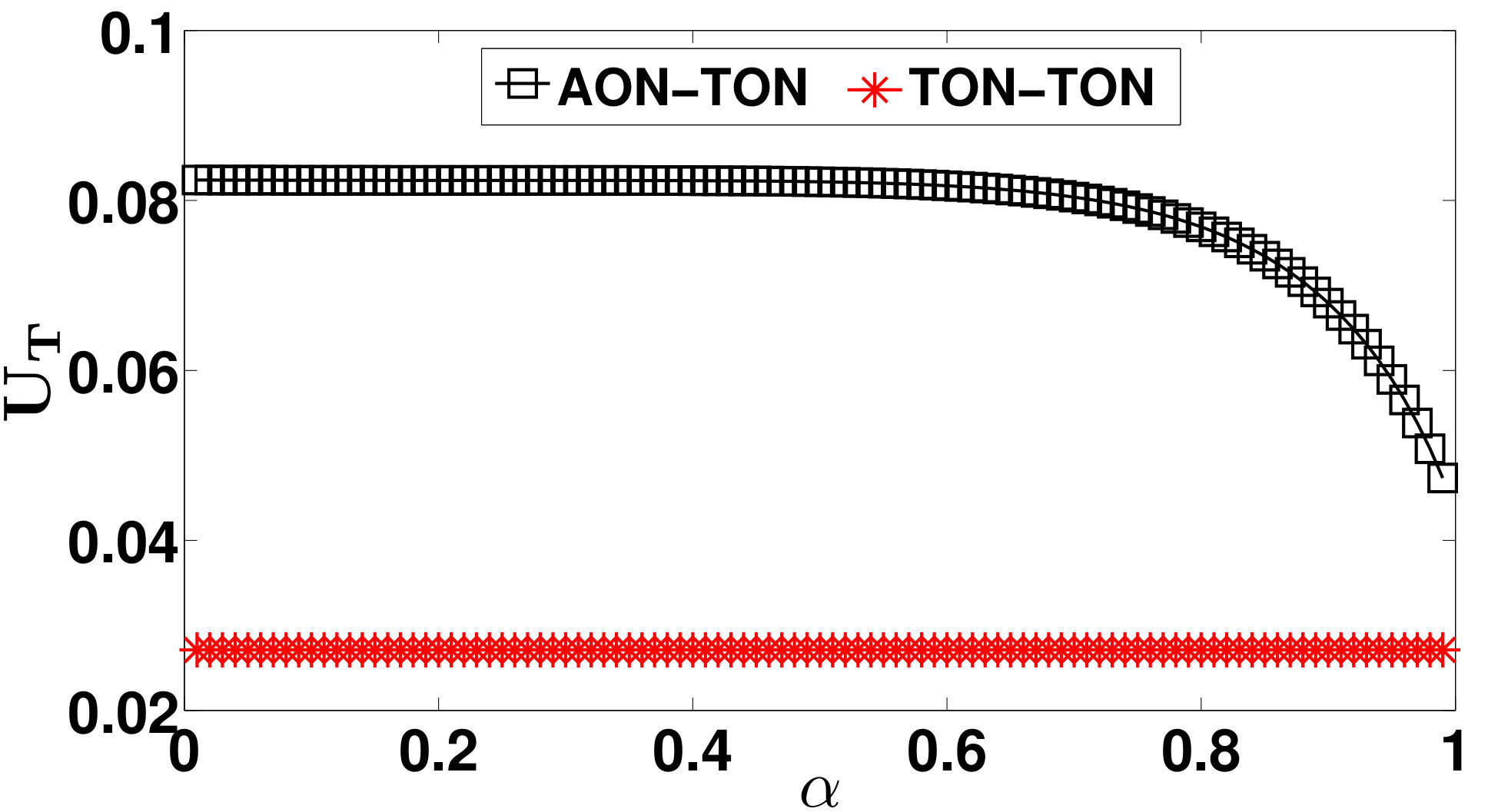 Figure 14
 Figure 15
 Figure 16
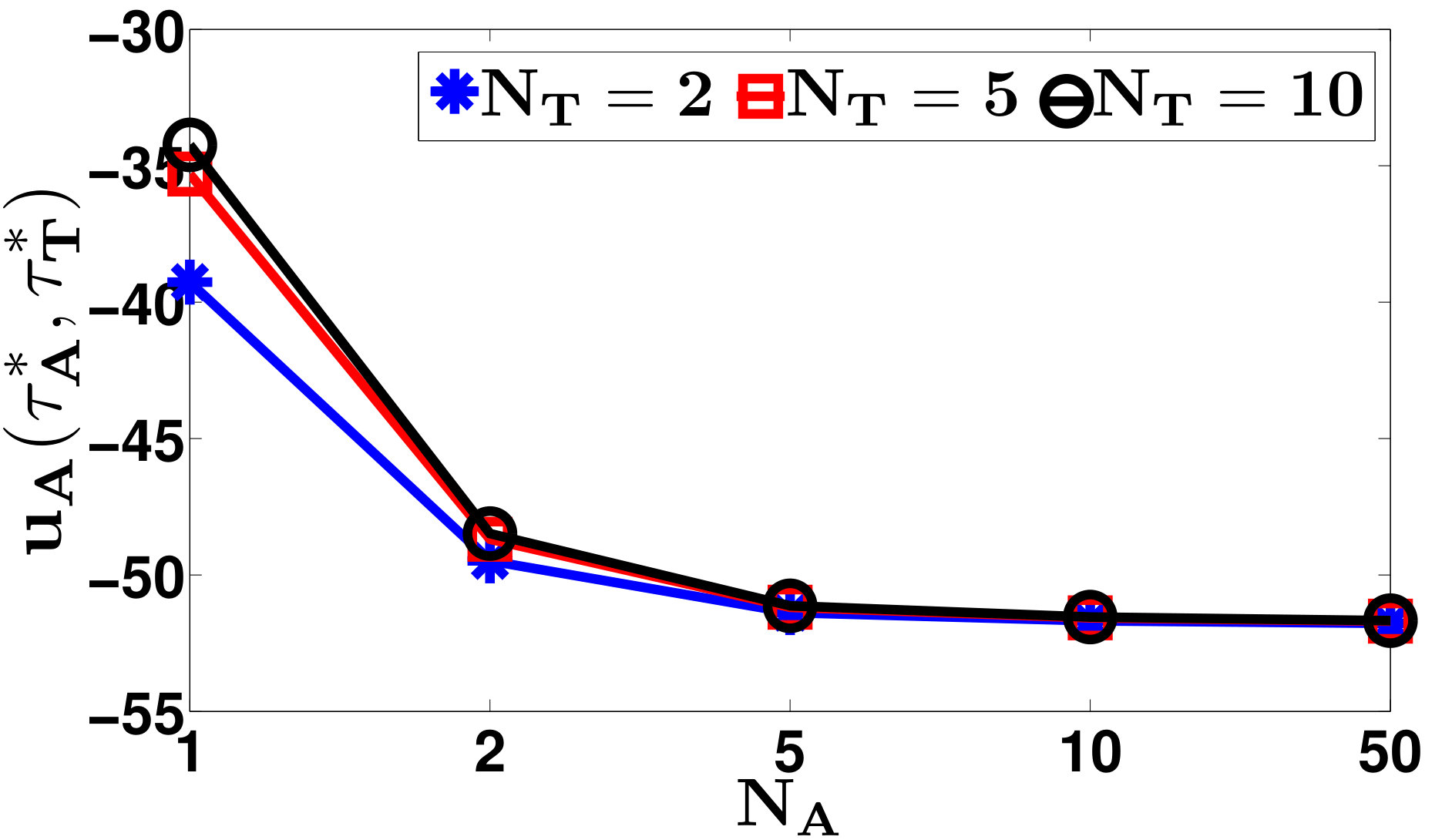 Figure 17
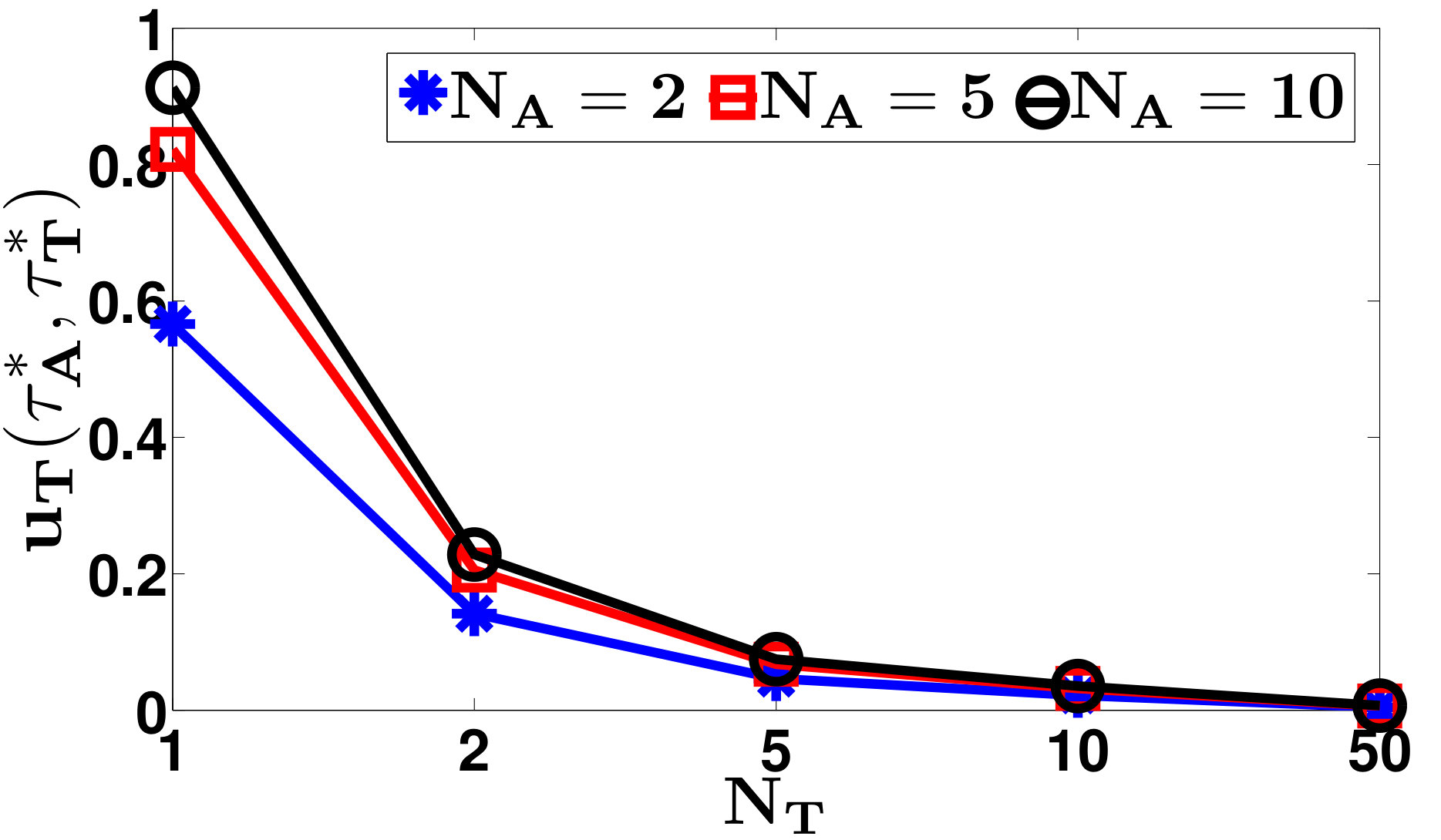 Figure 18
| Coexistence scenario (I-II) | Frequency of successful transmission in Network I | Frequency of successful transmission in Network II | Frequency of collision |
Frequency of
(I, II) |
|---|---|---|---|---|
| AON-AON | ||||
| AON-TON | ||||
| TON-TON | NA, NA |
Peer Reviews
No public reviews on file for this paper yet. If you reviewed it on a platform where reviews are public (OpenReview, ICLR, NeurIPS, ICML), you can paste yours below so the community can read it here.
Code & Models
Videos
No videos yet. Explain this paper in a talk, walkthrough, or lecture? Add one.
Coexistence of Age and Throughput Optimizing Networks: A Game Theoretic Approach
Sneihil Gopal*∗, Sanjit K. Kaul∗* and Rakesh Chaturvedi*†*
*∗*Wireless Systems Lab, IIIT-Delhi, India
*†*Department of Social Sciences & Humanities, IIIT-Delhi, India
{sneihilg, skkaul, rakesh}@iiitd.ac.in
Abstract
Real-time monitoring applications have Internet-of-Things (IoT) devices sense and communicate information (status updates) to a monitoring facility. Such applications desire the status updates available at the monitor to be fresh and would like to minimize the age of delivered updates. Networks of such devices may share wireless spectrum with WiFi networks. Often, they use a CSMA/CA based medium access similar to WiFi. However, unlike them, a WiFi network would like to provide high throughputs for its users.
We model the coexistence of such networks as a repeated game with two players, an age optimizing network (AON) and a throughput optimizing network (TON), where an AON aims to minimize the age of updates and a TON seeks to maximize throughput. We define the stage game, parameterized by the average age of the AON at the beginning of the stage, and derive its mixed strategy Nash equilibrium (MSNE). We study the evolution of the equilibrium strategies over time, when players play the MSNE in each stage, and the resulting average discounted payoffs of the networks. It turns out that it is more favorable for a TON to share spectrum with an AON in comparison to sharing with another TON. The key to this lies in the MSNE strategy of the AON that occasionally refrains all its nodes from transmitting during a stage. Such stages allow the TON competition free access to the medium.
I Introduction
The ubiquity of Internet-of-Things (IoT) devices has led to the emergence of applications that require these devices to sense and communicate information (status updates) to a monitoring facility, or share with other devices, in a timely manner. These applications include real-time monitoring systems such as disaster management, environmental monitoring and surveillance [1, references therein], which require timely-delivery of information updates to a common ground station for better system performance, to networked control systems like vehicular networks, where each vehicle broadcasts status (position, velocity, steering angle, and etc.) to nearby vehicles in real-time for safety and collision avoidance[2].
Such networks often share the wireless spectrum with WiFi networks. For instance, the Federal Communications Commission (FCC) in the US opened up the GHz band, previously reserved for vehicular communication, for use by high throughput WiFi ( ac) devices, leading to the possibility of coexistence between WiFi and vehicular networks [3]. Similarly, IoT devices like Unmanned Aerial Vehicles (UAVs), equipped with a/b/g/n technology, operate in the and GHz bands in use by WiFi networks.
While a network of IoT devices would like to optimize freshness of status updates, a WiFi network would like to provide high throughputs for its users. We quantify freshness using the metric of age of information [4] and refer to the former network as an age optimizing network (AON) and to the latter as a throughput optimizing network (TON).
In this work, we investigate the coexistence of an AON and a TON when both networks use a WiFi like CSMA/CA based medium access from a MAC layer perspective. We use a repeated game theoretic approach. We assume networks are selfish players and aim to optimize their respective utilities i.e. an AON aims to minimize the age of updates and a TON seek to maximize its throughput. Our specific contributions include
- •
We model the interaction between an AON and a TON in each CSMA/CA slot as a non-cooperative stage game, define the stage game which is parameterized by the average age of the AON at the beginning of the stage and derive its mixed strategy Nash equilibrium (MSNE).
- •
Our analysis shows that the equilibrium strategy of each network is independent of the other network and the equilibrium strategy of the AON in each stage is a function of the average age seen at the beginning of the stage. We study the subgame perfect equilibria that involves players playing the equilibrium strategy in each stage and analyse the evolution of these strategies over time.
- •
We show that unlike prior works on coexistence of CSMA/CA based networks, where networks access the medium aggressively to maximize their respective utilities [5], in AON-TON coexistence, the requirement of timely updates [4] by the AON makes it conservative. Consequently, spectrum sharing with an AON becomes beneficial for a TON in contrast to sharing with another TON. Specifically, we show that the equilibrium strategy of the AON occasionally refrains the AON nodes from transmitting during a stage in order to ensure freshness of updates. Such stages allow the TON competition free access to the medium, therefore, improving its payoff.
The rest of the paper is organized as follows. Section II describes the related works. The network model is described in Section III. This is followed by formulation of the game in Section IV. In Section V, we discuss the results and we conclude with a summary of our observations in Section VI.
II Related Work
Works such as [3] and [6] study the impact of vehicular communications on WiFi and vice versa. In these works, authors look at the coexistence of vehicular and WiFi networks as the coexistence of two CSMA/CA based networks, where the packets of vehicular network take precedence over that of WiFi. In contrast to [3] and [6], we look at the coexistence problem as that of coexistence of networks which have equal access rights to the spectrum, use similar access mechanisms but have different objectives.
In [7] and [8] authors consider UAV applications. While in [7] authors derive an optimum strategy for timely delivery of data so as to minimize communication delay, in [8] authors evaluate n and ac in a UAV setting in terms of achievable throughput. Delay and throughput used in the aforementioned works are commonly used performance metrics, however, they fail to measure the freshness of the updates. In contrast to [7] and [8], we employ the age of information metric, which adequately captures the freshness of updates. Works such as [9] and [10] investigate age of information in wireless networks.
Note that while throughput as the payoff function has been extensively studied from the game theoretic point of view (for example, see [5, 11]), age as a payoff function has not garnered much attention yet. In [12] and [13], authors study an adversarial setting where one player aims to maintain the freshness of information updates while the other player aims to prevent this. Also, in our preliminary work [14], we propose a game theoretic approach to study the coexistence of DSRC (Dedicated Short Range communication aka vehicular communications) and WiFi, where the DSRC network desires to minimize the time-average age of information and the WiFi network aims to maximize the average throughput. We studied the one-shot game and evaluated the Nash and Stackelberg equilibrium strategies. However, the model in [14] did not capture well the interaction of networks, evolution of their respective strategies and payoffs over time, which the repeated game model allows us to capture in this work. In this work, via the repeated game model we are able to shed better light on the AON-TON interaction and how their different utilities distinguish their coexistence from the coexistence of two utility maximizing CSMA/CA based networks.
III Network Model
We consider a network which consists of age optimizing and throughput optimizing nodes that contend for access to the shared wireless medium. We assume the number of nodes is time-invariant. In general, both AON and TON nodes access the medium using a CSMA/CA based mechanism in which nodes use contention windows (CW) and one or more backoff stages to gain access to the medium111In CSMA/CA, nodes employ a window based backoff mechanism to gain access to the medium. The node first senses the medium and if the medium is busy it chooses a backoff time uniformly from the interval , where is set equal to . The interval is doubled after each unsuccessful transmission until the value equals , where is the maximum backoff stage.. We model this mechanism as in [15].
We assume that all nodes can sense each other’s packet transmissions. This allows modeling the CSMA/CA mechanism as a slotted multiaccess system. A slot may be an idle slot in which no node transmits a packet or it may be a slot that sees a successful transmission. This happens when exactly one node transmits. If more than one node transmits, none of the transmissions are successfully decoded and the slot sees a collision. Further, we assume that all nodes always have a packet to send. The modeling in [15] shows that the CSMA/CA settings of minimum contention window (), number of backoff stages and the number of nodes can be mapped to the probability with which a node attempts transmission in a slot. We use this probability to calculate the probabilities defined next. We will define the probabilities of interest for a certain network of nodes indexed .
Let denote the probability with which node attempts transmission in a slot. Let be the probability of an idle slot, which is a slot in which no node transmits. We have
[TABLE]
Let be the probability of a successful transmission by node in a slot and let be the probability of a successful transmission in a slot. We say that node sees a busy slot if in the slot node doesn’t transmit and exactly one other node transmits. Let be the probability that a busy slot is seen by node . Let be the probability that a collision occurs in a slot. We have
[TABLE]
Let and denote the lengths of an idle, successful, and collision slot, respectively. In this work, we assume . The other case of practical interest, for when using RTS/CTS, is . The analysis for this case can be carried out in a similar manner to that in this paper. We skip the details in this paper.
Next we define the throughput of a TON node and the age of an AON node in terms of the above probabilities and slot lengths.
III-A Throughput of a TON node over a slot
Let the rate of transmission be fixed to bits/sec in any slot. Define the throughput of a TON node in a slot as the number of bits transmitted successfully in the slot. This is a random variable with probability mass function (PMF)
[TABLE]
Using (3), we define the average throughput of node as
[TABLE]
The average throughput of TON in a slot is
[TABLE]
Note that the throughput in a slot is independent of that in the previous slots.
III-B Age of an AON node over a slot
Let be the status update age of an AON node at other nodes in the AON at time . When the freshest update of node at AON node at time is time-stamped , the status update age, or simply the age, of node at node is defined as . We assume that a status update packet that AON node attempts to transmit in a slot contains an update that is fresh at the beginning of the slot. As a result, node ’s age either resets to if a successful transmission slot occurs or increases by , or at all other nodes in the AON, respectively, in case an idle slot, collision slot or a busy slot occurs. Note that node ’s age at the end of a slot is determined by its age at the beginning of the slot and the type of the slot. Figure 1 shows an example sample path of the age of a certain AON node . In what follows we will drop the explicit mention of time and let be the age observed at the end and be the age observed at the beginning of a given slot by node .
The age , observed by node at the end of a slot is thus a random variable with PMF conditioned on age at the beginning of a slot given by
[TABLE]
Using (6), we define the conditional expected age
[TABLE]
The average age of an AON at the end of the slot is
[TABLE]
IV The Age-Throughput Optimizing Repeated Game
We define a repeated game to model the interaction between an AON and a TON. In every CSMA/CA slot, networks must compete for access with the goal of maximizing their expected payoff over an infinite horizon (a countably infinite number of slots). We capture the interaction in a slot as a non-cooperative stage game . The interaction over the infinite horizon is modeled as the stage game played repeatedly in every slot and defined as . Next, we define these games in detail.
IV-A Stage game
We define a parameterized strategic one-shot game , where is the set of players, is the set of strategy of player , is the payoff of player and is the additional parameter input to the game , which is the average age (8) of the AON seen at the beginning of the slot. We define the game in detail.
- •
Players: We have two players namely AON () and TON (). Specifically, .
- •
Strategy: Let denote transmit and denote idle. For AON comprising of nodes, the set of pure strategies is , where is the set of strategies for a certain AON node . Similarly, for the TON comprising of nodes, the set of pure strategies is , where is the set of strategies for a certain TON node .
We allow networks to play mixed strategies. In general, for the strategic game , we can define as the set of all probability distributions over the set of strategies of player , where . A mixed strategy for player is an element , such that is a probability distribution over . For example, for an AON with , the set of pure strategies is and the probability distribution over is such that for all and .
In this work, we restrict ourselves to the space of probability distributions such that the mixed strategies of an AON are a function of and that of a TON are a function of , where and , as defined earlier, are the probabilities with which nodes in an AON and a TON, respectively, attempt transmission in a slot. Specifically, we force all the nodes to choose the same probability to attempt transmission. As a result, the probability distribution for an AON with , parameterized by , is .
Similarly, the probability distribution for a TON with , parameterized by , is .
We therefore allow the AON and the TON to choose and , respectively, to compute the mixed strategies.
- •
Payoffs: We have throughput optimizing nodes that attempt transmission with probablity and age optimizing nodes that attempt transmission with probability . Thus, by substituting for that is a TON node and for that is an AON node, we can calculate the probabilities (1)-(2) of both the TON and the AON nodes. The probabilities can be substituted in (3)-(4) and (6)-(7), respectively, to obtain the average throughput in (5) and average age in (8). We use these to obtain the stage payoffs and of the TON and the AON, respectively. They are
[TABLE]
The networks would like to maximize their payoffs.
IV-B Mixed Strategy Nash Equilibrium
As stated in [16], every finite strategic-form game has a mixed strategy Nash equilibrium (MSNE). Therefore, we allow players to randomize between pure strategies and find the mixed strategy Nash equilibrium. For a strategic game defined in Section IV-A, a mixed-strategy profile is a Nash equilibrium [16], if is the best response of player to his opponents’ mixed strategy , for all . We have
[TABLE]
where is the profile of mixed strategy. Since the probability distributions and are parameterized by and , respectively, we find in order to compute the mixed strategy Nash equilibrium.
Proposition 1**.**
The parameter required to compute the mixed strategy Nash equilibrium , for the 2-player one-shot game when is
[TABLE]
Proof: The proof is given in Appendix A.
As seen in (11a) and (11b), the access probabilities and required to compute the equilibrium strategies of the AON and the TON, respectively, have the following unique properties: (i) both and are independent of the number of nodes and access probability of the other network and (ii) in any slot is a function of average age observed at the beginning of the slot i.e. . As a result, the equilibrium strategy of each network is also its dominant strategy and the equilibrium strategy of the AON in any slot is a function of .
Figure 2 shows the and for the TON and the AON, respectively, corresponding to different selection of nodes in the network. We show for and . This choice of gives (see (11a)). Figure 2b shows that the access probability of the AON increases from to with increase in from to for . Also, the access probability of the AON decreases from to as number of nodes in the AON increases from to for .
A distinct feature of the stage game is the effect of self-contention and competition on the network utilities which we had also observed in our earlier work [14]. We define self-contention as the impact of nodes within one’s own network and competition as the impact of nodes in the other network. Figure 3 shows the affect of self-contention and competition on the network utilities, when networks play their respective equilibrium strategies. As shown in Figure 3a, as the number of nodes in the AON increase, the payoff of the TON increases. Intuitively, since increase in the number of AON nodes results in increase in competition, the payoff of the TON should decrease. However, the payoff of the TON increases. For example, for , as shown in Figure 3a, the payoff of the TON increases from to as increases from to . This increase is due to increase in self-contention within the AON which forces the network to be conservative and hence benefits the TON. Similarly as shown in Figure 3b, as the number of TON nodes increases the AON payoff improves.
IV-C Repeated game
As the networks coexist over a long period of time, the one-shot game defined in Section IV-A is played in every stage (slot) . We consider an infinitely repeated game, defined as with perfect monitoring [16] i.e. at the end of each stage, all players observe the action profile chosen by every other player222Assumptions such as imperfect and private monitoring are more realistic. However, for ease of exposition, we assume perfect monitoring and propose to study coexistence under other monitoring assumptions in the future.. In addition to the action profiles, players also observe i.e. the average age of the AON at the end of stage . We refer to as the state variable. A feasible strategy of the repeated game, in general, would depend on the history of play and the state variable. However, here we restrict ourselves to studying the subgame perfect equilibria that involves the simplest kind of strategies i.e. players play the MSNE in each stage. In a repeated game with no state variable such a strategy would perhaps be uninteresting. However, our game is a repeated game where the AON equilibrium strategy as shown in (11a) in any stage is a function of the state variable. The dependence of the AON equilibrium strategy on the state variable intertwines the utilities of the networks, even though the equilibrium strategy of each network is independent of the other network and allows us to explore interesting aspects of the game.
Figure 4 shows the payoffs (see (9)-(10)) and the access probabilities of the TON and the AON for the repeated game . The results correspond to a AON-TON coexistence with . Figure 4b and 4c, illustrating the evolution of age and access probability of the AON, are interlinked. As shown in (11a), , is a function of age observed in the beginning of a stage. The threshold value i.e. , for , , and is . As a result, nodes in the AON access the medium with in any stage only if the average age in the stage exceeds a threshold value i.e. , otherwise . For instance, in Figure 4c, for since , however, for , as exceeds the threshold value.
Player ’s average discounted payoff for the game , where is
[TABLE]
where, the expectation is taken with respect to the strategy profile , is player ’s payoff in stage and is the discount factor. Note that a discount factor closer to means that the player values not only the stage payoff but also the payoff in the future i.e. the player is far-sighted, whereas closer to [math] means that the player is myopic and values only the current payoff. By substituting (9) and (10) in (12), we can obtain the average discounted payoffs and of the TON and the AON, respectively.
V Results
In this section, we first discuss the simulation setup and later the results. For what follows, we set , , and . In practice, the idle slot is much smaller than a collision or a successful transmission slot, that is, . We select for the simulation results discussed ahead. We make different selections of and to illustrate the impact of self-contention and competition. Specifically, we simulate for and . We consider for computing the discounted payoffs. Different selections of allow us to study the behavior of myopic and far-sighted players. We use Monte Carlo simulations to compute the average discounted payoff of the AON and the TON. We compute the average over independent runs each comprising of stages. For each run, we consider the initial age . Also, we fix the rate of transmission for each node in the WiFi network to bit/sec.
To understand the impact of coexistence on the AON and the TON, we consider three coexistence scenarios: (i) an AON coexists with a TON, (ii) an AON coexists with another AON and (iii) a TON coexists with another TON. Similar to AON-TON coexistence, networks in AON-AON and TON-TON coexistence randomize between pure strategies333The parameter , where , required to compute the mixed strategy Nash equilibrium , for AON-AON coexistence with and nodes in AON and , respectively, is
Similarly, the parameter , where , required to compute the mixed strategy Nash equilibrium , for TON-TON coexistence with and nodes in TON and , respectively, is .. Figure 5 shows the discounted payoff with respect to the discount factor for the above coexistence scenario. We now discuss the impact of AON on TON payoff and TON on AON payoff in detail.
Impact of AON on TON payoff: As shown in Figure 5a, a TON sees significant improvement in payoff when the coexisting network is an AON. This improvement in TON payoff is due to the dynamic nature of the AON equilibrium strategy (11a). The empirical frequency of occurence of when an AON coexists with a TON and each network has nodes is . This means that a TON gets an additional stages to transmit without any competition from the AON in AON-TON coexistence as compared to TON-TON coexistence. Consequently, the empirical frequency of TON seeing a successful transmission increases from as seen in TON-TON coexistence to in AON-TON coexistence. Also, the empirical frequency of failed transmissions (collision) decreases from as seen in TON-TON coexistence to in AON-TON coexistence. Table I shows the empirical frequency of successful transmission, collision and for different scenarios under study.
Figure 6a shows the discounted payoff of a TON for both AON-TON and TON-TON coexistence. As shown in Figure 6a, the benefits for a TON in AON-TON coexistence further increases, as the size of the AON network increases. This is due to the increase in self-contention within the AON, which forces it to be conservative. As shown in (11a), the age threshold increases with increase in . As a result, the frequency of occurence of increases. We illustrate the increase in the frequency of occurence of with increasing number of AON nodes in Figure 6b. This increase in the frequency of occurence of works in favour of a TON.
Impact of TON on AON payoff: As shown in Figure 5b, an AON sees a larger age when it coexists with a TON as compared to when it coexists with another AON. The frequency of occurence of as shown in Table I is and for AON-AON and AON-TON coexistence, respectively. While the frequency of occurence of in AON-AON coexistence is higher than in AON-TON coexistence, the age in the former coexistence scenario is still smaller than that in the latter. This is due to the increase in contention from the TON, which has a static equilibrium strategy and which increases the probability of collision from in AON-AON coexistence to in AON-TON coexistence as shown in Table I. Therefore, spectrum sharing with a TON is detrimental for an AON as compared to sharing with another AON.
VI Conclusion
We formulated a repeated game to study the coexistence problem between age and throughput optimizing networks. We characterized the mixed strategy Nash equilibrium of the stage game and studied the evolution of the equilibrium strategies over time and the resulting average discounted payoffs of the networks. We showed that unlike TON-TON coexistence where nodes in both the networks access the medium aggressively to maximize their respective throughputs, in AON-AON coexistence, the requirement of timely updates of the AON makes it conservative and occasionally refrains its nodes from accessing the medium. This works in favour of the TON, therefore, making spectrum sharing with an AON beneficial for a TON in comparison to when a TON shares the medium with another TON. In addition, we showed that spectrum sharing with a TON is detrimental to an AON in comparison to sharing with another AON.
Appendix A Mixed Strategy Nash Equilibrium (MSNE)
We define as the parameter required to compute the mixed strategy Nash equilibrium of the one-shot game. We begin by finding the of the AON network by solving the optimization problem
[TABLE]
where, is the payoff of the AON network defined as
[TABLE]
The Lagrangian of the optimization problem (13) is
[TABLE]
where is the Karush-Kuhn-Tucker (KKT) multiplier vector. The first derivative of the objective function in (13) is
[TABLE]
The KKT conditions can be written as
[TABLE]
We consider three cases. In case (i), we consider . From the stationarity condition (14a), we get
[TABLE]
In case (ii) we consider . Again, using (14a), we get . From (14f), we have , therefore, . On solving this inequality on we get, , where .
Finally, in case (iii) we consider . On solving (14a), we get , where .
Therefore, the solution from the KKT condition is
[TABLE]
where, . Under the assumption that length of successful transmission is equal to the length of collision i.e. , (18) reduces to
[TABLE]
Similarly, we find for the TON network by solving the optimization problem
[TABLE]
where, is the payoff of the TON network defined as
[TABLE]
The Lagrangian of the optimization problem (20) is
[TABLE]
where is the KKT multiplier vector. The first derivative of is
[TABLE]
The KKT conditions can be written as
[TABLE]
We consider the case when . From the (21a), we get . On solving the stationarity condition, we get , which is also the solution of the KKT conditions.
The reference list from the paper itself. Each links out to its DOI / PubMed record.
- 1[1] I. Bekmezci, O. K. Sahingoz, and Ş. Temel, “Flying ad-hoc networks (fanets): A survey,” Ad Hoc Networks , vol. 11, no. 3, pp. 1254–1270, 2013.
- 2[2] H. Hartenstein and L. Laberteaux, “A tutorial survey on vehicular ad hoc networks,” IEEE Communications magazine , vol. 46, no. 6, pp. 164–171, 2008.
- 3[3] J. Liu, G. Naik, and J.-M. J. Park, “Coexistence of dsrc and wi-fi: Impact on the performance of vehicular safety applications,” in Communications (ICC), 2017 IEEE International Conference on . IEEE, 2017, pp. 1–6.
- 4[4] S. Kaul, M. Gruteser, V. Rai, and J. Kenney, “Minimizing age of information in vehicular networks,” in Sensor, Mesh and Ad Hoc Communications and Networks (SECON), 2011 8th Annual IEEE Communications Society Conference on . IEEE, 2011, pp. 350–358.
- 5[5] M. Cagalj, S. Ganeriwal, I. Aad, and J.-P. Hubaux, “On selfish behavior in csma/ca networks,” in INFOCOM 2005. 24th Annual Joint Conference of the IEEE Computer and Communications Societies. Proceedings IEEE , vol. 4. IEEE, 2005, pp. 2513–2524.
- 6[6] G. Naik, J. Liu, and J.-M. J. Park, “Coexistence of dedicated short range communications (dsrc) and wi-fi: Implications to wi-fi performance,” in Proc. IEEE INFOCOM , 2017.
- 7[7] M. Asadpour, D. Giustiniano, K. A. Hummel, S. Heimlicher, and S. Egli, “Now or later?: Delaying data transfer in time-critical aerial communication,” in Proceedings of the ninth ACM conference on Emerging networking experiments and technologies . ACM, 2013, pp. 127–132.
- 8[8] S. Hayat, E. Yanmaz, and C. Bettstetter, “Experimental analysis of multipoint-to-point uav communications with ieee 802.11 n and 802.11 ac,” in 2015 IEEE 26th Annual International Symposium on Personal, Indoor, and Mobile Radio Communications (PIMRC) . IEEE, 2015, pp. 1991–1996.
